
Super fact 58 : In relativity, time is considered the fourth dimension, inseparable from the three spatial dimensions to form a four-dimensional continuum called spacetime. Adding time as a fourth dimension, not (x, y, z), but (x, y, z, t), results in spacetime measurements called spacetime intervals that all observers can agree on.
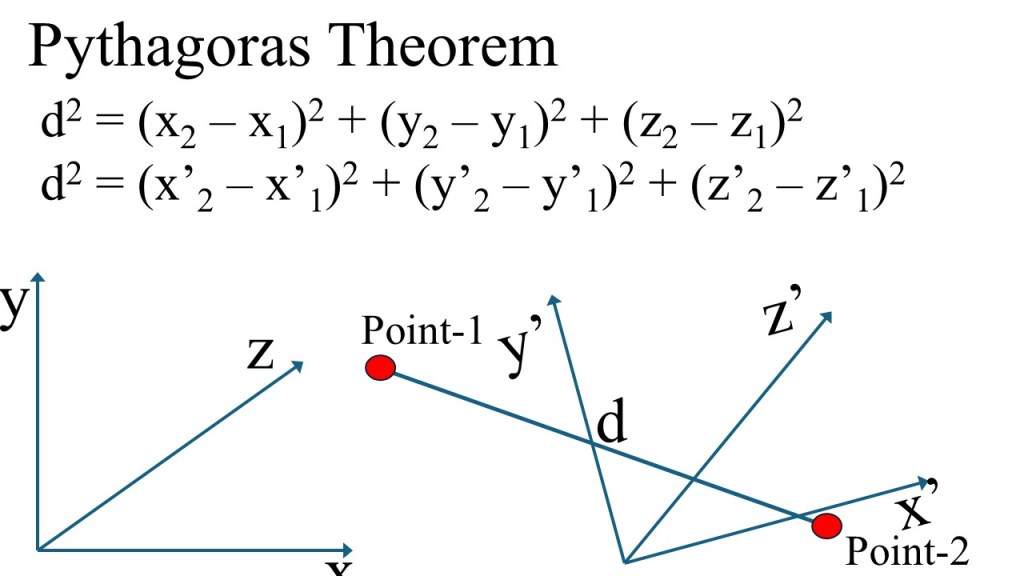
Before relativity the distance between two points was the same for all observers. The distance between points is calculated using the Pythagorean theorem: (d^{2}=x^{2}+y^{2}+z^{2}). You calculate the distance between two end points in a coordinate system using Pythagoras theorem because the points make right angled triangles along the x-axis, y-axis and z-axis. See the picture below.

Let say you add another coordinate system (x’, y’, z’). The new coordinate system could be translated and rotated compared to the first one. The values of (x, y, z) and (x’, y’, z’) would be different and yet the distance between point-1 and point-2 would be the same. Well as long as you don’t change units, like using meters in one coordinate system and feet in the other. The distance between the points would be a so-called invariant. Now imagine that you forgot to include one coordinate in Pythagoras theorem, for example, y and y’ or x and x’, then your calculation for the distance would be different for the two coordinate systems. We need all coordinates, or all dimensions. See the picture below.
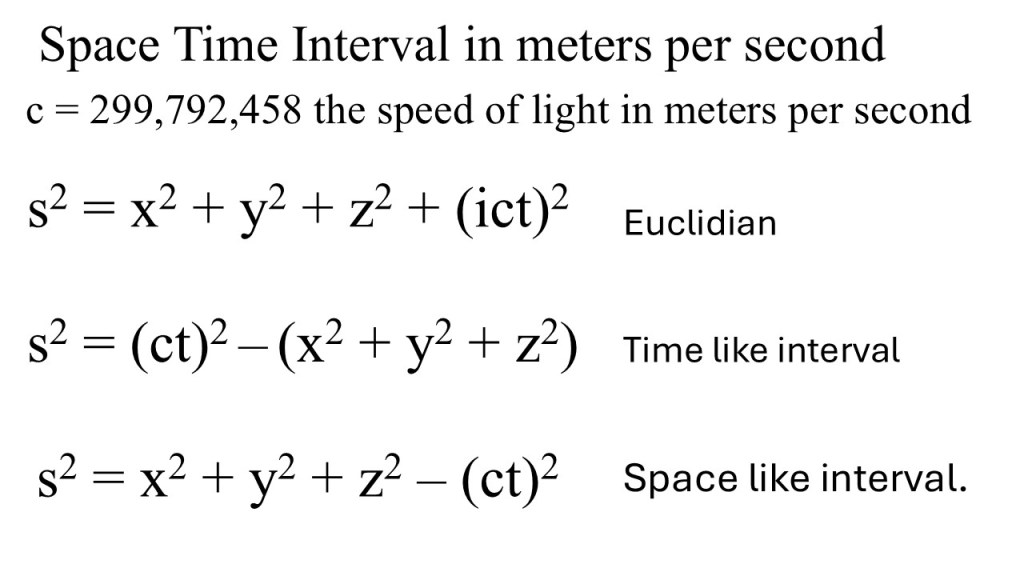
In relativity the length of objects, as well as the time between events is relative and varies from observer to observer. In other words, distance and time varies from coordinate system to coordinate system. However, if you add time to the three space dimensions and calculate the distance between events using the Pythagorean theorem for intervals (between two events): or (s^{2}= x^{2}+y^{2}+z^{2} – t^{2}) or (where the ‘t’ represents time in appropriate units), then the difference between different observers vanish. The interval is the same for all observers. It is a so-called invariant. The formula for the spacetime interval comes in a few different forms. One for distance like intervals (space distance bigger than time) (s^{2}= x^{2}+y^{2}+z^{2} – t^{2}), and one for time like intervals (time is bigger than the space distance) (s^{2}= t^{2} – (x^{2}+y^{2}+z^{2})). There is also one that includes the imaginary number (s^{2}= x^{2}+y^{2}+z^{2} + (it)^{2}). See below.

The interval concept was developed, not by Einstein, but by Hermann Minkowski (a few years after special relativity) and is often referred to as Minkowski space. Time is like a space coordinate but the opposite signs in the equation make it different. Based on articles I found it appears that the opposite signs (minus vs. plus) means that you cannot move “backwards” in time as you can in a space dimension.
I admit that this is a very abstract super fact, but it basically means that if you add time as an extra coordinate to the three space coordinates x, y, z you get something, the spacetime interval, that everyone regardless of speed, orientation, etc., agrees on, despite relativistic length contraction and despite time dilation and non-simultaneity.
Time Expressed in Appropriate Units
I would also like to explain what I mean by (where the ‘t’ represents time in appropriate units), as I stated in the above. For physical formulas to work they need to be expressed in consistent units. For example, you can’t use kilometers for the coordinate x, and miles for coordinate y, not without adding a constant to adjust for it. For the formula (s^{2}=x^{2}+y^{2}+z^{2}-t^{2}) to work you need to express time in a unit that corresponds the time light travels in one meter if x, y and z are expressed in meters. If you express x, y, and z in meters and express time in seconds you must adjust the formula with the constant c = 299,792,458, the speed of light in meters per second, so you get (s^{2}=x^{2}+y^{2}+z^{2}-(ct)^{2}). See the picture below.
Time Like Space Intervals
The formula for time like intervals is typically used for the situation where the time component is larger than the space component, which also means that it is possible to physically travel between the two events forming the space interval. As you can guess, that is a pretty normal situation. Let’s say you are watching TV and having a pizza. Your sofa is your coordinate system. You turn on the TV and 100 seconds later you move 2 meters to get a slice of pizza. Let’s calculate the spacetime distance between those two events.
The space component is easy, that’s 2 meters. However, if we express time in the time it takes light (in vacuum) to travel one meter we get 100 times 299,792,458. If you express time in seconds, you adjust it using the constant c = 299,792,458, and again you multiply 100 with 299,792,458, which is 29,979,245,800. So, the distance in time is almost 15 billion times larger. You really did not move far in space, but you moved very far in time. Now ask yourself. Are you spending your time well?
The Minus in Front of the Time Coordinate
There is one obvious difference between time and the space coordinates. In a coordinate system you can walk forward, along let’s say, the x-axis and then walk back the same way. You can walk back and forth as many times as you want, no problem, but you cannot do that with time. Time may be a space-time coordinate, but it is different from the other three coordinates in that way, and that’s where the opposite signs in the formula for the space-time interval comes in. This is beyond the scope of this super fact blog post, but you can read more about this here and here.
Other Relativity Related Superfacts
- The Speed of Light In Vacuum Is a Universal Constant
- Two events may be simultaneous for some but not for others
- GPS uses relativity for accuracy
- Time Dilation Goes Both Ways
- The Pole-Barn Paradox and Solution
To see the other Super Facts click here

 Super Facts
Fun facts to consider when writing fiction with an element of time travel. Thanks for the many details, Thomas!
LikeLiked by 1 person
Thank you Grant. I should say that after posting I realized that I need to clarify and add a few things. So in a few days the post will be better.
LikeLiked by 1 person
I can add I updated the post now. It is better and clearer.
LikeLiked by 1 person
Thanks, Thomas!
LikeLiked by 1 person
Wow, my son, who loves science and the possibility of time travel, will be really fascinated by this! I’ll show it to him later on!
LikeLiked by 1 person
Thank you Ada. I realized after posting that I need to clarify and maybe add a couple of things. For example, the last picture shows two formulas for the spacetime interval. They are really the same except the first one (proper distance) you use when the space distance is larger than the time, and the second one (proper time) when the time “distance” is larger than the space distance. I am not explaining this. I’ll fix in a few days.
LikeLiked by 1 person
Hi Ada I updated/fixed the post now.
LikeLiked by 1 person
Thanks, Thomas! I’ll look at with with my son later on!
LikeLiked by 1 person
Thank you Ada
LikeLiked by 1 person
Dear Thomas
I can’t stop praising you for your command on pen.
Thank you for liking my post ‘Potion’ 🙏
LikeLiked by 1 person
Thank you veerites
LikeLiked by 1 person
Hi zthomas, I have read a bit about this concept of time as a fourth dimension before. It is very interesting. I’ll share will Greg. He’ll enjoy all this maths 😉.
LikeLiked by 1 person
Thank you Robbie. I should say that after I posted I realized I need to update a couple of things, so if he sees it before I do he will probably correct me. For example, the last picture shows two formulas for the spacetime interval. They are really the same except one is the negative of the other. The first one (proper distance) you use when the space distance is larger than the time, and the second one (proper time) when the time “distance” is larger than the space distance. I am not explaining this, so I need to do that. I’ll fix in a few days.
LikeLike
Noted, thanks, Thomas 😃
LikeLiked by 1 person
Hello Robbie I updated/fixed the post now. It is clearer and more accurate.
LikeLike
Great, thanks 👍
LikeLiked by 1 person
🧭
LikeLike
Really interesting post although I don’t think I have what it takes to fully understand the science lol.
LikeLiked by 1 person
Thank you so much Pooja. I will update in a few days making it more accurate and easier to read. I realized after posting that it needs improvement.
LikeLiked by 2 people
I’ll check back in after a few days then. Thanks.
LikeLiked by 1 person
Thank you Pooja
LikeLiked by 1 person
You’re most welcome.
LikeLiked by 1 person
Hello Pooja I updated/fixed the post now. It is clearer and more accurate.
LikeLiked by 1 person
Great, I’ll go read it again.
LikeLiked by 1 person
Thank you Pooja
LikeLiked by 1 person
You’re very welcome.
LikeLiked by 1 person
I think I understood it better now although the formula’s are probably not something I will fully understand. Thanks for updating the post, definitely helped.
LikeLiked by 1 person
Thank you so much Pooja. Unfortunately, there are formula(s), but you could just note that while relativity makes space distances and times relative to each observer, if you add time in together with the space coordinates you get something (spacetime interva) that is the same for all. It is as if time is just another space coordinate, well almost. Like a space coordinate you can’t walk backwards in.
LikeLiked by 1 person
Hmm yeah that makes sense, thanks for explaining it that way.
LikeLiked by 1 person
Thank you Pooja
LikeLiked by 1 person
You’re very welcome.
LikeLiked by 1 person
A very interesting post, Thomas. Relativity is fascinating.
LikeLiked by 1 person
Thank you so much Lynette. I agree, there are a lot of things about relativity that are fascinating and not well known.
LikeLiked by 1 person
There was a time when I could have understood this with ease. Now, it’s going to take some time. Still, I agree with Lynette that it’s fascinating.
LikeLiked by 1 person
Thank you so much JoAnna. I am going to fix it up a little bit, so it is clearer. I think I’ll do that on Friday.
LikeLiked by 1 person
Good to know!
LikeLiked by 1 person
Hello JoAnna I updated/fixed the post now. It is clearer and more accurate.
LikeLike
Java Bean: “Ayyy, time! It puts the ‘T’ in ‘TARDIS’!”
LikeLiked by 1 person
Ha ha you are right Java Bean
LikeLike
Fascinating to read about, although I failed grade 12 math and it’s a bit over my head. 😉 Until this post, the only things I knew about the “space-time continuum” came from the “Back To The Future” movie series.
LikeLiked by 1 person
Thank you so much Debbie. I guess the take away can be that adding time as another dimension to the three space dimensions was for a compelling reason and not just on the whim. Another thing I brought up, which there seemed to be more than one opinion on, so that’s not part of the super fact, is that the minus sign, or rather the different sign between the time component and the three space dimensions, make it so that you cannot travel back in time. However, I need to improve this super fact post. I was not clear. One thing is that there are two ways to write the spacetime interval, that are each others negative, and one you use when the time component is bigger (proper time) and one when the distance (x,y,z) is bigger proper distance. I kind of messed up explaining that. Anyway, I remember back to the future. It was a fun movie.
LikeLiked by 1 person
Too bad! Going back in time is a fantasy that many of us have had. 🙂 And I never would have known you messed anything up, until you said that.
Back To The Future was a series of three movies, two of which went back in time (1985-1955, 1985-1955-1885) and one into the future (1985-2015). The real 2015 was nothing like how the movie depicted it. 😄
LikeLiked by 1 person
Yes damn the minus sign. Anyway, yes I remember what you are saying (about the movie).
LikeLiked by 1 person
Hello Debbie I updated/fixed the post now. It is clearer and more accurate.
LikeLiked by 1 person
Thanks for that! The material from those last two links you added were interesting as well.
LikeLiked by 1 person
Thank you so much Debbie. It isn’t enough evidence to add that to the super fact but it looks to me like the physics Professor who said that the minus sign prevented physical objects from returning back along the time axis, was the one who knew what he was talking about. What he said made perfect sense.
LikeLiked by 1 person
This is amazing, Thomas, and a bit confusing. This morning, I listened to Dr. Roman Yampolskiy talk about AI. Scary stuff, but the phenomenon has a connection to your post. I wish I understood it better.
LikeLiked by 1 person
It is difficult to explain. Harder than I thought. However, suffice it to say that time as another dimension added to our three visible space dimensions (x,y,z) is not added on a whim but has physical reasons. I should say that I am about to update this post. About AI, I agree, we have to be very careful with how we use it, or it could become very dangerous. I don’t know Dr. Roman Yampolskiy but I refer to the book Superintelligence by Nick Bostrom.
LikeLiked by 1 person
Hello Gwen I updated/fixed the post now. It is clearer and more accurate.
LikeLike
Dear Thomas
It’s a marvelous experience to read your posts & to know you through those.
Thank you for liking my post ‘Left4’🙏😊
LikeLiked by 1 person
Thank you veerites
LikeLiked by 1 person
For such a big dimension as Time is, you would think we’d have more of it than we seem to …
LikeLiked by 2 people
Well you have a lot of it. The last 10 seconds you’ve had 3 billion units, if you count a unit is the time it takes for light to travel one meter. What did you do with your 3 billion? In your life you have almost 800 quadrillion units. But I’ll understand your concern. They go by fast, at the speed of light in fact.
LikeLike
Your clarity in merging abstract physics with vivid examples makes relativity feel accessible, almost like storytelling. It invites not only scientists but dreamers too. I hope your work continues sparking curiosity across generations, inspiring both learning and wonder about the mystery of time.
LikeLiked by 1 person
Thank you so much for your kindness Livora. I very much appreciate your support and kind words.
LikeLiked by 1 person