The goal of this blog is to create a list of super facts. Important facts that are true with very high certainty and yet surprising, misunderstood, or disputed by many. This blog aims to be challenging, educational, and fun, without it being clickbait. I determine veracity using evidence, data from reputable sources and longstanding scientific consensus. Prepare to be challenged (I am). Intentionally seek the truth not confirmation of your belief.
Category: History
Important but surprising facts relating to History
Superfact 121: Between the years 1200BCE and 1150BCE (3,200 years ago) major civilizations in the Mediterranean and Near Eastern civilizations vanished or collapsed completely, notably Mycenaean Greece, the Hittite Empire, the Canaanite city-states, civilizations in eastern Libya, Balkans, and Babylon suffered a severe political decline and eventual fall during the Late Bronze Age collapse. Other civilizations such as the Assyrian empire and Egypt survived the Late Bronze Age collapse but emerged severely weakened.
Invasions, destruction and population movements during the Late Bronze Age collapse. The red, blue and yellow arrows represent invasions from different Sea Peoples. Alexikoua, CC BY-SA 3.0 https://creativecommons.org/licenses/by-sa/3.0, via Wikimedia Commons.
The Mediterranean and Near Eastern civilizations were powerful, important and wealthy, and their sudden collapse is one of the most consequential and mysterious events in history that ended in a dark age that lasted several hundred years, including the Greek Dark Ages, which lasted from c. 1200 BCE to c. 800 BCE.
Eastern Mediterranean and the Middle East during the 14th century BC; Mycenaean Greece in purple. Alexikoua,, CC BY-SA 3.0 <https://creativecommons.org/licenses/by-sa/3.0>, via Wikimedia Commons.
The reason for the late Bronze Age collapse is being debated but climate change, droughts, and invasions by the so called Sea Peoples are considered to be major reasons. The Trojan war, which is mostly fiction occurred around 1200 BCE. If you watched the recent 2026 movie the Odyssey, you probably notice the frequent references to the Sea Peoples. One of the Sea Peoples was the Philistines. If you want to take a deep dive into the late Bronze Age collapse, click here, or here.
Most of us know about the collapse of the Roman Empire around 400-500 AD and perhaps the fall of the Byzantine Empire in 1453 AD, but the late Bronze Age collapse may come as surprise to many despite it being so consequential, at least I was very surprised when I first learned about it. It was not just civilization collapsing but many at the same time. The collapse is also mysterious and shrouded in mythology. That is why I consider it a super fact.
The Collapse of Mycenaean Greece
The collapse of Mycenaean Greece stands out. No other part of the Eastern Mediterranean suffered a civilizational setback quite as intense as in Greece. I think most of us are aware that after the Mycenaean Greece came other periods in Greece’s history, the Greek Dark Ages, the Archaic period, and classical and Hellenistic periods, Alexander the Great, Plato, Aristotle, etc.
I learned in school that there was a Dorian invasion of Greece that displaced its original population and this led to the Greek Dark Ages before a rebirth of Greek civilization. This is most likely not true. The Mycenaean Greeks were not replaced by modern Greeks; they were the ancient Greeks. What likely happened was that climate change and drought resulted in crop failures, which in turn resulted in people movements and a range of invading peoples around the Mediterranean and the Near East. This is what may be remembered in Homer’s account of the Trojan War.
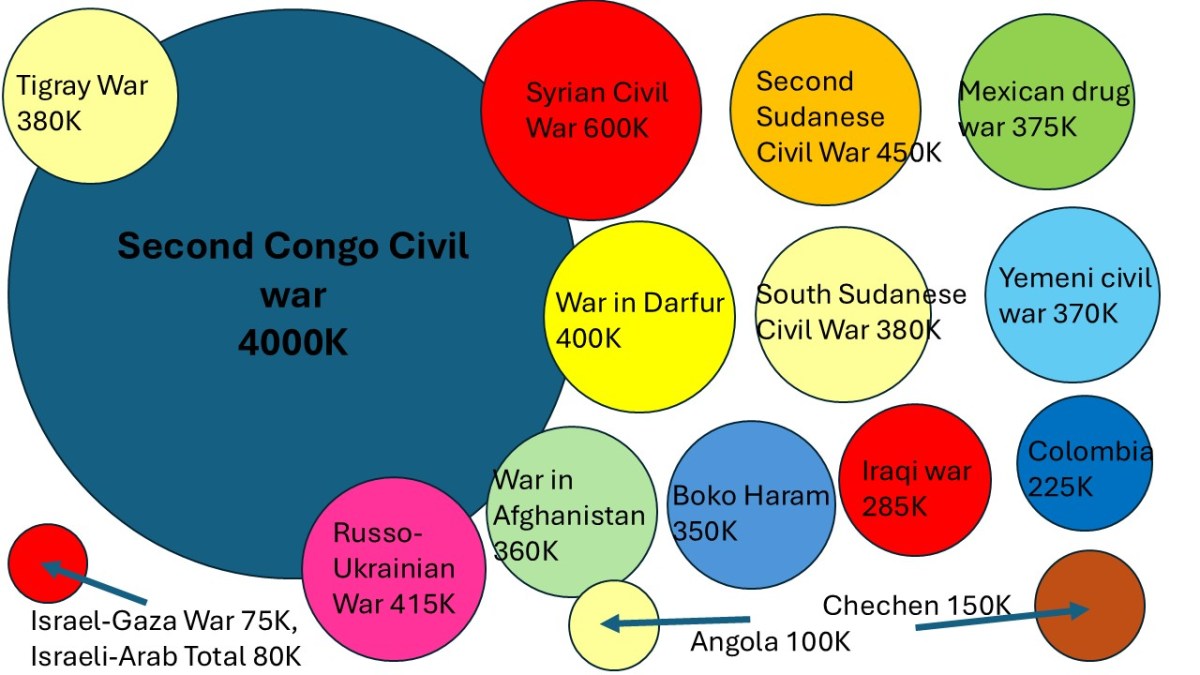
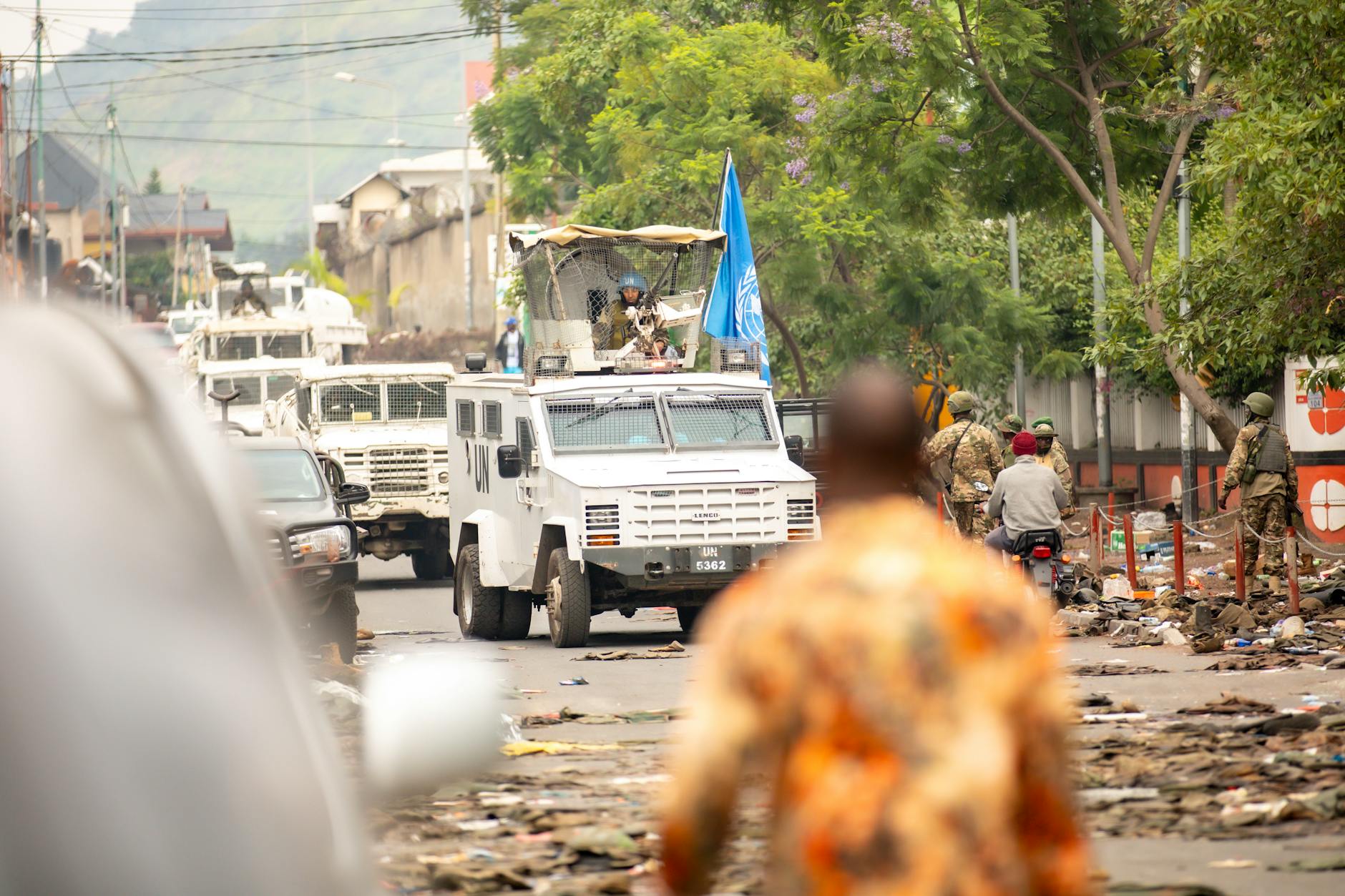
Super fact 95 : More than 4-5 million people died in Congo Civil War 1998 to 2003 and its aftermath (until 2007). In addition, some of the other of the deadliest wars in the 21st century are not well known.
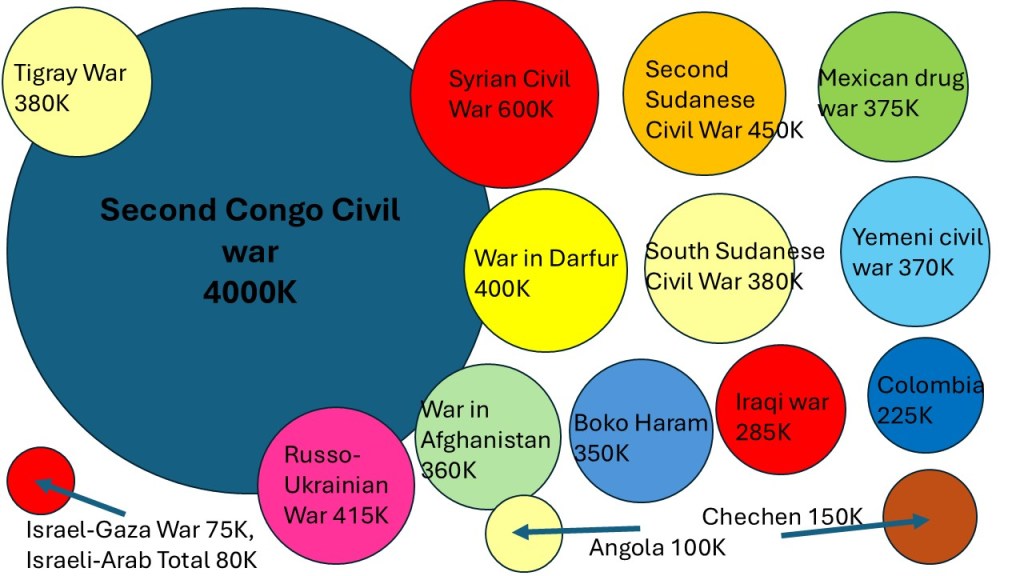
Below : 21st Century death toll from different wars, current and recent.
The number of deaths cited in the graphics above correspond to rough midpoint values of the estimates for the 21st century. K stands for one thousand deaths. The area of the circles corresponds to these midpoint estimates. See the list of conflicts under “Deadliest twenty first Century Wars”.
Notes on the graphics above:
The 16 wars included in the graphics above roughly correspond to the deadliest wars in the 21st century. However, a few of the wars included in the graphics are not among the 16 deadliest wars of the 21st century.
Some of the wars included above started in the 20th century. The number of deaths estimates corresponds to the portions that happened in the 21st century.
The number of deaths from the Congo Civil War include famine and plagues that resulted from the war.
I had a hard time finding an estimate for just the 21st century portion of the Congo Civil War. However, the vast majority of the deaths happened in the 21st century.
The death estimates for the Russo-Ukrainian War might be underestimated due to unreliable reporting by Russian authorities.
The Israeli-Gaza war may seem smaller than expected. However, media attention does not necessarily correspond to the size of the devastation of a conflict.
The estimate for the number of deaths for the current Iran-US-Israel war is between 3,600 to nearly 5,400 deaths, which is too small to be part of this post.
There are / were hundreds of wars and conflicts in the 21st century.
I consider this a super fact because it is true, an important history fact and despite the enormous losses in the Congo Civil War a lot of people do not know much about it and may not even have heard about it.
Chechen conflict 1994 to 2009. With an estimated 80 thousand to 230 thousand deaths, most of those, 150 thousand, happening in the 21st century.
Angolan Civil War 1975 to 2002. With an estimated 800 thousand deaths many in the final years of the conflict with an estimated 100 thousand in the 21st century.
Burundian Civil War 1993 to 2005. With an estimated 550 thousand to 800 thousand deaths, many in the final years of the conflict with an estimated 50 thousand deaths in the 21st century.
The Arab Israeli conflict 1948 to present (multiple wars) . With an estimated 200 thousand deaths in total with 80 thousand deaths happening in the 21st century.
The Israel Gaza conflict (2023 to present). With an estimated 75 thousand deaths.
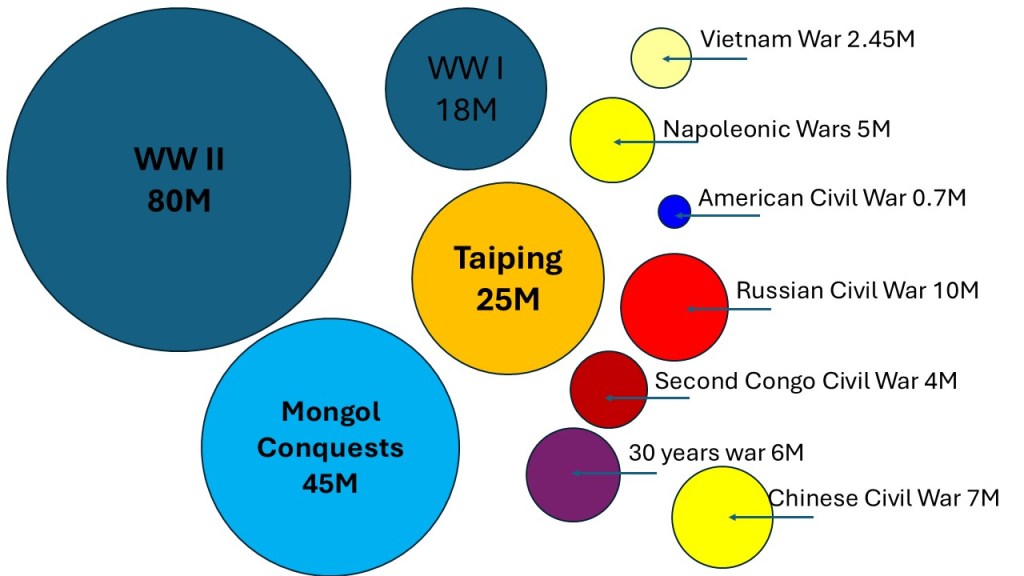
Superfact 93 :Around 20 to 30 million people died in the Taiping Rebellion, 1850 to 1864. It is the deadliest civil war in known history, the deadliest war in the 19th century, and the second deadliest war in all of known history. World War II was the deadliest.
The number of deaths cited in the graphics above are rough midpoint values of the estimates. The area of the circles corresponds to these midpoint estimates. Note Mongol conquests correspond to multiple wars during a time period of 162 years. The ‘M” corresponds to millions.
The Taiping rebellion is estimated to have caused the deaths of 20-30 million people. However, some estimates estimate that as many as 70 million people might have died in the Taiping rebellion. The Mongol invasions and conquests cost 30-60 million lives, but they comprised many wars and took place during a time period of 162 years (1206 – 1368). Therefore, you typically don’t count that as one war. Also note that the estimate for deaths caused by World War I does not include the Spanish flu.
I consider this a super fact because it is true, an important history fact and despite the enormous losses in the Taiping rebellion, a lot of people have never heard of it.
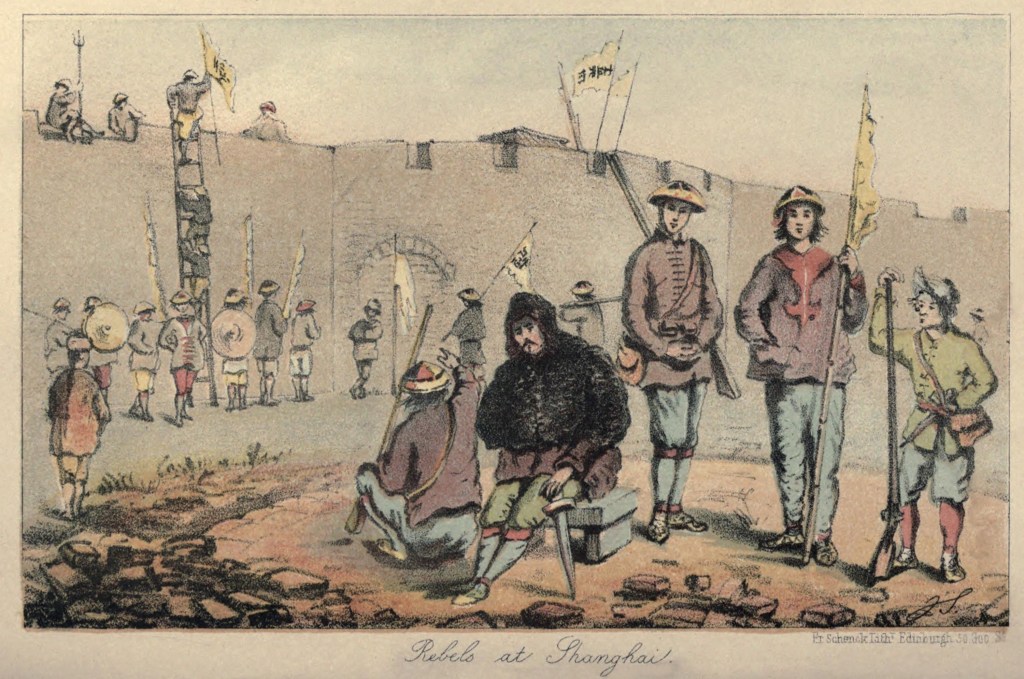
Taiping Rebels at Shanghai China in 1853-54. ‘Small Swords’ refers to daggers used by warriors or martial artists in close combat. 19th century print. Stock Illustration ID: 237232531 by Everett Collection.
The links above are from Encyclopedia Britannica and from Wikipedia. Also note that after the Napoleonic Wars entry I only listed wars that happened after World War II and resulted in around a million deaths. The exception is the American Civil War. The list would be too long otherwise.
The Taiping Rebellion
The Taiping Rebellion was a civil war in China between the Qing dynasty and the Taiping Heavenly Kingdom. The Taiping Heavenly Kingdom was a theocratic monarchy that tried to overthrow the Qing dynasty. It was led by Hong Xiuquan, a religious leader who believed he was Jesus younger brother. In the end the Qing dynasty prevailed but at a great cost.
A map showing the extent of the Taiping Heavenly Kingdom. The dark area is the extent towards the end. M.Bitton, CC BY-SA 4.0 https://creativecommons.org/licenses/by-sa/4.0, via Wikimedia Commons.
Super fact 74 : We celebrate the birth of Jesus on December 25th or December 24th, but it is quite unlikely that Jesus was born on those dates, and certainly not during the year zero.
Jesus Mary and Joseph Birth – This content was generated by an Artificial Intelligence (AI) system. Shutterstock Asset id: 2560713955
I’ve come across many adults who seriously believe that Jesus was born on December 25th. To them it will come as a big surprise to find out that the date of Jesus’ birth is never mentioned in the Gospels, or elsewhere in the Bible, not in any of the non-canonical Gospels, nor in any known historical sources. In addition, Luke’s Gospel mentions (Luke 2:8) shepherds tending flocks outdoors at night, which is not consistent with the cold winter in Judea. Biblical scholars (see 4th and 5th paragraphs in link) suggest that the information in the Gospel of Luke regarding the vision of John the Baptists father, Zechariah, leads to the conclusion that Jesus was likely born in September.
When was Jesus Born?
Jesus was not born during the year zero, because there was no year zero. The year after 1 BC (or BCE) is 1 AD (or CE). This causes problems for various scientific disciplines such as astronomy, climate science and history. The Gospel of Matthew mentioned that the birth took place during the time of Herod the Great who died in the year 4 BCE. I can add that Herod the Great got his moniker “Great” because of his extensive construction of cities, palaces, fortresses, aqueducts, and theaters across Judea, as well as the expansion of the Jewish temple.
The Gospel of Luke (Luke 2:1-2) states that the birth of Jesus took place during the census of the Roman governor of Syria, Quirinius (Cyrenius), which was in the year 6 CE, ten years after the death of Herod. However, there were other census taken earlier and scholars suggest that perhaps Luke’s account is a misstatement and that Mathew’s is more realistic. They conclude that Jesus was most likely born between 6 BCE and 4 BCE. As already mentioned it is very hard to pin down the time of the year when Jesus was born, but the month of September seems to be a likely candidate.
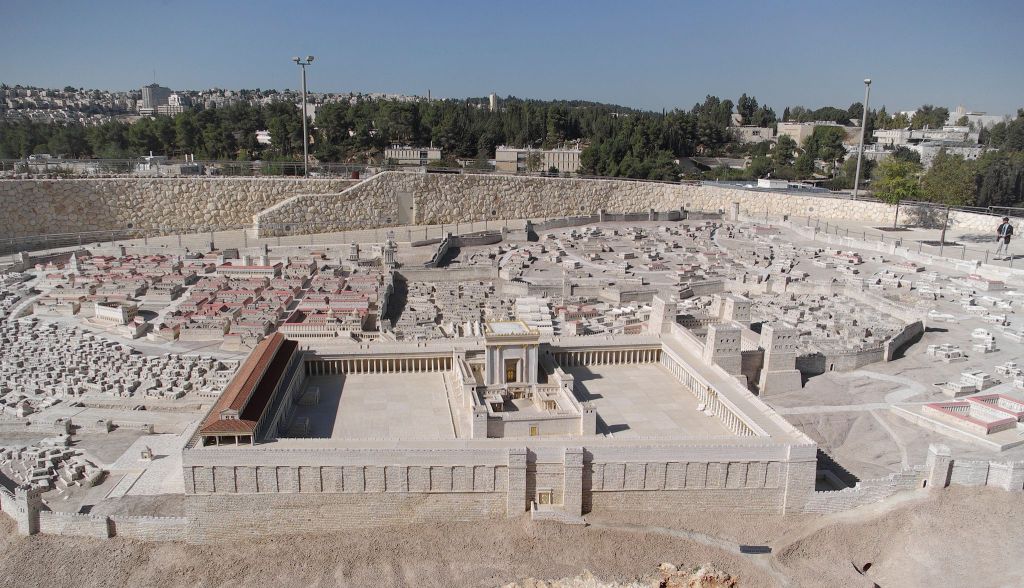
Herod was a builder and one of his projects was the expansion of the Temple. Herod’s Temple as depicted on the Holyland Model of Jerusalem. Berthold Werner, Public domain, via Wikimedia Commons.
Why is Christmas on December 25th?
During the first few centuries after the birth of Jesus Christians did not celebrate his birth. The first mention of the birth of Christ on December 25 comes in the 3rd century CE by Hippolytus of Rome. The Roman festival Sol Invictus, celebrating the birth of the Sun God was Celebrated on December 25th. Many pre-Christian cultures marked the shortest day of the year, on December 21 or 22, as an important moment in the calendar, celebrating the “rebirth” of the sun. Germanic peoples celebrated Yule, and various Celtic and Mediterranean cultures held celebrations centered around the winter solstice. It is possible that December 25th was chosen as the day to celebrate the birth of Jesus so that people did not have to change the dates of their celebrations.
Regarding Germanic peoples celebrating Yule. In my native country Sweden Christmas is referred to as “Jul” pronounced “Yool” / “Yuul”. The word “Jul” directly comes from the Old Norse word “jól,” which referred to the pre-Christian midwinter festival (Yule in English). You can read about Scandinavian mythology here or here.
Tomtar (plural of Tomte) or Nisse in Norwegian is a type of small magical people, or gnomes, related to Vitter folk. They are friendly and is an inspiration behind the Swedish version of Santa Claus. An illustration of a Tomte. Shutterstock ID: 2060057882 by PLIMPLUM.
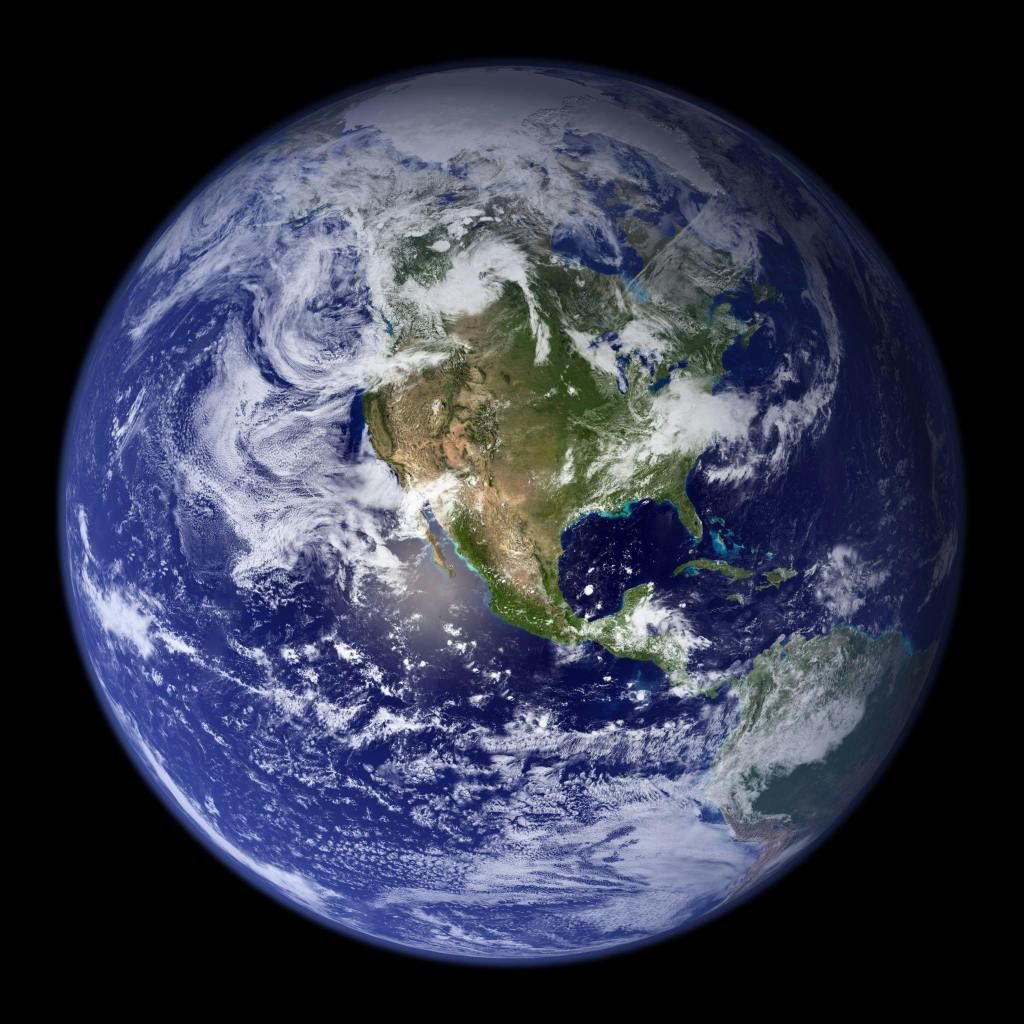
Super fact 28: That Earth is round, or spherical (or closely spherical) had been known for at least a couple of thousand years by the time Columbus set sail. Columbus did not set sail to prove that earth was round, and he knew it was round.
The ancient Greeks, particularly philosophers like Pythagoras and Aristotle knew that earth was round from observing how ships disappeared over the horizon hull first, while their masts were still visible. They noticed the earth’s round shadow cast on the moon during lunar eclipses.
If earth was flat, earth’s shadow would not appear round, especially not all the time. They also noticed that different constellations were visible depending on the location (on earth). So, noticing that earth was round was a simple and obvious observation that easily could be made thousands of years ago.
Earth is a sphere, or closely spherical. Photo by Pixabay on Pexels.com.
Columbus thought that the earth’s circumference was smaller than what Eratosthenes calculation had shown because he relied on maps created by Ptolemy instead of the calculations made by Eratosthenes. When he landed in the New World it seemed like Columbus had been vindicated but that did not last long. Essentially, Columbus sailed west and discovered America because he miscalculated the earth’s circumference.
Columbus thought earth was smaller. He did not know about the Pacific Ocean. Earth Pacific Ocean view Stock Illustration ID: 1617553012 by Matis75
It should be noted that even though the earth is very close to being a sphere, it is more correctly an ellipsoid because it is slightly bulging at the equator due to centrifugal forces. You sometimes hear people say that Copernicus or Galileo proposed that earth was round. This is of course false.
Copernicus’s theory of the solar system, the heliocentric model, proposed that the Sun is at the center of the solar system and the Earth, along with other planets, revolve around it. This was not a well-known fact at the time, unlike the fact that the earth is round. Galileo defended Copernicus theory. The famous alleged quote “And yet it moves” / “E pur si muove” is said to have originated from his argument with the church (however, this is not certain).
So, we know that people knew that earth was round thousands of years before Columbus, and thousands of years before the renaissance, and we know that Columbus did not sail west to prove that earth was round, and he certainly did not prove it. Yet I’ve heard this claim quite often, which is why I consider that earth being round being well known long before Columbus a super fact. Too few people believe earth to be flat like a pancake for me to consider earth being round a super fact.
Eratosthenes Calculates the Circumference of Earth
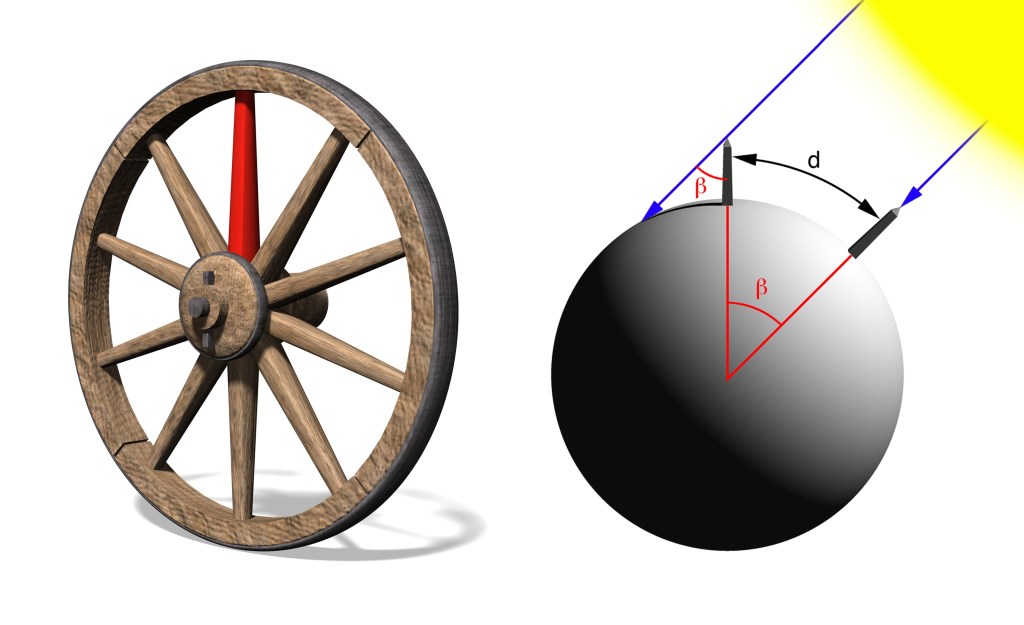
Around 500 BC (2,500 years ago) most Greeks believed that the Earth was round, but they did not know how big it was. The Greek philosopher and mathematician Eratosthenes devised a clever method of estimating its circumference and he got very close. He had heard from travelers about a well in Syene (now Aswan) that at noon on the summer solstice, about June 21 every year, the sun illuminated the entire bottom of a well, without casting any shadows, indicating that the sun was directly overhead. He had also heard that perfectly vertical poles had no shadows at this time.
The reason for this was that Syene/Aswan is located very close to the tropic of Cancer (23.5 degrees versus 24 degrees, or about 60 miles).
In Alexandria, north of Syene, the sun was not directly overhead on the summer solstice. Eratosthenes measured the angle of a shadow cast by a stick at noon on the summer solstice in Alexandria and found it to be 7.2 degrees. Using the distance from Alexandria to Syene and this angle Eratosthenes calculated earth’s circumference to be between 40,250 to 45,900 kilometers. Earth’s circumference is 40,075 kilometers.
Illustration of the measurement of the Earth circumference by Eratosthenes. On June 21st there is no shadow in Syene/Aswan but there is one in Alexandria. Asset id: 2319651251 by Javier Jaime
Resurgence in Flat Earth Beliefs
While very few people believed the Earth was flat 50 years ago, there has been a recent rise in Flat Earth conspiracy theories, largely fueled by online misinformation. Now a day 2% of Americans aged 18-24 years old firmly believe it is flat. That is despite the fact that it is easy to directly observe earth’s round shape. That is a small minority but why would anyone believe such a thing today.
For example, on a flat Earth, a Sun that shines in all directions would illuminate the entire surface at the same time, and all places would experience sunrise and sunset at the horizon at about the same time. With a spherical Earth, half the planet is in daylight at any given time and the other half experiences nighttime. Well just give someone overseas a phone call and you’ll see what the case is. In addition, different places have different amounts of daylight at the same time, which wouldn’t happen with a flat earth.
You can observe the round shape from an airplane. If you stand on a hill by the coast, you can see ships disappearing over the horizon hull first, and you can see earth’s round shadow cast on the moon during lunar eclipses. If you travel far, you can see the constellations and the stars being in different positions in the sky. The southern and northern hemisphere have completely different constellations.
Never mind Eratosthenes, gravity, the Coriolis force, other celestial bodies being round, eyewitness accounts by astronauts, ring-laser gyroscopes, and Foucault pendulums. The moon shows the same face to everyone on earth, which would not be possible if earth was flat. Also never mind NASA photos and the fact that no one has found the earth’s edge.
Below is a youTube video showing an animation composed of actual satellite photos by NASA. Earth is obviously round in this video.
In this video the near side of the moon is dark and what you see is the far side. The far side looks a little bit different from the near side of the moon. It is a new moon and the people on earth don’t see the moon. The sun is behind us and lights up both earth and the far side of the moon (this side people on earth do not see). Also, since there is daylight, the camera does not capture faint objects such as stars.









 Super Facts