The goal of this blog is to create a list of super facts. Important facts that are true with very high certainty and yet surprising, misunderstood, or disputed by many. This blog aims to be challenging, educational, and fun, without it being clickbait. I determine veracity using evidence, data from reputable sources and longstanding scientific consensus. Prepare to be challenged (I am). Intentionally seek the truth not confirmation of your belief.
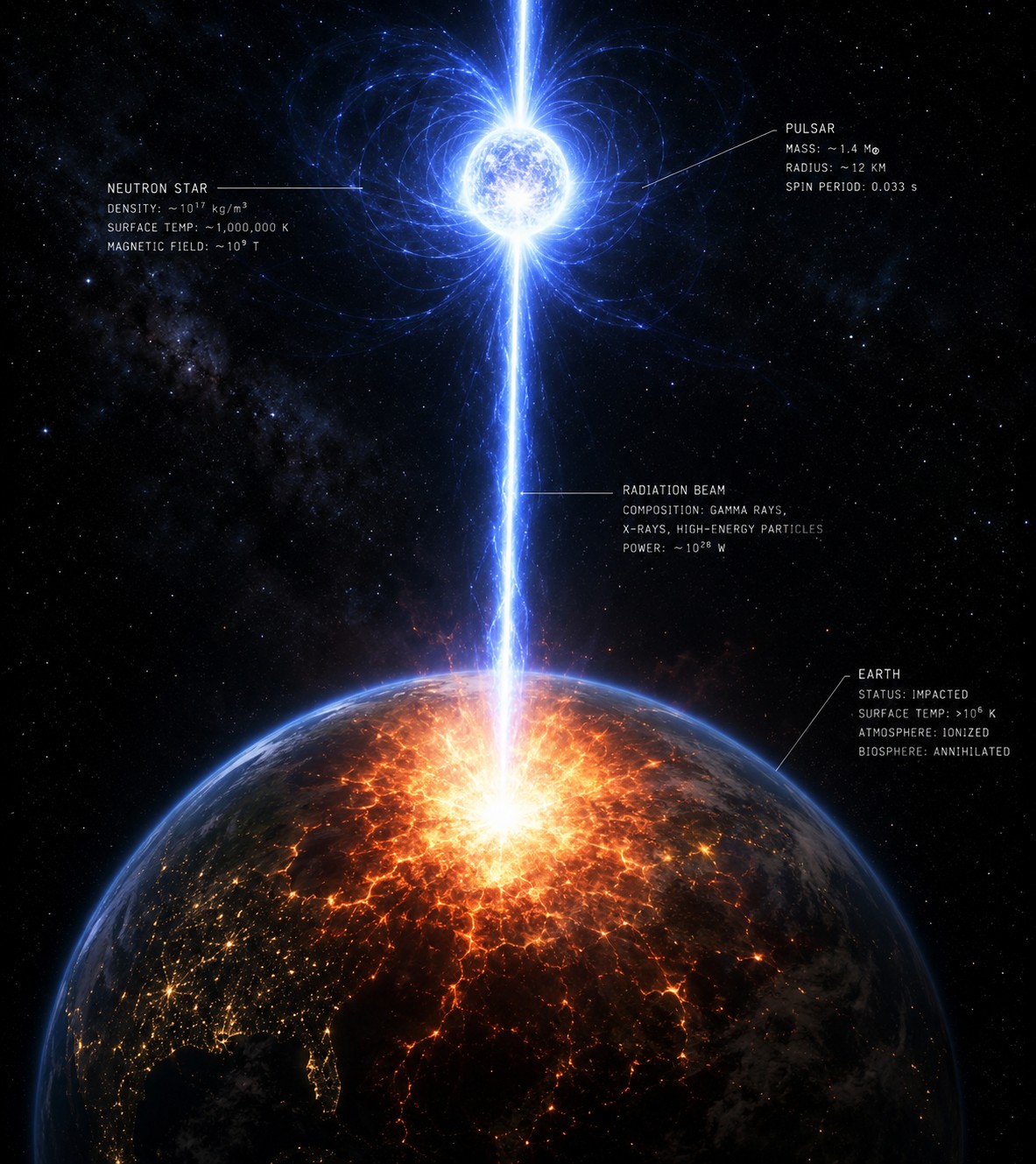
Super fact 108 : A Pulsar is a rapidly rotating neutron star that emits beams of electromagnetic radiation from its magnetic poles. The radioactive beam from a pulsar that is located where the sun is located would heat earth’s surface to tens of thousands of degrees. The pulsar may rotate hundreds of times per second, and we only detect the beam when it crosses our line of sight. A neutron star, or a pulsar, is vastly denser than the Sun, typically hundreds of trillions of times denser.
As mentioned, a pulsar is a rapidly rotating neutron star that emits beams of radiation from its magnetic poles. A neutron star is an ultra-dense remnant left behind when a massive supergiant star runs out of fuel and collapses. You can read more about neutron stars in my post here and you can read about neutron stars that act like super magnets called magnetars here. This web page feature a calculation of what the intensity of a pulsar beam would be if it hit Earth and the pulsar is located where the sun is.
The beam from a pulsar hits earth causing destruction. This is an AI picture generated by me and ChatGPT.
I consider this a super fact because pulsars are a very extreme type of star, which existence I believe comes as a surprise to many people.
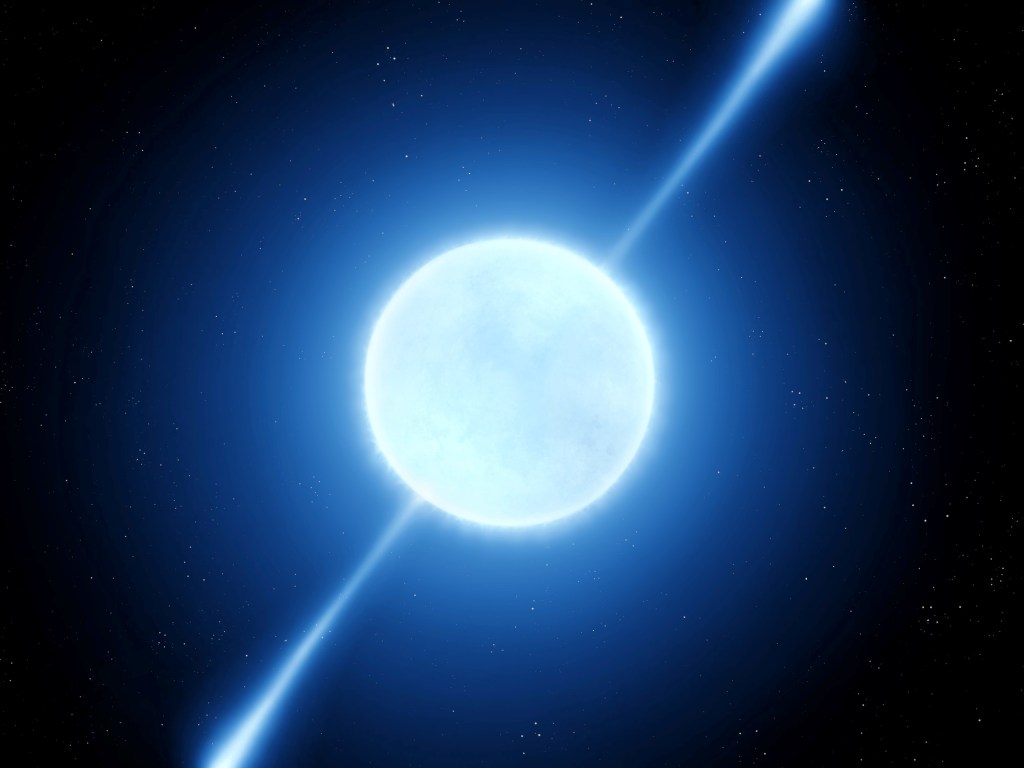
Pulsar with energetic jets in space. Shutterstock asset id: 2697475389 by Nazarii_Neshcherenskyi
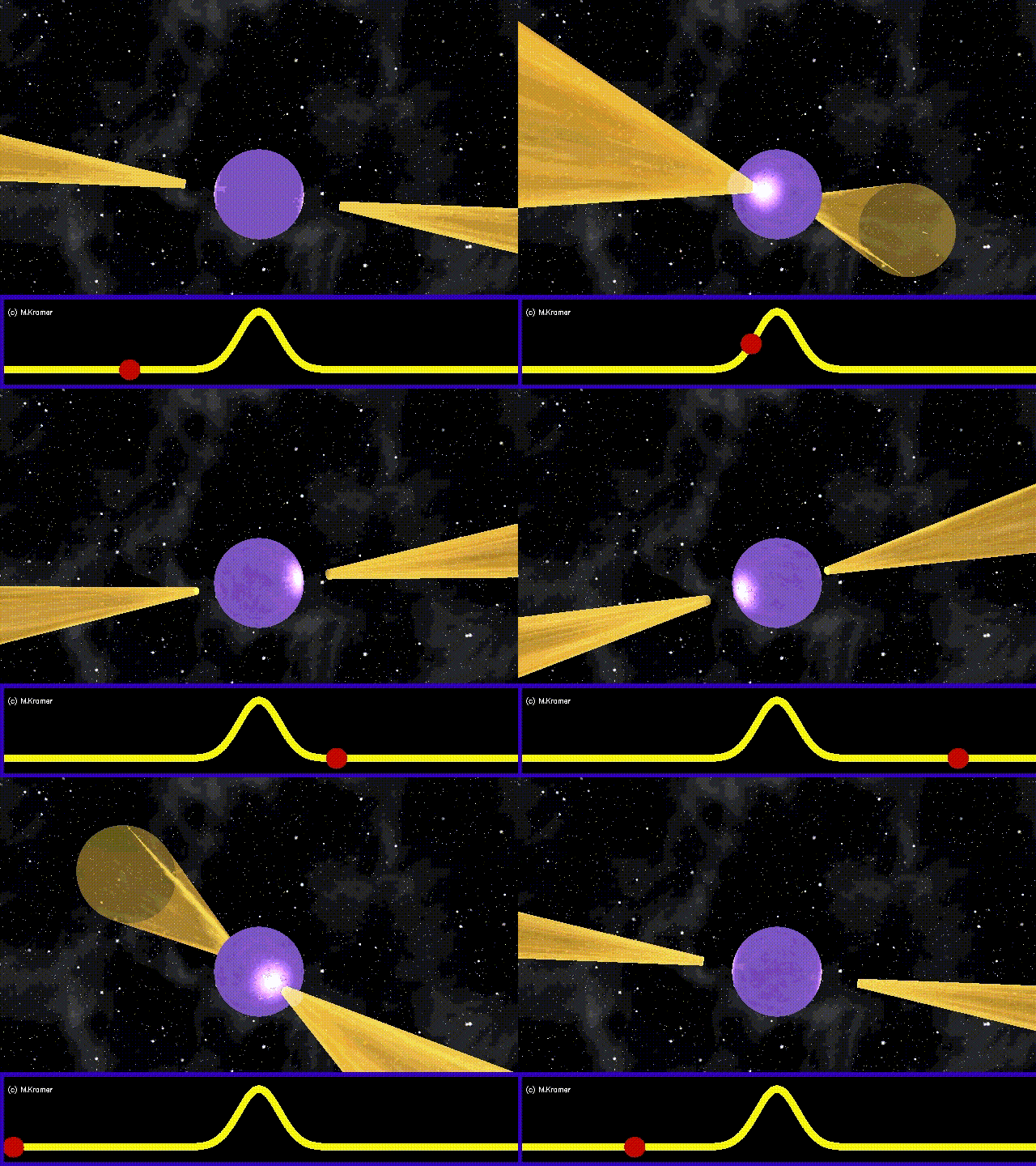
Below is a one and a half minute NASA video explaining what a pulsar is. It is taken from this website.
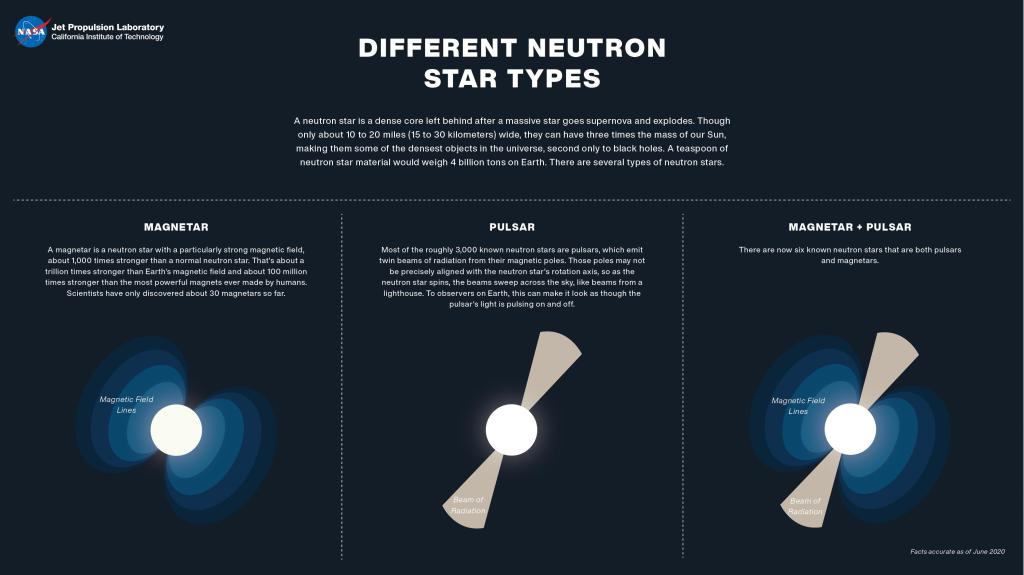
Different Types of Neutron Stars and Different types of Pulsars
Courtesy NASA/JPL-Caltech, Attribution, via Wikimedia Commons
Neutron stars are extreme stars. They are small super dense stars with extreme gravitational fields. They are in a sense like a gigantic atomic nucleus. Perhaps it is not surprising that they are extreme in other ways as well. There are pulsars, neutron stars which emit twin beams of radiation from their magnetic poles. Those poles may not be precisely aligned with the neutron star’s rotation axis, so as the neutron star spins, the beams sweep across the sky, like beams from a lighthouse. To observers on Earth, this can make it look as though the pulsar’s light is pulsing on and off.
There are different types of pulsars. Some spin extremely fast. They rotate hundreds of times per second, even 700 times per second. They are called Millisecond Pulsars. There are pulsars that emit beams of radio waves and pulsars that emit only gamma rays. A black widow pulsar a star system consisting of a rapidly spinning pulsar and a companion star that is being consumed by the pulsar like a black widow spider eats its mate. This link feature animation videos from NASA showing a star being consumed by a black widow pulsar.
Finally, there are magnetars, neutron stars with extremely powerful magnetic fields trillions and quadrillion times stronger than Earth’s magnetic field at the surface. You can read about them here.
Super fact 58 : In relativity, time is considered the fourth dimension, inseparable from the three spatial dimensions to form a four-dimensional continuum called spacetime. Adding time as a fourth dimension, not (x, y, z), but (x, y, z, t), results in spacetime measurements called spacetime intervals that all observers can agree on.
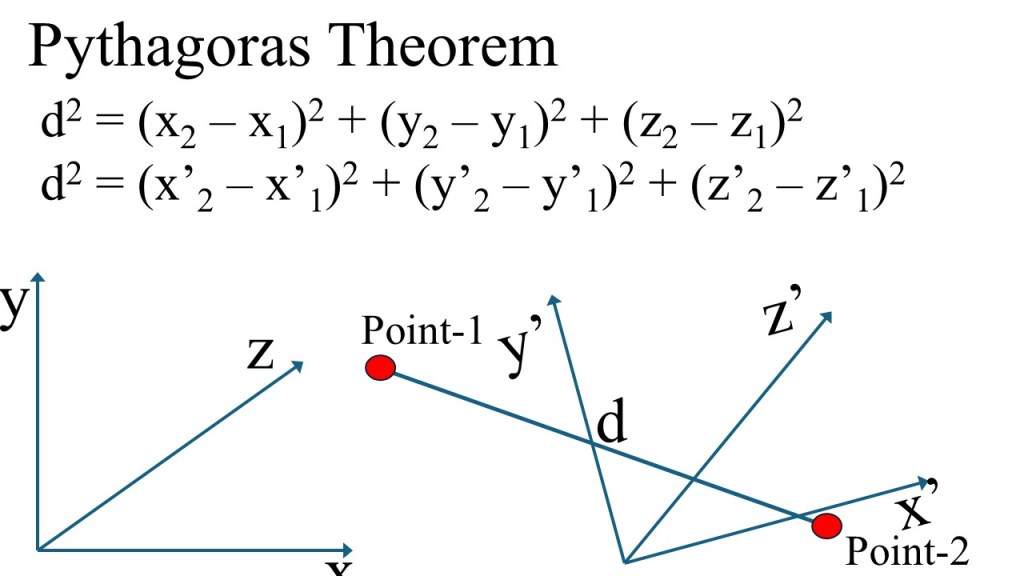
Before relativity the distance between two points was the same for all observers. The distance between points is calculated using the Pythagorean theorem: (d^{2}=x^{2}+y^{2}+z^{2}). You calculate the distance between two end points in a coordinate system using Pythagoras theorem because the points make right angled triangles along the x-axis, y-axis and z-axis. See the picture below.
Pythagoras theorem in two and three dimensions which also apply to the distance between two points. The points are indicated in red.
Let say you add another coordinate system (x’, y’, z’). The new coordinate system could be translated and rotated compared to the first one. The values of (x, y, z) and (x’, y’, z’) would be different and yet the distance between point-1 and point-2 would be the same. Well as long as you don’t change units, like using meters in one coordinate system and feet in the other. The distance between the points would be a so-called invariant. Now imagine that you forgot to include one coordinate in Pythagoras theorem, for example, y and y’ or x and x’, then your calculation for the distance would be different for the two coordinate systems. We need all coordinates, or all dimensions. See the picture below.
Pythagoras theorem is used to calculate the distance between two points from two different coordinate systems, with different coordinate values for the points. You still have the same distance for both coordinate systems. The points are indicated in red.
In relativity the length of objects, as well as the time between events is relative and varies from observer to observer. In other words, distance and time varies from coordinate system to coordinate system. However, if you add time to the three space dimensions and calculate the distance between events using the Pythagorean theorem for intervals (between two events): or (s^{2}= x^{2}+y^{2}+z^{2} – t^{2}) or (where the ‘t’ represents time in appropriate units), then the difference between different observers vanish. The interval is the same for all observers. It is a so-called invariant. The formula for the spacetime interval comes in a few different forms. One for distance like intervals (space distance bigger than time) (s^{2}= x^{2}+y^{2}+z^{2} – t^{2}), and one for time like intervals (time is bigger than the space distance) (s^{2}= t^{2} – (x^{2}+y^{2}+z^{2})). There is also one that includes the imaginary number (s^{2}= x^{2}+y^{2}+z^{2} + (it)^{2}). See below.
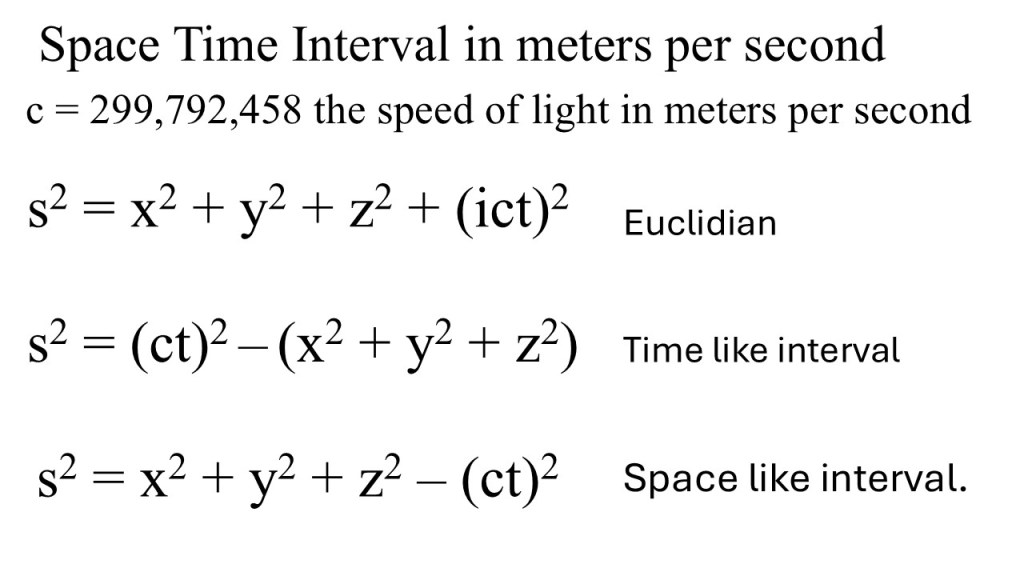
The three formulas for the spacetime interval above all assume that the unit used for time is the time it takes light in vacuum to travel the distance unit used. If that is meters, it would be the time it takes light to travel one meter. The top formula is the Euclidian form of spacetime. It contains only the ‘+’ operator at the expense of adding the imaginary number (square root of -1) in front of the time coordinate. The second form is typically used with time like intervals and considered the standard form. The third form is used when the distance between two events is larger than the time distance, or distance like intervals.
The interval concept was developed, not by Einstein, but by Hermann Minkowski (a few years after special relativity) and is often referred to as Minkowski space. Time is like a space coordinate but the opposite signs in the equation make it different. Based on articles I found it appears that the opposite signs (minus vs. plus) means that you cannot move “backwards” in time as you can in a space dimension.
I admit that this is a very abstract super fact, but it basically means that if you add time as an extra coordinate to the three space coordinates x, y, z you get something, the spacetime interval, that everyone regardless of speed, orientation, etc., agrees on, despite relativistic length contraction and despite time dilation and non-simultaneity.
Time Expressed in Appropriate Units
I would also like to explain what I mean by (where the ‘t’ represents time in appropriate units), as I stated in the above. For physical formulas to work they need to be expressed in consistent units. For example, you can’t use kilometers for the coordinate x, and miles for coordinate y, not without adding a constant to adjust for it. For the formula (s^{2}=x^{2}+y^{2}+z^{2}-t^{2}) to work you need to express time in a unit that corresponds the time light travels in one meter if x, y and z are expressed in meters. If you express x, y, and z in meters and express time in seconds you must adjust the formula with the constant c = 299,792,458, the speed of light in meters per second, so you get (s^{2}=x^{2}+y^{2}+z^{2}-(ct)^{2}). See the picture below.
If you measure the space coordinates in meters and the time in seconds you must adjust the units to match by inserting the speed of light in vacuum c = 299,792,458. The three forms of the space interval now have the constant c attached to the time coordinate.
Time Like Space Intervals
The formula for time like intervals is typically used for the situation where the time component is larger than the space component, which also means that it is possible to physically travel between the two events forming the space interval. As you can guess, that is a pretty normal situation. Let’s say you are watching TV and having a pizza. Your sofa is your coordinate system. You turn on the TV and 100 seconds later you move 2 meters to get a slice of pizza. Let’s calculate the spacetime distance between those two events.
The space component is easy, that’s 2 meters. However, if we express time in the time it takes light (in vacuum) to travel one meter we get 100 times 299,792,458. If you express time in seconds, you adjust it using the constant c = 299,792,458, and again you multiply 100 with 299,792,458, which is 29,979,245,800. So, the distance in time is almost 15 billion times larger. You really did not move far in space, but you moved very far in time. Now ask yourself. Are you spending your time well?
The Minus in Front of the Time Coordinate
There is one obvious difference between time and the space coordinates. In a coordinate system you can walk forward, along let’s say, the x-axis and then walk back the same way. You can walk back and forth as many times as you want, no problem, but you cannot do that with time. Time may be a space-time coordinate, but it is different from the other three coordinates in that way, and that’s where the opposite signs in the formula for the space-time interval comes in. This is beyond the scope of this super fact blog post, but you can read more about this here and here.
Super fact 56 : The Bermuda Triangle mystery is a myth. There is not a higher risk of disappearances in the Bermuda Triangle. To be specific, disappearances do not occur in the so-called Bermuda Triangle, or Devils Triangle, with any higher frequency than in other comparable regions of the ocean. The “mystery” of the Bermuda Triangle is largely a manufactured one, perpetuated by sensationalized accounts that often misrepresent the facts and downplay the role of natural hazards like storms.
The number of ships and aircraft reported missing in the Bermuda Triangle is not significantly greater, proportionally speaking, than in any other part of the ocean. The U.S. Coast Guard, along with NOAA, the U.S. Navy, Lloyds of London who pays out insurance for ships and aircraft lost/missing at sea, and other organizations do not recognize the Bermuda Triangle as a unique or mysterious geographic hazard. They emphasize that this is a highly traveled area where the losses are consistent with natural phenomena such as strong storms, the Gulf Stream, human error, and poor navigation, rather than any mysterious forces.
Considering all this, the number of disappearances and accidents is what you’d expect. The Bermuda Triangle isn’t any more mysterious than the Greenland square, the New Zeeland circle, or the Azores Octagon, that I just made up. I consider this a super fact because it is very likely true, and yet surprising to many people who are convinced that there really is a mystery. Furthermore, it is important because it is such a well-known myth.
The Bermuda Triangle: It is approximately defined as a triangle Florida, Bermuda, and Puerto Rico. There is no exact definition. Alphaiosderivative work: -Majestic-, Public domain, via Wikimedia Commons.
Bermuda Triangle Mysteries
Just because the risk of disappearances of planes and ships is not higher in the Bermuda Triangle, does not mean that there aren’t mysterious disappearances and mysterious phenomenon occurring in the Bermuda Triangle. Some notable disappearances are USS Cyclops (1918), Flight 19 (1945), Star Tiger and Star Ariel (1948–1949), and the Witchcraft (1967). However, there are mysteries and mysterious phenomena occurring all around the world.
One of the mysterious phenomena occurring in the Bermuda Triangle is ocean swirls, and rogue waves, and methane burps might be another problem, but it is far from unique to the Bermuda triangle, and there are no magnetic anomalies in the Bermuda triangle as often alleged.
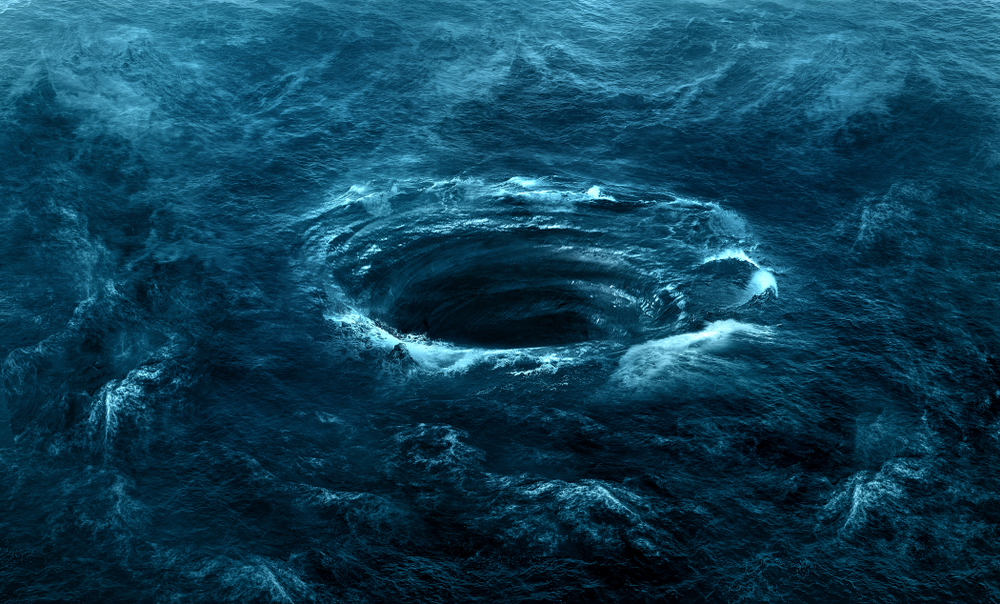
Ocean swirls frequently occur all over the world with some famous hotspots for ocean swirls by the coasts of Japan, Norway, Italy, Scotland, and Maine, USA. The ocean swirls in the Bermuda triangle might be due to movement of water between landmasses and/or the Gulf stream, but this is under investigation. There are no known giant or permanent ocean swirls in the Bermuda triangle.
Ocean swirl allegedly in the Bermuda Triangle Asset id: 1158148882 by PHOTO JUNCTION
As mentioned, another mysterious phenomenon is methane bubbling to the surface of the ocean. However, as can be seen in the maps in this National Geographic blog post the source of these methane burps of death aren’t typical to the Bermuda triangle. The methane hydrate field in the first map of the National Geographic blog post is mostly outside of the Bermuda triangle stretching from Cuba and up along the Florida coast. The second map, the world map, shows that these methane hydrate fields exist all around the world.
Our Honeymoon in Bermuda
Below are some old photos from our honeymoon in Bermuda in August of 1991.
I have two blogs, Leonberger Life and this one called Superfactful.
Leonberger Life feature amusing and heartwarming stories about our late Leonberger dog Bronco, as well as other Leonbergers. It also has a lot of information about the Leonberger breed, the history, care, training, Leonberger organizations, etc. I also wrote a Leonberger book, which I am featuring in the sidebar. With my Leonberger Life blog I want to spread information about the Leonberger breed, a rare, large, furry, friendly and fun dog breed and also bring attention to my book The Life and Times of Le Bronco von der Löwenhöhle, stories and tips from thirteen years with a Leonberger.
The goal of Superfactful, which is this blog, is to create a long list of facts that are important, not trivia, and that are known to be true and yet are either disputed by large segments of the public or highly surprising or misunderstood by many. I call these kinds of facts Super facts because they could potentially be very impactful on how we view the world.
Humans have accumulated an enormous amount of knowledge. Science does not know everything, but it knows a lot. The same cannot be said for us as individuals. We know next to nothing and harbor a lot of false beliefs. I think that is pretty much true for all of us, including me, but we may not know it. With this blog I am trying to correct some of that, at least regarding important facts. In addition, along the way, I am hoping to learn a lot myself and have some of my own false beliefs corrected.
In short, the change I would like to make in the world with my blog is to correct as many false beliefs as possible and educate my readers, and myself, about facts that are both important and mind blowing.
Smash your old beliefs with new surprising facts, super facts. Expand your mind. Shutterstock ID: 1685660680 by MattL_Images
What is a Super fact?
A super fact is:
An important fact but it can be simply stated.
Very surprising, shocking, widely disputed, misunderstood, or mind-blowing.
Yet it is true with a very high degree of certainty.
The first two criteria are subjective. The last criteria can be determined from longstanding scientific consensus, my own expertise and education (valid for just a few topics), agreement between multiple reliable online or offline sources such as agreement among research papers, reputable scientific organizations, NASA, NOAA, Pew Research Center, Our World in Data, etc. I should say I also link to less academic sources such as Wikipedia, but I do not solely rely on them.
You can read more about how I choose super facts here. Also, I am open to challenges based on good data (not opinions), as well as questions. With that I don’t mean that you cannot give your opinion in a comment. I just won’t update or remove a super fact based on an opinion. In addition, I am happy to receive suggestions for super facts. I am trying to collect a few hundred super facts and need all the help I can get. In the end I want to pick the 100 best ones. I might use a poll for that.
Sometimes a super fact involves doing myth busting of a popular myth and sometimes a super fact is stating something that is well known but disputed by many. In these cases, the evidence is likely to be conclusive, but the fact is still disputed by those who don’t know much about the evidence, or don’t want it to be true. In this case, I will include a substantial amount of evidence, and it might be lengthy. People get bamboozled all the time, and that includes me. It is not easy to admit that you have been bamboozled. You can read about my own experiences with that here.
Fact or myth. Shutterstock Asset id: 2327968607
Examples of Super Facts
At the time of posting this I have made plans for 150 super facts and so far, I have posted 54. I will post a lot more. Below I am listing a few of my first 54 super facts.
Superfact 5 : Two events may be simultaneous for some but not for others. Click to visit post.
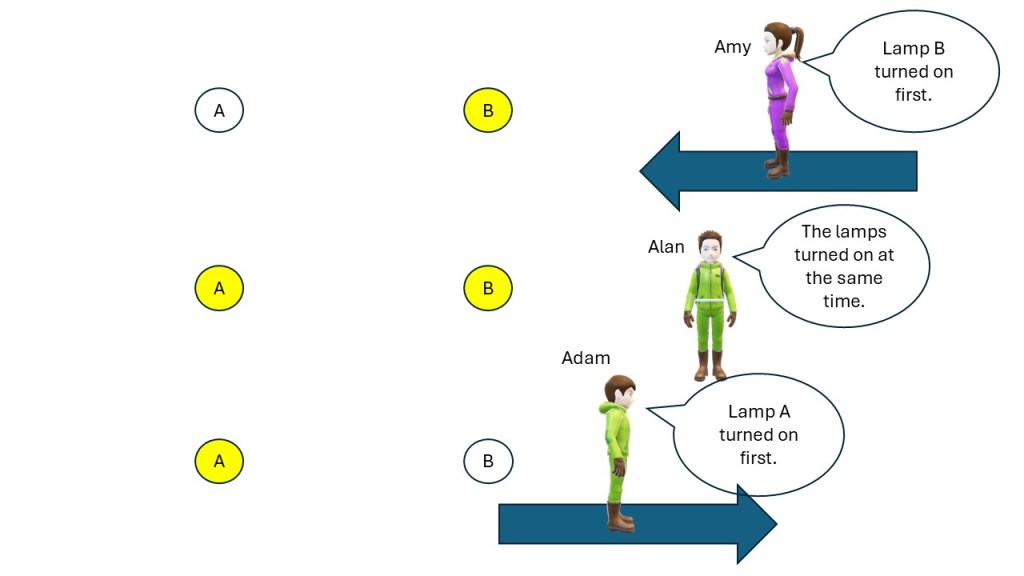
Two events may be simultaneous for some but not for others. This means that two events that are simultaneous to an observer may happen at different times to other observers. If two lamps A and B turn on at the same time according to observer #1, lamp A may turn on first for observer #2, and lamp B may turn on first for observer #3. All three observers are correct because time is relative.
Amy is traveling at a high speed to the left compared to two lamps A and B. Alan is standing still compared to the lamps. Adam is traveling at a high speed to the right compared to two lamps A and B. Alan turns on the lamps at the same time. After considering the travel time of the light she sees, Amy concludes that lamp B turned on first. After considering the travel time of the light he sees, Adam concludes that lamp A turned on first. I should add this non-simultaneity can only happen if the lamps are separated by a distance.
Superfact 7 : Poverty and child mortality has been sharply reduced worldwide. Click to visit post.
Extreme poverty as well as child mortality has been sharply reduced the world over. The countries that are the worst-off today are still better off than the countries that were doing the best at the beginning of the 19th century. Over the last 20 years extreme poverty and child mortality have continued to decline sharply.
Child mortality in in the world since 1950. The spike you see around the end of 1950 to 1960 is the great leap forward famine in China. In 1950 the child mortality rate was 22.7% and in 2023 the child mortality rate was 3.6%.
Superfact 25: Global Warming is Happening and is Caused by us – click to visit post.
Global warming is happening. Or if you call it Climate Change or Climate Disruption is indeed happening. And it is happening very fast. We also know that it is caused by us primarily as a result of our burning of fossil fuels. There is a long-standing scientific consensus on these two facts because the evidence is conclusive. Check the evidence in the post.
Superfact 28: That Earth is round was well known long before Columbus – click to visit post.
That Earth is round, or spherical (or closely spherical) had been known for at least a couple of thousand years by the time Columbus set sail. Columbus did not set sail to prove that earth was round, and he knew it was round.
Illustration of the measurement of the Earth circumference by Eratosthenes (2,300 years ago). On June 21st there is no shadow in Syene/Aswan but there is one in Alexandria. Asset id: 2319651251 by Javier Jaime










 Super Facts