The goal of this blog is to create a list of super facts. Important facts that are true with very high certainty and yet surprising, misunderstood, or disputed by many. This blog aims to be challenging, educational, and fun, without it being clickbait. I determine veracity using evidence, data from reputable sources and longstanding scientific consensus. Prepare to be challenged (I am). Intentionally seek the truth not confirmation of your belief.
I was very happy when I saw the post above. Sally is sharing my super fact 21: Superfact 21: It is often recommended that you should neuter or spay your dog by the age of 6 months even as early as 8 weeks. This may be OK for some smaller breeds but is dangerous to the health and longevity of many larger breeds. In addition, she is promoting my Leonberger dog book for which Robbie wrote a great review. Thank you so much Sally and Robbie. Please visit her post at the Smorgasbord blog magazine and read it.
Super fact 131 : There is no absolute reference point. All motion is relative. Since everything is in motion compared to something else, that means that everything is in motion. In addition, all material objects consist of particles that are in motion, and all objects with mass move through time.
I previously made a post on this topic called “Everything is in Motion – Stream of Consciousness”. For a Stream of Consciousness post you are supposed to write whatever comes to mind without editing, except for typos. Stream of Consciousness is a fun concept. However, it is not fit for a super fact post because a super fact post requires fact checking and linking to reputable sources and it needs to be well organized and well explained, and all that is editing. After writing Everything is in Motion – Stream of Consciousness I realized that “Everything is in Motion” is a super fact. It is an important observation and a fact that is far from obvious. With this post I am rewriting “Everything is in Motion – Stream of Consciousness” into a super-fact I call “Everything is in Motion”.
All Motion is Relative
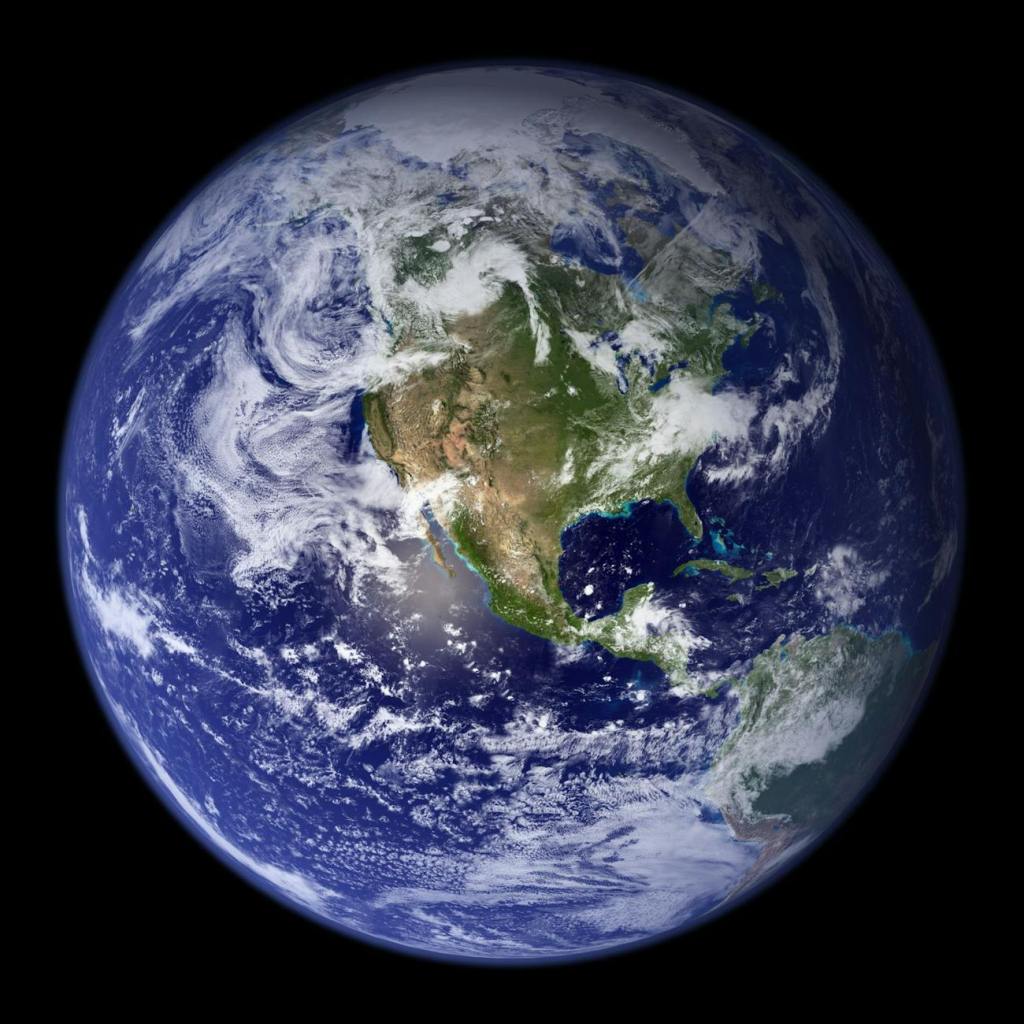
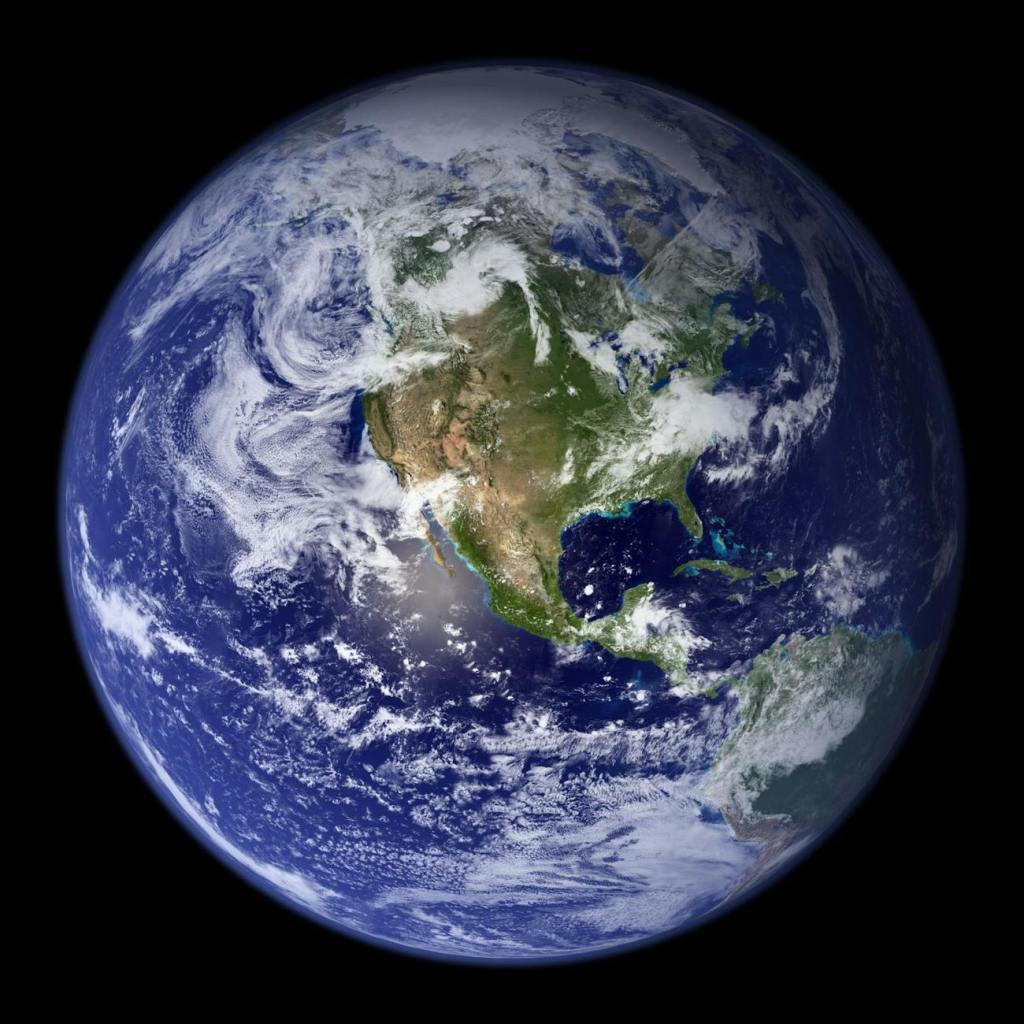
All motion is relative and everything moves in comparison to something else. You may be sitting in your chair completely still thinking that you are not moving but you are. Earth rotates around its axis at 1,040 miles per hour at the equator, and at 733 miles per hour at latitude 45 degrees. Latitude 45 degrees goes through New York and other northern States, as well as Europe. Sitting at the geographic north Pole won’t help you either because Earth is also wobbling and it is rotating around the sun at roughly 67,000 miles per hour or 107,000 kilometers per hour.
Man thinking he is sitting still drawn with the help of ChatGPT
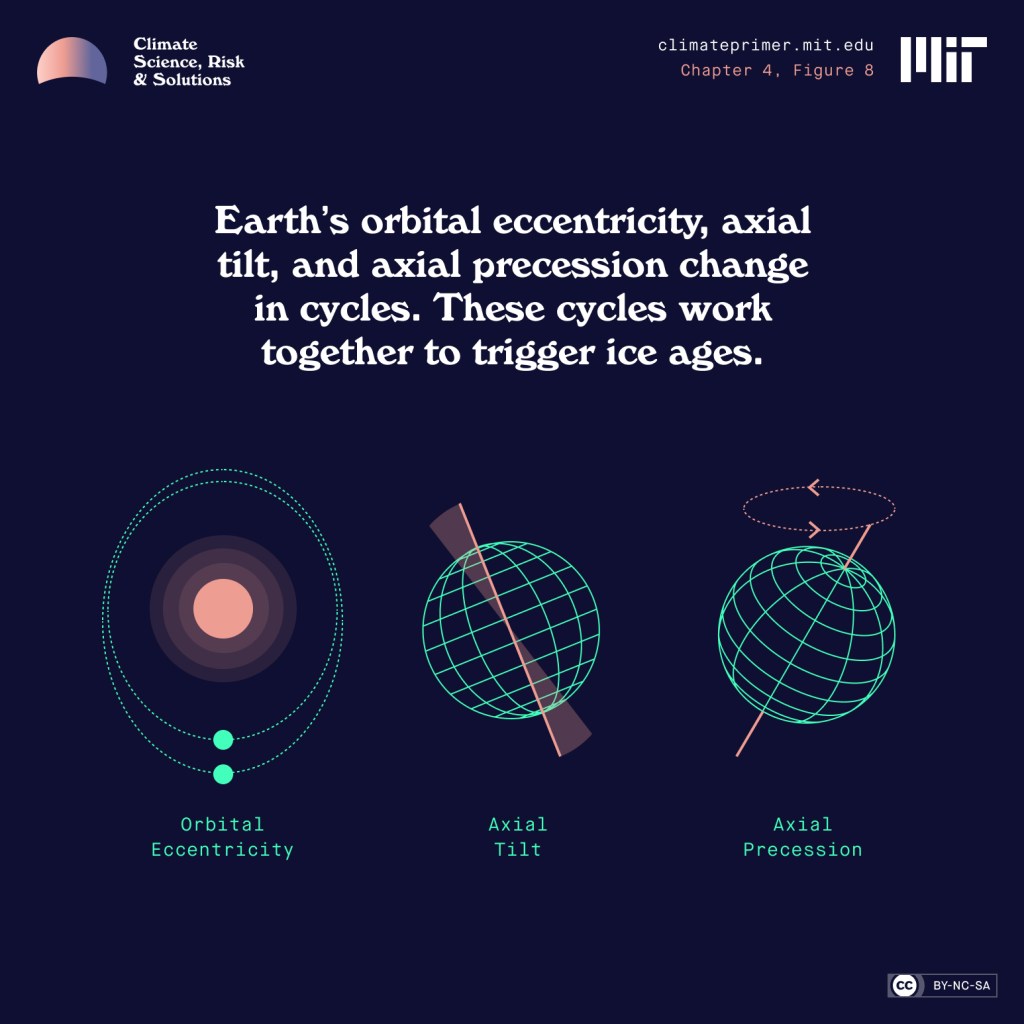
The picture below shows Earth’s three main orbital cycles. I used this picture in another context for super-fact #122 “Orbital Cycles are not the Cause of the current Global Warming”. In that context I wanted to point out that Earth’s orbital cycles are too slow (100,000 years, 41,000 years, and 26,000 years) to explain the sudden rapid rise in global temperatures that we are witnessing now. The orbital cycles are also currently slowly cooling Earth, not warming it. However, in this context I am using the picture for a different purpose, and that is to point out that even if you sit at the north pole (or anywhere else on Earth) you will be moving.
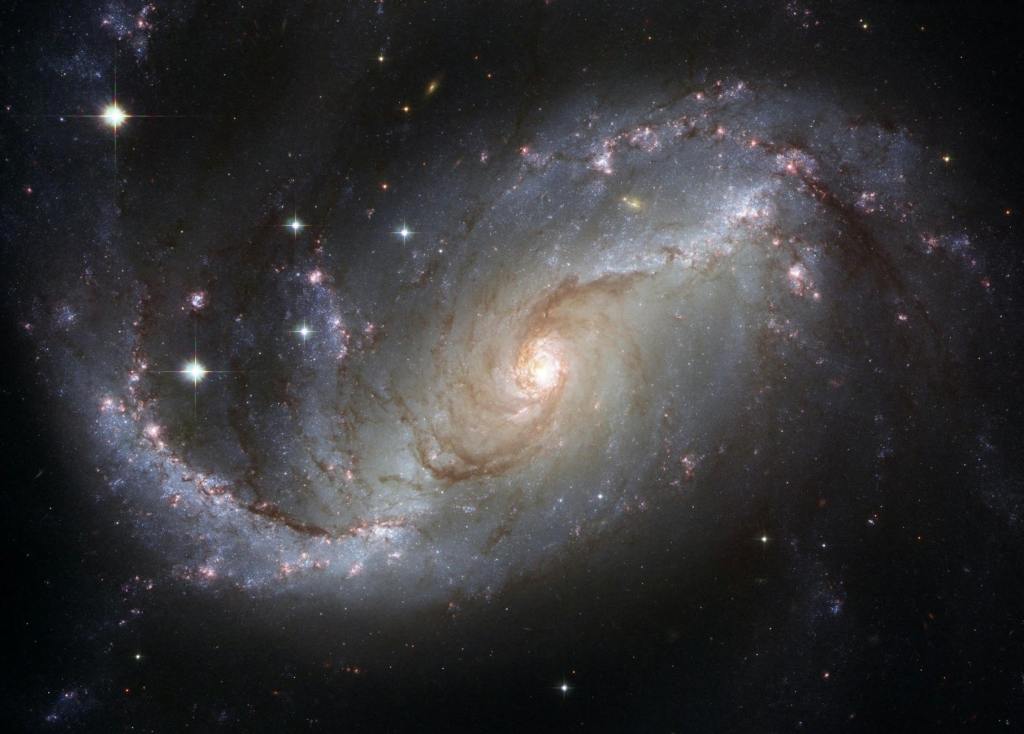
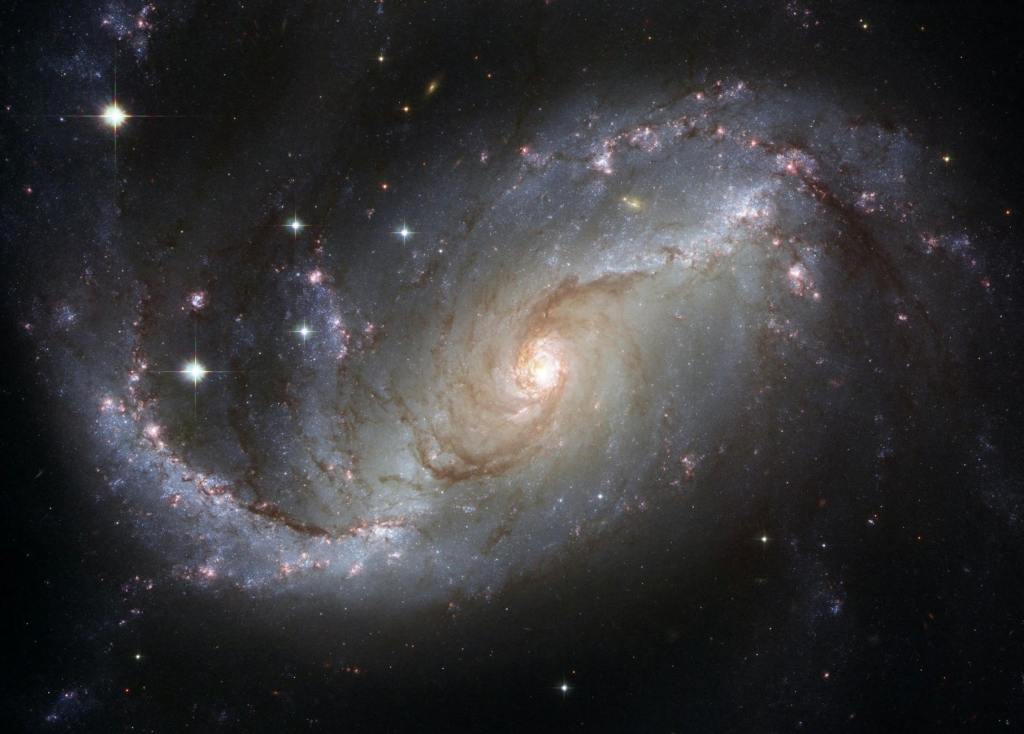
In addition, the sun is rotating around the center of our galaxy, the Milky Way at 514,000 to 560,000 miles per hour or 792,000 to 828,000 kilometer per hour, and our galaxy and the Andromeda galaxy are approaching each other at the speed of 110 kilometers per second, which is 396,000 kilometers per hour, or 246,000 miles per hour. Whether it is the Andromeda galaxy that is approaching us or our galaxy that is approaching the Andromeda galaxy is just a point of view. We are also moving at millions and billions of miles of hour compared to some other galaxies.
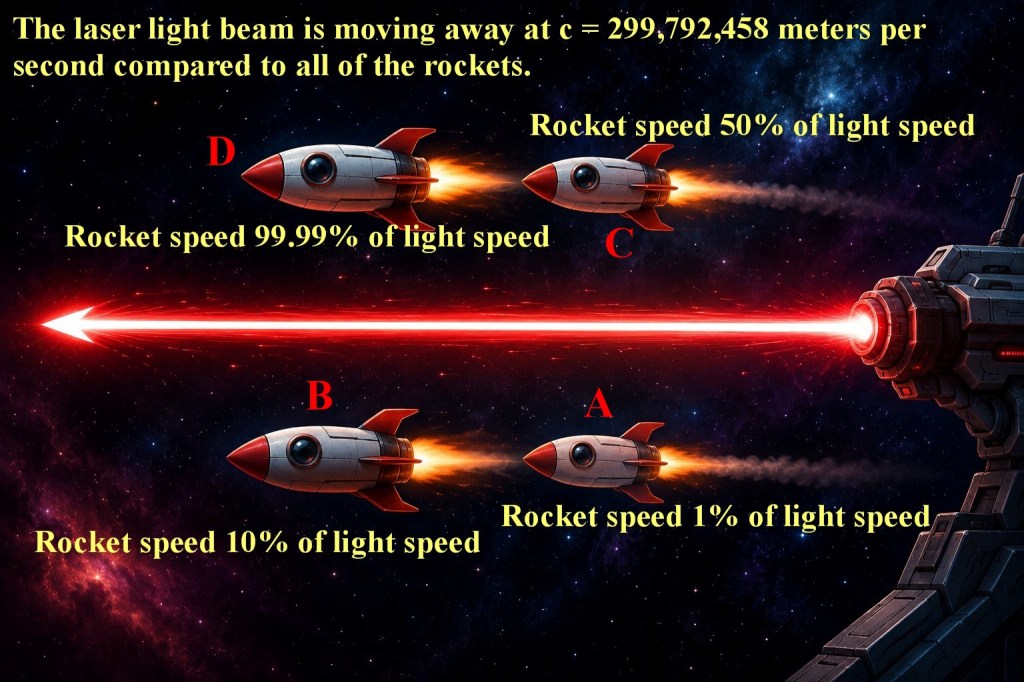
As mentioned, motion is not absolute. It is always relative to something else. The universe has no center, no ether to compare with, there is no absolute reference point. It is not possible to declare anything as truly standing still. Understanding this is the first step towards understanding the theories of relativity. According to the theories of relativity the speed of light, or the speed of light in vacuum if you will, is a universal constant c = 299,792,458. The speed of light in vacuum is the same for all observers regardless of their speed and the direction in which they are going. In other words, you are moving at the speed of c = 299,792,458 compared to all light.
Four rockets, A, B, C, and D, are traveling along a light (laser) beam. No matter how fast they travel along the light beam, the light beam will always travel c = 299,792,458 meters per second faster than they do. I generated this picture with the help of ChatGPT.
In addition, c = 299,792,458 is not a speed in a regular sense, but a conversion factor between space and time. All particles/objects without mass (light particles called photons, gluons and gravity waves) must always travel at this speed, whilst all objects that have mass can only travel slower than c = 299,792,458 (compared to other objects with mass).
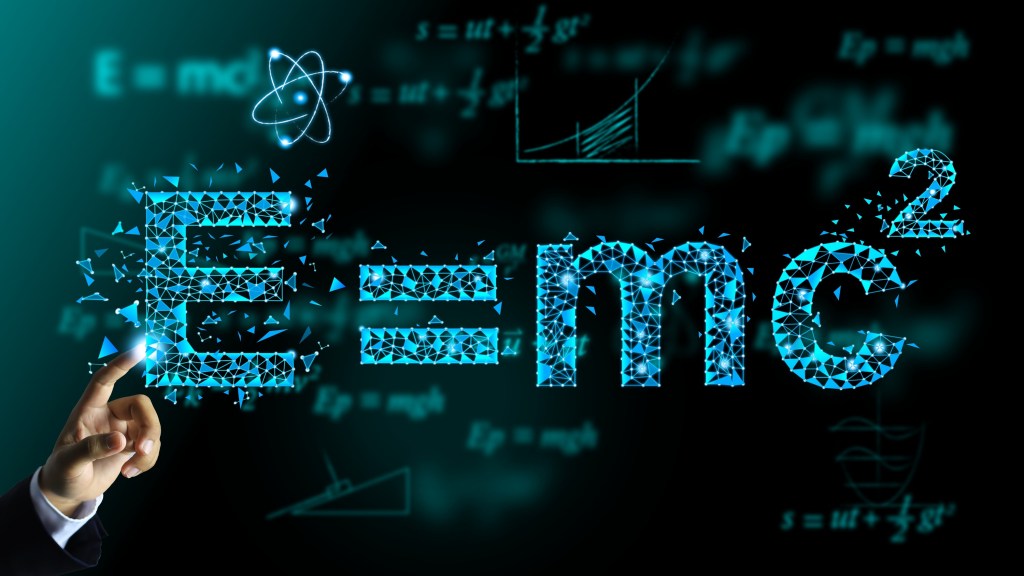
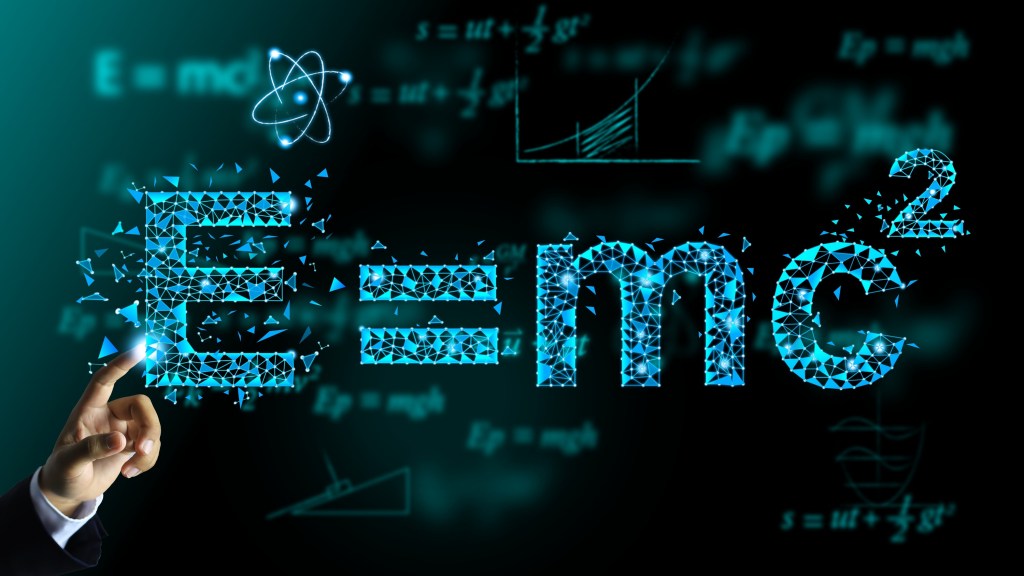
Mass is energy and vice versa, a direct result of the way time and space are related. Stock Photo ID: 2163111377 by Aree_S
You could say that compared to the reference frame of my choosing, which happens to be the chair I am sitting in, I am sitting still. I am not sure that would be fair but according to the theories of relativity you are also moving through time at the speed of c = 299,792,458. Well, that is assuming you have mass. For mass-less particles, like photons, time does not exist. Anyway, the fact that you are always moving kind sneaks in, no matter what you try.
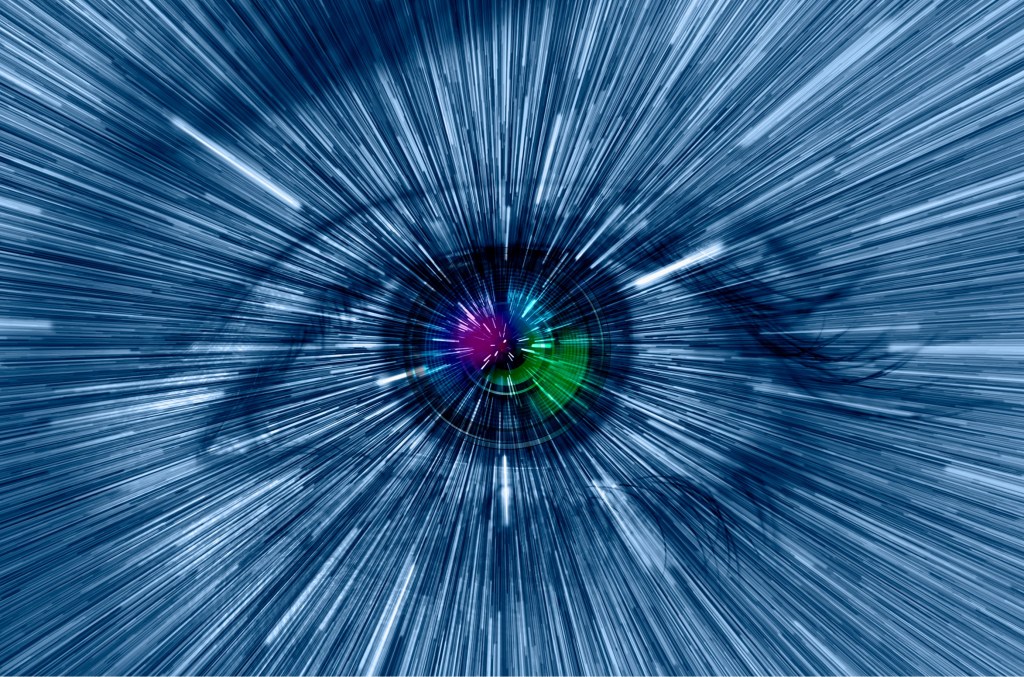
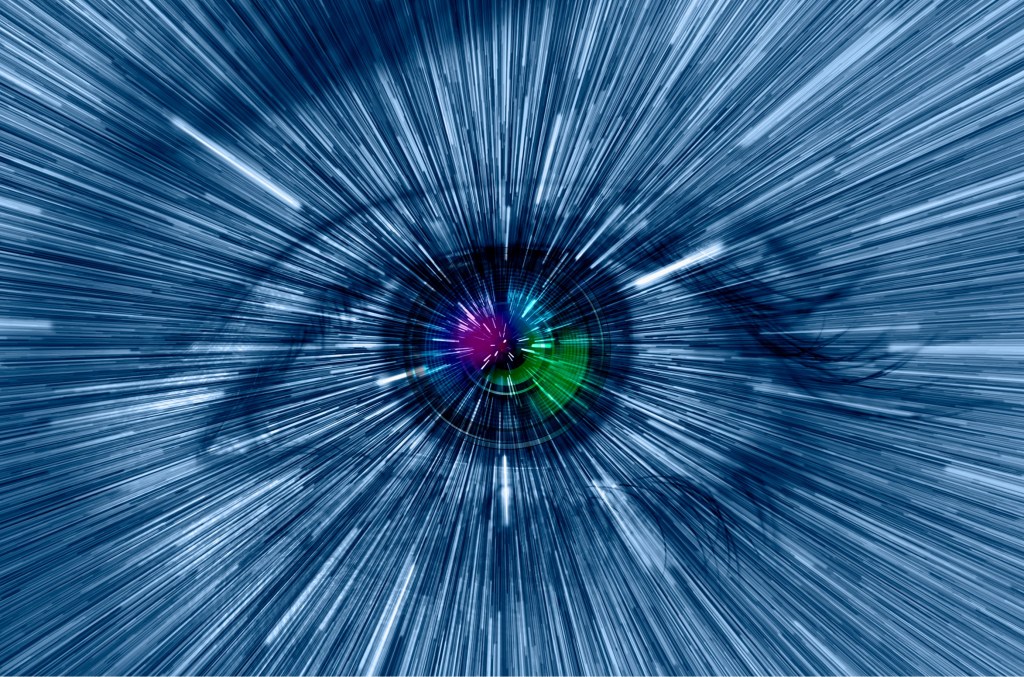
Billions of photons coming into the eye. For them time does not exist. Shutterstock asset id: 2629068895 by muratart.
You could raise a couple of objections to some of the claims in the last paragraphs. Very far away, beyond the limit of the visible Universe, galaxies can move away from us faster than the speed of light. However, they are not moving faster than the speed of light compared to the space where they are. What is going on is that space and time are stretching fast due to the expansion of the Universe.
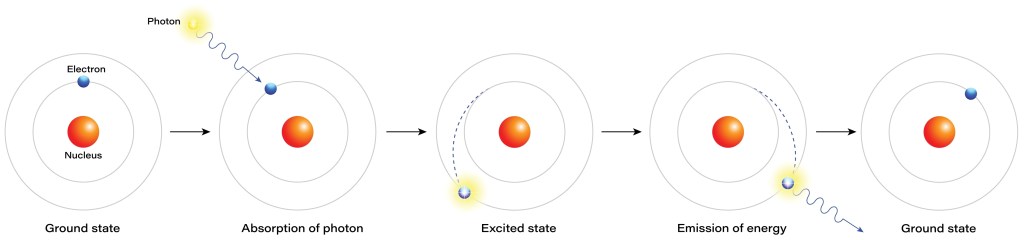
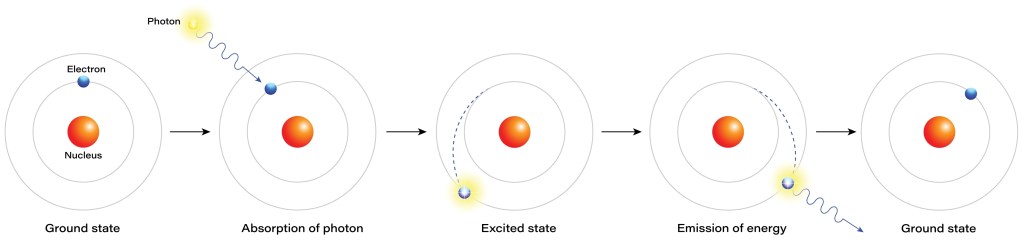
Another objection might be that light can move slower than c = 299,792,458 through transparent materials such as glass and water. So, how can the claim that all massless particles must always move at exactly the speed of light in vacuum be true? The answer to that is that the light particles (photons) in those materials are being absorbed and re-emitted as new photons by the atoms. However, in between the atoms the photons move exactly at the speed c = 299,792,458, or more correctly at the time-space conversion factor c = 299,792,458.
From ground state to excited state, absorption and emission of a photon in an atom. Shutterstock asset id: 2180385419 by rktz.
All Matter Consist of Molecules and Atoms that move
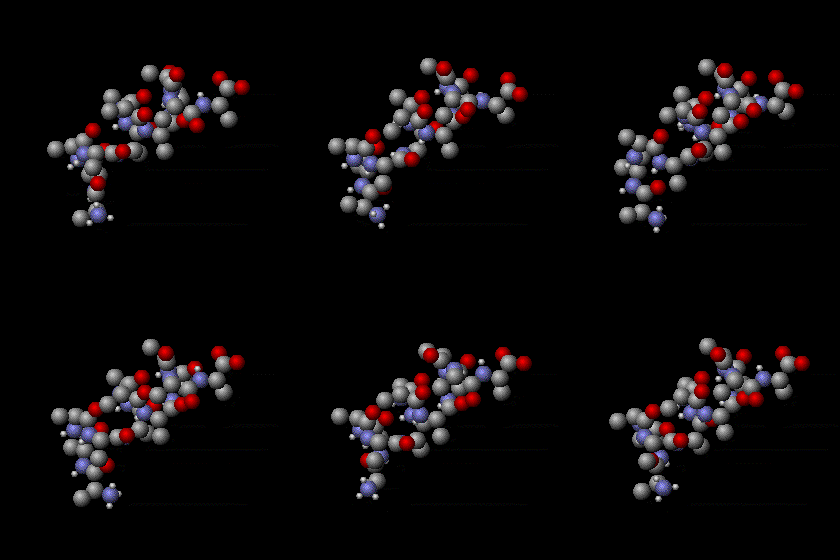
But wait, we are not done. Another fact is that everything is made of atoms and molecules that are never completely still. Temperature is a measure of their average kinetic energy (energy of motion). Even at the temperature absolute zero molecules and atoms are still moving. Yes, even at the lowest possible temperature they are still moving. It is impossible for atoms and molecules to stand completely still, just like children.
Thermal vibration of a segment of a protein’s alpha helix. Its amplitude increases with temperature. User:Greg_L on English wikipedia, uploaded to commons by User:Frokor, CC BY-SA 3.0 <http://creativecommons.org/licenses/by-sa/3.0/>, via Wikimedia Commons.
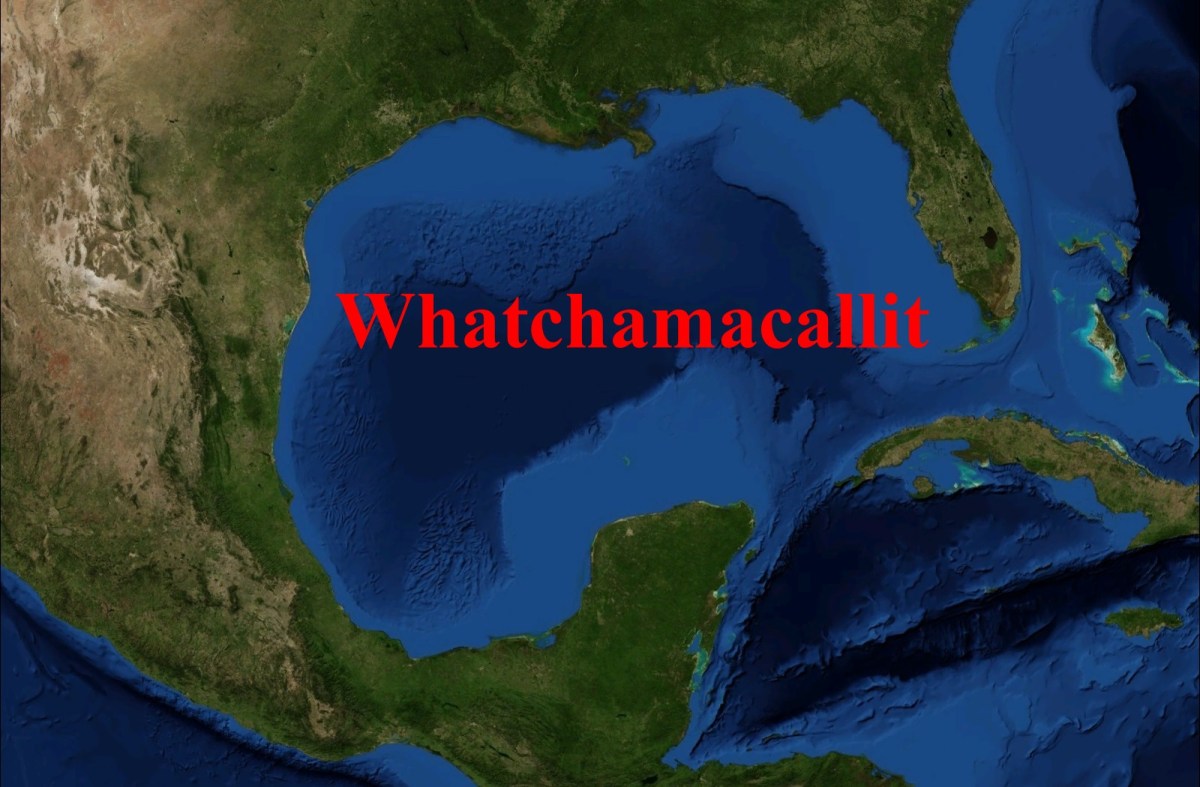
Super fact 130 : Gulf of America is not Recognized Internationally. The United Nations does not recognize the name “Gulf of America,” and continues to use the internationally established name Gulf of Mexico. The name “Gulf of America” applies only to the domestic agencies of the United States.
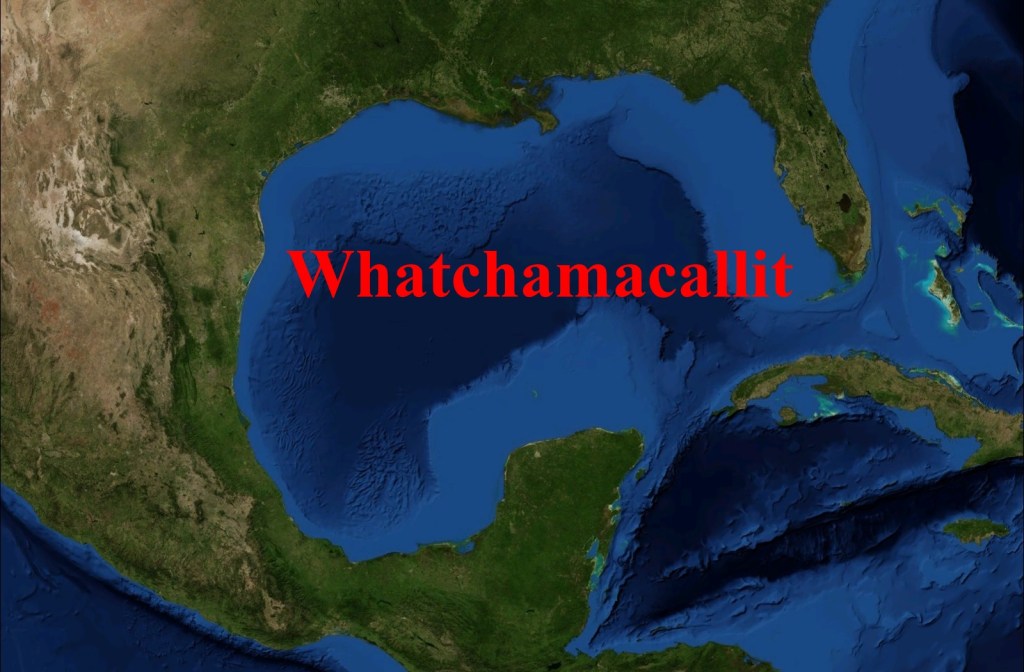
Aerial view of the gulf. National Aeronautics and Space Administration, GPL <http://www.gnu.org/licenses/gpl.html>, via Wikimedia Commons. I added the label “Whatchamacallit”.
The U.S. executive order renaming the body of water only applies within the United States and its federal agencies. International organizations and hydrographic groups, such as the International Hydrographic Organization, continue to officially recognize the historical name, the Gulf of Mexico. The UN (towards bottom) and global news organizations such as the AP will continue to use the name Gulf of Mexico.
Countries bordering the Gulf of Mexico / Gulf of America, including Mexico, do not recognize the name change. English speaking countries such as the UK continues to call it the Gulf of Mexico. You can read more about the UK stance here. In non-English speaking countries such as my native country Sweden, the Gulf is called something that translates to the “Gulf of Mexico”. In Swedish, the Gulf is called “Mexikanska golfen”, and it is the name that appears in media, on maps, and typically in speech.
The Geographic Names Information System (a US federal database) and US federal agencies adopted the name Gulf of America, and Google maps and Apple maps adopted the new name in the US. If you switch country, it may say Gulf of Mexico, or Gulf of Mexico or other local name followed by (Gulf of America), i.e., Gulf of America in parenthesis. MapQuest and OpenStreetMap chose not to adopt the name “Gulf of America” at all.
The six minutes and 43 seconds long video below by the mapping company World Maps Online explain why they did not adopt the name “Gulf of America”. In short, it is because they follow the UN naming conventions (at 5:40 in the video). Earlier in the video it is explained that the renaming only applies to the US continental shelf area, not the entire body of water, yes, even in the US the entire gulf was not renamed. The video also explains that naming conflicts are common and that there is no global authority that can resolve them and therefore the International Hydrographic Organization, the leading international map naming organization uses numbers instead of names. You are naturally free to listen to the whole video, but I am starting it 5 minutes in.
I have become aware that many Americans now incorrectly believe that the new name Gulf of America is “official” everywhere and therefore they go around trying to correct people. It is an important fact that is widely misunderstood and therefore I consider it a super fact.
My Personal Encounter with the Gulf of Mexico vs Gulf of America Controversy
I write beer reviews in various places, and I administer several Facebook beer review groups. When I said I was vacationing by the Gulf of Mexico in one of the Facebook beer groups that I administrate, two guys I have never seen posting anything in the group demanded that I change Gulf of Mexico to Gulf of America. I explained that this beer group is international. There are people from Germany, Sweden, France, Mexico, Canada, China, as well as US, posting in the group, so using a more internationally recognized name is just practical. I was not trying to make a point, which was true.
However, I can add that the name Gulf of America does not seem to be very popular even in the US. A February 2025 poll by Marquette University found that, among 1,018 respondents nationwide, 71% opposed renaming the Gulf of Mexico and only 29% supported the name change. So, the people who lecture others about using Gulf of America instead of Gulf of Mexico should maybe reconsider.
Origins of the name Gulf of Mexico
The name “Gulf of Mexico” is derived from the ethnonym Mexica referring to the Nahuatl-speaking people of the Valley of Mexico also known as the Aztecs. The name “Gulf of Mexico” has been in use since the 1550s and is internationally recognized.
Lake Ontario versus Lake America
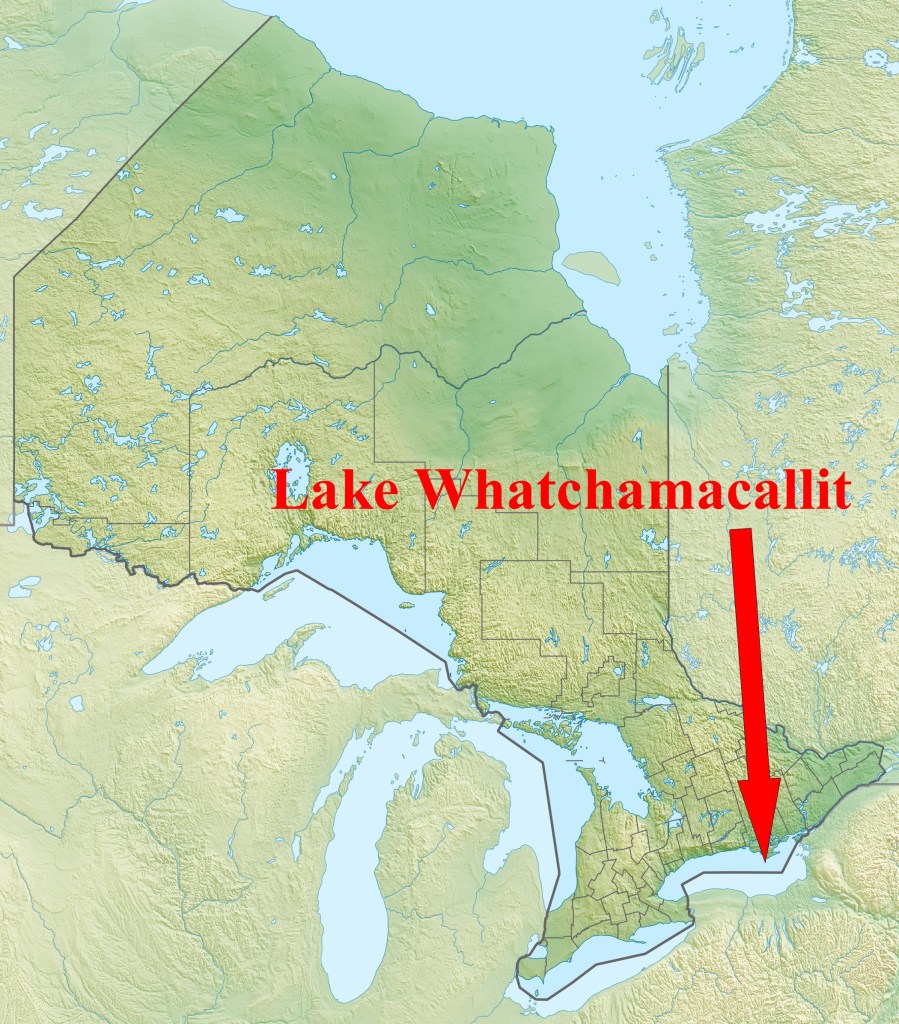
A similar situation exists with Lake Ontario. A US executive order has been issued to rename Lake Ontario to Lake America. However, this is not internationally recognized. As mentioned, a country can rename an international body of water for its own domestic agencies, but that change has no binding legal effect on other nations or international bodies.
As with the Gulf of Mexico the old and internationally used name “Lake Ontario” is derived from indigenous languages. The name Ontario is likely derived from the Iroquoian word Kaniatarí:io or Oniatarí:io meaning “lake of shining waters” or “beautiful lake”. It has been in use since at least 1641.
Lake Ontario is now called Lake America in the US. This is a file from the Wikimedia Commons from this Wikipedia location. I updated it by adding Lake Whatchamacallit.
I can add that our President has also issued an executive order changing the name Denali (also indigenous name) to Mount McKinley. However, this is in Alaska, which is US sovereign territory and a bit different. He can do that. Another situation exists with the proposed renaming of New Mexico to New America. New Mexico happens to be written into the New Mexico constitution, making an official name change beyond the President’s power. I can also add that Like the Gulf, the region historically known as Nuevo Mexico was named for the valley, not for the country or even the Spanish province of Mexico. Nuevo Mexico was probably named circa 1560 to 1580 and first appeared on maps in the early 1590s.
What About Renaming Canada Geese to Donald Ducks?
Finally, a little joke
Can Canada Geese be renamed to Donald Ducks? Asking for a President. I generated the picture with the help of ChatGPT.
Super fact 129 : Most fundamental forces of nature, gravity, electromagnetism, the weak nuclear force, become weaker as the distance between the objects with the charges increase, except for the strong nuclear force, which grows stronger, not weaker, when the distance between the quarks increases. The strong nuclear force is strange in other ways too. Unlike the electric force which has two forms of charges, positive and negative, the strong nuclear force has three forms of charge denoted red, blue, and green. It has actually six kinds of charges if you count anti-red, anti-blue, and anti-green. I can add that the strong nuclear force is the strongest fundamental force in nature.
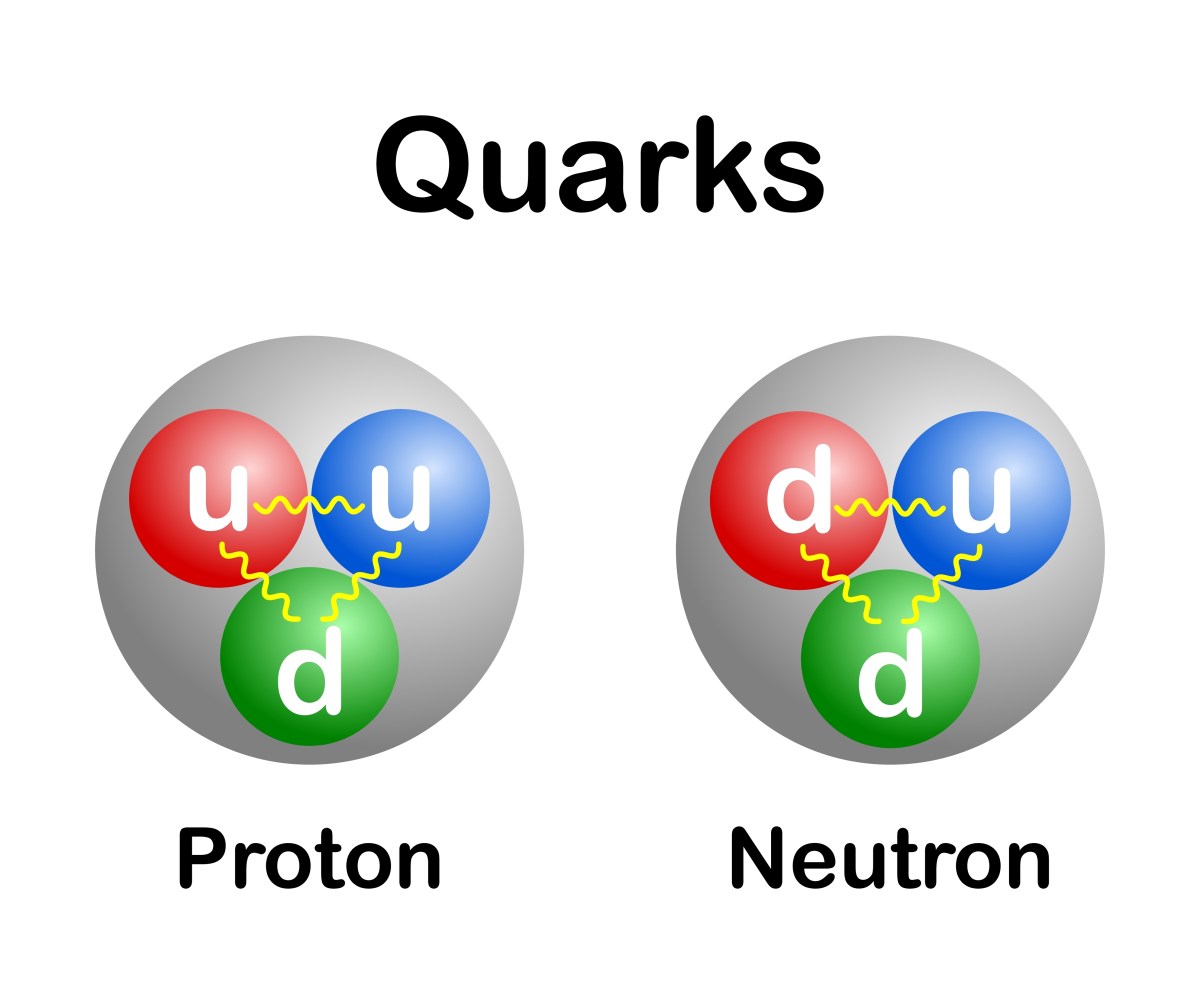
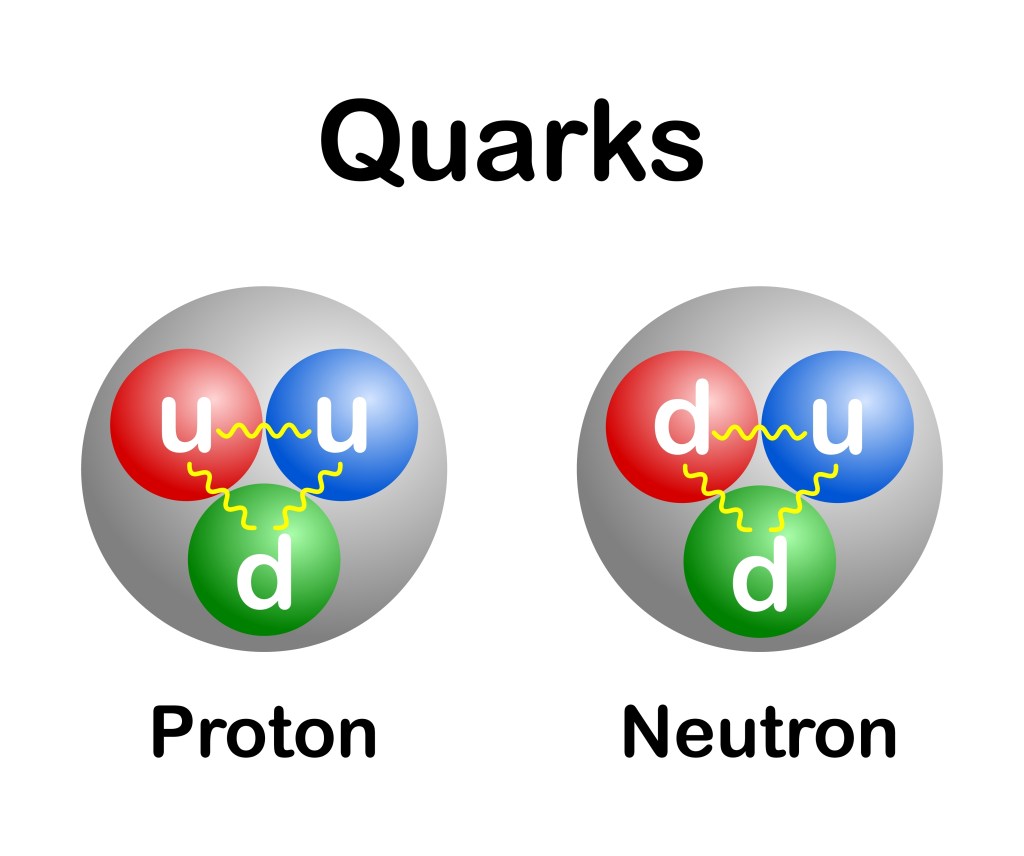
As you may know, atoms consist of particles. Electrons surround the nucleus of the atom. The nucleus of the atom is in the middle of the atom, and it consists of protons and neutrons. Electrons have a negative charge. Protons have a positive charge. Neutrons do not have an electrical charge. Electrons are so called elementary particles. They are not composed of other particles. Protons and Neutrons, on the other hand, are not elementary particles. They are composite particles consisting of quarks, gluons and quark pairs called mesons.
Quarks have electric charges, just like an electron and a positron, which is why a proton has an electric charge, a positive electric charge. However, as mentioned, in addition quarks have something called color charge. Unlike electric charges, which come in two forms, negative and positive, they come in three forms red, green and blue. In addition, there are also anti-red, anti-green, and anti-blue charges, making it six forms of charges. I should say that the color charges, red, green and blue, are not real colors. They are just names. Just like electric charges are associated with electric forces; color charges are associated with the nuclear strong force.
The proton and neutron each consist of three quarks. Protons consist of two up quarks and one down quark. Neutrons consist of two down quarks and one up quark. Both protons and neutrons have a net white charge. The yellow squiggly lines are gluons transporting color charge between the quarks. Asset id: 2333679305 by KRPD.
If you take an equal amount of positive and negative electric charges you get something that is electrically neutral. If you take an equal amount of red, green and blue you get what is called white, or neutral. If you take an equal amount of red and anti-red you also get white. Any other mix gives you a net color charge. As mentioned, unlike, for example, gravity or electromagnetism, which get weaker as objects move apart, the strong force grows stronger as quarks are pulled apart and weaker when they are squeezed together. This strange feature is referred to as Asymptotic Freedom.
As you separate a quark further and further from another the attractive strong force grows stronger and stronger until it becomes super strong, and at about 10,000 Newtons, which is more than one hundred billion times stronger than the force between an electron and a proton in a hydrogen atom it will finally quickly dimmish as if it was a rubber band that snapped. This event will create new particles and quarks, but not free quarks. 10,000 Newtons correspond to a weight of 2,200 pounds, like a small car. However, remember that we are talking about objects that are a trillion times smaller (in diameter) than one millimeter.
Not only is the nuclear strong force increasing with distance until it snaps, which is kind of strange, but by the time it snaps the force is shockingly gigantic for such a small particle. Therefore, this is a fact that is mind-blowing and kind of important to our understanding of the Universe and therefore I think it is a super-fact. With these kinds of forces inside the atomic nucleus no wonder we can blow up large cities using small amounts of the right matter.
The Other Fundamental Forces Become Weaker with Distance
As mentioned, the other fundamental forces gravity, electromagnetism, and the weak nuclear force get weaker as objects move apart. You may say what about friction, pressure, pulling a rope, and attraction between atoms in a molecule? Well, they are not fundamental forces and composed of electromagnetic forces at the bottom. Also, electric and magnetic forces are combined into electromagnetism because they are fundamentally the same thing.
Gravity gets Weaker as Masses Move Apart
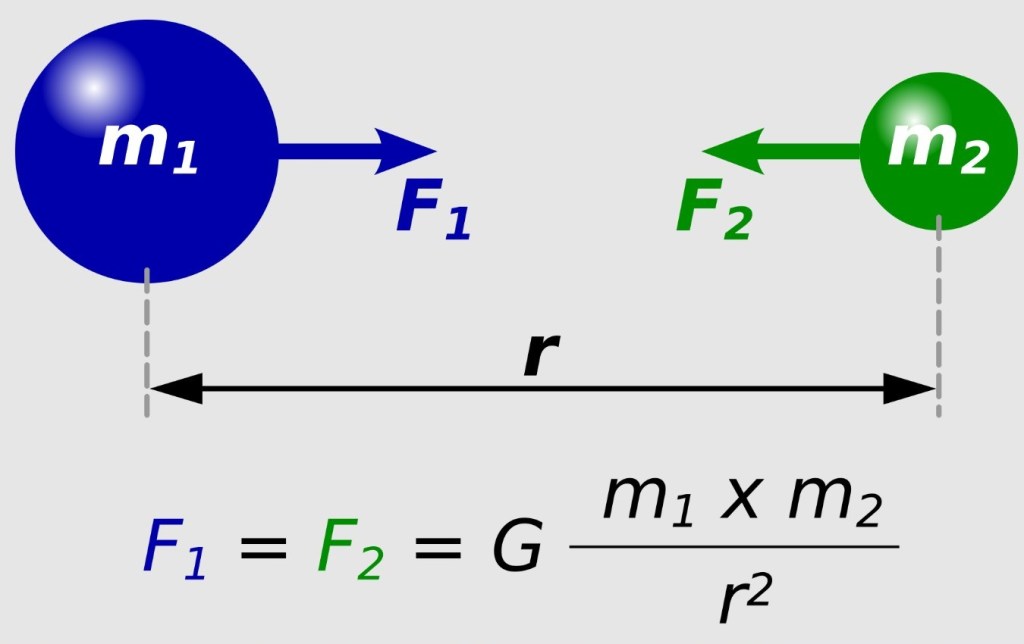
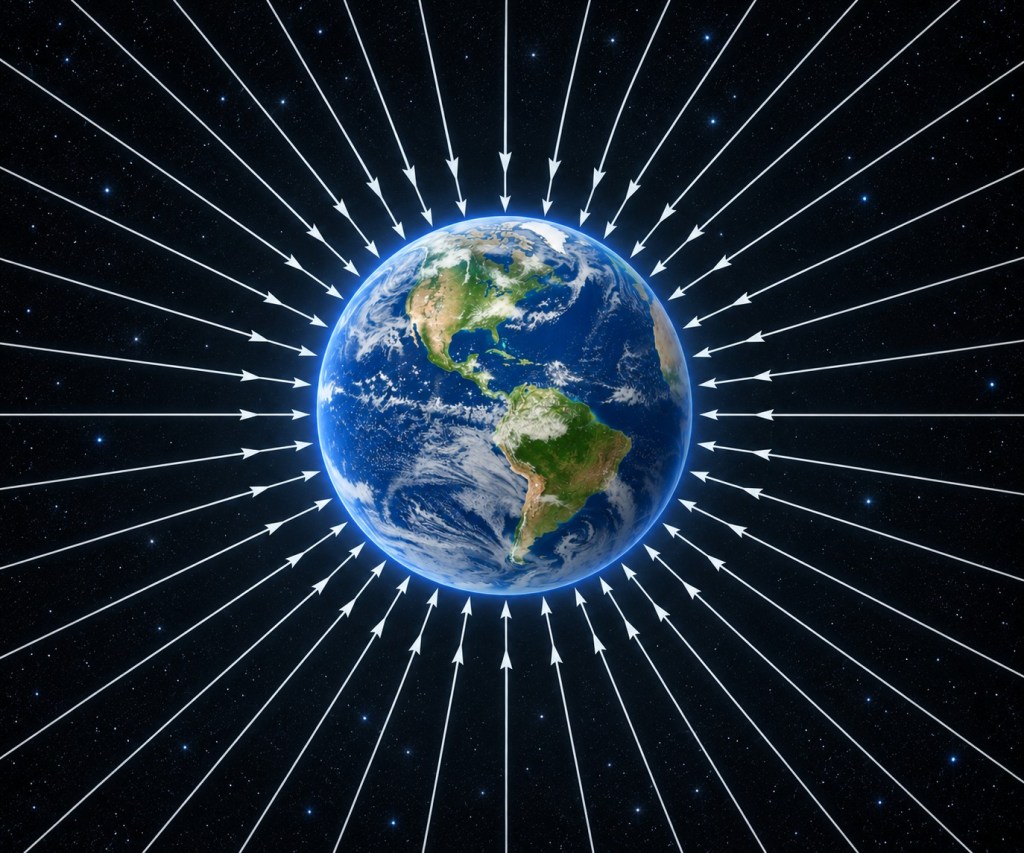
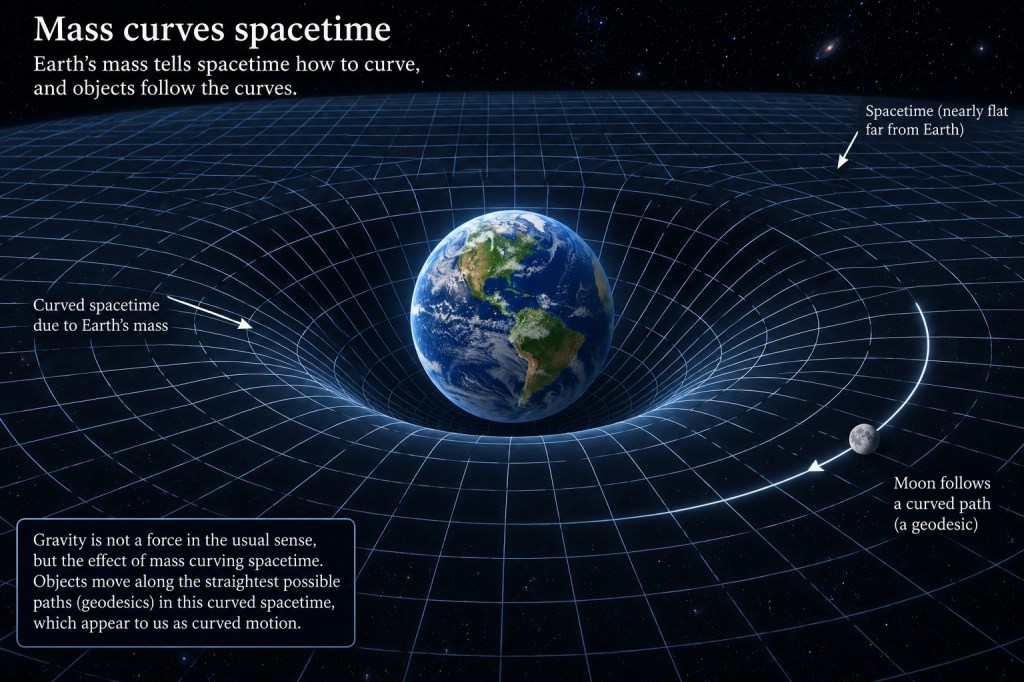
The force of gravity gets weaker as masses such as planet Earth, the moon, and the sun are separated further. Newtons law of gravity states that every object in the universe attracts every other object with a force that is directly proportional to the product of their masses and inversely proportional to the square of the distance between their centers.
This diagram describes the mechanisms of Newton’s law of universal gravitation; A point mass m1 attracts another point mass m2 by a force F2 pointing along the line intersecting both points. The force is proportional to the product of the two masses and inversely proportional to the square of the distance (r) between the point masses. Dennis Nilsson, CC BY 3.0 https://creativecommons.org/licenses/by/3.0, via Wikimedia CommonsThe force field lines demonstrate how gravity gets weaker as the gravitational field spreads out in space. I generated this picture using ChatGPT.Even if you use the more modern model of gravity, Einstein’s General Theory of Relativity, you can see how the curvature of space becomes less further away from Earth. I generated this picture using ChatGPT.
This does not happen with the strong nuclear force.
The Electromagnetic Force gets Weaker as Objects Move Apart
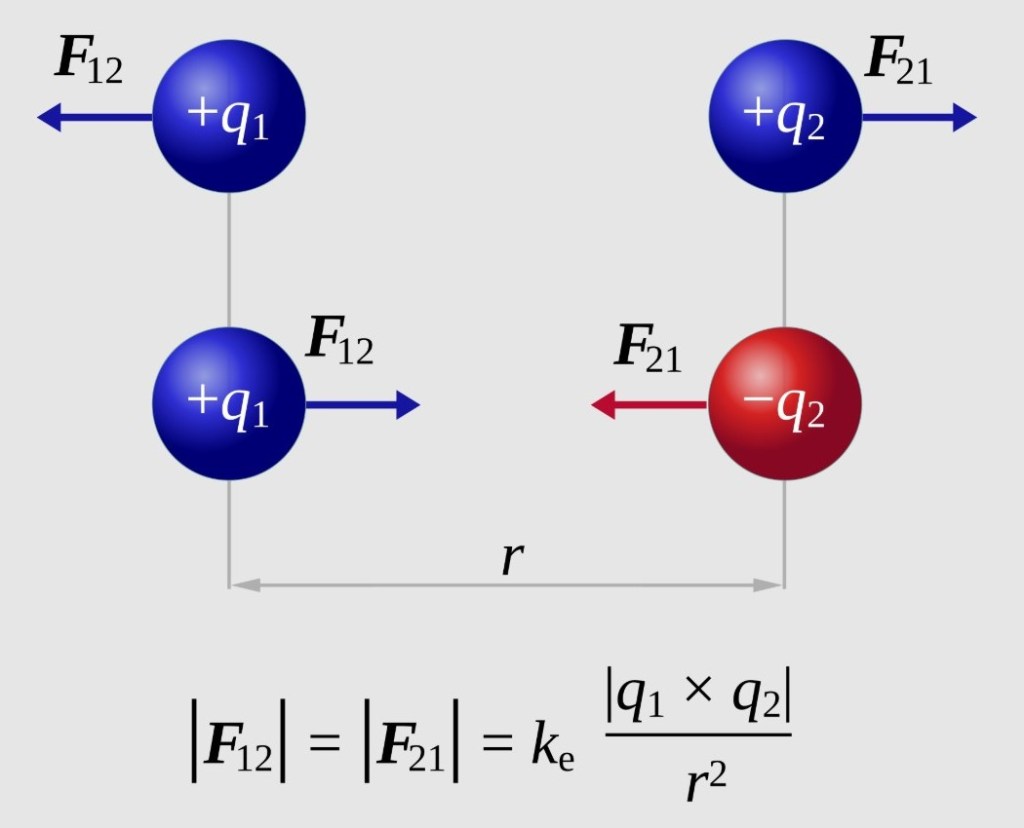
The electric force gets weaker as the charges are separated further. Coulombs law is similar to Newtons law of gravity. The force between them is inversely proportional to the square of the distance between their centers.
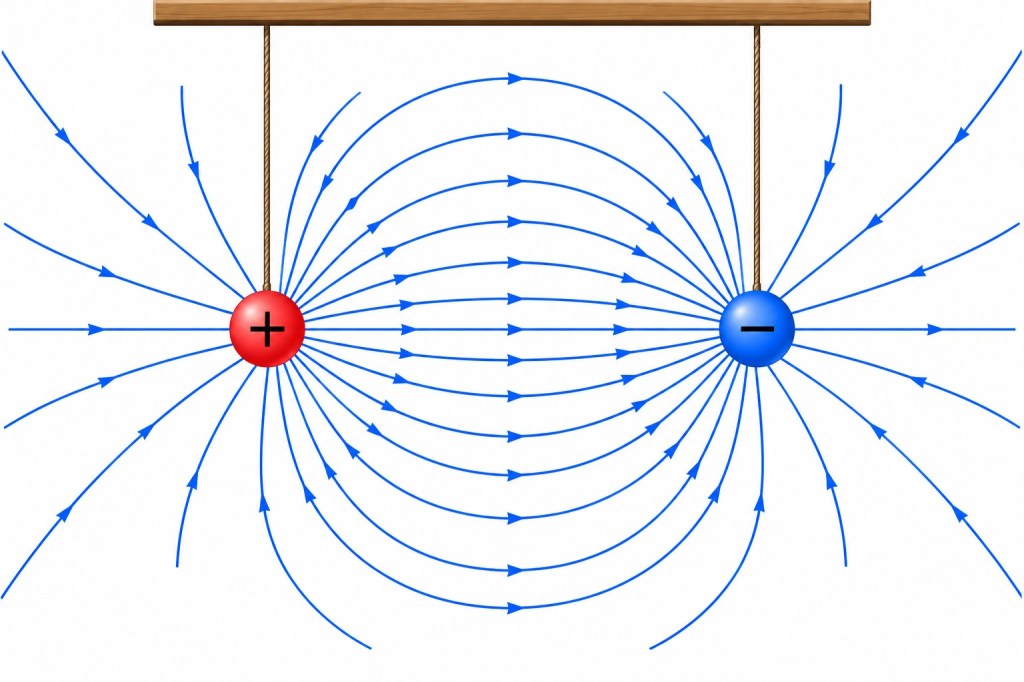
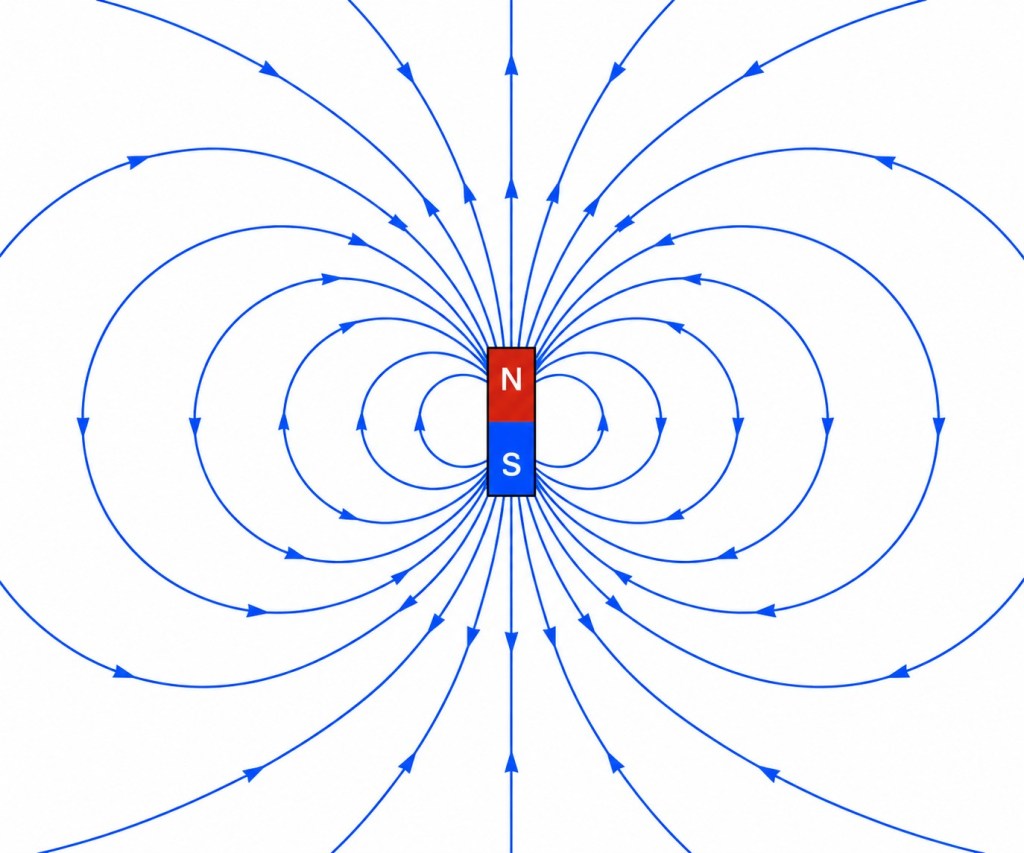
The magnitude of the electrostatic force F between two point charges q1 and q2 is directly proportional to the product of the magnitudes of charges and inversely proportional to the square of the distance between them. Like charges repel each other, and unlike charges attract each other. File:CoulombsLaw.svg: User:Dna-Dennis / *derivative work RJB1, CC BY 3.0 https://creativecommons.org/licenses/by/3.0, via Wikimedia Commons.The force field lines demonstrate how the electric force gets weaker as the electric field spreads out in space. I generated this picture using ChatGPT.Same thing with a magnetic dipole. The field lines are spreading out in space so the magnetic force (field) become weaker further away from the dipole. I generated this picture using ChatGPT.
Again, this does not happen with the strong nuclear force. It is different. The strong nuclear force is strange and very strong.
What is a Quark?
You can learn more about Quarks and the strong force by watching this 10 minute video below. The strong nuclear force is discussed towards the end of the video.
Today is the sixth time I participate in Linda Hill’s streams of consciousness. To read about the rules and participate click here. To read my five previous entries click here “Prediction Failures and My Lucky Day from Hell”, or here “The Review Wars on Amazon”, or here, “Reindeer Hide Memories”, or here “25 Sweet Leonberger and Dog Photos”, or here “Bad Travel Memories”. I put this post on my Super-factful blog because it is factual and not related to Leonbergers. “Everything is in Motion” could be a super fact, but a super-fact post requires editing, looking up facts, or verifying facts, and lots of links, so that is for another post. This post is just my musings.
2019-2020 SoCS Badge by Shelley!
Today’s prompt for Stream of Consciousness Saturday September 5, 2026, is “Motion”. Use it anyway you’d like. The first rule is: there should be minimal planning and no editing except typos. I did not edit but I did add a few pictures. I like adding pictures. I just copied the pictures including captions from a few of my other posts.
The first thing that came to my mind for this prompt was that Motion is relative and everything is in Motion. You may be sitting in your chair completely still thinking that you are not moving but you are. Earth rotates around its axis at hundreds or thousands of miles per hour and you follow along wherever you are sitting. Sitting at the geographic north Pole won’t help you because Earth is also wobbling and it is rotating around the sun at more than 60 thousand miles per hour, and the sun is rotating around the center of our galaxy the Milky Way at several hundred thousands miles per hour, and our galaxy is moving compared to the Andromeda galaxy at millions of miles per hour, and it moves billions of miles per hour compared to other galaxies.
Motion is not absolute. It is always relative to something else. The universe has no center, no ether to compare with, there is no absolute reference point. It is not possible to declare anything as truly standing still. Understanding this is the first step towards understanding the theories of relativity.
Mass is energy and vice versa, a direct result of the way time and space are related. Stock Photo ID: 2163111377 by Aree_S
You could of course say that; well, compared to my reference frame, my room right here, I am sitting still. I am not in motion compared to my chair. So, in that sense it is possible to say that I am not in motion. Well, I am sorry to disappoint you. You are still moving through time at the speed of light. To bring up relativity again, space and time is a four dimensional continuum, and space can be converted into time and vice versa. The conversion factor between space and time is a constant identical to the speed of light in vacuum. Without explaining the details this means that you when you are sitting absolutely still in space, relative to something like your chair, you are still moving through time, in that reference frame, at the speed of light. You see “Everything is in Motion” is an unescapable fact.
Man thinking he is sitting still drawn with the help of ChatGPT
A related interesting fact is that nothing that has mass can move through space at the speed of light. Everything that has mass must move slower than the speed of light through space. Conversely, particles that do not have mass, such as light particles (called photons), and gluons, must always move through space at the speed of light, and as a result for them time does not move. Actually, for them time does not exist.
Billions of photons coming into the eye. For them time does not exist. Shutterstock asset id: 2629068895 by muratart.
There are a couple of obvious objections to the last paragraph. Very far away, beyond the limit of the visible Universe, galaxies can move away from us faster than the speed of light. However, they are not moving faster than the speed of light compared to the space where they are. What is going on is that space and time are stretching fast due to the expansion of the Universe.
Another objection is that light can move slower than the speed of light in vacuum through transparent materials such as glass and water, so how can the claim that all massless particles must always move at exactly the speed of light in vacuum be true? The answer to that is that the light particles (photons) in those materials are being absorbed and re-emitted as new photons by the atoms. However, in between the atoms the photons move exactly at the speed of light in vacuum.
From ground state to excited state, absorption and emission of a photon in an atom. Shutterstock asset id: 2180385419 by rktz.
Anyway, the conclusion is, “Everything is in Motion”, through space, and through time.






 Super Facts