
I think that one of the most interesting series science books for beginners that I’ve come across is the Baby University series. I bought it for our soon to be born first grandchild Jack, but I couldn’t help but go through them myself. It is a great series for those who hope to put their one-year-old toddlers in a PhD program. But seriously, these books explain science concepts as simply as it is possible to do. The books may still be a little bit tough for babies, but I think 2–3-year-olds might get something out of them. The point of the books is not to make young children understand complex scientific concepts but to introduce the vocabulary and build curiosity.
Below I am presenting five books in the series, General Relativity for Babies, Electromagnetism for Babies, Artificial Intelligence for Babies, Quantum Physics for Babies, and Organic Chemistry for Babies. I am providing my review for the book and a link to my review as well as the book and a photo of the front cover.
General Relativity for Babies
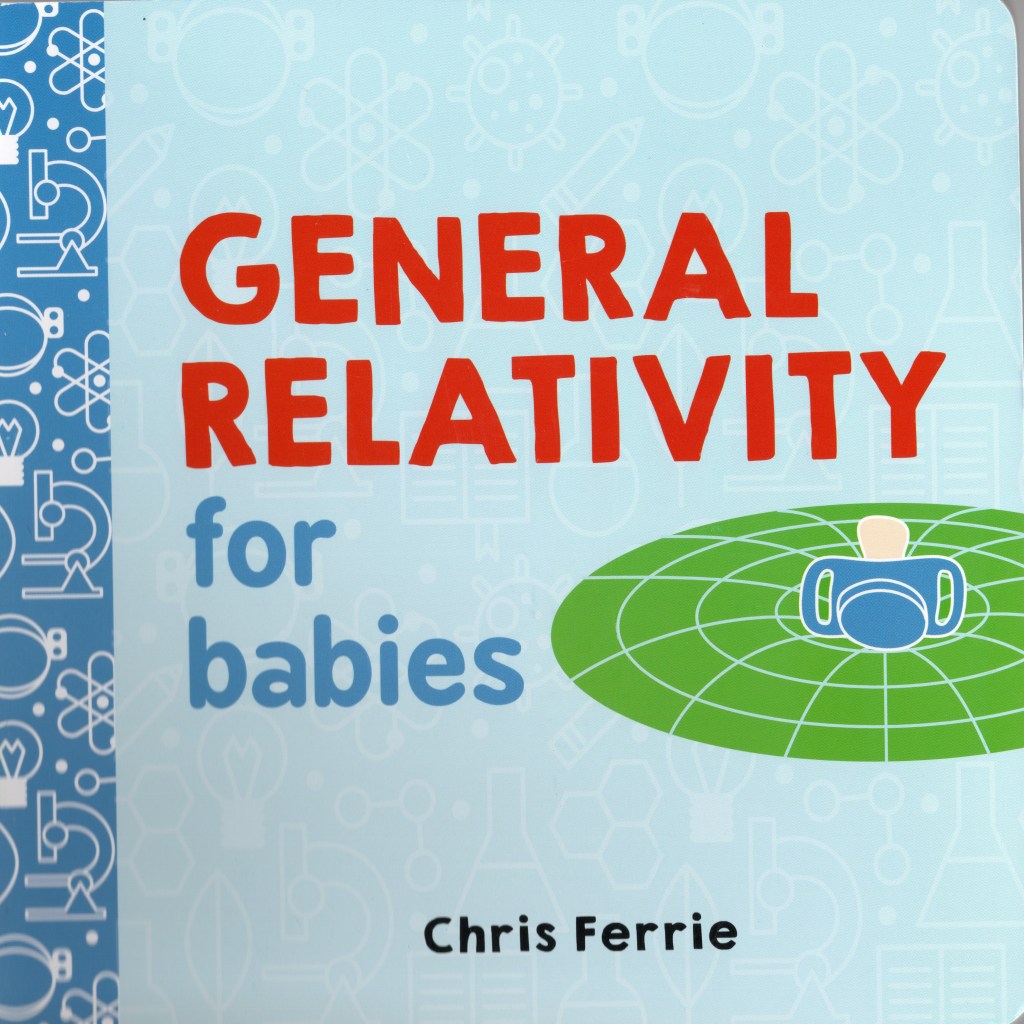
This is the Amazon link for General Relativity for Babies.
My Review for General Relativity for Babies
General Relativity as Simplified as Possible
We bought this board book for our not yet born grandson. This book simplifies the General Theory of Relativity as far as you possibly can. It uses simple language and colorful illustrations to give the reader an idea of what is going on. Different sized masses are different sized balls, space-time curvature is illustrated using a distorted grid, and objects orbiting larger masses, such as a star, are shown as small balls having their paths curved by a warped grid. There are simple explanations for what a black hole is and what gravity waves are.
A baby would not understand this book but maybe someone who is 3-4 years old would. But your expectations need to be realistic. It should also be noted that even if you understand the book, the explanations are too simplistic for you to really understand General Relativity, but the explanations are not so simple that they are wrong. The book will just give you an idea of what is going on. However, I was impressed by the fact that the author and illustrator were able to present such an abstract theory in a way that makes it possible for a child to at least have a clue. I think that the most important aspect of the book is not whether the child understands General Relativity but the interest in science that it may evoke.
Electromagnetism for Babies

This is the Amazon link for Electromagnetism for Babies.
My Review for Electromagnetism for Babies
Electromagnetism Simplified for Young Children
We bought this short and colorfully illustrated board book for our not yet born grandson. I don’t think a baby will understand it but maybe when he is 2-3 years old. The book explains in simple terms and with colorful simple illustrations the basic concepts of charges, and attraction between negative and positive charges, and repulsion between two positive balls/charges and two negative balls. It explains about electrical and magnetic fields, and the fact that charges rotate around magnets. I believe this book can spur a child’s interest in science and engineering.
Artificial Intelligence for babies
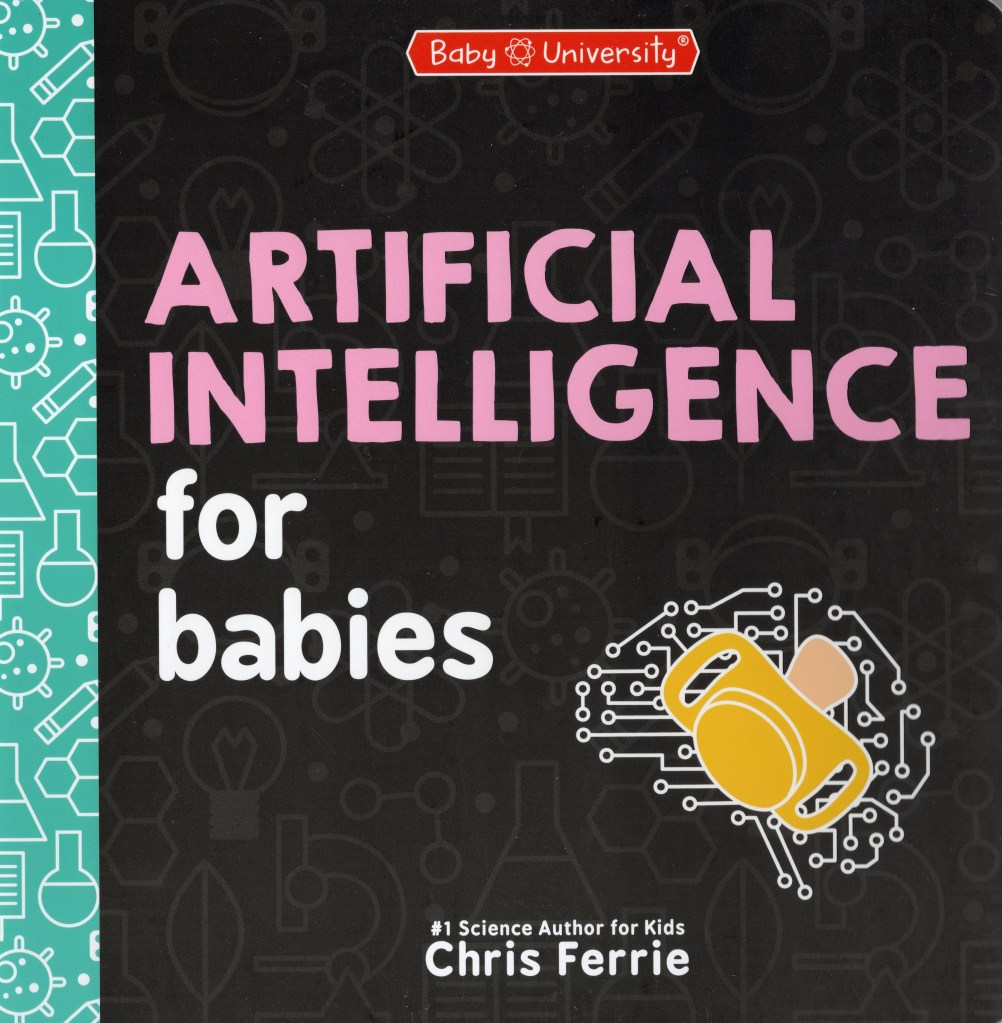
This is the Amazon link for Artificial Intelligence for babies.
My Review for Artificial Intelligence for babies
Artificial Intelligence for Small Children
We bought this board book for our not yet born grandson. He will not be able to understand it until he is at least one years old, but that is OK. The book explains the difference between a dog, a live thing, and a computer. It does this in very simple terms that I believe a young child could understand. According to the book, a computer can do some things that are impressive, such as complex calculations, and you can teach it certain skills, but it is not adaptable like a dog. I think that is about what you can make a very young child understand. Naturally, there are no neural networks or AI algorithms in the book. However, I think it sells artificial intelligence short, since artificial intelligence is becoming increasingly adaptable.
Quantum Physics for babies

This is the Amazon link for Quantum Physics for babies.
My Review for Quantum Physics for babies
Quantum Physics for Young Children and Adults who Detested Physics Class
We bought this board book for our not yet born grandson. We may need to wait until he is 2-3 years old before it makes sense to read it to him. In the meantime, it is also a good book for adults without a solid science education. The book talks about colorful balls with energy and presents a simplified version of the Bohr model of the atom. There are blue balls called electrons and red balls called protons in the middle (the nucleus). The electrons travel in circular orbits around the middle. Light can change the energy of electrons causing them to jump between the orbits.
My daughter made the comment that a baby is only going to understand that an electron is a blue ball and a proton is a red ball, which isn’t a correct description of electrons and protons. Protons and electrons don’t have specific colors, not to mention that a simplified Bohr model for the atom is quite different from the more realistic Schrödinger’s model of the atom with quantum waves and probabilistic electron clouds. However, I am still very impressed by how simple the author and the illustrator succeeded in making this abstract topic. It is a good start for budding physicists.
Organic Chemistry for babies

This is the Amazon link for Organic Chemistry for babies.
My Review for Organic Chemistry for babies
Your First Book on Organic Chemistry
We bought this board book for our not yet born grandson. We will read it to him when he is 1-3 years old. Right now, we can read it. This book simplifies Organic as far as you possibly can. It uses simple language and colorful illustrations to give the reader an idea of what organic chemistry is. Basically, atoms are balls of different kinds. Atoms make up everything. Atoms can stick to each other, and they can make different shapes. The balls we call carbon (in black) can stick to small white balls called hydrogen and other balls called oxygen. We call those organic molecules, and they make up plants, food, and medicines. I think this is simple enough for a 1–3-year-old to understand, but not a baby. In my opinion, a better name for this series would have been “for Big Boys or Girls” rather than babies, because young children don’t like being called babies.
To watch a woman read Quantum Physics for Babies. Click on the YouTube video below.
To see the Super Facts click here


Wow – that’s fantastic!
LikeLiked by 2 people
Yes get them started early with vocabulary and some concepts
LikeLiked by 1 person
These little books are great! In fact, they seem to be about my speed in actually (maybe) understanding any of these science facts. It would be fun if they could be put together with a cute little song/tune, sort of like the series for kids “Schoolhouse Rock” which even I learned things about. Music helps to learn I think. 🙂
LikeLiked by 3 people
Yes I think you are onto something. Turn the books into a TV series with music.
LikeLiked by 2 people
Wow! I really wish these were available for my son when he was a baby. He’d have particularly appreciated the on about quantum physics!
LikeLiked by 2 people
Yes I agree. We had the Magic Schoolbus but I don’t remember if it touched the really abstract concepts. I don’t think so.
LikeLiked by 1 person
Interesting series of books, and based on the comments, there’s a target market. Thanks for lifting up our eyes, Thomas!
LikeLiked by 2 people
Thank you Grant. 44 books so far and some of them have more than a 1,000 reviews on Amazon.
LikeLiked by 1 person
That’s fantastic, Thomas! Another example of finding and filling a reader-centric niche, authentic storytelling that entertains, informs, and inspires.
LikeLiked by 1 person
Yes I agree. Thank you Grant.
LikeLiked by 1 person
A good idea that might spark curiosity about science!
I wonder if there are books about these topics for adults who panic when they see mathematical equations but want to have a basic understanding?
LikeLiked by 2 people
Good question. There are books like Quantum Physics for Dummies but they are unfortunately not for novices. The word “Dummies” is typically misleading and it turns out to be quite complicated books. I will keep my eyes open and see if I find something.
LikeLiked by 1 person
Thank you, Thomas!
LikeLiked by 1 person
What a lovely post. If you don’t mind, I’d like to repost this in full on my education blog (https://askatechteacher.com). It has a lot of great information for parents.
LikeLiked by 2 people
🙂
LikeLiked by 1 person
And with that I meant reposting too of course.
LikeLike
Thank you!
LikeLiked by 1 person
Thank you so much Jacqui. You can certainly take anything you like from this post or other posts. About your new project. I don’t have any teaching experience, well, other than teaching assistant in grad school and putting other engineers to sleep when doing presentations.
LikeLiked by 1 person
What great books to have for little ones. Great idea.
LikeLiked by 2 people
Yes I agree with you Esther. Making it as simple as possible and getting them used to concepts and vocabulary at a very early age.
LikeLiked by 1 person
Java Bean: “Ayyy, it is never too soon to start learning how to be a mad scientist and take over the world, sí?”
LikeLiked by 2 people
I agree Java Bean. Maybe they should write science books for dogs too, so you can also be a mad scientist.
LikeLike
I might order one of two of these for myself… and my granddaughter and future grandchildren of course.
LikeLiked by 2 people
Yes that is not a bad idea. There are 44 of them, so lots of topics to choose from.
LikeLiked by 1 person
What a fun series! I have a 3yo grandson. I think he’d enjoy these.
LikeLiked by 2 people
Yes I think he probably will. It is entertainment for the adult reading it too.
LikeLiked by 1 person
What a good idea. Thank you.
LikeLiked by 3 people
I never got very close to quantum physics back in the day (although I do remember covering entanglement and experiments like the one where they send photons through a grate[?] and the measurements retroactively affected what the photons did[?] ― I’m a little foggy on the whole thing, it’s been a while …), but I did have chemical engineer buddies back in college and all they could talk about was how hard organic chemistry was. So I’m not sure which one I’m more impressed at seeing boiled down to a book explaining it to very young children lol
LikeLiked by 2 people
I know a little bit about it. I have a master’s degree in engineering physics from Uppsala University and a PhD in Electrical Engineering and Applied Physics from Case Western, and I’ve taken several courses in Quantum Physics. It wasn’t the route I would follow. For me it was robotics/mechatronics/electrical engineering and software engineering. However, I know a little bit.
When you said “experiments like the one where they send photons through a grate” I think you are talking about the version of the double slit experiment with photons or electrons, where they first don’t try to detect individual particles and you get a beautiful wave interference pattern. Then you try to detect which of the slits an electron goes through and when you do that the wave interference pattern vanishes as if the particles know they have been detected and change their behavior drastically. The only problem is that detecting a particle without influencing it is impossible according to Heisenberg’s uncertainty principle, and in reality, this experiment as described in textbooks has never been done. It is just a thought experiment. However, allegedly there is an alternative called the Mach Zehnder Interferometer, which I don’t know enough about. You also mention entanglement, which is a strange phenomenon, tested with Bell’s theorem experiment. But it gets very complicated, and so is organic chemistry but I don’t know much about it.
Anyway, I am ranting. You are right, these books don’t get into the nitty gritty. But you can choose your level of complicated.
LikeLiked by 1 person
Think more fun for the parents . My grandchild was given Quantum physics and her dad read it to her as a baby!
LikeLiked by 2 people
Navasolanature that is very cool. I’ll bet he had good time reading it to his baby.
LikeLiked by 1 person
Kept him awake!
LikeLiked by 1 person
I believe that
LikeLiked by 1 person
I love it, what great books to bring into a child’s life to add curiosity and depth in learning science terms and vocabulary.
LikeLiked by 1 person
Yes, that is exactly right. Thank you Kerri.
LikeLiked by 1 person
My 12 year old grandson told me yesterday his favorite class now is science.. last year it was math.. I can resonate with the science love but the math part is iffy… do u have any recommendations for kids his age?
LikeLiked by 1 person
I have a lot of good math books but they are all for adults studying or teaching physics or math. My kids are in their 20’s and everything we had for them when they were young we’ve thrown away. Calculus for babies would obviously be too young. You could maybe try something like IXL The Ultimate 7th Grade Math Workbook. I think the best is if you ask a teacher.
LikeLiked by 1 person
I’m not so confident in the teaching in this state and or teachers I’ve seen some crazy homework and the math has been so rearranged here it’s like a foreign language. The history is something that boggles my mind and nothing at all about history. I’m with my jaw open everytime I see the homework and they roll their eyes and say “I told you”. Thank goodness wood shop hasn’t changed so far anyways.
LikeLiked by 1 person
Kerri I don’t know which state you live in, but I am pretty sure Tensor Calculus and Toplogy is not for a 12 year old, so you need to ask either a teacher or a parent with kids that age. Jacqui whom I linked to above is a teacher, a fellow blogger and an author who knows a lot.
LikeLiked by 1 person
Wow, that is so cool, Thomas! I had to laugh that you’ve bought these for a little grandson who’s still on the way. Lol. But what a wonderful introduction to science. (I should read them, honestly). Hehe. Jack may not understand the concepts until he’s 2 or 3, but babies love board-books and “reading.” He’s going to have so much fun and all the smarter for it.
LikeLiked by 1 person
Thank you Diane. Yes that is what it is about vocabulary and concepts at an early age, but I seriously don’t think a baby will understand. We also bought him more traditional children’s books like Richard Scarry.
LikeLiked by 1 person
He’ll see the blue balls and red balls and they’ll be just balls at first, but their brains are little sponges. 😀
LikeLiked by 1 person
Yes you are right. Subatomic particles are just colored balls and then you take the next step.
LikeLiked by 1 person
Dear Thomas
I was quite impressed by your post. It has given a new point of view.
Thanks for liking my post, ‘Writer’ 🙏
LikeLiked by 1 person
What a great concept! Love it 😎
LikeLiked by 1 person
It’s fun for the little ones and parents.
LikeLiked by 1 person
Such a great way to get kids interested in science early on. Plus, this makes it fun for them which sometimes teachers don’t always do a good job of.
LikeLiked by 1 person
Yes you are right. You have start with simple explanations. I think it is very easy for teachers to forget how confusing it can be the first time you learn something. Dunning-Kruger goes both ways. People who know just a little don’t realize that they know too little to understand they understand too little. At the same time people who know a lot about topic underestimate how difficult it is for those who don’t know the topic yet. You have to use your imagination and imagine the students situation. The books may be more for young children rather than actual babies.
LikeLiked by 1 person
Yes, so true. And yeah I assumed it’s for kids not exactly babies.
LikeLiked by 1 person
Wow, talk about starting young! I think those books are more like my level when it comes to science. 😊
LikeLiked by 2 people
I think there is some inflation, or deflation, in the alleged intended audience for science books. Naturally babies will not understand these books even though they may pick up on some vocabulary and become curious. The same with “…for Dummies” books. Despite the name you often need a college degree in the topic to be able to read them, not to mention the “introduction to…..” books filled with differential equations on the first page. The title often indicates that it is easier than it is.
LikeLiked by 1 person
Great explanation Thomas, thank you. It makes much sense how you’ve explained it. 😊
LikeLiked by 1 person
Thank you Debby
LikeLiked by 1 person