
Super fact 82 : All known cellular life descends from a single Last Universal Common Ancestor (LUCA). All animals, all plants, fungi, algae, green and red algae, kelp, phytoplankton, cyanobacteria, amoebas, amoebozoa, diatoms, stramenopiles, rhizaria, hacrobia, all eukaryote, all archaea, all bacteria, all the millions of species on Earth come from one single ancestor known as the Last Universal Common Ancestor – LUCA. Viruses are an exception, but viruses are not considered life.
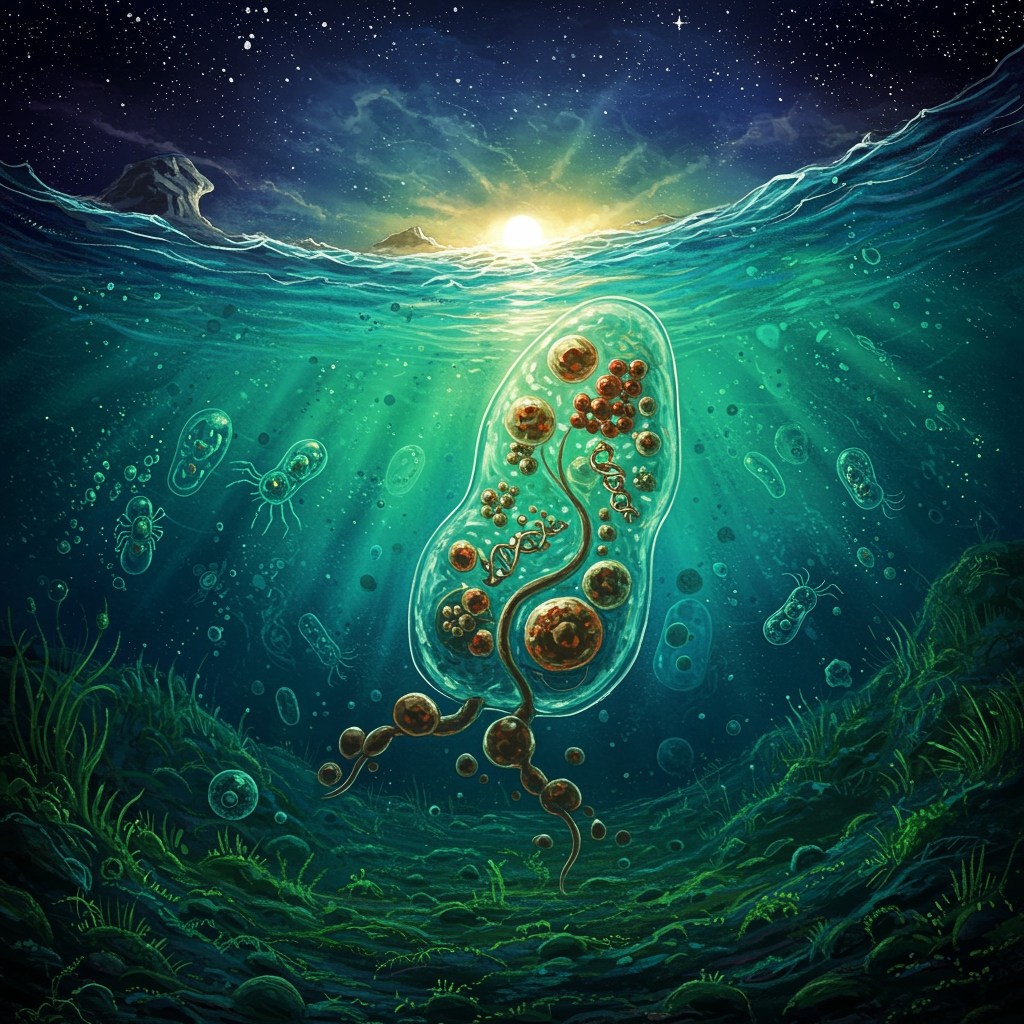
LUCA, the Last Universal Common Ancestor, was not the first life form. It was preceded by earlier, simpler life forms that did not survive. LUCA was a single-celled, bacteria-like microorganism that existed roughly 4.2 billion years ago, or about 400 million years after planet Earth first formed. It was the final common ancestor for all currently living organisms. It thrived near hydrothermal vents as part of a larger microbial community before the three domains of life bacteria, archaea, and Eukarya diverged. This is a super fact because it is true, or at least highly probable, it is surprising and amazing and kind of important.
How Do We Know All Life Has a Common Ancestor ?
The answer is genome mining. By surveying nearly 2000 genomes of modern microbes we not only know that all life has a common ancestor (LUCA), that lived roughly 4.2 billion years ago, but we also know that it thrived near hydrothermal vents as part of a larger microbial community. This is analogous to another of my posts “Humans and Chimpanzees Have a Common Ancestor”. By sequencing human DNA and chimpanzee and bonobo DNA we know that humans and chimpanzees have a common ancestor. No fossils, or other information from the past is needed. DNA is a great tool for determining relationships between species and for finding information about past life, without the need of fossils.
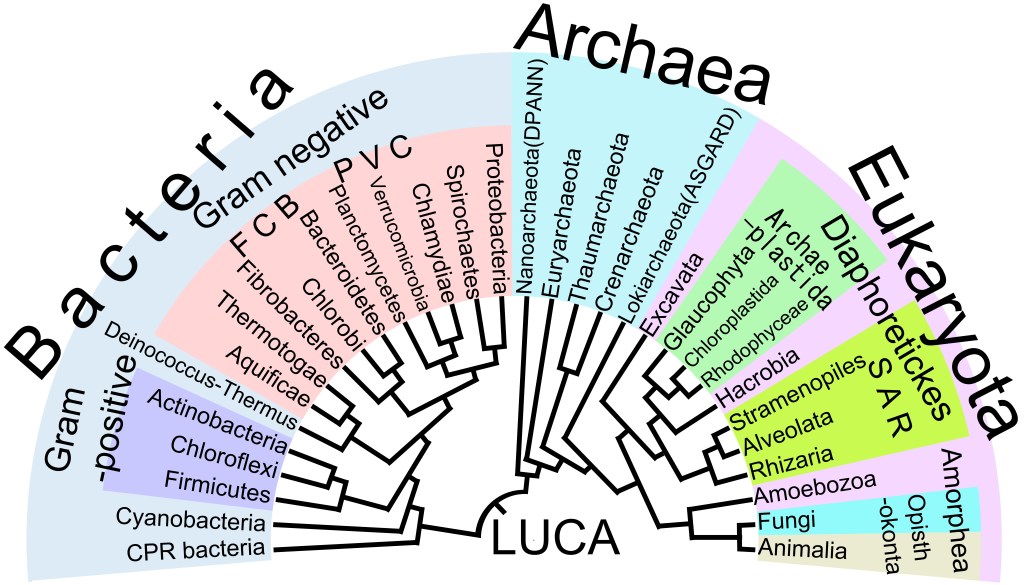
To be more specific, the detailed biochemical similarity of all current life makes the existence of LUCA widely accepted by biochemists. There is a Universal Genetic Code, which means that nearly all living things use the same DNA/RNA-based genetic code to translate genetic information into proteins. There is a shared molecular machinery, for example, all life relies on ribosomes for protein synthesis, similar energy carriers like ATP, and the same 20 amino acids. All life uses the same mirror-image form of molecules, a signature of a single, common ancestry. In addition, there is a “core” set of 355 gene families present in both modern bacteria and archaea, which were likely inherited from LUCA. Finally, we have phylogenetic mapping, protein-sequence-based phylogenetic trees converge on a single root, indicating a common ancestry for all life. See the phylogenetic tree of life below.
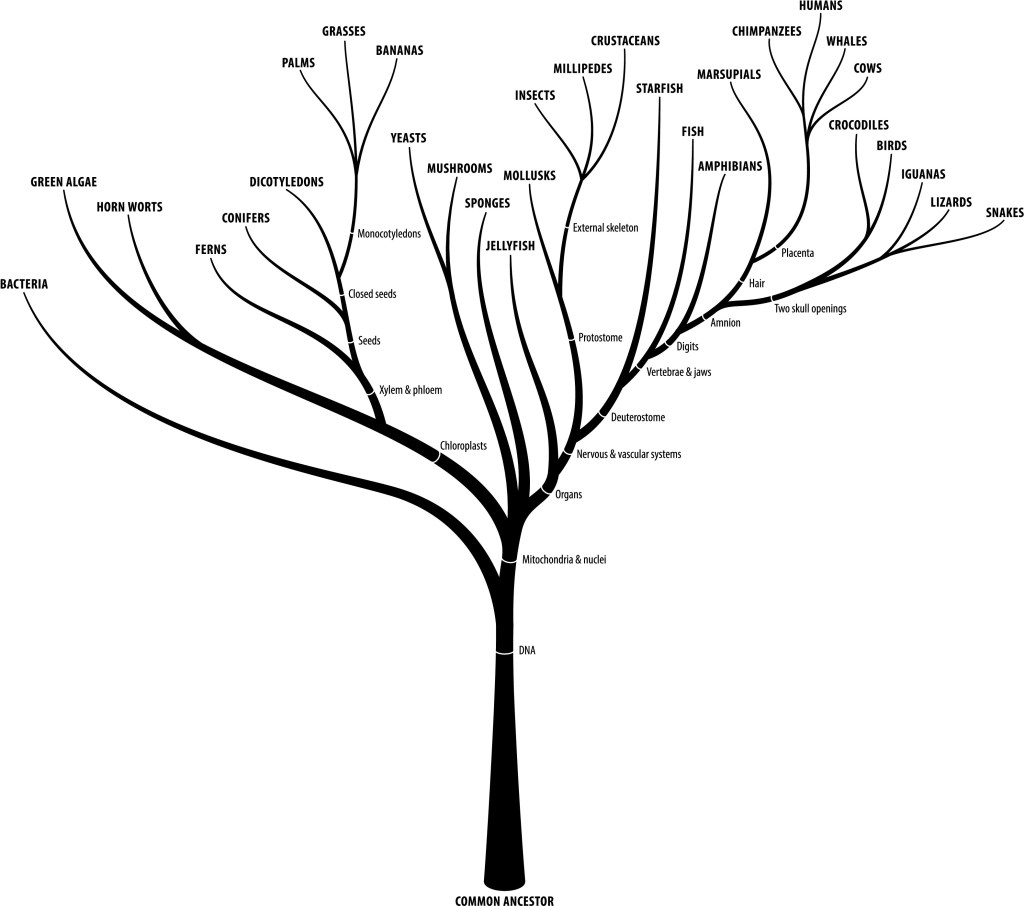
Below is another view of the diversification of life that focuses on the inventions made by life.
It should be noted that in addition to viruses there were likely other forms of life that existed alongside LUCA or before it. There was likely non-cellular life as well as cellular life that died out, RNA-based life, self-replicating nucleic acids, etc. It should also be noted that if some of the large viruses were to be reclassified as life, or a life form not based on LUCA were to be discovered then our “current LUCA” would no longer be LUCA, but just the ancestor of “almost all life”. That would still be amazing, just slightly less so.
The existence of LUCA brings up an interesting question. What would happen if we found DNA based life on another planet and its DNA showed that it also originated from LUCA ?
Other Evolution Related Super Facts
- Neanderthals Never Lived in Africa
- Evolution is a Fact
- The Second Law of Thermodynamics Does Not Contradict Evolution
- Humans and Chimpanzees Have a Common Ancestor
To see the other Super Facts click here


Another very interesting post, Thomas. Thank you.
LikeLiked by 2 people
Thank you so much Lynette
LikeLiked by 2 people
Wow, this is really mind-blowing! I’ll tell my son about LUCA when he gets home from school – he’ll be fascinated, I’m sure!
LikeLiked by 2 people
Yes it is quite fascinating. I hope your son likes it. Thank you so much Ada.
LikeLiked by 2 people
This is very interesting and I did not know this information. Your last question opens up many thought channels especially for writers who can make leaps of unsupported imagination.
LikeLiked by 2 people
Thank you so much Robbie. Yes I was thinking that could be a starter for a science fiction as well as future shocking news. If we found life on another planet that also originated from LUCA, does that mean the all life on Earth came from that planet, or the opposite that the life on that planet came from Earth. Or what if it was totally different from LUCA, then life on that planet must have evolved completely independent from life on Earth. Something for science fiction writers to explore.
LikeLiked by 1 person
Yes, very interesting.
LikeLiked by 1 person
Thank you Robbie
LikeLike
🧡
LikeLiked by 1 person
You always enlighten on things we don’t know. Thank you, Thomas.
LikeLiked by 2 people
Thank you so much for your kind words Esther
LikeLiked by 2 people
Lulu: “Go back far enough, we’re all related!”
LikeLiked by 2 people
Yes you are right Lulu. We have so many common ancestors with so much life. Dogs/Wolves and humans probably have a common ancestor that lived maybe 100-300 million years ago, some primitive mammal.
LikeLiked by 1 person
This subject is endlessly fascinating, Thomas. I actually didn’t realize that viruses aren’t considered life forms. Is that because they must use life forms to reproduce themselves?
LikeLiked by 3 people
Thank you so much Audrey. About viruses, yes that is part of it. They are considered parasitic genetic material rather than life because “they must use life forms to reproduce themselves” like you say and they don’t have an independent metabolism, don’t consume energy, they aren’t self-regulating, and are acellular. Outside of a hostcell they are just dormant particles even though they have DNA/RNA. However, there is a serious debate about how to classify life.
LikeLiked by 2 people
That is pretty interesting.
LikeLiked by 3 people
Thank you so much Jacqui and speaking of ancestors I just bought the paperback version of Balance of Nature allegedly arriving Wednesday. I am very much looking forward to reading it.
LikeLiked by 2 people
Thank you! I’m excited!
LikeLiked by 1 person
Yes it is exciting
LikeLiked by 1 person
Very informative post, Thomas. Thank you! You’ve given me much to think about. Have a great day!
LikeLiked by 2 people
Thank you so much for your very kind words Gwen and I wish you a great day as well.
LikeLiked by 2 people
This is an excellent and interesting post, Thomas.
LikeLiked by 3 people
Thank you so much for your kind words Kymber
LikeLiked by 2 people
Somehow, I always knew this, Thomas, but never had a name for it – now I do, LUCA. This is just so cool. The Tree of Life image is mesmerizing. It’s amazing to think that every living thing on this planet is the result of 4.2 billion years of successful genetics and survival. A fascinating post. 🙂 You made my day.
LikeLiked by 2 people
It is great you knew about for a long time. It went from being a hypothesis and with DNA sequencing evidence it has grown into a fact with high certainty, so its been around for a while. I agree it is pretty cool. Thank you so much for your very kind words Diane.
LikeLiked by 2 people
I didn’t know it scientifically, just that it made sense. 😀 Yes, so cool.
LikeLiked by 1 person
That it is very cool and I agree it does make sense.
LikeLiked by 1 person
Fascinating!
LikeLiked by 2 people
Thank you Chris
LikeLiked by 1 person
Very interesting, Thomas. Thanks. 🙂
LikeLiked by 2 people
Thank you so much Ilsa
LikeLiked by 2 people
Thank you for the fascinating post. Genome mining certainly has produced some interesting results!
LikeLiked by 2 people
Thank you so much David. And you are right genome mining certainly has produced some interesting results including that I have a lot of Neanderthal genes (99 percentile), that I am medium suscpetible to diabetes, is less afraid of heights than average, that I don’t like asparagus, brussel sprouts, and cauliflower, and prefer vanilla over chocolate (my 23AndMe gene mining got that right) and that my wife is very afraid of heights, loves chocolate and don’t mind asparagus, brussel sprouts, and cauliflower.
LikeLiked by 2 people
The last I said a bit in jest, but it is true. I was amazed over what they could tell.
LikeLiked by 1 person
This entire post was fascinating, especially the above question! Do you think that’s a possibility? Very mind-blowing stuff here, Thomas.
LikeLiked by 1 person
Thank you so much Debbie. That question just popped into my head. If life on another planet also originated from LUCA then you have to wonder if we, or someone else from Earth brought it to that planet, or the other way around, and if the latter, what happened to all the other Earth organisms. If the life on the other did not originate from LUCA than it is quite likely that life emerged there independently from Earth. The life might be very common in the Universe. Yes lots to think about.
LikeLike
I never heard this before. Thanks for sharing!
LikeLiked by 2 people
Yes it is kind of amazing. Thank you Dawn.
LikeLiked by 1 person