
Super fact 78 : A neutron star is vastly denser than the Sun, typically hundreds of trillions of times denser. In addition, the gravity on a neutron star is a few billion times stronger than on the Sun’s surface. Therefore, a cubic meter of neutron star material weighs roughly septillion times (1,000,000,000,000,000,000,000,000 times) more than a cubic meter of Sun’s average density material placed on the sun’s surface.
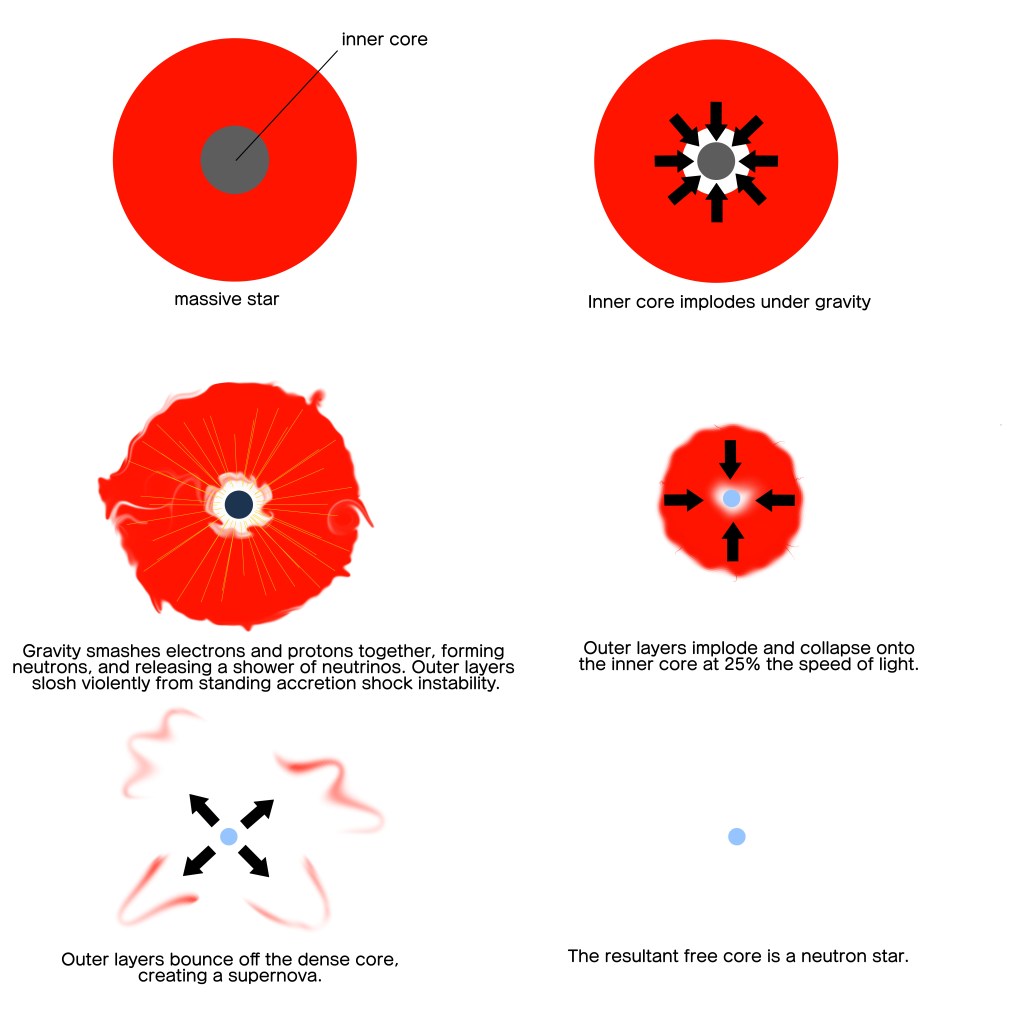
A neutron star is the core of a collapsed supergiant star. It is the remnant of a supernova explosion of a massive star. The original star typically has a mass of 10 to 25 solar masses and the core remnant a mass between 1.4 to 2 times the mass of the sun but confined into a sphere with a diameter of on average 12 miles. That is quite small for so much mass and will result in a material so compressed that it is hundreds of trillions of times denser than our sun. A tablespoonful of a neutron star would have the same mass as Mount Everest.
The neutron star is so compressed that it has the density of an atomic nucleus. The extreme pressure causes the electrons and protons in normal matter to combine into neutrons. If the core remnant would be a bit more than 2.2 times the mass of the sun it would turn into a black hole. In that sense a neutron star is the last stop before a collapsing giant star becomes a black hole.
Let’s do the calculation. Let’s say the density of a neutron star is 200 trillion times that of the Sun, and the gravity is 5 billion times stronger (100 billion to 200 billion times stronger than Earth’s gravity). That results in the matter on a neutron star weighing a septillion time (1,000,000,000,000,000,000,000,000 times) more than the same volume of matter of the average density of the sun on the sun’s surface. I should say I asked ChatGPT to make this calculation using its own numbers, and it got roughly the same answer.
I can add that the average density of the sun is 1.4 grams per cubic centimeter which is less than that the average density of the earth, which is 5.5 grams per cubic centimeter. On the other hand, the gravity on the Sun’s surface is about 28 times stronger than on Earth, so if you make these comparisons with Earth instead of the sun the numbers get seven times worse, or seven septillion (7,000,000,000,000,000,000,000,000). I can add that even though neutron stars are extreme they are not rare. NASA estimates that there are a billion of them in our Milky Way Galaxy.
I consider this a super fact because it is true, and it is somewhat important to be aware of the extremes of the Universe. It tells us about who we are and our place in the Universe. A septillion times more weight, for the same volume and densities hundreds of trillions of times larger than the Sun or the Earth are surprising and shocking numbers.
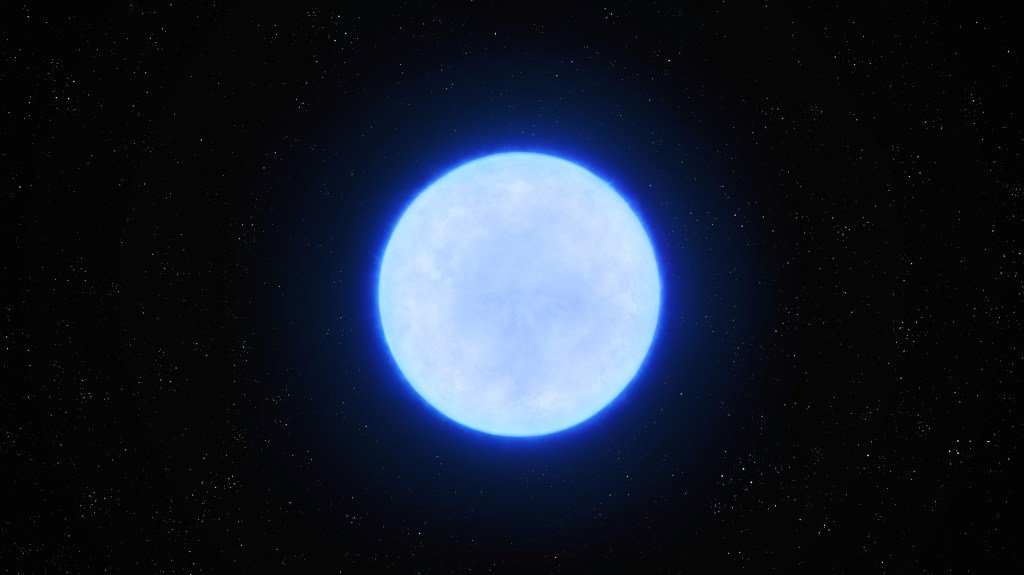
To watch a two minute video about Neutron stars, see below.
Different Types of Neutron Stars
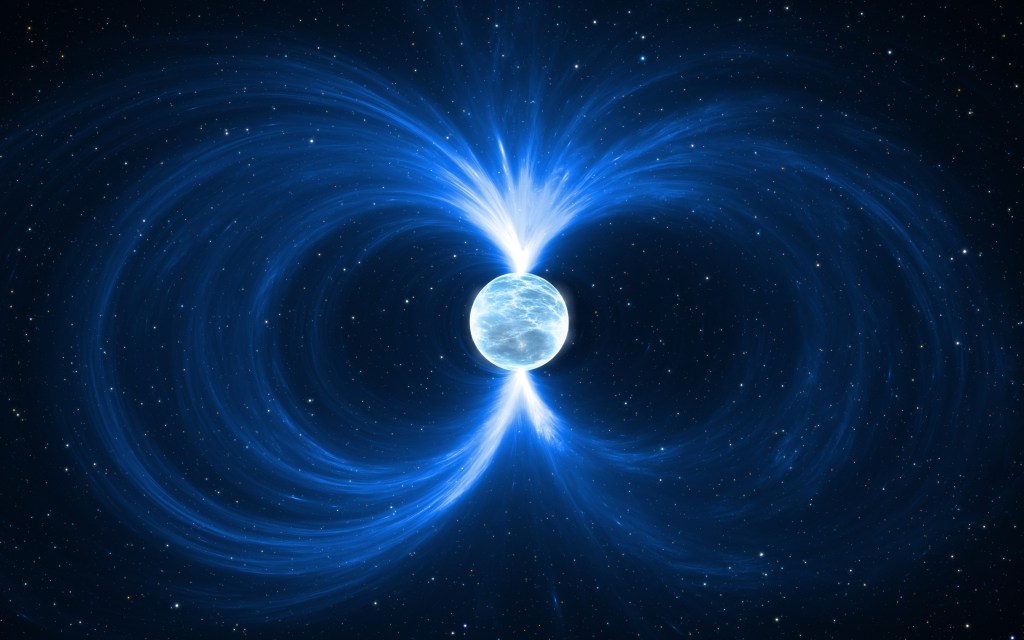
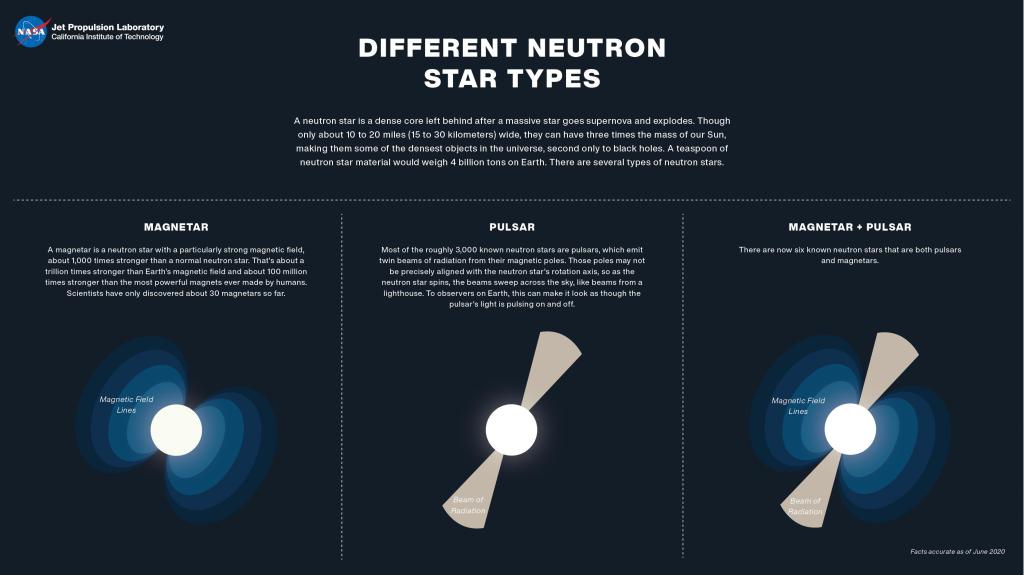
Neutron stars are extreme stars. They are small super dense stars with extreme gravitational fields. They are in a sense like a gigantic atomic nucleus. Perhaps it is not surprising that they are extreme in other ways as well. There are pulsars, neutron stars which emit twin beams of radiation from their magnetic poles. Those poles may not be precisely aligned with the neutron star’s rotation axis, so as the neutron star spins, the beams sweep across the sky, like beams from a lighthouse. To observers on Earth, this can make it look as though the pulsar’s light is pulsing on and off.
There are magnetars, neutron stars with extremely powerful magnetic fields trillions and quadrillion times stronger than Earth’s magnetic field at the surface. If one were to get close to Earth, at the distance about the same as the moon, you would see a small new star in the sky, as cars and other metallic objects lift from the ground and the magnetic strips of credit cards and computer hard drives are erased.
There are additional classes of neutron stars such as black widow pulsars, blasting a nearby star with radiation thus killing the star, soft gamma repeaters, magnetars emitting short burst of X-rays and gamma rays in irregular repeating patterns. There are binary neutron stars (two neutron stars orbiting each other) and they sometimes merge, collide, emitting detectable gravity waves. Click on the link to see a video visualization.
Other extreme stellar objects
- We are Star Dust
- The Bizarre Reality of Black Holes
- The Strange Worlds of Exoplanets
- The Enormous Kuiper belt
- Quasar TON 618
- Magnetars
To see the other Super Facts click here

 Super Facts
A very interesting and informative post, Thomas. Thanks for sharing.
LikeLiked by 2 people
Thank you so much Lynette
LikeLiked by 1 person
Hi Thomas, the information about the size, Mass and density of neutron stars is amazing. I’ve never even heard of them.
LikeLiked by 1 person
Yes there are many extreme objects in the Universe that people have not heard of. We live in a strange Universe. Thank you Robbie.
LikeLike
Yes, itt is marvelous, just like our planet.
LikeLiked by 1 person
Yes you are right Robbie.
LikeLike
💜
LikeLiked by 1 person
I didn’t know any of this. Thank again for your insightful explanation.
LikeLiked by 1 person
Thank you so much Esther.
LikeLiked by 1 person
Java Bean: “Ayyy, but is a neutron star denser than fruitcake? That’s the real question!”
LikeLiked by 2 people
Ha ha Java Bean, that is a good question.
LikeLiked by 1 person
I’m pretty sure nothing in the known universe is denser than fruitcake 😁
LikeLiked by 1 person
Yes fruitcakes are pretty dense, probably on the border of imploding into black holes.
LikeLike
Wow!!!!!!!🤩
LikeLiked by 1 person
Yes it is extreme beyond comprhension. Thank you Kerri.
LikeLiked by 1 person
This is both fascinating, and a bit scary – next time I see a car being lifted off the ground I’ll look for a magnatar 😊 Maggie
LikeLiked by 1 person
Ha ha, they are certainly very extreme objects, beyond comprehension.
LikeLiked by 1 person
This stuff is amazing. One of the reasons why smart people study this stuff and why people like myself read about what the smart people study.
Thanks, Thomas for all the reminders.
LikeLiked by 2 people
Thank you so much Denise. I feel the same way. It is fascinating stuff.
LikeLiked by 2 people
I really resonate with this.
Reading about these extremes highlights how science is both an intellectual achievement and a humbling one. It shows how much there is to know — and how valuable it is that some people dedicate their lives to exploring these questions for the rest of us.
LikeLiked by 2 people
“how valuable it is that some people dedicate their lives to exploring these questions for the rest of us” – yes I feel the same way Livora
LikeLiked by 2 people
There are aspects of the universe that are beyond comprehension. Neutron stars fit perfectly into that category. Thank you for explaining the science.
LikeLiked by 2 people
Thank you so much for your kind words Paul. You are right Neutron stars are so extreme it is beyond comprehension.
LikeLiked by 1 person
I appreciate how you put this — “beyond comprehension” feels exactly right.
Neutron stars seem to sit at the edge of what the human mind can meaningfully picture, reminding us that understanding does not always mean visualizing, but trusting well-tested science.
LikeLiked by 1 person
Again brilliant observations Livora
LikeLiked by 1 person
Incredible! Thank you, Thomas.
LikeLiked by 1 person
Thank you so much Gwen
LikeLike
Nice overview of these fascinating objects, Thomas. It’s always wild to think that matter can be compacted as tightly as happens in a neutron star.
LikeLiked by 2 people
Thank you David. It is certainly mind blowing to me.
LikeLiked by 2 people
Well said.
The idea that matter can be compressed to near-nuclear density without becoming a black hole is one of those facts that quietly reshapes how we think about mass, gravity, and the structure of reality itself.
LikeLiked by 2 people
You are so right Livora and I can add that David is an Astronomer
LikeLiked by 2 people
Wow! I didn’t know any of this,Thomas the universe is fascinating and so diverse…Thank you for sharing 😎🙏
LikeLiked by 1 person
Yes it is full of extreme objects and strange things. Thank you so much Carol.
LikeLiked by 1 person
Thank you for laying this out so clearly, Thomas.
What strikes me most is not just the staggering numbers, but how neutron stars expose the limits of human intuition. They force us to accept that reality operates far beyond everyday experience — and that humility is a rational response to the universe.
This truly earns the name “super fact.”
LikeLiked by 1 person
Thank you so much Livora for your very kind and very insightful words. That “humility is a rational response to the universe” is a brilliany observation.
LikeLiked by 1 person
Fascinating post, Thomas. Density that dense is hard to comprehend!
LikeLiked by 1 person
Yes I agree. Density that extreme is mindblowing
LikeLike