
Super fact 86 : Early humans, early homo sapiens, lived at the same time as many other human species including Neanderthals, Denisovans, Homo floresiensis, Homo naledi, Homo luzonensis. Homo heidelbergensis, Homo erectus, and maybe other species as well.
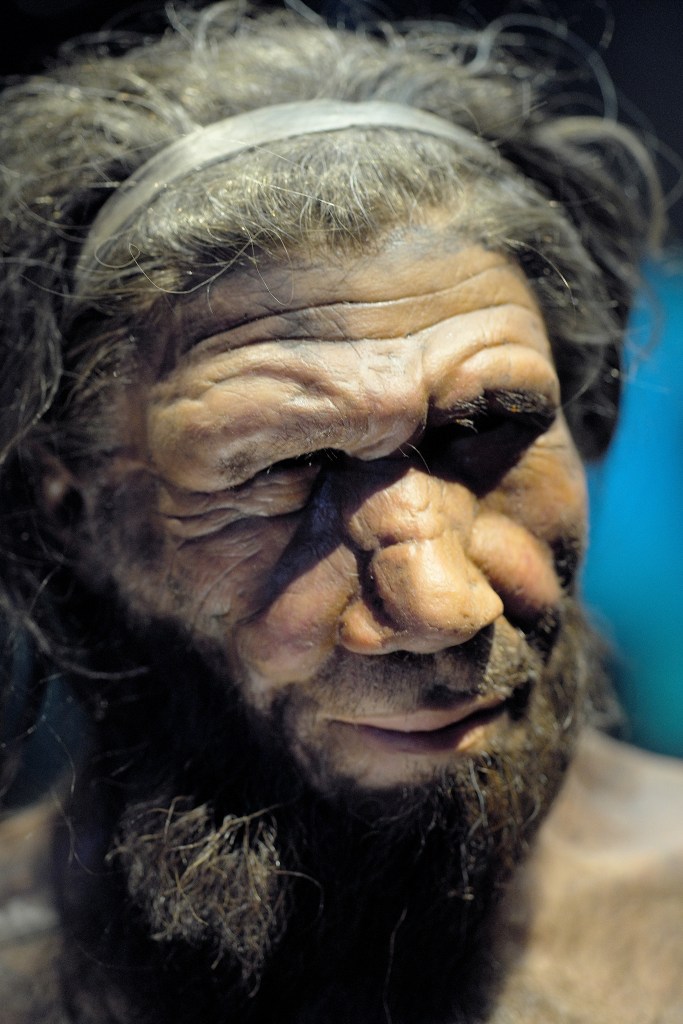
Homo sapiens co-existed with several other Homo species. Homo erectus and Homo heidelbergensis are direct ancestors to Homo sapiens that survived long enough to exist at the same time as Homo sapiens.
Homo sapiens emerged around 300,000 years ago in Africa and Homo erectus died out around 100,000 years ago and Homo heidelbergensis died out around 200,000 years ago. Homo floresiensis died out 50,000 years ago, the most recent Homo luzonensis is 50,000 years old but they may have survived longer, Homo naledi existed approximately 335,000 to 236,000 years ago, Neanderthals interbred with homo sapiens and died out around 40,000 years ago, the Denisovans also interbred with homo sapiens and died out around 30,000 to 50,000 years ago. You can read more here and here.
You may wonder how different species can interbreed with each other. More on that later in this post.
I consider this a super fact because it is true, surprising to those who did not know this, and ancient human history is kind of important. Even if you knew that homo sapiens lived along other homo species the fact that the world used to be so crowded with different homo species may come as a surprise. Where did they all go?
Direct Ancestors of Homo Sapiens
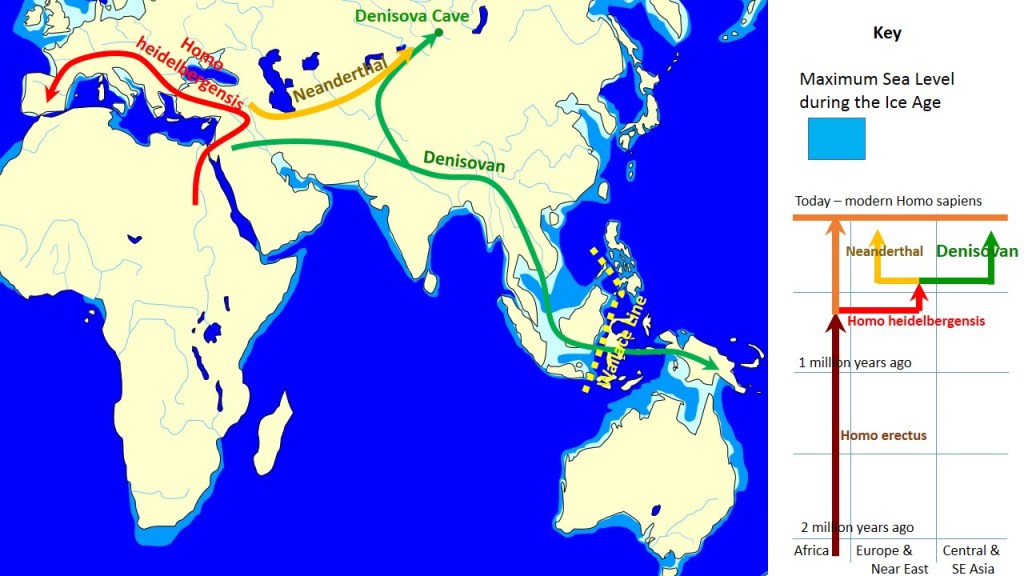
Homo heidelbergensis is widely considered a pivotal common ancestor to Homo sapiens, Neanderthals, and Denisovans. Since Homo Erectus is a direct ancestor to Homo heidelbergensis it is also a direct ancestor to Homo sapiens, Neanderthals, and Denisovans. Homo Erectus is also a direct ancestor to Homo floresiensis but Homo heidelbergensis is not considered an ancestor to Homo floresiensis. The picture below shows the direct ancestors to Homo Sapiens.

Geographic spread of Homo Sapiens and other Homo Species
Homo heidelbergensis is an ancestor to Neanderthals, Denisovans and Homo sapiens (and Homo erectus is an ancestor to Homo heidelbergensis). However, whilst Neanderthals emerged in Europe and Asia, Denisovans evolved in Asia, and Homo sapiens emerged in Africa.
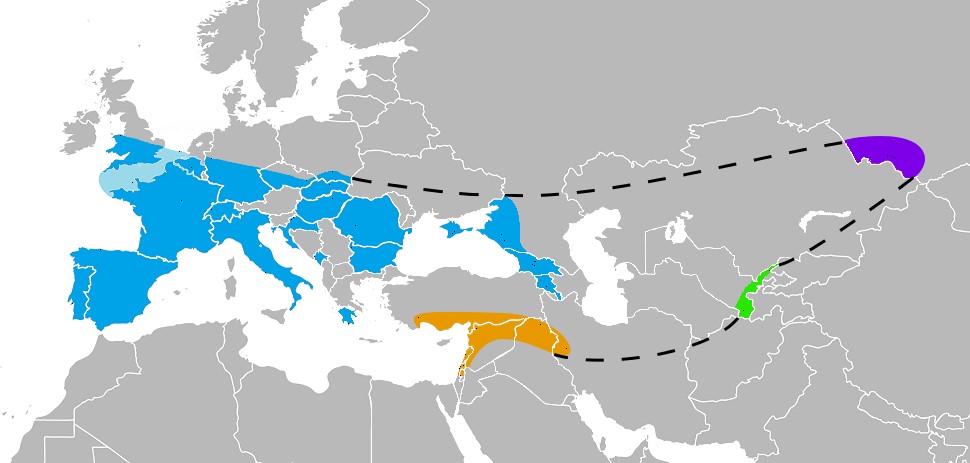
The map below indicates where skeleton remains of Neanderthals had been found as of 2017.
Interbreeding and Defining a Species
Homo Neanderthalensis and Homo Sapiens (or Homo Sapiens Sapiens) interbred, and so did Homo Denisova and Homo Sapiens, and Homo Neanderthalensis interbred with Homo Denisova. What a mess! Homo Neanderthalensis and Homo Sapiens were different species, so it may seem strange that they could interbreed. However, species is a complex concept.
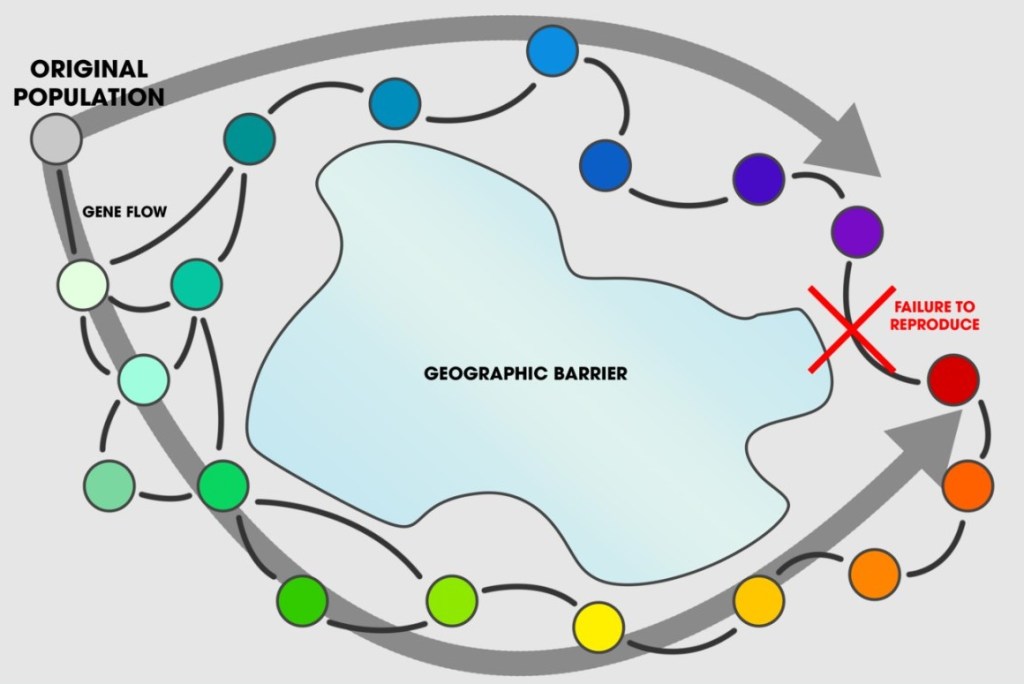
Speciation is considered relative. It is often said that two animals belong to the same species if they can interbreed in nature and produce viable, fertile offspring. However, it is not that simple. An animal A may be able to successfully interbreed with an animal B, and that animal B may be able to successfully interbreed with an animal C, but animal A and C cannot interbreed. Animal A could be said to be a different species relative to animal C but animal B could be said to be the same species as both animal A & C. A great geography related example of this is ring species. In a ring species, gene flow occurs between neighboring populations of a species, but at the ends of the ring the populations don’t interbreed.
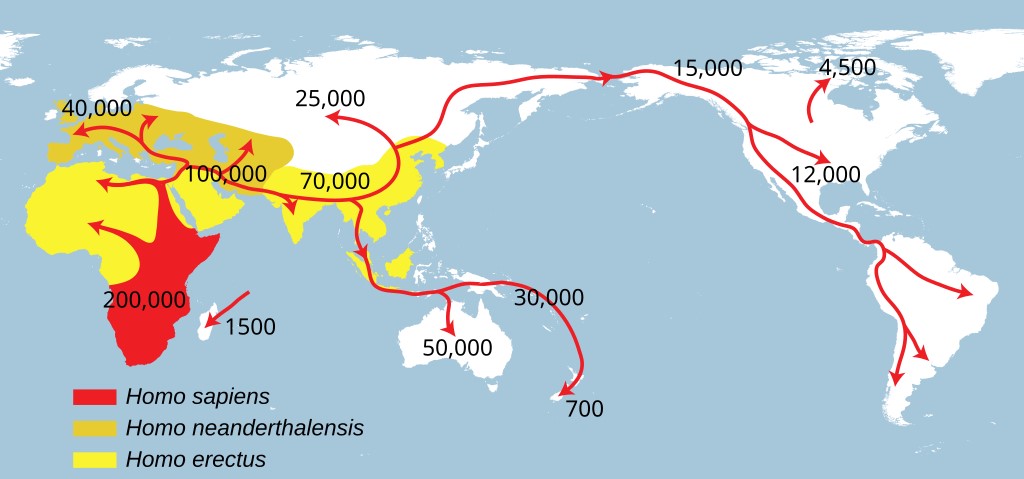
For the case of Neanderthals and Homo sapiens (and Denisovans); at certain points in history, you could consider Homo Neanderthalensis and Homo Sapiens to be different subspecies rather than different species. That is why you sometimes hear the terms Homo Sapiens Neanderthalensis and Homo Sapiens Sapiens. I can add that Homo sapiens certainly got around, as you can see on the map below.
Is Thomas Wikman a Neanderthal ?
I can add that genetic testing can reveal how much Neanderthal DNA you have. I took a test with 23AndMe to find out about my ancestry (it was 98% Scandinavian and Finnish) and to find out about my risk for genetic illnesses. 23AndMe also told me that I was in the 99 percentiles with respect to carrying Neanderthal genes, meaning that I had unusually many Neanderthal genes. I joined the 23AndMe Neanderthal club (you had to be in the 98 percentile).
However, I quit after people in the club started saying that we should demand reparations from those with less Neanderthal genes because they exterminated us. It might have been a bizarre joke, but I decided not to stay around to find out. Later, after 23AndMe went bankrupt, I deleted mine and my wife’s data and quit. I was afraid 23AndMe might sell the DNA data to health insurance companies.

This is some other evolution and natural history related posts
- We Know That the Earth is Billions of Years Old
- Neanderthals Never Lived in Africa
- Evolution is a Fact
- Humans and Chimpanzees Have a Common Ancestor
- All Life Have a Common Ancestor
- Birds are Avian Dinosaurs
- The Evolution of Whales is No Longer a Mystery
To see the other Super Facts click here

 Super Facts
It’s amazing that skeletal remains are still being found from all those thousands of years ago. I wonder who will find me, some 50,000 years from now.
LikeLiked by 2 people
Unfortunately, fossilization is a one in a billion times event, and then someone has to find it. We have found 6,000 fossils from human species, but hundreds of billions have lived. However, a rapid burial in a tarpit instead of a cemetery may do it. But you brought up an interesting possibility. How can we guarantee that a species millions of years into the future could find out about our existence.
LikeLiked by 2 people
I guess we could have tar pitoriums instead of crematoriums….
LikeLiked by 2 people
Ha ha that is an interesting inventions
LikeLiked by 2 people
Might be a bit costly though. Only the rich will ever be found by future “scientists.”
LikeLiked by 2 people
Yes trying to make yourself findable after death might be a futile poject.
LikeLiked by 2 people
Yes, think I’ll give up on that one.
LikeLiked by 2 people
Yes me too
LikeLiked by 2 people
Oh dear. I guess I’d better leave my mark before I go then.
LikeLiked by 2 people
For an eternal memory a gold plate will last millions and billions of years. But again someone has to find it and tectonic plates will move around burying things maybe miles into the ground during that time. Maybe something in space.
LikeLiked by 2 people
I suppose it would be a bit crowded if everyone’s bones were “findable” forever.
LikeLiked by 2 people
It is a very low risk for that even if you gold plated or found other ways to forever preserve the bones. It would still be difficult to find, because the ground shifts, buries things deeper, and and then there’s plate tectonics that can move things miles away over many millions of years. Some have suggested that a civlization like ours may be difficult to find after 50 million years despite all we’ve built and billions of people and cattle.
LikeLiked by 2 people
Everything is always changing.
LikeLiked by 2 people
Yes that is right. Change is one thing you can expect.
LikeLiked by 2 people
This is an endlessly interesting subject, Thomas. I’ve never had my DNA tested and probably will not, given the issues around such data and where it might end up, but I wonder what such a test might have shown.
I recently read a book called Ancient Bones by Madelaine Böhme, which suggests that a good part of human evolution took place in Eurasia, rather than Africa. I can’t comment as to how accurate this idea might be, but it was interesting to follow the arguments.
LikeLiked by 2 people
Thank you so much Audrey. We felt our DNA was safe with 23AndMe until they went bankrupt. Now they have an incentive to sell it to insurance companies to save themselves. Insurance companies should not use DNA to determine whether to reject or accept clients. What would be the point of insurance if they started doing that. I did know about Madelaine Böhme’s book it sounds very interesting.
LikeLiked by 2 people
What strikes me most in your post is not just that Homo sapiens coexisted with so many other human species, but how contingent survival appears in retrospect. When you lay out the timelines, it becomes less a story of inevitability and more a story of fragile overlap.
The comments touched on memory, fossils, and even future discoverability—but I keep wondering about something slightly different: what determines which branch becomes “history” and which becomes sediment? Was it climate, cooperation, migration patterns—or something more subtle, like adaptability under pressure? Your post quietly reminds us that our presence today is not proof of superiority, but perhaps of circumstance. That, to me, is the real super fact.
LikeLiked by 1 person
Thank you so much Livora for your kind words and for the interesting questions. I do not have an answer to those questions but if you look down a few comments below you’ll see Jacqui Murray. She writes books on per historic human species, for example, Neanderthals, early homo sapiens, homo habilis and homo erectus. They are adventure novels but she does thorough research and you get some ideas about how they could survive from those books. Examples of a couple of her series are Dawn of Humanity and Savage Land.
LikeLiked by 1 person
Thank you very much for your interesting post, Thomas. It’s amazing the distance we humanoids have come. Your story about the people wanting “extermination reparations” had me chuckling until like you, I started wondering if some of them might be serious!
LikeLiked by 2 people
Thank you so much Lynette. The fact that some of them sounded serious is what prompted me to leave the group, but as a joke it is just funny.
LikeLiked by 2 people
What an interesting post! I actually didn’t know that homo sapiens lived along other homo species, so this was fascinating!
LikeLiked by 2 people
Thank you so much Ada. I’ve known it for a while, maybe a decade, but when I first came across the information I thought it was pretty surprising.
LikeLiked by 2 people
Incredibly interesting! Just excellent, Thomas.
LikeLiked by 2 people
Thank you so much for your kind words Chris
LikeLiked by 2 people
Java Bean: “Ayyy, our Dada thinks on the one hand it would be super interesting if there were still multiple species of humans around, but on the other hand, he also thinks that the fact that homo sapiens can’t even get along with other homo sapiens probably wouldn’t bode well for how that would go …”
LikeLiked by 2 people
Thank you so much Java Bean. I think you are right. We can’t even get along with other homo sapiens so that would too much of a challenge for us, and now with nuclear weapons and other powerful weapons, who knows what we would do to each other. Dogs are doing much better.
LikeLiked by 1 person
You’re speaking my language, Thomas! I too wondered why Neanderthals and H.sapiens could breed, spent way too much time digging into that question. It does occasionally happen in nature and could explain why scientists think breeding between Neanderthals and H.sapiens worked for the female but not the male and is one of many theories why Neanderthals went extinct.
But we know they didn’t. They live on in people like you!
LikeLiked by 1 person
Thank you so much Jacqui that is very interesting information. In the past I thought species was something well defined but then I found out that it was more complicated and fuzzy. I was wondering how Neanderthals and humans, supposedly different species could interbreed, but now I know that species and subspecies is not as clearcut.
LikeLiked by 2 people
I think that’s why–the mating thing–scientists have want so badly to make Neanderthals a subspecies of sapiens, but it just doesn’t work. They now don’t even consider them forbears to H.sapiens (except all those mixed children).
LikeLiked by 2 people
Yes that is interesting. It is more complicated than one might expect.
LikeLiked by 2 people
Thanks for another fascinating post. I really appreciated the information about how closely related species might be able to interbreed and produce viable offspring under certain circumstances. I suspect DNA research will continue to refine how we understand species and subspecies as we continue to get more data.
LikeLiked by 2 people
Thank you so much David. Yes species defined as cannot interbreed with viable offspring is a definition with some holes in it. It often works but not always. DNA analysis is a fairly new tool that is giving us a lot of information. It is going to be interesting to see what else they will find out.
LikeLiked by 2 people
I took some anthropology classes a few years ago, but boy have things changed since then. So interesting!
LikeLiked by 2 people
Yes science is marching forward and things change. Also if you see something I did not get right, don’t be afraid to tell me.
LikeLiked by 2 people
Oh gosh, I don’t even think I’d notice. It all looked right to me.
LikeLiked by 2 people
Thank you so much Diana.
LikeLiked by 2 people
Amazing 😍😄
LikeLiked by 2 people
Thank you Baby Dreamland
LikeLiked by 1 person
I didn’t know these species co-existed at the same time, nor was I aware there were so many! Homo erectus, homo sapiens and neanderthals are familar, but not the others. Homo heidelbergensis was especially interesting to me, so I appreciate that you included links.
LikeLiked by 2 people
Thank you so much Debbie. I knew about this about ten years ago because of a book I read but I had to refresh my knowledge about it. It is quite interesting and our family tree keep getting larger.
LikeLiked by 2 people