Transitional Fossils are not rare

Superfact 115: Transitional Fossils are not rare. Fossilization itself is a rare event and despite that paleontologists have discovered numerous transitional fossils that illustrate the gradual evolution of, for example, humans, whales, horses, rhinos, other mammals, birds, fish to amphibians (fishapods), etc.

Skulls of different types of hominids, displayed in a museum. | Transitional Fossils are not rare
Shutterstock asset id: 2500328883 by Rebel Red Runner

As mentioned, fossilization is an extremely rare event and therefore the fossil record is expected to be incomplete and to contain “gaps”. Additionally, many transitional species had smaller populations or lived in environments where preservation was difficult. Another thing to keep in mind is that evolution is not a linear chain. There are no perfect halfway points. Species evolve and diversify in a branching tree. A transitional fossil is any fossilized remain of a life form that exhibits traits common to both an ancestral group and its later descendant group, meaning every organism is technically transitional.

Blue color on the left slowly fading into the red color on the right.
Microevolution is small changes resulting in large changes over time. Macroevolution are multiple microevolutionary steps turning into “macroevolution”.

What people tend to focus on is transitional fossils between ancestral groups and descendant groups that are far part, and feature interesting differences, and are far back in time, such as the land living ancestors of whales and modern whales, which before such transitional fossils were found represented a large “gap”. What may come as a surprise to many people is that many so called “gaps” have been filled out by new fossil discoveries. You can of course always add new “gaps” as old ones are filled in. You can always imagine as many gaps as you’d like.

However, gaps, or “missing links”, or the quantity of transitional fossils, etc., does not represent a problem for the theory of evolution as often claimed. In other words, Transitional Fossils are not rare.

The photo shows a Australopithecus afarensis skeleton on a wooden background.
Australopithecus afarensis – walking posture. Chiswick Chap, CC BY-SA 3.0 https://creativecommons.org/licenses/by-sa/3.0, via Wikimedia Commons

The picture above shows the famous Lucy skeleton. She belonged to a species called Australopithecus afarensis, which is a famous transitional species in human evolution, bridging the gap between more primitive, quadrupedal ancestors and the later Homo genus.

Below is a simplified cladogram showing hominin ancestry including Australopithecus afarensis. Notice that we did not descend from chimpanzees, but we have a common ancestor with chimpanzees. This was discovered from DNA analysis.

At the bottom of the cladogram is a box that says “hominin ancestor. A tree branches off from this box. On the left is a chimpanzee and the right a tree for seven hominin species including modern humans.” | Transitional Fossils are not rare
Simple cladogram showing evolution of modern man from Hominid Ancestor Shutterstock Asset id: 2093535535 by CLOUD-WALKER.

The creationist talking point about “missing links”, or the supposed lack of transitional fossils is misguided (see point 13) but very common in popular culture. Not too long ago I read a book “Darwin on trial” by Phillip E. Johnson, which is often considered to be a scientific and powerful creationist rebuttal of the theory of evolution. This book featured many erroneous assertions including this talking point and, in addition, it misrepresented the fossil record with respect to transitional fossils.

Pretty much all of the around 300 Amazon reviewers for this book bought his arguments and gave the book five stars. Only a few well informed individuals saw the problems. I have also come across this argument many times in my personal life and on social media, and I know a lot of people around the world accept it. Millions, if not hundreds of millions of people believe something that is false on this important topic. That is why I consider “Transitional Fossils are not rare” a super fact.

Some Famous Transitional Fossils

Technically all fossils can be considered transitional fossils and there are hundreds that have been recognized to have clear and interesting transitional features. Below I am mentioning just a few of those. I’ve already mentioned, “Lucy”, the hominid Australopithecus afarensis which represents an evolutionary transition between modern bipedal humans and their quadrupedal ape ancestors. We have found a few hundred Homo erectus fossils, and naturally Homo Erectus is considered another transitional fossil(s) that is crucial to human evolution. It bridges the gap between more primitive, ape-like hominins (like Australopithecus) and modern humans (Homo sapiens).

An almost intact Homo Erectus skull.
H. e. georgicus (above) is an early subspecies of Homo Erectus. It represents one of the earliest dispersals out of Africa about 1.8 million years ago. Gerbil, CC BY-SA 4.0 https://creativecommons.org/licenses/by-sa/4.0, via Wikimedia Commons.

As a side note, according to this article, Homo Erectus genetic material was recently sequenced for the first time, and it shows ‘deep genetic links’ with modern humans. Since DNA material degrade by time and Homo Erectus lived hundreds of thousands of years ago, that is quite remarkable.

Another famous transitional fossil is Tiktaalik roseae. Tiktaalik roseae is a link in evolution from swimming fish to four-legged vertebrates. Tiktaalik lived 375 million years ago, and its skeletal structure shows that it could prop itself up in shallow water and use its limbs for support as most four-legged animals do, and its head resembled that of a crocodile. It also had other characteristics that were like both fish and four legged animals.

The illustration shows a fish like animal with a body resembling something in between a fish and a reptile.
Life restoration of Tiktaalik roseae. Nobu Tamura (http://spinops.blogspot.com), CC BY-SA 3.0 http://creativecommons.org/licenses/by-sa/3.0/, via Wikimedia Commons.
This illustration shows the crocodile like head more clearly and the Tiktaalik roseae is halfway up from the water. | Transitional Fossils are not rare
Another illustration of Tiktaalik roseae. Zina Deretsky, National  Science Foundation, Public domain, via Wikimedia Commons.

Archaeopteryx is a birdlike dinosaur that retained reptilian features such as teeth and a bony tail while having advanced flight feathers. 14 Archaeopteryx fossils have been found. Partially because of transitional fossils found Birds are now reclassified as Avian Dinosaurs.

Original Archaeopteryx skeleton embedded in rock.
Archaeopteryx lithographica, specimen displayed at the Museum für Naturkunde in Berlin. (This image shows the original fossil – not a cast.) H. Raab (User: Vesta), CC BY-SA 3.0 <https://creativecommons.org/licenses/by-sa/3.0&gt;, via Wikimedia Commons.
Closeup of fossilized scary petrified Archaeopteryx transitional fossil between dinosaur and modern birds remains in stone with details of the skeleton with skull and bones. | Transitional Fossils are not rare
Another Archaeopteryx fossil. Shutterstock Asset id: 1913076019 by Natalia van D.

Caudipteryx was a small oviraptorosaurian dinosaur that lived 125 million years ago. It had teeth but was otherwise very birdlike. It was likely a swift runner. You can read about another dozen interesting dinosaur to bird transitional species in my post “Birds are Avian Dinosaurs”.

A bird like skeleton
Caudipteryx zoui, Skelett – Untere Kreide – Liaoning/China – aufgenommen im Museum am Löwentor, Stuttgart. Ra’ike (see also: de:Benutzer:Ra’ike), CC BY-SA 3.0 <https://creativecommons.org/licenses/by-sa/3.0&gt;, via Wikimedia Commons.

Thrinaxodon is a 230-million-year-old cynodont, in other words, a mammal-like reptile. Its posture was something between a reptile and a mammal, it had mammal like teeth, it was likely warm blooded, and mammal like ear drums. However, it laid eggs, its spine and jaw were like that of a reptile, and it had a light sensor on its forehead typical for reptiles.

A hairless animal that looks like a cuddly mammal.
Nobu Tamura (http://spinops.blogspot.com), CC BY-SA 3.0 http://creativecommons.org/licenses/by-sa/3.0/, via Wikimedia Commons.

Eohippus was Also known as Hyracotherium, this 50-million-year-old ancestor of the horse was dog-sized and had four toes on its front feet and three on its back.

Three small horse like animals. | Transitional Fossils are not rare
Eohippus illustration. Charles Robert Knight, Public domain, via Wikimedia Commons.

Cooksonia lived 425 million years ago and is considered the oldest known vascular plant (have specialized tissue to transport water).  It is therefore a crucial evolutionary transition between primitive, non-vascular bryophytes (like mosses and liverworts) and the first true vascular plants (like ferns and advanced tracheophytes).

Mushroom looking plant that is partially green.
A cartoon of Cooksonia, reconstructed with non-photosynthetic axes, dependent on its gametophyte. Smith609Ground texture from  Image:Mud closeup.jpg, CC BY 3.0 <https://creativecommons.org/licenses/by/3.0&gt;, via Wikimedia Commons.

The case of the whales did present a bit of a mystery for a while. Scientists recognized that whales descended from land animals already in the 19th century. However, it was not until the 1980’s that intermediate fossils for whale evolution were found.

In addition, molecular and genetic / DNA studies showed that Hippopotamus and whales were closely related. Until then the evolution of whales was a bit of a mystery and creationists frequently mocked the lack of intermediate fossils for whale evolution. However, as you can see in my super fact post “The Evolution of Whales is No Longer a Mystery” we’ve found dozens of intermediate (transitional) fossils between land mammals such as Pakicetus and modern whales. Below is an Ambulocetus skeleton. To see the other transitional species (with illustrations) check my link.

A skeleton of an Ambulocetus hanging on a wall.
Fossil of Ambulocetus, an extinct whale- Took the photo at Naturalis museum, Leiden. Ghedoghedo, CC BY-SA 3.0 https://creativecommons.org/licenses/by-sa/3.0, via Wikimedia Commons.

I said that there were hundreds of transitional fossils that have been recognized to have clear and interesting transitional features. Well, that might be many thousands. In any case, transitional fossils are not lacking and are not rare. The mystery of the missing links is a myth.

Other Super Facts Related to Evolution

To see the Other Super Facts click here

Early Homo Sapiens lived at the same time as many other human species

Super fact 86 : Early humans, early homo sapiens, lived at the same time as many other human species including Neanderthals, Denisovans, Homo floresiensis, Homo naledi, Homo luzonensis. Homo heidelbergensis, Homo erectus, and maybe other species as well.

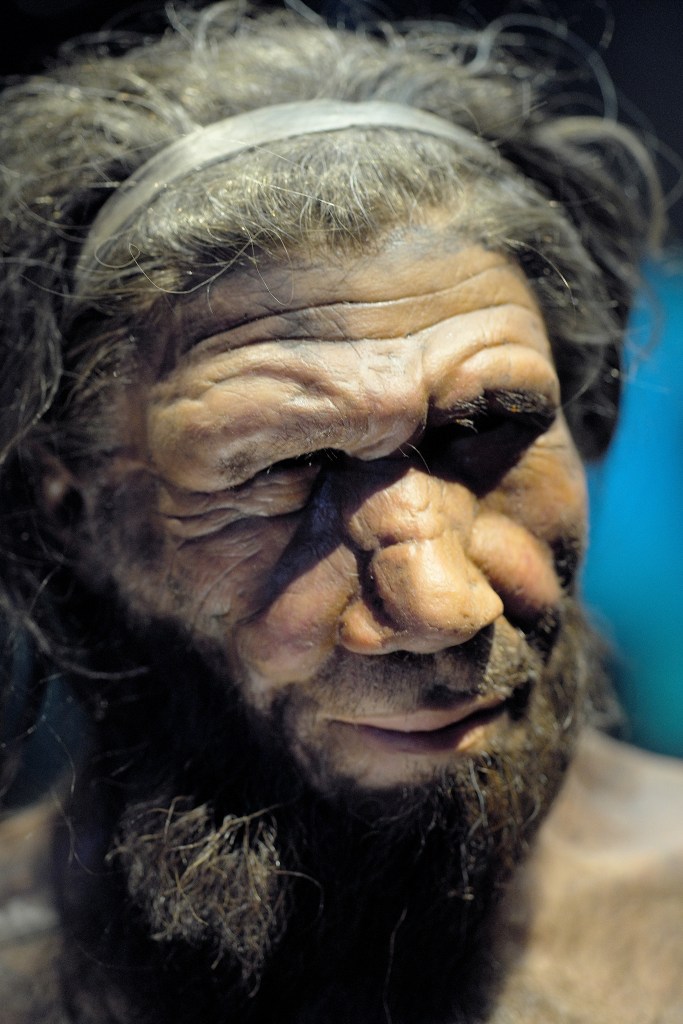
Photo of a reconstruction of a Neanderthal man. | Early Homo Sapiens lived at the same time as many other human species
Reconstruction of a Neanderthal by Natural History Museum. Werner Ustorf, CC BY-SA 2.0 https://creativecommons.org/licenses/by-sa/2.0, via Wikimedia Commons.

Homo sapiens co-existed with several other Homo species. Homo erectus and Homo heidelbergensis are direct ancestors to Homo sapiens that survived long enough to exist at the same time as Homo sapiens.

Homo sapiens emerged around 300,000 years ago in Africa and Homo erectus died out around 100,000 years ago and Homo heidelbergensis died out around 200,000 years ago. Homo floresiensis died out 50,000 years ago, the most recent Homo luzonensis is 50,000 years old but they may have survived longer, Homo naledi existed approximately 335,000 to 236,000 years ago, Neanderthals interbred with homo sapiens and died out around 40,000 years ago, the Denisovans also interbred with homo sapiens and died out around 30,000 to 50,000 years ago. You can read more here and here.

You may wonder how different species can interbreed with each other. More on that later in this post.

I consider this a super fact because it is true, surprising to those who did not know this, and ancient human history is kind of important. Even if you knew that homo sapiens lived along other homo species the fact that the world used to be so crowded with different homo species may come as a surprise. Where did they all go?

Direct Ancestors of Homo Sapiens

Homo heidelbergensis is widely considered a pivotal common ancestor to Homo sapiens, Neanderthals, and Denisovans. Since Homo Erectus is a direct ancestor to Homo heidelbergensis it is also a direct ancestor to Homo sapiens, Neanderthals, and Denisovans. Homo Erectus is also a direct ancestor to Homo floresiensis but Homo heidelbergensis is not considered an ancestor to Homo floresiensis. The picture below shows the direct ancestors to Homo Sapiens.

The skulls are from left to right Australopithecus africanus 3.3 - 2 million years ago, Homo habilis 2.4 to 1.5 million years ago, Homo erectus 1.6 to 600 thousand years ago, Homo heidelbergensis 700 thousand to 200 thousand years ago, early homo sapiens 300 thousand to 45 thousand years ago, anatomically modern human 130 thousand years ago until now.
Skulls of successive (or near-successive, depending on the source) human evolutionary ancestors, up until ‘modern’ Homo sapiens. Mya – million years ago, kya – thousand years ago. SimplisticReps, CC BY-SA 4.0 <https://creativecommons.org/licenses/by-sa/4.0&gt;, via Wikimedia Commons.

Geographic spread of Homo Sapiens and other Homo Species

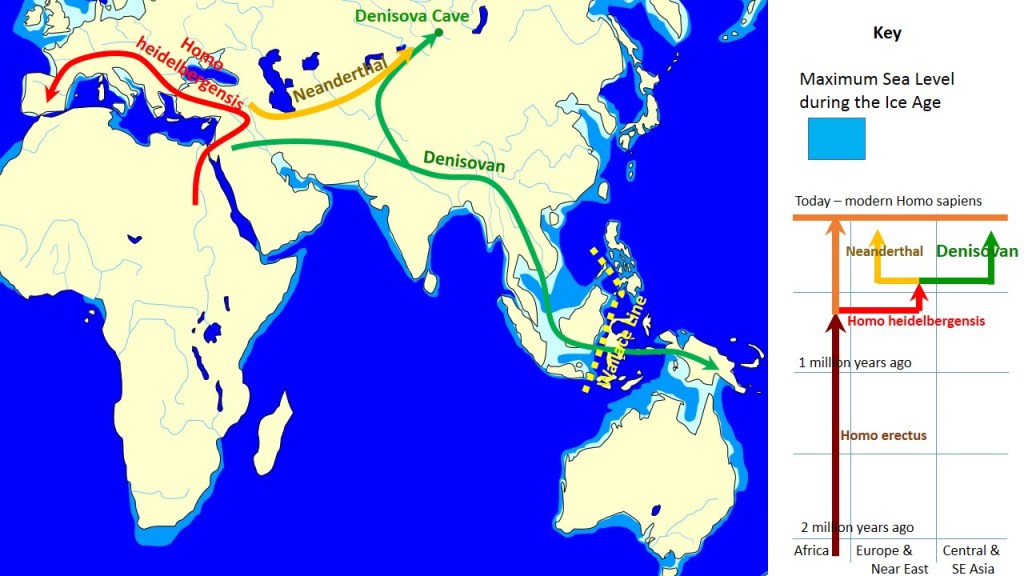
Homo heidelbergensis is an ancestor to Neanderthals, Denisovans and Homo sapiens (and Homo erectus is an ancestor to Homo heidelbergensis). However, whilst Neanderthals emerged in Europe and Asia, Denisovans evolved in Asia, and Homo sapiens emerged in Africa.

The map shows the movement of Homo heidelbergensis originating in Africa and moving into Europe and Asia with Neanderthals (in yellow) emerging in Europe and moving into Asia. The Denisovans emerged in Asia and spread further east. | Early Homo Sapiens lived at the same time as many other human species
The evolution and geographic spread of Denisovans as compared with Neanderthals, Homo heidelbergensis and Homo erectus. John D. Croft at English Wikipedia, CC BY-SA 3.0 https://creativecommons.org/licenses/by-sa/3.0, via Wikimedia Commons.

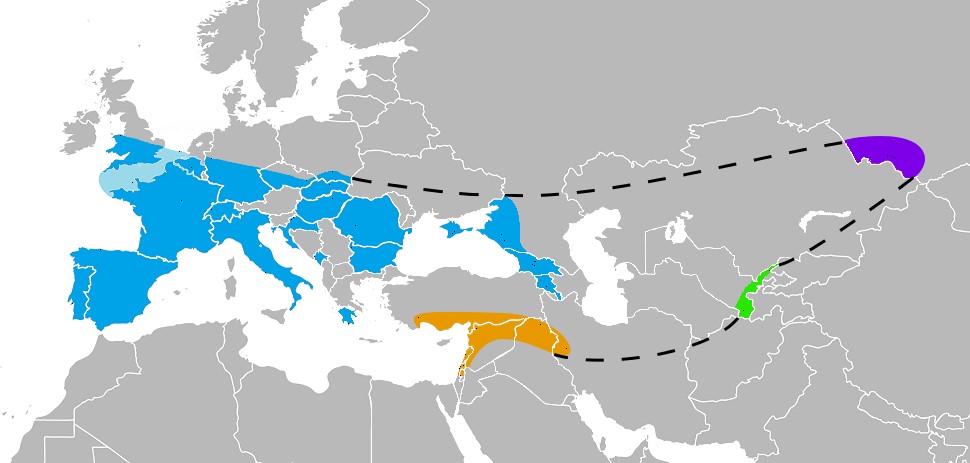
The map below indicates where skeleton remains of Neanderthals had been found as of 2017.

This map of Europe and West Asia shows the region where Neanderthals have been found.
Known Neanderthal range in Europe (blue), Southwest Asia (orange), Uzbekistan (green), and the Altai mountains (violet), as inferred by their skeletal remains (not stone tools). There were 165 such places by 2017. Nilenbert, N. Perrault, auteur du guide complet du canotageI, CC BY-SA 3.0 <http://creativecommons.org/licenses/by-sa/3.0/&gt;, via Wikimedia Commons.

Interbreeding and Defining a Species

Homo Neanderthalensis and Homo Sapiens (or Homo Sapiens Sapiens) interbred, and so did Homo Denisova and Homo Sapiens, and Homo Neanderthalensis interbred with Homo Denisova. What a mess! Homo Neanderthalensis and Homo Sapiens were different species, so it may seem strange that they could interbreed. However, species is a complex concept.

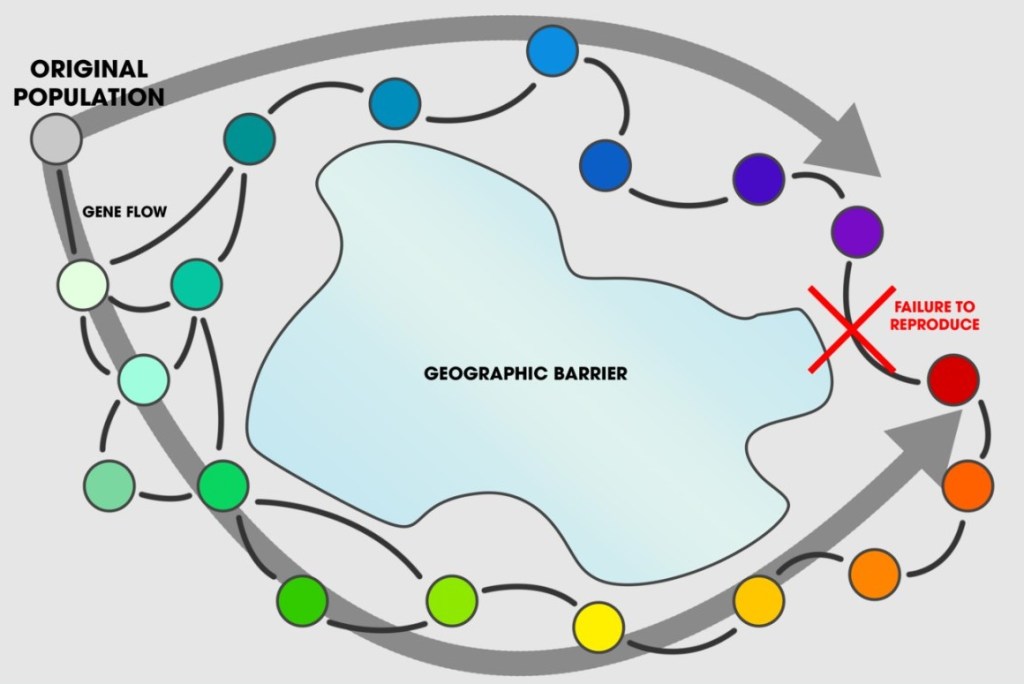
Speciation is considered relative. It is often said that two animals belong to the same species if they can interbreed in nature and produce viable, fertile offspring. However, it is not that simple. An animal A may be able to successfully interbreed with an animal B, and that animal B may be able to successfully interbreed with an animal C, but animal A and C cannot interbreed. Animal A could be said to be a different species relative to animal C but animal B could be said to be the same species as both animal A & C. A great geography related example of this is ring species. In a ring species, gene flow occurs between neighboring populations of a species, but at the ends of the ring the populations don’t interbreed.

The picture depicts different subspecies as little colored circles centered around a big lake. The color changes a little bit at the time. All the circles next to each other can interbreed.
Illustration of ring species, an example of how speciation can be relative. All the circles next to each other can interbreed but at the end it no longer works. Andrew Z. Colvin, CC BY-SA 4.0 <https://creativecommons.org/licenses/by-sa/4.0&gt;, via Wikimedia Commons.

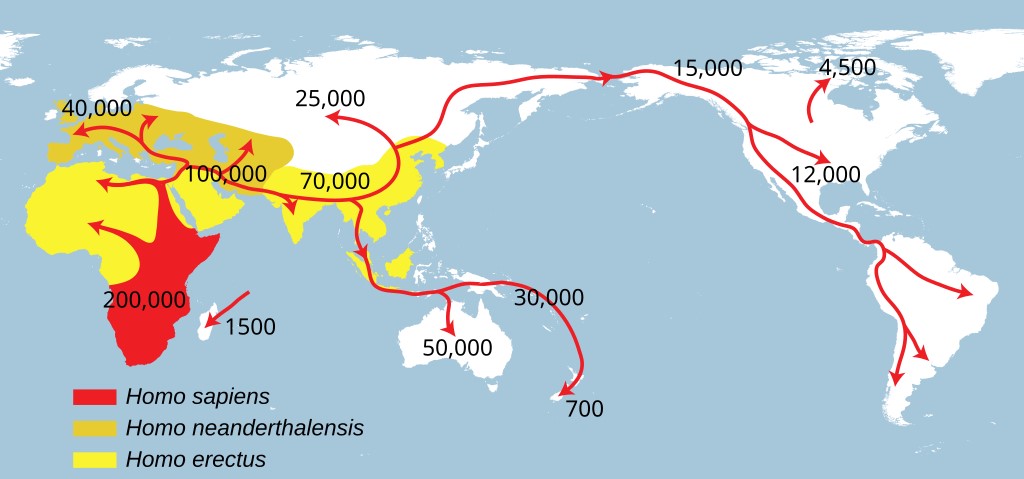
For the case of Neanderthals and Homo sapiens (and Denisovans); at certain points in history, you could consider Homo Neanderthalensis and Homo Sapiens to be different subspecies rather than different species. That is why you sometimes hear the terms Homo Sapiens Neanderthalensis and Homo Sapiens Sapiens. I can add that Homo sapiens certainly got around, as you can see on the map below.

A world map showing portions of Africa being yellow and red, and portions of Asia being yellow and dark yellow with red arrows representing migrating Homo Sapiens. The map features several time markers representing the arrival of Homo Sapiens. | Early Homo Sapiens lived at the same time as many other human species
The spread of Homo Erectus (yellow), Homo Sapiens (red) and Homo Neanderthalensis (dark yellow). NordNordWest, Public domain, via Wikimedia Commons.

Is Thomas Wikman a Neanderthal ?

I can add that genetic testing can reveal how much Neanderthal DNA you have. I took a test with 23AndMe to find out about my ancestry (it was 98% Scandinavian and Finnish) and to find out about my risk for genetic illnesses. 23AndMe also told me that I was in the 99 percentiles with respect to carrying Neanderthal genes, meaning that I had unusually many Neanderthal genes. I joined the 23AndMe Neanderthal club (you had to be in the 98 percentile).

However, I quit after people in the club started saying that we should demand reparations from those with less Neanderthal genes because they exterminated us. It might have been a bizarre joke, but I decided not to stay around to find out. Later, after 23AndMe went bankrupt, I deleted mine and my wife’s data and quit. I was afraid 23AndMe might sell the DNA data to health insurance companies.

Man geneticist. Doctor sits at table in genetic laboratory. Chains of DNA or RNA. Sequencing human genome. Doctor studies DNA. Geneticist conducts scientific experiments Geneticist looks at test tubes
Geneticist sequencing human genome Asset id: 2479929725 by FOTOGRIN

This is some other evolution and natural history related posts


To see the other Super Facts click here