
Super fact 78 : A neutron star is vastly denser than the Sun, typically hundreds of trillions of times denser. In addition, the gravity on a neutron star is a few billion times stronger than on the Sun’s surface. Therefore, a cubic meter of neutron star material weighs roughly septillion times (1,000,000,000,000,000,000,000,000 times) more than a cubic meter of Sun’s average density material placed on the sun’s surface.
A neutron star is the core of a collapsed supergiant star. It is the remnant of a supernova explosion of a massive star. The original star typically has a mass of 10 to 25 solar masses and the core remnant a mass between 1.4 to 2 times the mass of the sun but confined into a sphere with a diameter of on average 12 miles. That is quite small for so much mass and will result in a material so compressed that it is hundreds of trillions of times denser than our sun. A tablespoonful of a neutron star would have the same mass as Mount Everest.
The neutron star is so compressed that it has the density of an atomic nucleus. The extreme pressure causes the electrons and protons in normal matter to combine into neutrons. If the core remnant would be a bit more than 2.2 times the mass of the sun it would turn into a black hole. In that sense a neutron star is the last stop before a collapsing giant star becomes a black hole.
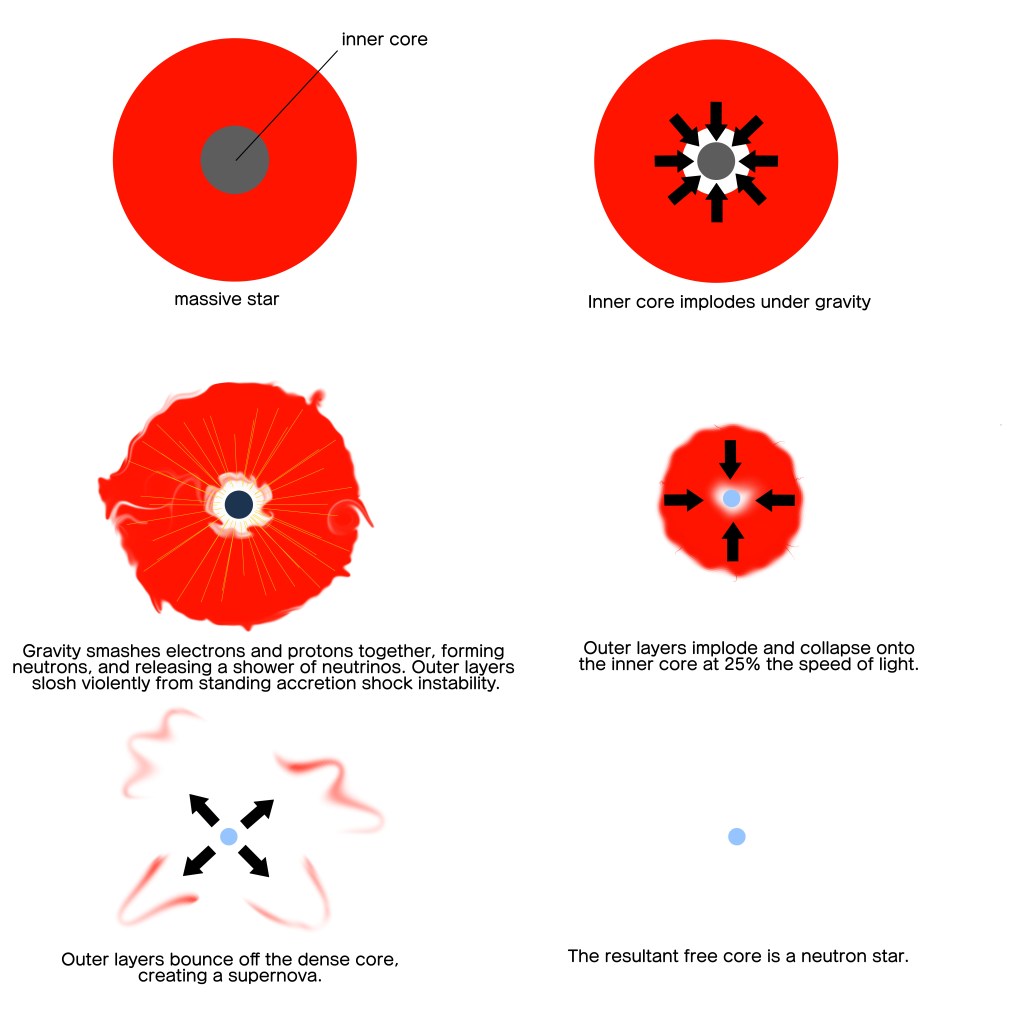
Let’s do the calculation. Let’s say the density of a neutron star is 200 trillion times that of the Sun, and the gravity is 5 billion times stronger (100 billion to 200 billion times stronger than Earth’s gravity). That results in the matter on a neutron star weighing a septillion time (1,000,000,000,000,000,000,000,000 times) more than the same volume of matter of the average density of the sun on the sun’s surface. I should say I asked ChatGPT to make this calculation using its own numbers, and it got roughly the same answer.
I can add that the average density of the sun is 1.4 grams per cubic centimeter which is less than that the average density of the earth, which is 5.5 grams per cubic centimeter. On the other hand, the gravity on the Sun’s surface is about 28 times stronger than on Earth, so if you make these comparisons with Earth instead of the sun the numbers get seven times worse, or seven septillion (7,000,000,000,000,000,000,000,000). I can add that even though neutron stars are extreme they are not rare. NASA estimates that there are a billion of them in our Milky Way Galaxy.
I consider this a super fact because it is true, and it is somewhat important to be aware of the extremes of the Universe. It tells us about who we are and our place in the Universe. A septillion times more weight, for the same volume and densities hundreds of trillions of times larger than the Sun or the Earth are surprising and shocking numbers.
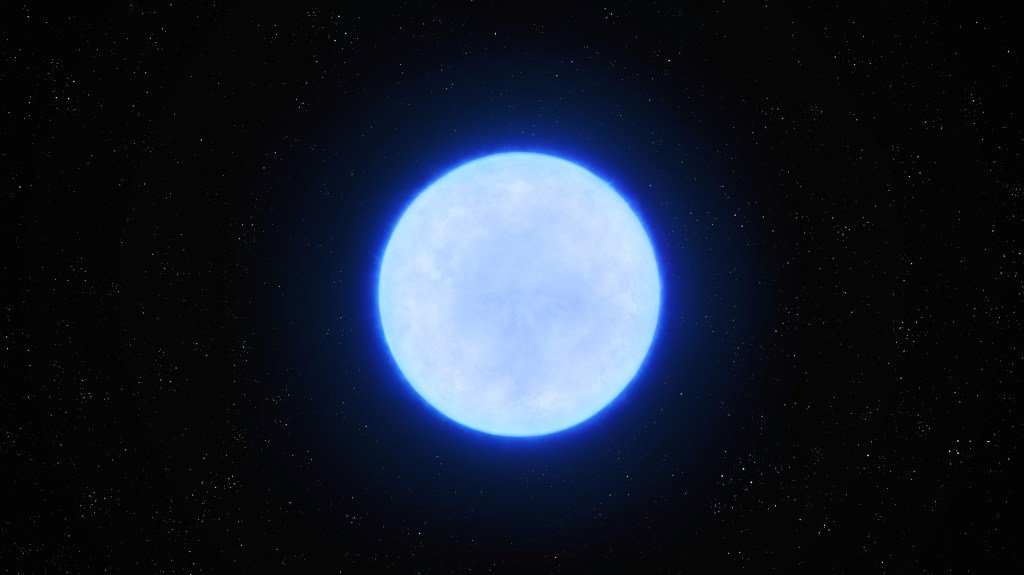
To watch a two minute video about Neutron stars, see below.
Different Types of Neutron Stars
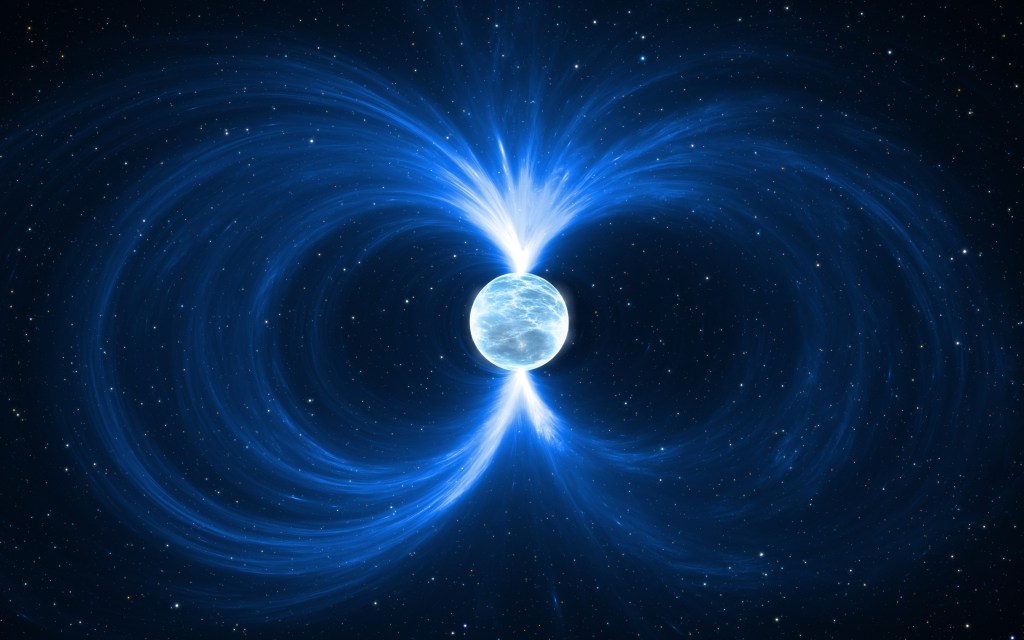
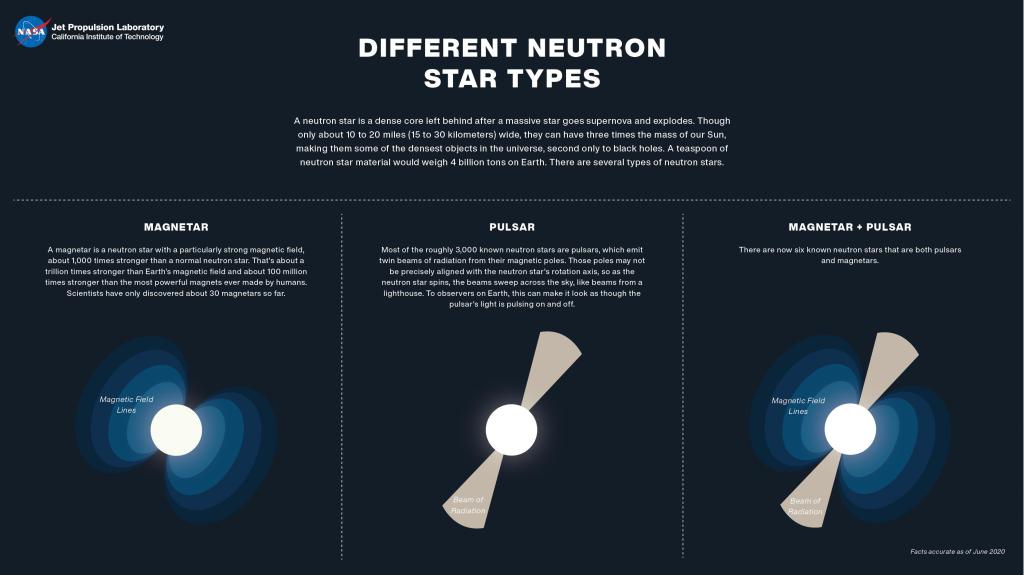
Neutron stars are extreme stars. They are small super dense stars with extreme gravitational fields. They are in a sense like a gigantic atomic nucleus. Perhaps it is not surprising that they are extreme in other ways as well. There are pulsars, neutron stars which emit twin beams of radiation from their magnetic poles. Those poles may not be precisely aligned with the neutron star’s rotation axis, so as the neutron star spins, the beams sweep across the sky, like beams from a lighthouse. To observers on Earth, this can make it look as though the pulsar’s light is pulsing on and off.
There are magnetars, neutron stars with extremely powerful magnetic fields trillions and quadrillion times stronger than Earth’s magnetic field at the surface. If one were to get close to Earth, at the distance about the same as the moon, you would see a small new star in the sky, as cars and other metallic objects lift from the ground and the magnetic strips of credit cards and computer hard drives are erased.
There are additional classes of neutron stars such as black widow pulsars, blasting a nearby star with radiation thus killing the star, soft gamma repeaters, magnetars emitting short burst of X-rays and gamma rays in irregular repeating patterns. There are binary neutron stars (two neutron stars orbiting each other) and they sometimes merge, collide, emitting detectable gravity waves. Click on the link to see a video visualization.
Other extreme stellar objects
- We are Star Dust
- The Bizarre Reality of Black Holes
- The Strange Worlds of Exoplanets
- The Enormous Kuiper belt
- Quasar TON 618
- Magnetars
 Super Facts