Relativity Visualized by Lewis Carroll Epstein

The goal of this blog is to create a list of what I call super facts. Super facts are important and true facts that are nevertheless highly surprising to many or disputed or misunderstood by many. In a sense this is a myth busting blog regarding important information. However, I also make posts that are not super facts but feature other interesting information, such as this book review and book recommendation.

Relativity Visualized by Lewis Carroll Epstein

Lewis Carroll Epstein <<Link-1>> is a physicist, teacher and author who has written a number of physics books for layman. He is somewhat famous for coming up with ingenious ways of using diagrams, pictures and puzzles to explain complex matters without using mathematics. His approach is unorthodox but, in my opinion, quite successful. You still have to invest time in reading this 200-page long book and solving most of the puzzles to understand what is going on. The book features some math, notably regarding the derivation of the formula for energy-mass equivalency E = mc2. However, it is in a special section for “teachers only”.

It is an old book and the only version currently available on Amazon is the paperback version. The publisher of the paperback is Insight Press; First Edition (January 1, 1985), ASIN : 093521805X, ISBN-13 : 978-0935218053, 206 pages, item weight : 12.8 ounces, dimensions : 6.25 x 0.75 x 9 inches. It costs $48.99 on US Amazon. Click here to order it from Amazon.com.

The front cover features the title “Relativity Visualized” and the author’s name and in the background is the night sky with the milky way. At the bottom of the front cover is a train with a head lamp and a light beam | Relativity Visualized by Lewis Carroll Epstein
Front cover of the paperback version of Relativity Visualized by Lewis Carroll Epstein. Click on the image to go to the Amazon page for the paperback version of the book.

Amazon’s Description of the Relativity Visualized By Lewis Carroll Epstein

Perfect for those interested in physics but who are not physicists or mathematicians, this book makes relativity so simple that a child can understand it. By replacing equations with diagrams, the book allows non-specialist readers to fully understand the concepts in relativity without the slow, painful progress so often associated with a complicated scientific subject. It allows readers not only to know how relativity works, but also to intuitively understand it.

This is my five-star review for Relativity Visualized

Note, I wrote this review in 2016, so it is relatively old, pun intended. In my original Amazon review I used very large paragraphs. I have changed that by breaking up the paragraphs a bit but without changing the content in any way.

Relatively Intuitive

In my opinion the theories of relativity are among the most interesting intellectual achievements in human history. They revolutionized physics and changed the way we think about physics, space, time, mass, energy, electromagnetism and essentially everything in nature. Despite that fact, the theories of relativity are deterministic and possible to visualize, and unlike Quantum Physics they are not statistical in nature and they don’t have a big issue with interpretation.

I’ve been interested in this topic ever since I came across it as a high school student. Therefore, I did not learn a lot about relativity from this book. I was more interested in the approach to explaining it, and I think his approach is a very good one.

I’ve found that an explanation for relativity that lacks rigor and quantitative reasoning creates misconceptions. The reader may end up thinking he understands it when he doesn’t. I’ve also found that books that focus on deriving complex equations were not only unattainable to the layman but sometimes left the mathematically inclined student with a poor understanding of relativity as well.

Lewis Carroll Epstein’s book “Relativity Visualized” seems to succeed in making relativity accessible to both the layman and those who are mathematically inclined. He explains the special theory of relativity and the general theory of relativity using graphs, visual constructs, and logical puzzles that the reader solves for himself. In a sense he allows the reader to develop the theories of relativity on his own. He avoids equations and formulas, but the reader will still discover more exactly what is going on.

One thing that really impressed me with this book is its special focus on the difference between what you see/experience and what you measure. As an example, take two lights that flash at the same time (in your reference frame). They could appear to flash at different times if the distance between them is large. So, you will see them flash at different times. However, if you time the light flashes and take the distance into account you can measure that they flashed at the same time (non-relativistic situation).

In relativity the differences you measure between frames do not only arise from the distance the light travels or from Doppler Effects but also from the relativity of time and space as well, and Epstein explains the details without confusing the reader. He focuses a lot on simultaneity/non-simultaneity right from the very beginning, and in my opinion understanding relativistic non-simultaneity is crucial to understanding what is going on.

The book also discusses the General Theory of Relativity. The General Theory of Relativity is often seen as completely off limits to the layman. It is typically explained using complex tensor calculus, differential geometry, and topology, or alternatively in a non-technical vague way that leaves the reader clueless. General Relativity was born out of an enigma. Special relativity had shown that energy and mass are the same things, so light has mass. A light beam traveling through a gravitational field must thus bend.

However, that means that the side of the light closer to the mass will travel a shorter distance. From known properties of light (always a transverse/orthogonal wave) this means that the side of the light beam closer to the mass moves slower than the outer rim which would violate the constancy of the speed of light in vacuum.

To solve this enigma Einstein had to introduce a time warp in gravitational fields. Later he discovered that this time warp would cause objects to fall towards the masses that caused the time warp and the practical effect of this turned out to be essentially identical to Newton’s theory of gravity and thus the mysterious force of gravity could be removed. Einstein also discovered that there is a warp effect on space which is negligible unless the speed of the objects is large (like magnetism for electric forces). The book helps you visualize all of this without using complex math.

Lewis Carroll Epstein’s book contains unique pedagogic approaches, novel geometric representations of relativity, as well as engaging questions and answers. For this reason, the book is fiercely protected by copyright law. On the negative side, his writing style is somewhat rigid and old fashioned, the drawings and the graphics are sometimes of low quality, and the book might be quite a bit of work for the layman reader, so it requires that you are really interested. However, overall, this is a very rigorous, detailed, correct, and yet entertaining book that I highly recommend.

Good Myths

I also would like to mention another tool that Lewis Carroll Epstein use in his book, and that is the concept of a Good Myth. A Good Myth is a description that isn’t technical and maybe not exact but that isn’t wrong either. In a loose way it captures the truth of what is going on.

An example of one of these myths is that everything, including all of us, is always traveling through time and space at exactly the speed of light in vacuum. In other words, we are all traveling at the speed of c = 299,792,458 meters per second. If we are sitting still, then we are traveling through time at the speed of light. If we are traveling through space at the speed of light then we are not traveling through time at all, like photons, for which time does not exist.

If we are traveling through space at a high speed, then if we add, in a vector way (Pythagoras theorem), our speed in space to our speed in time, they together will add up to the speed of light in vacuum. But that means that we are traveling through time at a speed that is less than the speed of light. So, our clocks will run slower.
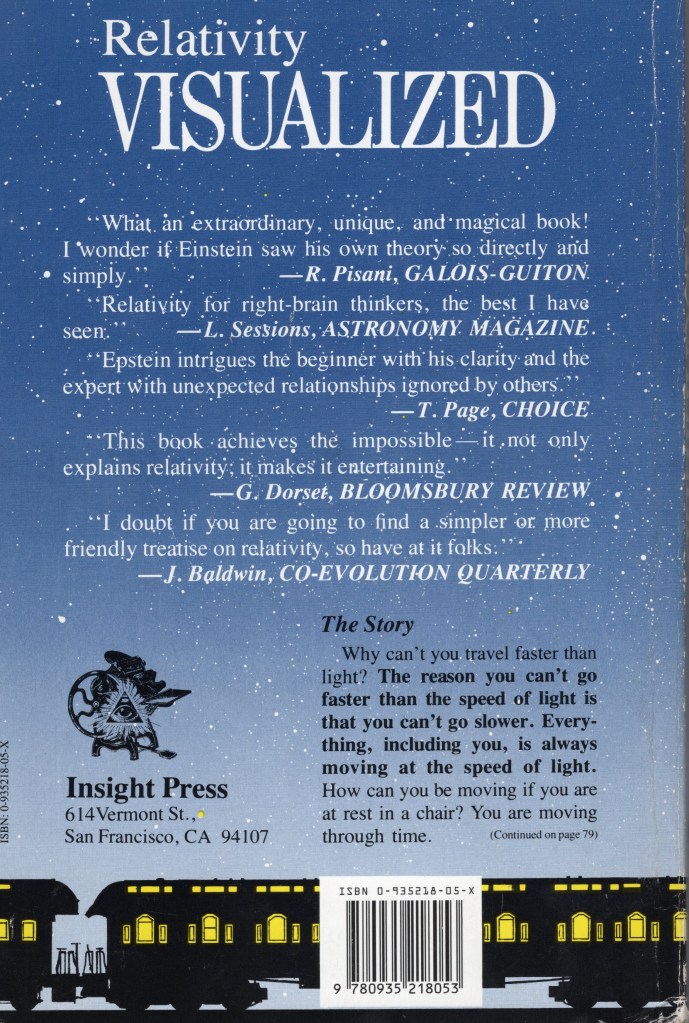
The back cover features the title of the book, praise for the book and very brief description | Relativity Visualized by Lewis Carroll Epstein
Back cover of the paperback version of Relativity Visualized by Lewis Carroll Epstein.

Other Posts on Relativity

Below is a list of other posts I made on Relativity

  • The Speed of Light In Vacuum Is a Universal Constant : to see post click here
  • Two events may be simultaneous for some but not for others : to see post click here
  • Time Dilation Goes Both Ways : to see post click here
  • The Pole-Barn Paradox and Solution : to see post click here
  • Book-Review : The Special Theory of Relativity by David Bohm : to see post click here
Do you feel that you are traveling through time at the speed of light?

To see the Super Facts click here

The Speed of Light In Vacuum Is a Universal Constant

Superfact 4 : The Speed of Light In Vacuum Is a Universal Constant

The speed of light in vacuum is a universal constant. The speed of light in vacuum is the same for all observers regardless of their speed and the direction in which they are going. It is always c = 299,792,458 meters per second. If you try to catch up to a light beam and try to travel close to the speed of the light beam, you will not be able to catch up. The speed of the light beam will still be c = 299,792,458 meters per second compared to you no matter how fast you go. This is possible because time and space don’t behave like we expect.

Superfacts

This is the fifth post of my super-factful blog and my fourth super-fact. As I mentioned previously, the goal of this blog is to create a long list of facts that are important and known to be true and yet are either disputed by large segments of the public or highly surprising or misunderstood by many.

These facts are not trivia, they are accepted as true by the experts in the relevant fields, the evidence that the fact is true is impressive, and they are important to the way we view the world and to what we believe, and despite being known to be true they are hard pills to swallow for many. They are not scientific theories or complicated insights but facts that can be stated simply. In a paragraph or less. They may need more explanation than you can fit in one paragraph, but they can be stated, with a brief explanation in just one paragraph.

The Fourth Superfact

My fourth super-fact is that the speed of light in vacuum compared to yourself is the same regardless of your motion. A beam from a flashlight you are pointing forward is traveling at a specific speed c = 299,792,458 meters per second forward, no matter what you are comparing to. It is important to understand that speed is relative. If you drive 95 miles per hour on a Texas highway you are driving 95 miles per hour compared to the pavement, but you are traveling more than 2,000 miles per hour compared to the moon.

However, a light beam will be traveling at the speed of c = 299,792,458 meters per second (186,000 miles per second) compared to the pavement and also compared to the moon, the sun, the galaxy, the fastest spaceship possible and another light beam. The speed of light in vacuum is not relative. For light in vacuum there is only one speed compared to everything.

Someone passing you at the speed of 99.99% of the speed of light in vacuum will measure his flashlight beam to have the speed c = 299,792,458 meters per second and he will measure your flashlight beam to have the speed c = 299,792,458 meters per second and so will you. It is as if c + c = c. 1 + 1 = 1 not 2, didn’t you know? This is logically possible because time and space is different for different observers.

This is quite shocking if you haven’t come across it before and there are a lot of people (not professional physicists) who refuse to believe it. So, in my opinion it is a super fact. In summary:

No matter how fast you travel, or in what direction, or where you are, you will measure the speed of light in vacuum compared to yourself to be c = 299,792,458 meters per second or approximately 186,000 miles per second or 671 million miles per hour. That goes for all light beams passing by you regardless of origin.

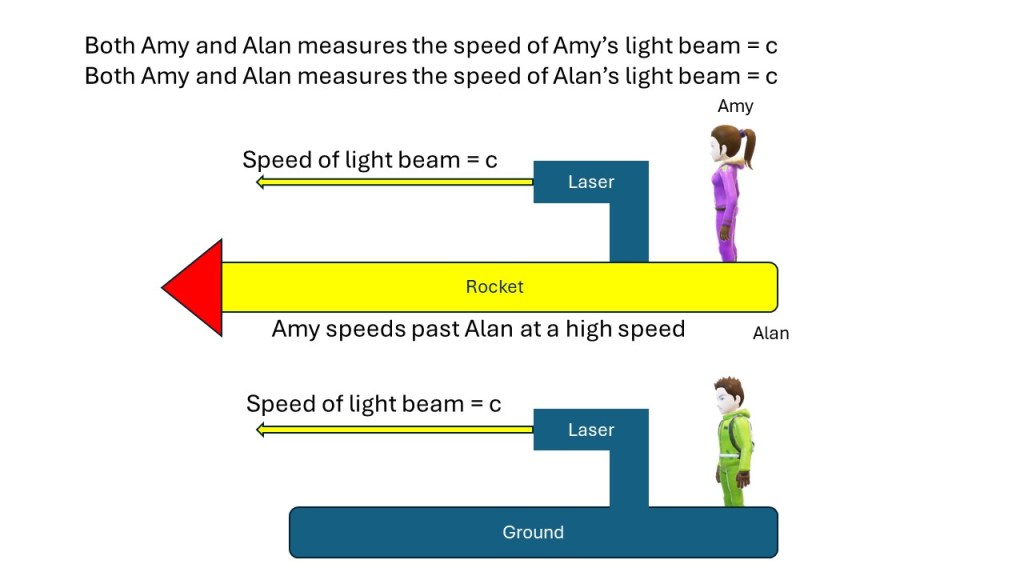
The picture shows two people Alan and Amy. Alan is on the ground. Amy is flying by Alan in a rocket speeding left. Both Alan and Amy are pointing lasers to the left.
In this picture Amy is traveling past Alan in a rocket. Both have a laser. Both measure the speed of both laser beams to be c = 299,792,458 meters per second.

In the picture above let’s say Amy is flying past Alan at half the speed of light. If you believe Alan when he says that both laser beams are traveling at the speed of c = 186,000 miles per second, then you would expect Amy to measure her laser beam to travel at a speed that is half of that c/2 = 93,000 miles per hour, but she doesn’t. She measures her laser light beam to travel at the speed of c = 186,000 miles per second just like Alan. This seems contradictory.

The solution that the special theory of relativity offers for this paradox is that time and space are relative and Amy and Alan measure time and space differently (more on that in another post).

The Speed of Light In Vacuum Is a Universal Constant
Time is going to be different for me than for you. From shutterstock Illustration ID: 1055076638 by andrey_l

I should add that the realization that the speed of light in vacuum is a constant regardless of the speed or direction of the observer or the light source was a result of many experiments, which began with the Michelson-Morley experiments at Case Western Reserve University, Cleveland, Ohio in the years 1881-1887.

At first scientists thought that there was an ether, which acted as a medium for light. They assumed that earth would be moving through this ether. What they tried to establish was earth’s velocity through the ether, but all measurements resulted in light always having the same speed, in all directions, all the time, in summer and in winter, no matter in which direction earth was going. At first, they tried to explain this by saying that the ether compressed the experimental equipment and distorted clocks exactly so that it seemed like the speed of light in vacuum always came out the same.

Others said that earth was dragging the ether with it, but that explanation turned out not to hold water. With the special theory of relativity in 1905 those speculations were laid to rest. It was the way time and space were constructed and connected.

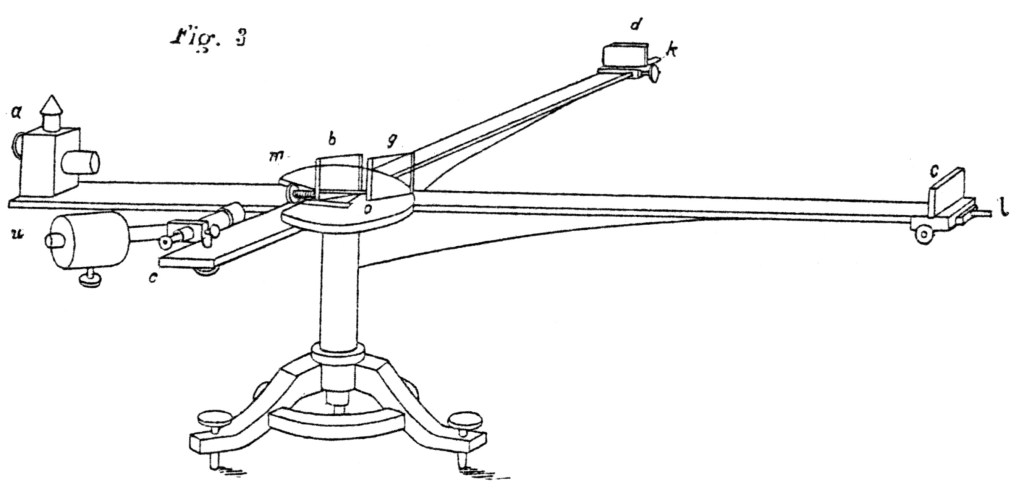
This is a drawing of the Michelson interferometer used at Case Western Reserve University
The first Michelson-Interferometer from 1881. It was used to measure the speed difference of two light beams (well a split light beam) with a very high accuracy (for the time). The light traveled with the same speed in all directions and no matter what earth’s position and speed was in its orbit around the sun. This picture is taken from Wikipedia and is in the public domain of the United States.
The speed c = 299,792,458 meters per second is a universal speed limit created by time and space

I should point out that there is nothing magical about the speed of light in a vacuum. Light traveling through matter, like glass or water, does not travel at this speed c, but slower. That is why I keep saying the “speed of light in vacuum” instead of “the speed of light”.

It is also not entirely correct to say that the speed of light in vacuum is a universal constant, because it isn’t only about the speed light. It is just that light that travels unimpeded through vacuum reaches the universal speed limit created by time and space, or the space-time continuum (that’s another post). The light is prevented from traveling infinitely fast by this speed limit, and light is not the only thing behaving this way. All massless particles / radiation is prevented from reaching infinite speed by this universal speed limit and they will also travel with exactly the same speed c = 299,792,458 meters per second compared to all observers, just like light in vacuum.

So how is time and space arranged to cause this universal speed limit? Well, that is a surprising super fact post for another day (I will link to it once I have made the post). I can add that the discovery that light in vacuum is a universal constant changed basically everything in physics. We had to change the equations and the physics regarding not just time and space but energy, momentum, mass, force, electromagnetics, space geometry, particle physics, and much more. The energy and mass equivalency is a direct result of this E = mc2.

Examples:

Below are some examples of what this discovery led to. Again, don’t worry about the details or how it works. I might explain these effects in future super fact posts and link to them.

  • Time for travelers moving fast compared to you is running slower.
  • Length intervals for travelers moving fast compared to you are contracted.
  • Simultaneous events may not be simultaneous for another observer.
  • The order of events may be reversed for different observers.
  • If you accelerate to a speed that is 99.999% of the speed of light you still haven’t gotten any closer to the speed of light from your perspective. Light in vacuum will still speed off from you at c = 186,000 miles per second. You think you’ll keep accelerating but that the light keeps accelerating just as much ahead of you. You cannot catch up. What other observers see is you accelerating less and less and never catch up even though you get closer.
  • Forces, the mass of objects, momentum, energy and many other physical quantities will reach infinity as you approach the speed of light in vacuum assuming you are not a massless particle.
  • Mass is energy and vice versa E = mc2
  • Magnetic fields pop out as a relativistic side-effect of moving charges.
The E = mc2 formula | The Speed of Light In Vacuum Is a Universal Constant
Mass is energy and vice versa, a direct result of the way time and space are related. Stock Photo ID: 2163111377 by Aree_S
Can We Travel Faster Than The Speed Of Light?

So, it seems like we cannot travel faster than the speed of light in vacuum. It seems like the universal speed limit is a hard limit, unlike the speed limits on Texas highways. That is maybe true, at least locally where we are.

However, you could get around it, by what is kind of cheating, by stretching and bending space to the extreme by using, for example, enormous amounts of negative energy. That’s happening to our Universe over a scale of tens of billions of lightyears. I should add that a lightyear is the distance light in vacuum travel in one year. Stretching and bending space is not part of the special theory of relativity. That is Einstein’s General Theory of Relativity.


To see the other Super Facts click here