Light is Beyond the Reach of Time

Superfact 116: Time and space do not exist for light particles (called photons) and not for other particles without mass either. All massless particles travel at the speed c = 299,792,458 meters per second compared to all other objects regardless of how fast those other objects are moving. Objects / particles that have mass will always travel slower than c = 299,792,458 meters per second. The speed of light, c, is not really a speed. It is a conversion factor between space and time. It is therefore a universal constant.

An eye with photons streaming into it. | Light is Beyond the Reach of Time
Billions of photons coming into the eye. Shutterstock asset id: 2629068895 by muratart.

Light does not travel through a medium, like a sound wave, or a water wave does. There is no medium for light to travel in. Photons are massless, which means that an extremely tiny force, an infinitesimal smallest possible force, could send a photon off at infinite speed. There is no mass to hold the photon back.

However, the conversion factor between space and time c = 299,792,458 meters per second will prevent that and the photon will travel at this “speed”. Since c is a conversion factor, a physical constant describing time and space, this is not motion, or movement, in a normal sense. Space and time won’t allow any physical event to have any effect faster, and no information of any kind can travel faster than c = 299,792,458 meters per second.

One of the effects of the speed of light being a universal constant is that different observers measure different distances and time durations, and even the order of events may be in different orders for different observers. As you travel ever closer to the speed of light the time it will take to travel between two points will shrink towards zero as you approach the speed of light. In addition, the distance between the two points will shrink. You can read Albert Einsteins original paper on the topic here, and about space-time here.

This means that from the photon’s perspective there will be no time at all. A photon, or a light beam, will travel from Earth to a distant galaxy a billion light years away in an instant. It will not take a billion years. It will not take one year. It will not take one second. It will not take one microsecond. It will not take a nanosecond, or a picosecond, or a trillionth of a picosecond. It will take zero seconds. The Big Bang and the end of the Universe (if there is one) happen at the same exact moment to a photon. Time does not exist for a photon (or a gluon, or any other mass-less particle).

This is a mind-blowing fact, and it is true and important to our understanding of the Universe. Therefore, I consider it a super fact.

What does the Speed of Light Being a Universal Constant Mean ?

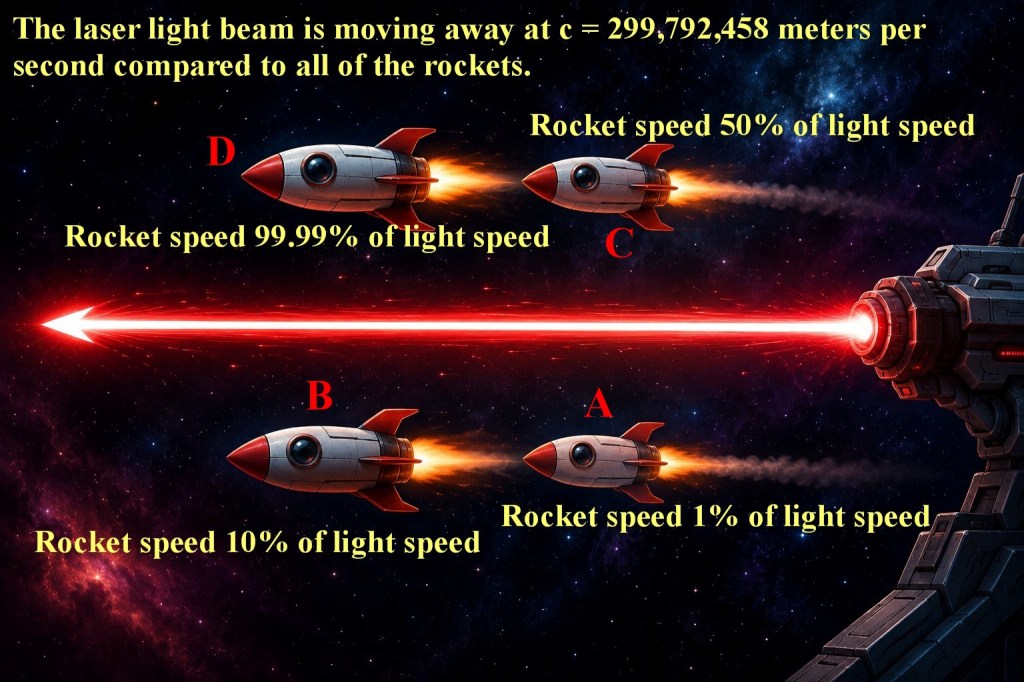
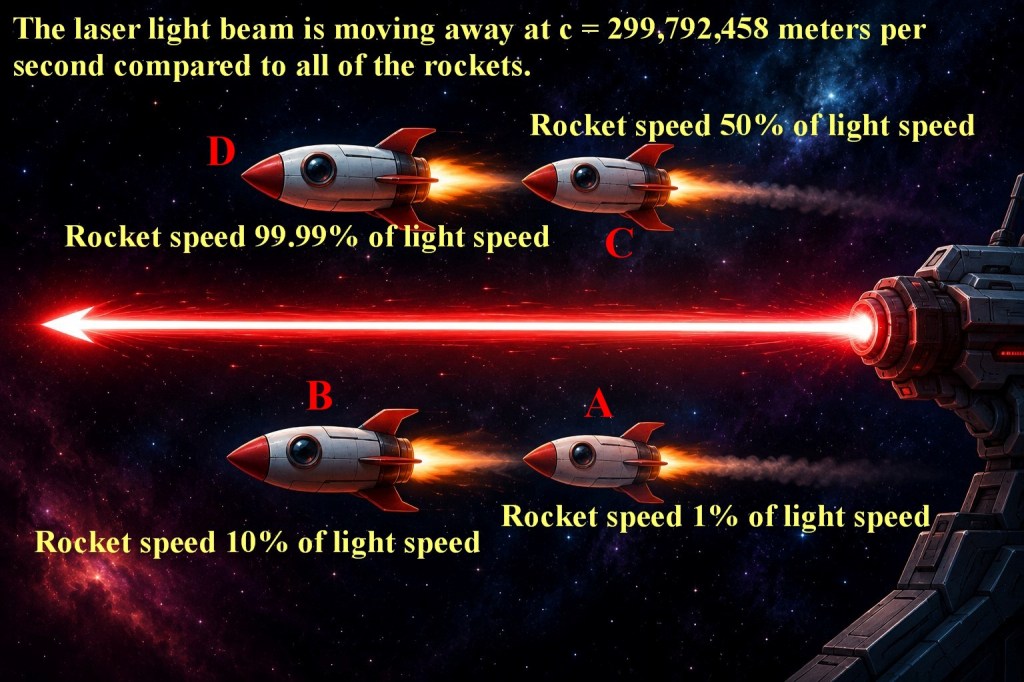
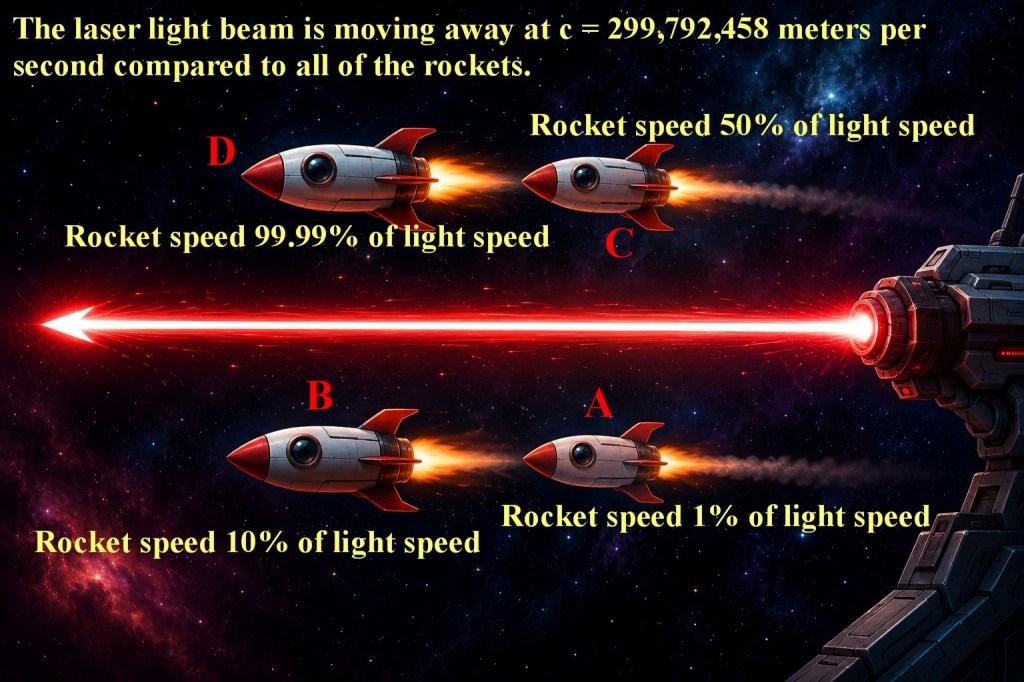
A spaceship on the right is shooting out a laser beam towards the left. Alongside the laser beam are four rockets trying to catch up with the light beam.
Four rockets, A, B, C, and D, are traveling along a light (laser) beam. No matter how fast they travel along the light beam, the light beam will always travel c = 299,792,458 meters per second faster than they do. I generated this picture with the help of ChatGPT.

The first thing to acknowledge about the speed of light (in vacuum) is that it is a universal constant as explained in my post “The Speed of Light in Vacuum Is a Universal Constant”. However, I am explaining this fact slightly differently in the next few paragraphs with the help of the picture above.

In the picture above we are emitting a light beam from our spaceship using our super laser. There are also four rockets that travel along the light beam. The rocket on the lower right (rocket A) travel at 1% of the speed of light v = 2,997,924.5 meters per second (or 2,998 miles per second). That is extremely fast, but much slower than light. You would think that the light beam would travel a little bit slower compared to this rocket at the relative speed c – v = 299,792,458 – 2,997,924.5 = 296,794,533.5 meters per second. But it doesn’t. The light beam is still speeding ahead of rocket A at exactly c = 299,792,458 meters per second.

What happens if you compare the beam with the rocket in the lower left (rocket B)? That rocket travels at 10% the speed of the light beam. Shouldn’t the light beam move 10% slower compared to that rocket? No, the light beam speeds ahead at exactly c = 299,792,458 meters per second compared to rocket B, once again.

Now take rocket C in the upper right corner. It also travels along the light beam but at half the speed of light. Shouldn’t the light beam travel at half of the speed of light compared to rocket C? No, it will stubbornly travel at exactly c = 299,792,458 meters per second compared to rocket C. Not less and not more.

The same is true for the rocket in the upper left, rocket D. It travels at 99.99% of the light speed compared to us in the spaceship, and yet the light beam will stubbornly travel at exactly c = 299,792,458 meters per second compared to rocket D. Not less and not more.

The universal speed c = 299,792,458 meters per second is not so much about light. As mentioned, it is a conversion factor between space and time. You take this conversion factor with you everywhere you go and regardless of how fast you move. That’s the way time and space works.

The fact that the speed of light is a universal constant that is exactly the same for all observers, no matter how fast they move, should tell you that it is not a speed in a normal sense. It is not really a “speed” at all. As mentioned, it is a conversion factor between space and time. Light isn’t really travelling super-fast. It is just conforming to the geometric reality of time and space, and to us it looks like it is travelling at the speed c = 299,792,458 meters per second.

The Space-Time Interval for Light is Zero

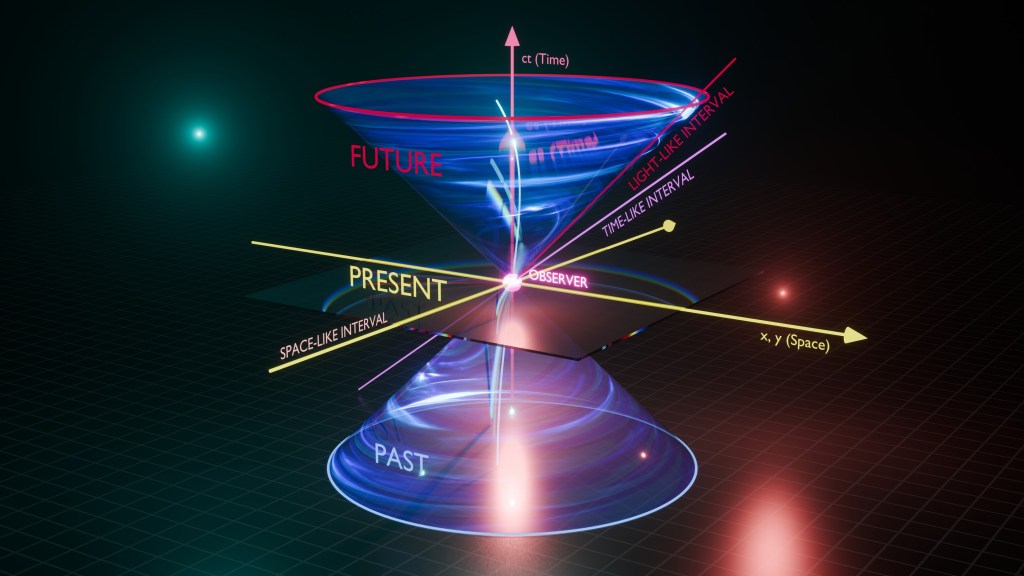
I mentioned that from the photons perspective time does not exist but that from our perspective light travel through space or seem to travel through space and that takes time. However, for us space and time are separate things. If you combine them and measure space-time intervals instead you get a more complete picture. In 3D space you get the distance between two points by adding the differences between the coordinates using Pythagoras theorem, s^{2}=x^{2}+y^{2}+z^{2}. (x, y, and z, are differences in the coordinates) As long as you are consistent with the units you will always get the same distance regardless of position and orientation of your coordinate system. You can read more here.

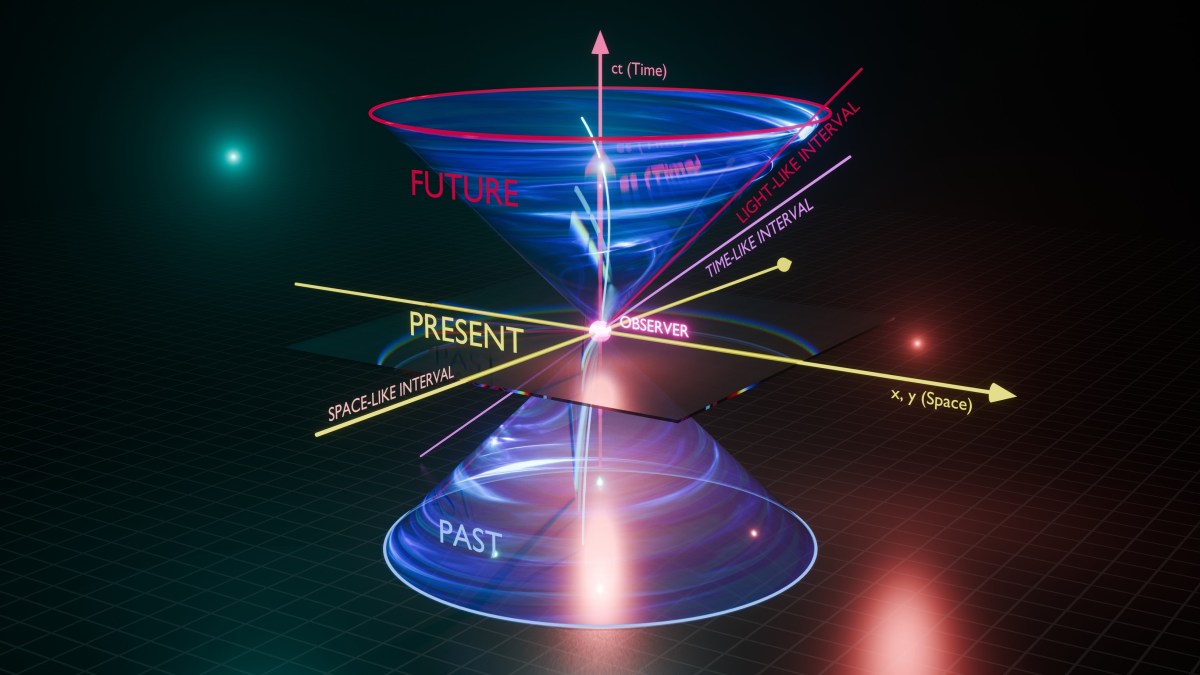
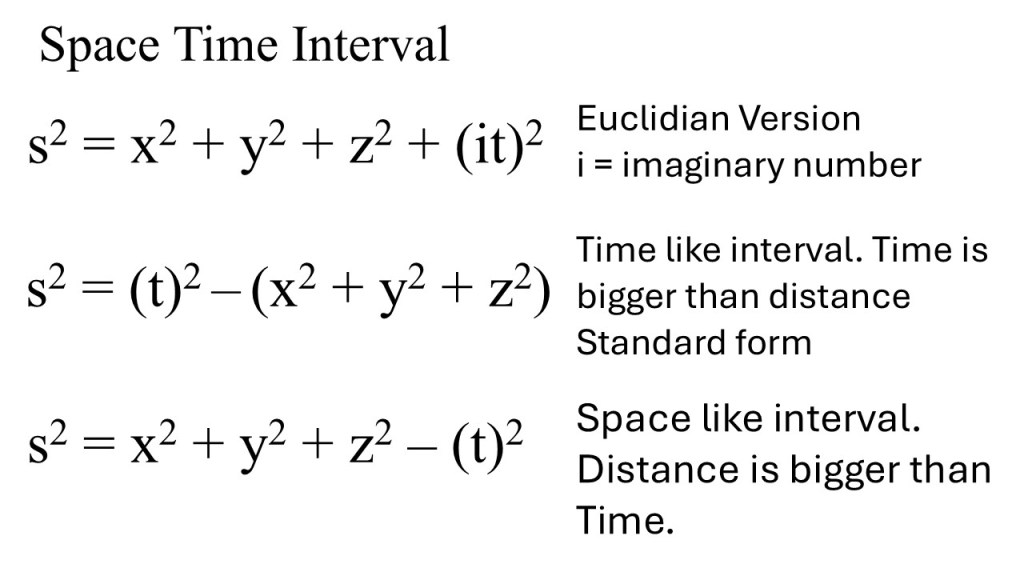
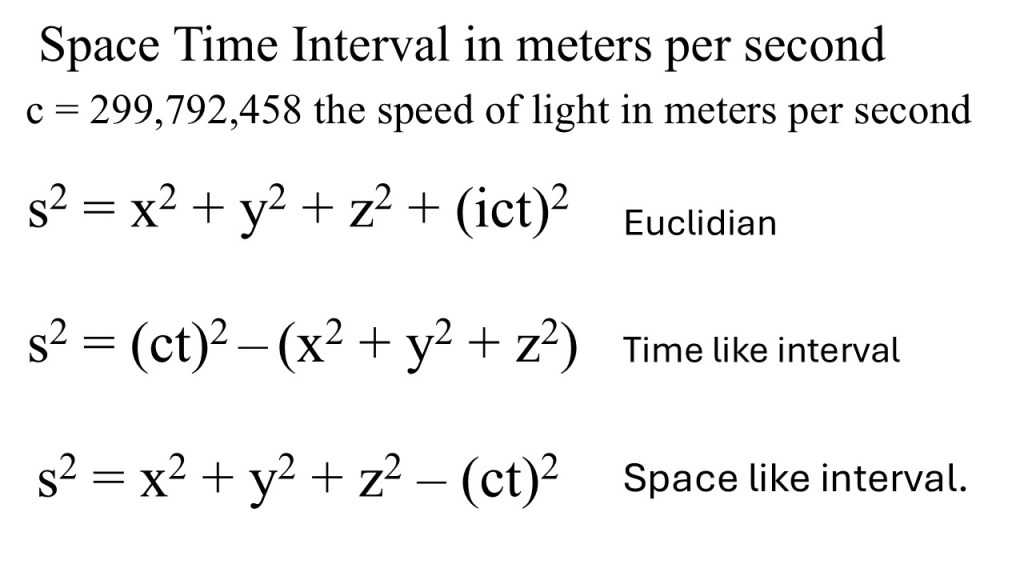
If you add time to Pythagoras theorem you will get the space-time interval, which interestingly enough is the same for all observers. There is no time dilation or length contraction in the interval. s^{2}=x^{2}+y^{2}+z^{2}+(it)^{2} As you might suspect, intervals involving light travelling from one event to another will always be zero for all observers, and not just from the photons perspective. And again, the same applies to all massless particles. Below are the Pythagoras formulas for different versions of the interval. In the top picture it is assumed that the conversion factor c = 299,792,458 meters per second has already been baked into to the time variable and in the bottom it has not. This is not any stranger than converting feet to meters.

The image shows three formulas for the spacetime interval Euclidian: “(s^{2}=x^{2}+y^{2}+z^{2}+(it)^{2}”.  For Time like intervals, the standard form: “(s^{2} = t^{2} – (x^{2}+y^{2}+z^{2}))”. For distance like intervals: “(s^{2} = ((x^{2}+y^{2}+z^{2}) – t^{2}))”. | Light is Beyond the Reach of Time
The three formulas for the spacetime interval above all assume that the unit used for time is the time it takes light in vacuum to travel the distance unit used. If that is meters, it would be the time it takes light to travel one meter. The top formula is the Euclidian form of spacetime. It contains only the ‘+’ operator at the expense of adding the imaginary number (square root of -1) in front of the time coordinate. The second form is typically used with time like intervals and considered the standard form. The third form is used when the distance between two events is larger than the time distance, or distance like intervals.
The image shows the formulas for the spacetime interval with the constant representing the speed of light in vacuum “(s^{2}=x^{2}+y^{2}+z^{2}+(ict)^{2}”,  “s^{2}= (ct)^{2} – (x^{2}+y^{2}+z^{2})” and “(s^{2}=x^{2}+y^{2}+z^{2}-(ct)^{2}”.
If you measure the space coordinates in meters and the time in seconds you must adjust the units to match by inserting the speed of light in vacuum c = 299,792,458. The three forms of the space interval now have the constant c attached to the time coordinate.

What about the speed of light in water ?

It is well known that the speed of light in transparent materials such as water and glass is slower than the speed of light in vacuum. The speed of light it water is about 75% of the speed in vacuum and about 70% or less in glass (depending of the type of glass) compared to the speed in vacuum. In some materials the speed of light can be much less than that. This seems to violate what I said above about the speed of light always moving at c = 299,792,458 meters per second for all observers regardless of their speed.

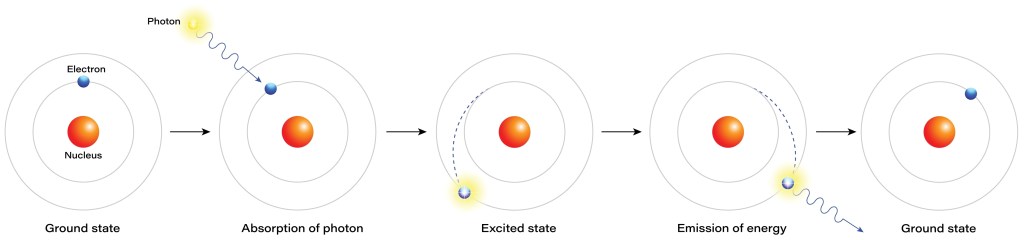
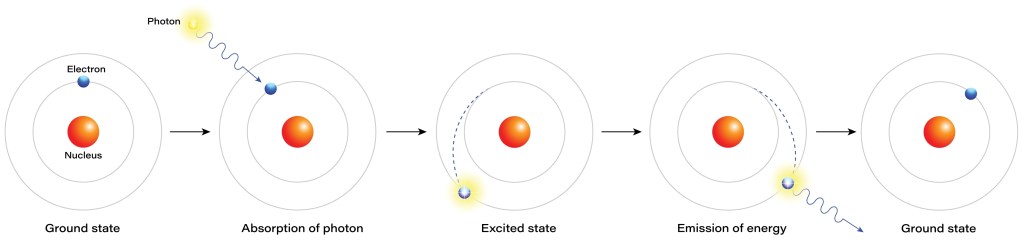
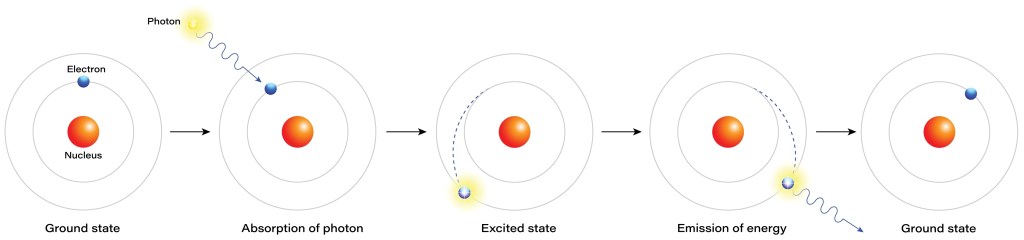
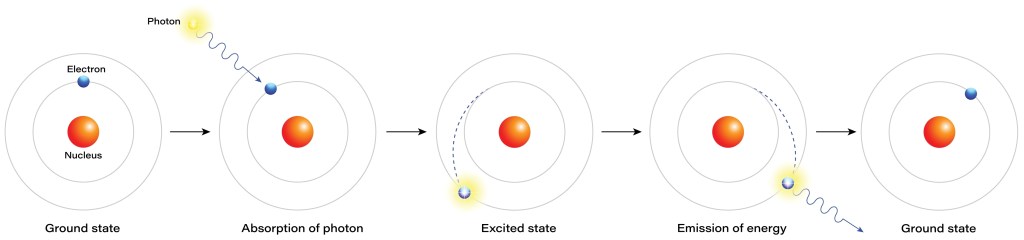
What is going on is that when light moves through matter it is being absorbed and emitted as it “travels” between the atoms in the material, and this absorption and emittance process takes time. This time is extremely short but long enough to be measurable. As the photons move in between the atoms they travel at the “speed”  c = 299,792,458 meters per second, the time to space conversion factor I’ve been talking about. See the illustration below.

From left to right, an atom absorbs a photon, which excites an electron that jumps into a higher orbit. Then it emits a photon and the electron falls back to the ground state again. | Light is Beyond the Reach of Time
From ground state to excited state, absorption and emission of a photon in an atom. Shutterstock asset id: 2180385419 by rktz.

More about the mass of a Photon

I’ve said photons have no mass. According to Einstein’s theory of special relativity, time does not pass (or effectively “exist”) from the perspective of a massless particle. However, this is the intrinsic mass or so called proper mass or invariant mass. It is the mass of an object as measured by an observer who is completely at rest relative to it. This intrinsic mass is the mass that a photon does not have.

The mass of an electron is 511 Kilo Electron Volts, which is  0.0000000000000000000000000009109 grams. That is the intrinsic mass of the electron. If an electron is sped up to close the speed of light its mass increases and goes toward infinity. If its speed is very close to the speed of light its mass could be much bigger than that of the entire Universe. That’s because as you are increasing the speed of the electron, you are increasing its kinetic energy and as you increase the total energy of the electron you also increase its total mass according to E = mc2.

As the electron’s speed approaches the speed of light the kinetic energy goes toward infinity. That is one reason why it is impossible to travel at exactly the speed of light for anything but massless particles. Infinite energy and infinite mass are not realistic. We, the objects that have mass, can move closer and closer to light speed but never get there.

However, the intrinsic mass for photons is zero and therefore the photon is travelling at exactly the speed of light, c = 299,792,458 meters per second. E = mc2 still applies to light but the mass is not the intrinsic mass, which is zero, but the total mass, and the total mass can pretty much take on any number.

What about Warp Drives ?

So, nothing with mass can travel at the speed of light, and nothing can exceed it. What about the warp drive in Star Trek? As I said, the speed of light is not really a speed but the conversion factor between time and space. It is a geometric fact of space-time. That is a pretty difficult reality to get around, just like it is pretty difficult to push Earth out of its orbit by pushing on the floor. However, there is a way to cheat and that is to stretch space-time itself. This is theoretically possible, but it requires colossal amounts of mass-energy and enormous amounts of negative energy. We don’t even know if negative energy exists on a macroscopic scale.

So, no one knows if a warp drive is possible, and if it isn’t, then we are stuck moving slower than the speed of light, which would make interstellar travel very difficult and inconvenient.

Richard Feyman’s Lecture on Why Light Is NOT Moving Through Space?

The YouTube video below is very long, 48 minutes. However, Richard Feyman, Nobel prize winner in physics, has a knack for explaining extremely abstract concepts so that they are easy to understand. If you are very interested in this topic and have some extra time, this is a fascinating lecture. He certainly explains this topic better than I can.

Other Super Facts Related to the Speed of Light

To see the Other Super Facts click here

Relativity Visualized by Lewis Carroll Epstein

The goal of this blog is to create a list of what I call super facts. Super facts are important and true facts that are nevertheless highly surprising to many or disputed or misunderstood by many. In a sense this is a myth busting blog regarding important information. However, I also make posts that are not super facts but feature other interesting information, such as this book review and book recommendation.

Relativity Visualized by Lewis Carroll Epstein

Lewis Carroll Epstein <<Link-1>> is a physicist, teacher and author who has written a number of physics books for layman. He is somewhat famous for coming up with ingenious ways of using diagrams, pictures and puzzles to explain complex matters without using mathematics. His approach is unorthodox but, in my opinion, quite successful. You still have to invest time in reading this 200-page long book and solving most of the puzzles to understand what is going on. The book features some math, notably regarding the derivation of the formula for energy-mass equivalency E = mc2. However, it is in a special section for “teachers only”.

It is an old book and the only version currently available on Amazon is the paperback version. The publisher of the paperback is Insight Press; First Edition (January 1, 1985), ASIN : 093521805X, ISBN-13 : 978-0935218053, 206 pages, item weight : 12.8 ounces, dimensions : 6.25 x 0.75 x 9 inches. It costs $48.99 on US Amazon. Click here to order it from Amazon.com.

The front cover features the title “Relativity Visualized” and the author’s name and in the background is the night sky with the milky way. At the bottom of the front cover is a train with a head lamp and a light beam | Relativity Visualized by Lewis Carroll Epstein
Front cover of the paperback version of Relativity Visualized by Lewis Carroll Epstein. Click on the image to go to the Amazon page for the paperback version of the book.

Amazon’s Description of the Relativity Visualized By Lewis Carroll Epstein

Perfect for those interested in physics but who are not physicists or mathematicians, this book makes relativity so simple that a child can understand it. By replacing equations with diagrams, the book allows non-specialist readers to fully understand the concepts in relativity without the slow, painful progress so often associated with a complicated scientific subject. It allows readers not only to know how relativity works, but also to intuitively understand it.

This is my five-star review for Relativity Visualized

Note, I wrote this review in 2016, so it is relatively old, pun intended. In my original Amazon review I used very large paragraphs. I have changed that by breaking up the paragraphs a bit but without changing the content in any way.

Relatively Intuitive

In my opinion the theories of relativity are among the most interesting intellectual achievements in human history. They revolutionized physics and changed the way we think about physics, space, time, mass, energy, electromagnetism and essentially everything in nature. Despite that fact, the theories of relativity are deterministic and possible to visualize, and unlike Quantum Physics they are not statistical in nature and they don’t have a big issue with interpretation.

I’ve been interested in this topic ever since I came across it as a high school student. Therefore, I did not learn a lot about relativity from this book. I was more interested in the approach to explaining it, and I think his approach is a very good one.

I’ve found that an explanation for relativity that lacks rigor and quantitative reasoning creates misconceptions. The reader may end up thinking he understands it when he doesn’t. I’ve also found that books that focus on deriving complex equations were not only unattainable to the layman but sometimes left the mathematically inclined student with a poor understanding of relativity as well.

Lewis Carroll Epstein’s book “Relativity Visualized” seems to succeed in making relativity accessible to both the layman and those who are mathematically inclined. He explains the special theory of relativity and the general theory of relativity using graphs, visual constructs, and logical puzzles that the reader solves for himself. In a sense he allows the reader to develop the theories of relativity on his own. He avoids equations and formulas, but the reader will still discover more exactly what is going on.

One thing that really impressed me with this book is its special focus on the difference between what you see/experience and what you measure. As an example, take two lights that flash at the same time (in your reference frame). They could appear to flash at different times if the distance between them is large. So, you will see them flash at different times. However, if you time the light flashes and take the distance into account you can measure that they flashed at the same time (non-relativistic situation).

In relativity the differences you measure between frames do not only arise from the distance the light travels or from Doppler Effects but also from the relativity of time and space as well, and Epstein explains the details without confusing the reader. He focuses a lot on simultaneity/non-simultaneity right from the very beginning, and in my opinion understanding relativistic non-simultaneity is crucial to understanding what is going on.

The book also discusses the General Theory of Relativity. The General Theory of Relativity is often seen as completely off limits to the layman. It is typically explained using complex tensor calculus, differential geometry, and topology, or alternatively in a non-technical vague way that leaves the reader clueless. General Relativity was born out of an enigma. Special relativity had shown that energy and mass are the same things, so light has mass. A light beam traveling through a gravitational field must thus bend.

However, that means that the side of the light closer to the mass will travel a shorter distance. From known properties of light (always a transverse/orthogonal wave) this means that the side of the light beam closer to the mass moves slower than the outer rim which would violate the constancy of the speed of light in vacuum.

To solve this enigma Einstein had to introduce a time warp in gravitational fields. Later he discovered that this time warp would cause objects to fall towards the masses that caused the time warp and the practical effect of this turned out to be essentially identical to Newton’s theory of gravity and thus the mysterious force of gravity could be removed. Einstein also discovered that there is a warp effect on space which is negligible unless the speed of the objects is large (like magnetism for electric forces). The book helps you visualize all of this without using complex math.

Lewis Carroll Epstein’s book contains unique pedagogic approaches, novel geometric representations of relativity, as well as engaging questions and answers. For this reason, the book is fiercely protected by copyright law. On the negative side, his writing style is somewhat rigid and old fashioned, the drawings and the graphics are sometimes of low quality, and the book might be quite a bit of work for the layman reader, so it requires that you are really interested. However, overall, this is a very rigorous, detailed, correct, and yet entertaining book that I highly recommend.

Good Myths

I also would like to mention another tool that Lewis Carroll Epstein use in his book, and that is the concept of a Good Myth. A Good Myth is a description that isn’t technical and maybe not exact but that isn’t wrong either. In a loose way it captures the truth of what is going on.

An example of one of these myths is that everything, including all of us, is always traveling through time and space at exactly the speed of light in vacuum. In other words, we are all traveling at the speed of c = 299,792,458 meters per second. If we are sitting still, then we are traveling through time at the speed of light. If we are traveling through space at the speed of light then we are not traveling through time at all, like photons, for which time does not exist.

If we are traveling through space at a high speed, then if we add, in a vector way (Pythagoras theorem), our speed in space to our speed in time, they together will add up to the speed of light in vacuum. But that means that we are traveling through time at a speed that is less than the speed of light. So, our clocks will run slower.

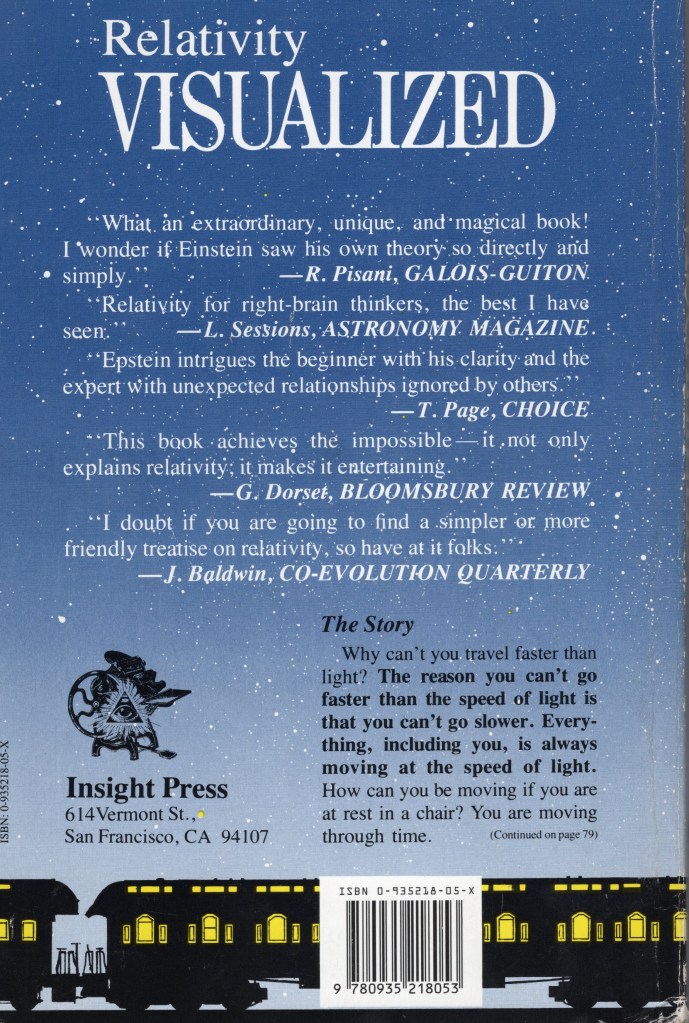
The back cover features the title of the book, praise for the book and very brief description | Relativity Visualized by Lewis Carroll Epstein
Back cover of the paperback version of Relativity Visualized by Lewis Carroll Epstein.

Other Posts on Relativity

Below is a list of other posts I made on Relativity

  • The Speed of Light In Vacuum Is a Universal Constant : to see post click here
  • Two events may be simultaneous for some but not for others : to see post click here
  • Time Dilation Goes Both Ways : to see post click here
  • The Pole-Barn Paradox and Solution : to see post click here
  • Book-Review : The Special Theory of Relativity by David Bohm : to see post click here

Do you feel that you are traveling through time at the speed of light?

To see the Super Facts click here

Time Dilation Goes Both Ways

Super fact 38 : If two observers are moving compared to each other both will observe the other’s time as being slower. In other words, both observers will observe the other’s clocks as ticking slower. Time slowing down is referred to as Time Dilation. And this post is about how time dilation goes both ways.

A lot of people know that if someone moves very fast his clocks will run slower. That’s relativity. If someone speeds through space in a rocket ship, close to the speed of light his time will slow down. When one hour passes on earth only half an hour may pass in the rocket. What comes as a shock to many people is when they find out that the converse is also true. When one hour passes in the rocket only half an hour will pass on earth.

Clearly that looks like a contradiction, but there is an explanation. I consider this a super fact because it is so strange and almost impossible for people to believe, and yet it is true.

The image shows two clocks side by side. On the left is a wall clock and on the right a wristwatch | Time Dilation Goes Both Ways
The guy on earth says my clock (left) is ticking double as fast as the rocket man’s clock (right). The rocket man say’s my clock (right) is ticking double as fast as the clock on earth (left). Who is right? Surprisingly both of them.

Postulates of Special Relativity

The two postulates of special relativity are:

  • The laws of physics are the same in all inertial frames of reference. An inertial frame is a system that moves at a constant velocity.
  • The speed of light in a vacuum is constant for all observers, regardless of the motion of the light source.

The first postulate is called the principle of relativity and goes all the way back to Galileo Galilei. It means that no experiment can determine whether you are at rest or moving at a constant velocity. The reciprocity of time dilation follows from this postulate. If the time for the rocket man in the example above was ticking at half the speed compared to the time for the guy on earth and they both agreed, then you could tell who was standing still and who was moving from that fact.

The first postulate demands that they disagree. The guy on earth thinks the rocket man’s clock is ticking at half the speed of his own clock, whilst the rocket man think it is earth man’s clock that is going slow. Therefore, you can’t tell who is standing still, which is what the first postulate requires.

The second postulate is the more shocking one and is special to relativity. It was discovered experimentally at the end of the 19th century but was too difficult for scientists to accept at first so various ad hoc explanations were put forth to explain it away, until the theories of relativity were created. I designated this postulate as my super fact #4 and you can read about it here.

The picture shows two people Alan and Amy. Alan is on the ground. Amy is flying by Alan in a rocket speeding left. Both Alan and Amy are pointing lasers to the left | Time Dilation Goes Both Ways
In this picture Amy is traveling past Alan in a rocket. Both have a laser. Both measure the speed of both laser beams to be c = 299,792,458 meters per second. The speed of light is a universal constant.

Time Dilation

In the pictures below I am showing two rocket systems in space, Amy’s rocket and Alan’s rocket. They are travelling at a high speed compared to each other. Each rocket has a light clock that consists of a light beam bouncing up and down between a mirror in the ceiling and a mirror on the floor. The two light clocks are identical, and each bounce corresponds to a microsecond.

Amy is passing Alan at a high speed, and therefore Alan will see Amy’s light clock running slower than his because Amy’s light beam must travel further. Remember, the speed of light is identical for both light clocks (light speed is a universal constant). For those interested I am also deriving the formula for time dilation.

The picture shows two systems, each with a clock consisting of light beams bouncing between mirrors. In this set up Alan is stationary compared to us and therefore his light beam only moves vertically.
Alan and Amy have identical light clocks. We call the time it takes for the light beam to go from the floor to the ceiling (one clock tick) Dt in Amy’s case and Dt’ (reference frame) for Alan. Amy is speeding past Alan towards the left. From Alan’s perspective Amy’s clock is running slower. Using Pythagoras theorem, it is possible to derive the formula for time dilation shown in the lower left corner.

Since Amy moving left is the same as Amy standing still and Alan moving right you can say that Alan is the one moving fast. In this case it is Alan’s light clock that is ticking slower because from this viewpoint it is his light beam that has to travel further. From Amy’s perspective it is Alan’s clock that is going slower.

The picture shows two systems, each with a clock consisting of light beams bouncing between mirrors. In this set up Amy is stationary compared to us and therefore her light beam only moves vertically | Time Dilation Goes Both Ways
It is equally correct to say that Amy is standing still and that it is Alan that is moving fast to the right. This time (pun not intended) it is Alan’s clock that is ticking slower. Dt corresponds to Alan’s clock ticks and Amy’s clock ticks are Dt’.

This seemingly contradictory situation is resolved by the fact that Amy’s and Alan’s perspectives will drift apart as they continue their journey. They will increasingly disagree on whether events are simultaneous or not, and they will disagree in which order events occur. This is another shocking fact, or as I refer to it, super fact. It is strange but it resolves the apparent contradiction of reciprocal time dilation. I am explaining this in greater detail in this post.

The Twin Paradox

But what happens if one of Amy or Alan decides to turn around so that they meet up again. If Amy’s clock runs slower from Alan’s perspective and Alan’s clock runs slower from Amy’s perspective, how can you reconcile that when they meet up again? It turns out that whoever is turning around or accelerating or decelerating to turn back is the one who will have the least time pass. If Amy is the one turning back, then she will age less than Alan. During her acceleration she will see Alan’s clock starting to run faster and faster until he is older her.

Let say Alan’s clock is running half the speed of Amy’s clock from Amy’s perspective and Amy’s clock is running half the speed of Alan’s clock from Alan’s perspective. Let’s also say that Amy traveled to the left for 10 years before turning around.

From Alan’s perspective she would have traveled 20 years before turning around. However, from Amy’s perspective 5 years would have passed on Alan’s clock. As she turns around Alan’s clock will run faster and catch up so that when they meet up again Amy will be aged 20 years, while Alan will be aged 40 years. That is 35 years of catching up for Alan’s clock from Amy’s perspective. Alan’s clock advanced 35 years from Amy’s perspective after Amy turned around. In the end Amy will be the younger one.

The picture shows Amy on the left turning around and Alan on the right. Text explains what happens | Time Dilation Goes Both Ways
Observe that the fast-forward advancement of Alan’s clock from Amy’s perspective happens only while Amy is in the process of turning around (accelerating / decelerating). Further, how fast the fast forward happens depends on the distance as well. Once Amy is traveling at a constant speed again (inertial frame) Alan’s clock will run slower again from Amy’s perspective.

A somewhat halting but OK analogy for the 35 years of catching up that happens on Alan’s clock from Amy’s perspective is when you turn a boat around on a wavy sea. As you are moving in the direction of the waves the waves will hit you much less often (if at all) but after you turn around and move against them the waves will hit your boat very frequently. Alan’s clock will run faster for Amy whilst she is turning around.

Book Recommendations on Relativity

To see the other Super Facts click here

Two events may be simultaneous for some but not for others

Superfact 5 : Two events may be simultaneous for some but not for others

Two events may be simultaneous for some but not for others. This means that two events that are simultaneous to an observer may happen at different times to other observers. If two lamps A and B turn on at the same time according to observer #1, lamp A may turn on first for observer #2, and lamp B may turn on first for observer #3. All three observers are correct because time is relative.

Previous Fact:

My previous blog post “The Speed of Light In Vacuum Is a Universal Constant” explained that the speed of light in vacuum compared to yourself is the same regardless of your motion or the origin of the light beam. A beam from a flashlight you are holding is traveling at a specific speed c = 299,792,458 meters per second as compared to you. If your friend is traveling at half the speed of light compared to you, he will still agree that the light beam from your flashlight is traveling at the specific speed c = 299,792,458 meters per second as compared to him, just like his own light beam by the way.

No matter how everyone is traveling everyone agrees that all light beams everywhere, emanating from everyone’s flashlights, all travel at exactly the same speed c = 299,792,458 meters per second. Like I said, the speed of light in vacuum is a universal constant. This is made possible by accepting that space and time are relative, but what does that mean? As mentioned in the other post this leads to the special theory of relativity.

I can add that since we are talking about relativity, or rather special relativity, relativistic effects have been very well tested by thousands of experiments and are not in doubt by the scientific community. Don’t be fooled by the word “theory” in special theory of relativity. “Theory” is not used the same way in science as in everyday language.

Two people Alan and Amy. Alan is on the ground. Amy is flying by Alan in a rocket speeding left. Both Alan and Amy are pointing lasers to the left.
In this picture Amy is traveling past Alan in a rocket. Both have a laser. Both measure the speed of both laser beams to be c = 299,792,458 meters per second.

Relativity of simultaneity

Time is relative not only means that clocks are running slower in moving systems or that distances are contracted. It means that observers will disagree on how fast clocks are running and even disagree on whether events are simultaneous or not and in which order events occur.

If you are traveling through space at a very high speed and your wife/husband is back on earth, you can’t really ask yourself, “I wonder what my wife/husband is doing now?”, because what time it is back on earth depends on how it is calculated and by which observer. There is no universal now. Time is not absolute. Time is relative. The speed of light in vacuum is what is absolute.

I should add that if you combine space and time into spacetime you get an entity that is the same for all observers, the spacetime interval. You can say that in four dimensions the relativity disappears, but that is beyond the scope of this blog post.

Three pairs of lamps and three people. The setup is used to show three situations | Two events may be simultaneous for some but not for others
Amy is traveling at a high speed to the left compared to two lamps A and B. Alan is standing still compared to the lamps. Adam is traveling at a high speed to the right compared to two lamps A and B. Alan turns on the lamps at the same time. After considering the travel time of the light she sees, Amy concludes that lamp B turned on first. After considering the travel time of the light he sees, Adam concludes that lamp A turned on first. I should add this non-simultaneity can only happen if the lamps are separated by a distance.

Below I am going to explain what is going on in more detail. If you don’t want to get into the details you can stop reading here. I am not going to explain the theory of special relativity, but I will explain some of the background and it gets a little bit complicated. Explaining scientific theories is not the goal of this blog. The goal of this blog is to list scientifically/expert accepted facts that are still disputed amongst the public or are highly surprising facts. Let’s look at time dilation first.

Time dilation

That clocks run at different speeds as a result of the constancy of speed of light in vacuum is pretty much well accepted. This is called time dilation. If Amy is passing Alan at a high speed, Alan will see Amy’s clocks running slower than his. This can be illustrated by the light clocks depicted below. The light clocks consist of light beams that are bouncing up and down between the floor and a mirror in the ceiling. Since light in vacuum is a universal constant, this is a very precise and reliable clock.

However, from Alan’s perspective the light beam in Amy’s system/spaceship must go farther than in Alan’s system (but note, from Amy’s perspective it is the opposite). Since the speed of all light beams in vacuum is a universal constant Amy’s clock is slower from Alan’s perspective.

Two systems, each with a clock consisting of light beams bouncing between mirrors. In this set up Alan is stationary compared to us and therefore his light beam only moves vertically.
Alan and Amy have identical light clocks. We call the time it takes for the light beam to go from the floor to the ceiling (one clock tick) Dt in Amy’s case and Dt’ (reference frame) for Alan. Amy is speeding past Alan towards the left. From Alan’s perspective Amy’s clock is running slower. Using Pythagoras theorem, it is possible to derive the formula for time dilation shown in the lower left corner.

When you realize that speeds and velocities are relative, a difficulty arises, perhaps even an apparent paradox. Let’s assume that you are flying in a rocket in space, and you meet another rocket, and your relative speed is 10 million miles per hour.

Is the other rocket standing still and you are moving at 10 million miles per hour? Is the other rocket moving towards you at 10 million miles per hour and you are one standing still? Or are both moving at the speed of 5 million per hour towards each other? Who gets to decide? Do we decide what is “standing-still” by tying it to a point on the surface of planet Earth, the center of planet Earth, the center of our solar system, or the center of our galaxy, or maybe another galaxy or an ether that no one can find?

The point is velocities are always compared to something and can be assigned arbitrary numbers. That means that if an observer, Amy, is speeding past another observer, Alan, at a high speed, then Alan thinks that Amy’s clock runs slower, but note, speed is relative, so we can reverse the situation. In fact, Amy thinks that it is Alan’s clock that runs slower.

Two systems, each with a clock consisting of light beams bouncing between mirrors. In this set up Amy is stationary compared to us and therefore her light beam only moves vertically.
It is equally correct to say that Amy is standing still and that it is Alan that is moving fast to the right. This time (pun not intended) the clock ticks Dt correspond to Alan’s clock ticks and Amy’s clock ticks are Dt’.

To understand how this works and why this is not a contradiction you need the Lorentz transform. The Lorentz transform is a so-called coordinate transform that incorporates time and space (as variable x), and it determines the specific time and space coordinate for one system based on the time and space coordinate for another and the relative velocity between the two. The Lorentz transform is a way of keeping account of time and space coordinates and using it correctly resolves any apparent paradoxes.

It is a bit more complicated to derive the Lorentz transform, and it is beyond the scope of this blog post. Suffice it to say that it is the vx/c2 term in the equation that both explains how it is possible for both Amy and Alan to consider the other’s clock slower and introduces the non-simultaneity aspect of special relativity. You have to look at both space and time to get the full picture.

Lorents transform formula | Two events may be simultaneous for some but not for others
The Lorentz transform is a so-called coordinate transform that incorporates time and space (as variable x), and it determines the specific time and space coordinate for one system based on the time and space coordinate for another and the relative velocity between the two.

The Twin Paradox

There is one obvious paradox that I need to address. Let’s say that Amy and Alan are of the same age. Then Amy leaves earth and travels at high speeds toward the star Sirius. From Alan’s perspective Amy’s clocks are running slower and from Amy’s perspective Alan’s clocks are running slower.

What will happen if Amy turns around and returns to earth after visiting Sirius and they meet up again? Will Amy be younger than Alan or will Alan be younger than Amy. Will they both be younger than each other? Well, the latter is not possible. You have to keep count of the time and what happens is that during the decelerations/accelerations necessary for Amy to turn around as well as the speed-up/slow-down around earth, Amy will catch up on the time that she lost with Alan.

In other words, her acceleration will make it so Alan’s clocks will run faster. When she comes back and meets up with Alan back on earth, Alan will be much older than her.

Recommended Reading

Below is some recommended reading on the Special Theory of Relativity.

Note after copying all the text from my word document to WordPress I realized that wordpress cannot handle symblic characters. Thus all my delta-t were turned into Dt. I am sorry about that.


To see the other Super Facts click here

The Speed of Light In Vacuum Is a Universal Constant

Superfact 4 : The Speed of Light In Vacuum Is a Universal Constant

The speed of light in vacuum is a universal constant. The speed of light in vacuum is the same for all observers regardless of their speed and the direction in which they are going. It is always c = 299,792,458 meters per second. If you try to catch up to a light beam and try to travel close to the speed of the light beam, you will not be able to catch up. The speed of the light beam will still be c = 299,792,458 meters per second compared to you no matter how fast you go. This is possible because time and space don’t behave like we expect.

Superfacts

This is the fifth post of my super-factful blog and my fourth super-fact. As I mentioned previously, the goal of this blog is to create a long list of facts that are important and known to be true and yet are either disputed by large segments of the public or highly surprising or misunderstood by many.

These facts are not trivia, they are accepted as true by the experts in the relevant fields, the evidence that the fact is true is impressive, and they are important to the way we view the world and to what we believe, and despite being known to be true they are hard pills to swallow for many. They are not scientific theories or complicated insights but facts that can be stated simply. In a paragraph or less. They may need more explanation than you can fit in one paragraph, but they can be stated, with a brief explanation in just one paragraph.

The Fourth Superfact

My fourth super-fact is that the speed of light in vacuum compared to yourself is the same regardless of your motion. A beam from a flashlight you are pointing forward is traveling at a specific speed c = 299,792,458 meters per second forward, no matter what you are comparing to. It is important to understand that speed is relative. If you drive 95 miles per hour on a Texas highway you are driving 95 miles per hour compared to the pavement, but you are traveling more than 2,000 miles per hour compared to the moon.

However, a light beam will be traveling at the speed of c = 299,792,458 meters per second (186,000 miles per second) compared to the pavement and also compared to the moon, the sun, the galaxy, the fastest spaceship possible and another light beam. The speed of light in vacuum is not relative. For light in vacuum there is only one speed compared to everything.

Someone passing you at the speed of 99.99% of the speed of light in vacuum will measure his flashlight beam to have the speed c = 299,792,458 meters per second and he will measure your flashlight beam to have the speed c = 299,792,458 meters per second and so will you. It is as if c + c = c. 1 + 1 = 1 not 2, didn’t you know? This is logically possible because time and space is different for different observers.

This is quite shocking if you haven’t come across it before and there are a lot of people (not professional physicists) who refuse to believe it. So, in my opinion it is a super fact. In summary:

No matter how fast you travel, or in what direction, or where you are, you will measure the speed of light in vacuum compared to yourself to be c = 299,792,458 meters per second or approximately 186,000 miles per second or 671 million miles per hour. That goes for all light beams passing by you regardless of origin.

The picture shows two people Alan and Amy. Alan is on the ground. Amy is flying by Alan in a rocket speeding left. Both Alan and Amy are pointing lasers to the left.
In this picture Amy is traveling past Alan in a rocket. Both have a laser. Both measure the speed of both laser beams to be c = 299,792,458 meters per second.

In the picture above let’s say Amy is flying past Alan at half the speed of light. If you believe Alan when he says that both laser beams are traveling at the speed of c = 186,000 miles per second, then you would expect Amy to measure her laser beam to travel at a speed that is half of that c/2 = 93,000 miles per hour, but she doesn’t. She measures her laser light beam to travel at the speed of c = 186,000 miles per second just like Alan. This seems contradictory.

The solution that the special theory of relativity offers for this paradox is that time and space are relative and Amy and Alan measure time and space differently (more on that in another post).

The Speed of Light In Vacuum Is a Universal Constant
Time is going to be different for me than for you. From shutterstock Illustration ID: 1055076638 by andrey_l

I should add that the realization that the speed of light in vacuum is a constant regardless of the speed or direction of the observer or the light source was a result of many experiments, which began with the Michelson-Morley experiments at Case Western Reserve University, Cleveland, Ohio in the years 1881-1887.

At first scientists thought that there was an ether, which acted as a medium for light. They assumed that earth would be moving through this ether. What they tried to establish was earth’s velocity through the ether, but all measurements resulted in light always having the same speed, in all directions, all the time, in summer and in winter, no matter in which direction earth was going. At first, they tried to explain this by saying that the ether compressed the experimental equipment and distorted clocks exactly so that it seemed like the speed of light in vacuum always came out the same.

Others said that earth was dragging the ether with it, but that explanation turned out not to hold water. With the special theory of relativity in 1905 those speculations were laid to rest. It was the way time and space were constructed and connected.

This is a drawing of the Michelson interferometer used at Case Western Reserve University
The first Michelson-Interferometer from 1881. It was used to measure the speed difference of two light beams (well a split light beam) with a very high accuracy (for the time). The light traveled with the same speed in all directions and no matter what earth’s position and speed was in its orbit around the sun. This picture is taken from Wikipedia and is in the public domain of the United States.
The speed c = 299,792,458 meters per second is a universal speed limit created by time and space

I should point out that there is nothing magical about the speed of light in a vacuum. Light traveling through matter, like glass or water, does not travel at this speed c, but slower. That is why I keep saying the “speed of light in vacuum” instead of “the speed of light”.

It is also not entirely correct to say that the speed of light in vacuum is a universal constant, because it isn’t only about the speed light. It is just that light that travels unimpeded through vacuum reaches the universal speed limit created by time and space, or the space-time continuum (that’s another post). The light is prevented from traveling infinitely fast by this speed limit, and light is not the only thing behaving this way. All massless particles / radiation is prevented from reaching infinite speed by this universal speed limit and they will also travel with exactly the same speed c = 299,792,458 meters per second compared to all observers, just like light in vacuum.

So how is time and space arranged to cause this universal speed limit? Well, that is a surprising super fact post for another day (I will link to it once I have made the post). I can add that the discovery that light in vacuum is a universal constant changed basically everything in physics. We had to change the equations and the physics regarding not just time and space but energy, momentum, mass, force, electromagnetics, space geometry, particle physics, and much more. The energy and mass equivalency is a direct result of this E = mc2.

Examples:

Below are some examples of what this discovery led to. Again, don’t worry about the details or how it works. I might explain these effects in future super fact posts and link to them.

  • Time for travelers moving fast compared to you is running slower.
  • Length intervals for travelers moving fast compared to you are contracted.
  • Simultaneous events may not be simultaneous for another observer.
  • The order of events may be reversed for different observers.
  • If you accelerate to a speed that is 99.999% of the speed of light you still haven’t gotten any closer to the speed of light from your perspective. Light in vacuum will still speed off from you at c = 186,000 miles per second. You think you’ll keep accelerating but that the light keeps accelerating just as much ahead of you. You cannot catch up. What other observers see is you accelerating less and less and never catch up even though you get closer.
  • Forces, the mass of objects, momentum, energy and many other physical quantities will reach infinity as you approach the speed of light in vacuum assuming you are not a massless particle.
  • Mass is energy and vice versa E = mc2
  • Magnetic fields pop out as a relativistic side-effect of moving charges.
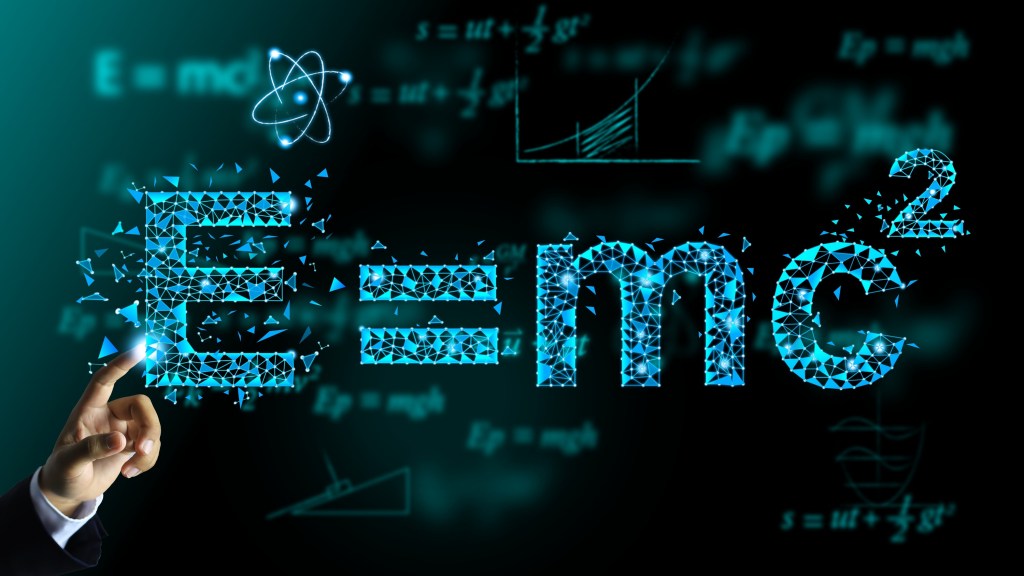
The E = mc2 formula | The Speed of Light In Vacuum Is a Universal Constant
Mass is energy and vice versa, a direct result of the way time and space are related. Stock Photo ID: 2163111377 by Aree_S
Can We Travel Faster Than The Speed Of Light?

So, it seems like we cannot travel faster than the speed of light in vacuum. It seems like the universal speed limit is a hard limit, unlike the speed limits on Texas highways. That is maybe true, at least locally where we are.

However, you could get around it, by what is kind of cheating, by stretching and bending space to the extreme by using, for example, enormous amounts of negative energy. That’s happening to our Universe over a scale of tens of billions of lightyears. I should add that a lightyear is the distance light in vacuum travel in one year. Stretching and bending space is not part of the special theory of relativity. That is Einstein’s General Theory of Relativity.


To see the other Super Facts click here