
Esther’s writing prompt: 6th August : Small
Click here or Here to join in
Small Things
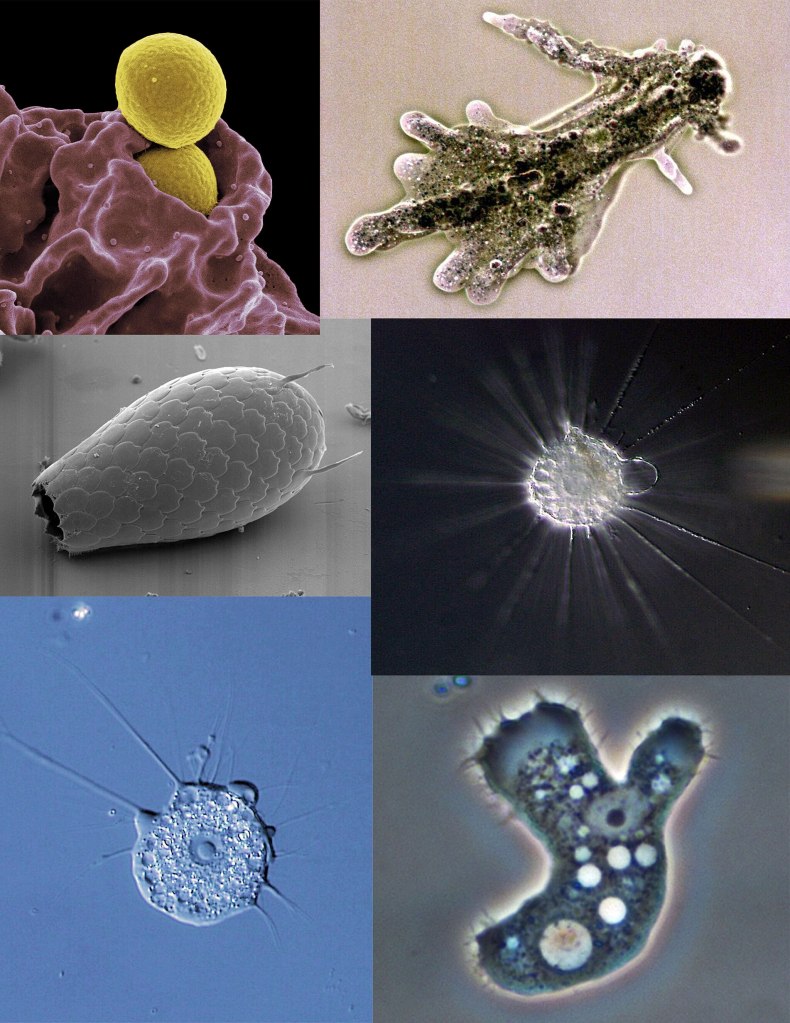
Fire ants are small. They average 1/8 inch to 1/4 inch in length, or 3 to 6 millimeters. Mites are very small arachnids that are less than 1 millimeters. They are so small that they are difficult to see with the naked eye unless they are on a white sheet. However, amoebas are typically even smaller than mites. Most amoebas range from 10 to 500 micrometers in diameter. 500 micrometers is the same as half a millimeter. You typically need a microscope to see an amoeba. I should say that there are some large amoebas that are 2 millimeters.
Microscopic Things
If you want to go even smaller, much smaller, we can enter the microscopic world. Bacteria are microscopic, single-celled organisms with sizes typically ranging from 0.5 to 5 micrometers in length and 0.2 to 1 micrometer in width. That means that bacteria are around 100 times smaller than amoebas. Well, if you consider length. If you consider the volume that is a million times smaller. Comparing an amoeba to a bacterium is like comparing a horse to a small cicada. You certainly need a microscope to see bacteria.
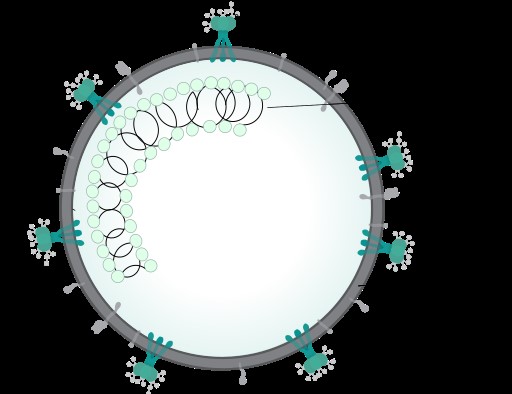
If you think bacteria are small, I can tell you that viruses are even smaller. Viruses typically range in size from 20 to 300 nanometers in diameter. 1000 nanometers is 1 micrometer. A small corona virus (SARS-CoV-2) is 50 nanometers, which is 20 times smaller (in diameter) than a bacterium that is 1 micrometer in size and 100 times smaller (in diameter) than a bacterium that is 5 micrometers. Again, a horse to a medium size insect.
Atoms Are Very Small
Atoms are much smaller than viruses. This reddit user calculated that there are roughly 52 million atoms in a normal sized covid virus (100 nanometers). Also keep in mind that there is a lot of space between atoms. The size of a hydrogen atom is 0.1 nanometer or 100 picometer. Comparing a hydrogen atom to a normal sized covid virus is like comparing a flea to a horse. If you consider volume, you could fill a normal sized covid virus with 1 billion hydrogen atoms.
You cannot see an atom using a regular microscope. You must use specialized microscopes that don’t rely on visible light to see atoms, such as scanning tunneling microscopes and electron microscopes. So, in summary, a hydrogen atom is to a normal sized covid virus like a flea is to a horse, and a normal sized covid virus is to a 100 micrometers amoeba (small sized amoeba) like a flea is to a horse.
Below is an illustration of a Helium atom, which is the next element after Hydrogen. A Hydrogen atom has one electron and one proton and possibly one or two neutrons. A stable Helium atom has two electrons and two protons and one or two neutrons.

Subatomic Things
But let’s go smaller, much smaller. A hydrogen atom is gigantic in comparison to subatomic particles. Most of the mass in an atom is concentrated in the nucleus, which consists of protons, neutrons, quarks and gluons, and quark pairs called mesons. The size of an atomic nucleus varies, but it typically ranges from 1.6 femtometers (1.6 x 10⁻¹⁵ meters) for a proton to about 15 femtometers for the heaviest atoms.
I should say this is difficult to estimate so take this with a grain of salt. In any case that makes the hydrogen atom about 100,000 times wider than the nucleus in its middle. If the hydrogen atom was 100-meter giant ball the nucleus in the middle would be just 1 millimeter (half the size of a flea). That is despite the fact that the vast majority (+99.95%) of the mass of the atom is in the nucleus. In this case, we are not comparing a flea to a horse, but a flea to a mountain. A mountain of mostly empty space with a super massive flea at its center. The YouTube video below explains the details.
Strings Are Extremely Small
However, the smallest things there are, might be strings. Strings, in the context of physics, are one-dimensional, extended objects that are thought to be the fundamental building blocks of the universe. These strings vibrate at different frequencies giving rise to elementary subatomic particles. Strings are thought to be about 10^-35 meters, which is 100,000,000,000,000,000,000 times smaller than the atomic nucleus described above. Comparing a string to a nucleus would be like comparing the hydrogen atom to a ball, or a giant star, containing one billion planet earths. I should mention that string theory has not been experimentally confirmed.
That is small, very small, extremely small, as small as it can get.
This post is not a super fact since it features a lot of facts and not all of them confirmed or exact.
 Super Facts