
Super fact 29: EV Cars emit less pollution than Internal Combustion Engine Cars, even considering manufacturing, disposal and EV Cars being charged by dirty grids.
EV Cars emitting less carbon pollution is a Super Fact
At least here in Texas it is quite common to hear people say that EV cars do not reduce emissions. After all EV cars use electricity from the dirty grid. It is also frequently implied that environmentalists and people who care about fossil fuel emissions do not understand that the electricity for EV cars typically comes from the dirty grid. However, the environmentalists I know do know that. In fact, they typically know more and have sometimes done the math. This is why I consider it a super fact. We know that it is true that EV Cars emit less carbon pollution. This is a fact that matters, it is not trivia, and yet this fact is frequently disputed, argued over, or surprising to people.
EV Cars are more efficient than Internal Combustion Engines
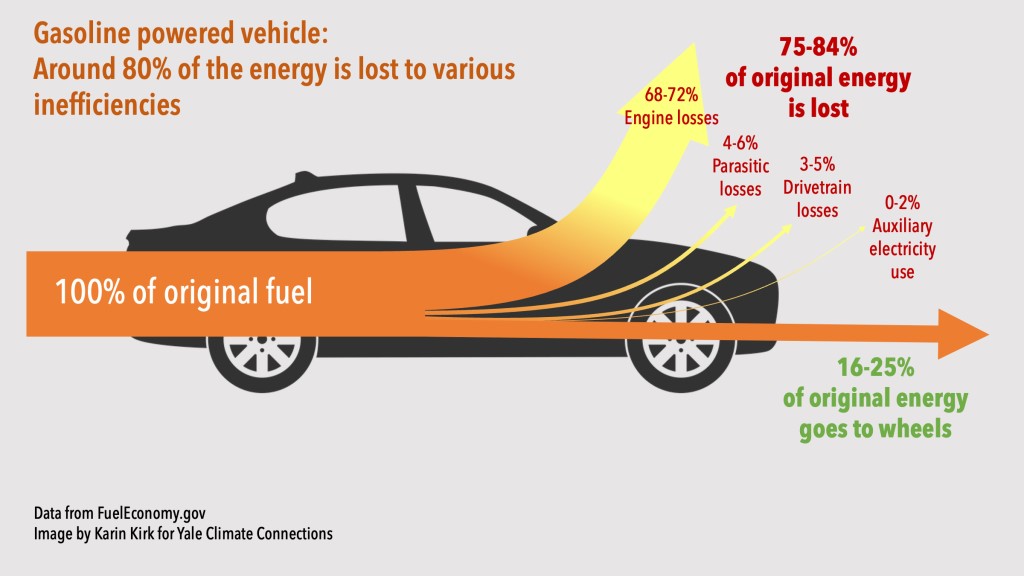
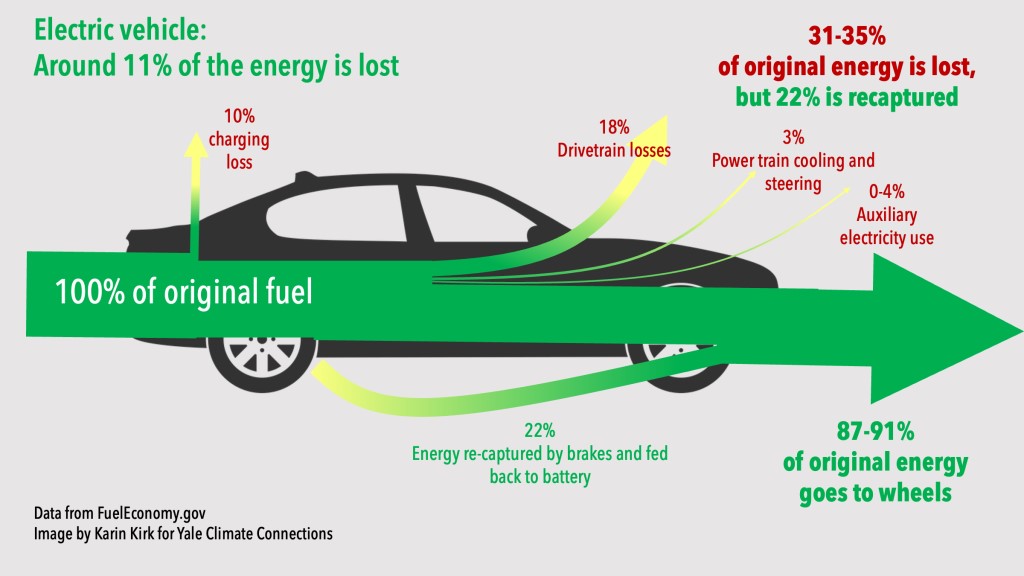
For starters, EV cars are much more efficient than Internal Combustion Engine cars, or ICE, and even a coal-fired power plant is less wasteful than a car engine. The net result is that the emissions caused by EVs via the electrical grid are significantly less per mile. The miles per gallon equivalent (MPGe) for electric vehicles (EVs) varies by state/grid and depends on the model of the car but in general it is much better than for an ICE . Replacing gasoline-powered cars with EVs saves energy, regardless of the energy source used to recharge the EVs. For an ICE 16-25% of the original energy goes to the wheels whereas for an EV 87-91% of the original energy goes to the wheels.
The Manufacture and Disposal of EV Cars
It takes more energy to manufacture an EV battery for an EV car than it does to produce a combustion engine. So, the production of an electric vehicle does emit more carbon than a petrol car. However, the lower emissions resulting from driving an EV means that an electric car quickly pays back that debt, so to speak. It is typically paid back within two years, according to Hannah Richie, the research director at Our World in Data. The statistics show that switching from an average ICE to an equally sized EV will save 1.2 tons of carbon emissions per person and year. That is a lot considering that the average carbon footprint per year is 4 tons worldwide and 14.4 tons per year for an American.
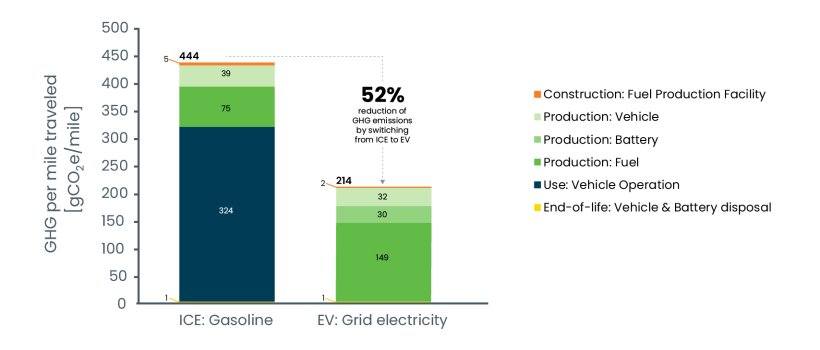
So, are electric vehicles definitely better for the climate than gas-powered cars? This article from MIT answers the question in the affirmative. The graph below includes construction of facilities, manufacturing of vehicle and battery, production of fuel, vehicle operation as well as disposal. It is taken from this government website and this article also answers the question above in the affirmative. This is an article from the Department of Energy is stating the same thing.
Hannah Richie at Our World in Data also states that other environmental damages related to EVs such as mining for minerals are less than the damage from mining and extraction for fossil fuel cars, and she claims that the price of lithium-ion batteries has fallen by 98% over the last three decades. It should be noted that EVs are becoming increasingly common. According to Our World in Data in 2022, 88% of all cars sold in Norway were EVs and 54% of all cars in Sweden were EVs.
Other EV Myths
There are other EV myths that you may want to have debunked, such as Electric vehicle batteries are unreliable and need to be replaced every few years. In 2011 battery failures were common, 7.5%, but in 2023 battery failures were 0.1%. See this article for details and other myth debunking. A related post is my post on electrification.
I should add that there are some drawbacks with EVs such as the easy with which you can charge them, depending on your location. This post is not a promotion of EVs, and I do not drive an EV for various reasons. This post, like most posts in this blog, is about correcting misinformation and getting the facts correct.
To see the other Super Facts click here

 Super Facts
Very interesting. I don’t drive but I think it’s nice when people that do take the environment into consideration and try to use cars that are better for the planet.
LikeLiked by 2 people
Not driving and using public transportation certainly saves the most emissions. We have a hybrid, better than standard ICE but not an EV
LikeLiked by 1 person
I see, hybrid is good too. My cousin has a hybrid too.
LikeLiked by 1 person
Check out https://m.youtube.com/watch?v=3eC5FFoCq4s (It turns out, hybrids are really hard).
LikeLiked by 2 people
Yes they are really hard on the engine. Interesting video. We’ve taken well care of ours.
LikeLiked by 1 person
Very interesting, Thomas! I don’t drive an EV and I think the charging part is the biggest drawback (nevermind the price!) but the facts you wrote about are pretty cool. Thank you for sharing 😊
LikeLiked by 2 people
It is the same reason we don’t have an EV. In Sweden and Norway it is a lot easier to own an EV. We have a hybrid though. As you said, in my blog I am focusing on the facts and myth busting. Maybe one day I will get an EV but not today.
LikeLiked by 1 person
Hi Thomas, this is a very useful post. It’s good to have support for the benefits of EVs as these questions and debates do arise.
LikeLiked by 1 person
Yes you are right. A little bit of myth busting does not hurt.
LikeLike
Exactly.
LikeLiked by 1 person
I’m hoping my next car can be an EV, assuming that a certain administration hasn’t completely destroyed the market for them via short-sighted kingly fiats …
LikeLiked by 2 people
The $7,500 tax credit and the $4,000 tax credit for used ones will be probably go out the window any minute we’ll see. However, the global market is moving toward EVs so the difficulty and cost with owning an EV is likely to be temporary. As for now we have a hybrid.
LikeLiked by 1 person
I suppose electric cars are the solution? Or hybrid.
LikeLiked by 2 people
From what I’ve read and from what I see in Europe (esp. Sweden/Norway) EVs are the future. However, here in the US it is still not easy to own an EV. We currently have a hybrid.
LikeLike
I think it lost my comment. Try two! So much about EVs remains confusing. My son plans to buy one when he returns from deployment to Korea so I’ll learn a lot firsthand.
LikeLiked by 1 person
I’ve had problems with my comments too. I’ve lost about half of them over the last three days. About your son planning to get an EV. That is exciting. It is still not easy to get an EV in the US (compared to Sweden/Norway) but I wish him good luck. I am interested in finding out what he learns. This post was just a myth busting post about the greenhouse gas emissions. Also, thank you so much to him for his service.
LikeLiked by 1 person
I’m always losing comments lately I now copy comments just in case its been worse this week…Anyway electric vehicles all my children have electric cars and they are cheaper and more efficient they love theirs .
LikeLiked by 2 people
That is quite impressive and I am glad they love them. It is a little tougher to own them here in Texas so we just a hybrid. I lose comments all the time too, about half of them.
LikeLiked by 1 person
Java Bean: “Ayyy, more rides, less smog ― sounds like a win to us dogs!”
LikeLiked by 2 people
You are right Java Bean. Our dog Rollo loves car rides too, but not the smog.
LikeLike
Thanks for this detailed look into how Electric Vehicles actually emit less carbon pollution than gas vehicles. I haven’t ever worked through the numbers before. This makes a lot of sense.
LikeLiked by 2 people
Thank you so much for looking at it David
LikeLiked by 1 person
good to know!
LikeLiked by 1 person
Thank you da-AL
LikeLiked by 1 person
Thanks for sharing this Thomas. Good to have the facts!🙌🏽
LikeLiked by 1 person
Thank you so much Cindy. Yes it is widely misunderstood but the EVs really do contribute less emissions.
LikeLike
What about hydrogen fuel cells?
Also, why don’t environmentalists seek to separate the hydrogen from oil or natural gas, leaving behind elemental carbon? Then hydrogen can be used and produce only water, no carbon dioxide or monoxide. The elemental carbon could be used as building material. Does it take much energy to separate the hydrogen?
LikeLiked by 1 person
Hydrogen fuel cells are promising but there are challenges. A decade ago I had great hopes for hydrogen fuel cells, but it is not as easy as it sounds. It currently takes a lot of energy to separate the hydrogen out, and then it is very flammable and leaks very easily and it is difficult to store. Perhaps those problems will be solved one day but then the infrastructure around it has to be built too. That is why we don’t have a hydrogen fuel economy yet.
LikeLike
Why don’t more hybrid cars have a system to recover energy from brakes? Is it called a Kinetic Energy Recovery System (KERS)? Why don’t more cars have it?
LikeLiked by 1 person
Sorry World Questioner, I did not see this comment until now. Short answer, I have no clue, but I cheated and I asked Google AI you first question and this is what came out.
More hybrid cars do have regenerative braking, but it’s less powerful than in pure EVs because hybrids have smaller batteries, less powerful electric motors, and must blend regen with traditional friction brakes for safety and control, especially at low speeds or in emergencies, meaning some energy is always lost as heat, making it less efficient than in a dedicated electric vehicle.
LikeLike
Sorry, the red highlighting was unintentional
LikeLike
I believe that EV cars are ecological under two conditions: they are solar-charged and feature regenerative braking.
There’s no way coal-fired power plants are more fuel-efficient than gasoline and Diesel engines. Coal-fired power plants use turbogenerators, do they not? Do they also have steam turbine generators in addition to gas turbines?
LikeLiked by 1 person
It is definitely better than what you say and as some of the links in my post explain why. Electric motors are 3–4 times more efficient, so even if the electricity is produced from coal, the EV wastes far less energy than a sedan. Now the question that comes to mind is, if the grid is pure coal (very rare) does an EV emit (indirectly) more or less carbon emissions than a sedan of the same size. I took a short cut and asked Google AI this question “If the electricity comes from coal does an EV still emit less carbon than a sedan of the same size” This was the answer
“Yes, even when charged with electricity from a coal-heavy grid, an electric vehicle (EV) generally emits significantly less carbon dioxide (CO2) over its lifetime than a comparable gasoline sedan”
That is surprising since coal is super dirty. However, if you read the various articles about it, you’ll see it is not too surprising.
LikeLike