


So, on what subject(s) am I an authority? My understanding on what being an authority on a subject means is that it is being an expert with recognized credibility on that subject. However, the word “authority” has so many other meanings and it brings to mind the “appeal to authority fallacy”. The “appeal to authority fallacy” refers to appealing to influential people or organizations who may not necessarily be experts, and regardless of the evidence.
In science you don’t really have such authorities, you have experts who often disagree with each other. In the event almost all experts agree on a certain fact that has been thoroughly vetted you can trust that fact with nearly 100% certainty, and that is not appeal to authority but a probability argument. Therefore, I don’t really like the use of the word authority in this context. It is confusing. I would have preferred the question to be “In what subject(s) do you have recognized expertise?”
Robotics
Reflex Control for Obstacle Avoidance and Self Preservation
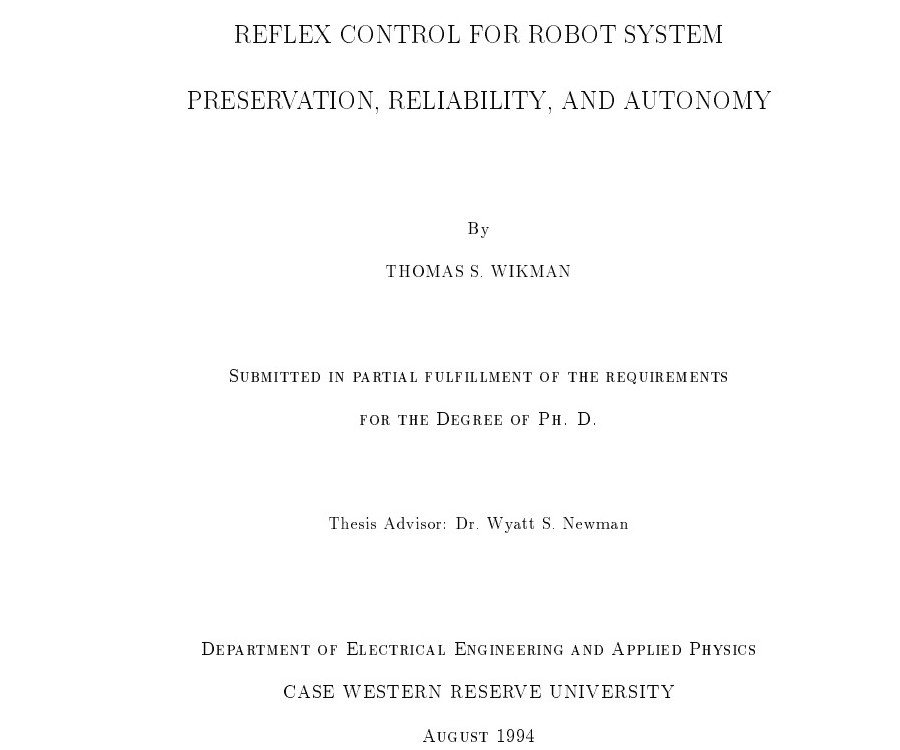
My PhD thesis was in Robotics, specifically Reflex Control for Obstacle Avoidance and Self Preservation. Therefore, you can say that I am an expert on Reflex Control for Obstacle Avoidance and Self Preservation, Reflex Control (in Robotics) as well as Robotics. My expertise has been recognized through my published research papers, the citing of those papers, my PhD thesis, and my peers including Rodney Brooks.
Rodney Brooks is a former director of the MIT Computer Science and Artificial Intelligence Laboratory, founder of several robotics research companies, and he is arguably the most famous roboticist in the world. In the 1990’s he was featured on the front page in national magazines such as Time Magazine several times. During my internship at the Robotics Lab at Sandia National Laboratory in Albuquerque, New Mexico in 1993, I spoke to Rodney Brooks about my research, and he congratulated me on my research, which he liked.
Briefly, reflex control in Robotics refers to functionally simple, quick, and reliable behaviors that override whatever more complex algorithms or humans (joystick / telerobotics) are commanding in case those algorithms or humans execute dangerous motion. Take for example, a robot moving quickly among multiple objects and the path planning algorithm generates a faulty command that would result in a collision when executed. The reflex control layer would detect the problem (assuming it knows about the objects) and halt the robot before it collided with the object. This would need to happen quickly, in milliseconds, and always in a failsafe way. After the collision has been avoided the system or the human can figure out what went wrong and figure out a new path.
To do this the Reflex controller needs to be embedded with the motion controller, and know the characteristics of the motors, the robot configuration, and mechanical characteristics, such as mass, friction model, inertia, etc., exactly. The result is that when you drive a robot around among multiple objects such as boxes hanging from the ceiling, coat racks, and sombreros, and other robots it will avoid colliding with these objects regardless of input from people or high-level path planning algorithms. It looked like the objects were protected by an invisible force field.
Robot Kinematics
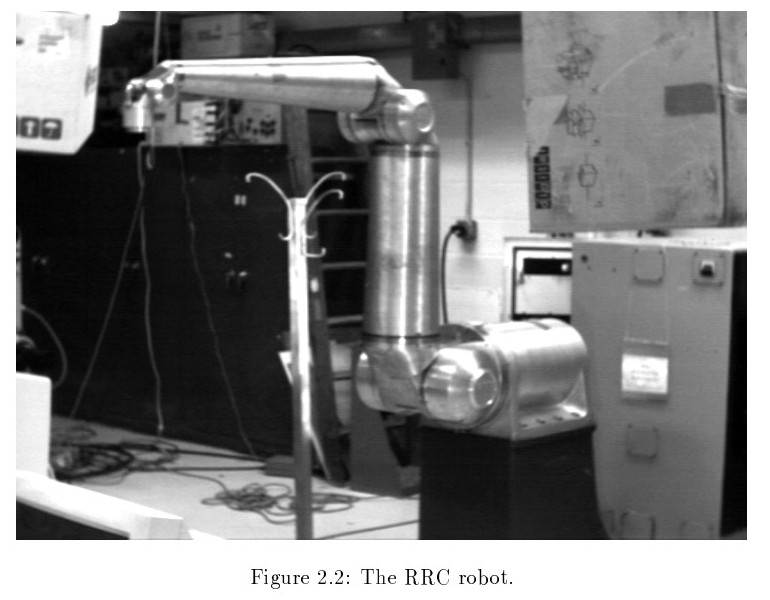
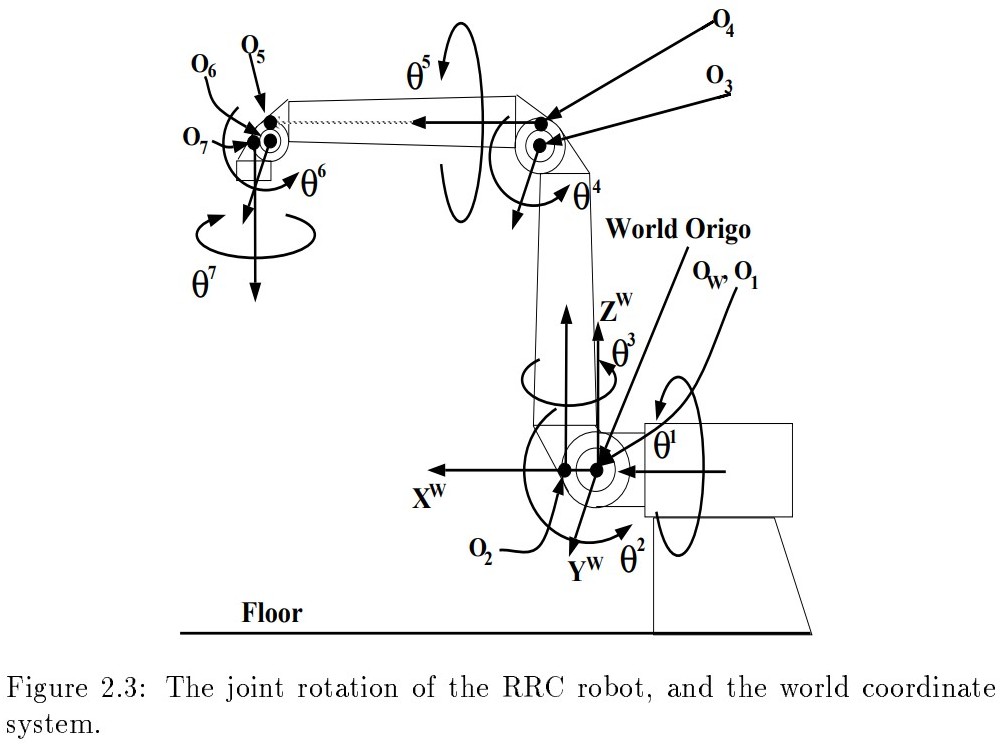
In addition, to “Reflex Control for Obstacle Avoidance and Self Preservation” or “Reflex Control for Robots”, which is very narrow field, I gained expertise in fields of robotics that are a bit wider. One such field is robot kinematics. That includes, for example, calculating the position, speed and acceleration of the tool tip (the end tip) of the robot from the position and motion of the joints of the robot. Or it could be calculating the possible joint angles from the position of the tool tip. The RRC robot was a seven-jointed robot so this could get complicated. I should say that when I worked for ABB Robotics (after my Ph.D) I created the kinematic models for 30+ of ABB Robotics robots. Therefore, I have expertise and recognized credibility in Robot Kinematics as well.
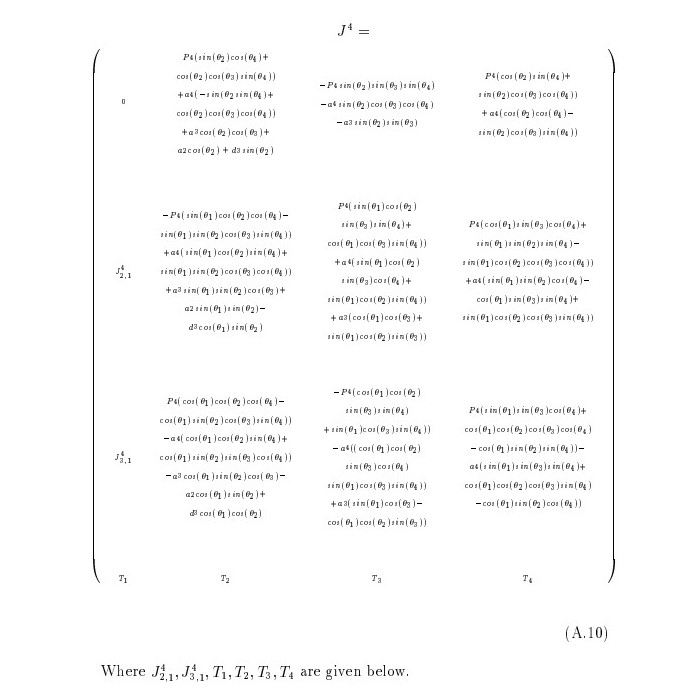
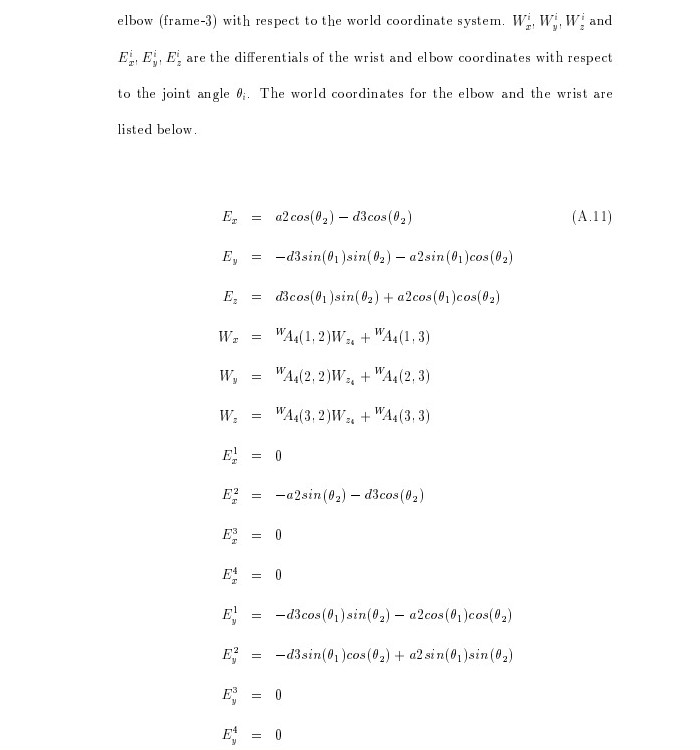
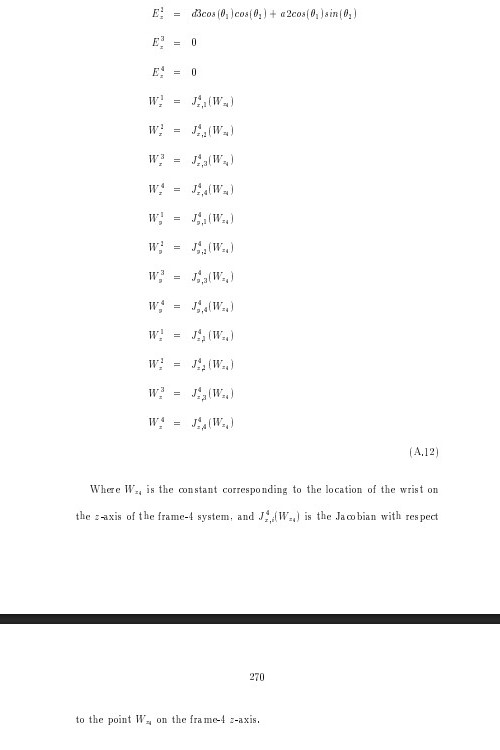
Robot kinematics can get complicated, at least for a seven-jointed robot like the RRC Robot. An example is the Jacobian, which is a matrix that relates joint velocities to end-effector / tool-tip velocities. The Jacobian is crucial for understanding and controlling robot motion, particularly for inverse kinematics and trajectory planning. Below is the Jacobian for the first four joints of the RRC robot. I spent an entire day deriving it. Depending on your eyesight it is difficult to read the scribbles, but it is a bunch of very long, mostly trigonometric equations. Don’t worry about understanding the matrix, it is just to show how complicated robot kinematics can get.

Configuration Space in Robotics
Another subject I gained a lot of expertise in is configuration space or so-called C-space. It is related to robot kinematics. C-space is a mathematical representation of all possible configurations a robot can take. In C-space for a robot arm (like the RRC Robot) the coordinates are the joint angles instead of X, Y and Z. For the seven-jointed RRC robot you have seven joint angles and C-space is thus seven dimensions. C-space is very useful if you succeed in representing obstacles in it. A point might become a curve, or multi-dimensional membrane in C-space, and a ball might become a multi-dimensional banana. I had a lot of fun creating algorithms for creating C-space with obstacles in it.
My Other Expertise
I also have a degree a master’s degree in engineering physics (Teknisk Fysik) from Uppsala University in Sweden. I should say that engineering physics in Uppsala was focused a lot on theoretical physics and modern physics as well as practical applications for physics. Case Western Reserve University later converted this degree to a master’s in electrical engineering. I loved physics and was a good student, but my special interest was the theory of relativity. Even though I had and still have a hard time with the General Theory of relativity and I studied the special theory of relativity way beyond what was required at school, and I read dozens of technical books on the subject. So, this is also sort of an area expertise for me.
Below are some links to topics related to the special theory of relativity on this website:
- The Speed of Light In Vacuum Is a Universal Constant
- Two events may be simultaneous for some but not for others
- GPS uses relativity for accuracy
- Time Dilation Goes Both Ways
- The Pole-Barn Paradox and Solution
I spent at least 30 years working with software as a software engineer / robotics engineer and gained a lot of experience in software development. It was mostly embedded software but also graphical user interfaces, things you can see on a screen, and Networking Software Development. I worked a lot with Visual Studio, a powerful, expandable, and popular integrated development environment (IDE) from Microsoft.
I developed a lot of code using C++ and C#, .Net, WPF, but also other languages and libraries. I started with Visual Studio 97 (in 1997), then Visual Studio 6, Visual Studio .NET 2002, Visual Studio .NET 2003, Visual Studio 2005, Visual Studio 2008, Visual Studio 2010, Visual Studio 2012, Visual Studio 2015, Visual Studio 2017, but I never got around to Visual Studio 2019 and Visual Studio 2022. So, you can say that I am an expert on Visual Studio with C++ and C# and .NET (I am less of an expert on the other languages typically used with Visual Studio).
Later in life I also came to learn a lot about climate change / climate disruption / global warming / the greenhouse effect whatever you call it. I used to be skeptical about climate change, and I thought it might be politicized by the scientific community, but after some interesting red flags I took a deep dive into the subject, and I learned that climate change is very real and caused by us. I was politicized not the scientific community. There is a scientific consensus on the subject for very good reasons. I continued by reading dozens of climate science papers and several dozens of technical and non-technical books on the topic. Therefore, at this point I know more about it than a lot of people. Maybe expert is a strong word, but almost expert.
Least but not last
Being a Leonberger Dog Expert
I know a lot about Leonbergers because my family was lucky enough to live with one for thirteen years. His name was Le Bronco von der Löwenhöhle—but we called him “Bronco” for short. Bronco wasn’t our only dog, but our world wouldn’t have been the same without him. For instance, he once saved the life of our pug by fending off an attack from another dog. He probably saved our Labrador’s life, too, by sniffing out an impending insulin shock before it happened. Then there was the time he scared off a trespasser who’d been terrorizing my wife and other women in the neighborhood.
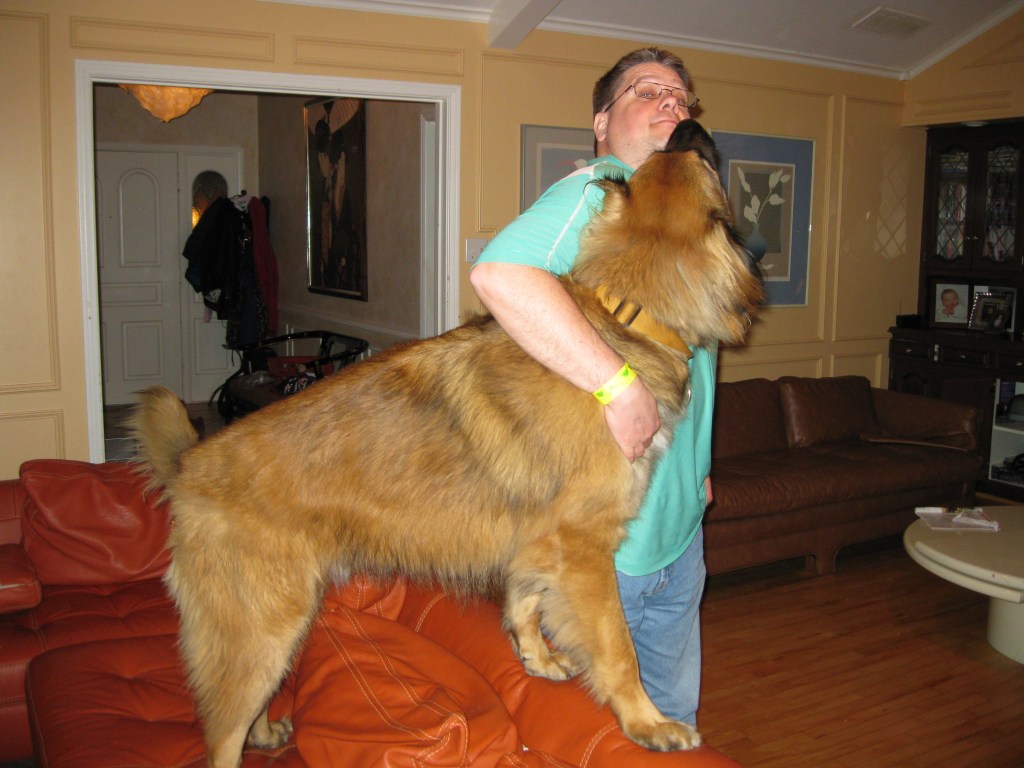
Bronco is no longer with us, but even in his passing he was distinctive. Leonbergers tend to live less than nine years—but Bronco came very close to reaching his thirteenth birthday. In fact, he received an award for longevity called the “Grey Muzzle Award.” We already knew he was a special dog, but we sent his DNA to two labs for research anyway. I wrote a book about our amazing Bronco and his many amusing adventures and included helpful information on Leonbergers for new owners and interested dog lovers. I also have a Leonberger website.
In the process of writing my book about Bronco and Leonbergers I came to learn a lot about Leonberger dogs, the Leonberger breed standard, their history, health issues, Leonberger organizations, health and care, etc. I became a bit of a Leonberger expert. If you are interested in the book, check it out here or here. You can also get it from Amazon in many other countries, Barnes & Noble, Chapters Indigo and many other bookstores. For more information check here.
To see the Super Facts click here

 Super Facts
It’s truly amazing how Bronco lived nearly 13 years. What an amazing dog he was.
LikeLiked by 1 person
Yes I think so too. He was amazing and we think about him all the time. Thank you so much Sara.
LikeLiked by 1 person
I have to mention Bronco and the fact he had a long life well lived and loved partly down to you guys the rest ..breeding…Robotics most of this post went straight over my head however one store and one restaurant where I live use robotics one goes arround the store avoiding the shoppers carrying some special offers..the one in a restaurant we frequent brings out your order and knows which table to stop at its so cool…again avoiding any obstacals (people) …Have a great weekend Thomas 🙂
LikeLiked by 1 person
Thank you so much for your kind words Carol. Bronco cetrainly left us with beautiful memories and we miss him. That sounds like a very cool mobile robot. Yes obstacle avoidance is a very important field in robotics.
LikeLiked by 1 person
It is, Thomas I love watching it bring food out 🙂
LikeLiked by 1 person
I would like to visit this restaurant. What is the name?
LikeLiked by 1 person
Hi Thomas..I live in Thailand it’s called Ootoya Japanese Restaurant but it might not be a chain which reaches your shores though… 🙂
LikeLiked by 1 person
Oh Thailand, well that is a bit far. I just looked it up and Ootoya does have a restaurant in New York too. It is still a bit far but I will keep in mind next time I visit New York.
LikeLiked by 1 person
Hi Thomas…A bit closer than Thailand…if I remember I will take a picture next time we go as its one of my grandaughters favourite restaurants 🙂
LikeLiked by 1 person
Yes that would be very cool to see
LikeLiked by 1 person
Fascinating read, Thomas.
Your distinction between “authority” and “recognized expertise” is well-argued and refreshingly honest. I was especially intrigued by your work on reflex control; the image of a robot navigating objects as if surrounded by an invisible force field is both poetic and technically striking. Thank you for sharing such a detailed, behind-the-scenes look at robotics. It makes a complex field accessible and human.
Happy 4th of July!
Thinking back, I wonder what beer will be on the menu today.
LikeLiked by 1 person
Thank you so much Patricia. We made a video of the RRC robot as it was navigating and creating maps using a sonar sensor and it looked like an animal. Unfortunately, I no longer have any of those videos. As for beers today, I Westvleteren, not Westvleteren 12 but Westvleteren 8 and Westvleteren 10. I also have Yellow Rose my favorite Texas IPA and I have struck by lightning and bit by a cobra, an imperial IPA, a smoked Märzen (rauchbier), and a bourbon barrel aged pumpkin beer, and a few more. I have not decided.
LikeLiked by 1 person
Wishing everyone a festive 4th of July!
This idiom, “struck by lightning and bit by a cobra” is priceless!! I love idioms.
LikeLiked by 1 person
Thank you so much Patricia. It is the first time I hear “struck by lightning and bit by a cobra”. I agree with you and I just noticed that it is brewed by Prairie Artisan Ales, my favorite Oklahoma brewery. Maybe I’ll have that one while grilling.
LikeLike
Grilling and celebrating – that, I understand. There’s no celebration without a “braai” here either. And nothing keeps a South African from turning a braai into a celebration either 🙂
LikeLiked by 1 person
Ha ha that is interesting so braai is barbeque i afrikaans?
LikeLiked by 1 person
More than barbecue, it encompasses the whole experience of enjoying good food and good company.
LikeLiked by 1 person
That is interesting. I didn’t know that.
LikeLiked by 1 person
I love the topic of robotics, but got lost at the title! And then the formulae. Sigh. Elon Musk–help me!
LikeLiked by 1 person
Thank you so much Jacqui. In the past you always had to have coordinate transform matrixes and Jacobians and possibly inverse kinematics and it was tough math. Well if you wanted high performance robots with high speed and precision. I liked doing the math though. However, I’ve read that now a day there are ways of getting around it using neural networks. Happy 4th of July.
LikeLiked by 1 person
Java Bean: “Ayyy, wow, that is a lot of math! Our Dada says he is having flashbacks to Differential Equations or ‘Diff-EQ’ or ‘Diffie-Screw’, which apparently are all the same thing with different names.”
Lulu: “Kind of like us and all our nicknames!”
Java Bean: “Sí! Only less affectionate I think.”
Chaplin: “Around here we know a little bit about a lot and a lot about a little bit, but when it comes to dogs, we know the most about vizslas, even though we haven’t got any of those at the moment.”
Charlee: “Bean kind of looks like one, though.”
LikeLiked by 1 person
Java Bean, I did not know your Dada did math, and I did differential equations too. They were in the dynamics/moving mechanics of robotics, and in non-linear control systems for robots, and in physics and in economics too, of all places. That was Macroeconomics, specifically Keynesian economics. Non-linear differential equations can be tricky. Chaplin knowing about Vizslas is great knowledge and you all Java Bean, Chaplin, Lulu and Charlee have great nick names.
LikeLiked by 1 person
I did math for the first couple years of college, before switching to philosophy and psychology. I still remember the concepts of differential equations and the rest even though I’m quite sure I couldn’t solve the area under a curve anymore … 😁
LikeLiked by 1 person
That is interesting. I loved math, but if you are an engineering major you will not dive into advanced math as deep as a math major. I don’t know what I would have thought if I was a math major. I guess about the area under a curve, for me it all depends on the curve. I can still do the simple ones (y = x^2).
LikeLike
Hi 👋 this post is a bit to long for me to read today.. but I’m sure it’s really good! Have a great holiday weekend
LikeLiked by 1 person
Thank you have a good holiday you too
LikeLiked by 1 person
👍💙
LikeLiked by 1 person
I find your scientific mind fascinating, Thomas, because it’s so different from my non-scientific mind! Lol. I appreciate that you explain most things in a way that I can understand, and I always feel a little smarter after reading your posts.
Robotics – hey, someone’s gotta do it. Hehe. Leonbergers and dogs in general – that’s right up my alley.
LikeLiked by 1 person
Thank you so much Diane. We are all different. The creative and imaginative books you write is something I have no idea how you do it. I think Leonbergers and dogs is everyone’s topic.
LikeLiked by 1 person
Thanks, Thomas, for the kind comment. Have a dog-wonderful day. They have a lot to show us about fun and love.
LikeLiked by 1 person
Thank you Diane and have a wonderful dog-day you too
LikeLiked by 1 person
You’re an incredibly intelligent person, I’m awful at all the sciences and maths- I’m in awe of those that are so good at those subjects. It’s also very cool how you took the time to read more about climate change and ended up with a different opinion than before. I really like how much your family takes care of its pets and that you took the time to learn more about Leonbergers. Bronco making it to 13 despite the average being less than 9 shows he was loved and properly cared for.
LikeLiked by 1 person
Well, thank you so much for your very kind words Pooja. We know different things and you know and understand a lot of things I don’t. You are an incredibly intelligent person.
LikeLiked by 1 person
Thank you as well but I think it really takes so much to be good at stuff like physics and maths. That’s so impressive to me.
LikeLiked by 1 person
Thank you so much Pooja. I am very impressed by your Word-Press and SEO knowledge and your poetic talent.
LikeLiked by 1 person
Thanks, that’s really nice of you to say.
LikeLiked by 1 person
Fantastic!
LikeLiked by 1 person
Thank you Dawn
LikeLike
Very interesting, esp about climate change. Great post! 😎👏
LikeLiked by 1 person
Thank you so much Darryl
LikeLike
Very impressive, Thomas! I enjoyed learning more about that brilliant mind of yours—merging robotics, engineering physics, climate change, and Leonbergers. Whee!
LikeLiked by 1 person
Thank you so much for your very kind words Mindful Mystic.
LikeLike
Hi Thomas. Expertise is definitely the correct word. And you are amazing at science, and of course, taking care of Le Bronco for such longevity. I believe they say the same lifespan for Newfoundlanders. My sister had one and lived until almost 13! 🙂
LikeLiked by 1 person
Thank you so much Debby. Yes the Newfoundlanders are in the same boat (or gene pool) as Leonbergers. They are related (St. Bernards, Newfoundland, Leonbergers, Pyrenee dogs). It is amazing about your sister’s Newfoundland reaching almost 13.
LikeLiked by 1 person
Strange phenonema. 🙂 🙂
LikeLiked by 1 person
Yes it makes me wonder if the Leonberger Health Foundation International also take DNA from related species such as Newfoundland and St. Bernards or if they have their own health foundations.
LikeLiked by 1 person
I love your research-focused approach to the questions of life, Thomas. Though it may not appear to be so, I’m a researcher at heart — but more of human nature and the non-measurable parts of life. BTW, I had never heard of Leonbergers before your posts and love the breed. 😊
LikeLiked by 1 person
Thank you so much for your kind words Gwen. Most people have not heard of the Leonberger breed. It is a rare breed. Its cousin the St. Bernard is more common.
LikeLiked by 1 person
Fascinante 💯
LikeLiked by 1 person
Hi Thomas, I really enjoyed this post. It is good to learn so much more about you.
LikeLiked by 1 person
Thank you so much for your kind words Robbie
LikeLike