
Esther’s writing prompt: 6th August : Small
Click here or Here to join in
Small Things
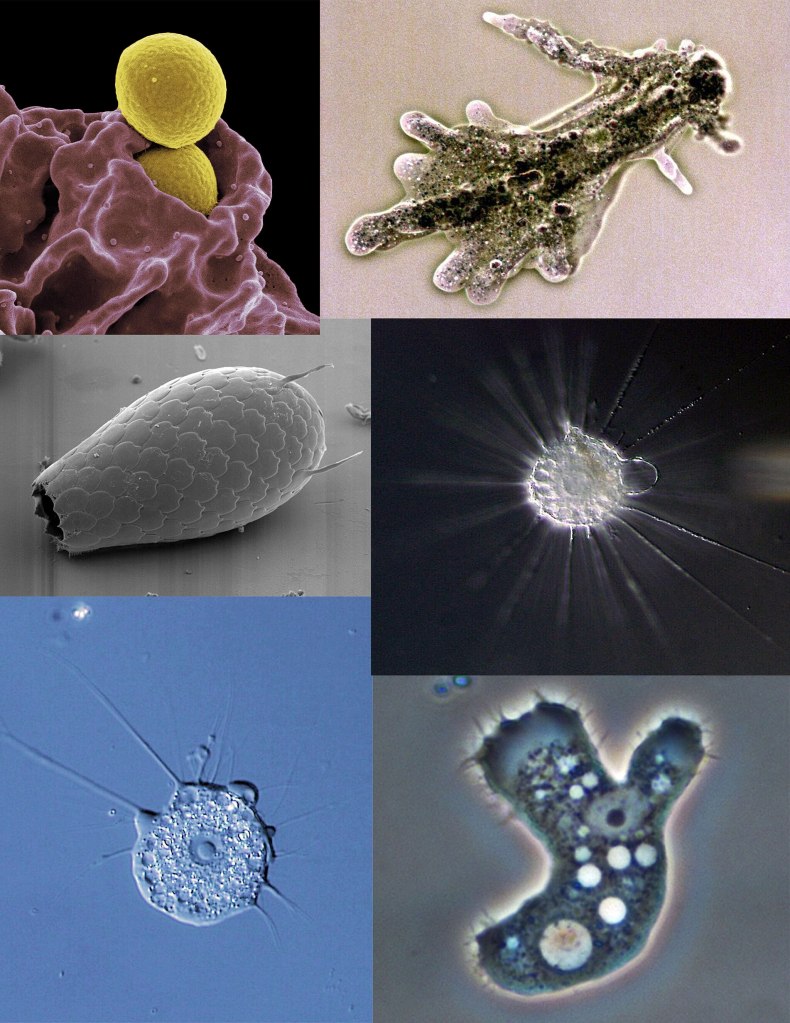
Fire ants are small. They average 1/8 inch to 1/4 inch in length, or 3 to 6 millimeters. Mites are very small arachnids that are less than 1 millimeters. They are so small that they are difficult to see with the naked eye unless they are on a white sheet. However, amoebas are typically even smaller than mites. Most amoebas range from 10 to 500 micrometers in diameter. 500 micrometers is the same as half a millimeter. You typically need a microscope to see an amoeba. I should say that there are some large amoebas that are 2 millimeters.
Microscopic Things
If you want to go even smaller, much smaller, we can enter the microscopic world. Bacteria are microscopic, single-celled organisms with sizes typically ranging from 0.5 to 5 micrometers in length and 0.2 to 1 micrometer in width. That means that bacteria are around 100 times smaller than amoebas. Well, if you consider length. If you consider the volume that is a million times smaller. Comparing an amoeba to a bacterium is like comparing a horse to a small cicada. You certainly need a microscope to see bacteria.
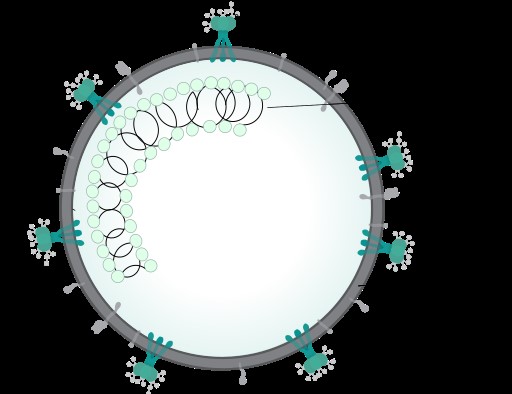
If you think bacteria are small, I can tell you that viruses are even smaller. Viruses typically range in size from 20 to 300 nanometers in diameter. 1000 nanometers is 1 micrometer. A small corona virus (SARS-CoV-2) is 50 nanometers, which is 20 times smaller (in diameter) than a bacterium that is 1 micrometer in size and 100 times smaller (in diameter) than a bacterium that is 5 micrometers. Again, a horse to a medium size insect.
Atoms Are Very Small
Atoms are much smaller than viruses. This reddit user calculated that there are roughly 52 million atoms in a normal sized covid virus (100 nanometers). Also keep in mind that there is a lot of space between atoms. The size of a hydrogen atom is 0.1 nanometer or 100 picometer. Comparing a hydrogen atom to a normal sized covid virus is like comparing a flea to a horse. If you consider volume, you could fill a normal sized covid virus with 1 billion hydrogen atoms.
You cannot see an atom using a regular microscope. You must use specialized microscopes that don’t rely on visible light to see atoms, such as scanning tunneling microscopes and electron microscopes. So, in summary, a hydrogen atom is to a normal sized covid virus like a flea is to a horse, and a normal sized covid virus is to a 100 micrometers amoeba (small sized amoeba) like a flea is to a horse.
Below is an illustration of a Helium atom, which is the next element after Hydrogen. A Hydrogen atom has one electron and one proton and possibly one or two neutrons. A stable Helium atom has two electrons and two protons and one or two neutrons.

Subatomic Things
But let’s go smaller, much smaller. A hydrogen atom is gigantic in comparison to subatomic particles. Most of the mass in an atom is concentrated in the nucleus, which consists of protons, neutrons, quarks and gluons, and quark pairs called mesons. The size of an atomic nucleus varies, but it typically ranges from 1.6 femtometers (1.6 x 10⁻¹⁵ meters) for a proton to about 15 femtometers for the heaviest atoms.
I should say this is difficult to estimate so take this with a grain of salt. In any case that makes the hydrogen atom about 100,000 times wider than the nucleus in its middle. If the hydrogen atom was 100-meter giant ball the nucleus in the middle would be just 1 millimeter (half the size of a flea). That is despite the fact that the vast majority (+99.95%) of the mass of the atom is in the nucleus. In this case, we are not comparing a flea to a horse, but a flea to a mountain. A mountain of mostly empty space with a super massive flea at its center. The YouTube video below explains the details.
Strings Are Extremely Small
However, the smallest things there are, might be strings. Strings, in the context of physics, are one-dimensional, extended objects that are thought to be the fundamental building blocks of the universe. These strings vibrate at different frequencies giving rise to elementary subatomic particles. Strings are thought to be about 10^-35 meters, which is 100,000,000,000,000,000,000 times smaller than the atomic nucleus described above. Comparing a string to a nucleus would be like comparing the hydrogen atom to a ball, or a giant star, containing one billion planet earths. I should mention that string theory has not been experimentally confirmed.
That is small, very small, extremely small, as small as it can get.
This post is not a super fact since it features a lot of facts and not all of them confirmed or exact.
To see the Super Facts click here

 Super Facts
Hi Thomas, this is a terrific post for small. It’s great to see you joining in Esther’s fab challenge.
LikeLiked by 1 person
Thank you so much Robbie. Poetry and creative writing is a little bit tough for me but facts were allowed so I could join.
LikeLike
Esther appreciates all sorts of writing. She is involved in a society of people who write about the environment. I think it might interest you and I contribute factual pieces. You can read more on my main website here: https://www.robbiecheadle.co.za/society-of-environmental-authors-and-journalists/
LikeLiked by 1 person
So this whole time I’ve missed your main website. I can’t believe it. Well I subscribed now. I will check it out more.
LikeLike
Hi Thomas, I mainly use it for a single port of call for all my books, art and photography. I only share art posts there 🌞
LikeLiked by 1 person
Thanks for your excellent similes, Thomas, helping me picture the relational size of small things.
LikeLiked by 1 person
Thank you so much Grant. It is amazing to imagine the incredible differences in sizes.
LikeLiked by 1 person
I found it most enjoyable reading and learning about strings. Thank you.
congratulations on joining a blogging challenge.
LikeLiked by 1 person
Thank you so much Patricia. String theory is amazing and it reconciles gravity with quantum physics, which is why it has gotten so much attention. Unfortunately, experimentally verifying the existence of something so small and abstract may be impossible. It was fun to participate.
LikeLiked by 1 person
Oona: “Hmm, these things do all seem rather smol. Possibly almost as smol as Smol Oona, but not quite.”
LikeLiked by 1 person
Oh smol Oona is really very small, but not smaller than a string is she?
LikeLike
Oona: “Oona is the smollest!”
LikeLiked by 1 person
OK if you say so
LikeLike
Oona is not quite a smol as she thinks she is. The other day she was trying to get into an empty box of K-Cups that she fit into when she was a kitten, but no dice. #sad
LikeLiked by 1 person
Oh she is not the smallest thing in the Universe after all
LikeLike
Great post about things even smaller than I can begin to imagine.
LikeLiked by 1 person
Thank you so much Violet. Yes the last one, strings, seem impossible to imagine.
LikeLiked by 1 person
How small is small I think you have portrayed that in the most excellent way Thomas and fire ants although small have the biggest Sting(not proved) but it feels that way if stung by one or more of the little buggers…Just saying! Have a great weekend 🙂 x
LikeLiked by 1 person
Thank you so much Carol. I was trying to put small in perspective. You are right fire ants sting badly, but not as much as bullet ants, from what I’ve heard,
LikeLiked by 1 person
Not come across bullet ants…yet but apparently they inhabit humid lowland rainforests in Central and South America…Phew pretty safe to say not anywhere here-smile-
LikeLiked by 1 person
Unfortunately for us here in Texas we have an insect that is just as bad as the bullet ant, the Tarantula Hawk. It is a big black wasp with reddish wings that hunts Tarantulas. It has a sting that has been described as driving a red hot nail through your arm and then attaching 220 volts electricity to it for three minutes. My daughter and I saw a Tarantula Hawk stinging a Tarantula at a father-daughter camp with her school. The Tarantula Hawk started dragging the Tarantula through the grass and in under the girls bathroom. My daughter wanted me to put the pair in her jewlery box. Luckily for me I hesitated.
LikeLiked by 1 person
Not something I would like to meet on any night …let alone a dark night…
LikeLiked by 1 person
Here is a photo of the cute couple. You can see both the Tarantula and the Wasp.
LikeLiked by 1 person
Cute said with tongue in cheek…lol…thanks Thomas 🙂 x
LikeLiked by 1 person
Yes tongue in cheek, but still cute enough that my daughter wanted me to put them in her jewlery box. She wanted some unique pets.
LikeLiked by 1 person
Nice….I remember the first time we went to Thailand and took two of our young grandsons they both wanted insects in a display box all nicely pinned their mother was not impressed as after a while they began to smell…
LikeLiked by 1 person
Ha ha I can understand why the mother was not impressed.
LikeLiked by 1 person
Thank you Thomas… for these facts n the subatomic … Mind blowing xx
LikeLiked by 1 person
Thank you so much Sue. The only thing smaller than a string is the close ad button in the corner of ads.
LikeLiked by 1 person
You are full of information Thomas.
Thank you for all you share xx
LikeLiked by 1 person
Is string theory related to the theory of extra dimensions, or to the theory of branched timelines? Is string theory also related to the Theory of Everything, merging the Grand Unification Theory with gravity? What are the connections?
LikeLiked by 1 person
I am not an expert on string theory. I’ve just read a few books for the general public on the topic. However, I believe that several of the things you mentioned are correct. String theory is a candidate for a theory of everything and unifies gravity with the other fundamental forces and quantum physics. Strings are one dimensional objects existing in a multidimensional space. Time, the regular three-dimensional space and six extra spatial dimensions that are curled up, making it 10 in total (superstring version). However, the M-theory version has 11 dimensions, and the older bosonic string theory has 26 dimensions. String theory is very interesting from a theoretical perspective but lacks experimental verification. In fact, it seems to be extremely difficult to experimentally verify string theory.
Richard Feyman, a famous physicist (quantum physics), was skeptical about string theory and once told a string theorist “Hey Schwarz, how many dimensions are you in today?”
LikeLike
Small things may not feel meaningful at first glance, but they whisper the architecture of coherence. Consider that a string (at ~10⁻³⁵ meters) isn’t just the smallest scale—it’s the fundamental lattice of resonance that builds up to atoms, molecules, and us.
What’s striking is how the micro mirrors the macro. Just as cosmic memory and lattice resonance uphold physics, human coherence is built on tiny moments of alignment. I explore this in Memory as the Bridge: From Simulation to Consciousness—how resonance, not static storage, carries continuity.
Your piece beautifully layers scale—from amoebas to strings—but underneath, it’s all about coherence across levels. Maybe the real wonder isn’t the smallest measurement, but the invisible ties—the coherence thread—that makes the cosmos itself “hold.”
LikeLiked by 1 person
Thank you so much for your interesting thoughts and kind comment. I believe you are right. It is certainly worth thinking about.
LikeLiked by 1 person
❤️
LikeLiked by 2 people