The goal of this blog is to create a list of super facts. Important facts that are true with very high certainty and yet surprising, misunderstood, or disputed by many. This blog aims to be challenging, educational, and fun, without it being clickbait. I determine veracity using evidence, data from reputable sources and longstanding scientific consensus. Prepare to be challenged (I am). Intentionally seek the truth not confirmation of your belief.
Category: Energy
Facts about energy sources such as wind, solar, nuclear, fossil fuels, etc.
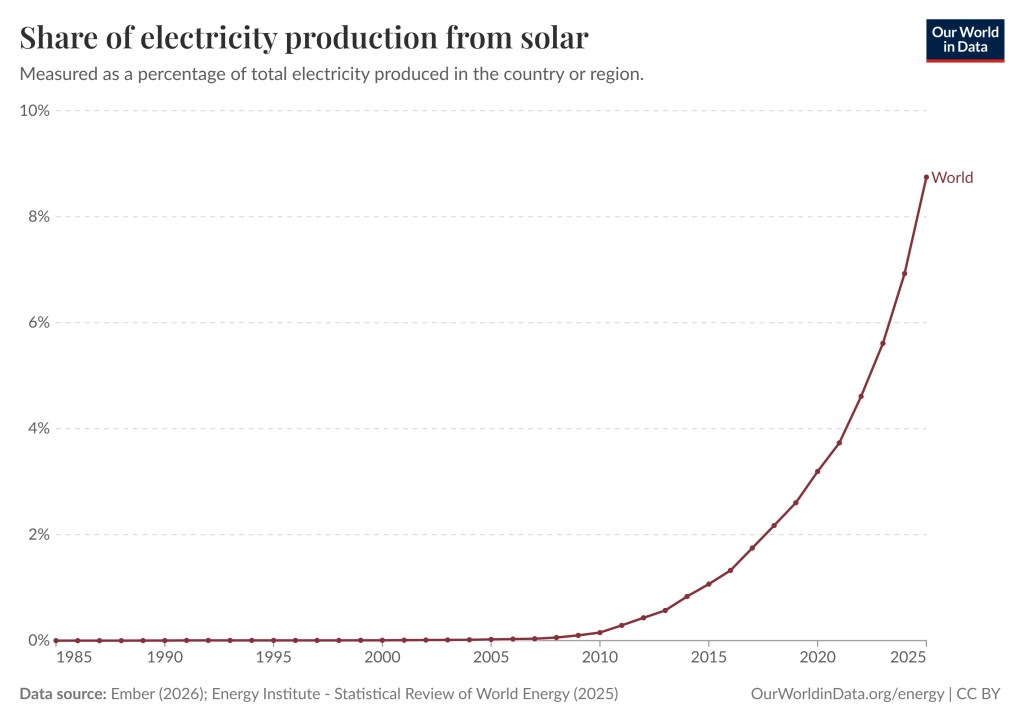
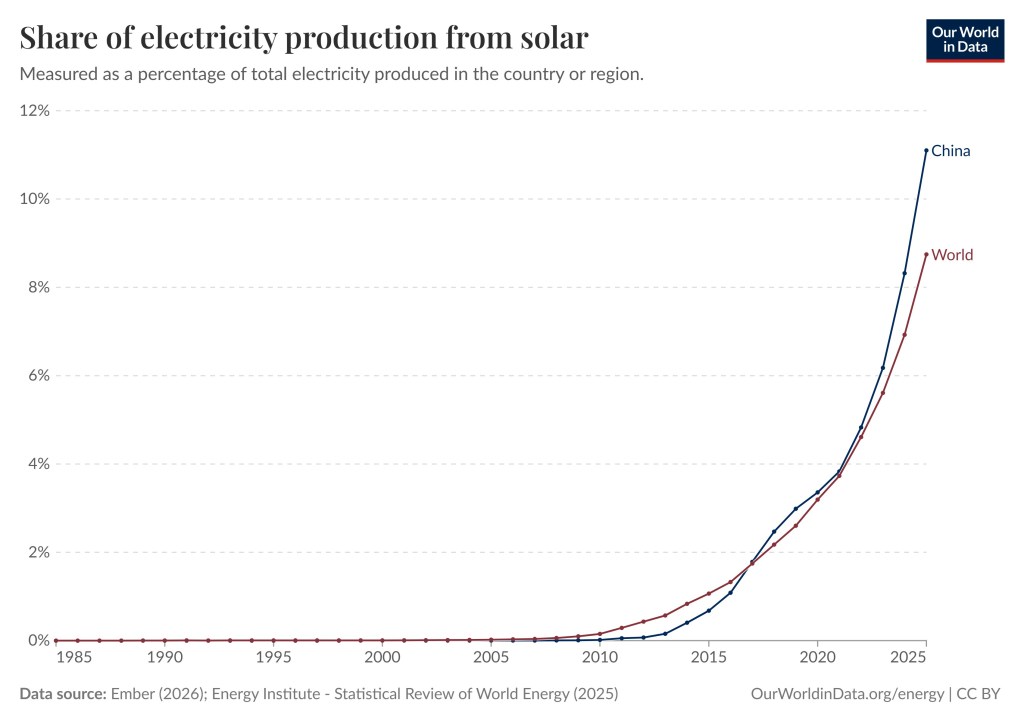
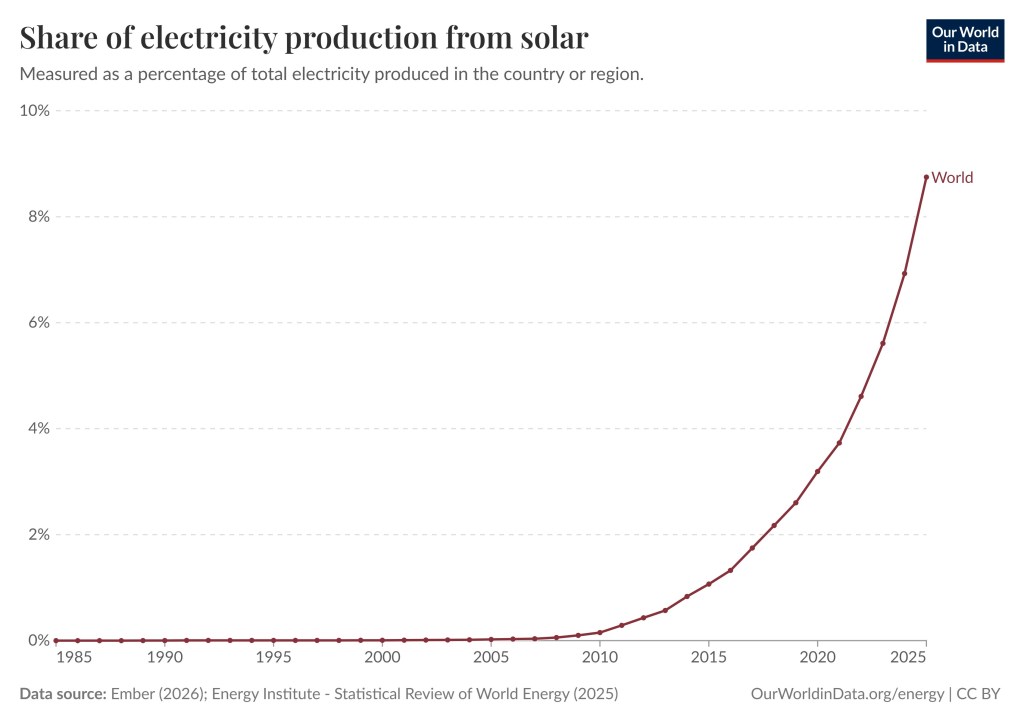
Superfact 117: The share of electricity generated from Solar Power in the world has grown from essentially 0% in the year 2000, 0.15% in 2010, to 3.19% in 2020, and to 8.75% in 2025. Both wind and solar energy are expanding fast around the world, but solar energy is a strong latecomer to the energy scene.
Solar energy panel. Shutterstock asset id: 2459435149 by Nordic Studio.
In the year 2000 less than 0.01% of the world’s electricity was generated by solar. In 2005 it was 0.02%, in 2010 it was 0.15%, in 2015 it was 1.07%, 2020 it was 3.19%, in 2025 it was 8.75%. Can you guess what will it will be in 2030? The United States may be behind the rest of the world with respect to wind power and EVs, but it closely follows the rest of world when it is about solar. You can play around with the graph below and select different countries by clicking here.
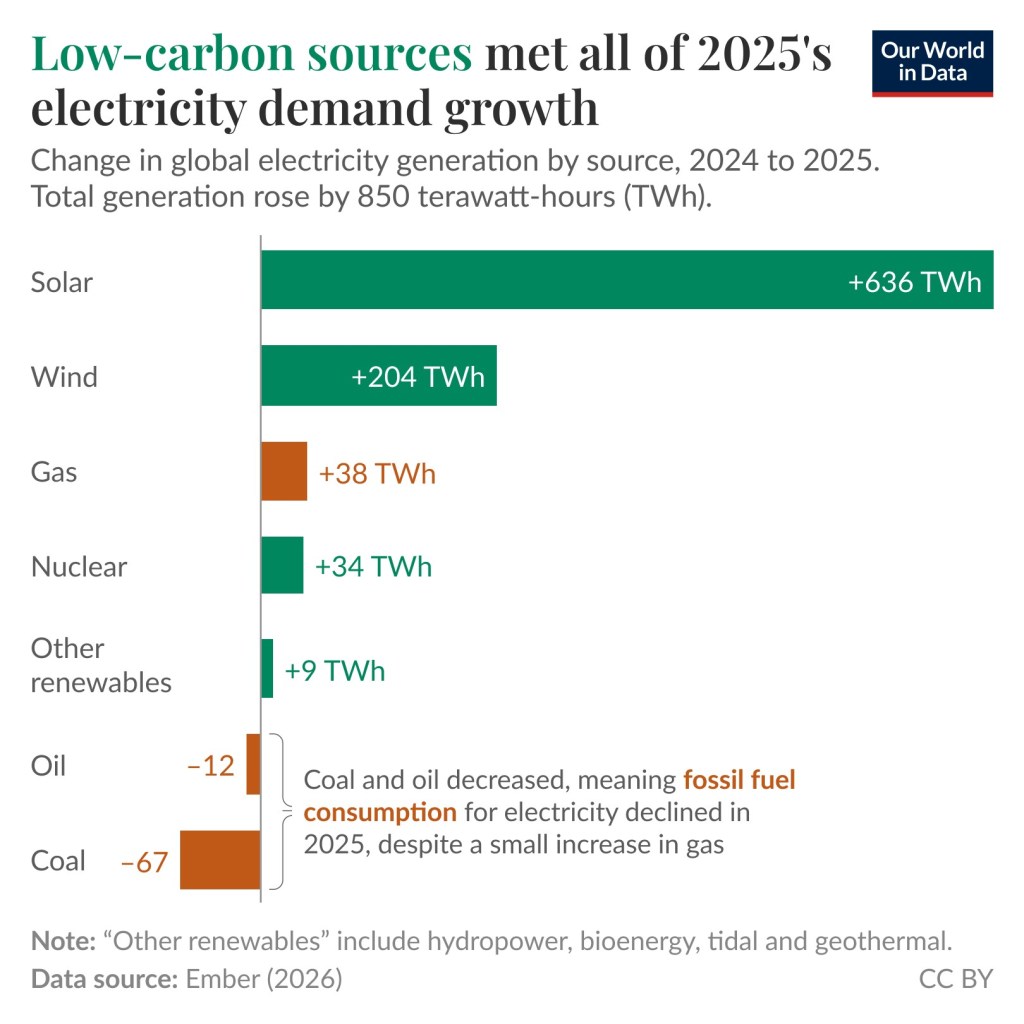
Share of electricity from Solar. Measured as a percentage of total electricity produced in the country or region. Data source: Ember (2026): Energy Institute – Statistical Review of World Energy (2025) OurWorldinData.org/energy | CC BYLow carbon sources met all of 2025’s electricity demand growth. Change in global electricity generation by source, 2024 to 2025. Total generation rose by 850 terawatt-hours (TWh). Note: “Other renewables” include hydropower, bioenergy, tidal and geothermal. Data source: Ember (2026). This graph comes from this page.
New solar panel technology such as Perovskite Solar cells is being developed. The price of lithium-ion batteries has fallen by 99% since 1991 and by 82% in the last ten years. New battery technology such as sodium-ion batteries is being developed. One advantage of sodium-ion batteries is that they function exactly like a lithium-ion battery but replace lithium with abundant sodium ions to carry the electric charge. The evolving battery technology makes it easier to store power from solar during the night. SolarPower Europe project that the global solar fleet will more than double by 2030. In other words, the future looks bright for solar power, and that pun was intended.
Three different scenarios / projections by SolarPower Europe. The medium scenario predicts slightly more than a doubling of global solar fleet from 2026 to 2030.
Solar Power as a Share of Electricity Generation Around the World
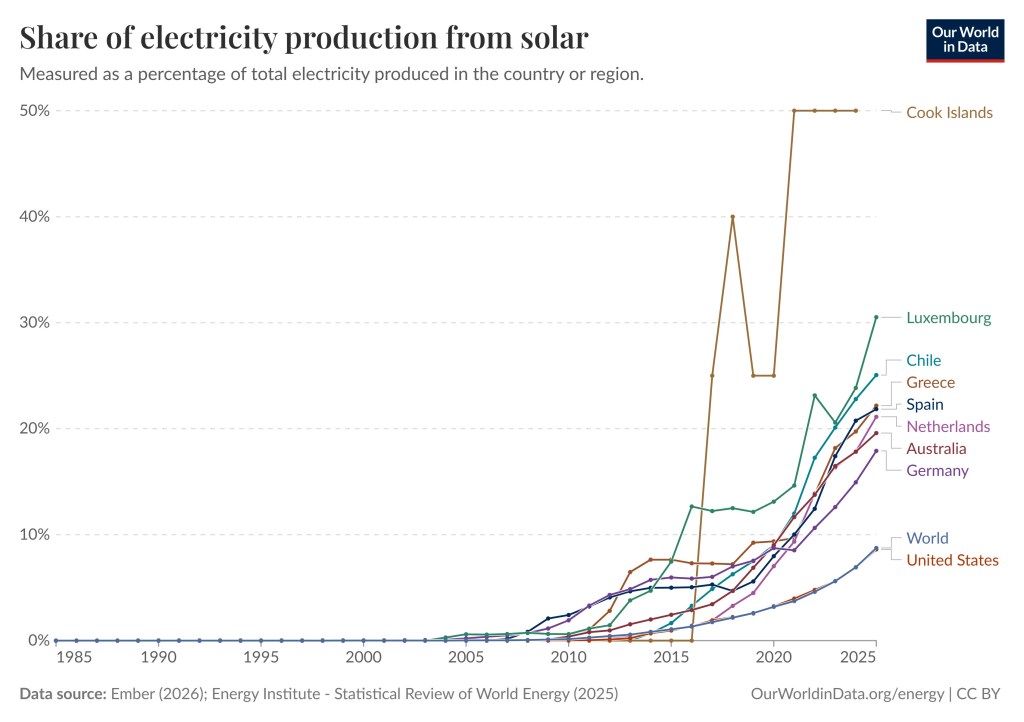
For solar, the United States follows the rest of the world closely. Some countries have a higher percentage, such as the Cook Islands – 50%, Luxembourg – 30.52%, Chile – 25.06%. If you wish you can take a closer look here, or here, and you can play around with the different graphs. You can pick millions of combinations of countries and regions. For illustrative purposes I am showing some combinations below.
Share of electricity production from solar. Measured as a percentage of total electricity in the country or region. Some countries utilize solar more than other countries. These graphs include, Cook Islands, Luxembourg, Chile, Greece, Spain, Netherlands, Australia, Germany, the World and the United States. Data source: Ember (2026); Energy Institute – Statistical Review of World Energy (2025) OurWorldinData.org/energy | CC BYThis graph shows that China has expanded their share of solar power a bit faster than the rest of the world. The share of electricity generated from Solar Power in the world was 8.75% in 2025 and in China 11.1%. Share of electricity production from solar. Measure as a percentage of total electricity in the country or region. Data source: Ember (2026); Energy Institute – Statistical Review of World Energy (2025) OurWorldinData.org/energy | CC BYThis graph shows the share of electricity generated from Solar Power in the largest countries and economic regions in the world. The share of electricity generated from Solar Power in the EU was 13.13% in 2025, in China 11.1%, in India 9.42%, in the World 8.75%, and in the US 8.6%. Data source: Ember (2026); Energy Institute – Statistical Review of World Energy (2025) OurWorldinData.org/energy | CC BY
How Clean and Safe is Solar Energy ?
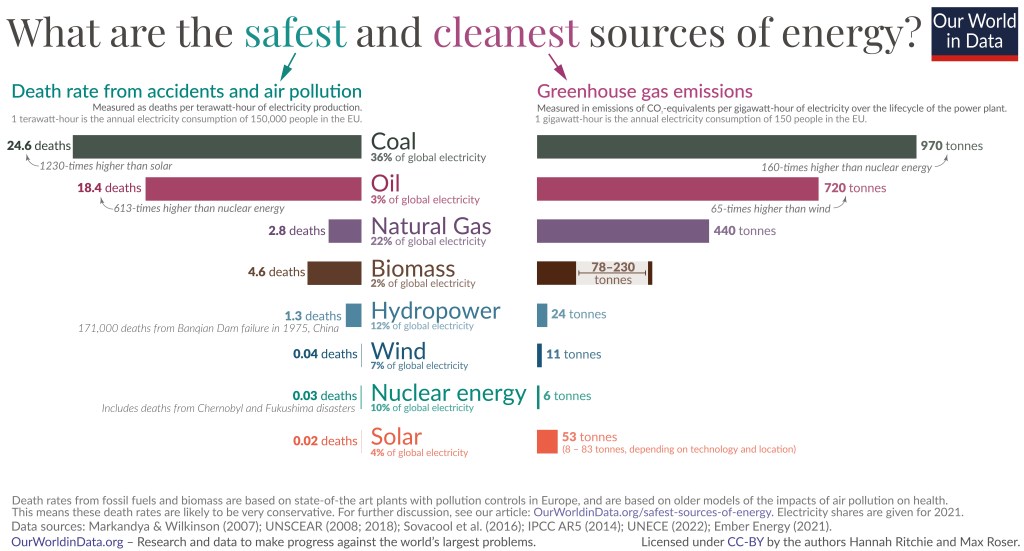
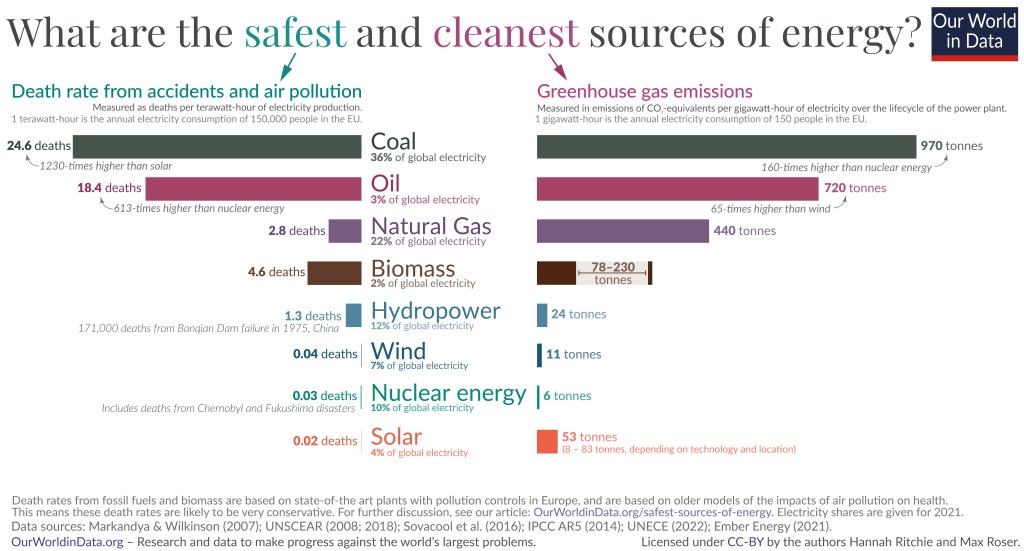
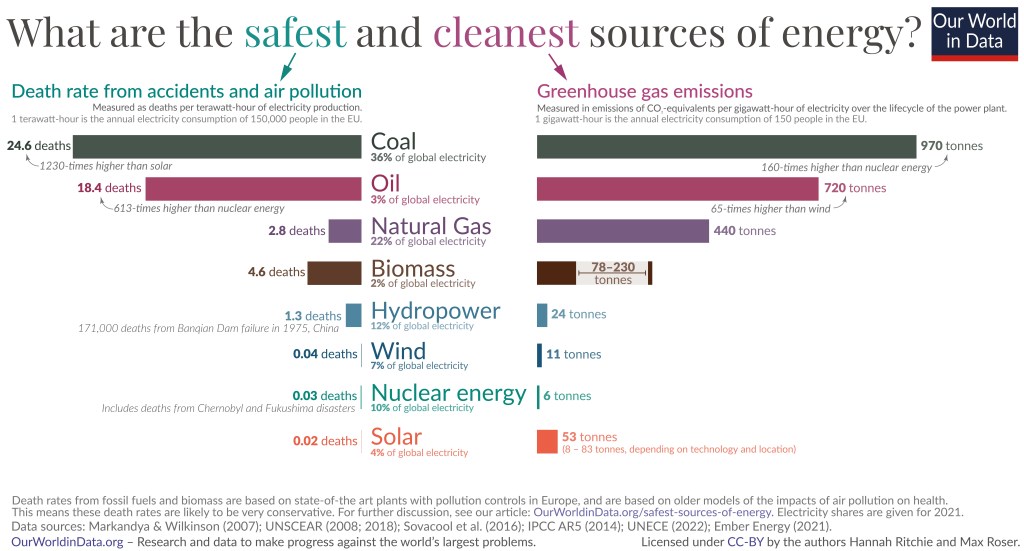
You sometimes come across claims that renewable energy isn’t really clean energy. The truth is that renewable energy such as wind, solar, etc., is much cleaner than gas, oil, and coal. These energy sources are also much safer and using them saves a lot of lives. As you can see, among the eight energy sources depicted solar is the safest, and among the cleanest. Coal has 1,230 times higher death rate than solar. According to the Energy Policy Institute at the University of Chicago Chinese citizens can expect to live on average 2.2 years longer than they would have a decade ago, due to the sharp drop in pollution. This is thanks to the increased use of EVs and renewables such as solar.
Greenhouse gas emissions and death rates from various sources of energy. Fossil fuels and biomass are based on state-of-the art plants with pollution control in Europe and are based on older models of the impacts of air pollution on health. This means that these death rates are likely to be very conservative. The graph shows that renewables and nuclear energy are the cleanest and safest forms of energy. For further discussion see the article: OurWorldinData.org/safest-sources-of-energy. Electricity shares are given for 2021. Data sources: Markandya & Wilkinson (2007); UNSCEAR (2008: 2018); Sovacol et al. (2016); IPCC AR5 (2014); UNECE (2022); Ember Energy (2001). OurWorldinData.org – Research and data to make progress against the world’s largest problems. Licensed under CC-BY by the authors Hannah Ritchie and Max Roser. Citation : Hannah Ritchie (2020) – “What are the safest and cleanest sources of energy?” Published online at OurWorldinData.org. Retrieved from: ‘https://archive.ourworldindata.org/20260202-100556/safest-sources-of-energy.html‘ [Online Resource] (archived on February 2, 2026).
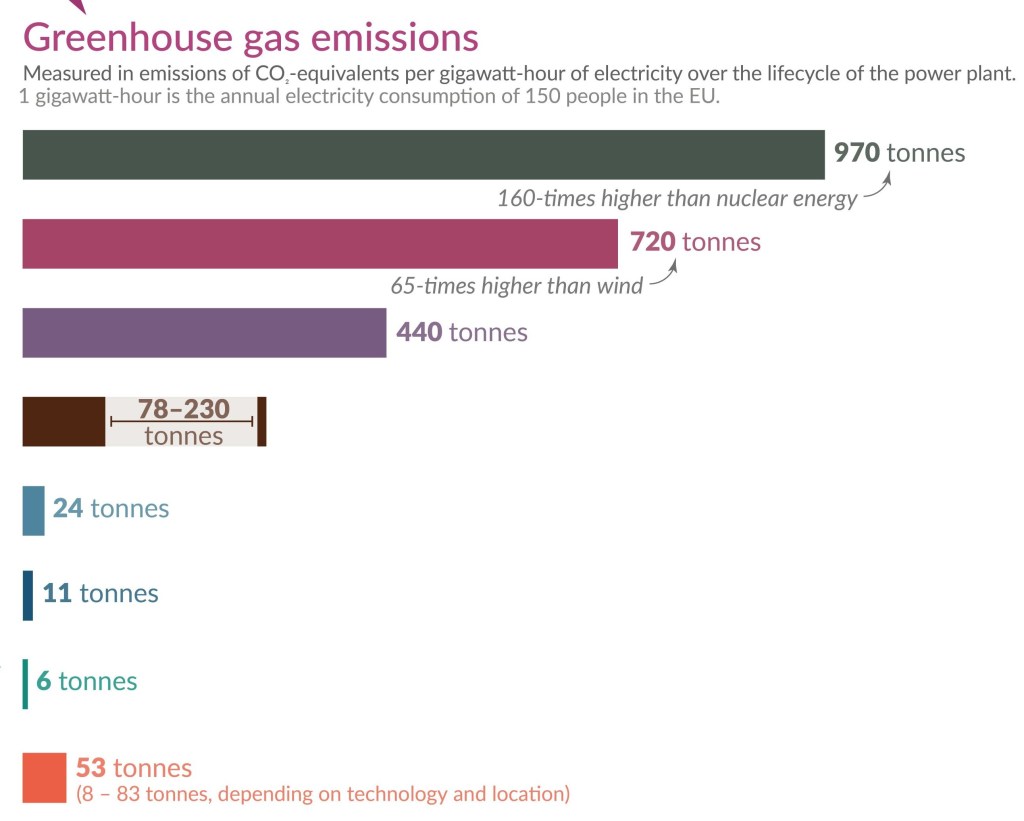
Below are two pictures corresponding to zoom-in of the graph above.
Death rates from accidents and air pollution. Measured as deaths per terawatt-hour of electricity production. 1 terawatt-hour is the annual electricity consumption of 150,000 people in the EU. The graph shows that coal, oil, gas, and biomass are a lot deadlier than hydropower, wind, nuclear power, and solar.Greenhouse gas emissions. Measured in emissions of CO2 per gigawatt-hour of electricity over the lifecycle of the power plant. 1 gigawatt-hour is the annual electricity consumption of 150 people in the EU. The graph shows that coal, oil, gas, and biomass are responsible for a lot more greenhouse gas emissions than hydropower, wind, nuclear power, and solar.
Important Climate and Energy Facts
As I said, the misinformation about climate science has bamboozled a lot of people. We know that climate change / global warming is happening. We have also known for several decades that the current climate change / global warming is not natural. It is caused by us, chiefly due to the burning of fossil fuels. Yet many non-scientists dispute it.
The scientific evidence is conclusive, but a lot of people know very little about the evidence. It includes satellites directly measuring our greenhouse gases trapping heat, the upper troposphere is cooling whilst the lower atmosphere is warming, showing that the heating is from greenhouse gases, the unnatural speed of the warming is another piece of evidence, isotope studies, climate models, etc. Below are fourteen super facts related to climate science and clean energy.
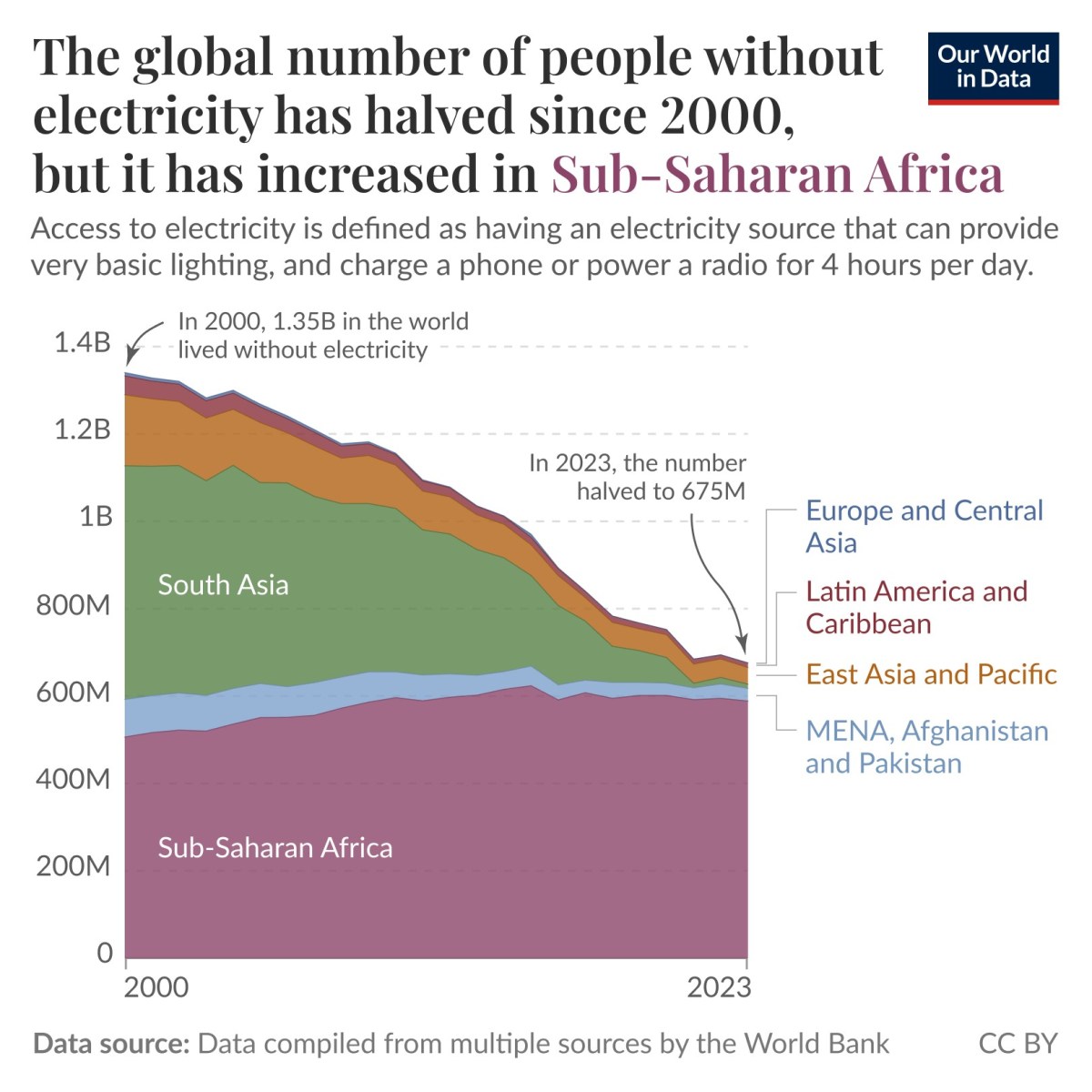
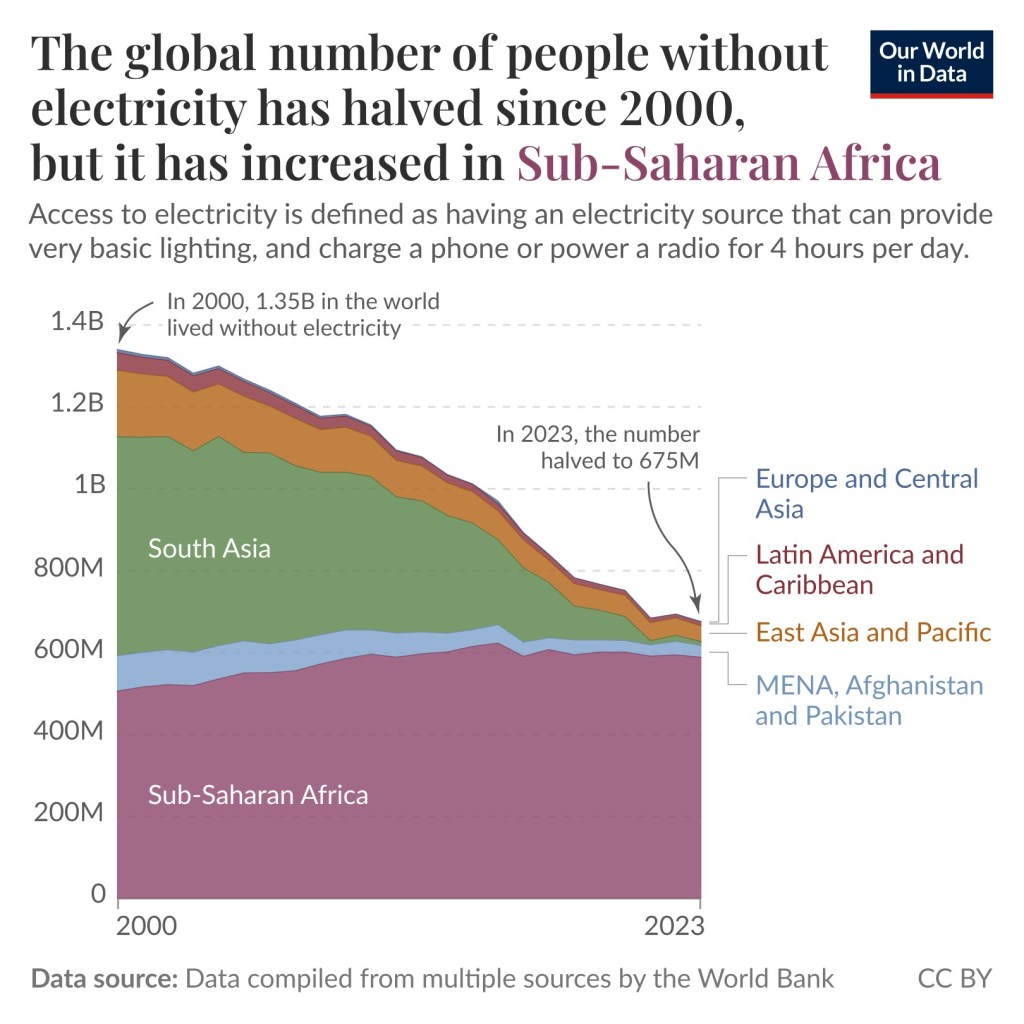
Super fact 109 : The global number of people without electricity has halved since 2000, but it has increased in Sub-Saharan Africa. In the year 2000 1.35 billion people in the world was without electricity and in the year 2023 it was 675 million people according to Our World in Data. The dark aspect of the statistics is that the number of people without electricity in Sub-Saharan Africa has increased from 500 million people to more than 600 million people.
The global number of people without electricity has halved since 2000, but it has increased in Sub-Saharan Africa. Access to electricity is defined as having an electricity source that can provide very basic lightning and charge a phone or power a radio for 4 hours per day. Data source: Data compiled from multiple sources by the World Bank. CC BY. The graphs come from this page from Our World in Data.
This also means that the share of people without electricity living in Sub-Saharan Africa increased from 37% in the year 2000 to 80% now. However, it is also true that the share of people in Sub-Saharan Africa with electricity has doubled, rising from 26% to 53%. What is going on is that population growth has outpaced this expansion, meaning the number of people without electricity has still risen.
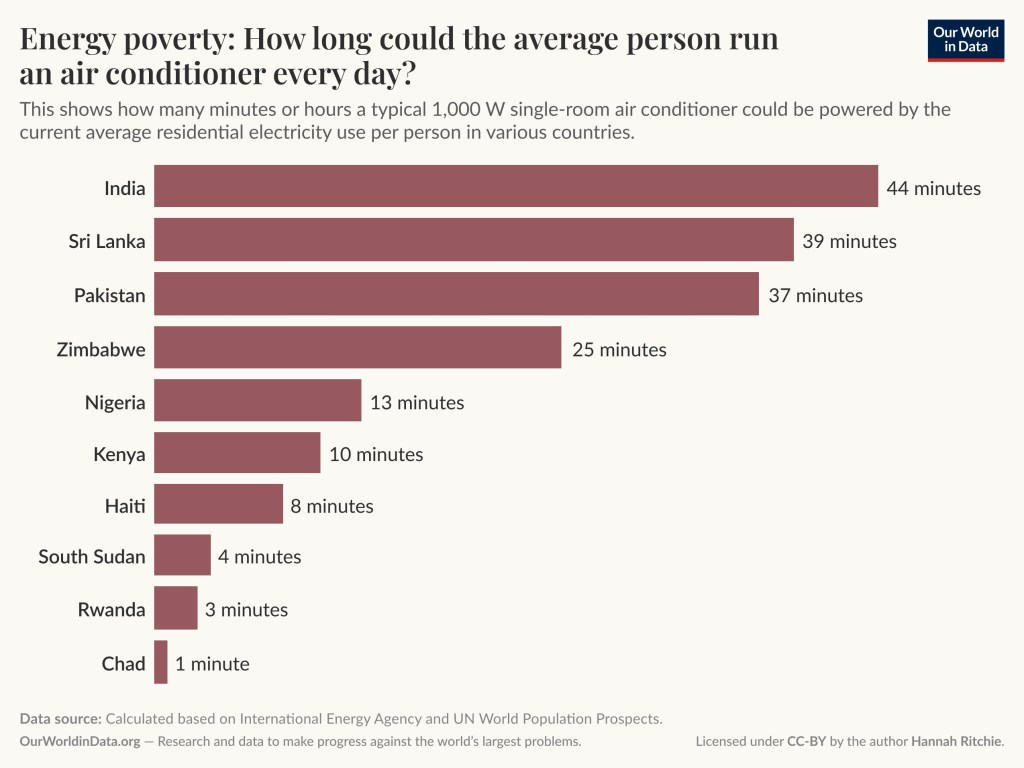
For the rest of the world, it is unequivocally good news. For example, in South Asia more than 500 million people lacked electricity in the year 2000, 414 million lacked electricity in 2010, and only 27 million people lacked electricity in 2023. Another way to look at the access to energy gap is by considering how long it is possible to run an air conditioner in different countries. Click here for data and analysis. In summary, the news for Sub-Saharan Africa is complicated but for the rest of the World, it is very good news. To read more about this topic click here.
I consider this a super fact because I believe it is an important but surprising fact in two parts. First the great news for the world and secondly the mixed news for Sub-Saharan Africa.
No Relief for the Heat Down in Africa
As mentioned, four of the five regions of the world, Europe and Central Asia, Latin America and the Caribbean, East Asia and the Pacific, MENA, Afghanistan, and Pakistan have made substantial progress. However, Sub-Saharan Africa is a complicated case. Note that MENA stand for Middle East and North Africa.
An alternative way of looking at access to electricity is to consider how much electricity is being used in each country and how that translates into the number of hours or minutes that an air conditioner could be running. Note it doesn’t mean that an air conditioner will be shut off after, let say 25 minutes, just that is much electricity one person use. What should be noted from the graph below is how dire the situation still looks like in Sub-Saharan countries. Sub-Saharan Africa is still very behind in this regard, and the fact that global warming is likely to hit Africa very hard that is not good news.
Energy Poverty: How long could the average person run an air conditioner every day? This is how many hours a typical 1000 W single-room air conditioner could be powered by the current average residential electricity use per person in various countries. Data source: Calculated based on International Energy Agency and UN World Population Prospects. OurWorldinData.org – Research and data to make progress against the world’s largest problems. Licensed under CC BY by the author Hannah Ritchie. The graph is coming from this page from Our World in Data.
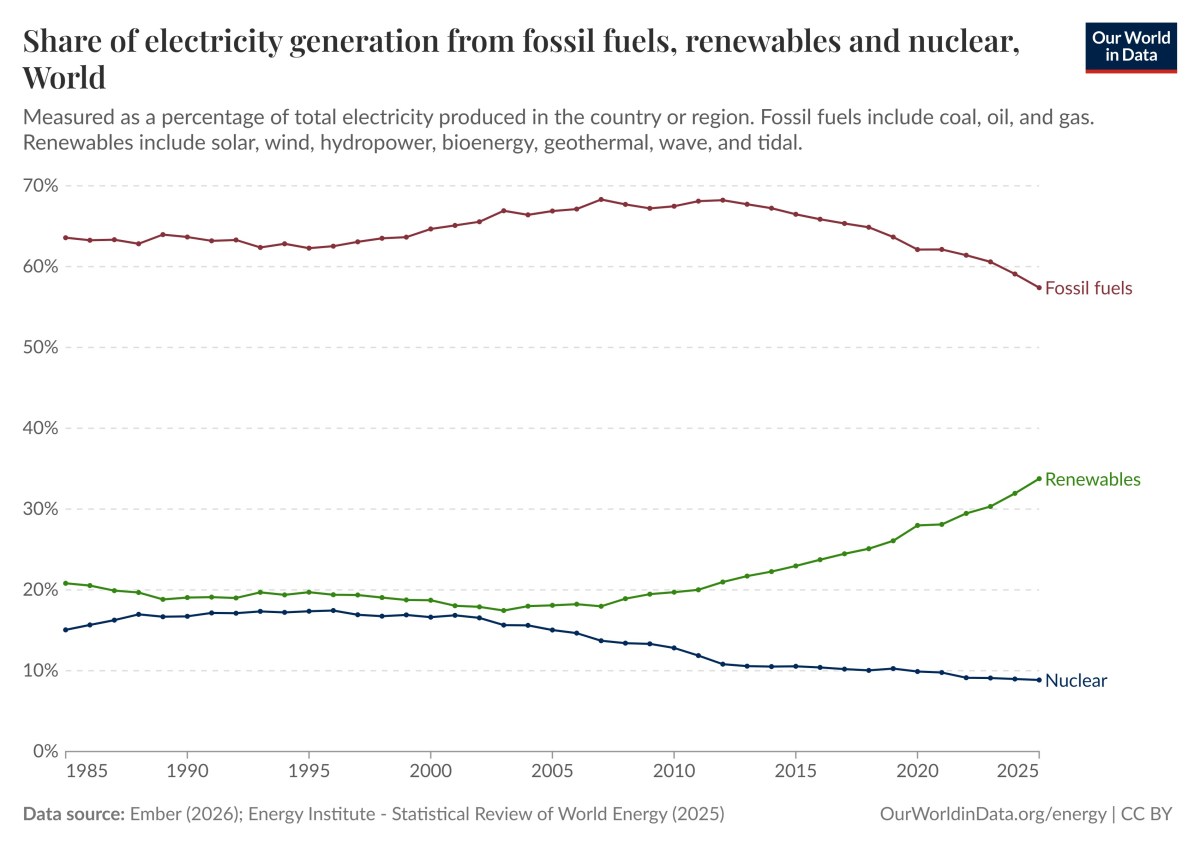
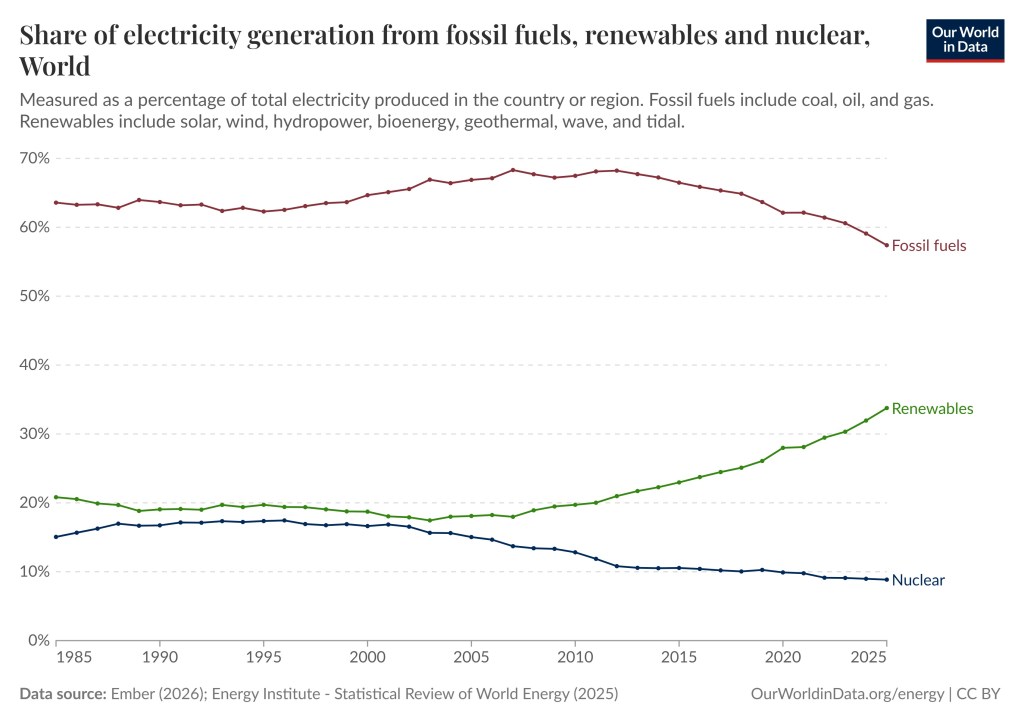
Superfact 100: The share of fossil fuels for electricity generation is decreasing and EVs are replacing internal combustion engines. The share of hydro and nuclear energy, which is clean energy, is decreasing, but the sharp increase in the share provided by renewables such as wind and solar is more than making up for it. In addition, there are new clean energy sources that are very promising but not yet widely implemented such as geothermal energy and fusion energy. The energy landscape is changing rapidly.
Share of electricity generation from fossil fuels, renewables and nuclear, world. Measured as a percentage of total electricity produced in the world. Fossil fuels include coal, oil and gas. Renewables include solar, wind, hydropower, bioenergy, wave and tidal. Data source Ember (2026): Energy institute – Statistical Review of World Energy (2025) OurWorldinData.org/energy | CC BY.
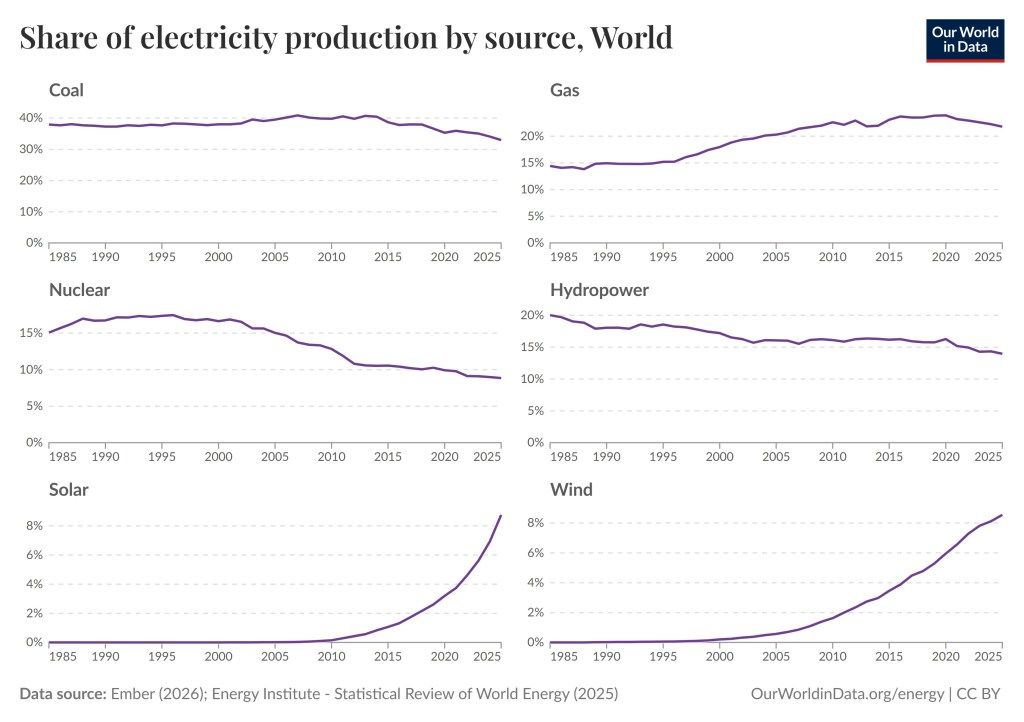
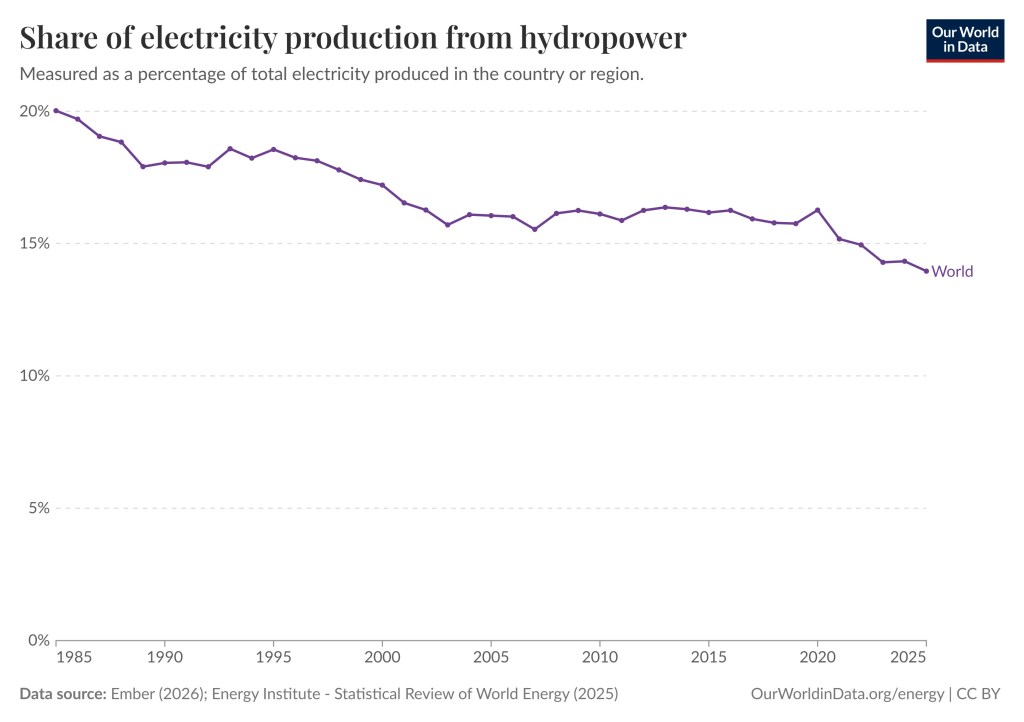
As can be seen in the graph above the share of electricity in the world generated by fossil fuels has gone down in recent years (from 66.48% in 2015 to 57.39% in 2025), and the share of electricity generated by nuclear has also gone down (from 10.55% in 2015 to 8.85% in 2025) whilst the share of electricity generated by renewables has increased (from 22.97% in 2015 to 33.76% in 2025). This is even though the most prominent source of renewable energy, hydro, has decreased its share substantially (from 16.2% in 2015 to 14% in 2025) as can be seen in the graph below.
What is going on is that two sources of renewable energy, wind and solar, have increased their share of electricity generated substantially (wind: from 3.5% in 2015 to 8.5% in 2025) and (solar: from 1.1% in 2015 to 8.7% in 2025), which can be seen in the graph below. It should be noted that renewable energy encompasses solar, wind, hydropower, bioenergy, geothermal, wave, and tidal sources.
To play around with the graph above and other similar graphs click here and select and look at the bottom charts. To play around with the graph below and similar graphs click here and select and look at the bottom charts.
Share of electricity production by source, World. Data source (2026): Energy Institute – Statistical Review of World Energy (2025) OurWorldinData.org/energy | CC BY.
So far, I’ve been talking about the share of electricity production in the world by different energy sources. However, the world is using more and more electricity. Populations are growing, economies are growing, and the world is electrifying, for example, because of the worldwide adaption of EVs.
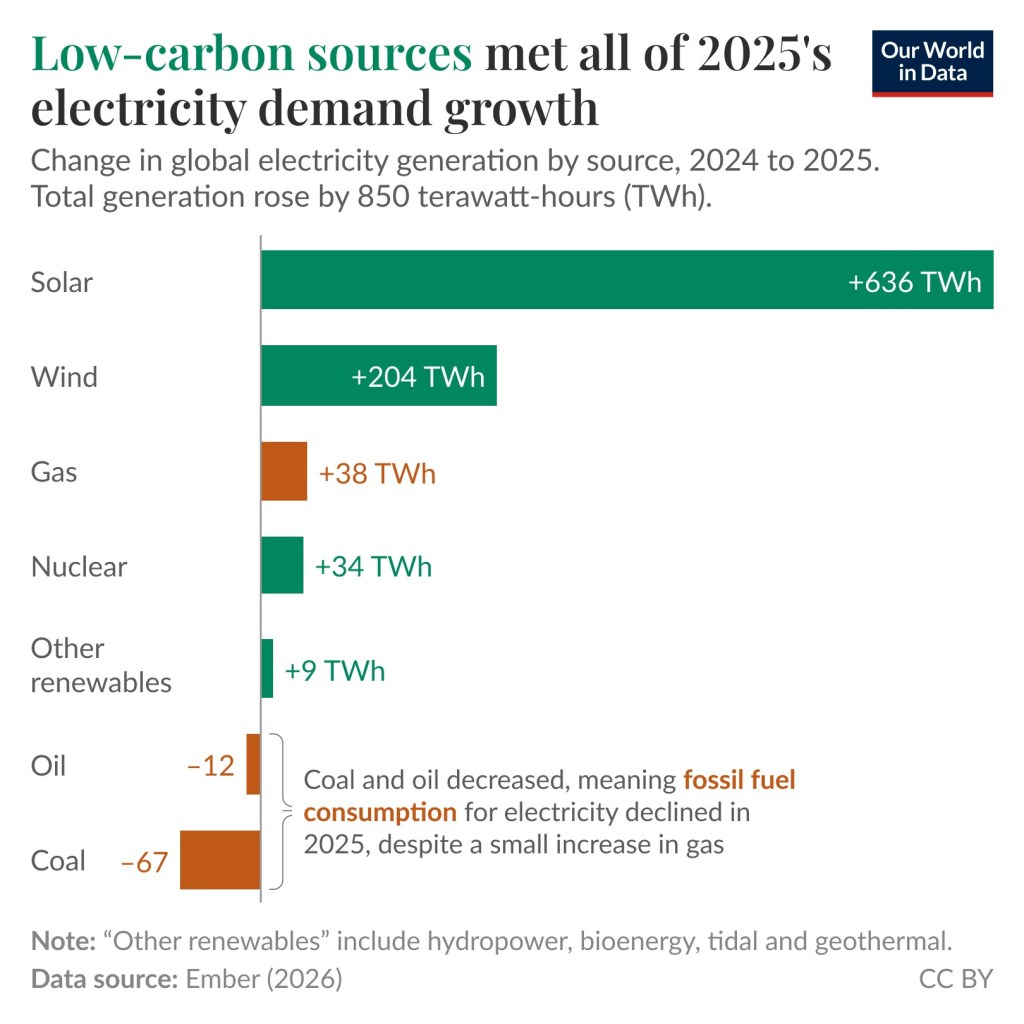
Just because an energy source’s share of electricity production is decreasing does not mean its total global electricity generation by that source is decreasing. In fact, as the share of electricity production by fossil fuels has decreased, the total production of electricity by fossil fuels has increased, well up until now. For the first time in history the total global electricity generation by fossil fuels went down in 2025. Note that since coal and oil decreased in the graph below fossil fuel consumption for electricity declined in 2025, despite s small increase in gas. This means that the use of fossil fuels is finally decreasing.
Low carbon sources met all of 2025’s electricity demand growth. Change in global electricity generation by source, 2024 to 2025. Total generation rose by 850 terawatt-hours (TWh). Note: “Other renewables” include hydropower, bioenergy, tidal and geothermal. Data source: Ember (2026). This graph comes from this page.
The practice of burning fossil fuels to generate electricity and for transportation is becoming less dominant. I believe this fact is surprising to many people, especially Americans since the current administration has taken a strong anti-renewable and anti-climate-science stance, and many Americans are not aware of what is happening in the rest of world in this regard. Superfact #100 is a super fact because the data is reliable, it is surprising to many people, and it is important.
It should be noted that we will likely keep using fossil fuels to produce fertilizers, plastics, medicines, and chemicals for a long time. However, this corresponds to only a few percent of our current use of fossil fuels and seems to be a lot better use of fossil fuels than burning it all up for energy. In fact, we may need the remaining fossil fuels for that purpose. In this post I am using data provided by Our World in Data which in turn got data from Ember Energy, or the International Energy Agency.
The Current Administration’s Opposition to Renewables and Climate Science
I am trying to keep politics out of my blog. However, the current administration’s strong opposition to and the misinformation they disseminate about renewables and climate science makes it difficult to discuss this renewable energy without bringing it up. It is an important piece in our understanding of what is going on. The misinformation about climate science (and other scientific topics) has bamboozled a lot of people and the actions taken to hinder the deployment of renewables have had real consequences. However, it is important to remember that the current situation here in the US is temporary and has a limited impact on the rest of the world.
Some actions that current administration has taken are:
Science organizations such as NOAA and NFS-NCAR have had their budgets severely cut and have been threatened to be dismantled. Websites related to climate science have been taken down. Click here to read more. NASA is also threatened to have its science programs severely cut (by 47%), as well as other programs, but it has not yet been implemented. Click here to read more.
Restricting or ordering the freezing of permits for renewables, canceling tax credits and investment credits for renewables, ordering the cancelation of renewables under construction, for additional information click here, or here.
In 2009 the EPA found that atmospheric concentrations of greenhouse gases endanger both current and future generations, enabling EPA to regulate greenhouse gases. This, so called endangerment finding was overturned in February 2026 by the administration. This article explain why there is no Scientific justification to revoke the endangerment finding.
The administration paid one billion dollars to France’s TotalEnergies in exchange for not developing windfarms on the east coast (kind of a bribe).
Pentagon has frozen permitting since last August halting more than 250 onshore wind projects, including those on private land, which is not only preventing us from meeting our energy needs, but is indirectly a violation of private property rights.
The United States is the only country to have withdrawn from the Paris Agreement (January 27, 2026). Three other countries, Iran, Libya, and Yemen, did not join.
95,000 employees, including 10,000+ with PhD’s, at government science agencies (more than a third of them) have either been laid off / fired, or left, as a result of current policies. This effects CDC, NIH (National Institute of Health), and especially anything related to climate science. Many scientists have left the US for Europe.
There is not wonder many in the United States incorrectly believe clean energy is on its way out. I should say that even though support for solar and wind has declined in the US, solar and wind remain the sources of energy that most people want the federal government to encourage over any other source of energy, according to this Pew Research article.
Important Climate and Energy Facts
As I said, the misinformation about climate science has bamboozled a lot of people. As an example. We know that climate change / global warming is happening. We have also known for several decades that the current climate change / global warming is not natural. It is caused by us, chiefly due to the burning of fossil fuels. The scientific evidence is conclusive. It includes satellites directly measuring our greenhouse gases trapping heat, the upper troposphere is cooling whilst the lower atmosphere is warming, showing that the heating is from greenhouse gases, the unnatural speed of the warming, isotope studies, climate models, etc. How many people know about this? I believe very few people do. Below are eleven related super facts.
Greenhouse gas emissions and death rates from various sources of energy. Fossil fuels and biomass are based on state-of-the art plants with pollution control in Europe and are based on older models of the impacts of air pollution on health. This means that these death rates are likely to be very conservative. The graph shows that renewables and nuclear are the cleanest and safest forms of energy. For further discussion see the article: OurWorldinData.org/safest-sources-of-energy. Electricity shares are given for 2021. Data sources: Markandya & Wilkinson (2007); UNSCEAR (2008: 2018); Sovacol et al. (2016); IPCC AR5 (2014); UNECE (2022); Ember Energy (2001). OurWorldinData.org – Research and data to make progress against the world’s largest problems. Licensed under CC-BY by the authors Hannah Ritchie and Max Roser. Citation : Hannah Ritchie (2020) – “What are the safest and cleanest sources of energy?” Published online at OurWorldinData.org. Retrieved from: ‘https://archive.ourworldindata.org/20260202-100556/safest-sources-of-energy.html’ [Online Resource] (archived on February 2, 2026).
The Share of EVs
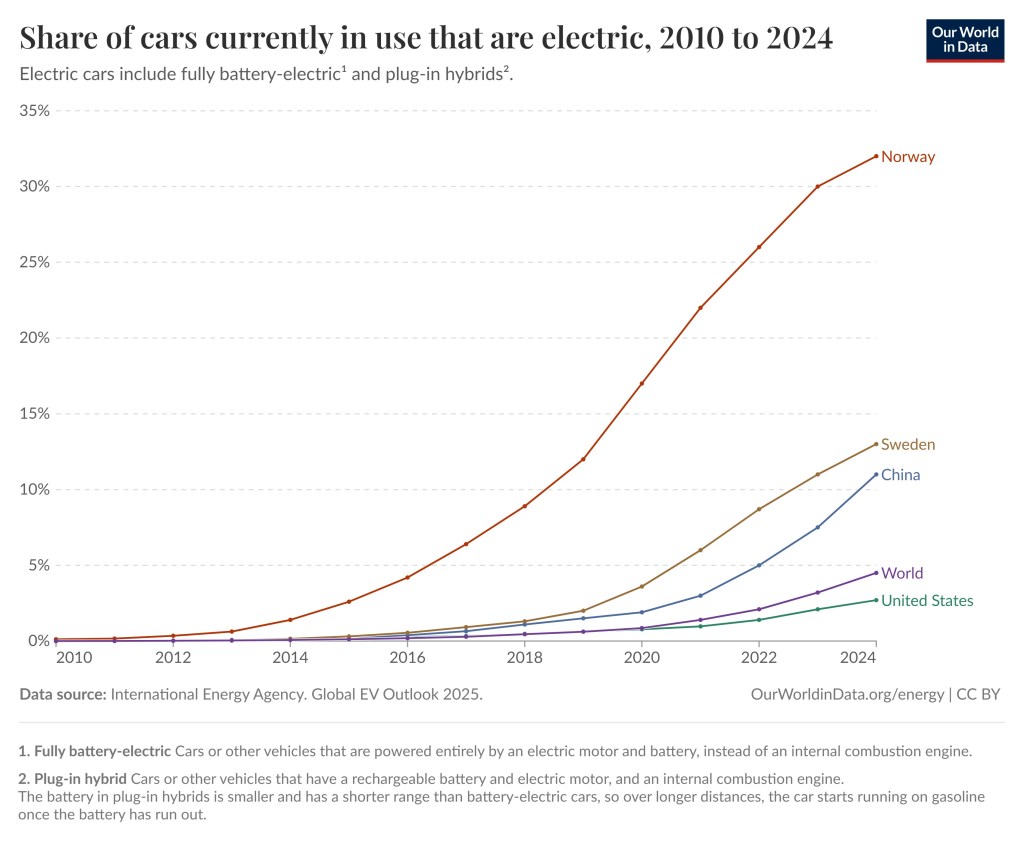
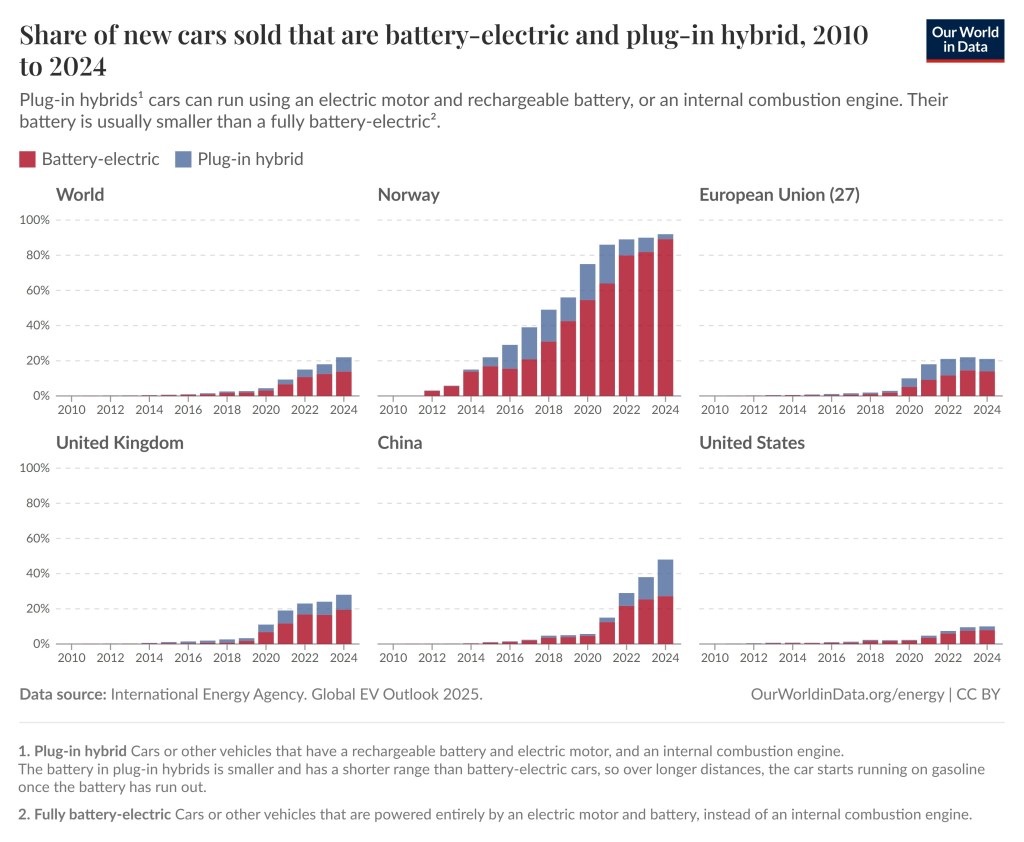
Another phenomenon that results in less burning of fossil fuels than we otherwise would have is that electric cars and plug-in hybrid are becoming more common in the world. Going from nearly non-existent in 2010 electric cars (EVs) are now starting to show up around the world. The share of electric cars on the roads in 2024 was in the United States was 2.7%, in the world 4.5%, in China 11%, in Sweden 13% and in Norway 32%.
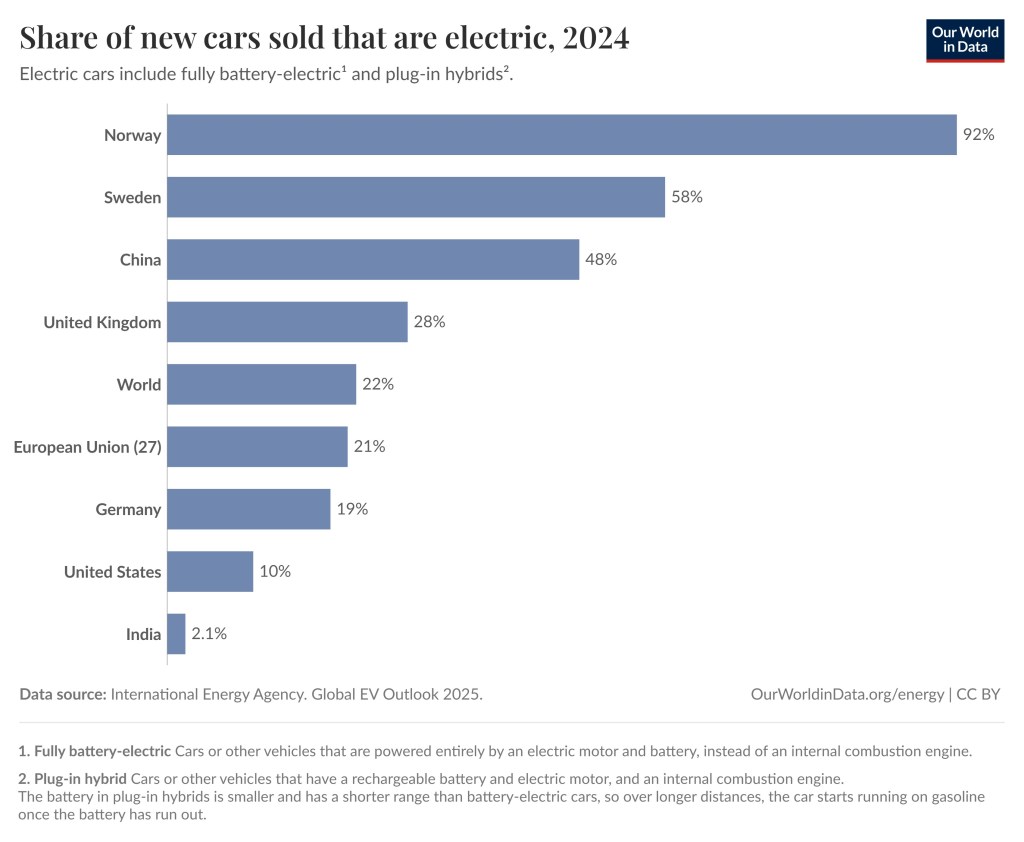
What matters more (for the future) is the sale of new EVs and plug-in hybrids. The share of new cars that are electric was 22% for the world, 10% in the United States, 21% in the EU, 28% in the United Kingdom, 48% in China, 58% in Sweden, 92% in Norway. In 2025 the share of new cars that were electric was 98% in Norway according to this website. To see more EV statistics and play around with various graphs visit this link.
One thing that might be surprising to Americans is that EVs are quite common in many other countries including EU, the Scandinavian countries, and China. Another is that EVs are indeed significantly cleaner than internal combustion engines, even when charged from a relatively dirty grid. See this super fact (29) EV Cars Indeed Emit Less Carbon Pollution.
Share of cars currently in use that are electric, 2010 to 2024. Electric cars include fully battery-electric and plug-in hybrids. With battery-electric cars is meant cars or other vehicles that are powered entirely by an electric motor and battery, instead of an internal combustion engine. With plug-in hybrid is meant cars or other vehicles that have a rechargeable battery and electric motor, and an internal combustion engine. The battery in plug-in hybrids is smaller and has a shorter range than battery-electric cars, so over longer distances, the car starts running on gasoline once the battery has run out. Data source: International Energy Agency Global EV Outlook 2025. OurWorldinData.org/energy | CC BYBattery-electric cars are depicted with brown and plug-in hybrid in blue. Share of new cars sold that are battery-electric and plug-in hybrid, 2010 to 2024. Plug-in hybrids cars can run using an electric motor and rechargeable battery, or an internal combustion engine. Their battery is usually smaller than a fully battery-electric. Data source: International Energy Agency Global EV Outlook 2025. OurWorldinData.org/energy | CC BYShare of new cars sold that are electric, 2024. Electric cars include fully battery-electric and plug-in hybrids. Data source: International Energy Agency Global EV Outlook 2025. OurWorldinData.org | CC BY
Share of electricity production by source EU, US, China
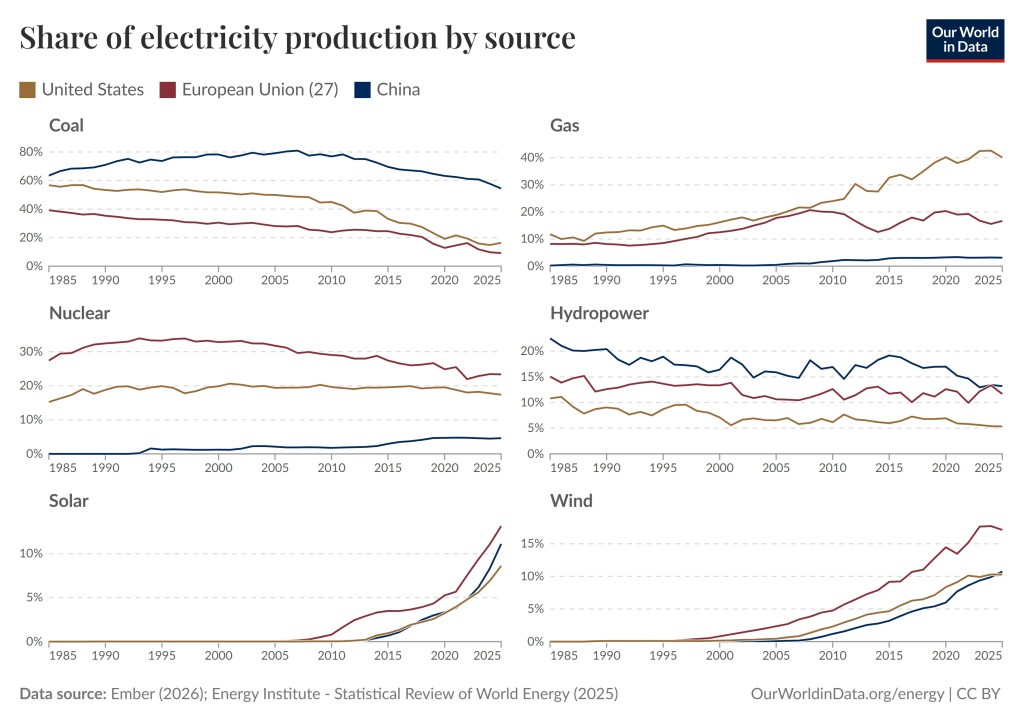
The first graph in this post depicted the share of electricity production by source for the world. The graph below breaks it up to show the share of electricity production by source for the three largest economies in the world, the United States, China and the EU. Again, the share of energy from coal, nuclear and hydro is decreasing whilst the share from wind and solar is going up for all three markets. One notable difference from the top graph is that gas keep increasing for the United States.
Share of electricity production by source, United States, European Union, and China. Data source: Ember (2026): Energy Institute – Statistical Review of World Energy (2025) OurWorldData.org/energy | CC BY
The Share of Electricity Production from Wind
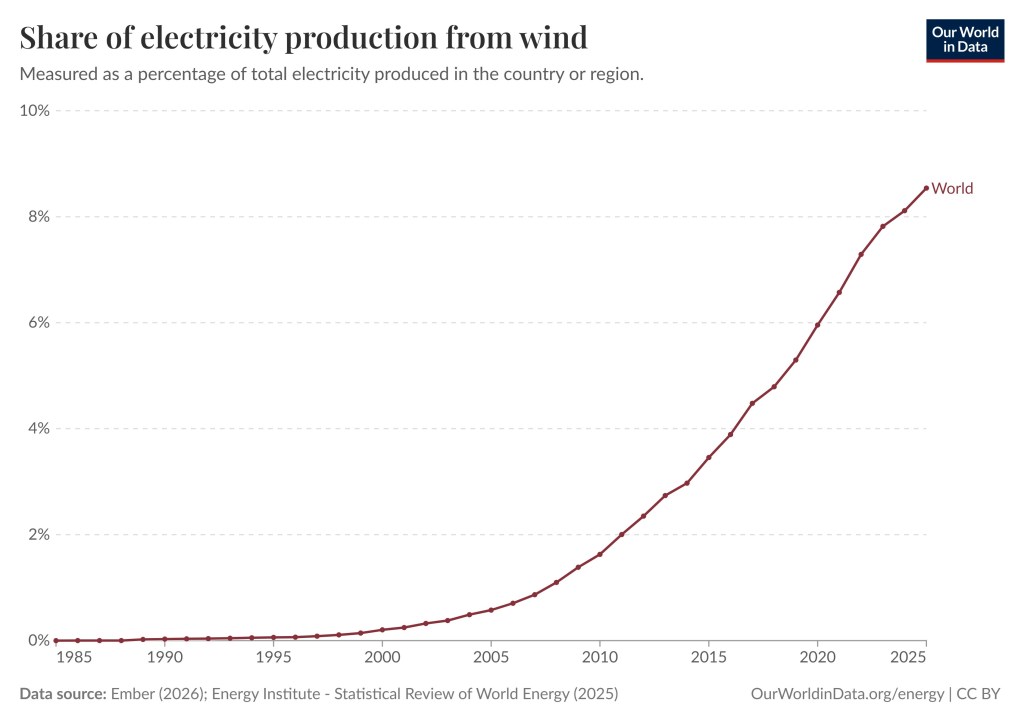
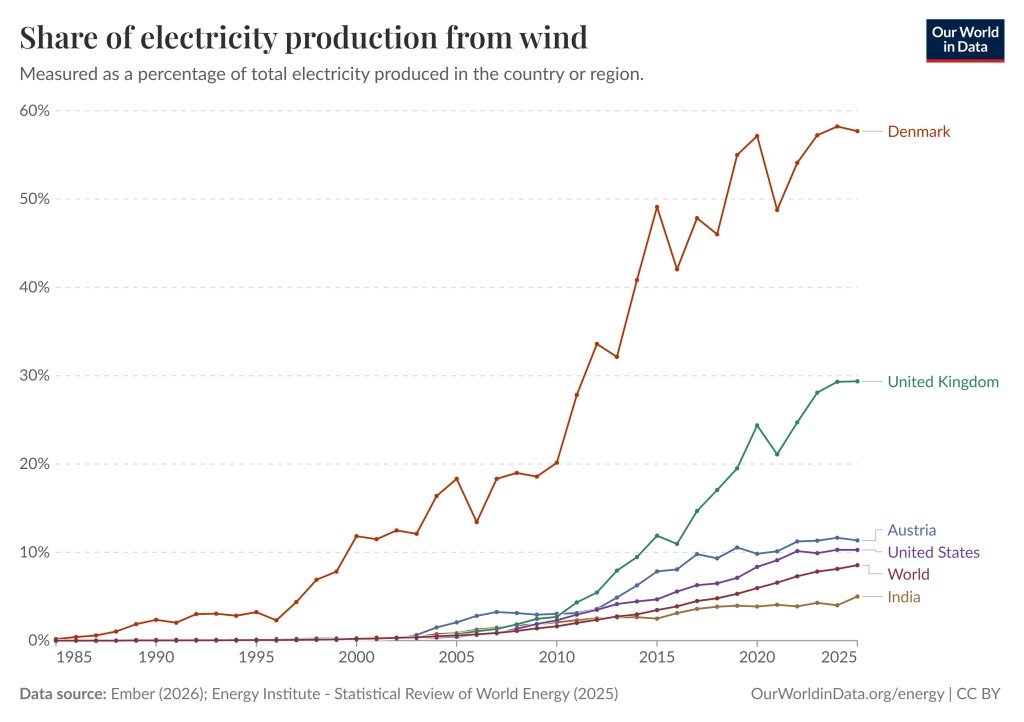
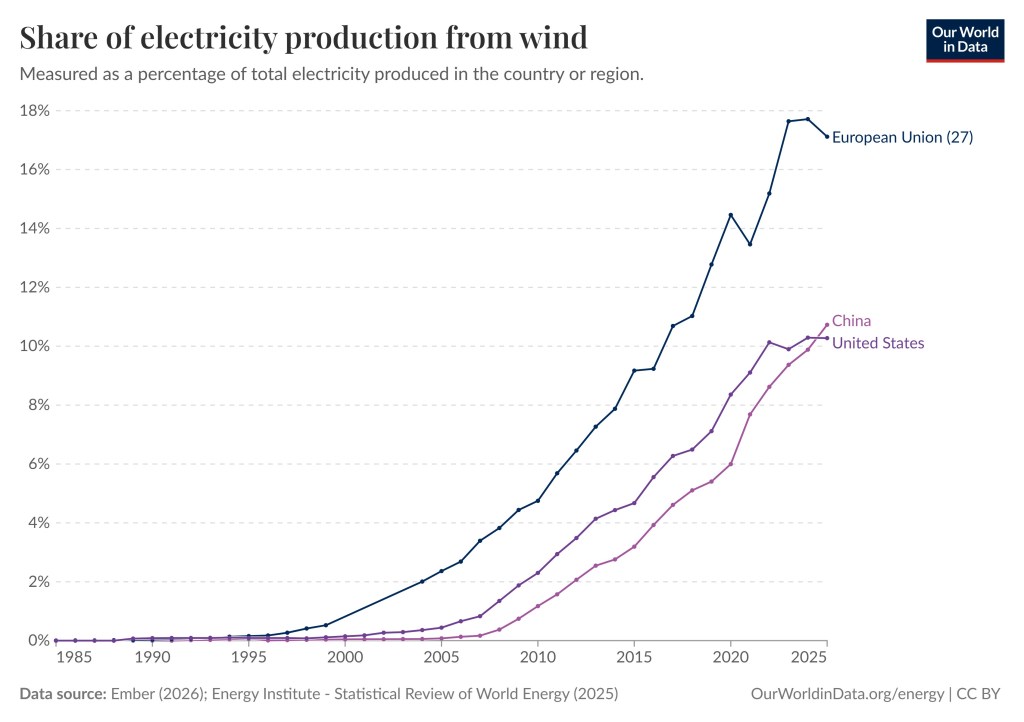
Below are a few charts depicting the share of electricity production from wind. The first graph is already included in the second chart from the top (above). However, this is a close up. The second graph depicts the share of electricity production from wind for multiple countries. It should be noted that Denmark and the United Kingdom are prominent users of wind power. For Denmark the share of electricity production from wind is almost 60%. By clicking here you can play around with the graphs and generate as many different graphs as you wish.
Share of electricity production from wind. Measured as a percentage of total electricity produced in the world. Data source: Ember (2026): Energy Institute – Statistical Review of World Energy (2025) OurWorldinData.org/energy | CC BYShare of electricity production from wind. Measured as a percentage of total electricity produced in the country or region. Data source: Ember (2026): Energy Institute – Statistical Review of World Energy (2025) OurWorldinData.org/energy | CC BYShare of electricity production from wind. Measured as a percentage of total electricity produced in the United States, China and the European Union. Data source: Ember (2026): Energy Institute – Statistical Review of World Energy (2025) OurWorldinData.org/energy | CC BY
The Share of Electricity from Solar
The share of electricity from Solar for the world has grown from essentially 0% in the year 2000 to 3.19% in 2020 to 8.75% in 2025. For solar, the United States follows the rest of the world closely. Some countries have a higher percentage, such as the Cook Islands – 50%, Luxembourg – 30.52%, Chile – 25.06%. If you wish you can take a look here, or here, and you can play around with the different graphs. You can create millions of scenarios at your pleasure.
Share of electricity from Solar. Measured as a percentage of total electricity produced in the country or region. Data source: Ember (2026): Energy Institute – Statistical Review of World Energy (2025) OurWorldinData.org/energy | CC BY
The Share of Electricity Production from Hydropower
Hydro is a renewable energy source but its share of electricity production in the world has gone down. Unlike solar and wind, hydro is not an intermittent source of energy, so that is not necessarily something to celebrate. The intermittency of solar and wind can be mitigated using batteries, or energy sources that are not intermittent, preferably clean energy sources such as hydro and nuclear. Hydro is still the world’s most popular renewable energy source but that is changing quickly.
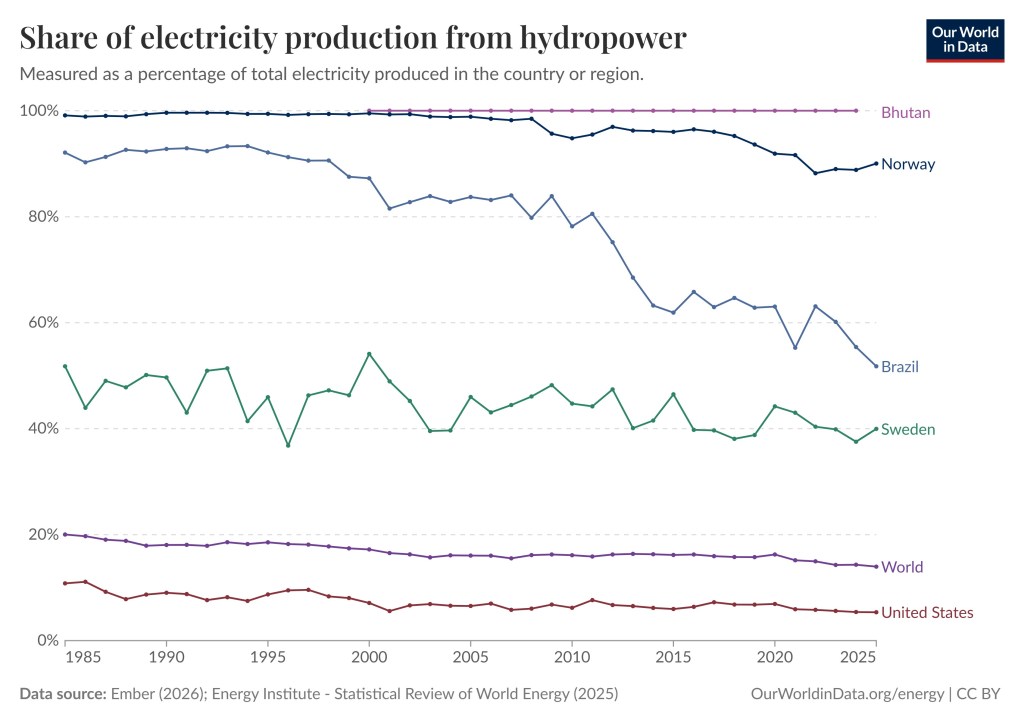
The graph below shows that the share of electricity production from hydropower for the world is 13.96%, USA 5.35%, Bhutan 100%, Norway 90.03%, Brazil 51.78%, Sweden 39.97%. If you wish you can take a look here, or here, and you can play around with the different graphs. You can create millions of scenarios at your pleasure.
Share of electricity production from hydropower. Measured as a percentage of total electricity produced in the world. Data source: Ember (2026): Energy Institute – Statistical Review of World Energy (2025) OurWorldinData.org/energy | CC BYShare of electricity production from hydropower. Measured as a percentage of total electricity produced in the world and five countries (Bhutan, Norway, Brazil, Sweden, United States). Bhutan remains at 100% hydro, Norway went from 99.12% in 1985 to 90.03% in 2025, Brazil went from 92.10% hydro in 1985 to 51.78% in 2025, Sweden went from 51.76% hydro in 1985 to 39.97% in 2025, the United States went from 10.81% hydro in 1985 to 5.35% in 2025. The world went from 20.02% hydro in 1985 to 13.96% in 2025. Data source: Ember (2026): Energy Institute – Statistical Review of World Energy (2025) OurWorldinData.org/energy | CC BY
The Share of Electricity Production from Nuclear
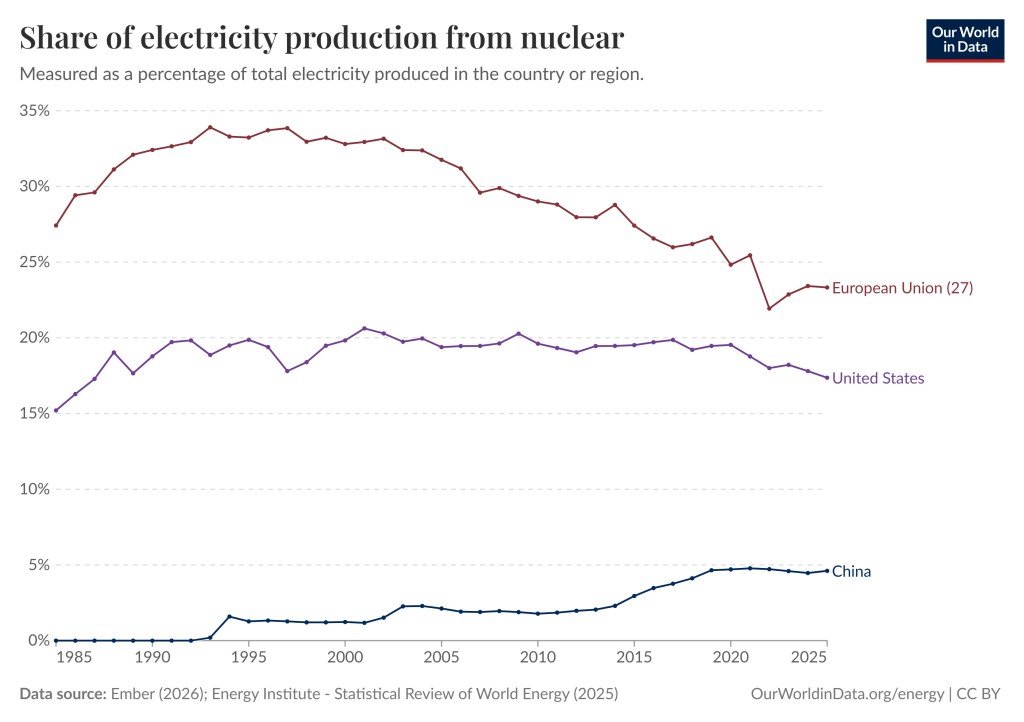
The share of electricity production in the world from nuclear went down from 15.06% in 1985 to 8.85% in 2025, which is a significant drop. During the same time the share of electricity production from nuclear in the United States went from 15.20% in 1985 to 17.36% in 2025, for China the numbers are 0% in 1985 to 4.61% in 2025, and for EU the share of electricity production in 1985 was 27.42% and in 2025 23.32%. However, in 1993% the share of electricity production in 1993 was 33.90%.
So, nuclear has taken a big step back in EU. Germany cancelled nuclear power entirely, for better and for worse. To interact with the graphs shown below or see other (millions) related charts or maps click here, or here.
Share of electricity production from nuclear. Measured as a percentage of total electricity produced in the world’s three largest economies, the United States, EU, and China. Data source: Ember (2026): Energy Institute – Statistical Review of World Energy (2025) OurWorldinData.org/energy | CC BY
Geothermal a Promising source of Energy
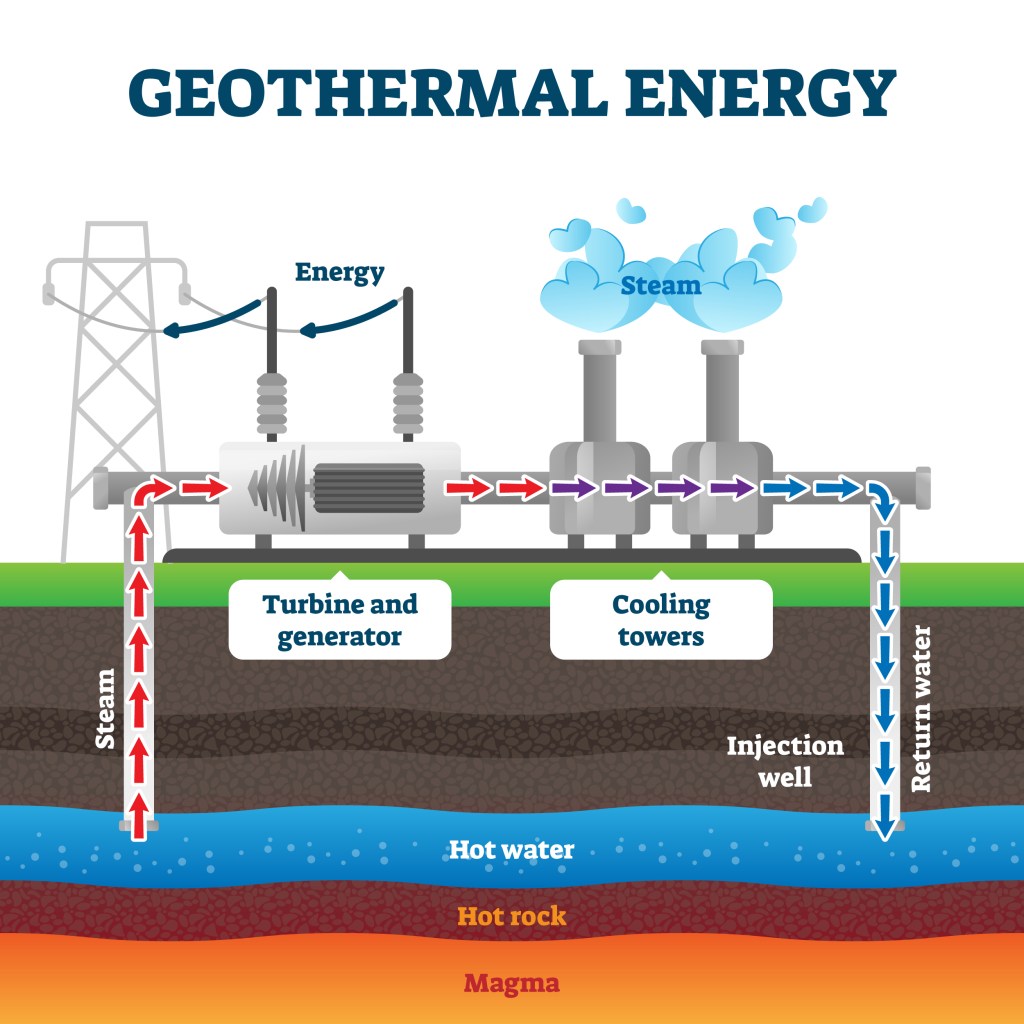
Another reason to believe that the energy transition away from fossil fuels has begun, is that in addition to fossil fuels losing share of total electricity produced, there are promising emerging renewables, such as Geothermal energy. Geothermal energy uses natural heat from deep within the Earth to generate electricity or heat buildings. Wells tap into underground hot water/steam reservoirs, forcing it up to spin turbines that power generators, after which the water is cooled and reinjected to replenish the source (see the picture below).
Geothermal energy production example diagram illustration. Industrial renewable green energy plant example. Steam flow from the underground hot water to turbine generator and cooling towers. Shutterstock Asset id: 1637621995 by VectorMine.
Just like renewables geothermal energy is low emissions energy source but unlike renewables it is not an intermittent energy source. It is as of yet not widely used and not cost effective. However, it appears that might change soon. The advanced drilling techniques needed are utilizing oil and gas expertise and could therefore provide a good transition from fossil fuels to geothermal.
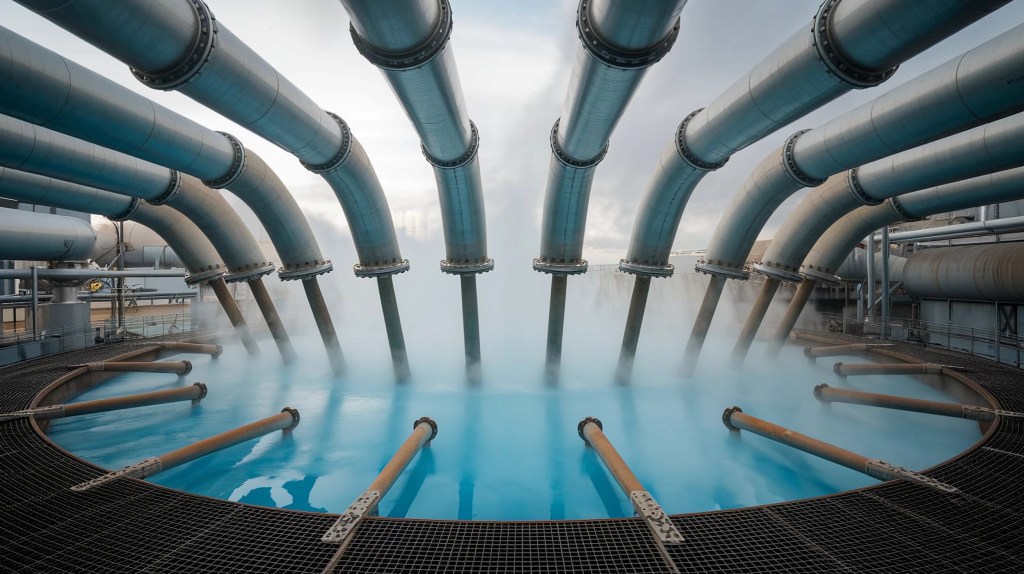
Geothermal power plant from above Shutterstock Asset id: 2539157855 by Alrasyiqin
Is Fusion Power the Future ?
Fusion power is a clean, and near-limitless energy source generated by smashing light atomic nuclei together, usually hydrogen isotope, to form heavier ones. It is a form of nuclear power that releases immense heat. It replicates the process that powers the Sun. Unlike wind and solar it is not intermittent and can generate carbon-free baseload electricity without long-lived radioactive waste. However, it cannot yet be used to produce energy. That does not mean it will not work in the future.
Nuclear fusion power generator concept image, 3d rendering Shutterstock asset id: 2262106105 by MeshCube.
Conclusion
The share of fossil fuels for electricity generation is decreasing despite the fact that the share from hydro and nuclear is also decreasing. The reason is the spectacular increase in the share provided by wind and solar. In addition, EV cars are rapidly replacing internal combustion cars around the world, especially in the EU and China. There are also renewable or clean energy sources that show great promise even though they are not yet widespread. This means that fossil fuels, coal, natural gas, and oil, which are all dirty and dangerous energy sources, are finally being replaced by cleaner alternatives.
Superfact 96: Nuclear power is a relatively clean and safe energy source that produces no atmospheric emissions during operation. However, there are some problems with nuclear power, but they are often overblown.
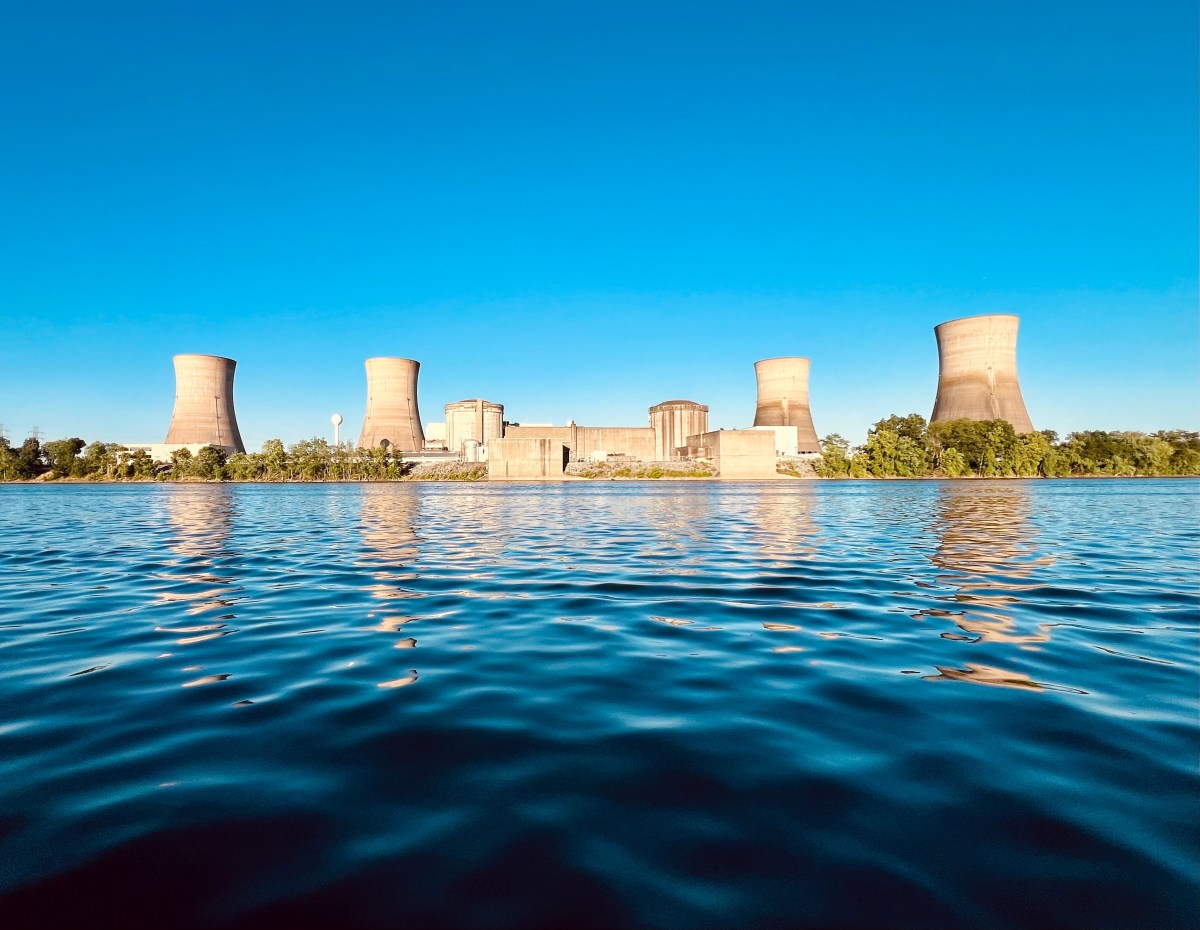
The Three Mile Island Nuclear Power Plant south of Harrisburg, Pennsylvania. March 28, 1979, a nuclear accident at the Three Mile Island nuclear power plant sent shockwaves across the world, raising fears about nuclear power. However, no one died, and no one was hurt. Shutterstock Asset id: 2512612545 by Aubrie K
Clean energy sources are often defamed by disinformation and misunderstandings. For example, wind power turbines are not bird killing machines. Contrary to what you often hear wind power is indeed a very clean, cheap and sustainable energy source. Nuclear power is another misunderstood energy source. Wind power, solar power, hydro, and nuclear power are all considered clean energy because they produce no greenhouse gases or air pollution during operation and they also have very low life-cycle emissions.
The graph below from Our World in Data depicting lifetime greenhouse gas emissions (construction, operation, disposal) and safety data for the European Union, show that the lifetime greenhouse gas emissions of coal power is 162 times higher than those of nuclear power and coal kill 820 times as many people as nuclear power. The lifetime greenhouse gas emissions of natural gas are 120 times higher than those of nuclear power and kill 613 times as many people as nuclear power. The difference is staggering.
Death rates from fossil fuels and biomass are based on state-of-the art plants with pollution control in Europe and are based on older models of the impacts of air pollution on health. This means that these death rates are likely to be very conservative. For further discussion see our article: OurWorldinData.org/safest-sources-of-energy. Electricity shares are given for 2021. Data sources: Markandya & Wilkinson (2007); UNSCEAR (2008: 2018); Sovacol et al. (2016); IPCC AR5 (2014); UNECE (2022); Ember Energy (2001). OurWorldinData.org – Research and data to make progress against the world’s largest problems. Licensed under CC-BY by the authors Hannah Ritchie and Max Roser. Citation : Hannah Ritchie (2020) – “What are the safest and cleanest sources of energy?” Published online at OurWorldinData.org. Retrieved from: ‘https://archive.ourworldindata.org/20260202-100556/safest-sources-of-energy.html’ [Online Resource] (archived on February 2, 2026).
In the graph above, greenhouse gas emissions are measured of CO2 equivalents per Gigawatt-hour of electricity over the lifecycle of the power plant. 1 Gigawatt-hour is the annual electricity consumption of 150 people in the EU. Death rate from accidents and air pollution is measured as deaths per Terawatt hour of electricity production. 1 terawatt hour is the annual electricity consumption of 150,000 people in the EU.
I should mention that there are problems with nuclear power that are not entirely covered by the graph above, including radioactive waste, a history of spectacular accidents, and a perceived connection to nuclear arms. However, as you will see later in this post, even though these problems get a lot of media attention, they are not as scary as one might think. However, it should be noted that nuclear power in its current form is not a cheap source of energy, but that is a different topic.
I consider this a super fact because nuclear power is often thought of as an extremely dangerous and dirty source of energy, which is not the case.
How Does Nuclear Power Work ?
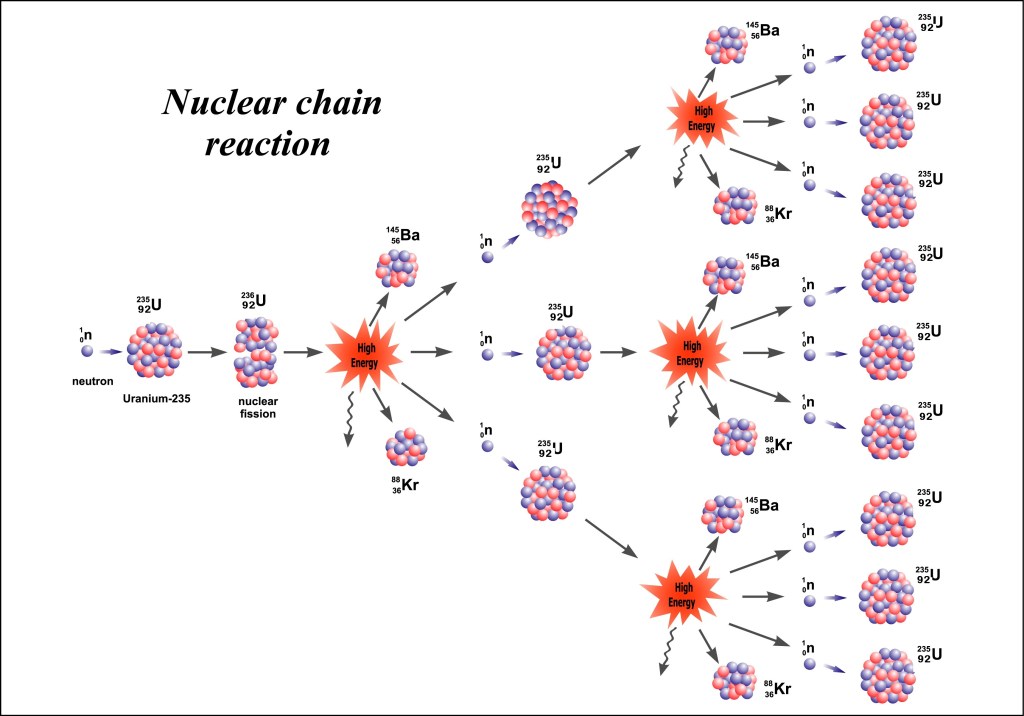
Illustration of nuclear chain reaction. Uranium-235 fission. Shutterstock asset id: 73714504 by Mpanchenko. Note I corrected an error in the picture.
The fuel (fuel rods) in a nuclear power station consists primarily of stacked ceramic pellets made of low enriched uranium dioxide housed inside sealed metal tubes. The uranium consists primarily of two uranium isotopes U-238, which has 92 protons and 146 neutrons and U-235, which has 92 protons and 143 neutrons. Uranium always has 92 protons. The isotope that is used for fission is U-235. Natural Uranium consists of 0.7% U-235, trace amounts of U-236 and the rest (99.3%) is U-238. The uranium in nuclear fuel rods is either natural (0.7% U-235) or a few percent of U-235 (low enriched uranium). This should be contrasted with a uranium atomic bomb which has at least 80% U-235 (highly enriched).
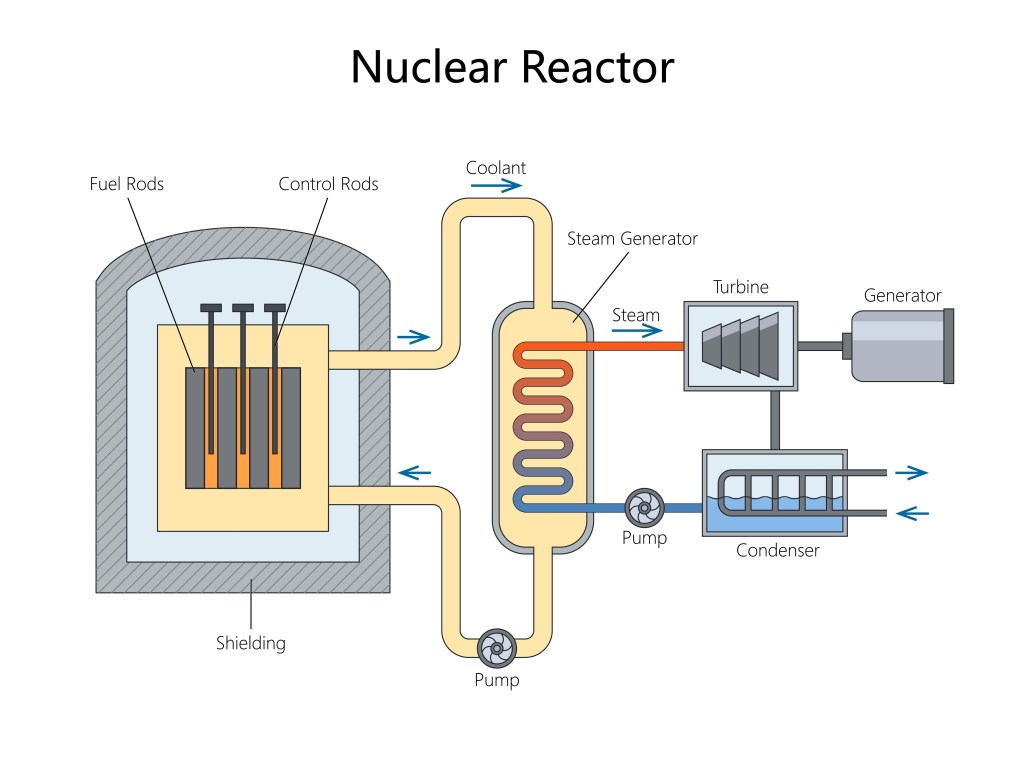
A nuclear power plant generates electricity using heat from nuclear reactions. Inside the reactor, atoms of fuel (uranium) undergo nuclear fission, where they split apart and release a large amount of heat. The fuel rods (see picture below) in a nuclear power station consist primarily of stacked ceramic pellets made of low enriched uranium dioxide housed inside sealed metal tubes. There are also control rods in a nuclear power station, which consist of materials with a high neutron absorption cross-section. The control rods are used to regulate the reaction. If they are fully inserted the reaction will stop. Also note that nuclear reactors have a containment shield (at least in western countries).
Fission generates heat, which generates high pressure steam, which pushes a turbine around, which turns a generator, which generates electricity, which is transformed to the right voltage and delivered to customers. Science educational illustration Shutterstock Asset id: 2658971563 by Alexander_P
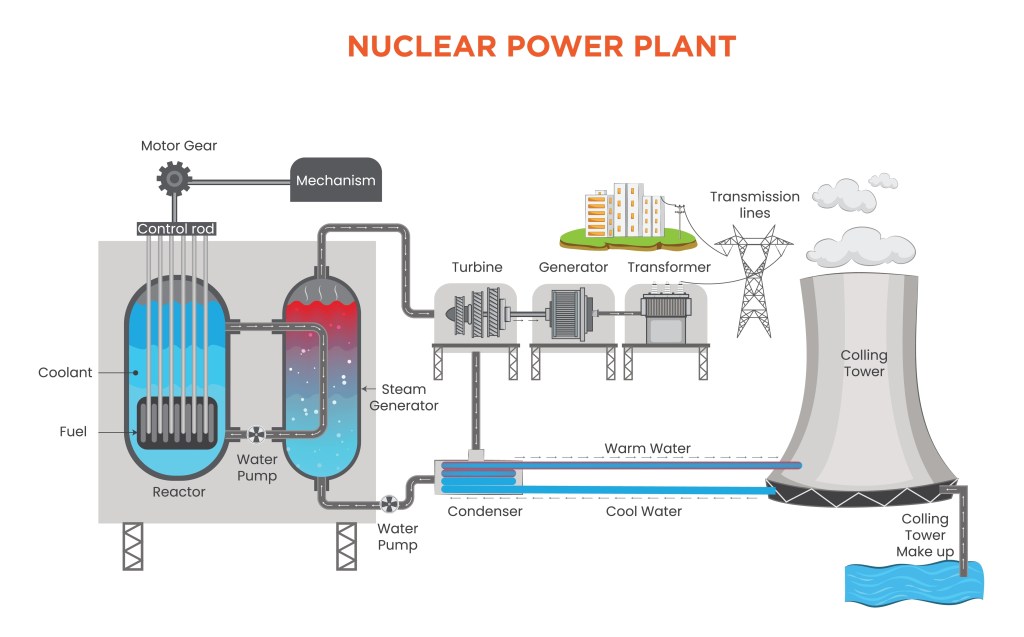
Below is an alternative illustration.
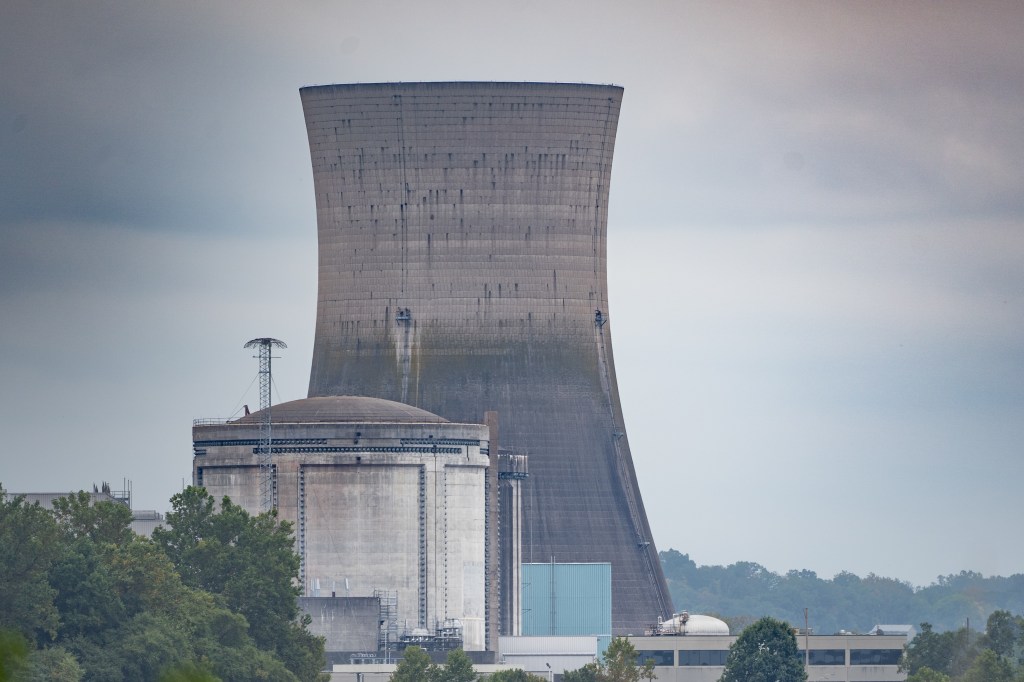
A nuclear power plant generates electricity by using heat from nuclear fission to produce steam, which drives turbines connected to electrical generators. This illustration also depicts the nuclear power plant’s use of water for cooling. Don’t worry, the water will not turn radioactive. It is a separate isolated loop. Shutterstock Asset id: 2525528665 by Papia Majumder.Three Mile Island Nuclear Plant, located in Pennsylvania, is known for a partial meltdown in 1979 Shutterstock. This photo shows the reactor as well as the cooling tower. Asset id: 2520903273 by Amy Lutz.
What about Chernobyl ?
The Chernobyl disaster, which occurred on April 26, 1986, was the worst nuclear disaster in history. 50 people died as a direct result of the disaster and an estimated 4,000, perhaps 10,000 future cancer deaths are predicted from the disaster. However, it should be noted that an estimated half million people died from coal pollution in the United States over the first two decades of the 21st century. You have to compare.
Another, thing to keep in mind is that the Chernobyl reactors were RBMK reactors (Reaktor Bolshoy Moshchnosti Kanalnyy), an extremely flawed, old and dangerous design that only exists in Russia (or the former Soviet Union). Above I mentioned that the control rods slow down the nuclear reaction when inserted between the fuel rods and stop the reaction when fully inserted. In an RBMK reactor, it is the other way around. The control rods speed up the reaction when inserted. Add the fact that the Chernobyl reactor did not have a containment shield designed to contain a major release of radioactivity, unlike Western reactors and that the Soviet Union was an authoritarian and secretive regime that made things much worse. A nuclear disaster similar to Chernobyl is highly unlikely to happen in the West.
The Fukushima nuclear disaster was caused by a severe earthquake and a 15 meter tsunami. Around 2,300 died from the evacuation, and 15,000 people died from the Earthquake, but it is estimated that no one, or perhaps one person died as a direct result from the nuclear disaster itself. As mentioned no one died from the Three Mile Island accident.
What about Radioactive Waste?
Radioactive waste stored on-site at nuclear power stations (spent fuel) is often millions of times more radioactive than long-term disposal waste. It is important to remember that highly radioactive isotopes decay fast (that’s why they are dangerous), which means that long-term disposal waste is not very dangerous. We are surrounded by radioactivity and our by far largest exposure to ionizing radiation comes from the radon in our basements.
Does nuclear power for energy generation increase the risk for nuclear weapons proliferation?
While commercial nuclear energy and weapons programs share technology, they are distinct processes. The historical data and studies show that national nuclear energy programs in general don’t lead to the development of nuclear weapons. No country officially developed nuclear weapons based on a pre-existing commercial nuclear power industry. Typically, nuclear-armed nations developed dedicated, military-focused, and often secret reactors to produce plutonium or facilities to enrich uranium for weapons. Also, the issue is mostly moot for countries that already have nuclear weapons, such as the United States.
Conclusion
Nuclear power is clean and safe. It might be our cleanest energy source that can provide baseload power. However, there are other concerns including the possibility of spectacular accidents, radioactive waste and the possibility that nuclear power for energy might aid nuclear weapons proliferation. Luckily, it appears that these concerns are overblown. It should be noted that nuclear power, as implemented today, is not cheap energy, but that is a different topic.
Superfact 87: Wind energy is a clean, renewable, and sustainable power source that produces no atmospheric emissions or water pollution during operation. Manufacturing and installation have a small carbon footprint that is much smaller than the carbon footprint of the fossil fuels they potentially replace.
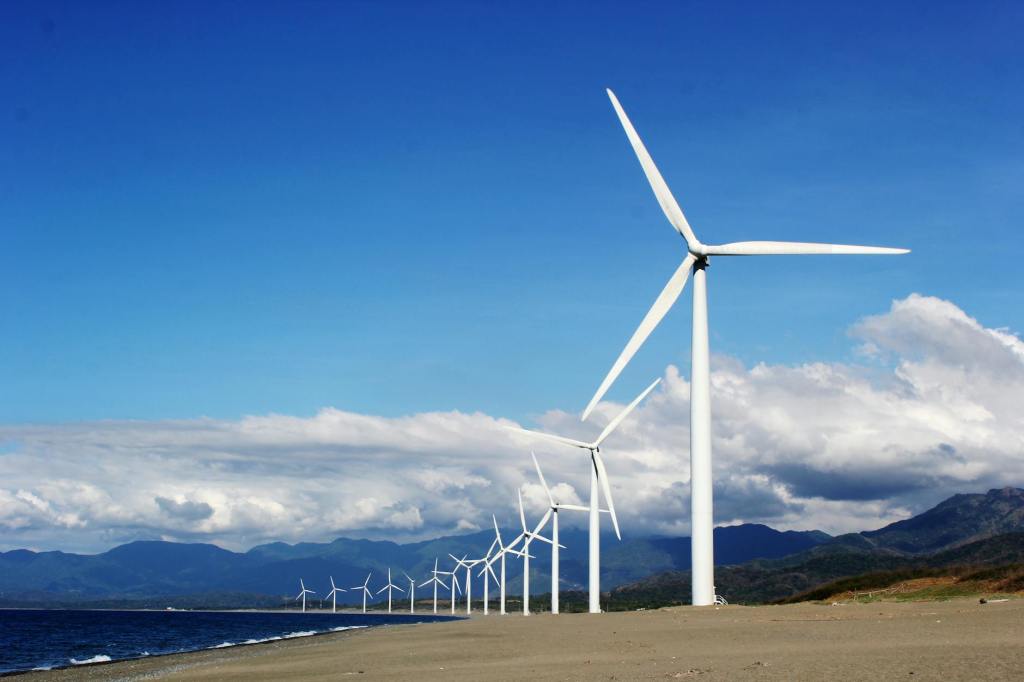
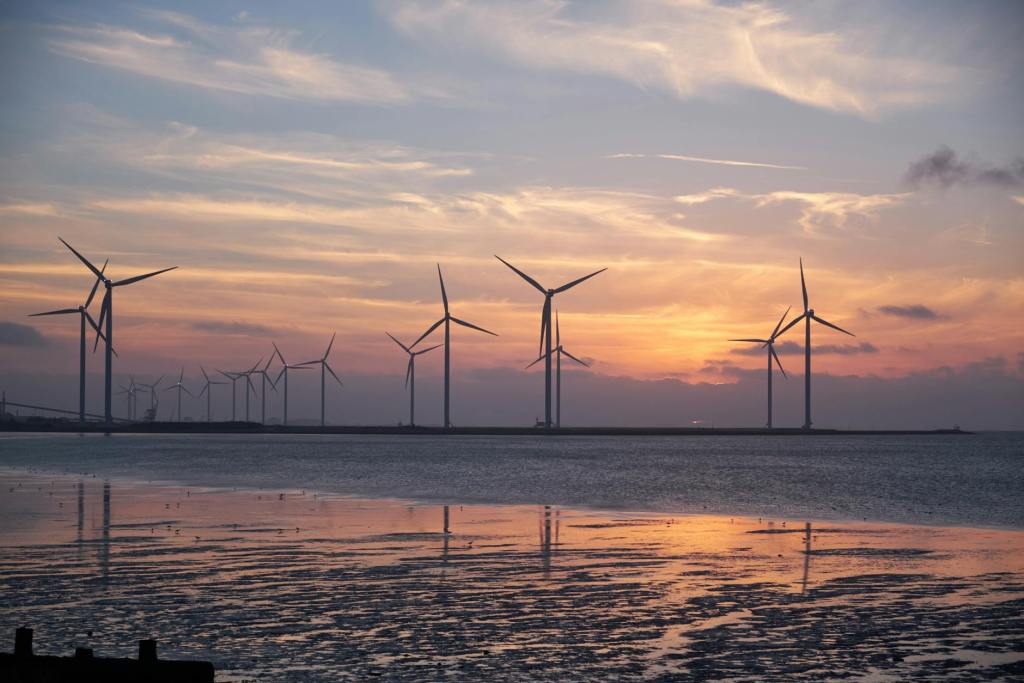
Photo from pexels.com
There is a lot of disinformation being spread about wind power. One recent example is the TV series Landman which presents demonstrably false claims as facts. In Texas where I live the problem with deceitful anti-renewable propaganda is especially severe. It is important to check with reputable sources before you believe what you come across. Wind energy is not 100% clean and not without issues but it is much safer and cleaner than the fossil fuels they potentially replace. Below is a two minute video that explains this.
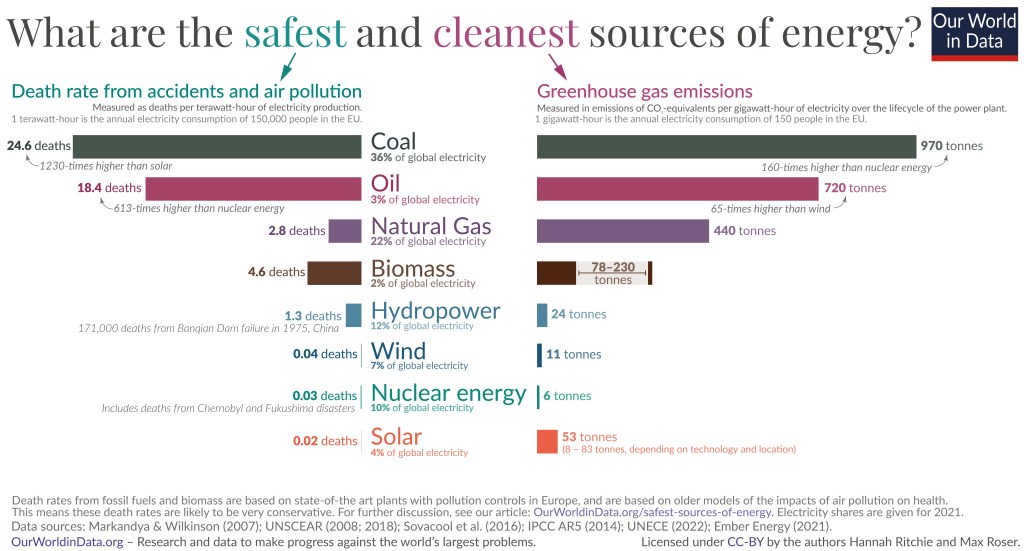
The graph below from Our World in Data depicting lifetime greenhouse gas emissions (construction, operation, disposal) show that the lifetime greenhouse gas emissions of coal power are 88 times higher than those of wind power and kill 615 times as many people as wind power. The lifetime greenhouse gas emissions of natural gas are 40 times higher than those of wind power and kill 460 times as many people as wind power. The difference is staggering. When someone tells you that there’s nothing clean about wind power, they are not just lying to you, they are lying very big.
In the graph below, greenhouse gas emissions is measured of CO2 equivalents per Gigawatt-hour of electricity over the lifecycle of the power plant. 1 Gigawatt-hour is the annual electricity consumption of 150 people in the EU. Death rate from accidents and air pollution is measured as deaths per Terawatt hour of electricity production. 1 terawatt hour is the annual electricity consumption of 150,000 people in the EU.
Death rates from fossil fuels and biomass are based on state-of-the art plants with pollution control in Europe and are based on older models of the impacts of air pollution on health. This means these death rates are likely to be very conservative. For further discussion see our article: OurWorldinData.org/safest-sources-of-energy. Electricity shares are given for 2021. Data sources: Markandya & Wilkinson (2007); UNSCEAR (2008: 2018); Sovacol et al. (2016); IPCC AR5 (2014); UNECE (2022); Ember Energy (2001). OurWorldinData.org – Research and data to make progress against the world’s largest problems. Licensed under CC-BY by the authors Hannah Ritchie and Max Roser. Citation : Hannah Ritchie (2020) – “What are the safest and cleanest sources of energy?” Published online at OurWorldinData.org. Retrieved from: ‘https://archive.ourworldindata.org/20260202-100556/safest-sources-of-energy.html’ [Online Resource] (archived on February 2, 2026).
As you can see wind power is safe and emits very little greenhouse gases over its lifetime. In addition, there is no water impact associated with the operation of wind turbines, but a relatively small amount is used in manufacturing. There are other issues with land use, sounds, rare earth mining, waste, and effects on wildlife particularly birds.
However, these issues are in general smaller than depicted must be compared to issues with the fossil fuels they replace. For example, 15 billion tons of fossil fuels (including 9 billion tons of coal) are mined every year and burned whilst the annual mining for all clean energy technologies is around 7 million tons (2,000 times less). More about birds in the next section. Overall wind energy is a clean, renewable, and a sustainable power source. You can read more about this here, here, here, or here.
I am referring to this fact as a super fact because, it is true, an important topic, and yet it’s a fact that is difficult for many people to believe. Too much misinformation has been spread about wind power. I expect some people to dismiss this fact out of hand. But that is the point of super facts, they are true but hard to believe for many, or surprising, and perhaps even shocking.
Wind power saves a lot more birds than it kills
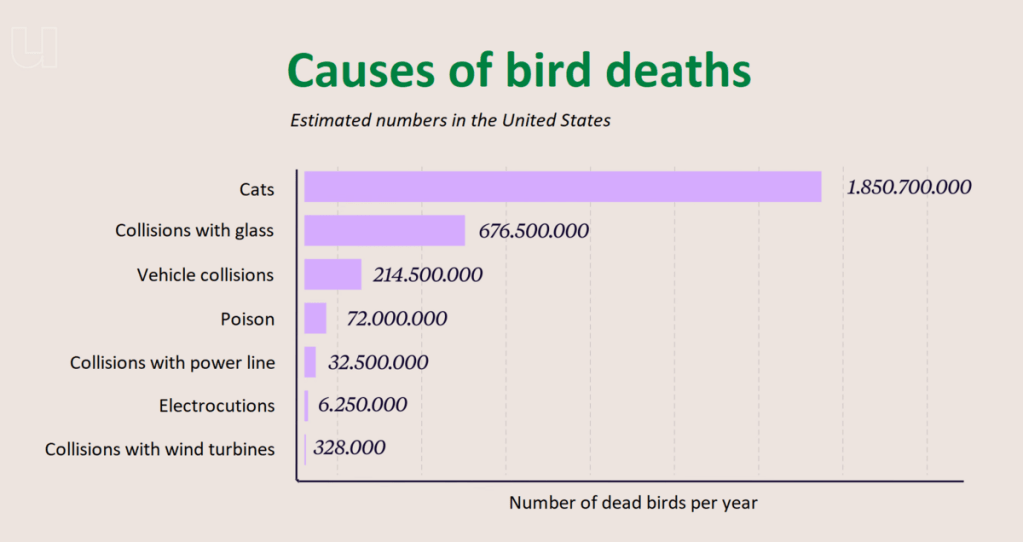
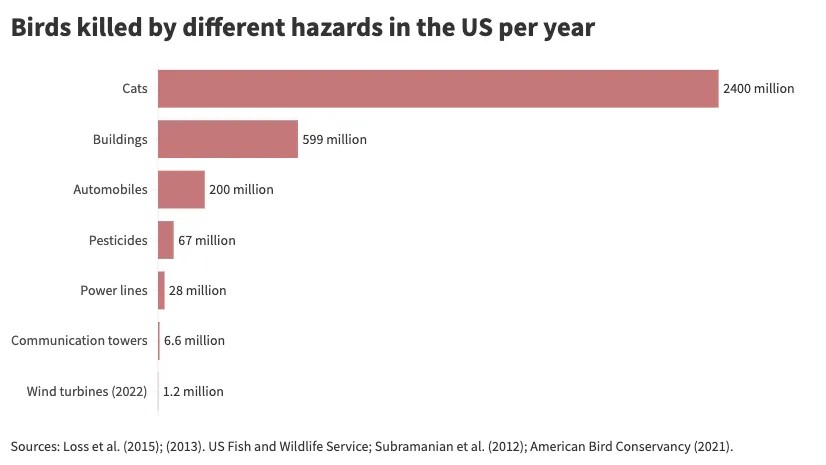
It may come as a surprise to some, but wind power is not a major cause of bird death. Wind farms are estimated to be responsible for losing less than 0.4 birds per gigawatt-hour (GWh) of electricity generated, compared to over 5 birds per GWh for fossil fueled power stations. This means that replacing fossil fuels with wind power saves a lot more birds than wind power turbines take. In addition, cats, windows, cars, poison and powerlines are examples of things that kill a lot more birds than wind power does. Cats kill thousands of times more birds than wind power does, and this usually does not bother us. Note I love both dogs and cats.
It is difficult to make exact estimates of bird deaths but below are some interesting graphs from reputable sources, confirmed by many other studies and analysis, such as this overview from MIT and this analysis by Hannah Richie. The numbers aren’t the same, but they make the same point. You can read more about this here.
From Wikipedia: Universiteit van Nederland, CC BY 3.0 https://creativecommons.org/licenses/by/3.0, via Wikimedia CommonsAn alternative graph taken from Hannah Richie / Our World in Data, using alternative sources essentially showing the same thing. Sources: Loss et al. (2015), (2013), US Fish and Wildlife Service; Subramnayan et al. (2012), American Bird Conservancy (2021).
That does not mean we shouldn’t do our best to reduce bird deaths from wind power stations. However, don’t fall for the misinformation that is trying to paint it is a big problem specifically for wind power.
Photo from pexels.com
Wind Power is Inexpensive
Finally, a bit of a deviation from the main topic. In addition to being a relatively clean, renewable, and sustainable power source, wind power is now relatively cheap, which explains its recent success around the world. I am bringing this up because another widespread myth about wind power is that it is expensive and wouldn’t survive without subsidies.
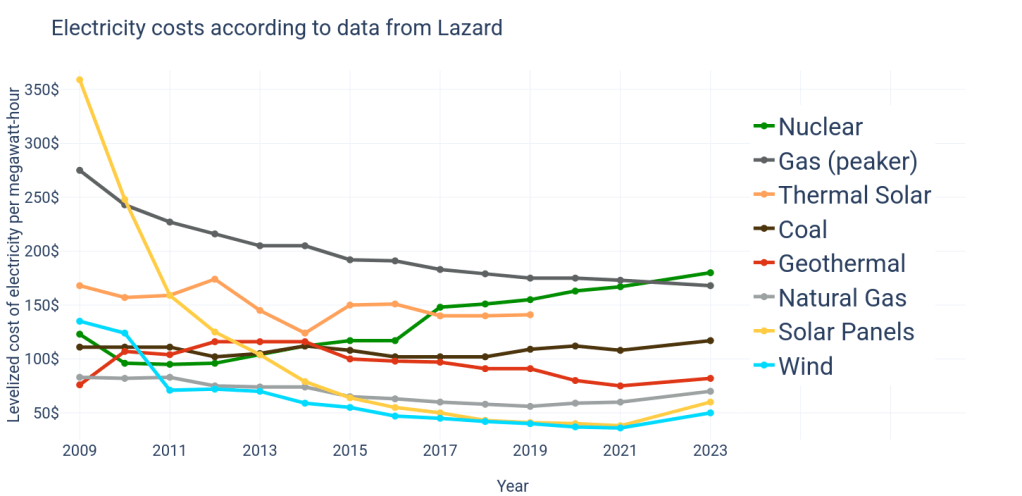
Practically all energy sources are subsidized, and fossil fuels have a long history of government subsidies. Below is the average unsubsidized levelized cost of energy according to Lazard. Levelized means that construction costs, land rent, and other costs not directly caused by electricity generation are taken into consideration. Notice how cheap wind is (blue line). This graph is for the United States.
Average unsubsidized levelized cost of energy. Notice that the light blue line indicates that wind power is pretty cheap. Mir-445511, CC BY-SA 4.0 https://creativecommons.org/licenses/by-sa/4.0, via Wikimedia Commons.
Windpower is not only relatively cheap. Wind power is one of the most efficient and sustainable energy sources available. The energy required to manufacture, install, and maintain wind turbines is small compared to the energy they produce over their lifespan. This is known as their energy return on investment (EROI), which is quite favorable for wind energy. The Institute of Environmental Management and Assessment (IEMA) states that the average wind farm will pay back the energy that was used in its manufacture within 3-5 months of operation. This article in the journal Renewable Energy found that the average windfarm produces 20-25 times more energy during its operational life than was used to construct and install its turbines. It included data from 119 turbines across 50 sites going back 30 years.
It is important to be aware that there are many false claims floating around about wind power. The sound from wind power stations does not cause cancer, it does not use any other energy sources while operating; it solely harnesses the kinetic energy from the wind to generate electricity, meaning it only relies on wind to function as its primary energy source. Windpower is not a major cause if bird deaths. To read more about false claims about wind power click here.
Conclusion
There are positive and negative aspects of wind power, like any other source of energy. One issue with wind power (and solar) is that it is an intermittent source of energy. When the wind is not blowing you need other sources of energy (until there is sufficient energy storage). This is less of a problem when you have a mix of energy sources and in practice it has not been a big problem so far. However, what we know is that Wind Energy is indeed clean energy, much cleaner than the fossil fuels they potentially replace, and also relatively cheap, even without subsidies.





 Super Facts