
Super fact 55 : The enormous Kuiper belt.
The Kuiper Belt is a vast torus/donut shaped region of space beyond Neptune, filled with icy, rocky bodies, including dwarf planets like Pluto. It shares a lot of similarities with the Asteroid belt, but it is much larger, and further out. The Kuiper belt is 20 times wider than the Asteroid belt, 1,000 larger by volume, and 20 to 200 times more massive than the Asteroid belt. It extends from roughly 30 to 50 astronomical units (AU) from the Sun.
I can add that one Astronomical Unit (AU) is the distance from the sun to Earth.

The Kuiper belt is like a giant Asteroid belt located further out, beyond Neptune. The Kuiper Object Pluto, formerly known as the Planet Pluto, is the most admired, the cutest and most beloved of all planets, and it was the first Kuiper object discovered in 1930. However, we did not know of the existence of the Kuiper belt at the time. The Kuiper belt was discovered in 1992 and predicted to possibly exist by Astronomer Gerard Kuiper in 1951. The discovery of the Kuiper belt was one of the reasons Pluto was demoted from its planet status in 2006. There are other dwarf planets in the Kuiper belt similar Pluto, including Makemake, Haumea, and Eris. However, there could be hundreds. Ceres is a dwarf planet located in the Asteroid belt. To read more about the Kuiper belt and verify the facts above, click here, or here, or here.
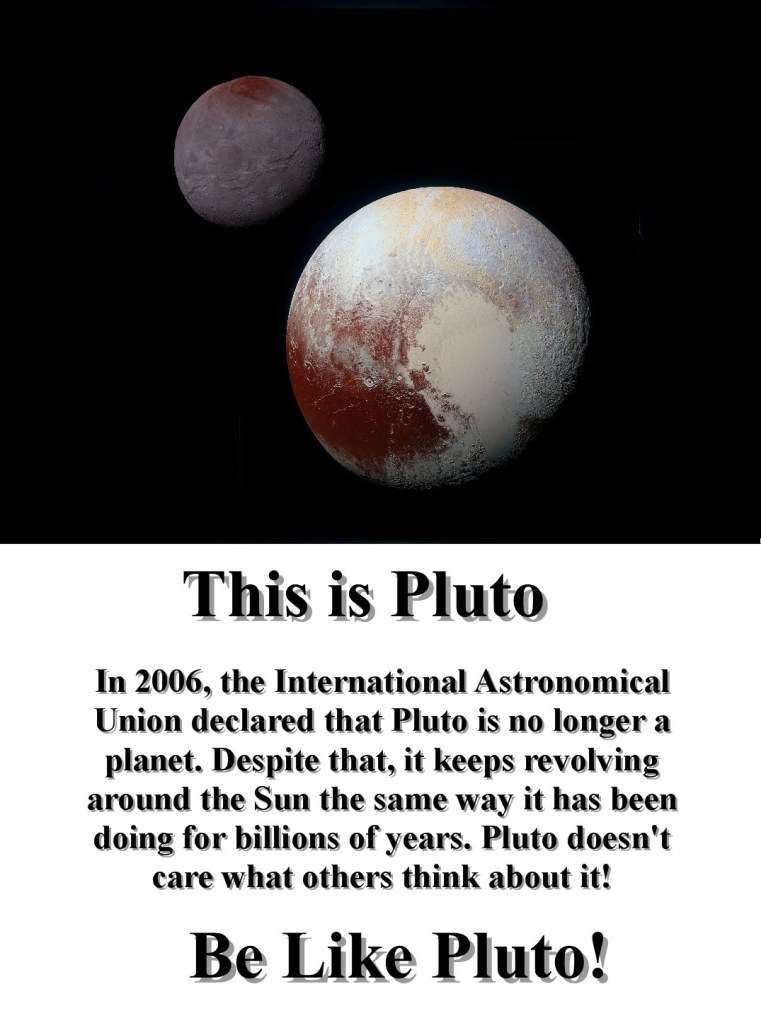
I selected this to be a super fact because the existence of the Kuiper belt drastically changed our view of our Solar system, so it is important, we know it exists, so it is a true fact, and despite its enormous size the Kuiper belt is much less known than the Asteroid belt, and its existence often comes as a surprise to people.
The Kuiper Belt Resides in Darkness
You may wonder why the Kuiper belt was discovered so late whilst the Asteroid belt has been known since the beginning of the 19th century (Ceres 1801, Pallas 1802, Vesta 1807, etc.) The reason is that the Kuiper belt resides in darkness. The Asteroid belt is 2.2AU to 3.2AU from the sun whereas the Kuiper belt is between 30 to 50AU from the sun.
Let’s say you take an object that is 2.5AU from the sun and place it at a distance that is 40AU from the sun. Due to the spreading of the light the object will now receive 16 X 16 = 256 times less sunlight. This is called Geometric dilution. In addition, this light needs to be reflected back to earth for us to see the object, and once again the light will spread resulting in 256 X 256 = 65,536 times less light reaching our telescopes. The Kuiper belt is huge, but it resides in darkness. Despite this fact, we have now discovered and catalogued more than 2,000 Kuiper belt objects. However, it is estimated that there are hundreds of thousands of Kuiper belt objects wider than 100 kilometers.
What is a Dwarf Planet?
A planet as well as dwarf planet is a celestial body that orbits the Sun and is nearly round due to its own gravity. Basically, it must be large enough to have compressed itself to a near spherical shape. To be classified as a planet and not a dwarf planet it must also have cleared its orbit of debris. So, a dwarf planet is therefore a celestial body that orbits the Sun, is nearly round due to its own gravity, but has not cleared the neighborhood around its orbit. Obviously, a planet in the Asteroid belt or the Kuiper belt is a dwarf planet. Just to make this complicated Astronomers have found giant exoplanets that have not cleared their orbit of debris . I wonder, are these exo-planets giant dwarf planets?
Oort Cloud
Astronomer and Author David Lee Summers (blog here) reminded me of the Oort cloud, which could be interesting to bring up in this context. The Oort Cloud is a vast spherical cloud of icy bodies, which is hypothesized to surround the solar system, extending from about 2,000 to 200,000 AU. It is thus thousands of times further out and wide than the Kuiper belt. I say hypothesized because the objects are so small, there’s really no direct observation of them and there’s some variation in numbers for its distance and extent, meaning it’s still not well defined yet. Still, its outer edge is believed to be the boundary between where the sun’s gravity dominates and the galaxy’s gravity dominates.
The Oort cloud is generally considered to be the outer edge of the solar system and believed to be the origin of most long period comets. The Oort cloud is thought to encompass two regions: a disc-shaped inner Oort cloud aligned with the solar ecliptic (also called its Hills cloud) and a spherical outer Oort cloud enclosing the entire Solar System.

Other Astronomy Related Super Facts
- We are Star Dust
- The Strange Worlds of Exoplanets
- The vastness of space and the beginning of infinity
- The Bizarre Reality of Black Holes
- That Earth is round was well known long before Columbus
To see the other Super Facts click here

 Super Facts
Why is clearing its path of debris a defining characteristic for a planet? Because it can’t crash into objects?
LikeLiked by 1 person
That is a good question you have to ask an Astronomer. However, I read a book about this some years ago. I should say the book was written by an Astronomer who was unhappy with the decision so it might be biased. He said that at first, they were going to go with large enough so that its gravity squeezed it into a ball, and that’s it. However, that would have included not just Pluto as a planet but Ceres in the Asteroid belt as well, which has never been considered a planet before, not to mention potentially hundreds of Pluto like objects/dwarf-planets in the Kuiper belt. We’ve only found four Pluto-like planets / dwarf planets so far, but it might be many more. That would make a very long rhyme for children. They also considered using other criteria such as the diameter, but since it was once thought that Pluto was larger than Mercury (better measurements changed that) and there might be Kuiper belt objects bigger than Mercury, that was not considered a good one. We don’t want to lose Mercury as a planet.
.
To add the criteria clearing its path of debris would keep our existing planets as planets but exclude objects in the Asteroid belt and the Kuiper belt. So, squeezed into a ball by gravity and clearing its path of debris was the two criteria they went with. However, the author said that there are problems with that definition too, because other solar systems seem to have giant planets, bigger than Jupiter, that have not cleared their path of debris. Does the definition make sense for them? The conclusion of this book was, we aren’t done with this definition. I am going to see if I can find this book. I should say that Neil De Grasse Tyson did not agree with this author.
LikeLike
Ah, the definition makes sense in this context. We’ll see what transpires with time. Thanks for the comprehensive answer 💙
LikeLiked by 1 person
Yes it will be interesting to see what happens in the future.
LikeLike
PS a great post. Space is very intriging
LikeLiked by 1 person
Thank you so much Robbie
LikeLike
🌖🌎🌙☄️
LikeLiked by 1 person
Interesting fact about the geometric dilution, Thomas. I love the way Pluto reacts to others. That’s my goal for the day. Don’t pay attention to them. Don’t even ignore them!
LikeLiked by 1 person
Thank you. Yes you are right Grant. Be like Pluto!
LikeLiked by 1 person
Wow, what a cool post! Space has always fascinated me!
LikeLiked by 1 person
Thank you so much Ada. I really appreciate it.
LikeLiked by 1 person
Interesting, Thomas there is so much we don’t know about space and so much we will never know….I guess if it doesn’t clear the debris then the danger is a bit like meteorites I guess they could just be on a collision course and a danger for the planet if they fell out of their orbit…or am I way of course I don’t know much about space…I just have a fascination for space…
LikeLiked by 1 person
Thank you so much Carol. I am also fascinated by space. I did not pick astrophysics/physics/astronomy as my field because I felt Engineering was safer employment wise, but if I had picked based on what I like best I would have picked one of those. Regarding using clearing debris, Robbie above asked about that and I wrote a long answer based on a book I’ve read a few years ago, well several years ago. I am going to try to find it and maybe make a post.
LikeLiked by 1 person
No pressure Thomas…however I look forward to it 🙂
LikeLiked by 1 person
Thank you Carol
LikeLiked by 1 person
There’s so much of interest here. Space is so fascinating.
LikeLiked by 1 person
Thank you so much Esther. I agree, space is fascinating.
LikeLiked by 1 person
Cute Pluto meme!
LikeLiked by 1 person
Thank you Jacqui. I think I saw it on Facebook, but may not have remembered it exactly.
LikeLiked by 1 person
So these bodies out there are what they are, regardless of how we classify them. Like Robbie, I wonder why clearing debris is a defining characteristic. Maybe it shows that the body has a certain level of autonomy?
LikeLiked by 1 person
You are right. It is a matter of classification and it doesn’t change what they are. Previously there was no clear definition of what a planet was and they wanted to exclude Asteroid objects and Kuiper belt objects from being planets while keeping the planets we already had, that’s why clearing the orbit of debris was a clever way of accomplishing that. That’s based on a book I’ve read. However, I gave Robbie above a long answer to that question.
LikeLiked by 1 person
I will have a look at that answer. Thanks, Thomas!
LikeLiked by 1 person
Thank you Audrey
LikeLiked by 1 person
I remember learning about the Kuiper Belt in one of my astronomy classes in university. I didn’t remember too much about it though so it was fun reading the post. Pluto is definitely the cutest planet lol, I don’t know why but everyone seems so attached to it.
LikeLiked by 1 person
Yes most people know about the Asteroid belt even though it is much smaller by far. You have to take an astronomy class to learn about Kuiper belt. I believe the dog Pluto was named after the former planet Pluto that is why it seems cute. I am speculating, but it has a special place in people’s hearts, especially children. I’ve read that the International Astronomical Union and its Astronomers got a lot mail from children when this happened.
LikeLiked by 1 person
Yeah, I took two astronomy courses and in one of them learn about the Kuiper belt. I forgot about the dog Pluto, that may have something to do with it. I also remember there was a viral meme when I was a teenager about how Pluto’s surface had what looked like a heart from afar and people really loved that.
LikeLiked by 1 person
Yes I remember that now, about the heart. I can add that the guy who was behind the New Horizons mission to Pluto, Dr. S. Alan Stern, graduated from St. Mark’s School of Texas in 1975, which is where my boys went. He was there doing speeches.
LikeLiked by 1 person
Oh I see, that’s very cool. What did your boys study there?
LikeLiked by 1 person
Well it was a school for children from first grade up and including high school 1-12 so they studied everything children do. I should say that our oldest son quit after 10th grade even though he was doing well and went to a different school. St. Marks School of Texas is an all boys school and is a bit strict and sheltered and he didn’t like it when he got older.
LikeLiked by 1 person
Oh okay, got it. I understand, I went to a private school which was quite strict too and as a teenager that feels very restrictive.
LikeLiked by 1 person
Both you and my kids went to private school but I went to public school, so I did not personally have that experience, but it seemed like it was more competitive and more strict. My impression though is that private schools tend to be better academically.
LikeLiked by 1 person
Yeah, definitely more competitive and strict in my experience as well but it can be better academically. I think going to private school did very much help my studies.
LikeLiked by 1 person
It is great that private school helped your studies. However, some cannot keep up.
LikeLiked by 1 person
Yeah, a few of my friends had that issue and I also ended up struggling with maths although I was fine with other subjects. It can be a very fast paced so if you have a subject you’re not naturally good at it can be hard to keep up.
LikeLiked by 1 person
I am glad you were able to keep up Pooja. It is not easy. I had to reply to an older comment because we reached the maximum comment depth of 10.
LikeLiked by 1 person
Oh no problem and yeah I’m glad I could keep up but it did leave me burnt out so I took a gap year before university.
LikeLiked by 1 person
Gap years can be refreshing. Back in Sweden at the time young men got a gap year before college because you had to do a one year army service. No studies for a year, but with all physical exercise, shooting, throwing hand grenades, and sleeping in the forest, you were glad to be back at school. It was a way of refreshing and be happy to be back.
LikeLiked by 1 person
Oh I see, I didn’t know Sweden had that rule where you have to enlist for a year.
LikeLiked by 1 person
Sweden does not have that rule anymore, but when I was young they did. It was because of the cold war. However, now with Russia being more aggressive it might be needed more than ever. Sorry I have to reply to a previous comment because we reached the maximum depth of commenting (10).
LikeLiked by 1 person
That’s fine. Oh I see, that makes sense. Hopefully, things don’t escalate too much in Europe again but it seems likely they will.
LikeLiked by 1 person
Yes Russia has fought many wars against Finland and Sweden in the past, and Putin has recently threatened Sweden (over joining NATO) so it is an issue. I can add that when I was in my early 20’s I created the part of the electronics for a Swedish military Jet called JAS Gripen and it has become pretty popular in small countries the world over. Sweden is considering giving Ukraine JAS Gripen planes. That might not be popular with Putin. An interesting anecdot is that when I was a teenager I was apprehended, and interrogated at gun point, at the Finland station in Leningrad (now Saint Petersburg). One of the men in charge of foreign visitors in Leningrad at this time was a young officer Vladimir Putin.
LikeLiked by 1 person
Wow, I didn’t expect that, that’s such a crazy thing to have experienced. Did you talk to him at all when you were interrogated? That’s so impressive that you created that. I studied the Cold War so extensively and yet I don’t remember anything much about Russia being at war with Finland or Sweden, I’m going to do some more reading about it because I’m absolutely fascinated.
LikeLiked by 1 person
Sorry Pooja, I should explain. The wars between Russia Finland and Sweden were far in the past not during the cold war, even though Finland and Sweden were threatened by Russia and had their borders violated by Russia during the cold war. There were several wars between Sweden/Finland and Russia hundreds of years but then in 1809 Russia invaded and took Finland, which was a province of Sweden at the time. Then after the Russian revolution Finland took its chances and freed itself from Russia 1918. Then during the WWII the Soviet Union attacked Finland and there were two wars, but since 1945 there has not been any hot war between Sweden/Finland and Russia, just a tense situation.
About Putin, I just thought that maybe I might have seen him since he was in charge of things that I got caught up in. But there were other people interrogating me and we were a group.
LikeLiked by 1 person
Oh okay, that explains it much better. I know almost nothing about the history of that region so it’s nice to learn more. I didn’t even know Finland used to be a province of Sweden.
Maybe he had been in the area though. Glad you were in a group, it would probably be a lot scarier if you were interrogated alone.
LikeLiked by 1 person
Yes, being interrogated alone would have been bad. However, my parents would never have allowed me to go to the Soviet Union alone. I was a minor at the time. Sorry I explained myself really badly.
LikeLiked by 1 person
Not at all, I’m just curious about the details since it’s an interesting experience.
LikeLiked by 1 person
Thank you Pooja
LikeLiked by 1 person
You’re welcome.
LikeLiked by 1 person
Great post about the Kuiper Belt. It is surprisingly large and even its estimated outer boundary is only a small fraction of the way to what we typically consider the “edge” of the solar system, which is the Oort Cloud. Current estimates suggest it extends from 2000 to 20,000 AU.
One note, I think it’s something of a misnomer to distinguish between dwarf planets and “real” planets. I would argue dwarf planets are also real planets, just ones that are small enough that they haven’t cleared their orbits of debris. I also say this because of astronomical naming conventions. “Dwarf” is simply small. In fact, we orbit a dwarf star, but no one says the dwarf star we orbit is not a real star.
LikeLiked by 2 people
Thank you so much David, and I really appreciate your help. I fixed the “real planet” issue but I realized I should probably add something about the Oort cloud, which I will do tomorrow.
LikeLiked by 1 person
You’re welcome. It’s worth reading a bit about the Oort Cloud. The objects are so small, there’s really no direct observation and there’s some variation in numbers for its distance and extent, meaning it’s still not well defined yet. Still, its outer edge is believed to be the boundary between where the sun’s gravity dominates the galaxy’s gravity dominates.
LikeLiked by 1 person
I knew about the Oort cloud but I don’t know much about it. But I will read up on it before I post another section. Thank you so much for all the interesting information. It is great to have an Astronomer helping me out.
LikeLiked by 1 person
My pleasure!
LikeLiked by 1 person
A fascinating topic and one I know too little about. Thanks for the education Thomas! It was always a mystery to me, why Pluto was downgraded from planet status. Love the meme! 😆
LikeLiked by 1 person
Yes I think it is a fascinating topic. Thank you so much Debbie.
LikeLiked by 1 person
hello, how are you? thank you for those explainations. have a nice day!
LikeLiked by 1 person
I am fine Carfax and thank you for stopping by. Have a nice day you too.
LikeLiked by 1 person
thanks for the read 🌌
LikeLiked by 1 person
Thank you Brittany
LikeLike
Absolutely fascinating… and brings up a rabbit hole of questions now, that one may keep me awake a night or two.
LikeLiked by 1 person
Thank you Kerri, but I hope you can sleep
LikeLiked by 1 person
😂😂I love planet study and all they stand for and that really sparked me.
LikeLiked by 1 person
Oh that is good to know. I think it is fascinating myself.
LikeLiked by 1 person
I will always think of Pluto as a planet, even if I’m wrong!
LikeLiked by 1 person
I think a lot of people do that.
LikeLike
Fascinating information Thomas. I think you are a super brain. 😃 I loved the Pluto meme.
LikeLiked by 1 person
Thank you so much for your kind words Debby. I saw the Pluto meme on Facebook. I hope I remember it right.
LikeLiked by 1 person
I love it! 🙂
LikeLiked by 1 person
Oona: “Pluto likes to hang out in the dark doing whatever Pluto wants to do and doesn’t care what anyone thinks of it? So you are saying that Pluto is … a cat. Oona understands completely.”
LikeLiked by 1 person
Ha ha I think you are right Oona
LikeLike
That mystical stretch beyond Neptune—silent, vast, and shadowed—is a reminder that the universe’s greatest structures often live in darkness. The Kuiper Belt isn’t just distant debris; it’s a field of frozen resonance, a fractured ring that quietly holds clues to how matter arranges itself where light barely reaches.
Thanks for spotlighting it—reminds us that some of the most compelling truths lie not in the brightest lights, but in the silent harmonics of the boundary.
LikeLiked by 2 people
That is a poetic and very interesting way of putting it. Thank you very much Dink.
LikeLiked by 1 person