
Super fact 63 : Evolution is both a fact and a scientific theory. It is a fact that life has changed over time. This is supported by overwhelming evidence, while the theory of evolution provides a comprehensive scientific explanation for these changes, using processes like natural selection.
This is very confusing to people who do not know what a scientific fact is or what a scientific theory is. First of all, a scientific fact (they exist) is not the same as the scientific theory associated with that fact. Secondly, theory in science does not mean a guess, or a hypothesis, as is often the case in common parlance. In science, a theory is far more than a guess — it is a well-tested, comprehensive explanation of natural phenomena, supported by an extensive body of evidence. I think a good example of this confusion is the following dialogue that I found on Facebook.
I follow “The Credible Hulk”, a Facebook page managed by a group of anonymous scientists dedicated to correcting misinformation around vaccines, global warming, evolution and GMOs. I did not save the post, but it went something like this: The Credible Hulk posted a meme that looked like this.
- Our planet Earth is not flat like a pancake
- Global Warming is real and is caused by us
- Evolution is a fact
- We’ve been to the moon
- Vaccines do not cause autism
One of the commentors said : “Calling evolution a “fact” defeats your argument. The Theory of Evolution is by definition a theory not a fact. It’s the currently agreed upon hypothesis but not a fact.” He did not know that he did not know what he was talking about. Since the Credible Hulk page is administered by scientists and a lot of its followers are also scientists, or people with a science education, he got schooled. You can read more about this confusion in my post “There Are Scientific Facts”, or here.
The evidence for evolution is both vast and compelling. Evolution is not just a process of the distant past — it can be observed in real time. Bacteria developing antibiotic resistance, viruses adapting to immune systems, and insects evolving resistance to pesticides are clear, measurable examples of evolution in action. The extensive fossil record, transitional fossils, comparative anatomy, sub-optimality, evidence from biogeography, etc., provide a very large body of conclusive evidence for evolution. Modern genetics provides perhaps the strongest proof of evolution.
Far from being a matter of belief, evolution is a scientifically established reality that shapes life continuously. Its understanding is vital, not only for biology but also for medicine, ecology, and environmental science. It allows us to track disease outbreaks, design new treatments, and appreciate the delicate balance of ecosystems. Evolution is not speculation — it is the foundation of modern biology and a dynamic process still unfolding around us. Evolution is a fact.
According to the pew research center around a third of all Americans reject the idea of evolution. Since this is an important fact that is widely disputed amongst the public, and yet we know it is true, I consider it a super fact. I also would like to reiterate that none of my super facts are scientific theories, but some of them are scientific facts, which again, is not the same thing.
Evidence for Evolution
The evidence for evolution as a phenomenon (fact) is conclusive as we can directly observe it (see below). That is all I need for my statement above that evolution is a fact. However, most people want to know how strong the evidence is for large-scale evolutionary changes that have occurred over geologic time, and what evidence there is for evolution being as the origin of species. In other words, how strong is the evidence for the theory of evolution. It turns out the evidence for that is also very strong. That is not the same as my super fact, but it is related and a quite interesting discussion.
Fossil records preserved in rock layers reveal a chronological history of life on Earth, documenting gradual changes in species over millions of years. Transitional fossils, such as Archaeopteryx linking dinosaurs to birds, demonstrate how one group of organisms evolved into another. Comparative anatomy adds to the case, showing homologous structures across species that point to shared ancestry.
Biogeography shows patterns of species distribution explained by common descent and migration. Modern genetics provides perhaps the strongest proof. DNA — the universal code of life — shows striking similarities across organisms. Humans, for example, share a large percentage of their genome with chimpanzees, and remarkably, the same genetic code underlies all living things, from bacteria to mammals, confirming a common evolutionary origin.
Making a list of all the evidence with brief explanations is far beyond the scope of this blog post and reading a 1,000,000+ word essay about evidence is not everyone’s cup of tea. Therefore, I am just providing a very small sample with very brief explanations (this post is long enough as it is).
This website offers a more extensive overview including 29+ evidences for so called macroevolution. Macroevolution describes large-scale evolutionary changes that occur over geologic time. Scientist tend to avoid the word Macroevolution because it is so misunderstood. First of all, Macroevolution is just the combination of a large number of smaller scale changes. New species do not randomly pop up because of some amazing mutation.
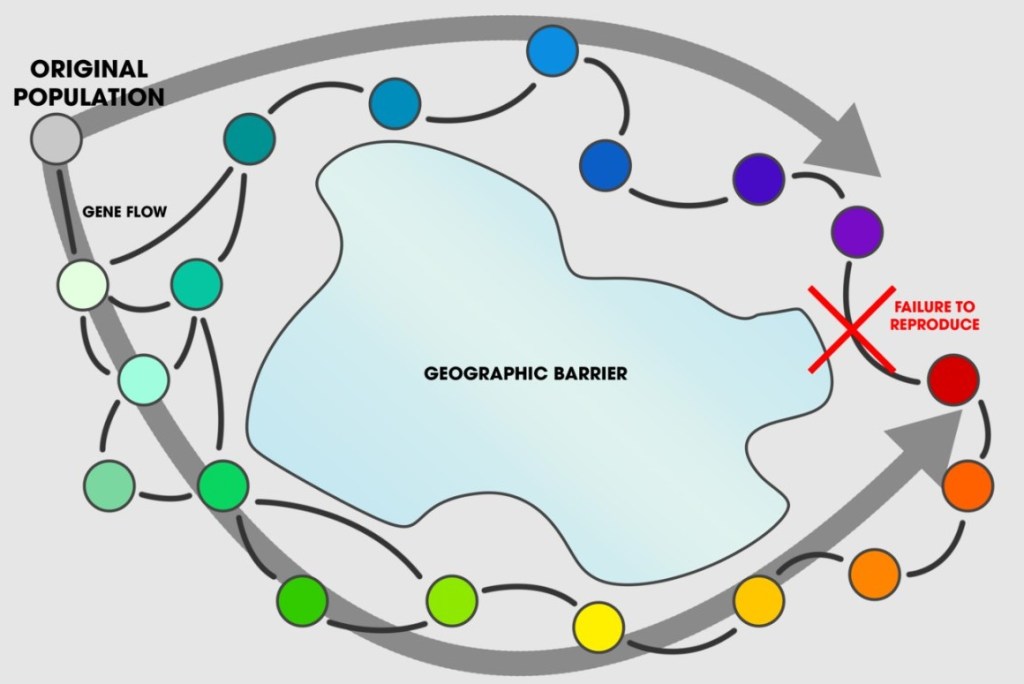
Speciation is considered relative. It is often said that two animals belong to the same species if they can interbreed in nature and produce viable, fertile offspring. However, it is not that simple. An animal A may be able to successfully interbreed with an animal B, and that animal B may be able to successfully interbreed with an animal C, but animal A and C cannot interbreed. Animal A could be said to be a different species relative to animal C but animal B could be said to be the same species as both animal A & C.
A great geography related example of this is ring species. In a ring species, gene flow occurs between neighboring populations of a species, but at the ends of the ring the populations don’t interbreed. Macroevolution is the result of repeated microevolution, so you cannot claim that microevolution is possible but not macroevolution.
Direct Observation
Evolution in viruses and bacteria has been observed and is well-documented, providing a direct window into evolutionary processes. Examples include the development of antibiotic-resistant bacteria, the annual evolution of influenza viruses and researchers can also directly observe rapid adaptation through experiments, such as the ongoing “arms race” between bacteria and viruses in lab settings. Direct observation supports my claim that “evolution is a fact”, because we’ve seen it. However, the evidence for so called macroevolution over longer periods of time is more indirect but still extremely strong.
Evidence from Biogeography
Biogeography provides evolutionary evidence by revealing patterns in the geographic distribution of species that can only be explained by common descent and evolutionary processes. For example, oceanic islands, which are islands that are formed from the sea bottom typically through volcanic activity, feature very narrow sets of native species (flora + fauna) that do not exist elsewhere.
One example is the Hawaiian Islands, which make up only 0.004 percent of the earth’s land and yet they contain nearly half of the world’s two thousand species of Drosophila. Darwin’s finches is another example. Another example is that oceanic islands do not have any native freshwater fish, or amphibians and rarely any native reptiles or mammals. These kinds of examples match the narrative that certain species (birds, insects, etc.) travelled to these islands and then evolved resulting in a unique set of species. BTW non-native freshwater fish, amphibians, and mammals do just fine, so it is not the environment. The book Why Evolution Is True by Jerry A. Coyne gives an extensive overview of biogeographic evidence for evolution.
Fossil Record
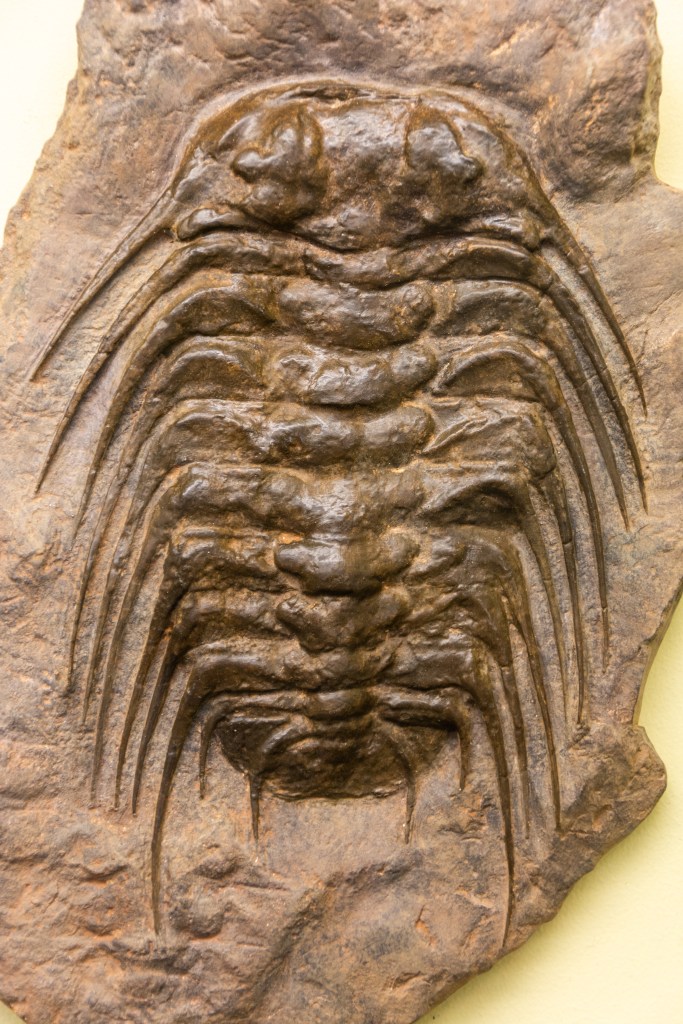
There are millions of found fossils representing 250,000 different species (there are likely trillions of not yet found fossils). The fossil record shows that early life was simple with complex life appearing later, with the youngest fossils being most similar to currently living species. It documents the orderly succession of life forms through geologic time. This is predicted by the theory of evolution. In addition, the various so called gaps in the fossil record keep being filled out. Opponents to evolution often criticize the dating methods used to date fossils. However, these criticisms do not hold water. You can read about that in my post We Know That the Earth is Billions of Years Old.
Evidence of Evolution from DNA
DNA provides strong evidence for evolution. It is perhaps the strongest evidence for evolution. For example, related species share genes for fundamental traits, and the more similar the DNA sequences of two organisms, the more recently they shared a common ancestor. As time goes by DNA mutations accumulate acting like a “genetic clock,” allowing scientists to estimate how long ago different lineages split from each other. That’s how we know that Chimpanzees and Hominins / Humans share a common ancestor about 6-8 million years ago without having a fossil.
I can add that this was just a sample with a very brief summary for each case. Other types of evidence is the development of embryos. For example, whale and dolphin embryos have limbs that disappear, fetuses look like fish early on, human fetuses go through a hairy (primate) stage. There is evidence in the anatomy of our bodies, sub-optimality, curious anatomical imperfections due to our evolutionary history, so called atavisms, and vestiges. But that is enough for now.
Objections to Evolution
If you pay attention to this topic, you will come across a lot of flawed objections to evolution. When I was a teenager, I was a young earth creationist myself. Since I did not know a lot about the subject at the time I accepted many of these flawed objections and I even believed in a young earth. It doesn’t matter how many flawed objections you have to a theory (or a fact), if they are flawed, they don’t matter. I was very interested in science and went to science high school in northern Sweden. As I learned more about science, I came to realize that I had been bamboozled. You can read more about that in my post “Bamboozlement Misunderstandings, Big Surprises and My Journey”.
Since then, I have tried to argue with creationists about evolution, and I have come to realize that a lot of people are very emotionally invested in their opposition to evolution. For example, back in high school my wife was asked whether she believed in evolution and when she said yes, another girl threatened to beat her up in the bathroom. Once I was arguing online with a couple of strict fundamentalists who took a very aggressive and self-assured attitude to the topic despite not knowing much about the related science or evidence. It seemed to be impossible for them to understand normal scientific or logical arguments and yet they were totally sure, and they used mockery a lot. One of them found out that I “believed/accepted” that global warming is real and caused by us and started mocking me for that, a totally unrelated issue. Then the other one told me that if you believe in evolution, then you and your children will burn in hell forever. Well, if that is really what you believe, no wonder you can’t be rational about it. Anyway, at this point I pressed the block button. Talk about a hot discussion.
In my youth I read dozens of creationist books of various kinds, so I’ve have come across a lot of creationist objections. In the end I came to realize that none of them worked. I can add that the book “The Counter-Creationism Handbook” address over 400 of the most prevalent claims made by creationists. Below I am just very briefly addressing a few.
If humans descended from monkeys how come there are still monkeys?
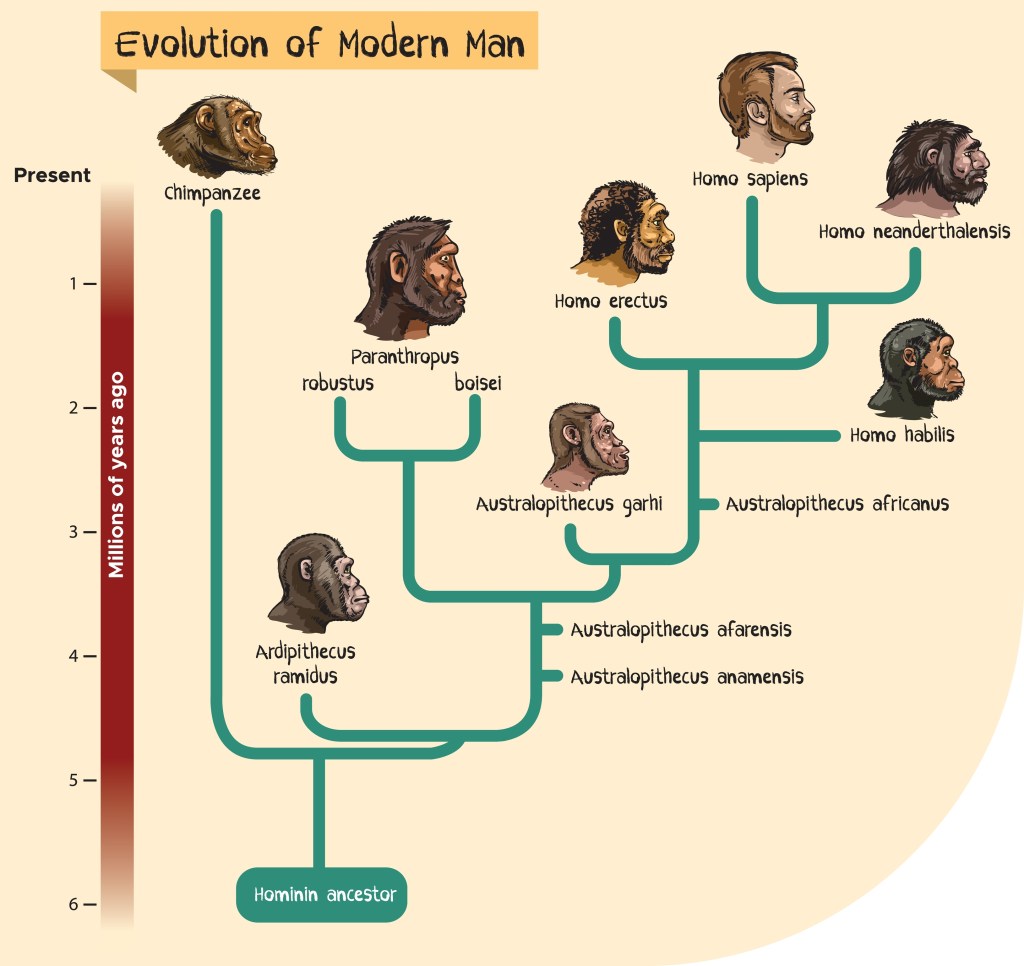
This is perhaps one of the more simplistic objections, but it is still worth mentioning. Even if it would have been true that monkeys evolved from monkeys, there’s no reason monkeys would stop existing just because humans evolved from some monkeys. However, that is not what happened. Genetics provides overwhelming evidence that hominins (including humans) and chimpanzees share a common ancestor. We have not found a fossil for this ancestor, but human and chimpanzee DNA tells us that such an ancestor lived about 6 to 8 million years ago. The simplified cladogram for hominins below demonstrates this. I can add that there are around 6000 hominin fossils, and up to 31 hominin species.
Evolution is not Falsifiable
A theory is scientific only if it can be proven false. It must be falsifiable. Opponents to evolution often claim that evolution is not falsifiable because it deals with unobservable, unrepeatable events. However, the theory of evolution is falsifiable. There are no Precambrian rabbits or Mesozoic human fossils, but if there were that would have proven the theory of evolution false. Note evolution would still have been directly observable (viruses and bacteria), so evolution is a fact that would still be true, but the theory of evolution would have been proven wrong.
Second law of Thermodynamics contradicts Evolution
The second law of thermodynamics states that entropy (typically denoted ‘S’ in physics), which could be said to represent disorder, always increases or stays the same in a closed system. Creationists believe evolution creates complexity and order, which would seem to be a decrease in entropy. One weakness of this argument is that entropy representing disorder only loosely relates to order and disorder as used in common language. More correctly, entropy is defined as; for a given set of macroscopic variables, the entropy measures the degree to which the probability of the system is spread out over different possible microstates. Much more importantly, the creationist argument fails because the second law of thermodynamics requires a closed system, and evolution does not operate in a closed system. For example, the sun is shining and providing earth with energy.

Evolution is Random and Improbable
Another creationist argument is that evolution is random, and randomness cannot create an elephant or an airplane. No matter how many times you randomly throw pieces of junk around you won’t get an airplane. The error in this argument is that evolution is not random. It is guided by natural selection (theory of evolution), and natural selection can be very powerful over time. For example, several computer simulations have been created to model the evolution of the eye, demonstrating that a complex camera-type eye can evolve gradually from a simple light-sensitive patch through a series of small, advantageous steps.
I can add that I have some personal experience with genetic algorithms myself. At work I created an algorithm that interpreted data from a camera for the purpose of sorting mail effectively. I started out with a chromosome that was very bad. Then my program applied random mutations and few other genetic features and allowed the best chromosomes to survive. Eventually a very complex but effective algorithm/chromosome resulted. I did not create this powerful algorithm; randomness combined with natural selection did. Randomly throw lots of junk around but also add some natural selection and you may very well get an airplane.
Microevolution is possible but not Macroevolution
Creationists like to say this because they must accept the reality of observable microevolution. It is a scientific fact. However, so called macroevolution is just repeated microevolution. There is no reason that macroevolution wouldn’t be possible. In addition, as you saw in the paragraphs before the ring species image above, the evidence for macroevolution is very strong. Again, microevolution and macroevolution are concepts that creationists like to use more than scientists.
Anyway, this became very long, almost 3,000 words.
To see the other Super Facts click here

 Super Facts
Thanks for explaining the difference between a scientism fact and theory: I’ve often wondered about this! The evidence for evolution is fascinating, especially around fossils and DNA evidence!
LikeLiked by 1 person
Thank you so much for your kind words Ada
LikeLiked by 1 person
You’re speaking my language, Thomas. I love how scientists (paleo-scientists) spent decades in search of the missing link only to conclude there wasn’t one. Incrementalism was the answer. Makes a lot of sense.
Good summary.
LikeLiked by 2 people
That is great to hear. Thank you so much Jacqui
LikeLiked by 1 person
Evolution does not try to explain the origin of life or the origin of the universe, right?
LikeLiked by 1 person
Yes that’s right. Origin of species but not the very beginning of origin of life.
LikeLike
The fossil record will never be complete. There will always be gaps. Do you know why? I know the answer, but I want you to answer first.
LikeLiked by 2 people
OK, fossilization is very rare and not all organisms are easily preserved. Even though we probably have found only a tiny amount of the fossils that exist, there could very well be a lot of species for which there are no fossils at all. But I am not sure what you are thinking.
LikeLike
The vast majority of organisms that die do not get preserved as fossils. That explains why only tens of thousands of transitional fossils are found, and not the billions that creationists expect.
Only a tiny fraction of the organisms that die get preserved as fossils.
Right?
LikeLiked by 1 person
Yes you are right. That is what all the science sources I come across say. BTW this blog post is based on your suggestion. I forgot to thank you.
LikeLike
Charles Darwin himself cited two potential challenges to his theory of evolution. One is the lack of transitional fossils at his time, and the other is the Cambrian Explosion, right? Darwin had hope that the transitional fossils would eventually be found, and many were, but the fossil record is still incomplete. Transitionals coexist with gaps,right?
LikeLiked by 2 people
I am not sure what you mean with “Transitionals coexist with gaps” but both exists.
LikeLike
Great article, Thomas.
LikeLiked by 2 people
Thank you so much Maggie
LikeLike
A fascinating post, Thomas. I was interested to learn that a third of Americans reject evolution. Given the political climate I have been considering the similarities between Canadians and Americans and am beginning to think that other than one language, there really aren’t that many. For instance, 41% (and climbing) of Canadians are atheist/agnostic/humanist while that number sits at 29% in the U.S. A majority of Canadians (51% and climbing) also believe that “religion does more harm than good” while only 20.5% of Americas agree with that statement. These are very grassroots differences between Americans and Canadians that people here are only now more seriously considering.
I think that the frequent rejection of scientific fact in the U.S. (and not just there) is directly related to the prevalent types of thinking around choosing to vote for Trump and people like him. Your online interaction with the fundamentalists “who took a very aggressive and self-assured attitude to the topic despite not knowing much about the related science or evidence” seems to be an example of that. We humans are very susceptible to being trained/ brainwashed/groomed into magical thinking that we then try to carry out despite reams of evidence to the contrary. The critical thinking skills are atrophied and stunted. When religion has the upper hand, logic, reason and evidence are condemned.
LikeLiked by 5 people
Yes from personal experience I know how hard it is to consider and honestly compare evidence when you have a religious or political “faith” to defend. It took me years to overcome some of my “bamboozlements” (in lack for a better word). Some people can find a way to make evidence for things like evolution, global warming, etc., coexist with their political/religious/tribal beliefs but some people can’t do it at all. They think with their feelings, and they don’t even want to hear about any evidence. They just know. They even view scientists and people who have come to a different conclusions from them as contemptable or even as enemies. Some fundamentalists are like that (like the ones I encountered).
LikeLiked by 1 person
I couldn’t agree with you more.
LikeLiked by 1 person
Thank you for pointing out the differences between Canadians and Americans, Lynette! I have seen that as well and agree woth your comment completely.
LikeLiked by 2 people
Many thanks for your comment, Debbie.
LikeLiked by 1 person
Thanks for such a nice, concise explanation. I talked online to one person years ago who went to a Christian school and was taught creationism. He no longer believed in Christianity, but he had trouble grasping evolution. The early ideas had sunk too deeply. I have to admire him for reading. One of the first books he tried reading was The Origin of Species.
LikeLiked by 2 people
Yes In agree, being curious and trying to grasp a concept like evolution is admirable. However, I would not have started the Origin of Species. The state of the field was very primitive when Darwin wrote that book, and it is probably not easy reading it either.
LikeLiked by 1 person
Agreed. I think he tackled Darwin because he was taught it was the big evil. I have not been able to make it through it myself. Darwin was really into pigeons.
I’ve long since lost contact with him so I don’t know how he’s doing now. He was a bright guy, so I imagine he made his way through.
LikeLiked by 1 person
That is interesting. Yes he seems to be a bright guy.
LikeLiked by 1 person
People reject the idea of evolution based on their religous beliefs and become ornery when challenged, because their whole life revolves around those beliefs, and they feel threated if you question them. And there’s nothing you can say to convince them otherwise. Lynette’s comments about the differences between Canadians and Americans is spot on!
LikeLiked by 3 people
Yes you are right. That was also me at one point. However, you could keep your faith, whatever it is, as well as accepting evolution, but most fundamentalists choose not to and end up having to fight evidence and even getting unfriendly. The differences between Americans and Canadians do not surprise me. There’s also quite a bit of difference between Swedes and Americans in that regard.
LikeLiked by 1 person
What I love most about this post is how it connects Evolution to everyday reality — not just fossils but living proof in genetics and medicine. It shows how deeply Scientific Theory and Evidence shape our understanding of life itself.
LikeLiked by 2 people
Thank you so much Livora. I really appreciate your kind words and support.
LikeLiked by 1 person
You’re most welcome! I’m really glad my words could reach you that way. Keep shining through your journey — your reflections always carry such sincerity and depth. Wishing you more light and inspiration ahead. ✨
LikeLiked by 1 person
Thank you so much again Livora. I wish you more light and inspiration ahead as well.
LikeLiked by 1 person
I really enjoyed how you explained evolution as well as your thoughts on macroevolution because I’ve had multiple conversations where people refuse to believe in the factual evidence that exists in favour of macroevolution.
LikeLiked by 2 people
Thank you so much Pooja. Same here. There is a hangup about “macroevolution” out there. It is just microevolution taking place during longer time and there’s plenty of compelling evidence for it. Because the word is so misunderstood and misused scientists don’t like to divide evolution into micro and macro evolution.
LikeLiked by 1 person
You’re most welcome. I think it has to do with people having different personal beliefs that don’t align with evolution. Yes, a lot of misunderstanding about it plus I find some people get instantly defensive even when evolution is just mentioned. They take it as like a personal attack without keeping an open mind.
LikeLiked by 1 person
Yes you are right. It is a sensitive topic, which is why I hesitated a bit to bring it up here. Thank you so much Pooja.
LikeLiked by 1 person
You’re very welcome. I’m glad you discussed it regardless.
LikeLiked by 1 person
Thank you so much Pooja
LikeLiked by 1 person
You’re most welcome.
LikeLiked by 1 person
Excellent post, Thomas. Thank you! I’ve always been drawn to mysticism, and I’ve always believed in the theory of evolution. It’s not a conflict for me, because I see the two as part of a whole. Believing in a loving God does not negate the evolutionary journey, nor is the reverse true for me. My son shared this fascinating link. I think you’ll like it. As always, you clarify and tantalize. Thank you.
LikeLiked by 1 person
Thank you so much Gwen. I think that is a wonderful way of viewing it and loved your link. In fact I wrote about this in my post We are Star Dust. I will add your link to this post.
LikeLiked by 1 person
impressed that you & anyone else has such patience to iterate this to all should already know better. thank you
LikeLiked by 1 person
Thank you so much for your kind words da-AL
LikeLiked by 1 person
Wow! I love the way you have explained it well in details, surely evolution is a fact. No more confusion, thanks 🙏….you’ve helped many of us🤝
LikeLiked by 2 people
Thank you much for your very kind words Cecilia
LikeLiked by 1 person
Much welcome thomasstigwikman. You really deserve it….surely you have done a great job,quait educative…. congrats 💯
LikeLike
Thanks for a well founded and researched post Thomas with a great breakdown and details sharing evolution with your great research and chart!!! 🙌🏽
LikeLiked by 1 person
Thank you so much Cindy for your very kind words.
LikeLike
Hi Thomas, this is a topic that fascinates me. I have always believed in evolution. At the Cradle of Mankind in South Africa you can see many of the skulls you showed here. There are a lot more than on your picture and they are all dated. An extraordinary experience.
LikeLiked by 1 person
Thank you Robbie. You are right the cladogram picture is very simplified. There are 31 known hominin species and 6000 found hominin fossils so far. I’ve read about that South Africa has a lot of these.
LikeLike
Hi Thomas, we do. I actually want to revisit and take more pictures.
LikeLiked by 1 person
That would be very interesting to see
LikeLike
Another fascinating post Thomas. What’s not to believe in the theory of evolution? We all evolved from somewhere, and DNA is proof. 😊
LikeLiked by 1 person
You are so right Debby. Thank you very much.
LikeLiked by 1 person
Thank you. 😁
LikeLiked by 1 person
Java Bean: “Ayyy, this is a great list of arguments and counter-arguments! I caught Dada nodding his head in agreement several times, most vigorously at the ‘closed vs. open system’ one. Apparently he finds that one particularly egregious …”
LikeLiked by 1 person
You are right Java Bean and Dada is right. The second law thermodynamics is valid if the system is not closed. When crystals form the entropy in the crystal decreases a lot but that is because of energy from the outside the crystal.
LikeLike
I enjoyed this topic, Thomas, though I came into it accepting evolution as a fact. In fact, I think evolution is fascinating. I like that we’re all connected! That we are all the successful offspring of millions of successful generations, going back to the primordial swamp.
Getting the facts was interesting, as well as distinguishing between fact and theory. I’ve met a few fundamentalists who don’t believe in evolution, and I agree that, in most cases, there’s no room for discussion. These are the same folks who believe that dinosaurs and man co-existed, and the Grand Canyon is only 6,000 years old.
LikeLiked by 1 person
Thank you so much Diane. I agree, it is a fascinating topic. You may think that in our modern world the vast majority of people regardless of religious and political belief would accept evolution as a reality but that is not how it works. On the other hand that is why this is a super fact.
LikeLiked by 1 person
Very interesting, Thomas I have always believed in evolution however I liked the fact you offered counter arguments…I like the fact there are two sides to every coin or it would be a very dull world and our brains would likely stagnate… 🙂 x
LikeLiked by 1 person
Thank you for your very kind words Carol
LikeLiked by 1 person
Didn’t Darwin say “If it could be demonstrated that any complex organ existed which could not possibly have been formed by numerous successive slight modifications, my theory would absolutely break down”?
LikeLiked by 1 person
That is very possible. I should say that he is referring to his theory of evolution, which provide a comprehensive scientific explanation for evolution, using processes like natural selection. He is not referring to the fact that evolution is happening, which is a fact that we know to be true. We know that evolution is happening. The theory of evolution explaining all of evolution is different. However, I can add that there is no evidence as of yet that the theory of evolution via natural selection cannot explain all of evolution. The attempted arguments for so called irreducible complexity have not held water (the eye is an example).
LikeLike
Did you know that a creationist was prohibited from taking rock samples from the Grand Canyon? Andrew Snelling specifically. https://www.forbes.com/sites/trevornace/2017/07/03/a-young-earth-creationist-just-sued-the-grand-canyon-over-religious-discrimination-and-won/
LikeLiked by 1 person
Yes I remember this, but it was several years ago. My guess is that they felt that with his young earth creationist views he was not a serious scientist, and therefore denied his request, but like the article said he sued for religious discrimination and won. An interesting case.
LikeLike
A theory isn’t just a guess. If it was a guess, it would be a hypothesis. There’s a reason evolution is called a theory, and not a hypothesis, right?
LikeLiked by 1 person
You are right, a theory in science is not just a guess. It is not a hypothesis. A scientific theory is a comprehensive explanation of a natural phenomenon, backed by a vast body of evidence, repeated observations, and rigorous testing. It is well-substantiated. It explains why or how something happens and can make accurate predictions.
LikeLike