
Super fact 75 : Magnetars are a type of neutron star with extremely powerful magnetic fields ranging from 10,000,000,000,000 Gauss to 1,000,000,000,000,000 Gauss. In comparison, Earth’s magnetic field varied from about 0.25 to 0.65 Gauss at the surface. In other words, the magnetar magnetic fields are from 20 or 40 Trillion times to 2 or 4 Quadrillion times stronger than Earth’s magnetic field at the surface.

The magnetic fields of magnetars are trillions of times stronger than the sun’s magnetic field, which is 1 Gauss on a quiet sun surface and 2,000 to 4,000 Gauss in sunspots. The magnetic field of an MRI’s machine is also incredibly strong (2,000 Gauss to 100,000 Gauss). It is thousands to over a hundred thousand times stronger than Earth’s magnetic field. That’s why you should not have metals around an MRI machine. However, the magnetic field of a magnetar is still hundreds of millions to tens of billions of times stronger than the magnetic field of an MRI machine, and the magnetic field is not confined to a small machine but surrounds a neutron star and stretches far out into space.
If you placed a magnetar halfway to the moon from Earth (a magnetar is around 12 miles in diameter), it would erase all the credit cards on Earth (see video below). If you get close to a Magnetar (1000 kilometers) cars and other metal would float up in the air and the atoms in yourbody would stretch into rods making organic chemistry impossible and kill you. If you placed a steel beam on the surface of a magnetar the magnetic field would pulverize it and destroy the atoms.
In 2004 a magnetar named SGR 1806-20 located 50,000 light years from our solar system (700 million times farther than the planet Jupiter) had a starquake disturbing the magnetic field and sending out a gamma burst that disrupted radio communication on Earth. I consider the existence of magnetars a super fact because the existence of these super magnetic monsters is shocking and not well known amongst the public, and yet their existence has been confirmed.
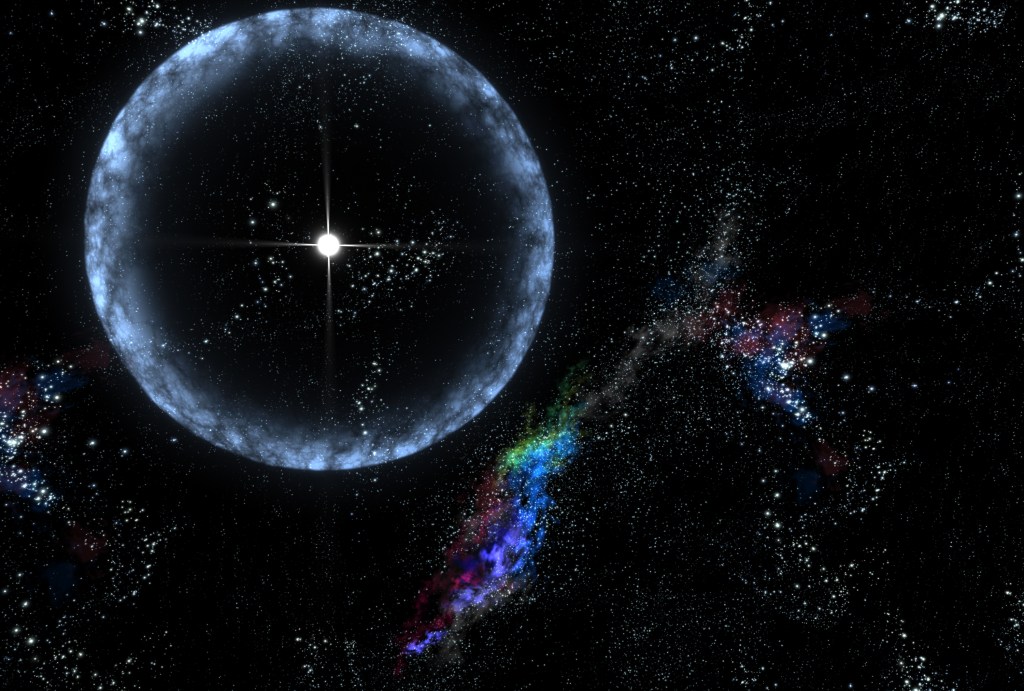
What Are Neutron Stars and Magnetars?
A neutron star is the gravitationally collapsed core of a massive supergiant star. The collapse causes it to become super compact and relatively small by volume. As the name implies the atoms are crushed, and protons and electrons merge into neutrons, making the neutron star mostly neutrons. The typical diameter of a neutron star ranges from 10 to 25 km (6 to 15 miles) depending on its mass. Neutron star material is extremely dense.
A normal-sized matchbox containing neutron-star material would have a weight of approximately 3 billion tons, the same weight as a 0.5-cubic-kilometer chunk of the Earth (a cube with edges of about 800 meters) from Earth’s surface, or a very large mountain. In addition, the gravity on a neutron star is immense, about 100 billion to 200 billion times stronger than Earth’s gravity.
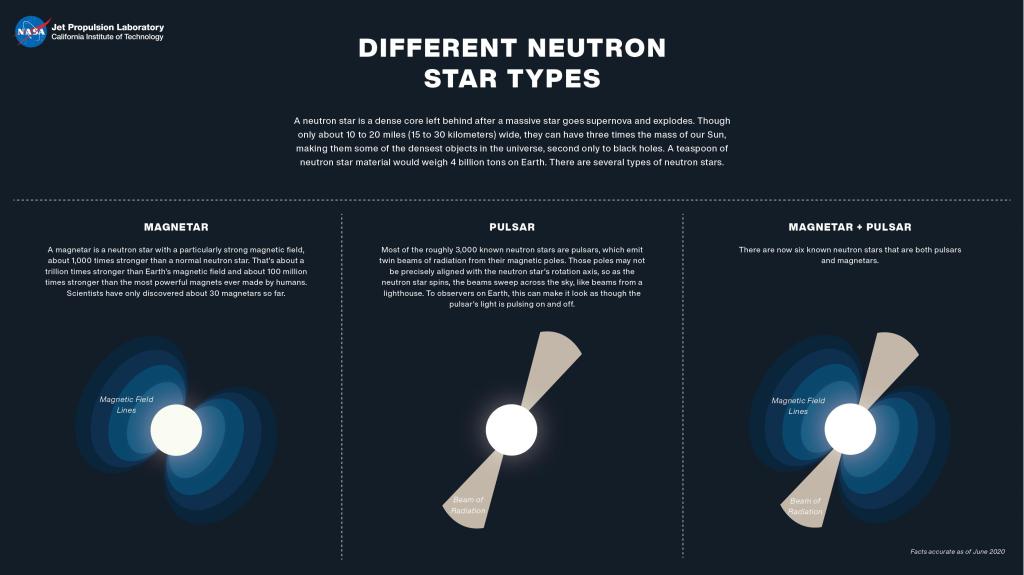
Magnetars are neutron stars with extremely powerful magnetic fields. They have the universe’s most powerful magnetic fields (trillions of times stronger than Earth’s) that power intense X-ray/gamma-ray bursts as its field decays, often seen as highly variable pulsars. They were first theorized in 1992 to explain Soft Gamma Repeaters (SGRs) and Anomalous X-ray Pulsars (AXPs). As of July 2021, 24 magnetars have been confirmed. According to the video below 30 magnetars have been confirmed in the Milky Way. There might be 3,000 in our Galaxy.
Magnetar YouTube Video
Other extreme stellar objects
- We are Star Dust
- The Bizarre Reality of Black Holes
- The Strange Worlds of Exoplanets
- The Enormous Kuiper belt
I wish all of you Happy Holidays and Happy New Year
To see the other Super Facts click here

 Super Facts
I think you’ve unveiled the plot for next Hollywood movie I’ve never heard of magnetars before. They are a bit scary. Maggie
LikeLiked by 1 person
Yes I think they are scary too, like black holes. Magnetic fields that can rip you apart like super strong stellar MRI machines. Lucklily they are rare. Out of the 300 billion stars in our Galaxy there is likely only 3,000. That is only 0.000001% of all stars.
LikeLike
Wow! I knew about neutron stars but not magnetars. As Maggie says, you might have the plot for the next Hollywood disaster movie!
LikeLiked by 2 people
Yes I can imagine a magnetar showing up in our solar system and getting close to earth and by the time you see can it as another small star in the sky (they are only 12 miles in diameter on average) your car is already floating around in the air. Then some people invent a nickel and iron shielded room and everyone is fighting to get inside as people are starting to be ripped apart by the magnetic field. Anyway, I am not good at writing movie scripts. Luckily these little monsters are extremely rare.
LikeLiked by 2 people
Hahaha. 😊 You definitely have a pretty great start on one, though!
LikeLiked by 1 person
Thank you Lynette. Maybe I should write science fiction stories, well maybe I need some practice first.
LikeLiked by 1 person
You would probably do better than you think. 😊
LikeLiked by 1 person
Thank you Lynette
LikeLiked by 1 person
My word, I didn’t know this information. What a scary idea that these huge magnets are floating about. Have a great day tomorrow, Thomas, and drink a good beer 🍺
LikeLiked by 1 person
Yes the first idea of their existence was 1992 so unlike black hole they relatively recent discoveries. People don’t know about them yet. Thank you Robbie. I just had a St. Bernadus Christmas Ale this evening and I wish you a Merry Christmas and a Happy New Year.
LikeLike
Sounds nice 😊
LikeLiked by 1 person
Yes it is a very good beer
LikeLike
🧡
LikeLiked by 1 person
Wow what a star! Very interesting to know about this and that video was good. Those number facts were beyond imagining, and scary. But like they said, we’d be history before much of that happened here.
Wishing you and your family a very Merry Christmas! 🙂
LikeLiked by 1 person
Yes I have to amit magnetars freak me out but they are so rare, only 0.000001% of all stars. We are not likely to encounter one. I am also wishing you and your family a very Merry Christmas. 🎄🎄🎄🎁🎁🎁
LikeLiked by 1 person
Something to think about besides Christmas, Thomas! Wishing you a good day, nevertheless!
LikeLiked by 1 person
Ha ha yes magnetars may not be a merry thought and neither is black holes, but Merry Christmas and Happy New Year Audrey. 🎄🎄🎄🎁🎁🎁
LikeLiked by 1 person
This article evokes a sense of awe mixed with quiet unease.
Your comparisons make extreme facts surprisingly easy to grasp.
Without exaggeration, the science feels both accessible and humbling.
It’s a reminder of how fragile we are in a vast universe.
LikeLiked by 1 person
Thank you so much for your very kind words Livora
LikeLiked by 1 person
Magnets, Donnie! Really, really, strong magnets …
https://www.youtube.com/watch?v=6ABBE39iHY0
LikeLiked by 1 person
Ha ha that is funny. Vacuum, really strong magnets, magnetars, black holes, they all suck in one way or another.
LikeLike
Magnetic fields a quadrillion times stronger than Earth’s? Magnetars are definitely cosmic powerhouses. Thanks for the informative article!
LikeLiked by 1 person
Yes you are right. Those extreme magnetic fields are umimaginable. If a magnetar is approaching earth, by the time they look like a star in the sky cars would alrerady floating around on earth.
LikeLiked by 1 person
Such an interesting post. I had literally never heard of Magnetars before.
LikeLike
I don’t think most people have heard of magnetars. They are exotic stars and very small voume wise (everage 12 miles across) but extremely powerful with magnetic fields that are just crazy. Their existence is shocking but not well known. Thank you Pooja.
LikeLiked by 1 person
You’re most welcome. They do sound quite interesting, especially due to the powerful magnetic fields. Maybe more will be known about them in the future.
LikeLike
Thanks for the great post about pulsars and magnestars. One fairly recent discovery I found fascinating was that some pulsars have planetary systems. These systems are quite rare, but it’s believed that as many as 1% of pulsars have planets. It’s thought the planets might have formed from material in the original supergiant star’s expanding envelope.
LikeLike
Wow that is amazing. I’ll guess those planets cannot be very hospitable. Thank you for the information David.
LikeLiked by 1 person
No, I don’t imagine they’re hospitable at all. Kurt MacPhearson and I wrote a poem a while back about prospectors looking for heavy elements on a pulsar planet and finding that it reminded them of a dusty cemetery.
LikeLiked by 1 person
I think the fact that you and and friend of yours wrote a poem about prospectors looking for heavy elements on a pulsar planet is very intriguing and amazing. It is certainly the kind of poetry I would read.
LikeLiked by 1 person