
Super fact 81 : Humans are not descended from chimpanzees, or monkeys, or any other primate living today. However, humans and chimpanzees share a common ancestor that lived roughly 5 to 7 million years ago. The two species evolved separately to become modern humans and chimpanzees. Humans and chimpanzees are closely related and share approximately 98.8% of their DNA. Studying the DNA, it is possible to determine how long ago this ancestor lived despite not having any fossils from this ancestor.
Chimpanzee genome sequencing and the sequencing of human DNA has led to the realization that human and chimpanzee DNA is very similar and that humans and chimpanzees share an ancestor. The fact that the great apes have 48 (24 pairs) chromosomes while humans have 46 (23 pairs) is not an issue. What happened was that the ancestral chromosomes corresponding to modern chimpanzee chromosomes 2A and 2B fused to create human chromosome 2. We can see that the genes in 2A and 2B line up with chromosome 2 and we can also see where the 2A and 2B merge in the human chromosome 2 (see picture below).
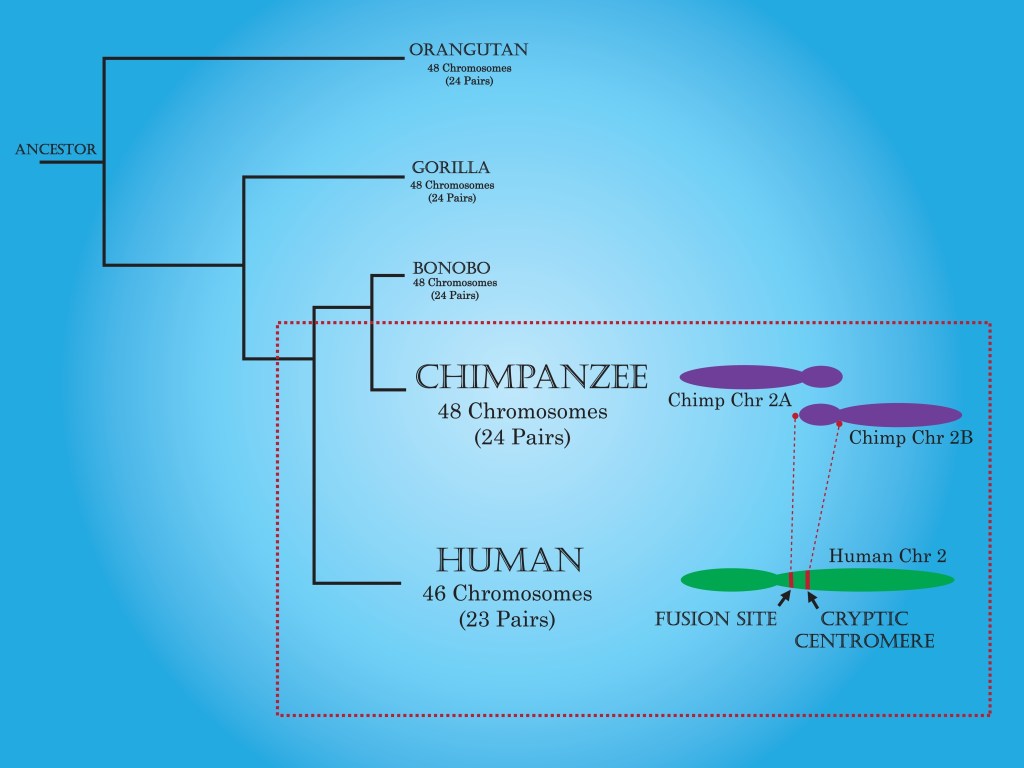
The graph above shows that gorillas, chimpanzees and humans share a common ancestor with orangutans. At the next level bonobos, chimpanzees and humans share a common ancestor with gorillas and finally chimpanzees and bonobos share a common ancestor with humans. We can deduct these things from DNA without needing fossils. We have found millions of fossils corresponding to more than 250,000 species. However, the best evidence for so called “macro evolution” and the best tool for determining relationships between species may not be the fossil record but DNA.
It should be noted that the terms “macro-evolution” and “micro-evolution” are terms that creationists like to use but that scientists do not like to use. Creationists like to say that microevolution is possible (it is observed) but not macroevolution. However, macroevolution is the result of repeated microevolution, so you cannot claim that microevolution is possible but not macroevolution. In addition, speciation is relative. An animal A may be able to successfully interbreed with an animal B, and that animal B may be able to successfully interbreed with an animal C, but animal A and C cannot interbreed. The border between microevolution and macroevolution is fuzzy.
The fact that we can determine evolutionary ancestry by sequencing DNA of living creatures may come as a surprise to many people. In addition, we can also determine how long ago a common ancestor lived. It may also come as an additional surprise to many that we are not descended from the great apes but share a common ancestor. Super fact 81 is a super fact because we know it is true, it is surprising to many, and important to know.
Identifying a common ancestor using DNA Sequencing
Below is a very high-level image of human and chimpanzee chromosomes referred to as a Karyotype. A karyotype is a laboratory-produced image or visual profile of an individual’s complete set of chromosomes, arranged in pairs by size, shape, and number.
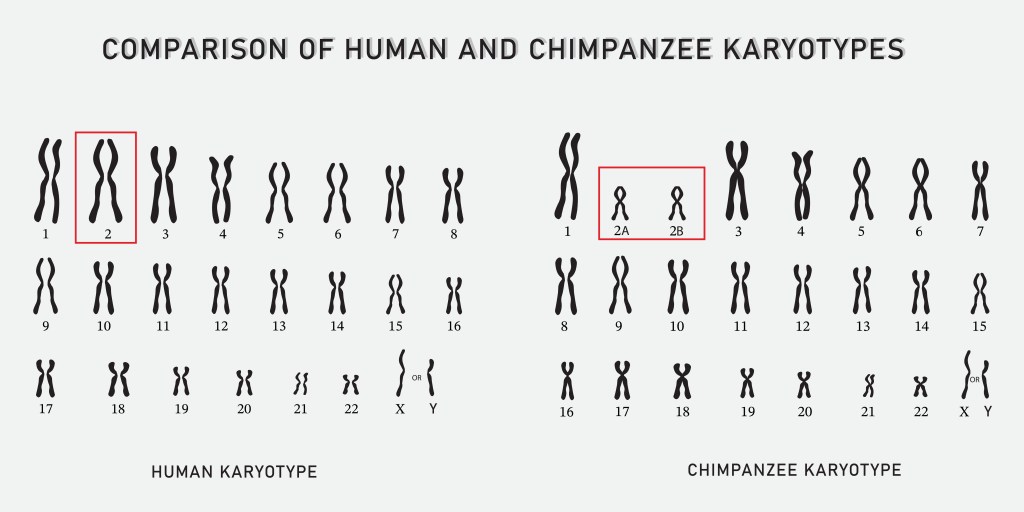
Based on the similarity in transposons, or jumping genes, pseudo genes, and genes in general (all of the genome) we know that the closest related living animals to humans are chimpanzees and bonobos. You can read more about this in the book Relics of Eden by Daniel Fairbanks, a book I highly recommend. According to the author the latest and perhaps best evidence for evolution as well as the fact that humans and chimpanzees have a common ancestor comes from so called junk-DNA. DNA that is not currently used but contains scientifically informative remnants of our evolutionary ancestry trapped in our DNA. The author refers to these remnants as relics.
Hominini species
Another interesting fact derived from DNA research is that chimpanzees and humans are more closely related than chimpanzees than to the other great apes. Based on the genetic record chimpanzees are no longer classified as great apes but as Hominini together with humans. The fact that there are three Hominini species (homo sapies – us humans, chimpanzees and bonobos) could maybe be another super fact.
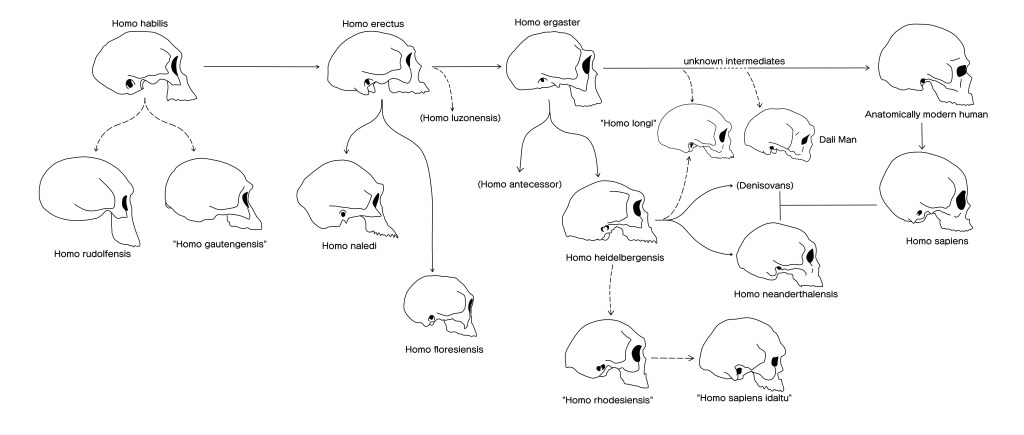
Speaking about hominini species, we have found more than 6,000 hominin fossils corresponding to dozens of species including Australopithecus, Paranthropus, Homo Habilis, Homo Erectus, Homo Heidelbergensis, Homo Neanderthalis, and Homo Sapiens. This link features a cool phylogenetic tree that includes Homo Sapiens (us), Neanderthals, as well as chimpanzees and bonobos.
Other Evolution Related Super Facts
- Neanderthals Never Lived in Africa
- Evolution is a Fact
- The Second Law of Thermodynamics Does Not Contradict Evolution
To see the other Super Facts click here

 Super Facts
So much effort has gone into making this informative and well-supported. A really resourceful post that’s worth revisiting and sharing.
LikeLiked by 2 people
Thank you so much for your kind words Vidisha.
LikeLiked by 2 people
A fascinating topic (and post), Thomas. I took several evolutionary anthropology courses in uni (as electives) and thoroughly enjoyed them.
LikeLiked by 2 people
That is very interesting. It is great to take some interesting classes outside of your focus. My focus in college was engineering and physics but I also took classes in economics, philosophy and other topics. I agree this is an interesting topic. I have to say I got into this topic through a backdoor, being a creationist when I was young, but I came to realize I was totally wrong as learned more science.
LikeLiked by 2 people
I liked how you located this post within your own learning history. It quietly affirms that ideas like these don’t just live in textbooks—they stay with us over time.
Your comment adds a sense of continuity that complements the article beautifully.
LikeLiked by 2 people
You’re speaking my language here, Thomas.
LikeLiked by 2 people
Yes I figured. It is your topic, and I am very much looking forward to your next book.
LikeLiked by 2 people
I love this article! Thank you for explaining this so well. It’s very interesting, Thomas.
LikeLiked by 2 people
Thank you so much for your kind words Kymber
LikeLiked by 2 people
Genealogical studies was one of my favourite classes in University, but they have learned so much since I took it, many years ago. Maggie
LikeLiked by 2 people
That is very interesting Maggie. Yes, when I was young there was no DNA sequencing, well it was in its early stages. Now we’ve done DNA sequencing on thousands of species including hundreds of extinct species. Science keeps marching on. Well I guess you know that. I have never taken a class in geneological studies but I am thinking that now when I am retried I should take some classes.
LikeLiked by 1 person
I should say, I had to take a year off work due to an injury so I took some classes at university, so it wasnt that long ago. 😊 Maggie
LikeLiked by 2 people
That is great. Taking the opportunity to educate yourself, is a wonderful thing to do, even if it is not work related.
LikeLiked by 1 person
It’s really cool how we branched off from chimpanzees a while ago. It’s funny when people say we evolved from monkeys. Yes, apes, but not from apes we see today!
There’s some cool info about Lucy who’s one of our ancestors. It’s so interesting that walking upright changed our evolution a lot,
LikeLiked by 2 people
Yes you are right Sara. There is so much misunderstanding around this topic. I’ve read about Lucy but not much. I have to look that up.
LikeLiked by 2 people
It’s amazing what we can do with DNA nowadays. I’m particularly fascinated by the use of genetic genealogy in solving crimes.
LikeLiked by 2 people
Yes I agree and like you say using genetics to solve crimes is fascinating. I think it is called Forensic Genetic Genealogy
LikeLiked by 1 person
That’s a thoughtful extension of the idea—seeing how genetic knowledge moves from theory into real-world application.
It’s a good reminder that this science doesn’t stay abstract; it actively reshapes how we understand identity, history, and responsibility.
LikeLiked by 1 person
Thank you so much Livora for your kind words and support
LikeLiked by 1 person
Really interesting and well described, thank you, Thomas…I did look up the Bonobos very interesting a shame they are endangered 🙂 x
LikeLiked by 2 people
Thank you so much Carol. Yes us humans, chimpanzees and bonobos are the only Homini species and one of us is endangered, which is sad.
LikeLiked by 2 people
Hi Thomas, this is an excellent post. Well laid out, easy to follow, and clearly explained. A great job.
LikeLiked by 2 people
Thank you so much Robbie for your very kind words
LikeLiked by 2 people
Interesting to learn that chimpanzees and bonobos are now classified as hominid species. I’d known we were closely related but not that they were no longer classified as great apes. Thanks for the informative post.
LikeLiked by 2 people
Thank you so much David. I should say not homonid species but homini species. I believe homini is a relatively new category, a so called biological tribe, rather than family.
LikeLiked by 2 people
I mis-spoke, assuming that homonin was just a synonym for homonid. It turns out all apes are hominids and always have been. Homonins or homonini are the narrower subset that used to include only humans but now includes chimpanzees and bonobos. It’s actually not a new category/tribe, as I understand, but until recently homo sapiens were believe to be the only homonini currently living.
LikeLiked by 2 people
Well, I think you figured this out much better than me. The terms are confusing. Homo…something, but the chimpanzees and bonobos were recently moved into a category where they weren’t before.
LikeLiked by 2 people
I really appreciated the care you took with the terminology here. That kind of precision doesn’t just clarify facts—it protects the conversation from drifting into false disagreements.
Your follow-up adds real value to the thread without overcorrecting anyone, which is not easy to do.
LikeLiked by 2 people
Thank you so much Livora
LikeLiked by 1 person
What stays with me here is how quietly decisive DNA becomes in this conversation.
Fossils invite interpretation, but chromosome fusion, shared transposons, and genomic alignment leave very little room for narrative preference. The story doesn’t need to be argued—it’s already written into the structure itself.
I appreciate how this piece doesn’t aim to persuade through volume or confrontation, but through patient clarity. That restraint feels especially important for topics that sit at the crossroads of science, belief, and misunderstanding.
LikeLiked by 1 person
Thank you so much for your kind words Livora and you are so right
LikeLiked by 1 person
Java Bean: “Ayyy, our Dada says that maybe if we were descended from bonobos, we would all be better off. We are not sure what he means by that …”
LikeLiked by 1 person
Java Bean, did you know that you are descended from wolves ? Tell that to Dada.
LikeLiked by 1 person
Some years back we watched a documentary or TV show called What Happened to the Wolf? that was a super interesting dive into the Wolves –> Dogs process. Now though when I search for that title I am just finding some recent foreign film drama, which is definitely not what we watched, and Google is insisting that the documentary I remember does not exist, so maybe I imagined it … 🤔
LikeLiked by 1 person
I certainly believe you, but since it was a while ago it might be difficult to find. The fact that there is a film drama with that name is going to make it much harder to find. Perhaps there is one word wrong?
LikeLike
It’s possible ― it was a long time ago! It might even have been an episode of Nova or something but I can’t find that either …
LikeLiked by 1 person
There are other documentaries that I’ve watched and cannot find. It happens.
LikeLiked by 1 person
Hi Thomas
Thanks for making it quite clear where we come from.
The Fab Four of Cley
🙂 🙂 🙂 🙂
LikeLiked by 1 person
Thank you so much Klausbernd
LikeLiked by 1 person
This was truly fascinating Thomas. Thank you for doing all the research. We’re all monkeys at heart. Lolol. 😊
LikeLiked by 1 person
Ha ha I just saw a Gary Larson cartoon depicting Charles Darwin on the ship the Beagle and all crew members were acting like monkeys and the captain asked Charles Darwin, “where did you get this idea from?”
LikeLiked by 1 person
😂🤣😊
LikeLiked by 1 person
We are all connected. I believe this applies to humans and animals. This makes sense to me just from looking at us and what we have in common. Thank you for the science to make this clearer. If we focused less on our differences and more on what we have in common, I think it would be a much better world.
LikeLiked by 1 person
Thank you so much JoAnna and you are so right, “we are all connected”.
LikeLiked by 1 person