The goal of this blog is to create a list of super facts. Important facts that are true with very high certainty and yet surprising, misunderstood, or disputed by many. This blog aims to be challenging, educational, and fun, without it being clickbait. I determine veracity using evidence, data from reputable sources and longstanding scientific consensus. Prepare to be challenged (I am). Intentionally seek the truth not confirmation of your belief.
Superfact 104: The evolution of eyes is convergent, meaning different, unrelated animal species independently evolved similar types of eyes. Biologists estimate that eyes have evolved independently between 40 to over 65 different times across various lineages. An example is the evolution of Cephalopod eyes (like squid and octopus) and vertebra eyes.
First of all, eyes evolved. Creationists often say that eyes are too complex too have evolved. That is because the eye is composed of many interdependent, finely tuned parts, for example, the cornea, iris, retina and lens. And that it cannot function without all those components already evolved. This is referred to as the argument for irreducible complexity.
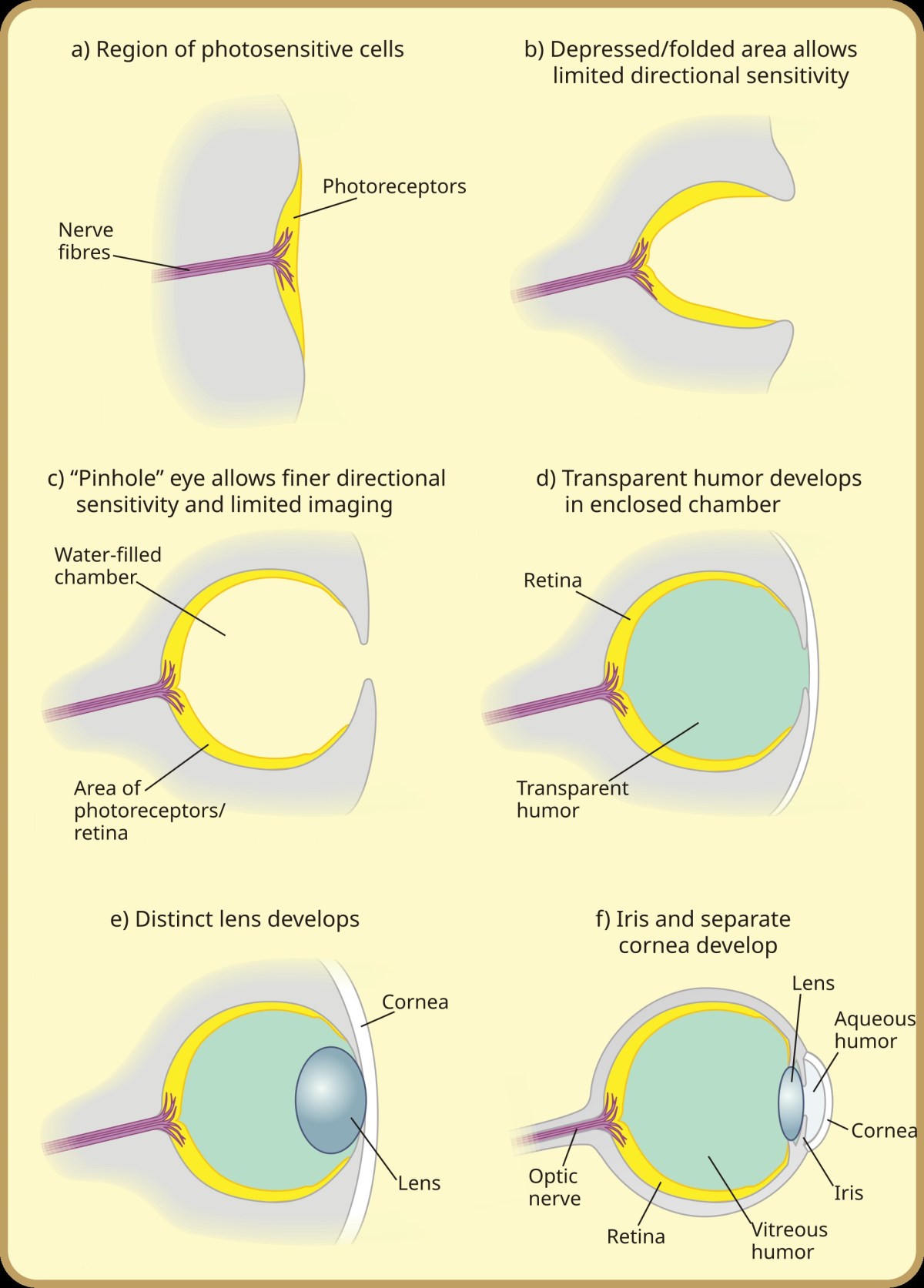
The problem with that argument is that evolution is not linear. The various intermediate steps may not have functioned as the final product but could still have provided evolutionary advantage. There are many intermediate “eyes” existing today in nature. As you can see in the picture below the evolution of the vertebra eye did not start with all the current parts.
Major stages in the evolution of the eye in vertebrates. Matticus78 at the English-language Wikipedia, CC BY-SA 3.0 http://creativecommons.org/licenses/by-sa/3.0/, via Wikimedia Commons.
In addition, the evolution of eyes is largely convergent. Biologists estimate that eyes have evolved independently between 40 to over 65 different times across various lineages. The cephalopods (like octopuses and squid) and vertebrates (like humans, mammals, birds and fish) evolved their camera-style eyes completely independently. This is one of nature’s most famous examples of convergent evolution, where two unrelated species arrive at the exact same biological solution to survive in their environments.
The fact that eyes evolved and that the irreducible complexity argument does not work comes as a surprise to creationists. That the various kinds of eyes in nature evolved separately but converged on similar complex structures is in general an amazing fact. It is a kind of an important fact that is true. Therefore, it is a super-fact in my opinion.
Eyes Are not an Example of Irreducible Complexity
The evidence that the complexity of eyes is not an example of irreducible complexity is strong. We can trace lineages via DNA and sub-optimality. We can also simulate the evolution of the eye using computers. In a simulation based on mutations and natural selection it took 363,992 generations to evolve an eye from an eyespot (light-sensing organelle) to a complex camera type eye, which probably corresponds to around half a million years. See The Evidence for Evolution by Alan R. Rogers.
I can add a personal anecdote. In my job as a software engineer trying to find better algorithms for sorting mail using the photos of the mail, including the address block, I tried using genetic algorithms. Genetic algorithms is a type of Artificial Intelligence that simulates evolution to create better systems (better algorithms and software). The genes corresponding to the best algorithms were allowed to propagate, recombine and mutate. That was the natural selection component.
What I saw was that the genetic algorithm could evolve the system into a complex and effective system of interdependent complex components that did not exist at the beginning. Several complex components working together did not require that components/parts evolve one after another. They can go through several formats from primitive to advanced and they can have different functions along the way. Some parts might evolve and then disappear and new kinds of parts pop up, as the total algorithm kept evolving. There is no reason to believe that irreducible complexity even exists.
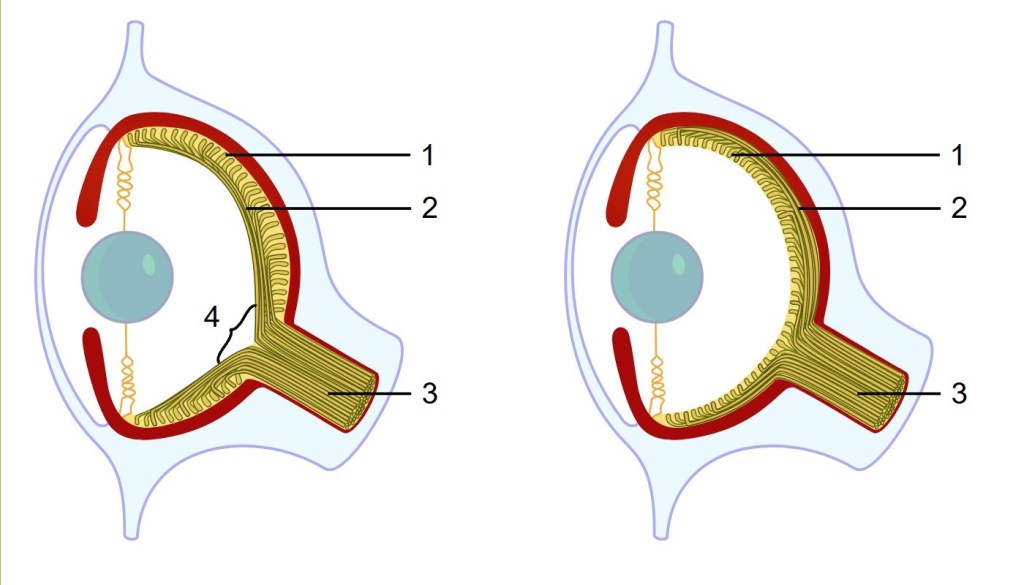
While both eyes share features like a cornea, iris, lens, and retina, they were built from different starting materials and possess some structural differences. In vertebrate eyes, the nerve fibers route before the retina, blocking some light and creating a blind spot where the fibers pass through the retina. In cephalopod eyes, the nerve fibers route behind the retina, and do not block light or disrupt the retina. In other words, the cephalopod eyes not having a blind spot are more perfect than our eyes.
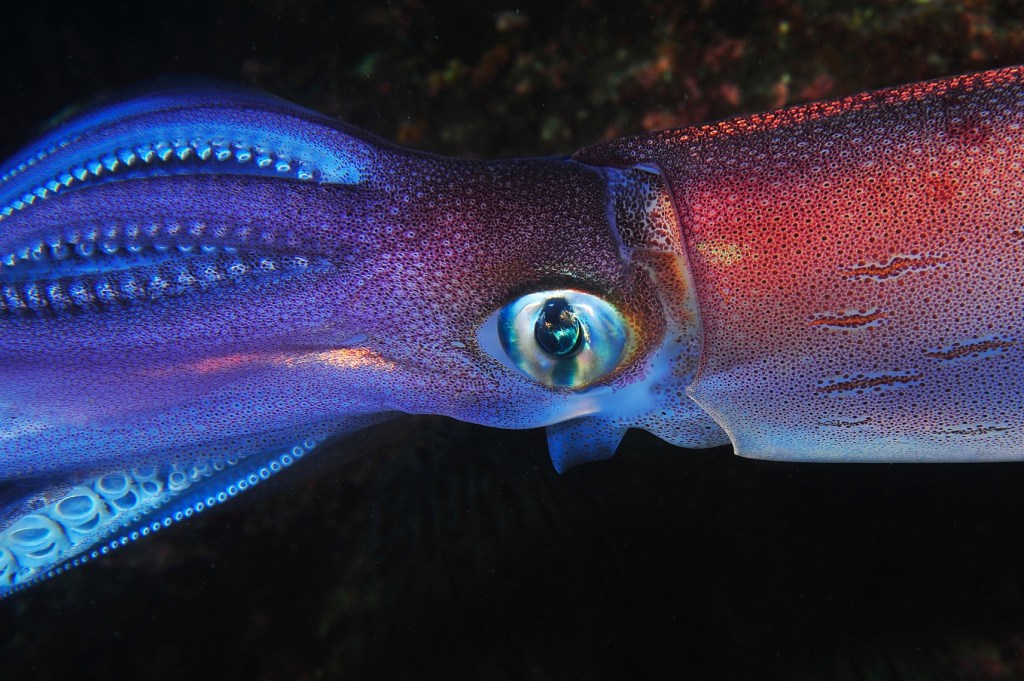
Look into the loving eyes of the squid. He does not have a blind spot. Atlantic Ocean squid macro photo. Shutterstock asset id: 1859007028 by Rui Palma
Superfact 89: There is overwhelming scientific evidence supporting so called macroevolution. Evidence for macroevolution includes the fossil record, molecular biology and DNA, biogeography, comparative anatomy, embryology, suboptimality, vestigial structures, etc.
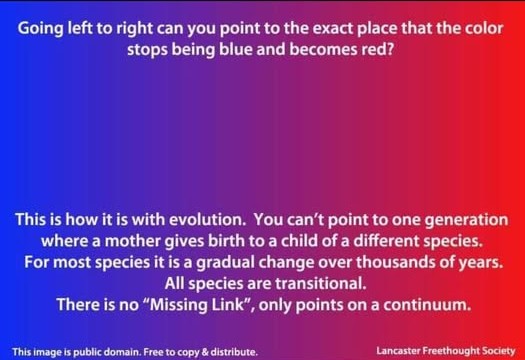
It is difficult to deny that so called microevolution is happening since it can be directly observed. However, it is quite common to come across claims that there is no evidence for macroevolution or that macroevolution is impossible and unscientific. These claims do not come from mainstream scientists but from creationists. There is no magical barrier between microevolution and macroevolution. Rather, macroevolution is just an accumulation of microevolutionary steps, and it is a fact that those changes have been slowly accumulating over millions and billions of years.
Microevolution is small changes resulting in large changes over time. There is no magical wall stopping multiple microevolution changes from turning into macroevolution.
It is often said that macroevolution is when a species evolves into another and that this represents a special barrier, impossible to breach. The existence of fuzzy boundaries between species and the existence of ring species demonstrate that this idea is faulty. See the next section for more information on this. Next after that, I am listing 10 selected types of evidence for macro evolution. If you wish to see an overview of 29+ Evidences for Macroevolution, click here. I can add that scientists do not like to use the terms microevolution and macroevolution since they are nebulous. These terms are more of a creationist thing. That’s why I been prefixing microevolution and macroevolution with “so called”.
Roughly a third of Americans believe the creationist claim that macroevolution is not possible, or that there is no evidence for it, even though we know that there is Strong evidence for macroevolution. Therefore, I consider this a super fact. Note, 97% of scientists support the theory of evolution. This is a brief Wikipedia article on evolution.
Note, this post is long, but if you are interested in it, you could just read a few instead of the evidences instead of all ten.
Speciation is considered relative
It is often said that two animals belong to the same species if they can interbreed in nature and produce viable, fertile offspring. However, it is not that simple.
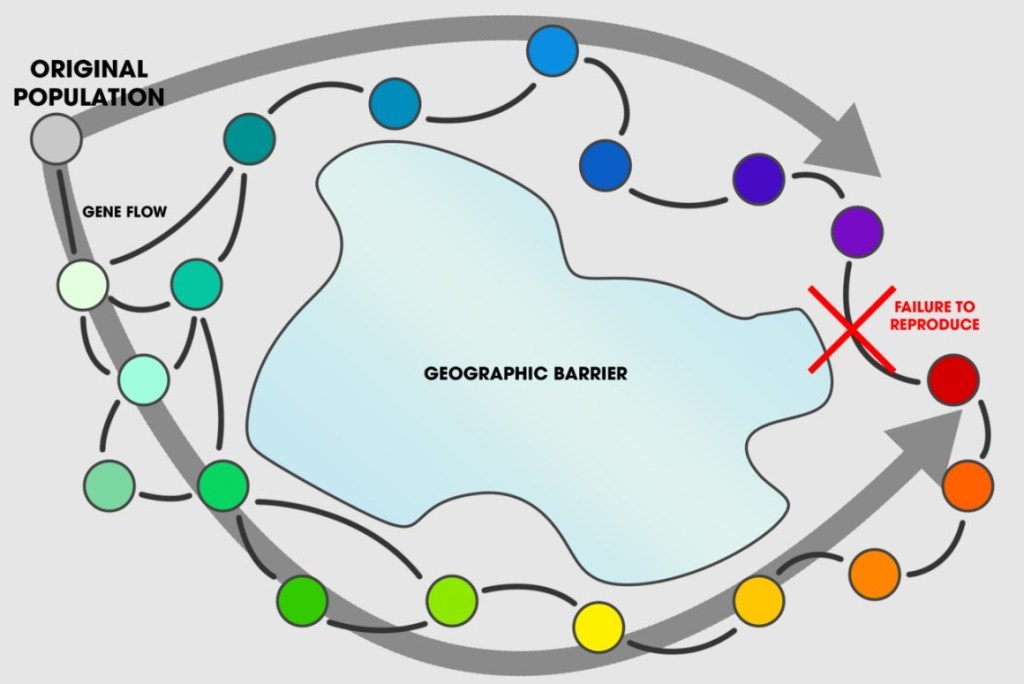
An animal A may be able to successfully interbreed with an animal B, and that animal B may be able to successfully interbreed with an animal C, but animal A and C cannot interbreed. Animal A could be said to be a different species relative to animal C, but animal B could be said to be the same species as both animal A & C using the definition above. A great geography related example of this is ring species. In a ring species, gene flow occurs between neighboring populations of a species, but at the ends of the ring the populations don’t interbreed.
Illustration of ring species, an example of how speciation can be relative. All the circles next to each other can interbreed but at the end it no longer works. Andrew Z. Colvin, CC BY-SA 4.0 https://creativecommons.org/licenses/by-sa/4.0, via Wikimedia Commons.
Next up are ten selected types of evidence for Macroevolution in no particular order.
The Fossil Record Show an Evolution from Simple to Complex Species
The fossil record is quite extensive and represents 250,000 different species, but it is very far from complete. That is expected. Fossilization is an extremely rare event, and fossils are hard to find. Among the 250,000 fossils from different species there are no Precambrian rabbits or Mesozoic human fossils. If there were, that would have falsified evolution and been evidence for a creator. This example shows first of all that the theory of evolution is falsifiable (all scientific theories have to be falsifiable) contrary to some creationist claims and it constitutes a form of evidence for evolution.
If evolution is true then a scan through the entire sequence of rock strata should show early life to be quite simple, with more complex species appearing only after some time. In addition, the youngest fossils should be those that are most similar to living species. The fact that this is the case is strong evidence for evolution, specifically macroevolution. You can read more about this in this relatively short book, The Evidence for Evolution, by Alan R. Rogers.
The fossil record is a lot more solid and much less problematic than the creationist books I have read claimed. Shutter Stock Photo ID: 1323000239 by Alizada Studios
We can Follow Lineages in the Fossil Record
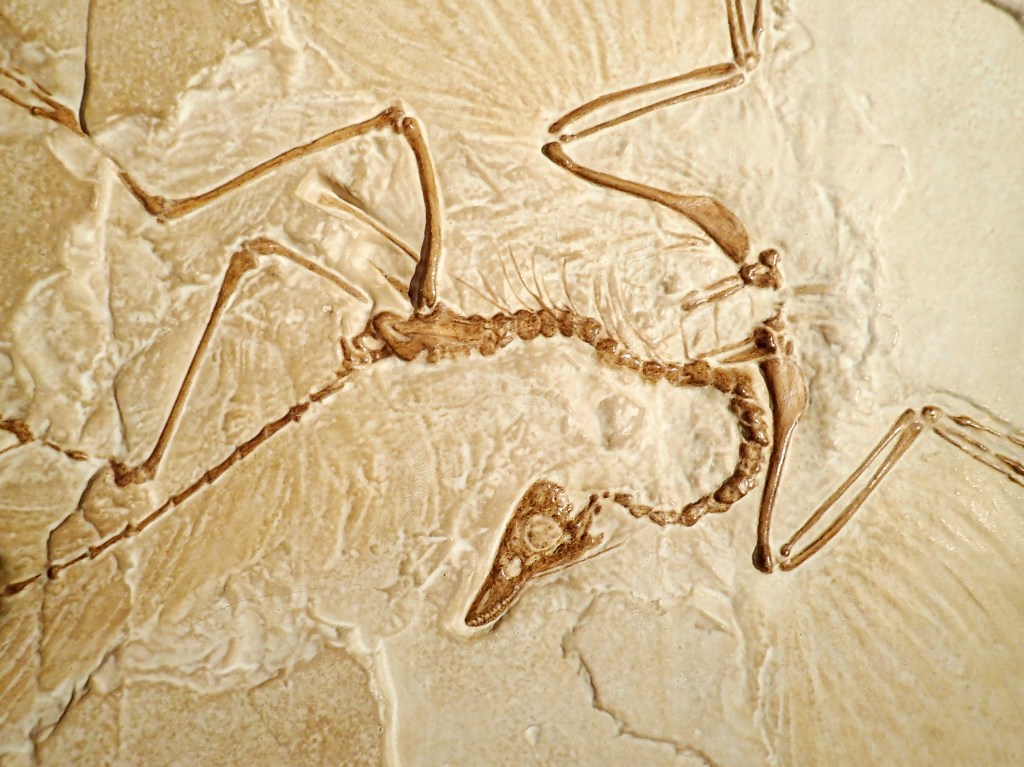
In the fossil record we can also follow lineages; species of animals and plants changing into something different over time. The fossil records show fish changing into amphibians, reptiles changing into mammals, dinosaurs into birds, artiodactyl like mammals into whales, apes into humans, etc. Creationists used to mock the fact that there were no transitional fossils between land mammals and whales and then they found Pakicetus in 1983 and then a lot more. As time passes the more transitional fossils we find.
Closeup of fossilized scary petrified Archaeopteryx transitional fossil between dinosaur and modern birds remains. Shutterstock Asset id: 1913076019 by Natalia van D.
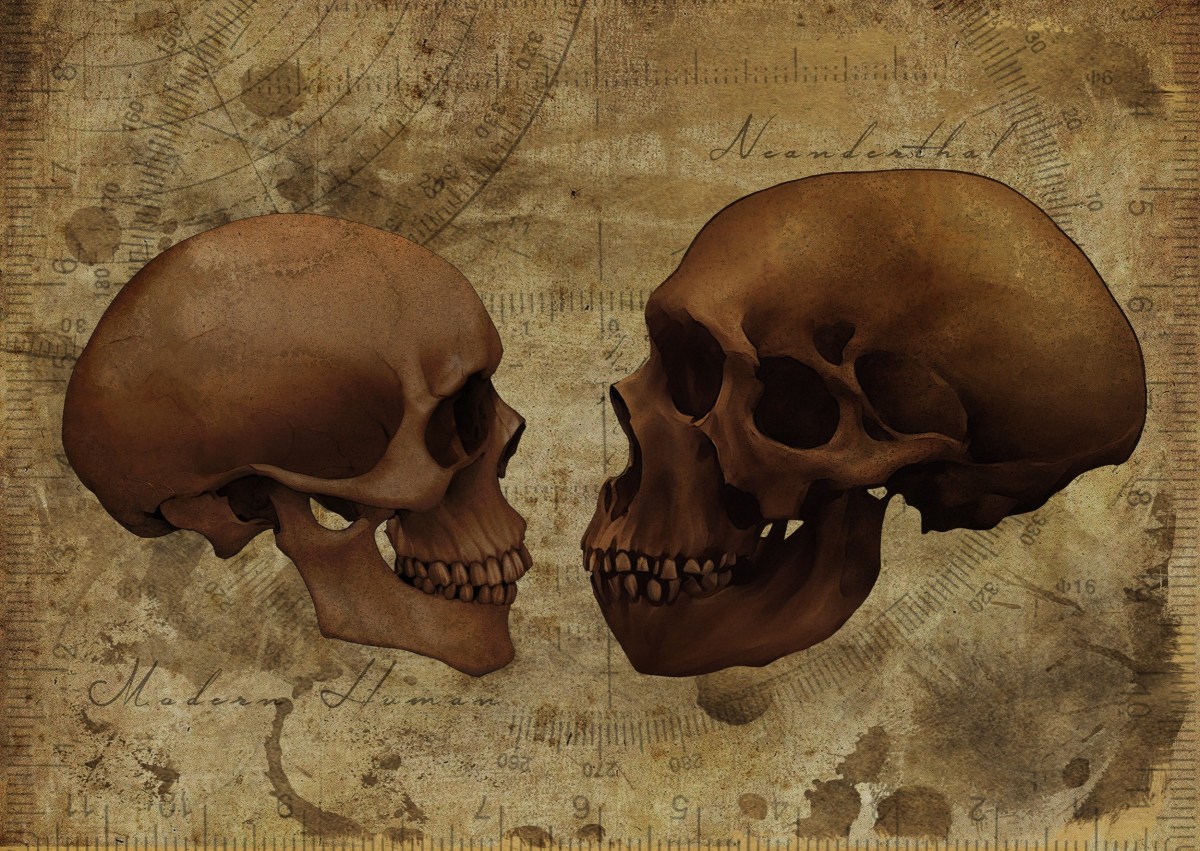
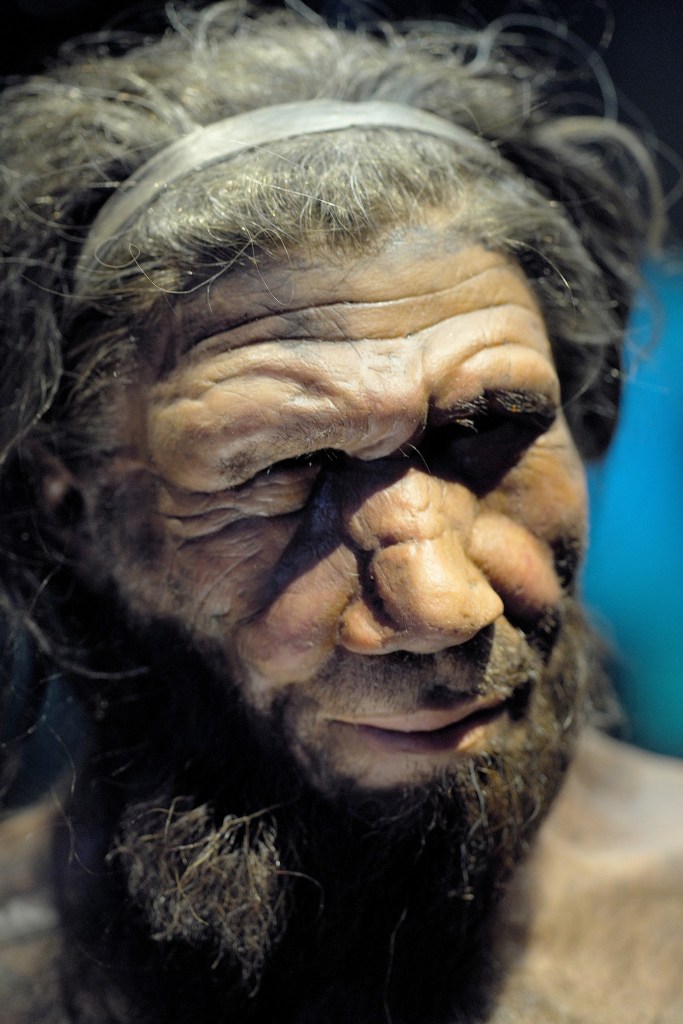
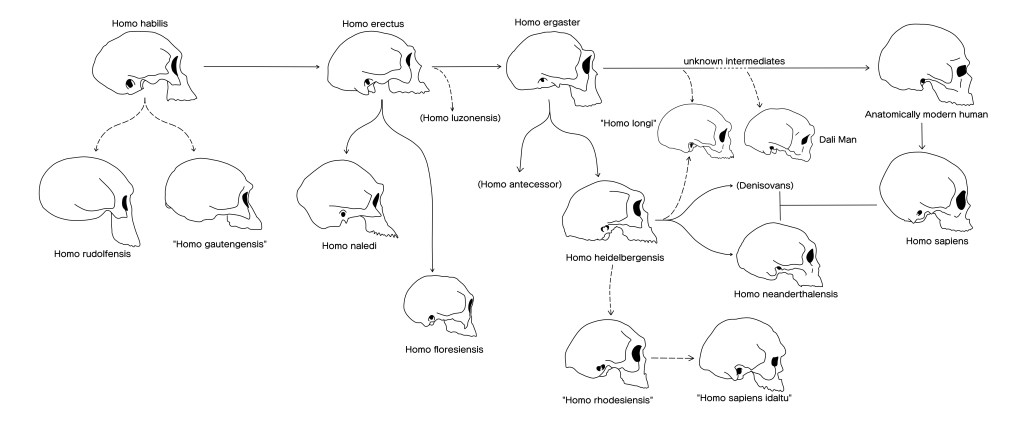
The fact that we can follow lineages and that they are consistent with the various dating methods is powerful evidence for evolution. Dating methods include radiometric dating methods (uranium-lead, potassium-argon, carbon-14), and sequencing and superposition, and conditions encoded in fossils such as the length of the day (varied throughout natural history) and more. To read more about dating methods and how we know Earth is billions of years old click here. The picture below illustrates the skull changes of hominids by time.
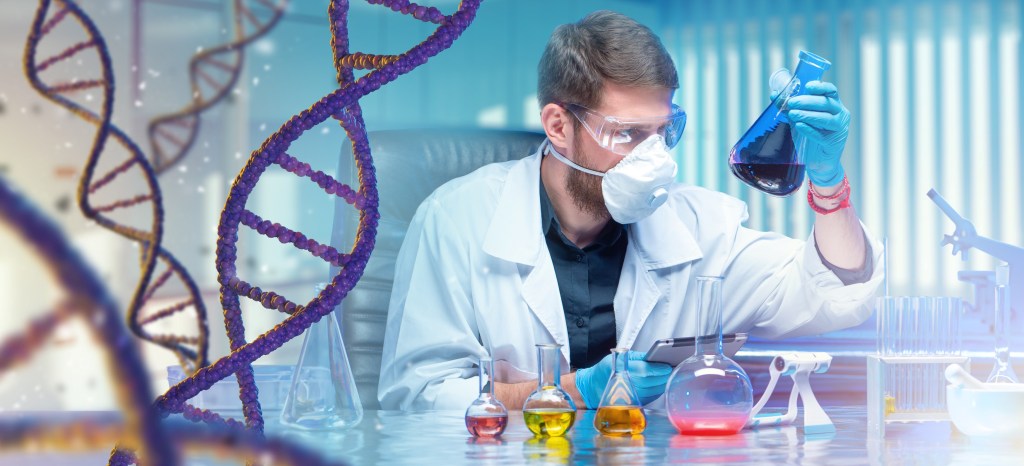
Molecular biology and DNA may be our best evidence for macroevolution. Our understanding of DNA has greatly increased over the last couple of decades. The human genome has been sequenced along with that of many other species, and we are able to compare the DNA and the genes of various species, and trace origins.
Geneticist sequencing human genome Asset id: 2479929725 by FOTOGRIN
Of special interest are pseudo genes, the millions of transposable elements (transposons and retroelements) as well as useless sequences, introns. These segments are especially interesting because they are unaffected by natural selection and therefore mutations pile up in them at a fairly constant rate. By comparing two such segments in two species we can tell how far the species are apart and even how far back in time their common ancestor lived.
Based on the similarity in transposons we know that the closest related living animals to whales and dolphins (outside their order) are Hippopotamus, which confirms what we know from the fossil record of whales and the mammals that whales evolved from. Whales and Hippopotamus have a common ancestor and since we’ve found dozens of intermediate fossils between land mammals and whales, the evolution of whales is no longer a mystery.
All living cetaceans including whales, dolphins, porpoises, sperm whales and hippopotamids / hippopotamus belong to a suborder of artiodactyls called whippomorpha. Hippopotamus and whales have a common ancestor. Note: I created this image by inserting a few pictures from Wikipedia commons including a mother sperm whale and her calf off the coast of Mauritius, a gray whale in captivity, a hippopotamus and two pre-historic whales (from the section Evolution of Whales – Intermediate Fossils).
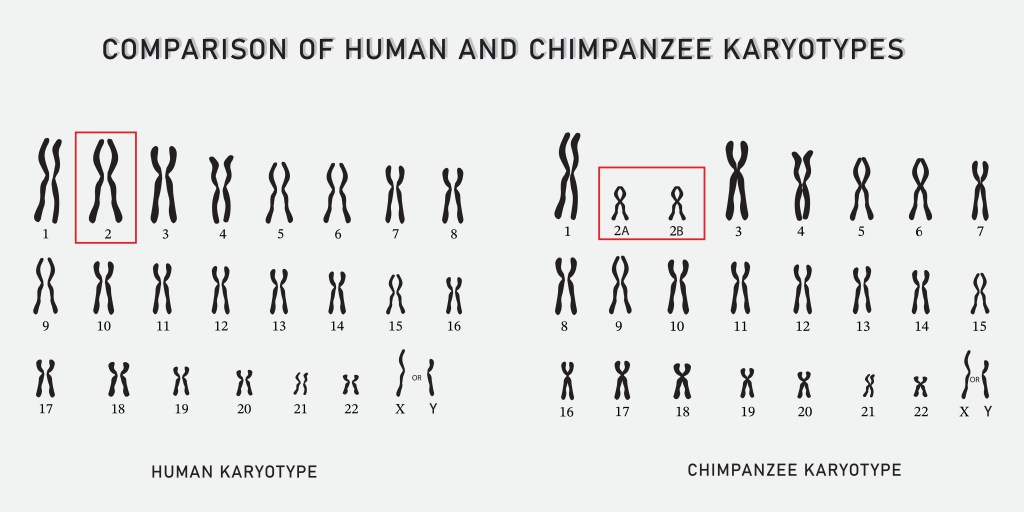
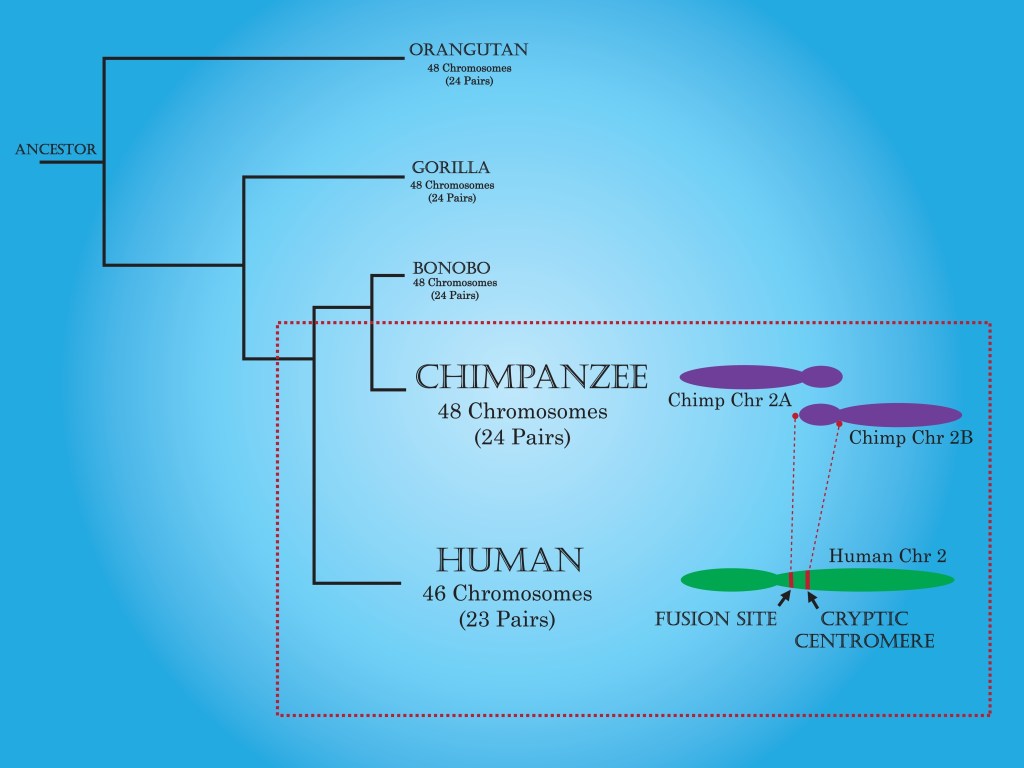
Based on the similarity in transposons, pseudo genes, and genes in general (all of the genome) we know that the closest related living animals to humans are chimpanzees and bonobos. In fact, chimpanzees and humans are more closely related than chimpanzees and the other great apes. Based on the genetic record chimpanzees are no longer classified as great apes but as Hominini together with humans. Also based on the genetic record we know that chimpanzees and humans had a common ancestor that lived about six million years ago. The fossil for this common ancestor has not been found, but the information in the DNA can often tell us more than the fossil record.
Comparison between human and chimpanzee karyotypes isolated on background. Shutterstock Asset id: 2432966649 by kanyanat wongsa.Evolution of humans via phylogenetics and differentiation between humans, chimpanzees, and other primates. Shutterstock Asset id: 2448150743 by kanyanat wongsa.Simple cladogram showing evolution of modern man from Hominid Ancestor Shutterstock Asset id: 2093535535 by CLOUD-WALKER.
The book Relics of Eden, the powerful evidence of evolution in human DNA by Daniel Fairbanks is good fairly in depth book on this topic.
Biogeography
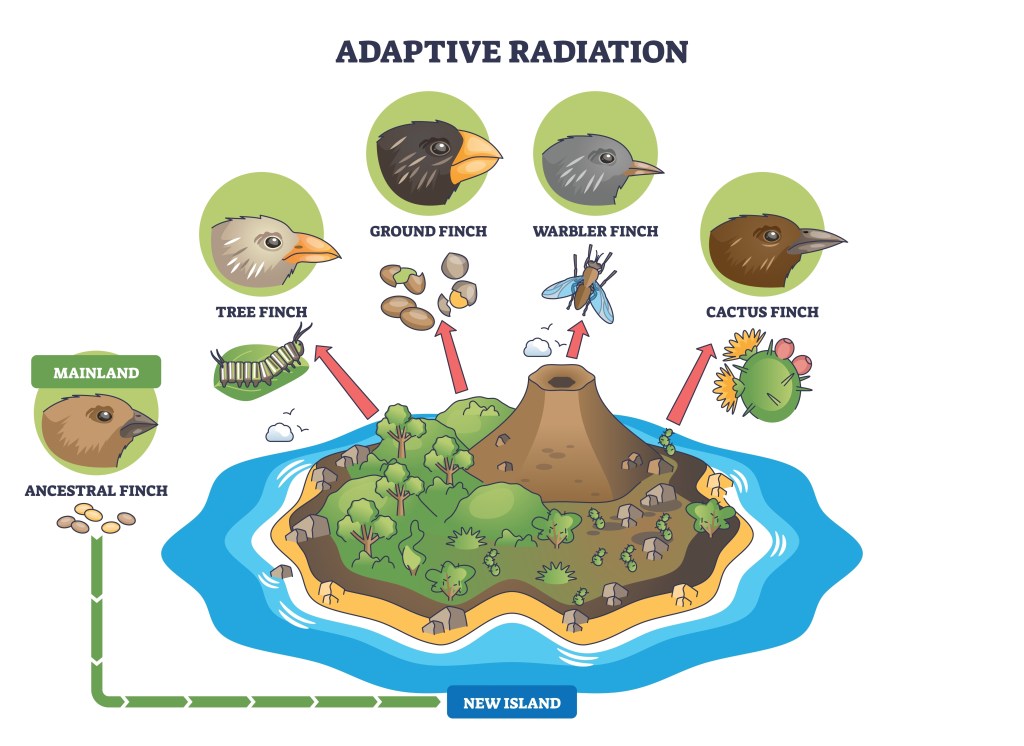
Biogeographic evidence for evolution / macroevolution is among the oldest types of evidence (Charles Darwin used it) and yet it is very powerful. Biogeographic evidence for evolution shows that species’ geographic distributions result from descent with modification and environmental adaptation, rather than just similar habitats. Key types of biogeographic evidence for macroevolution include species existing only on a certain island, adaptive radiation (e.g., Galápagos finches), tectonic-driven species distribution (e.g., marsupials), and convergent evolution of unrelated species in similar environments.
Adaptive radiation is a rapid evolutionary process where an ancestral species diversifies into a multitude of new species (or subspecies) to fill vacant ecological niches. Shutterstock Asset id: 2707584123 by VectorMine.
One example of biogeographical evidence for macroevolution is with so called oceanic islands. Oceanic islands are not part of a continent but are formed from the sea bottom typically through volcanic activity. Oceanic islands lack native freshwater fish and amphibians, and they rarely harbor native mammals and reptiles. However, freshwater fish, amphibians, mammals and reptiles thrive when introduced to oceanic islands. It’s just that they have to get there in the first place.
Instead, oceanic islands typically feature birds, insects, and plants that can more easily spread long distances. In addition, the species on oceanic islands are typically closely related and appear in relatively few groups. Add the fact that the species on oceanic islands resemble species on nearby continents but they are not the same. This strongly supports the narrative that some species from nearby continents migrated to newly formed oceanic islands and evolved.
The evidence gets even better if you look in more detail. For example, the Hawaiian Islands (oceanic islands) were formed in chronological order from west to east, as the divide between the continental shelves moved. The species on the different islands show a gradual transition in their physical properties and in their DNA as you go from west to east. This supports the narrative that the species hopped from one island to the next as the islands emerged, and then they evolved.
Comparative Anatomy
Similar anatomical structures in different species, such as the similar bone structure in a human arm, a bat wing, and a whale flipper indicate shared ancestry. Another is the heart structures in fish, amphibians, reptiles, birds, and mammals which show a homologous progression of development.
Embryology
Different species share similar developmental stages. For example, early embryos of reptiles, birds, and mammals, including humans, develop pharyngeal pouches that are similar to fish gills. Baleen whale embryos have teeth that are lost by birth, human embryos develop a tail that are later lost, and human fetuses develop hair around week 16-20 that is usually lost but remain on premature babies. The development of embryos goes through stages of similar embryos of fish, then amphibians, reptiles, and then mammals.
Suboptimality
There is a lot of evidence based on so called suboptimality. Our bodies and that of other animals are full of imperfections that make perfect sense from an evolutionary perspective but not much sense if we were created by a creator. One example is the “vas deference”, which follow a circuitous route from the testis up and around the ureter and back down to the penis, instead of going straight to the penis. As the testis gradually moved from inside our bodies (as it was in fish) to the outside, vas deference got stuck around the ureter like a water hose can get stuck around a tree. This makes perfect sense from an evolutionary perspective.
Vestigial Structures
Vestigial structures are non-functional anatomical features, organs, or behaviors that were functional in a species’ ancestors but have lost most or all of their original purpose through evolution. Examples include the whale hind legs, flightless bird wings, the human appendix, the tailbone, wisdom teeth, and goosebumps in humans.
Atavisms
Atavisms are rare reappearances of a lost ancestral trait in an individual. This could happen because ancestral genes are preserved but suppressed but, for example, a mutation allows the gene to be expressed. Examples include a human baby born with a tail, a snake with limbs or a chicken with teeth, dolphins with back flippers, or teeth in chickens. It is rare but evidence for evolution.
Traces of Common Descent
Traces of common descent in species, for example, homologous anatomical structures, similar embryological development, shared genetic codes, and phylogenetic mapping allows the construction of the tree of life. Phylogenetic mapping suggests that organisms inherited fundamental traits from a common ancestor. All life except viruses can be traced back to a common ancestor that lived 4.2 billion years ago. This also constitutes evidence for evolution / macroevolution.
I can add that when I was young, I read a lot of creationists books. I was totally sold on creationism but as I started learning about science that changed. One thing all the creationist books that I read had in common was that they avoided discussing the evidence for evolution and they did not provide evidence for creationism. Instead, they focused on trying to discredit evolution. As I learned more about science I came to realize that not even one of those objections were valid. An example is super fact #73 below.
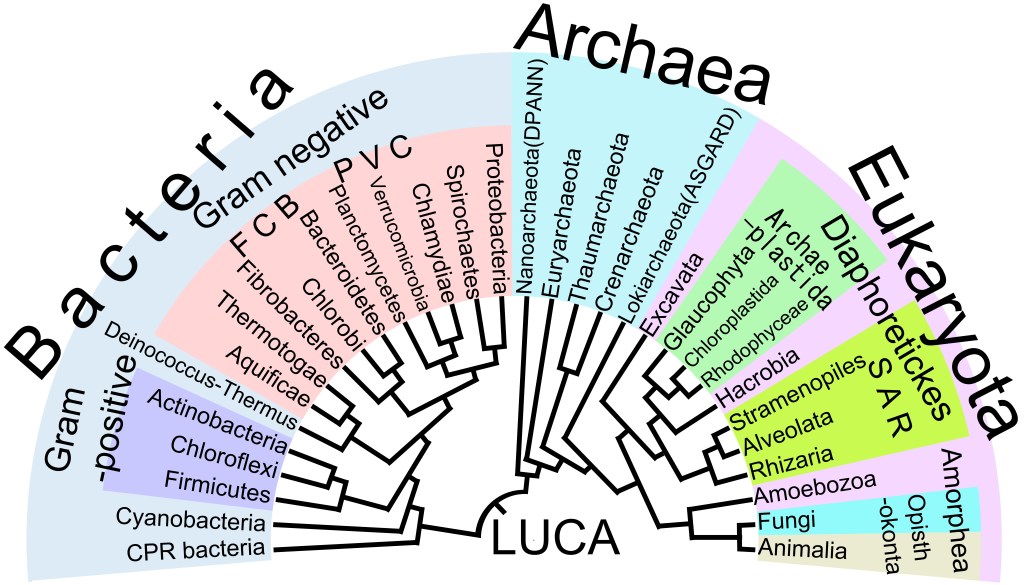
Super fact 82 : All known cellular life descends from a single Last Universal Common Ancestor (LUCA). All animals, all plants, fungi, algae, green and red algae, kelp, phytoplankton, cyanobacteria, amoebas, amoebozoa, diatoms, stramenopiles, rhizaria, hacrobia, all eukaryote, all archaea, all bacteria, all the millions of species on Earth come from one single ancestor known as the Last Universal Common Ancestor – LUCA. Viruses are an exception, but viruses are not considered life.
Last Universal Common Ancestor creation Shutterstock Asset id: 2666598705 by Shutterstock AI
The answer is genome mining. By surveying nearly 2000 genomes of modern microbes we not only know that all life has a common ancestor (LUCA), that lived roughly 4.2 billion years ago, but we also know that it thrived near hydrothermal vents as part of a larger microbial community. This is analogous to another of my posts “Humans and Chimpanzees Have a Common Ancestor”. By sequencing human DNA and chimpanzee and bonobo DNA we know that humans and chimpanzees have a common ancestor. No fossils, or other information from the past is needed. DNA is a great tool for determining relationships between species and for finding information about past life, without the need of fossils.
To be more specific, the detailed biochemical similarity of all current life makes the existence of LUCA widely accepted by biochemists. There is a Universal Genetic Code, which means that nearly all living things use the same DNA/RNA-based genetic code to translate genetic information into proteins. There is a shared molecular machinery, for example, all life relies on ribosomes for protein synthesis, similar energy carriers like ATP, and the same 20 amino acids. All life uses the same mirror-image form of molecules, a signature of a single, common ancestry. In addition, there is a “core” set of 355 gene families present in both modern bacteria and archaea, which were likely inherited from LUCA. Finally, we have phylogenetic mapping, protein-sequence-based phylogenetic trees converge on a single root, indicating a common ancestry for all life. See the phylogenetic tree of life below.
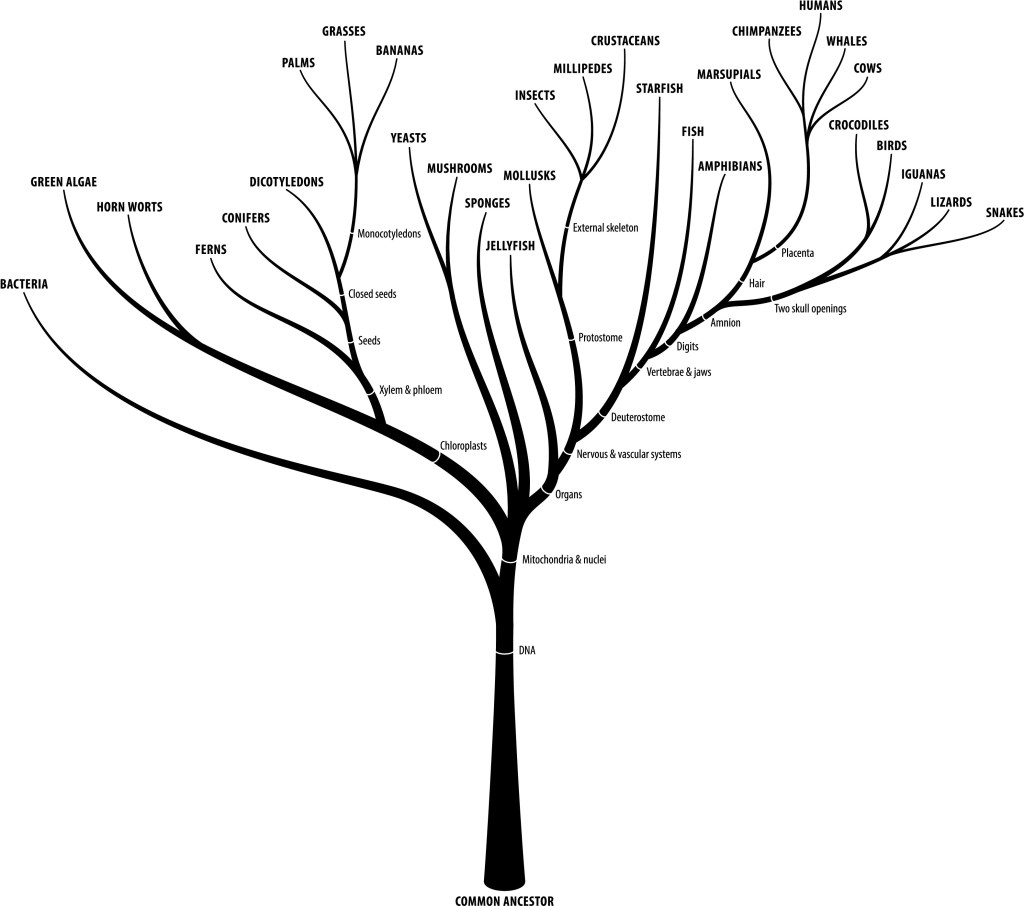
Below is another view of the diversification of life that focuses on the inventions made by life.
The evolutionary tree of life showing diversification, branching and key characteristics of each branch. Shutterstock Asset id: 228953155 by Zern Liew
It should be noted that in addition to viruses there were likely other forms of life that existed alongside LUCA or before it. There was likely non-cellular life as well as cellular life that died out, RNA-based life, self-replicating nucleic acids, etc. It should also be noted that if some of the large viruses were to be reclassified as life, or a life form not based on LUCA were to be discovered then our “current LUCA” would no longer be LUCA, but just the ancestor of “almost all life”. That would still be amazing, just slightly less so.
The existence of LUCA brings up an interesting question. What would happen if we found DNA based life on another planet and its DNA showed that it also originated from LUCA ?
Super fact 73 : The second law of thermodynamics, or the fact that entropy is always increasing in an isolated system does not contradict evolution. Life is not a closed system. The environment is providing energy, the sun is providing energy, geological forces are providing energy, etc.
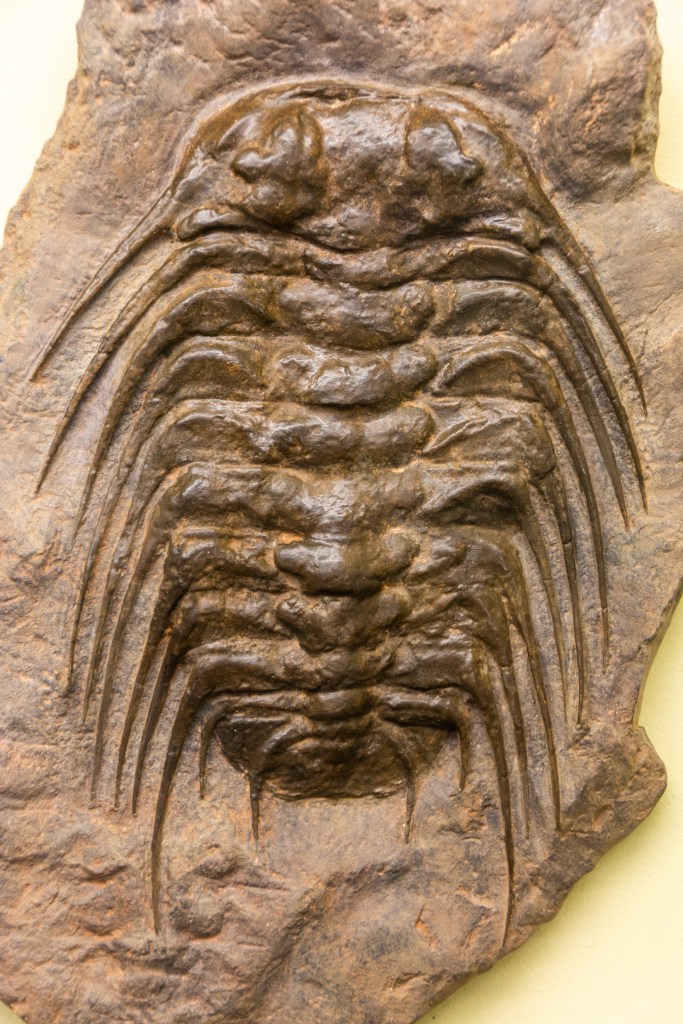
Does physical laws such as the second law of thermodynamics disprove evolution? This is a trilobite fossil. Shutter Stock Photo ID: 1323000239 by Alizada Studios
A lot of people have never heard of the second law of thermodynamics, or entropy and are unaware of the claim that the second law of thermodynamics contradicts evolution. So how can debunking this claim be surprising, and a super fact? The reason is that this is a popular claim among creationists and according to this Gallup poll 40% of Americans believe in creationism. The fact that this popular but false claim is rooted in a very basic misunderstanding of the second law of thermodynamics and what entropy is makes it super fact.
In the past I’ve read many creationist books that make the claim that the second law of thermodynamics contradicts evolution. One of them was Scientific Creationism (1985) by Henry M. Morris (the father of modern creation science), where he stated that the second law of thermodynamics says that everything tends towards disorder, making evolutionary development (ordering) impossible. The Death of Evolution: Restoring Faith and Wonder in a World of Doubt by Jim Nelson Black, another book I read, and which I gave a one star review on Amazon, makes the same claim. I’ve also come across a lot of people making this claim.
The people who make the claim that the Second Law of Thermodynamics contradict evolution typically do not understand the second law of thermodynamics and do not know what entropy is. Despite that fact they see it as a powerful argument against evolution. I’ve even seen it used against highly respected physics professors who “believe in”, well accept the reality of evolution, by people who had no understanding of the second law of thermodynamics. At one point I even believed the claim myself. Then I studied physics, and well, oops, I was forced to admit that I had been bamboozled.
The Second Law of Thermodynamics
The Second Law of Thermodynamics states that the total entropy (disorder) of an isolated system always increases over time. This means that natural processes tend to move from order to disorder (within the isolated system). It should be noted that disorder is a popular but imperfect metaphor for entropy. Entropy is not the same thing as what people think of as disorder. In physics entropy refers to the logarithm of the number of microstates compatible with the system’s measurable macroscopic state. As molecules randomly arrange themselves into new macroscopic states, the number of possible microstates will increase.
It also means that heat will spontaneously flow from hotter to colder objects, but never the reverse. Another thing it means is that mechanical energy can be converted to thermal energy, but never the reverse. It turns out that those seemingly different statements are physically identical.
Second law of thermodynamics. S corresponds to entropy. Shutter Stock Vector ID: 2342031619 by Sasha701
It is very possible that the entropy of an organism is lower compared to a blob corresponding to all its molecules randomly distributed within a blob. However, that organism did not evolve in isolation inside a hermetically enclosed box without any energy from the outside. Life and evolution operate in an environment full of energy coming from the sun, the Earth, winds, oceans, geological forces, radiation, etc. Evolution does not take place in an isolated system.
It is also important to understand that within an isolated system, pockets of lower entropy can form if they are offset by increased entropy elsewhere within the system. That’s what the word “total” in total entropy means. Crystal formation is an example of creating local pockets of lower entropy (less “disorder”) within a system, but this is always accompanied by a greater increase in entropy in the surroundings. The Universe is an isolated system so the entropy within the Universe should always increase, but again the local pockets of lower entropy that evolution may create are accompanied by a greater increase of entropy elsewhere.
Atoms in a crystal. The crystal represents a pocket of lower entropy. As this pocket of lower entropy forms there is equal of greater increase in entropy in the surroundings. What is true for the crystal is true for the molecules in living beings. Neither the formation of crystals nor the evolution of life contradicts the second law of thermodynamics. Asset id: 689181712 by BK_graphic.
Below is a YouTube video explaining how the second law of thermodynamics does not contradict evolution.
Entropy – Arrow of time
An interesting aspect of the second law of thermodynamics is that it makes entropy serve as an arrow of time. In general, the fundamental laws of physics are time reversible. The equations work the same forwards and backward in time. The equations for gravity, electromagnetism, and the strong nuclear force work the same regardless of time’s direction. An example is if you filmed a planet orbiting a star and played it backward, it would still follow the laws of motion the same way.
Throw a bunch of billiard balls on the floor and film them bouncing and hitting each other and the walls. If you then run the film backwards and forwards it would be far from obvious which is forward and which is backwards, except for the fact that the balls will slow down due to friction. However, balls slowing down due to friction is mechanical energy turning into heat, which is an example of the second law of thermodynamics. The fundamental laws of physics are time reversible, but the second law of thermodynamics is a notable exception. Entropy always increases in an isolated system (like the Universe). By measuring entropy, you can distinguish the past from the future, giving time a direction
Super fact 71 : Based on the fossil record today’s extinction rate is hundreds, or even thousands, of times higher than the natural baseline rate.
Collection of watercolor prehistoric and now extinct animals isolated on a white background. Hand painted illustration of Ice Age. Asset id: 2169205593 by Ekaterina Glazkova
Estimating the extinction rate is a complicated task that requires some assumptions and estimations. This article from the National Library of Medicine use what it claims to be conservative estimates, which would tend to minimize evidence of an emerging mass extinction. Despite that fact the average rate of vertebrate species loss over the last century is up to 100 times higher than the extinction rate without/before humans (background rate). Other sources claim an extinction rate that is 1,000 or even 10,000 the background rate.
To put some specific numbers on what a high extinction rate means, scientists count 881 animal species are known to have gone extinct since around 1500. If we include animal species that scientists suspect might be extinct, that number shoots up to 1,473. You can read more on the issue here or here or here.
Two Tasmanian Tigers. The Tasmanian Tiger or Thylacine was hunted to extinction. Benjamin, the last Tasmanian Tiger, died in 1936 in the Beaumaris Zoo in Tasmania. Baker; E.J. Keller., Public domain, via Wikimedia Commons
What is clear is that the current extinction rate is much higher than what is typical and we humans are the cause. This came as a shock to me the first time I found out about it, and it is certainly an important topic, and therefore a super fact. It is true, surprising to many, and important.
Those who want to minimize the problem with the ongoing extinctions often point out that extinctions are a natural part of evolution and that throughout Earth’s history up to around 98% of all species that have ever existed are now extinct. In my opinion, that argument fails to consider the enormity of Earth’s four billion year natural history. A lot of evolution happened during that time.
Modern humans have only been around 300,000 years, or 0.0075% of that time, a tiny blip in time. Human civilization has only been around for 12,000 years, or 0.0003% of that time, an even tinier blip in time. Like comparing an ant head to a mile. Us having a large negative impact on the natural world in such an extremely short time is quite notable.
By considering the extinction rate you get a better idea of the scope of the problem. The fact that the extinction rate today is significantly higher than the expected natural rate and that the primary cause of modern extinctions is human impact as opposed to natural phenomena, makes it a case for concern. To read about a related issue, “The Wild Mammal Biomass Has Substantially Declined”, click here.
Over the last 440 million years life on Earth has experienced five so called mass extinctions. A mass extinction event is when at least 75% of the world’s species are lost during a short period of time – geologically speaking. This period is not clearly defined but often defined to be two million years. Two million years may seem like a long time, but geologically speaking, it is a short time.
Extinction of the dinosaurs when a large asteroid hits earth 66 million years ago. It was the last mass extinction event. Asset id: 2196200279 by funstarts33
End Cretaceous (65 mya) – the event that killed off the dinosaurs.
Below is an overview of the five big mass extinctions in Earth’s history. The graph is from Our World in Data.
The Big Five Mass Extinctions in Earth’s History. A mass extinction is defined by the loss of at least 75% of species within a short period of time (geologically, this is around 2 million years). Extinctions are a natural part of evolution, but background rates are typically less than 5 families extinct per million years. Sources Barnosky et al (2011). Howard Hughes Medical Institute: McCallum (2015). Vertebrate biodiversity losses point to a sixth mass extinction. From Our World in Data.Are We in the Middle of a Sixth Mass Extinction ?3D illustration of a Glyptodon, also extinct, Asset id: 495169627
Biodiversity experts have estimated that about 30% (uncertainty range: 16–50%) of species have been globally threatened or driven to extinction since the year 1500. 30% globally threatened or extinct is not 75% that are actually extinct, but in just 500 years that looks like a quick start on a mass extinction. It should be noted that 500 years is just 0.025% of two million years. Issues such as deforestation, chiefly the result of replacing forests with agriculture, overexploitation, and global warming / climate change are driving extinctions and represent big biodiversity threats in the near future.
The Northern white rhino subspecies, the second-largest land mammal after elephants, has no hope of recovery after the last male died in 2018. Only a female and her daughter are left. The photo is of Angalifu, a male northern white rhinoceros at the San Diego Zoo Safari Park. Angalifu died of natural causes at the age of 44 on 14 December 2014. Sheep81, Public domain, via Wikimedia Commons.
Posting this on Thanksgiving Day may seem awkward. However, whether there will be a human caused sixth mass extinction or not depends on us, and it looks like more people want to protect our natural world. Many animals, such as the giant panda, bald eagle, the sea otter, black footed ferret, the Peregrine falcon, the blue whale, Rodrigues fruit bat, the Island night lizard, and the California condor, have been saved from extinction through conservation efforts like habitat restoration, anti-poaching laws, captive breeding programs, and reintroduction to the wild. Perhaps we are turning things around. We should give thanks to all who care.