
Superfact 87: Wind energy is a clean, renewable, and sustainable power source that produces no atmospheric emissions or water pollution during operation. Manufacturing and installation have a small carbon footprint that is much smaller than the carbon footprint of the fossil fuels they potentially replace.
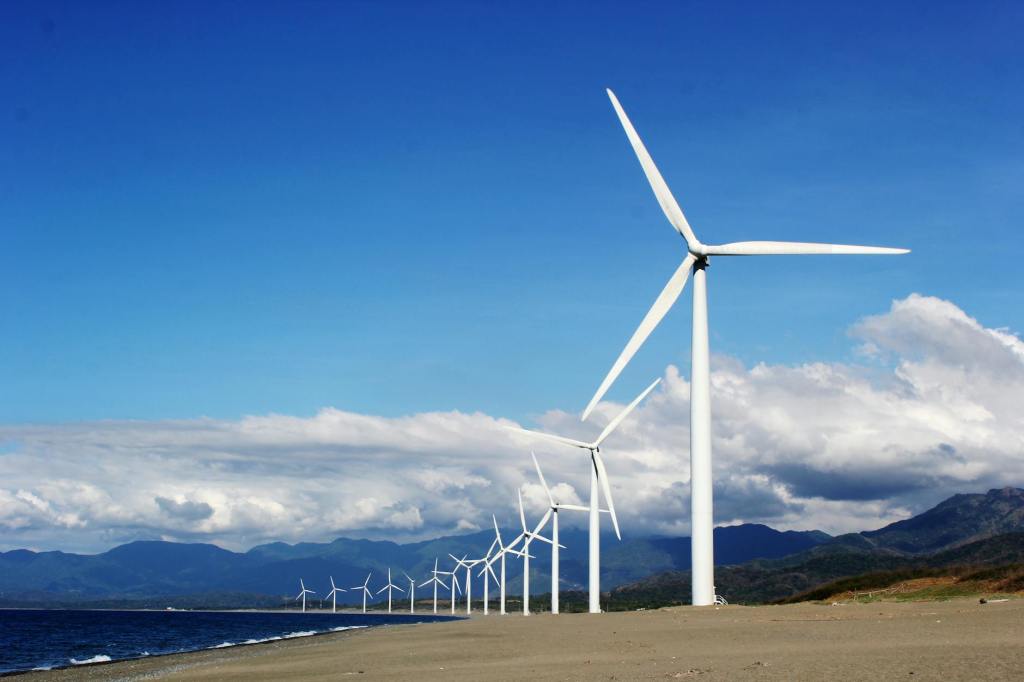
There is a lot of disinformation being spread about wind power. One recent example is the TV series Landman which presents demonstrably false claims as facts. In Texas where I live the problem with deceitful anti-renewable propaganda is especially severe. It is important to check with reputable sources before you believe what you come across. Wind energy is not 100% clean and not without issues but it is much safer and cleaner than the fossil fuels they potentially replace. Below is a two minute video that explains this.
The graph below from Our World in Data depicting lifetime greenhouse gas emissions (construction, operation, disposal) show that the lifetime greenhouse gas emissions of coal power are 88 times higher than those of wind power and kill 615 times as many people as wind power. The lifetime greenhouse gas emissions of natural gas are 40 times higher than those of wind power and kill 460 times as many people as wind power. The difference is staggering. When someone tells you that there’s nothing clean about wind power, they are not just lying to you, they are lying very big.
In the graph below, greenhouse gas emissions is measured of CO2 equivalents per Gigawatt-hour of electricity over the lifecycle of the power plant. 1 Gigawatt-hour is the annual electricity consumption of 150 people in the EU. Death rate from accidents and air pollution is measured as deaths per Terawatt hour of electricity production. 1 terawatt hour is the annual electricity consumption of 150,000 people in the EU.
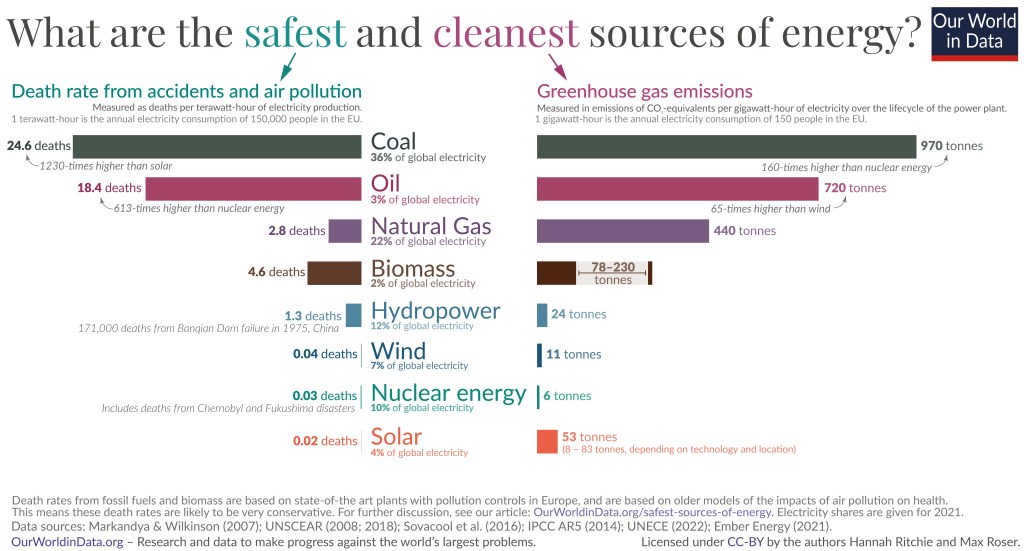
As you can see wind power is safe and emits very little greenhouse gases over its lifetime. In addition, there is no water impact associated with the operation of wind turbines, but a relatively small amount is used in manufacturing. There are other issues with land use, sounds, rare earth mining, waste, and effects on wildlife particularly birds.
However, these issues are in general smaller than depicted must be compared to issues with the fossil fuels they replace. For example, 15 billion tons of fossil fuels (including 9 billion tons of coal) are mined every year and burned whilst the annual mining for all clean energy technologies is around 7 million tons (2,000 times less). More about birds in the next section. Overall wind energy is a clean, renewable, and a sustainable power source. You can read more about this here, here, here, or here.
I am referring to this fact as a super fact because, it is true, an important topic, and yet it’s a fact that is difficult for many people to believe. Too much misinformation has been spread about wind power. I expect some people to dismiss this fact out of hand. But that is the point of super facts, they are true but hard to believe for many, or surprising, and perhaps even shocking.
Wind power saves a lot more birds than it kills
It may come as a surprise to some, but wind power is not a major cause of bird death. Wind farms are estimated to be responsible for losing less than 0.4 birds per gigawatt-hour (GWh) of electricity generated, compared to over 5 birds per GWh for fossil fueled power stations. This means that replacing fossil fuels with wind power saves a lot more birds than wind power turbines take. In addition, cats, windows, cars, poison and powerlines are examples of things that kill a lot more birds than wind power does. Cats kill thousands of times more birds than wind power does, and this usually does not bother us. Note I love both dogs and cats.
It is difficult to make exact estimates of bird deaths but below are some interesting graphs from reputable sources, confirmed by many other studies and analysis, such as this overview from MIT and this analysis by Hannah Richie. The numbers aren’t the same, but they make the same point. You can read more about this here.
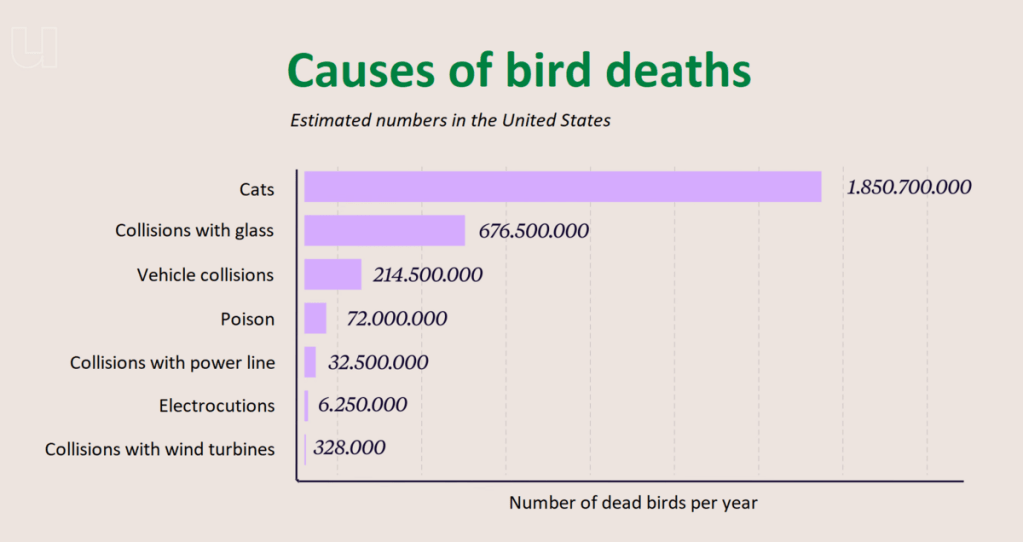
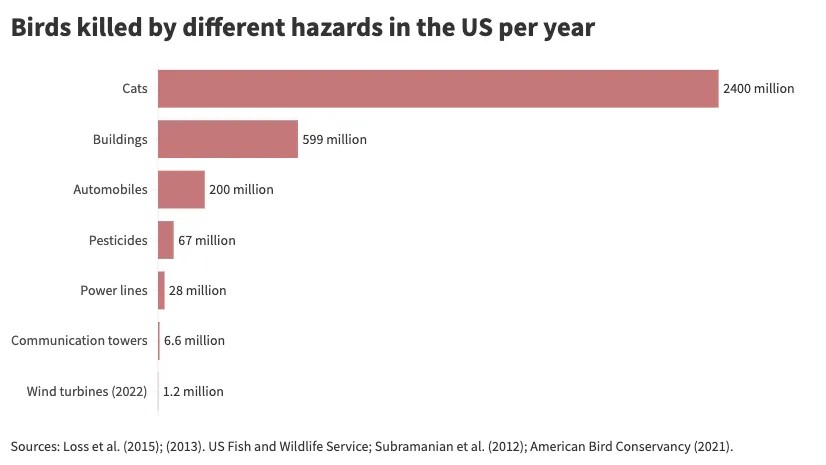
That does not mean we shouldn’t do our best to reduce bird deaths from wind power stations. However, don’t fall for the misinformation that is trying to paint it is a big problem specifically for wind power.
Wind Power is Inexpensive
Finally, a bit of a deviation from the main topic. In addition to being a relatively clean, renewable, and sustainable power source, wind power is now relatively cheap, which explains its recent success around the world. I am bringing this up because another widespread myth about wind power is that it is expensive and wouldn’t survive without subsidies.
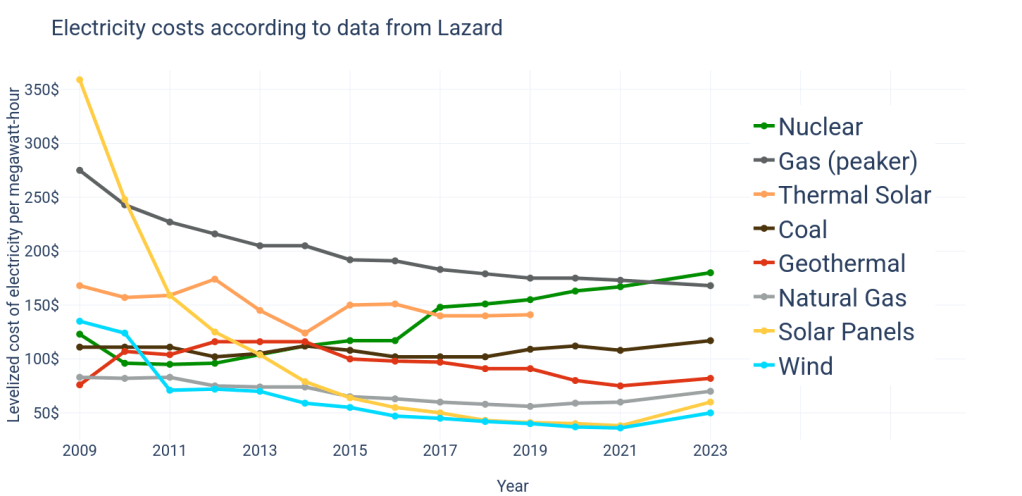
Practically all energy sources are subsidized, and fossil fuels have a long history of government subsidies. Below is the average unsubsidized levelized cost of energy according to Lazard. Levelized means that construction costs, land rent, and other costs not directly caused by electricity generation are taken into consideration. Notice how cheap wind is (blue line). This graph is for the United States.
Windpower is not only relatively cheap. Wind power is one of the most efficient and sustainable energy sources available. The energy required to manufacture, install, and maintain wind turbines is small compared to the energy they produce over their lifespan. This is known as their energy return on investment (EROI), which is quite favorable for wind energy. The Institute of Environmental Management and Assessment (IEMA) states that the average wind farm will pay back the energy that was used in its manufacture within 3-5 months of operation. This article in the journal Renewable Energy found that the average windfarm produces 20-25 times more energy during its operational life than was used to construct and install its turbines. It included data from 119 turbines across 50 sites going back 30 years.
It is important to be aware that there are many false claims floating around about wind power. The sound from wind power stations does not cause cancer, it does not use any other energy sources while operating; it solely harnesses the kinetic energy from the wind to generate electricity, meaning it only relies on wind to function as its primary energy source. Windpower is not a major cause if bird deaths. To read more about false claims about wind power click here.
Conclusion
There are positive and negative aspects of wind power, like any other source of energy. One issue with wind power (and solar) is that it is an intermittent source of energy. When the wind is not blowing you need other sources of energy (until there is sufficient energy storage). This is less of a problem when you have a mix of energy sources and in practice it has not been a big problem so far. However, what we know is that Wind Energy is indeed clean energy, much cleaner than the fossil fuels they potentially replace, and also relatively cheap, even without subsidies.
Other Posts by Me Related to Wind Power
- Nonsense and Rumors About Wind Power
- Wind power is providing more than a quarter of Texas Power
- Wind power is not a major cause of bird death
- 10 Wind Blowing Facts About Birds
To see the Other Super Facts click here

 Super Facts
Thanks for bringing such an important point in an effective way 😇
LikeLiked by 3 people
Thank you so much for your kind and supportive comment Aparna
LikeLiked by 3 people
It was a fantastic and informative read 😇
LikeLiked by 3 people
Thank you so much Aparna
LikeLiked by 2 people
Yes, I am familiar with the advantages and disadvantages of wind power and including all the outright falsehoods about it as well. Amazing what people will do or say to avoid change or new technologies and to maintain their power base. Thanks for your timely and thorough piece about this issue, Thomas.
LikeLiked by 4 people
Thank you so much for your kind and supportive comment Lynette. Yes I have to admit that find the flood of negativety against renewables both uninformed and surprising. I don’t as much of it in Sweden as I do here in Texas where I live now.
LikeLiked by 2 people
I can add that I believe you are right about “maintaining their power base”. The fossil fuel industry is a massive multi-trillion dollar industry that in the past has recieved an enormous amount of subsidies with the help of politicians. The anti-renewable stance is also deeply ingrained within certain political organizations that stand to lose a lot of prestige by backtracking. Data, scientific studies, and fair comparisons is a problem for them.
LikeLiked by 2 people
Oh yes, you are so right, Thomas.
LikeLiked by 2 people
Thank you Lynette
LikeLiked by 2 people
Java Bean: “Ayyy, sadly, it seems to be a lot easier to tell fabulous lies and have people believe them than it is to get them to actually look at facts, doesn’t it?”w
LikeLiked by 2 people
Yes, unfortunately you are right Java Bean. Some people say that facts don’t matter. However, a closer analysis of the related studies shows that politely correcting people’s misconceptions actually help in the long run for most people, but not always. People who are too emotionally invested in a false belief are not likely to even want to hear about the data and the facts. Then, like you point out, there are people who intentionally spread disinformation and are working very hard at doing so. They are a loud minority but they have a lot of influence.
LikeLiked by 1 person
Hi Thomas, thank you for sharing this excellent information about wind power. I saw a number of wind power turbines along the coast in the UK. The weather in the UK is well placed for sustainable wind power. In South Africa, solar power is better in the interior of the country.
LikeLiked by 3 people
Yes I can imagine South Africa being a great place for solar power and UK a great place for wind power. It may come as a surprise to many but for ERCOT – the Texas grid – the overall fuel mix for 2025 was 37% solar and wind, 23% wind and 14 % solar (all types of natural gas 43%, coal 13%, nuclear 8%). That does not include roof top solar. Solar is growing quickly in Texas. It may come as surprise because Texas is a fossil fuel state and the hostility towards renewables in Texas is pretty big among politicians as well as among a segment of the population. They are trying to shut it down but it is still growing.
LikeLiked by 1 person
Fascinating information, Thomas.
LikeLiked by 2 people
Thank you so much Robbie
LikeLiked by 1 person
💞
LikeLiked by 1 person
Great article Thomas, even living in a petroleum based economy province, we know the benefits of wind energy, and I rarely hear negative comments, other than they are not pretty. Maggie
LikeLiked by 2 people
Thank you so much Maggie. It is great to hear that you rarely hear negative comments. Where I live, in Texas, it is a bit different.
LikeLiked by 2 people
Well shared. Wind power is safe for the environment also.
LikeLiked by 2 people
Yes you are right. Thank you Priti.
LikeLiked by 2 people
🙏
LikeLiked by 1 person
Thanks for pointing out the facts and fallacies about wind power, Thomas! Canada is embracing it more than the U.S., and there is less negativity about it here.
https://knowledge.energyinst.org/new-energy-world/article?id=140002
I remember you wrote about the inaccuracies spouted by characters in the TV show, Landman. These actors are merely repeating lines. IMO, they are portraying typical attitudes of Texas oilmen, who obviously are against wind power. Nobody should think what they are saying is accurate. It’s not a documentary, and meant to be mere entertainment.
LikeLiked by 2 people
Thank you so much Debbie and that was a very interesting article. The amazing thing is that despite the negative attitude towards wind in Texas it keeps expanding. You are right about Landman, it is entertainment and no one should really believe it. However, the attempted rebuttal by female lawyer was so feeble that it appeared to me as intentional propaganda. I am afraid people will believe it.
LikeLiked by 2 people
Always interesting, Thomas. I do like the way you explain all these things.
LikeLiked by 2 people
Thank you so much for your kind words Chris
LikeLiked by 2 people
Thank you for the informative and balanced post about wind power. From all I’ve read, it’s definitely a resource worth utilizing.
I have had conversations with people who have been misled by the false claims about wind power and many do believe the false claims about the number of birds killed by windmills. In one such conversation, I suggested that if the person was so concerned for bird safety, they should remove the glass from their windows. I then showed them a graph similar to the ones you’ve shown. I think the statistics surprised them. Unfortunately, I also think they still tend to get much of their news from sources that spread false claims.
LikeLiked by 2 people
Thank you so much David. It sounds like you had an interesting conversation and I am glad you were able to informed him on the topic. You are right, there is so much misinformation and disinformation on this topic. False claims are everywhere and unfortunately some people are emotionally attached to the misinformation.
LikeLiked by 2 people
I will be so glad when the absurd war on clean energy being waged by the current “Administration” is over and we can get back to not trying to destroy the climate …
LikeLiked by 1 person
Yes me too. It is just a waste. The entire world is moving towards clean energy of various kinds and here we are trying to stop it. It is just taking our economy backwards.
LikeLiked by 1 person
I surely don’t know as much as you about all of this but from experience with family who have large wheat farms and family that worked in the land arena , this is another side… the windmills are taking over the farms, wildlife is near none in these areas, now over this last 6 years I’ve seen them destroy farmers and families.. where windmill companies leased farmers lands and promised years of shared profits , the windmill companies planted the windmills , ran w the money and then left many , so many farmers losing their land to the windmill companies that left after they installed.. arms of windmills were buried when broken , leaving land destroyed and farmers titles being tied to liens more than their properties are worth. Some refused windmills and they are the only farmers left standing and more and more are losing their land to these companies shenanigans. Profit before people.
So my take on windmills has another depth to it. They do no good when they are not installed with integrity and purpose but only profit.
My opinion is based on proven and seen with my own eyes facts, if that helps .
LikeLiked by 1 person
Yes, what you bring up is an aspect of wind power that I did not discuss and that I do not know much about. You are right, no energy source is perfect, and windmills need to be installed with integrity. Companies should not take advantage of people. I should say that based on what I’ve heard from the farmers here in Texas they are happy about the extra income they get, but that may not be true for everyone everywhere. Companies to be honest about what will happen and what the true income will be. Thank you for your comment, Kerri.
LikeLiked by 1 person
Of course I’m sure so many areas experience different aspects of it.
LikeLiked by 1 person
Yes you are right Kerri, and not just different areas but different companies too. Here in Dallas there are solar installation companies that are doing a good job and solar installation companies that are cheating their customers.
LikeLike
Wind energy is indeed clean energy, and so is solar energy, but what about hydroelectric power? For one thing, is hydroelectric energy bad for aquatic ecosystems? Wind turbines are a very minor cause of bird deaths, but is hydroelectric power a major cause of fish deaths? How the hydroelectric carbon foot print compares to wind and solar? Anything else?
LikeLiked by 1 person
Hydro is considered clean energy, but it is a relative term. With respect to greenhouse gas emissions Hydro generate double as much as wind but 20-30 times less than gas and coal, so definitely clean in that regard. Hydro is 20-40 times riskier than wind and solar but 10-20 less risky than gas and coal. (see the graph above). With respect to fish and other eco systems it depends a lot on how you implement it. You can build fish ladders, elevators, or pneumatic tubes to protect fish. I don’t have any numbers to compare fish wellbeing between hydro and gas and coal but carbon emissions are destroying coral reefs and causing ocean acidification, which is very bad for shellfish and for many saltwater fish. You always have to compare, and whether you call it clean or not I think depends on how it compares with gas and coal.
LikeLike