The Giant Bubble of No Space

Cosmology is the science of the origin and development of the universe, and this post is about a book on Cosmology, “What’s Eating the Universe?: And Other Cosmic Questions” by Paul Davies.

What’s eating the Universe is one of the 30 questions answered in this book. It refers to the mysterious gigantic super-voids we’ve found. Could they be the result of collisions with other universes? Could they be the result of expanding giant bubbles with no space at all in them? That’s not just empty bubbles with empty space, but bubbles in which space itself is missing. Try to imagine that. Some of the 30 questions have answers, others just feature several guesses.

The goal of this blog is to create a list of what I call super facts. Important facts that we know to be true and yet they are surprising, shocking or disputed among non-experts. Super facts are special facts that a well-informed person may want to know.

However, I sometimes create posts that are not super facts but just interesting information, such as this one. What’s eating the Universe is a relatively short and easy read. I bought the hardback version of it.

  • Hardcover –  Publisher : University of Chicago Press; First Edition (September 22, 2021), ISBN-10 : 022681629X, ISBN-13 : 978-0226816296, 208 pages, item weight : 12.2 ounces, dimensions : ‎5.67 x 0.71 x 8.58 inches, it costs $19.84 on Amazon. Click here to order it from Amazon.com.
  • Paperback –  Publisher : University of Chicago Press; First Edition (September 30, 2022), ISBN-10 : 0226823873, ISBN-13 : 978-0226823874, 183 pages, item weight : 9.6 ounces, dimensions : ‎ ‏ : 5.5 x 0.46 x 8.5 inches, it costs $15.67 on Amazon. Click here to order it from Amazon.com.
  • eTextBook –  Publisher : University of Chicago Press; First edition (September 22, 2021), ASIN : B096L2WP51, 172 pages, it costs $14.89 on US Amazon. Click here to order it from Amazon.com.
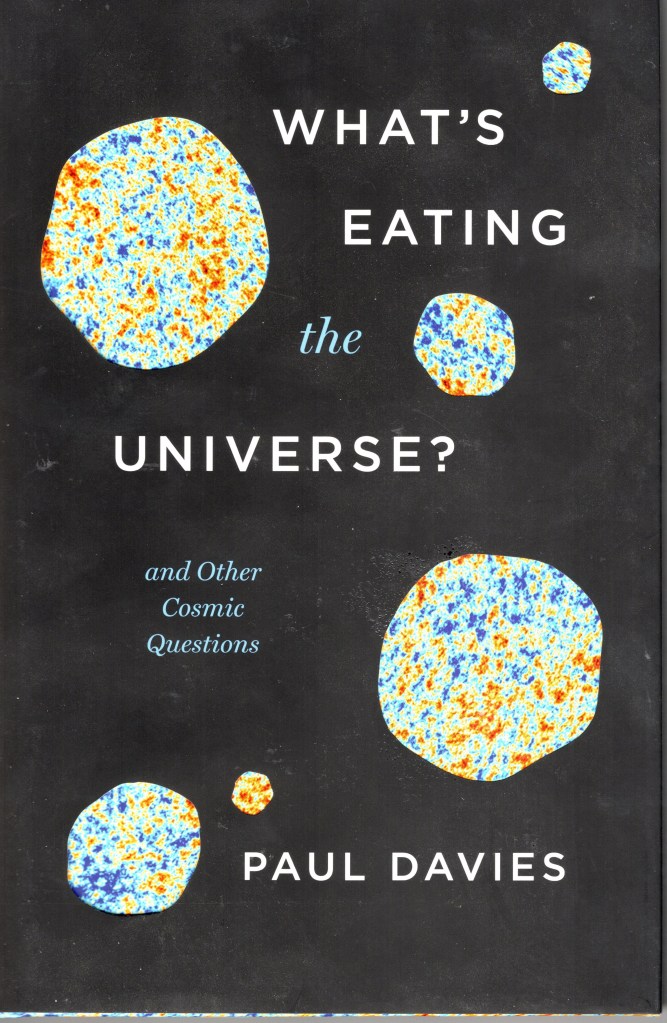
Front cover of What's Eating the Universe | The Giant Bubble of No Space
Front cover of What’s Eating the Universe? Click on the image to go to the Amazon page for the hardcover version of the book.

Amazon’s description of the book

Combining the latest scientific advances with storytelling skills unmatched in the cosmos, an award-winning astrophysicist and popular writer leads us on a tour of some of the greatest mysteries of our universe.

In the constellation of Eridanus, there lurks a cosmic It’s as if something has taken a huge bite out of the universe. But what is the culprit? The hole in the universe is just one of many puzzles keeping cosmologists busy. Supermassive black holes, bubbles of nothingness gobbling up space, monster universes swallowing others—these and many other bizarre ideas are being pursued by scientists.

Due to breathtaking progress in astronomy, the history of our universe is now better understood than the history of our own planet. But these advances have uncovered some startling riddles. In this electrifying new book, renowned cosmologist and author Paul Davies lucidly explains what we know about the cosmos and its enigmas, exploring the tantalizing—and sometimes terrifying—possibilities that lie before us.

As Davies guides us through the audacious research offering mind-bending solutions to these and other mysteries, he leads us up to the greatest outstanding conundrum of Why does the universe even exist in the first place? And how did a system of mindless, purposeless particles manage to bring forth conscious, thinking beings? Filled with wit and wonder, What’s Eating the Universe? is a dazzling tour of cosmic questions, sure to entertain, enchant, and inspire us all.

This is my five-star review for What’s Eating the Universe?: And Other Cosmic Questions.

Cosmology explained the easy way

This book is organized into 30 cosmological questions that the author is answering or clarifying. His explanations are naturally not in depth but high level and easy to understand for anyone with an interest in the topic. He manages to keep the topic fascinating and the book is a real page turner. I read the book in a little bit more than one day.

The book discusses cosmology, relativity, the standard model, black holes, the big bang, the CMB, dark matter, dark energy, multiverses and the fate of our Universe, extraterrestrials, and much more, and he gives us insight into the very latest discoveries and views of cosmology.

I especially enjoyed reading chapter 20 & 21 “Can the Universe Come from Nothing” and “How Many Universes Are There”. He tells us that most cosmologists he knows believe there are infinitely many universes. One model is eternal inflation, a space/time mechanism beyond our universe that keeps causing new universes to bubble up and initially expand rapidly, but there are other models. I was surprised that he didn’t mention Roger Penrose’s model, cycles of time, with one Universe giving rise to another (after full expansion and heat death).

However, if there’s only one Universe and time came into existence with it (singularity) it doesn’t help those who want to insert a creation moment. If time didn’t exist before the big bang, the concept of a prior physical cause is meaningless. Asking what was before the big bang is like asking what lies north of the North Pole.

I also especially enjoyed reading chapter 30 “What’s New on the Cosmic Horizon” in which he lists mysteries and recent exciting discoveries, the cold patch in Eridanus (CMB), the mystery with the Hubble constant, what’s beyond the standard model, the prospect of top-down models, etc. Well, all the chapters were interesting.

This book is a quick and easy summary of what’s going on in cosmology. It’s accessible and engrossing writing and the straightforward organization make the book a great introduction to the topic. I highly recommend this book.
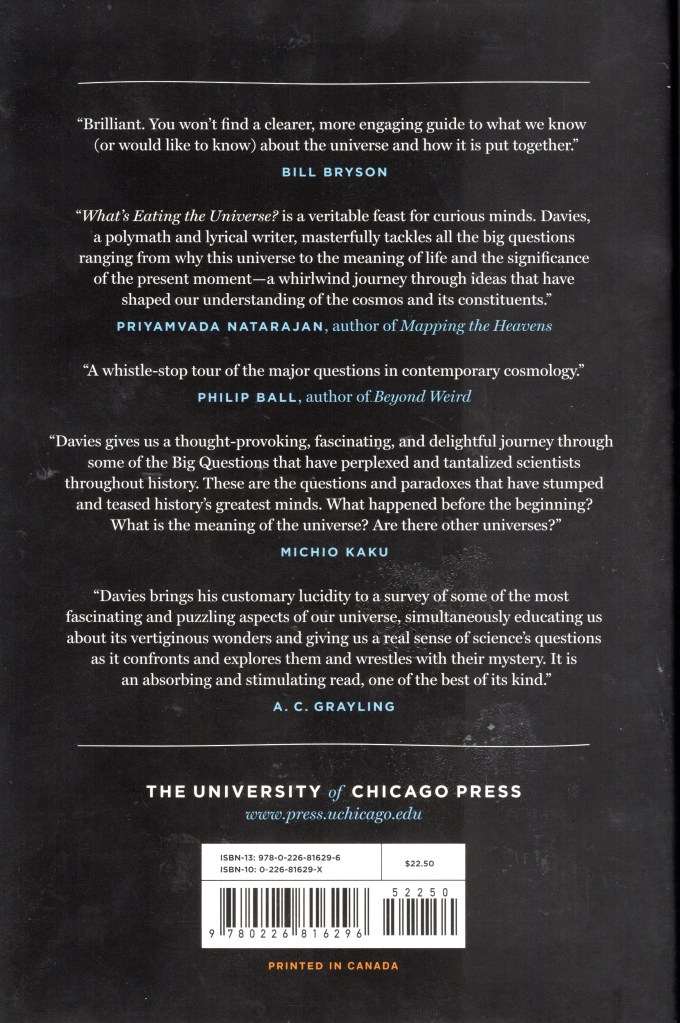
The back cover feature advanced praise for the book | Back cover of “What's Eating the Universe?”
Back cover of “What’s Eating the Universe?” Click on the image to go to the Amazon page for the paperback version of the book.

Finally, a list of the 30 questions

  • Journey from the Edge of Time
  • The search for the key to the Universe
  • Why is it dark at Night?
  • The Big Bang
  • Where is the Center of the Universe?
  • Why the Cosmos is Actually Fairly Simple?
  • What is the Speed of Space?
  • What is the Shape of Space?
  • Explaining the Cosmic Big Fix
  • Most of our Universe is Missing
  • What is Dark Energy
  • Where Does Matter Come From?
  • Gravity Conquers All
  • Warped Time and Black Holes
  • Is Time Travel Possible?
  • What is the Source of Time’s Puzzling Arrow?
  • The Black Hole Paradox
  • A Theory of Everything?
  • Fossils from the Cosmic Dawn
  • Can the Universe Come from Nothing?
  • How Many Universes Are There?
  • The Goldilocks Enigma
  • What’s Eating the Universe?
  • Is the Universe Actually a Botched Job?
  • Are We Alone?
  • Is ET in Our Backyard?
  • Why Am I Living Now?
  • The Fate of Our Universe
  • Is There a Meaning to It All?
  • What’s New on the Cosmic Horizon?
To see the Super Facts click here


The Surprising Monty Hall Problem

Superfact 22: Suppose you’re on a game show, and you’re given the choice between three doors: Behind one door is a car; behind the other two doors there are goats. You want to pick the car. You pick a door, and the host, who knows what’s behind the three doors, opens another door revealing a goat. Now the question is, is it to your advantage to switch door choice? The answer is yes. And that is the surprising Monty Hall Problem.

There is a blue door on the left, a red door in the middle, and a green door on the right | The Surprising Monty Hall Problem
The Monty Hall gameshow Three Doors Problem. There is a car behind one door, and goats behind the other two. You pick a door. Monty Hall, the gameshow host, opens one of the other doors and it has a goat. Should you change your choice of door? Yes, you should. But why? – Monty Hall Problem Stock Illustration ID: 1881849649 by SATYA94.

It is quite common to argue that it does not matter. You don’t know what is behind the two remaining doors so it should be 50/50 right? In a test involving 228 people only 13% chose to switch. However, you should switch.

Monty Hall, the gameshow host of the Let’s Make a Deal television game show, knows where the car is, so he never chooses the door with the car. And by curating the remaining two doors for you, he raises the odds that switching is always a good bet. By switching your choice, you have a 2/3 chance of winning the car but if you stay with your original choice, you only have a 1/3 chance of winning the car.

So why is this a super-fact? First, we know it is true. It is mathematically proven and experimentally verified that switching door is the best choice. Secondly, this was widely contested and is still surprising to people. Finally, probabilistic thinking is the key to being rational and making good decisions. This fact is true, important and disputed and thus a super fact.

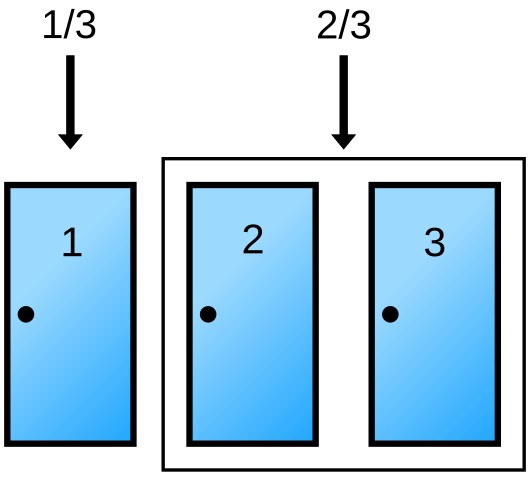
One way of viewing the situation is by noting that there is a 1/3 chance that the car is behind any door that the contestant picks and a 2/3 chance that the car is behind one of the other two doors.

The picture shows three doors, one marked 1/3 and two more grouped together under 2/3 | The Surprising Monty Hall Problem
The car has a 1/3 chance of being behind the contestant’s pick and a 2/3 chance of being behind the other two doors. Picture from Wikimedia commons public domain.

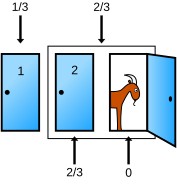
If Monty opens one of the two doors that the contestant did not pick there is still a 1/3 probability that the car is behind the door the contestant picked and a 2/3 chance that the car is behind one of the other two doors. However, one of the doors that the contestant did not pick is now known to feature a goat. Therefore, the probability that the car is behind the other door is 2/3.

The picture shows three doors, one marked 1/3 and two more grouped together under 2/3. The last door has a goat, and it is marked by 0. The door in the middle is marked by 2/3.
The host opens a door. The odds for the two sets don’t change but the odds become 0 for the open door and 2/3 for the closed door. Picture from Wikimedia commons public domain.

The table below is probably (no pun intended) a better way of illustrating the situation. In the table door 1 is the door designated to be the contestant’s first choice. Monty opens one of the remaining doors that has a goat behind it.

Behind door 1Behind door 2Behind door 3Result if staying at door 1Result if switching to door offered.
GoatGoatCarWins goatWins Car
GoatCarGoatWins goatWins Car
CarGoatGoatWins CarWins goat

There are various other ways of explaining the situation including Steven Pinker’s approach. It is easy to test this is real life and repeated experiments and simulations shown that if you switch you have a 2/3 chance of winning.

As an example of the controversy this probability puzzle caused was Marily Savant’s column in Parade Magazine. As a side note, Marilyn Vos Savant is the person who has the highest recorded intelligence quotient (IQ) as stated in the Guinness Book of Records. In response to a question regarding the Monty Hall game show problem she wrote that you should switch. She received letters from 10,000 readers disputing this, including 1,000 with PhDs. In the long run she prevailed.


To see the other Super Facts click here


The Little Book of Cosmology

Cosmology is the science of the origin and development of the universe, and this post is about a book on Cosmology, The Little Book of Cosmology by Lyman Page. This is a big and, in my opinion, interesting topic. A lot of cosmology is speculative, multiverses, what was before the big bang, has the universe always existed, has there been an infinite number of big bangs, what about conformal cyclic cosmology in which each cycle result in a new big bang (Roger Penrose), what is the future and end of the universe, is the Universe a hologram, is it self-aware, etc.

This book is not focused on scientific speculation but on what we know about the structure of the universe, the big bang and the expansion of the universe, the well understood basics. I think it is amazing how much we can learn from the Cosmic Microwave Background Radiation (CMB).

The goal of this blog is to create a list of what I call super facts. Important facts that we know to be true and yet they are surprising, shocking or disputed among non-experts. Super facts are special facts that a well-informed person may want to know. However, I sometimes create posts that are not super facts but just interesting information, such as this one. The Little Book of Cosmology is a relatively short and easy read. I bought the hardback version of it.

  • Hardcover –  Publisher : Princeton University Press; First Edition (April 7, 2020), ISBN-10 : 0691195781, ISBN-13 : 978-0691195780, 152 pages, item weight : 2.31 pounds, dimensions : 5.59 x 0.79 x 8.58 inches, it costs $15.39 on Amazon. Click here to order it from Amazon.com.
  • Kindle –  Publisher : Princeton University Press (April 7, 2020), ASIN : B07Z1DWB4P, 132 pages, it costs $9.99 on US Amazon. Click here to order it from Amazon.com.
The front cover features the title, the author, and geodesic lines forming a hyperbolic cone mesh | The Little Book of Cosmology by Lyman Page
Front cover of The Little Book of Cosmology. Click on the image to go to the Amazon page for the hardcover version of the book.

Amazon’s description of The Little Book of Cosmology by Lyman Page

The cutting-edge science that is taking the measure of the universe

The Little Book of Cosmology provides a breathtaking look at our universe on the grandest scales imaginable. Written by one of the world’s leading experimental cosmologists, this short but deeply insightful book describes what scientists are revealing through precise measurements of the faint thermal afterglow of the Big Bang—known as the cosmic microwave background, or CMB—and how their findings are transforming our view of the cosmos.

Blending the latest findings in cosmology with essential concepts from physics, Lyman Page first helps readers to grasp the sheer enormity of the universe, explaining how to understand the history of its formation and evolution in space and time. Then he sheds light on how spatial variations in the CMB formed, how they reveal the age, size, and geometry of the universe, and how they offer a blueprint for the formation of cosmic structure.

Not only does Page explain current observations and measurements, he describes how they can be woven together into a unified picture to form the Standard Model of Cosmology. Yet much remains unknown, and this incisive book also describes the search for ever deeper knowledge at the field’s frontiers—from quests to understand the nature of neutrinos and dark energy to investigations into the physics of the very early universe.

This is my five star review for The Little Book of Cosmology

What the Cosmic Microwave Background (CMB) can tell us

This is a short book describing the evolution of the Universe since the Big Bang and its composition. How do we know all this stuff? The Cosmic Microwave Background (CMB) can tell us a lot.

The CMB is a black body radiation remnant from the time (400,000 years after the Big Bang) when the Universe had cooled enough to allow the formation of hydrogen atoms and the decoupling of photons from electrons so that they could roam free.

CMB is in itself evidence for the Big Bang but in addition we get additional information from the minor anisotropy and polarization of the CMB, and add the composition of the elements (hydrogen, helium, lithium, and heavier elements), redshifts of galaxies, gravity lensing, and we can tell quite a bit about the evolution of the Universe and where it is heading.

It’s fascinating science detective work. This eventually leads to the Standard Model of Cosmology, which is something I’ve never heard of before, but it’s cool.

I found the facts about the size and age of the Universe, the early giant stars in the Universe, dark energy and dark matter, very interesting. The book is filled with basic and fascinating facts that I did not know. Because of the CMB (rather than particle accelerator experiments) we know roughly the mass (rest mass) of neutrinos.

We know why dark energy can’t be space dust, or rogue planetoids, or black holes or neutrinos, so what is it? The book explains why it can’t be any of those. There’s a lot we can know because of the CMB and other information, and some things we don’t know. Finding out what we do know was quite exciting and finding out what the mysterious “what we don’t know” was equally exciting. Again, the focus is on CMB and how it is measured, it tells us a lot.

The book is easy to read and require no degree in physics or mathematics. I admit I have a degree in Engineering Physics, and I am also interested in astronomy and cosmology, but I can tell it was light reading. It is a truly popular science book like those that Neil De Grasse Tyson writes, and it was short but very informative. There’s a lot of information you can extract from CMB. It was a fun short read for anyone interested in the mysteries of the Universe.

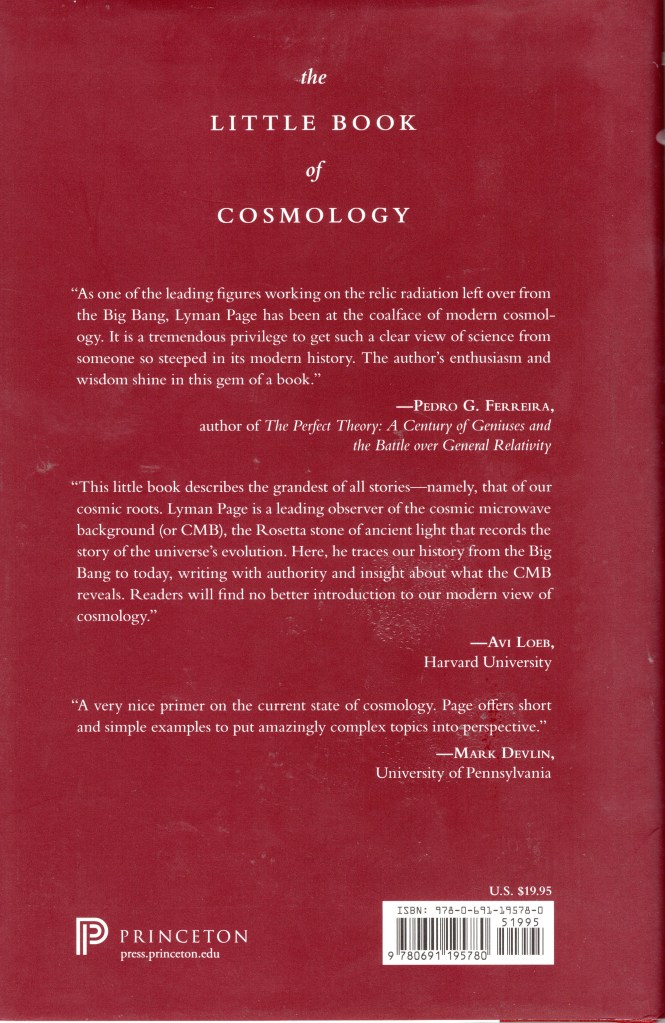
The back cover feature advanced praise for the book | The Little Book of Cosmology by Lyman Page
Back cover of The Little Book of Cosmology. Click on the image to go to the Amazon page for the kindle version of the book.

To see the Super Facts click here


Neutering or spaying a dog at 6 months old can be dangerous to their health

Superfact 21: Neutering or spaying a dog at 6 months old can be dangerous to their health depending on breed. It is often recommended that you should neuter or spay your dog by the age of 6 months even as early as 8 weeks. This may be OK for some smaller breeds but is dangerous to the health and longevity of many larger breeds.

Many dog welfare organizations, SPCA, ASCA, etc., recommend that dogs are neutered or spayed by the age of 6 months, or even as early as 8 weeks. It is also a common advice in dog books.

In addition, some veterinarians still hold onto this belief. It is easy to understand why. Dogs running loose and causing unwanted pregnancies resulting in puppies having to be euthanized is a sad problem we don’t want. 

Unfortunately, research has shown that neutering or spaying a dog at 6 months old can be dangerous to their health depending on the breed. You may need to wait 18 months or two years, and some breeds should not be neutered at all. In addition to the scientists in the relevant fields, professional and certified breeders, AKC and dog breed clubs and veterinarians who kept themselves informed on this issue are all aware of this.

In other words, we know this to be true, it is an important fact since so many of us own a dog, roughly half of all US households do, and yet this information is highly surprising to many. This is why I consider it a super fact.

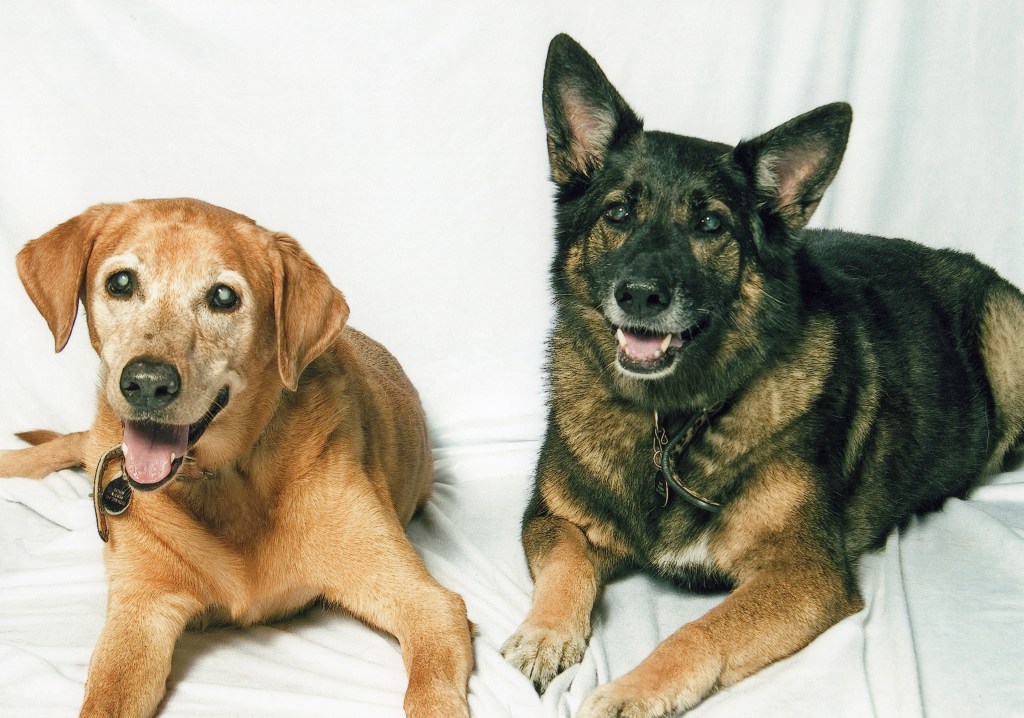
Our yellow lab Baylor is on the left. Our brown-black German Shepherd Baby is on the right | Neutering or spaying a dog at 6 months old can be dangerous to their health depending on breed
This is our Labrador Baylor and German Shepherd Baby. Too early neutering and spaying can severely harm their health.

This less than a year-old article from the AKC states that “an age of six to nine months of age may be appropriate for neutering or spaying a toy breed puppy or small breed puppy but a larger or giant breed may need to wait until they are near or over 12-18 months of age.” The article also provides the following interesting information.

Research conducted by the University of California – Davis reveals that for some dog breeds, neutering and spaying may be associated with the increased risks of certain health conditions such as joint disorders including hip or elbow dysplasia, cranial cruciate rupture or tear, and some cancers, such as lymphoma, mast cell tumor, hemangiosarcoma, and osteosarcoma.

The research conclusions are not surprising. Sex hormones are important in the development of any animal.  We know they affect psychological development as well as the musculoskeletal, cardiovascular, and the immune system.

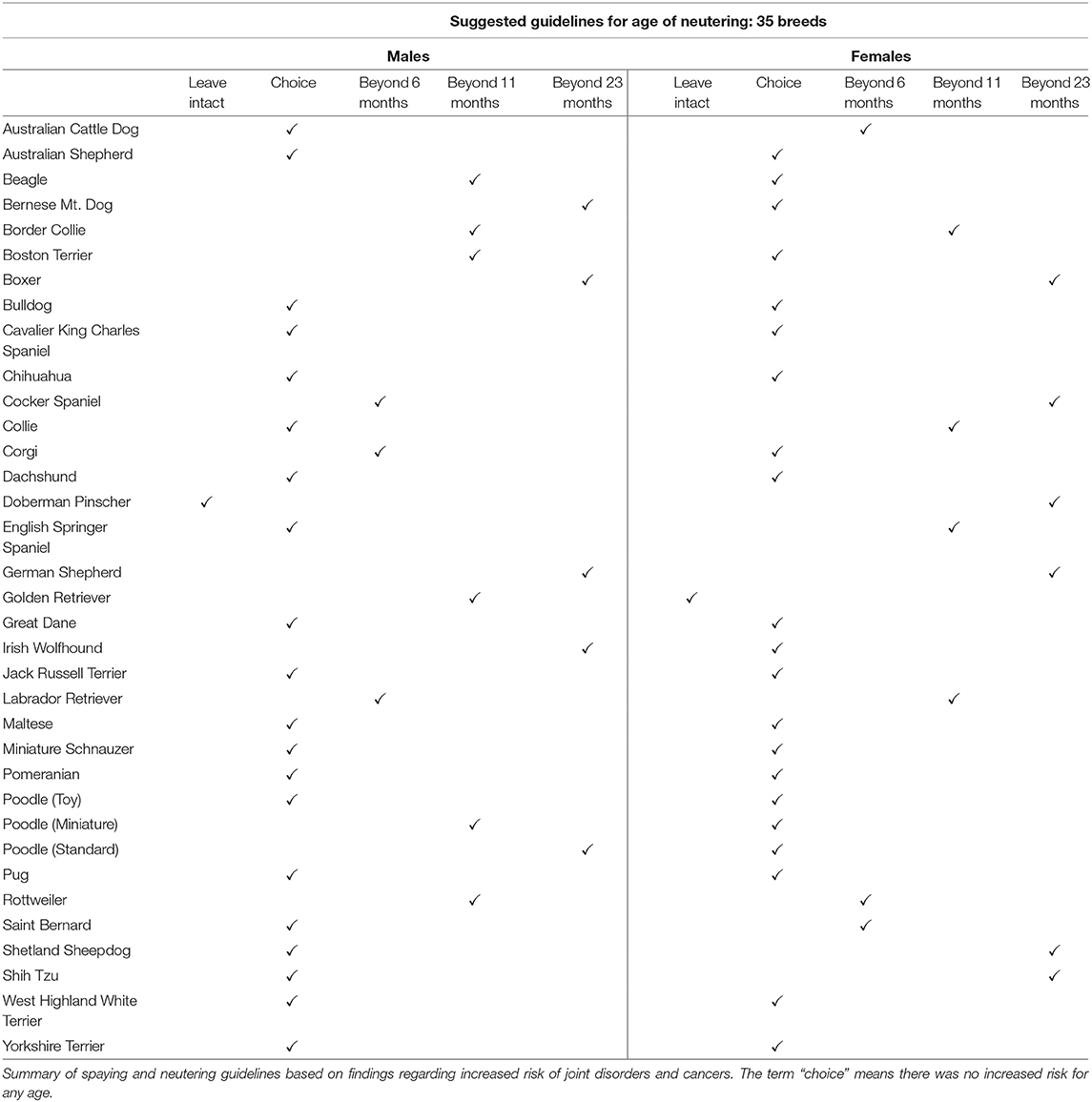
I believe this is the University of California – Davis article in question. It is from 2020. Notice that the suggested guidelines for age of neutering is beyond 23 months for several of the giant breeds in the table featuring 35 breeds.

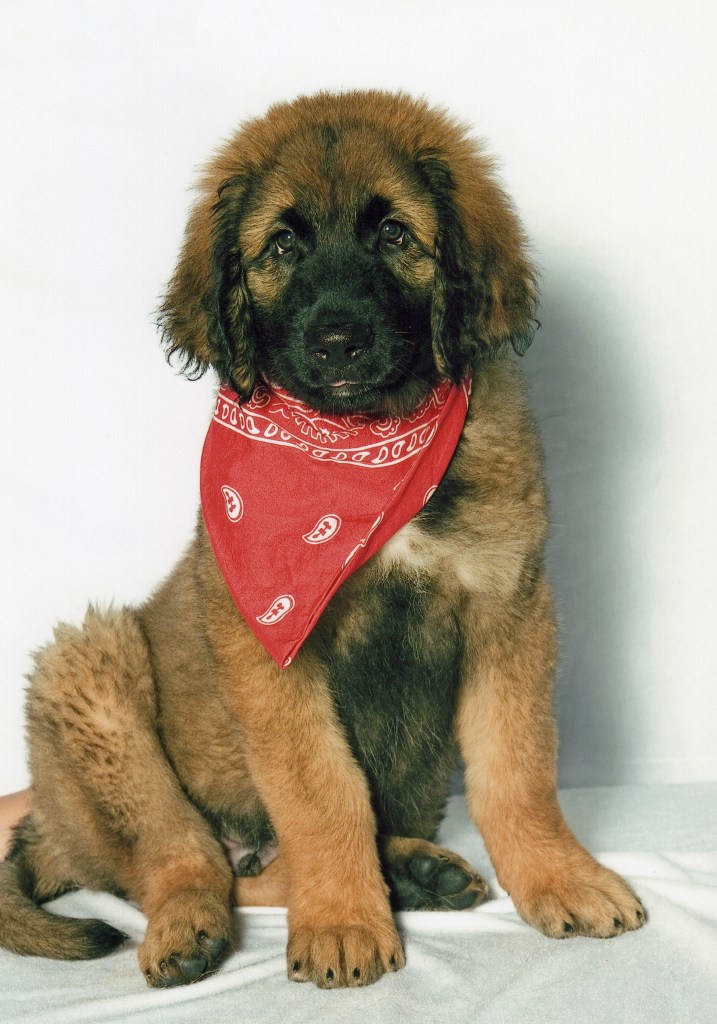
Bronco, our Leonberger puppy is looking straight into the camera. He is wearing a red bandana | Neutering or spaying a dog at 6 months old can be dangerous to their health depending on breed
Our three months old Leonberger Bronco. The Leonberger is a giant breed you can neuter when they are older than two years old.

Recommended Ages for Neutering and Spaying

Below is a list of recommended ages for neutering and spaying for selected dog breeds.

  • Australian Shepherd, for neutering and spaying it is your choice.
  • Bernese Mountain Dog, you should neuter beyond the age of 23 months, but for spaying you have a free choice.
  • Boxer, neuter and spay beyond the age of 23 months.
  • Boston Terrier, neuter beyond 11 months, but for spaying you have a free choice.
  • Doberman Pincher, never neuter, and you need to spay beyond the age of 23 months.
  • German Shepherd, neuter and spay beyond the age of 23 months.
  • Labrador Retriever, neuter beyond 6 months and spay beyond 11 months.
  • Corgi, neuter beyond 6 months, but for spaying you have a free choice.
  • Great Dane, despite being a very large dog you have a free choice for both neutering and spaying.
  • Rottweiler, neuter beyond 11 months, but for spaying beyond 6 months.
A mini-Australian Shepherd puppy is peeking out behind a sofa chair.
Our mini-Australian Shepherd puppy Rollo. You can neuter this breed at an earlier age.

We used to own a male Leonberger dog, which is a giant breed. Our breeder told us to wait beyond two years before neutering him, for health reasons. This article from Hillhaven Leonbergers states the following “We recommend not neutering until at least 2 years of age…Some Vets would recommend from 6 months but this is NOT a good idea.” To read more about the neutering and spaying of Leonberger dogs click here.

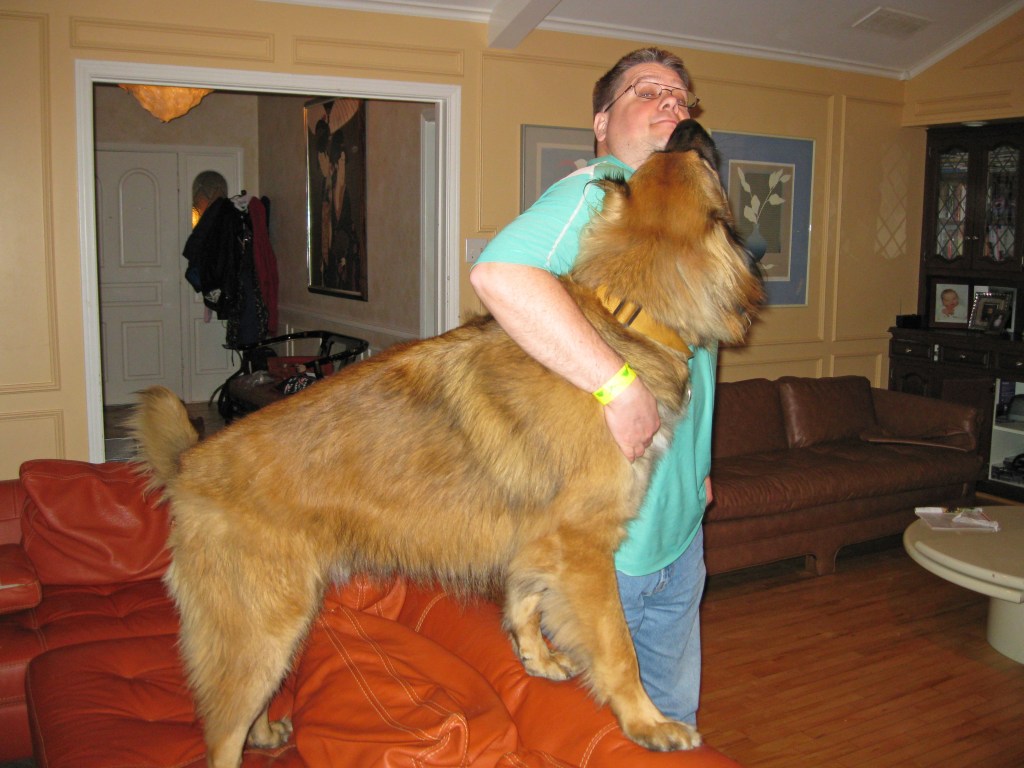
Our Leonberger dog Bronco is standing on a red leather sofa. He is stretching to give me a hug.
Our Leonberger dog Bronco is giving me a hug. He was about one year old in the picture. That is still too early to neuter him.

This article from the Saint Bernard Club of America states that “above all, no giant breed puppy should be altered before the growth plates in the bones have matured and closed, usually between 15 and 24 months of age.” This Newfoundland dog magazine states : Currently, the recommended age that a Newfoundland dog should be neutered is 18 to 24 months due to the possible health problems that can arise from altering before that age.

A Saint Bernard dog carrying the typical cognac container. There are mountains in the background | Neutering or spaying a dog at 6 months old can be dangerous to their health depending on breed
According to the article above you should wait to neuter Saint Bernard Dogs until they are close to two years old. Saint Bernard Stock Photo ID: 1713912484 by fred12.
A dark brown Newfoundland dog standing on a stump in the forest.
According to the article above you should wait to neuter Newfoundland Dogs until they are between 18 to 24 months old. Newfoundland dog Stock Photo ID: 1925281937 by Marsan.

Even though the expert advice regarding the best age for neutering and spaying varies, it is clear that doing it at six months old is too early for many breeds and can harm their health.


To see the other Super Facts click here


The Universal State of Obliviousness

At ABB Robotics in Auburn Hills, a suburb of Detroit, Michigan, where I used to work as an engineer, there was a steel door without a window that opened out into a hallway. Whomever designed this must have been clueless. When someone opened the door into the hallway, he would not know anything about what was on the other side of the door.

One day I saw a couple of guys standing and talking in the hallway in front of the door. Suddenly a fellow engineer opened the door, and it slammed into one of the guys, who screamed “hey watch it!”.

The thought that occurred to me was “no you watch it! Standing in front of that door is pretty clueless. How is the guy opening the door going to know that you are there?”. I did not say anything.

The fact of the matter was that the designer, the door opener, the guys hanging out in front of the door, all of them were oblivious. In my opinion the guy standing in front of the door and then when something happened instantly blaming the other guy was the most clueless.

The Universal State of Obliviousness
Photo by Brixiv on Pexels.com

Obliviousness

Obliviousness is a state of being unaware or unmindful of something or being ignorant of its existence. Some synonyms are clueless, ignorant, and unmindful. The goal of this blog is to create a list of what I call super facts. Important facts that we know to be true and yet they are often surprising, shocking or disputed among non-experts.

However, I will write about other related things as well, and today I am musing about obliviousness and cluelessness, something that afflicts us all more or less. Without obliviousness and cluelessness this super-fact blog could not exist.

I got the idea for this post by reading a comment on another blog post where the author mentioned that “…a woman on her phone in the supermarket walked into my trolley this morning…”. The woman with the phone was oblivious to her surroundings because of her fixation on her phone, a very common situation. I think most of us are guilty of this on occasion, but it is very annoying when the person who was staring at the phone is blaming the other party.

The same is true for people who walk backwards in crowded places and then blame the people they bump into. There are different levels of obliviousness.

A distracted young male employee focused only on his phone while walking through the crosswalk unaware of any incoming vehicles | The Universal State of Obliviousness
Stock Photo ID: 2340473623 by MDV Edwards

Obliviousness And Social Media

There are a lot of ways to be excessively oblivious. One of the most common and annoying examples on social media is in my opinion when people comment on articles they have not read.

I remember an experiment on Facebook where an organization posted an article with an intentionally misleading headline. The article was about something completely different, and the article even stated that the headline was misleading, and the article explained the experiment. If you read just a small part of the article you would know. The result was that most people commented on the headline, not the article. They did not read any of the article and fell into the trap.

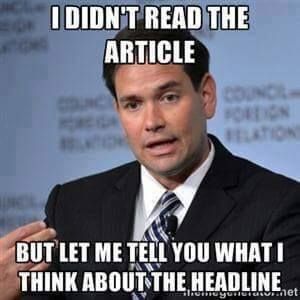
The photo shows a politician, Marc Rubio, with the caption “I didn’t read the article but let me tell you what I think about the headline” | The Universal State of Obliviousness
This is a commonly used meme from Pinterest.

Obliviousness pops up in all kinds of circumstances. On Facebook I am the administrator or moderator in half a dozen beer groups. In these groups people discuss and review beers.

One of the want-to-be influencers are posting in lots of groups without ever engaging with or reading other posts, with the result that he has completely missed that one of the beer groups is very international and was started by Italians. He unsuccessfully keeps trying to engage other members several times a day by posting questions such as “Don’t you love this unusually warm evening?”, “What beer are you drinking while watching the game tonight?”.

Basically, he thinks this international beer group is his hometown, not Belgium, China, Brazil, Germany, Italy or Australia. As a result, no one knows what he is talking about. After one year with hardly any likes or comments he still has not figured this out because he never looks at anyone else’s posts.

Standing on the table on our patio are two blue half-liter Paulaner Octobefest Bier plus a big one liter glass, some plastic pumpkins, and a gnome with a sign saying “Welcome to my beer garden”
Paulaner Octoberfest and my beer gnome, one of the photos I posted in various beer groups.

Oblivious Bilinguals

Another common example of extreme obliviousness happens when monolingual people judge bilingual people on their language abilities. I’ve written about that here.

People may speak and understand a second language perfectly and still have a strong accent in that language assuming they did not learn the second language in childhood. Unless you take speech therapy an accent is very difficult to lose in adulthood, something bilingual people know but many monolingual people do not know. You certainly cannot know everything, but when someone negatively judges people for having an accent their level of obliviousness is more extreme.

On the left, a business guy speaking a whole bunch of languages indicated by flags coming out of his mouth. On the right another businessman surrounded by question marks.
Past childhood it is much harder to accurately perceive and produce new sounds from another language Stock Photo ID: 1818291203 by pathdoc

Oblivious To Facts

Perhaps the most comical example of an extreme level of obliviousness is when people who know very little about a subject lecture the experts in the field and even mock the experts.

I recently read about such an example. A man was writing to a theoretical physicist, an expert on the second law of thermodynamics, telling him that the second law of thermodynamics contradicted evolution and that the physicist was an idiot for not knowing this. The man had fallen in the trap of believing a common but basic misunderstanding of the second law of thermodynamics.

Not understanding the second law of thermodynamics is one thing, assuming that your brief encounter with it makes you a superior expert on the topic compared to an expert with a PhD in physics is a much higher degree of obliviousness. I should say I see this type of situation quite often on social media.

Ludwig Boltzman’s formula from 1874
Second law of thermodynamics Shutter Stock Vector ID: 2342031619 by Sasha701

We can’t know or understand everything, and we are all more or less unaware of other cultures, places, the feelings and thoughts of others, we all get distracted sometimes, and we know a very tiny infinitesimal portion of existing knowledge, we are all oblivious. However, we can make it much worse by not trying.

What are your favorite examples of obliviousness ?


To see the Super Facts click here