Brief Answers to the Big Questions – Review

The goal of this blog is to create a list of what I call super facts. Super facts are important and true facts that nevertheless are surprising to a lot of people, mind-blowing, or misunderstood or disputed among non-experts. They are special facts that we all can learn something important from. However, I also create posts that are not super facts but feature other interesting information, such as this book review and book recommendation. The book is:

Brief Answers to the Big Questions by Stephen Hawking

Below I am listing the four editions of this book. I bought and read the hardback version.

  • Hardback –  Publisher : Bantam (October 16, 2018), ISBN-10 : 1984819194, ISBN-13 : 978-1984819192, 256 pages, item weight : 12.8 ounces, dimensions : 5.55 x 0.8 x 8.1 inches. It costs $11.58 on US Amazon. Click here to order it from Amazon.com.
  • Paperback –  Publisher : Random House Large Print (November 13, 2018), ISBN-10 : 1984887262, ISBN-13 : 978-1984887269, 352 pages, item weight : 10 ounces, dimensions : 5.3 x 0.82 x 7.8 inches. It costs $27.00 on US Amazon. Click here to order it from Amazon.com.
  • Kindle –  Publisher : Bantam (October 16, 2018), ASIN : B07D6BBGKL, ISBN-13 : 978-1984819208, 227 pages, it costs $5.99 on US Amazon. Click here to order it from Amazon.com.
  • Audiobook – Publisher : Random House Audio (October 16, 2018), ASIN : B07FW4NT2X, Listening length : 4 hours and 51 minutes. $0.99 with membership. Click here to order it from Amazon.com.
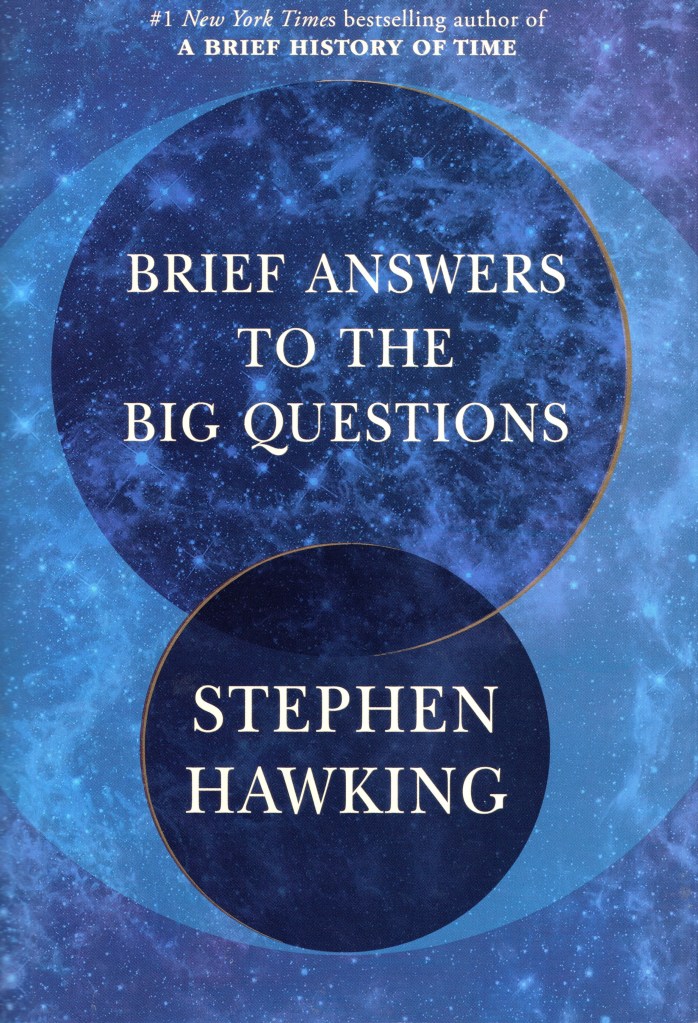
The front cover features the title and the name of author Stephen Hawking author of A Brief History of Time. This is on a blue background featuring two blue circles.
The front cover of Brief Answers to the Big Questions by Stephen Hawking. Click on the image to go to the Amazon page for the hardback version of the book.

Amazon’s Description of the Book

“Hawking’s parting gift to humanity . . . a book every thinking person worried about humanity’s future should read.”—NPR

NAMED ONE OF THE BEST BOOKS OF THE YEAR BY Forbes • The Guardian • Wired

Stephen Hawking was the most renowned scientist since Einstein, known both for his groundbreaking work in physics and cosmology and for his mischievous sense of humor. He educated millions of readers about the origins of the universe and the nature of black holes, and inspired millions more by defying a terrifying early prognosis of ALS, which originally gave him only two years to live. In later life he could communicate only by using a few facial muscles, but he continued to advance his field and serve as a revered voice on social and humanitarian issues.

Hawking not only unraveled some of the universe’s greatest mysteries but also believed science plays a critical role in fixing problems here on Earth. Now, as we face immense challenges on our planet—including climate change, the threat of nuclear war, and the development of artificial intelligence—he turns his attention to the most urgent issues facing us.

Will humanity survive? Should we colonize space? Does God exist? ​​These are just a few of the questions Hawking addresses in this wide-ranging, passionately argued final book from one of the greatest minds in history.

Featuring a foreword by Eddie Redmayne, who won an Oscar playing Stephen Hawking, an introduction by Nobel Laureate Kip Thorne, and an afterword from Hawking’s daughter, Lucy, Brief Answers to the Big Questions is a brilliant last message to the world.

This is my five star review for the book Brief Answers to the Big Questions

Smart but Brief Answers to Some Big Questions

People want answers to the big questions. Is there a God? How did it all begin? Is time travel possible? Is there other intelligent life in the Universe? Will artificial intelligence outsmart us? Will we survive on Earth? Should we colonize space? That’s some of the questions that Stephen Hawking address in this book. Stephen Hawking is answering these questions as simply and as briefly as possible at the same time as he uses advanced scientific knowledge and his deep insights and intelligence to do it. However, to read this book you need to be curious and open to using scientific knowledge and logic. The book is for those who intentionally seek the truth and not confirmation of their existing beliefs. That does not mean that Stephen Hawking will arrive at conclusive answers “Yes” or “No” answers.

Take for example the question “Is there a God?” His answer is not “Yes” or “No”. His answer is to explain why the Universe does not need a creator and assuming that the cosmological viewpoint that time and space came into existence with the Big Bang, why the Universe cannot even have a creator. He is using modern physics and logic to deduct those answers, but they are not identical to a simple “No”. As to whether we will survive on Earth, he states that global warming, which is caused by us burning fossil fuels, is potentially a civilization destroying threat, which we may not survive during the next 1,000 years. He says the same thing about nuclear weapons, which do not seem to go away and instead more countries want to adapt. At some point during the next 1,000 years something could go very wrong, whether it is a total nuclear war or runaway global warming. He is also concerned that malevolent Artificial Intelligence could one day outsmart us. He talks about the doomsday clock. These are all well informed opinions but not definite answers.

Along the way we learn about a lot of concepts from science, especially physics. We learn about quantum physics, special and general relativity, black holes, gravitational collapse, the big bang, inflation (the cosmological kind), multiverses, the strong and weak anthropic principle, the information paradox, hawking radiation, antiparticles, virtual particles, supertranslations, cosmic strings, the Higgs Boson, the Large Hadron Collider, vacuum fluctuations, the Casimir effect, the chronology protection conjecture, nuclear fusion, nanocrafts, the technological singularity, etc. He does not explore these concepts in depth but explains them well enough to be useful for answering the big questions for laymen. He is obviously an admirer of Albert Einstein, and I think for good reason I should add.

This book is written for laymen, people who are not physicists, and not experts on these matters. It is well written and relatively easy to understand. Not everyone will like all of the answers but as a reader make sure you understand the arguments and facts before you reject an answer because you don’t like it. Stephen Hawkings was an amazing scientist and he is certainly missed. I highly recommend this book to everyone.
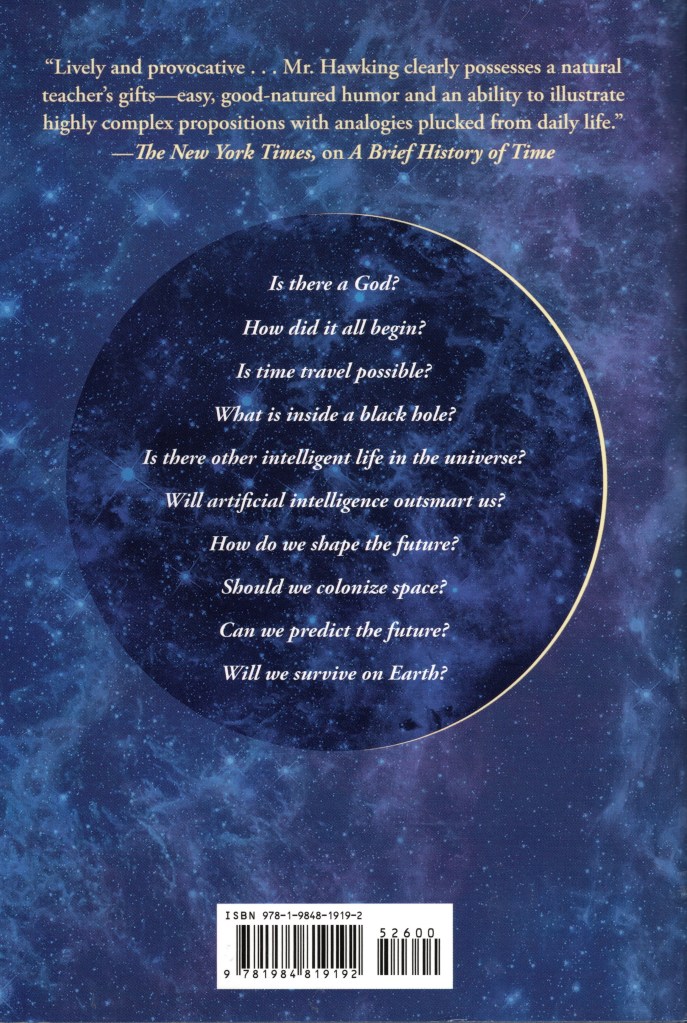
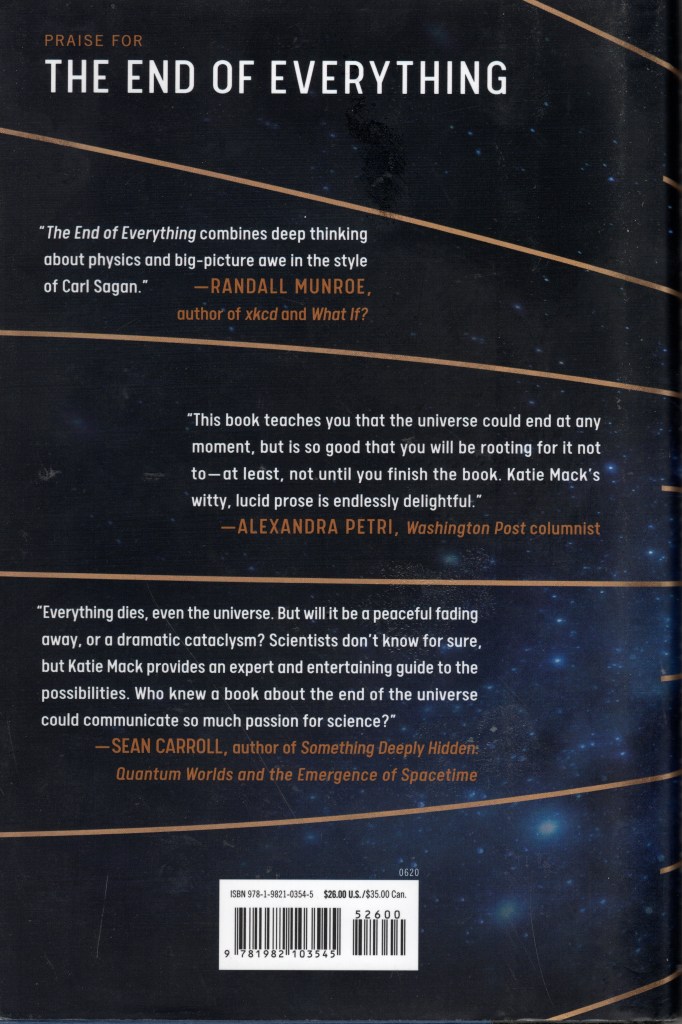
The back cover features advance praise for the book by the New York Times, as well as a list of the Big Questions that he is answering. The text is white on a dark blue background.
The back cover of Brief Answers to the Big Questions by Stephen Hawking. Click on the image to go to the Amazon page for the paperback version of the book.


To see the Super Facts click here

The Universe has a Redshift and its Increasing

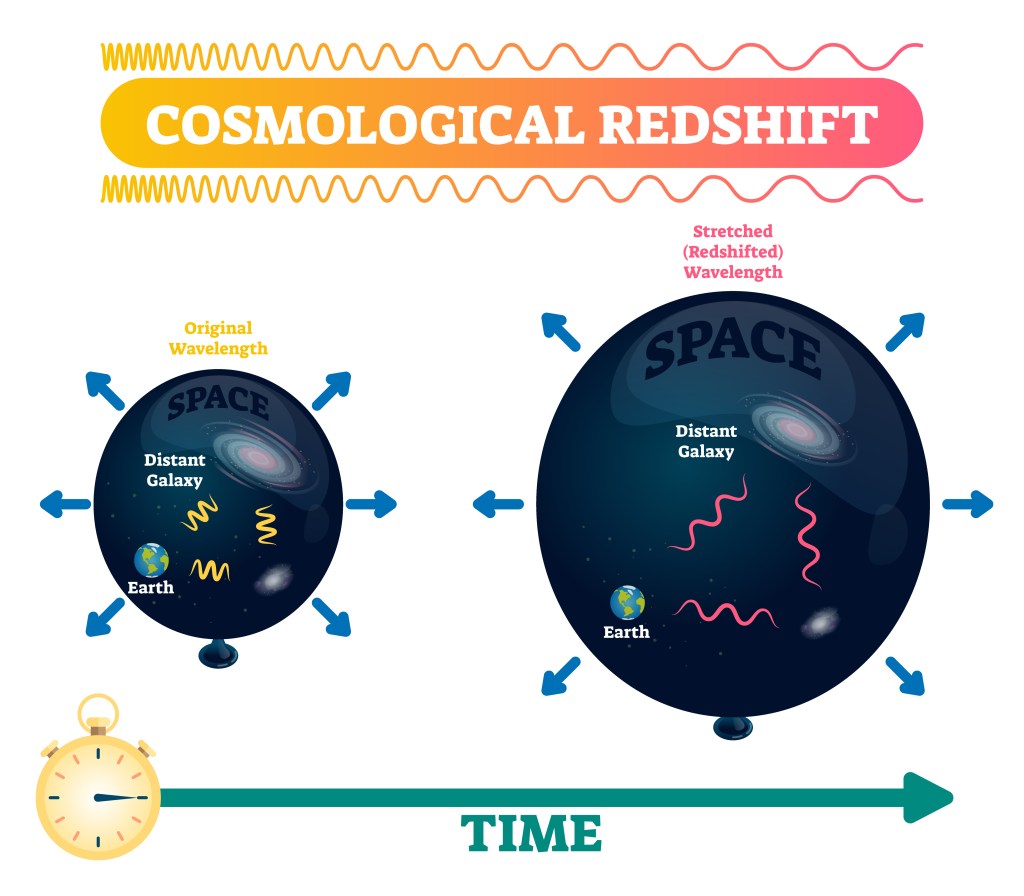
Super fact 79 : Distant galaxies appear redder (redshifted) because of the universe’s expansion. The farther away the galaxy, the redder it is. This cosmological redshift is also increasing because the Universe’s expansion is accelerating. Our Universe is getting more and more red every day.

Esther’s writing prompt: January 14 : Red

Click here or here  to join in.

Many people are aware that the Universe is expanding but may not know that this results in a measurable redshift. The faster a galaxy is moving away from us the redder it appears. This is called the cosmological redshift. Measuring these redshifts was how we discovered that our Universe is expanding.

Cosmological redshift vector illustration. Stretched and original space wavelength with earth and distant galaxy. Doppler effect astronomical phenomenon distance example. | The Universe has a Redshift and its Increasing
As the Universe expands and galaxies are moving away from each other the light will be stretched. Stretched light with longer wavelengths are more red. The phenomenon is called redshift. Shutterstock Asset id: 1180828402 by VectorMine.

At the end of the 1990’s it was also discovered that the Universe’s expansion was accelerating. This discovery came from measuring the redshifts (and apparent dimness) of distant Type Ia supernovae. I should add that measuring the increase in the cosmological redshift directly is difficult. However, it is expected to be possible when the Extremely Large Telescope (ELT) starts gathering data in 2027. I can add that there are also other types of evidence showing that the Universe’s expansion is accelerating.

Another surprising aspect is, if the Big Bang was like an explosion, gravity would pull back the galaxies making the expansion slow down and perhaps eventually even reverse. However, the opposite is happening. A common explanation is that a repulsive force, a sort of anti-gravity, referred to as dark energy, is responsible for this acceleration.

I call this a super fact because this is an observed phenomenon, it is important knowledge for how we view the world, and it is surprising. Many people have heard bits and pieces of this but do not have the fuller picture.

The Doppler Effect

The cosmological redshift is an example of the so called doppler effect. The doppler effect is the change in the frequency or wavelength of a wave in relation to an observer if the origin of the wave and the observer are moving compared to each other. If an object is moving towards you, let say an ambulance, the frequency of its sound will be higher (wavelength shorter).

After it passes you and moves away from the frequency will be lower (wavelength longer). In other words, the sound changes when the ambulance passes you. The same is true for other kinds of waves, including waves on the water, and light. If a light is travelling towards you at a high speed, it will look bluer. If a light is travelling away from you at a high speed it will look redder. The latter is what is called a redshift, cosmological redshift in our case.

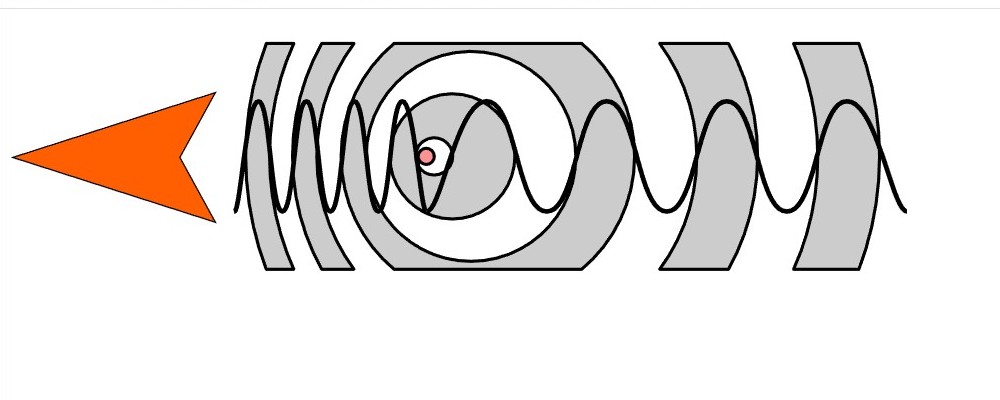
The object is indicated by a red dot, and a red arrow indicates the direction of motion.
Change of wavelength caused by motion of the source. When an object moves toward you the wavelengths get shorter and the frequency higher. When an object moves away from you the wavelengths get longer and the frequency lower. Original: Tkarcher Vector:  Tatoute, CC BY-SA 3.0 <http://creativecommons.org/licenses/by-sa/3.0/&gt;, via Wikimedia Commons
An animation illustrating how the Doppler effect causes a car engine or siren to sound higher in pitch when it is approaching than when it is receding. The red circles represent sound waves.
The Doppler effect causes a car engine or siren to sound higher in pitch when it is approaching than when it is receding. The red circles represent sound waves. Charly Whisky 18:20, 27 January 2007, CC BY-SA 3.0 <http://creativecommons.org/licenses/by-sa/3.0/&gt;, via Wikimedia Commons

Below is a three minute video explaining the doppler effect and redshift.


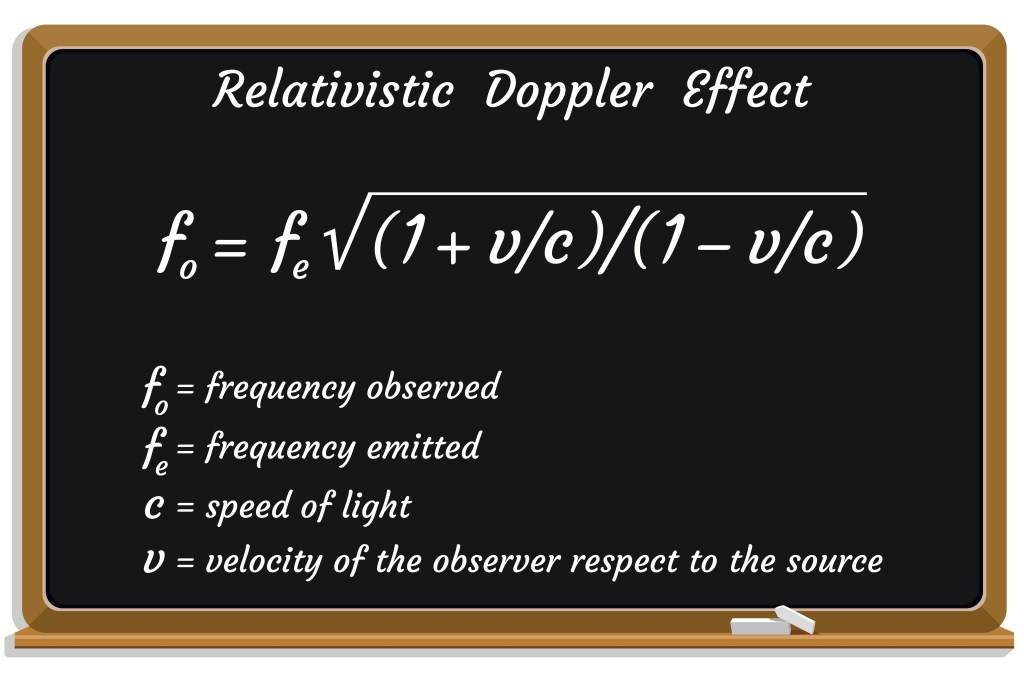
I can add that the constancy of the speed of light in vacuum changes the exact size of the doppler effect. The doppler effect remains as is for the most part but the formulas for the classical doppler effect, which you would use for sound, and the relativistic doppler effect, which you would use for light in space, are different. It is just to pick the right formula.

Doppler Effect Formula on a green chalkboard. Education. Science. Formula. Vector illustration. | The Universe has a Redshift and its Increasing
The classical formula for the doppler effect. There is a medium (air) but you don’t need to consider the constancy of the speed of light in vacuum. You use it for sound and water waves. Shutterstock Asset id: 2365938267 by Sasha701.
Relativistic Doppler Effect Formula on a black chalkboard. Education. Science. Formula. Vector illustration.
The relativistic formula for the doppler effect considers the constancy of the speed of light in vacuum but there is no medium to worry about. You use this formula for the doppler effect of light in space. Shutterstock Asset id: 2416786951 by Sasha701.

Measuring redshift

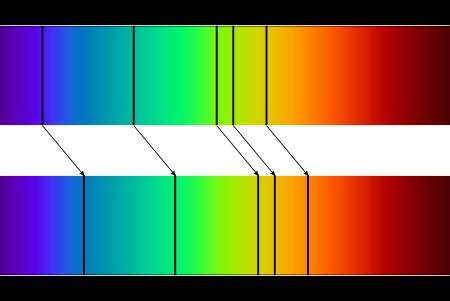
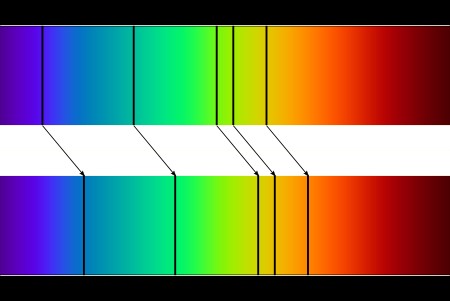
A common misconception is that astronomers take pictures of distant galaxies and somehow measure the “redness” of them, but that is not the case. When you take a spectrum of a heated element (such as hydrogen or helium in stars) it creates characteristic dark lines in the spectrum — like a fingerprint. Everything on the periodic table has its own characteristic fingerprint of lines at characteristic frequencies. In addition to measuring the cosmological redshift it makes it possible to identify the elements in a star and their proportions. See the picture below.

The top shows a colorful spectrum from blue to red with absorption lines in black. The bottom portion of the picture shows the same thing expect the black absorption lines have moved a bit to the right.
Visualization of redshifted absorption lines are redshifted due to velocity away from observer. Top lines are for an object at rest and in the bottom picture the object is moving away. Maxmath12, CC0, via Wikimedia Commons. This file is made available under the Creative Commons CC0 1.0 Universal Public Domain Dedication.

Expanding Universe Hazy IPA

Expanding Universe is a Hazy IPA, or a so called New England style IPA from First State Brewing, ABV 6.5%, IBU 25 (IBU = International Bitter Units). The fact that it is an IPA (India Pale Ale) means that it is Ale and therefore not a Lager. The fact that it is an IPA means that it is hop-forward and has an intense flavor and aroma. The fact that it is a Hazy / New England style IPA means that it is more fruity than bitter and looks cloudy, hazy, like juice. The flavor of Expanding Universe is mango, pineapple, and grapefruit. It has a low bitterness, it is fruity, juicy, and it is great if you like New England IPAs.

The picture shows a glass with yellow to light orange hazy liquid. There are green plants in the background.
Expanding Universe ABV 6.5%, IBU 25.

Related Posts


To see the Super Facts click here

There is strong evidence for the Big Bang

Super fact 37: There is strong evidence for the Big Bang, and we know a lot about how the Universe evolved through time since the Big Bang.

Considering the evidence that has accumulated throughout the years for the Big Bang it is hard to deny it happened. In my experience very few people are aware of this evidence, and they are surprised to find out how much evidence there is and how many details we know about the evolution of the universe. It is easy to believe that scientists are guessing when you don’t know much about the evidence yourself. But they are not guessing. That is why I call this a super fact.

In addition, there’s a lot of misconceptions around the Big Bang as well surprising facts. A few additional things that might surprise people are that the Big Bang was not like an explosion, the Universe did not expand into something. In addition, there might be multiverses and multiple Big Bangs, and there are cyclic models, and so-called eternal inflation. There are things we know and things we don’t know.

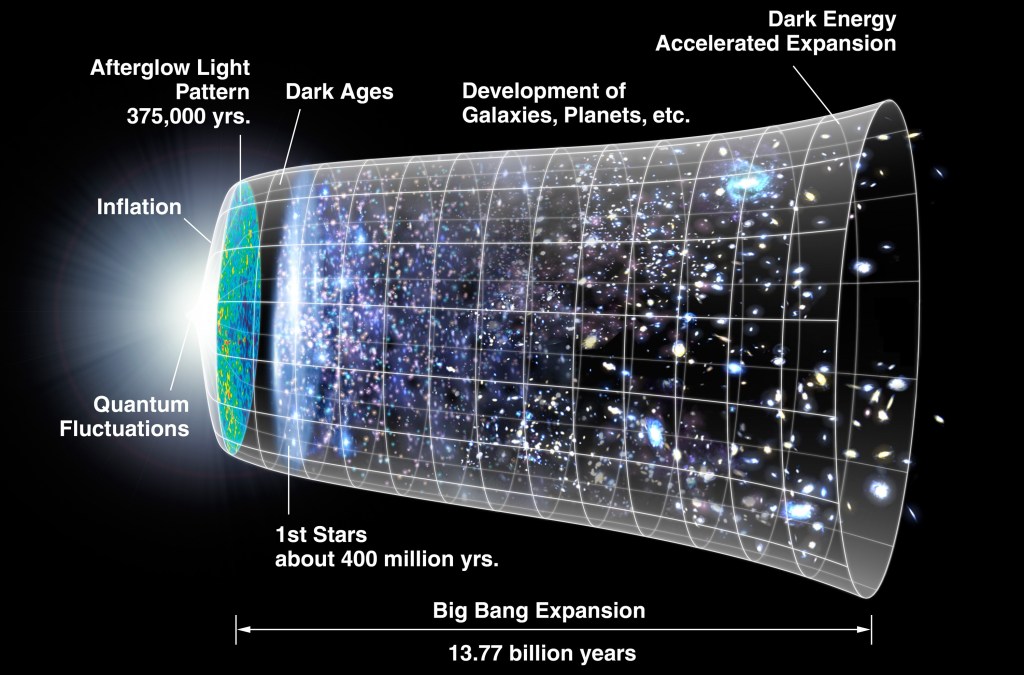
The pictures show an expanding Universe starting with quantum fluctuations followed by inflation, then an afterglow light pattern 375,000 after the Big Bang and then the so-called dark ages, the creation of stars and galaxies | There is strong evidence for the Big Bang
This file is in the public domain in the United States because it was solely created by NASA. (from Wikimedia commons

The Expansion of the Universe

It used to be believed that the Universe was static. In 1929 the astronomer Edwin Hubble discovered that the universe was expanding. He made this observation by analyzing the light from distant galaxies and noticing that their light was redshifted. I am going to explain what that means next.

Light emitted from elements, atoms and molecules have light absorption patterns that are unique to the atom/element in question. This is called a light spectrum. This makes it possible to identify the elements in a star and their proportions. Red shifted means that the absorption lines have moved towards red because the frequency of the light has been shifted due to the motion. This is called the doppler effect.

You can notice this phenomenon for the case of sound when an ambulance is coming towards you and then speeding by you. The sound changes. Hubble was using the redshift to the determine that further away the galaxy was the faster it was moving away from us.

The top shows a colorful spectrum from blue to red with absorption lines in black. The bottom portion of the picture shows the same thing expect the black absorption lines have moved a bit to the right.
Visualization of redshifted absorption lines are redshifted due to velocity away from observer. Top lines are for an object at rest and in the bottom picture the object is moving away. Maxmath12, CC0, via Wikimedia Commons. This file is made available under the Creative Commons CC0 1.0 Universal Public Domain Dedication.

A natural explanation for this is that the universe is expanding, and that it once must have been much more compressed, but it is not the only explanation. However, there is more evidence.

The Cosmic Microwave Background Radiation

If you assume that the universe once was much more compact and much hotter than today, particles such as protons, neutrons and electrons would have been free and close together preventing light from freely moving around. However, as the universe kept expanding and cooling these particles eventually should have been able to form atoms allowing light or electromagnetic radiation to freely move around.

Some physicists, Alpher, Herman and Gamow predicted around 1950 that this should have left behind a detectable microwave background radiation. This radiation was detected by chance in 1964 by two physicists, Penzias and Wilson. This radiation had the expected properties and careful study of this Cosmic Microwave Background Radiation (CMBR or CMB) has given us a lot of information about our universe and may give us information about other universes (multiverses).

Its existence is strong evidence that the universe once was very compressed and much hotter, i.e., the Big Bang. An interesting fact is that in old TVs, between the channels (old people will remember this), you had this fuzz, or war of the ants as some people called it, and part of that TV fuzz is the CMBR.

A big sky map with varying colors, yellow, red, green and blue | There is strong evidence for the Big Bang
This is a sky map of the cosmic background radiation from when the universe was around 380,000 years old. It was created with the help of satellite (NASA) measurements. The colors are artificial and show tiny temperature variations. NASA / WMAP Science Team, Public domain, via Wikimedia Commons.

You can watch a 4-minute video about the discovery of the CMBR narrated by Neil DeGrass Tyson on this PBS web page by clicking here.

Abundances of Light Elements

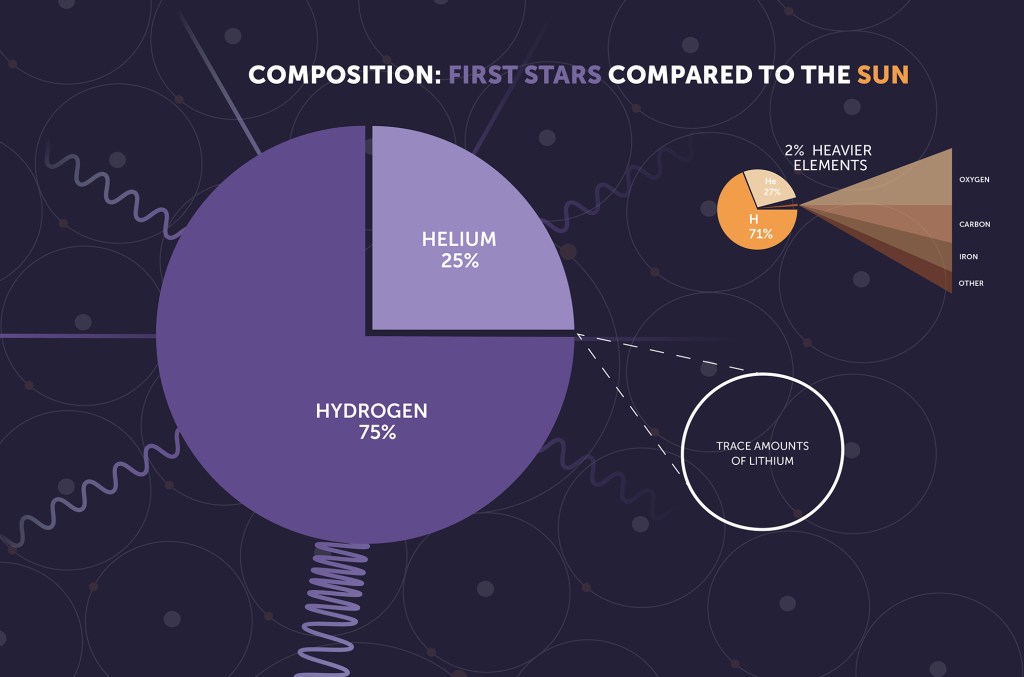
Yet another piece of evidence is the relative abundance of hydrogen and helium compared to heavier elements. The physics at the beginning of the Universe under the Big Bang tells us that initially regular matter should have consisted of 75% hydrogen and 25% helium and hardly anything else, and that is composition the oldest stars had when they were new. In addition, the oldest stars we’ve found appear to have an age just under the 13.8 billion years that we get for our Universe assuming the Big Bang theory (that’s another piece of evidence).

The picture consists of two pie chart graphs representing stars. The left one is a first-generation star with one pie for the 75% hydrogen and one pie for the 25% helium.
The first-generation stars consisted of 75% hydrogen and 25% helium and trace amounts of Lithium. A second or third generation star like our sun is still mostly hydrogen and helium but also many other elements. The rocky planets circling the sun are mainly elements heavier than hydrogen and helium. Image credit NASA, ESA, CSA, STScI

A Very Brief History of Time

So, it all started with a quantum fluctuation. The first 0.000000000000000000000000000000001 seconds is called the inflationary period characterized by super-fast expansion, much faster than the speed of light, as we know it today. At this time the strong nuclear force becomes distinct from the weak nuclear force.

I should point out that during the first 0.0000000000001 seconds the physics laws may not have applied in a normal sense. I should also point out that this was not an explosion. An explosion explodes into something but there was nothing else outside of the universe, so this is more like superfast growth.

At a fraction of a second protons and neutrons form from quarks and after one second neutrinos came into existence and if primordial black holes exist, they were formed at this time too. After two minutes nucleus consisting of neutrons and protons are formed, and the first elements hydrogen and helium formed. After 20 minutes an opaque hot plasma forms, after 100,000 years neutral helium atoms form, and after 375,000 years CMBR is created, etc.

This is just a small sample of everything that we know happened after the Big Bang, based on the known laws of physics. You can read about all the details in books like The First Three Minutes by Steven Weinberg or A Brief History of Time by Stephen Hawking.

vector illustration of up and down quarks in proton and neutron on white background. The proton (left) is a red and blue up quark and a green down quark. The neutron is a red and green down quark and a blue up quark | There is strong evidence for the Big Bang
The proton and neutron each consist of three quarks. They are formed at a fraction of a second after the Big Bang. Asset id: 2333679305 by KRPD.

Pre–Big Bang Cosmology

So, what was there before the Big Bang, if anything? Well, that part is speculation, but there are many good ideas. A popular hypothesis speaks of quantum fluctuations setting off the Big Bang. There are models in which the whole of spacetime is finite, including the Hartle–Hawking no-boundary condition. This means that time itself came into existence with the Big Bang and therefore nothing could have preceded it. This means that the Big Bang could not have been caused or created by anything else, just like a universe that has existed eternally could not have been caused or created by anything else.

In a sense, despite being 13.8 billion years old, the universe in this scenario would have always existed. Because the concept of “always” stops at 13.8 billion years ago. Stephen Hawking used the analogy of the north pole. You can’t go further north from the north pole.

There are other models that include multiverses, for example, eternal inflation, in which universal inflation ends locally here and there in a random fashion, each endpoint leading to a bubble universe, expanding from its own big bang. You can view this model as inflation being the river of time with the various universes popping up like bubbles in the stream.

In another model inflation is due to the movement of branes in string theory and Big Bangs are the result of colliding branes. There are cyclical models, such as Nobel Prize winner Roger Penrose’s Conformal cyclic cosmology in which one universe gives rise to another universe as it dies.

Notice that Pre-Big Bang Cosmology is speculative, but the reality of the Big Bang is backed by strong evidence.

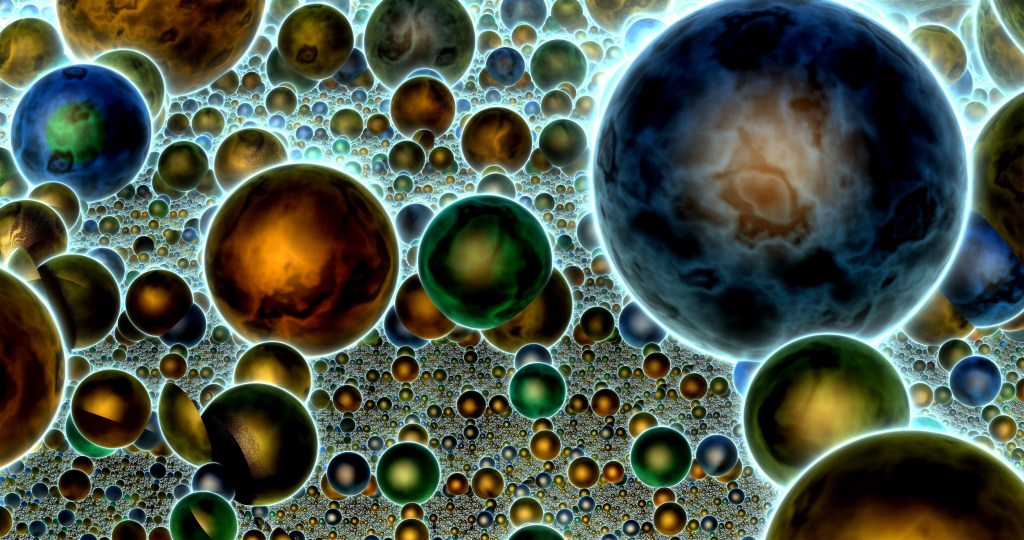
Thousands of universes represented as colorful balls | There is strong evidence for the Big Bang
The surface of a multiverse with a lot of universes 3d rendering Asset id: 2256998119 by Dr. Norbert Lange.

To see the other Super Facts click here

The End of Everything By Katie Mack

What will the end of everything be like? How will everything end? Will it be the Big Crunch as the Universe collapses back to a reverse Big Bang? Will it be the heat death, or what is better called the high-entropy death? Will it be the Big Rip as the Universe is ripped apart, or vacuum decay? Maybe it will be the Quantum Bubble of Death? Wouldn’t the Quantum Bubble of Death be a cool way to die?

The goal of this blog is to create a list of what I call super facts. Important facts that we know to be true and yet they are surprising, shocking or disputed among non-experts. Super facts are important facts that people get wrong. However, I sometimes create posts that are not super facts but other interesting information, such as this book review and book recommendation.

The End of Everything: (Astrophysically Speaking) by Katie Mack is a relatively easy book on cosmology. It features scientifically guided speculation on how the Universe will end. As in the previous book I reviewed the cosmic microwave background radiation (CMBR) is a major source for the information. It is amazing what it can tell you. I bought the hardback version of it. I can add that this book and my Amazon review was written in 2020, a good year for talking about the end of the world.

  • Hardcover –  Publisher : Scribner; Illustrated edition (August 4, 2020), ISBN-10 : 198210354X, ISBN-13 : 978-1982103545, 240 pages, item weight : 2.31 pounds, dimensions : ‎5.5 x 1 x 8.38 inches, it costs $19.14 on US Amazon. Click here to order it from Amazon.com.
  • Paperback –  Publisher : Scribner (May 4, 2021), ISBN-10 : 1982103558, ISBN-13 : 978-1982103552, 256 pages, item weight : 2.31 pounds, dimensions : ‎ ‏ : ‎5.5 x 0.6 x 8.38 inches, it costs $10.99 on Amazon. Click here to order it from Amazon.com.
  • Kindle –  Published : August 04, 2020, ASIN : B07Z41TTNK, 237 pages, it costs $14.89 on US Amazon. Click here to order it from Amazon.com.
  • Audiobook –  Publisher : Scribner (August 4, 2020), ASIN : B07Z8B5NZ8, it costs $13.12 on US Amazon. Click here to order it from Amazon.com.
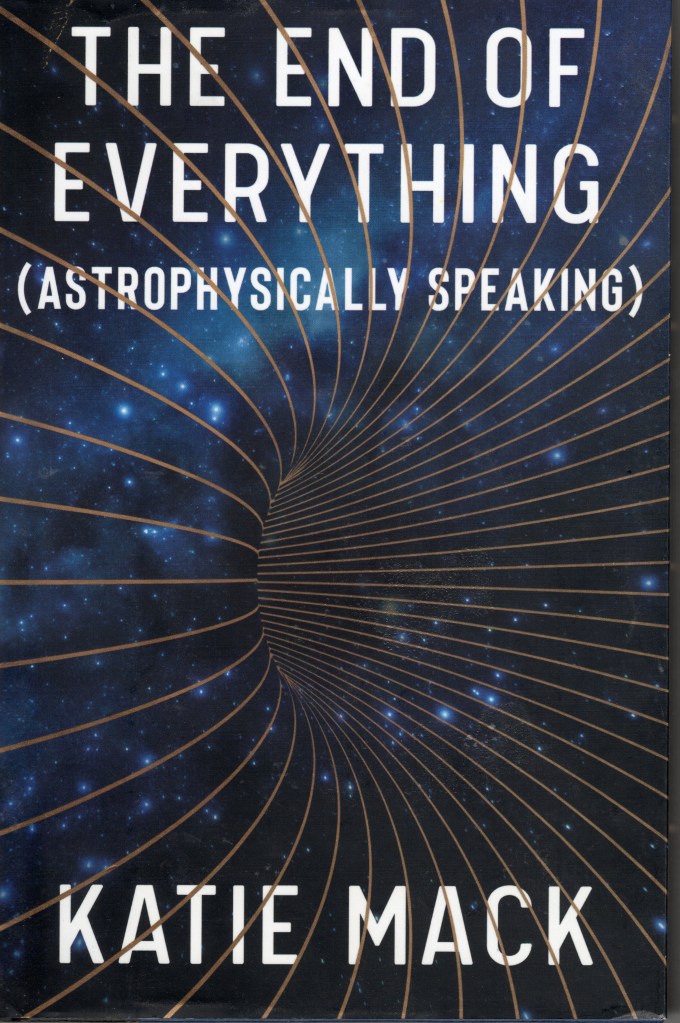
Front cover of The End of Everything By Katie Mack | The End of Everything
Front cover of The End of Everything? Click on the image to go to the Amazon page for the hardcover version of the book.

Amazon’s description of The End of Everything By Katie Mack

A NEW YORK TIMES NOTABLE BOOK OF 2020

NAMED A BEST BOOK OF THE YEAR BY * THE WASHINGTON POST * THE ECONOMIST * NEW SCIENTIST * PUBLISHERS WEEKLY * THE GUARDIAN

From one of the most dynamic rising stars in astrophysics, an “engrossing, elegant” (The New York Times) look at five ways the universe could end, and the mind-blowing lessons each scenario reveals about the most important concepts in cosmology.

We know the universe had a beginning. With the Big Bang, it expanded from a state of unimaginable density to an all-encompassing cosmic fireball to a simmering fluid of matter and energy, laying down the seeds for everything from black holes to one rocky planet orbiting a star near the edge of a spiral galaxy that happened to develop life as we know it. But what happens to the universe at the end of the story? And what does it mean for us now?

Dr. Katie Mack has been contemplating these questions since she was a young student, when her astronomy professor informed her the universe could end at any moment, in an instant. This revelation set her on the path toward theoretical astrophysics.

Now, with lively wit and humor, she takes us on a mind-bending tour through five of the cosmos’s possible finales: the Big Crunch, Heat Death, the Big Rip, Vacuum Decay (the one that could happen at any moment!), and the Bounce. Guiding us through cutting-edge science and major concepts in quantum mechanics, cosmology, string theory, and much more, The End of Everything is a wildly fun, surprisingly upbeat ride to the farthest reaches of all that we know.

This is my five-star review for The End of Everything

The End of the Universe can be a lot of fun

Katie Mack’s timely (it’s 2020 after all) survey of the various ways the Universe might end, based on current physics, was a delightful read. It is an interesting and fun book. We learn about the Big Crunch (the Universe shrinking back), the Heat Death, or rather the high-entropy death, the Big Rip, Vacuum decay, or the “quantum bubble of death” if you want to call it that, and the “bounce”. 

To understand where the various ideas regarding the end of the Universe come from, you need to understand some of the physics and the cosmology. We learn something about CMB, or the Cosmic Microwave Background, Big Bang, cosmic inflation, Planck Time, GUTs, Nucleosynthesis, the standard model, de Sitter Space, black holes, electroweak symmetry breaking, the Higgs Boson and the Higgs field, multiverses, and much more.

Perhaps most importantly, we learn about dark matter and dark energy, which are important concepts that have greatly changed cosmology over the last few years. Chapter 2 on the Big Bang reminded me a lot about an old book by Stephen Weinberg, the first 3 minutes. However, Katie Mack puts a modern spin on it and goes much further beyond our Universe. I was intrigued to hear that it might be possible to communicate between different Universes in a multiverse using gravity, or gravity waves.

The book is written for laymen, and I found it to be between Neil De Grasse Tyson / Carl Sagan and Stephen Hawking in difficulty level. The book covers a lot of concepts and theories but does so concisely, simply and not in a mathematical way. Not so simply though that it is misleading.

I am an Engineer with an undergrad degree in physics so I may not be the best person to judge whether this is an easy read for laymen, but I believe it is. I am very interested in these kinds of topics, and I read all popularized books on cosmology, modern physics, the standard model, that I can find. This was one of the most fun books that I’ve ever read.

The back cover of The End of Everything by Katie Mack
Back cover of The End of Everything? Click on the image to go to the Amazon page for the hardcover version of the book.

Would you like to travel in time into the future to see the end of the Universe?


To see the Super Facts click here


The Giant Bubble of No Space

Cosmology is the science of the origin and development of the universe, and this post is about a book on Cosmology, “What’s Eating the Universe?: And Other Cosmic Questions” by Paul Davies.

What’s eating the Universe is one of the 30 questions answered in this book. It refers to the mysterious gigantic super-voids we’ve found. Could they be the result of collisions with other universes? Could they be the result of expanding giant bubbles with no space at all in them? That’s not just empty bubbles with empty space, but bubbles in which space itself is missing. Try to imagine that. Some of the 30 questions have answers, others just feature several guesses.

The goal of this blog is to create a list of what I call super facts. Important facts that we know to be true and yet they are surprising, shocking or disputed among non-experts. Super facts are special facts that a well-informed person may want to know.

However, I sometimes create posts that are not super facts but just interesting information, such as this one. What’s eating the Universe is a relatively short and easy read. I bought the hardback version of it.

  • Hardcover –  Publisher : University of Chicago Press; First Edition (September 22, 2021), ISBN-10 : 022681629X, ISBN-13 : 978-0226816296, 208 pages, item weight : 12.2 ounces, dimensions : ‎5.67 x 0.71 x 8.58 inches, it costs $19.84 on Amazon. Click here to order it from Amazon.com.
  • Paperback –  Publisher : University of Chicago Press; First Edition (September 30, 2022), ISBN-10 : 0226823873, ISBN-13 : 978-0226823874, 183 pages, item weight : 9.6 ounces, dimensions : ‎ ‏ : 5.5 x 0.46 x 8.5 inches, it costs $15.67 on Amazon. Click here to order it from Amazon.com.
  • eTextBook –  Publisher : University of Chicago Press; First edition (September 22, 2021), ASIN : B096L2WP51, 172 pages, it costs $14.89 on US Amazon. Click here to order it from Amazon.com.
Front cover of What's Eating the Universe | The Giant Bubble of No Space
Front cover of What’s Eating the Universe? Click on the image to go to the Amazon page for the hardcover version of the book.

Amazon’s description of the book

Combining the latest scientific advances with storytelling skills unmatched in the cosmos, an award-winning astrophysicist and popular writer leads us on a tour of some of the greatest mysteries of our universe.

In the constellation of Eridanus, there lurks a cosmic It’s as if something has taken a huge bite out of the universe. But what is the culprit? The hole in the universe is just one of many puzzles keeping cosmologists busy. Supermassive black holes, bubbles of nothingness gobbling up space, monster universes swallowing others—these and many other bizarre ideas are being pursued by scientists.

Due to breathtaking progress in astronomy, the history of our universe is now better understood than the history of our own planet. But these advances have uncovered some startling riddles. In this electrifying new book, renowned cosmologist and author Paul Davies lucidly explains what we know about the cosmos and its enigmas, exploring the tantalizing—and sometimes terrifying—possibilities that lie before us.

As Davies guides us through the audacious research offering mind-bending solutions to these and other mysteries, he leads us up to the greatest outstanding conundrum of Why does the universe even exist in the first place? And how did a system of mindless, purposeless particles manage to bring forth conscious, thinking beings? Filled with wit and wonder, What’s Eating the Universe? is a dazzling tour of cosmic questions, sure to entertain, enchant, and inspire us all.

This is my five-star review for What’s Eating the Universe?: And Other Cosmic Questions.

Cosmology explained the easy way

This book is organized into 30 cosmological questions that the author is answering or clarifying. His explanations are naturally not in depth but high level and easy to understand for anyone with an interest in the topic. He manages to keep the topic fascinating and the book is a real page turner. I read the book in a little bit more than one day.

The book discusses cosmology, relativity, the standard model, black holes, the big bang, the CMB, dark matter, dark energy, multiverses and the fate of our Universe, extraterrestrials, and much more, and he gives us insight into the very latest discoveries and views of cosmology.

I especially enjoyed reading chapter 20 & 21 “Can the Universe Come from Nothing” and “How Many Universes Are There”. He tells us that most cosmologists he knows believe there are infinitely many universes. One model is eternal inflation, a space/time mechanism beyond our universe that keeps causing new universes to bubble up and initially expand rapidly, but there are other models. I was surprised that he didn’t mention Roger Penrose’s model, cycles of time, with one Universe giving rise to another (after full expansion and heat death).

However, if there’s only one Universe and time came into existence with it (singularity) it doesn’t help those who want to insert a creation moment. If time didn’t exist before the big bang, the concept of a prior physical cause is meaningless. Asking what was before the big bang is like asking what lies north of the North Pole.

I also especially enjoyed reading chapter 30 “What’s New on the Cosmic Horizon” in which he lists mysteries and recent exciting discoveries, the cold patch in Eridanus (CMB), the mystery with the Hubble constant, what’s beyond the standard model, the prospect of top-down models, etc. Well, all the chapters were interesting.

This book is a quick and easy summary of what’s going on in cosmology. It’s accessible and engrossing writing and the straightforward organization make the book a great introduction to the topic. I highly recommend this book.

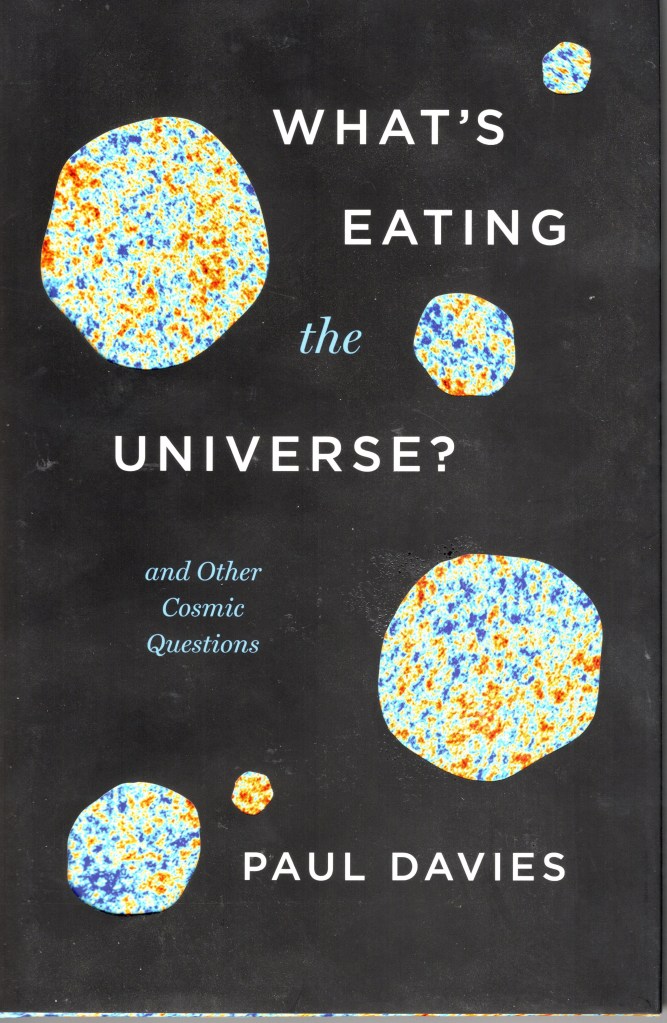
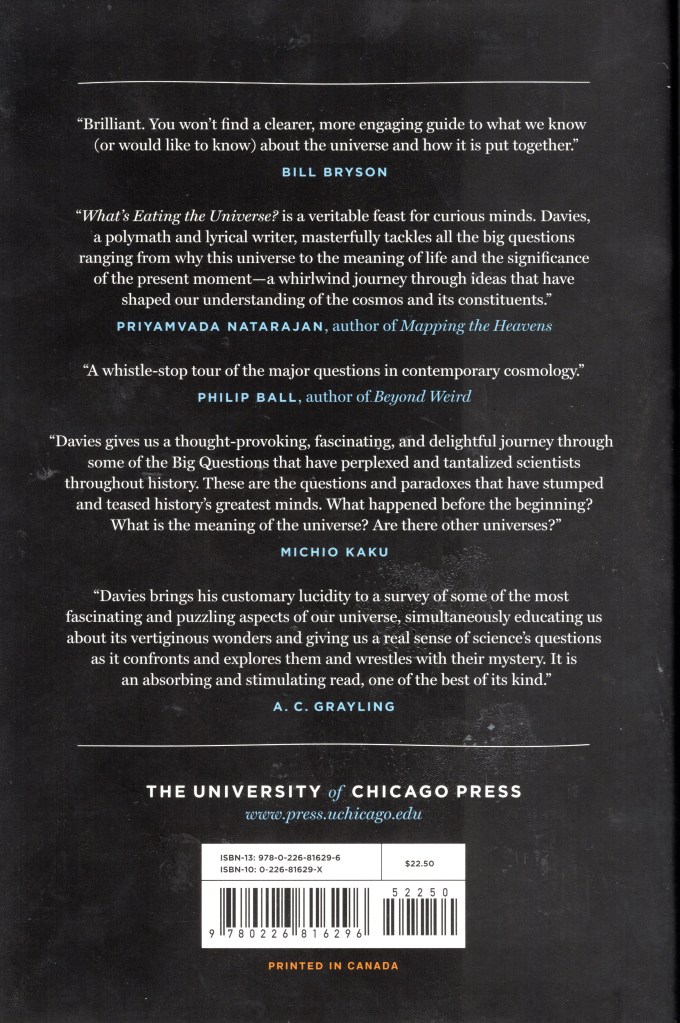
The back cover feature advanced praise for the book | Back cover of “What's Eating the Universe?”
Back cover of “What’s Eating the Universe?” Click on the image to go to the Amazon page for the paperback version of the book.

Finally, a list of the 30 questions

  • Journey from the Edge of Time
  • The search for the key to the Universe
  • Why is it dark at Night?
  • The Big Bang
  • Where is the Center of the Universe?
  • Why the Cosmos is Actually Fairly Simple?
  • What is the Speed of Space?
  • What is the Shape of Space?
  • Explaining the Cosmic Big Fix
  • Most of our Universe is Missing
  • What is Dark Energy
  • Where Does Matter Come From?
  • Gravity Conquers All
  • Warped Time and Black Holes
  • Is Time Travel Possible?
  • What is the Source of Time’s Puzzling Arrow?
  • The Black Hole Paradox
  • A Theory of Everything?
  • Fossils from the Cosmic Dawn
  • Can the Universe Come from Nothing?
  • How Many Universes Are There?
  • The Goldilocks Enigma
  • What’s Eating the Universe?
  • Is the Universe Actually a Botched Job?
  • Are We Alone?
  • Is ET in Our Backyard?
  • Why Am I Living Now?
  • The Fate of Our Universe
  • Is There a Meaning to It All?
  • What’s New on the Cosmic Horizon?

To see the Super Facts click here