Pulsars the Cosmic Lighthouses

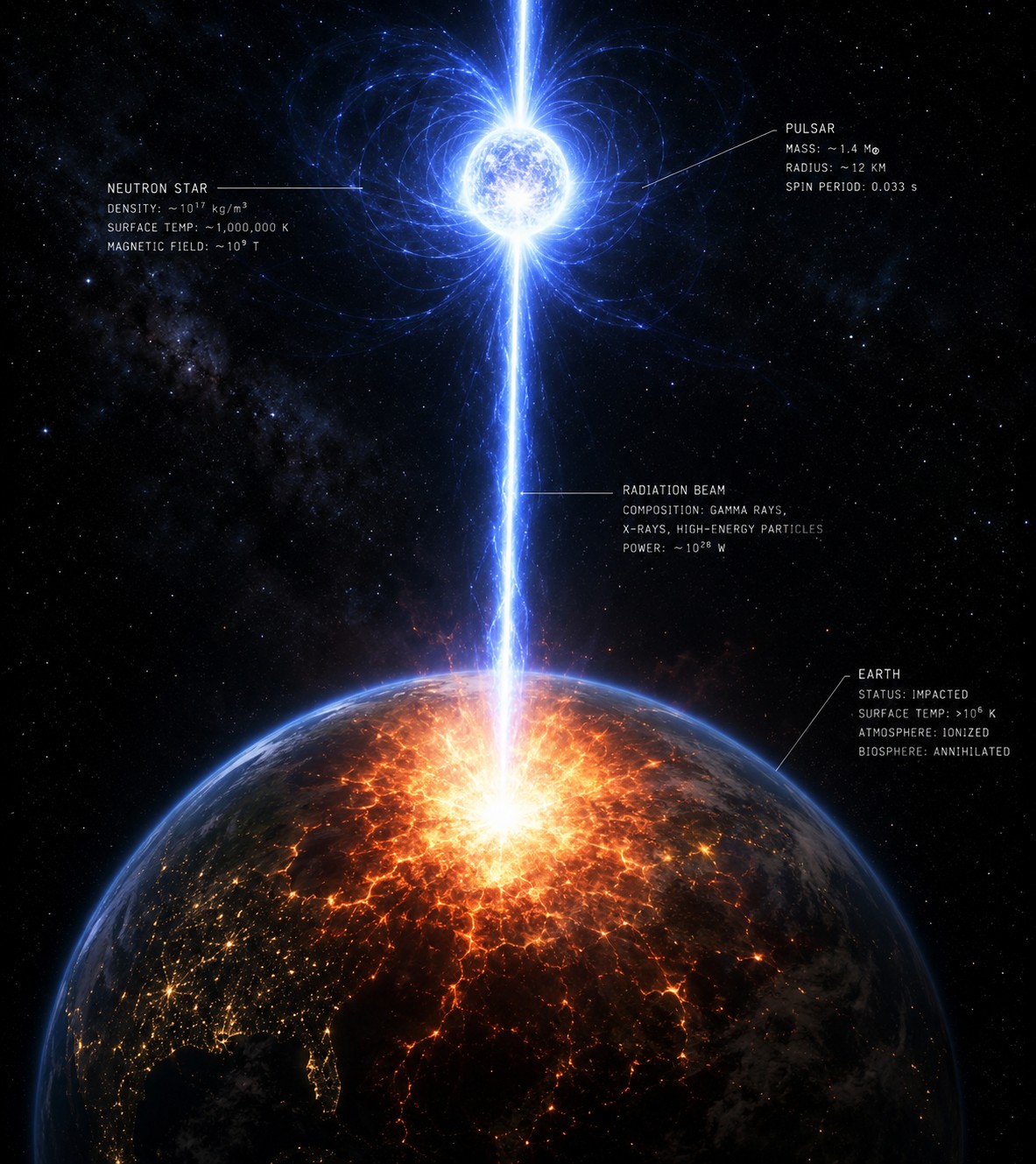
Super fact 108 : A Pulsar is a rapidly rotating neutron star that emits beams of electromagnetic radiation from its magnetic poles. The radioactive beam from a pulsar that is located where the sun is located would heat earth’s surface to tens of thousands of degrees. The pulsar may rotate hundreds of times per second, and we only detect the beam when it crosses our line of sight. A neutron star, or a pulsar, is vastly denser than the Sun, typically hundreds of trillions of times denser.
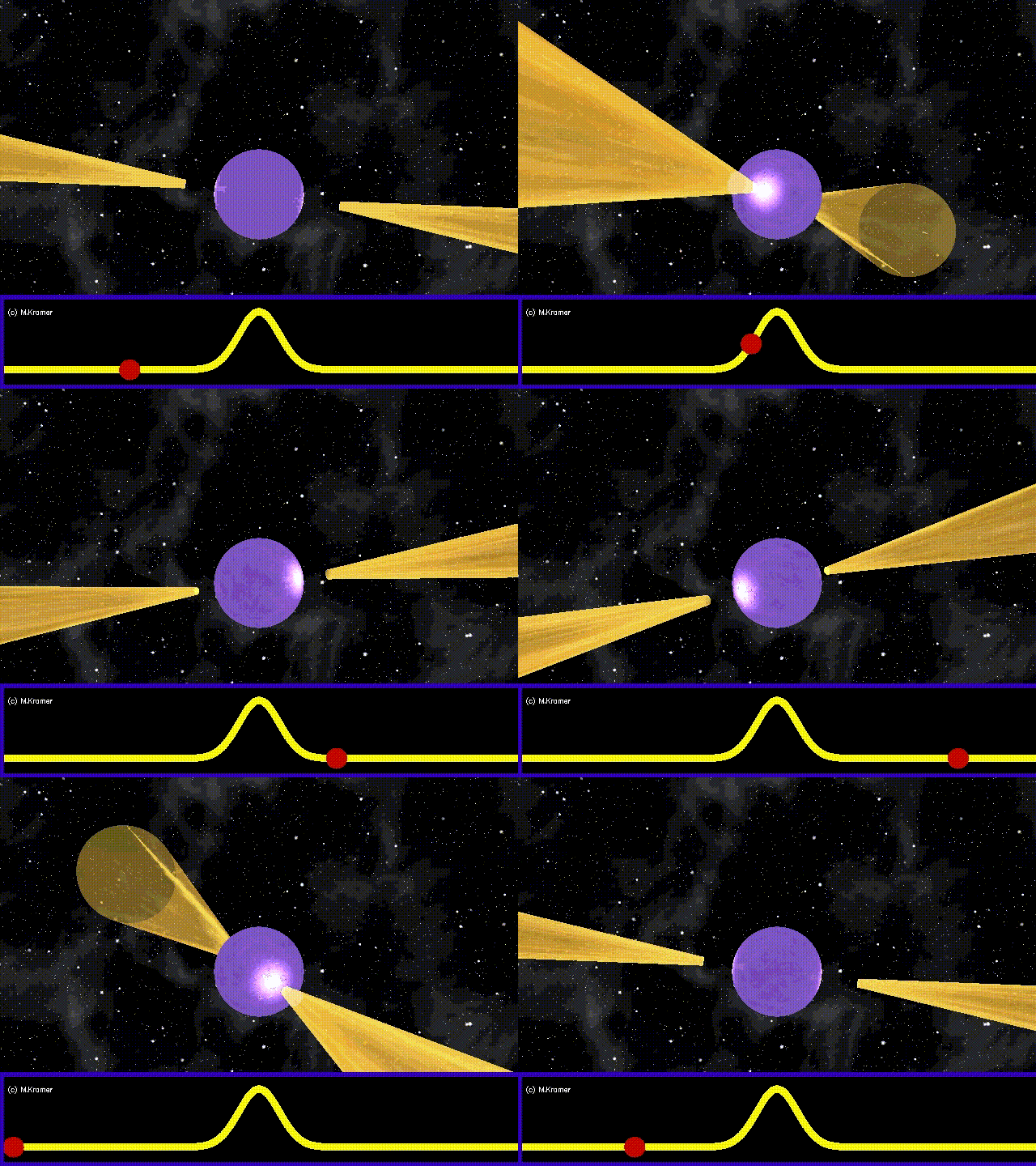
Illustration of the "lighthouse" effect produced by a pulsar| Pulsars the Cosmic Lighthouses
Illustration of the “lighthouse” effect produced by a pulsar. Michael Kramer, CC BY-SA 3.0 http://creativecommons.org/licenses/by-sa/3.0/, via Wikimedia Commons.

As mentioned, a pulsar is a rapidly rotating neutron star that emits beams of radiation from its magnetic poles. A neutron star is an ultra-dense remnant left behind when a massive supergiant star runs out of fuel and collapses. You can read more about neutron stars in my post here and you can read about neutron stars that act like super magnets called magnetars here. This web page feature a calculation of what the intensity of a pulsar beam would be if it hit Earth and the pulsar is located where the sun is.
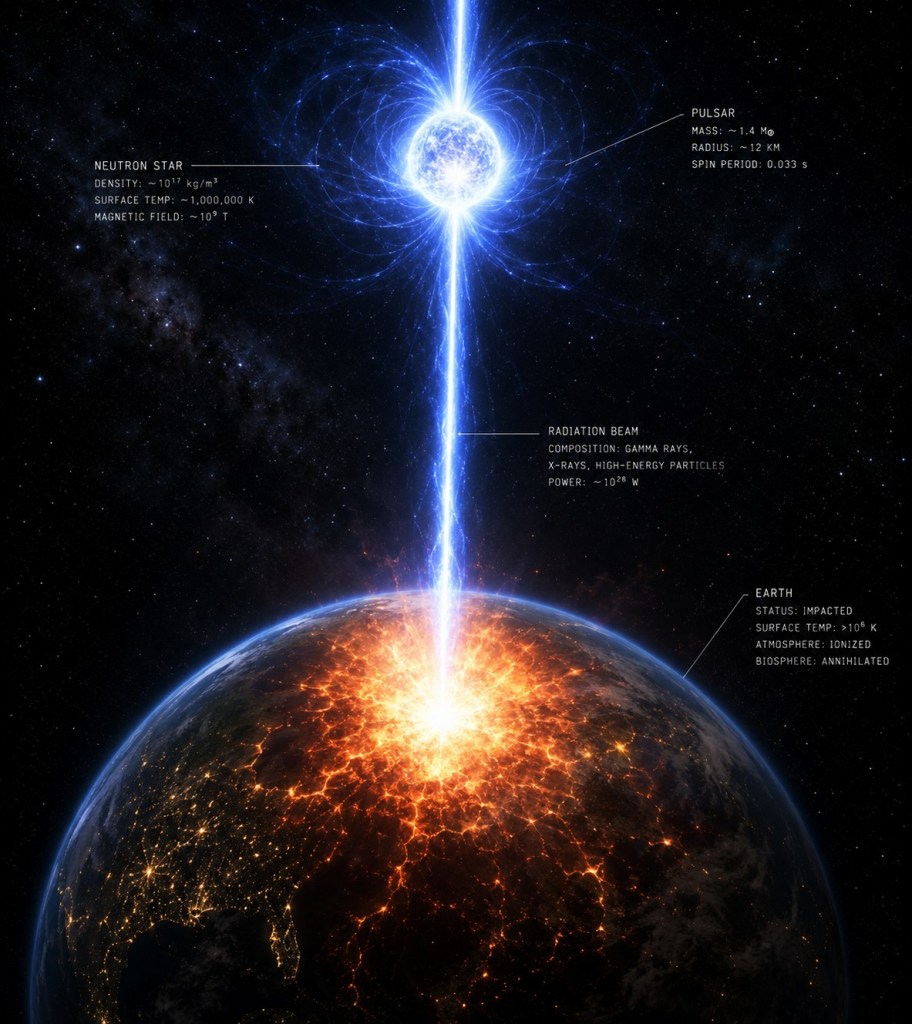
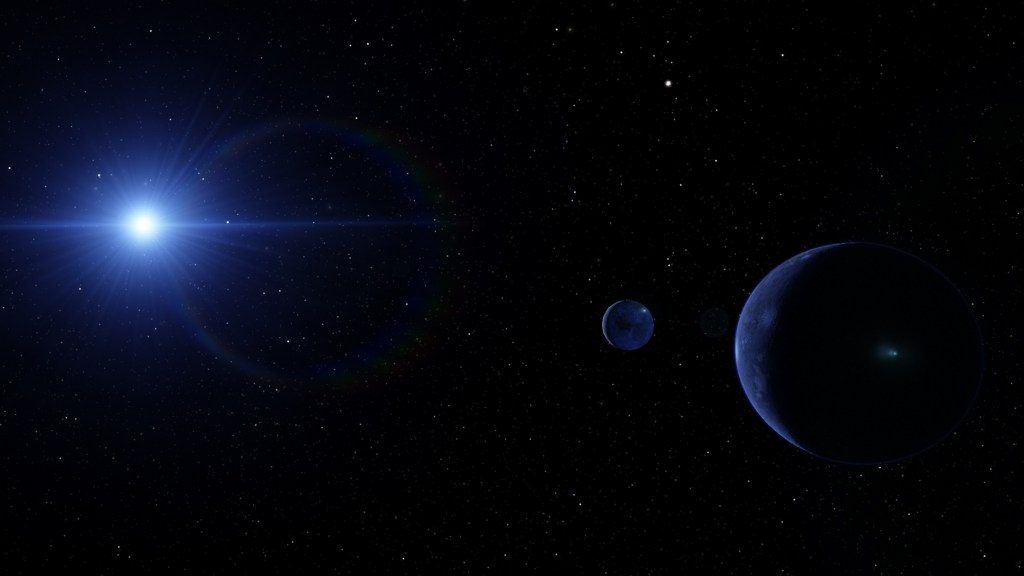
A blue pulsars / neutron star directs a beam toward earth and burns the surface.
The beam from a pulsar hits earth causing destruction. This is an AI picture generated by me and ChatGPT.

I consider this a super fact because pulsars are a very extreme type of star, which existence I believe comes as a surprise to many people.
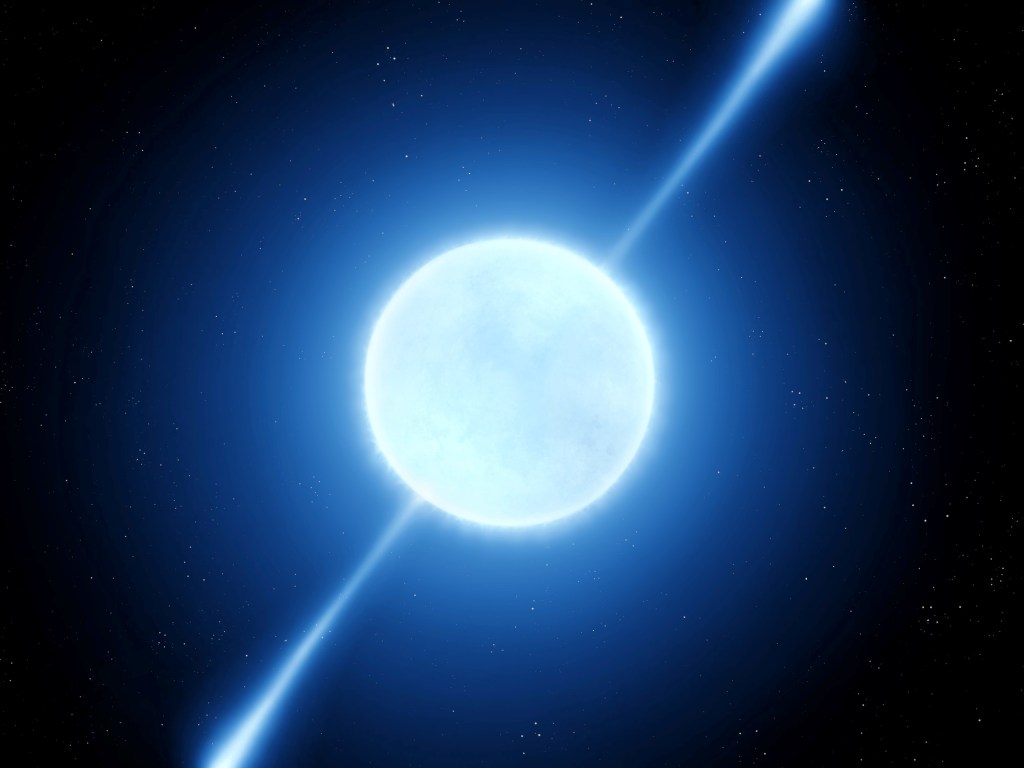
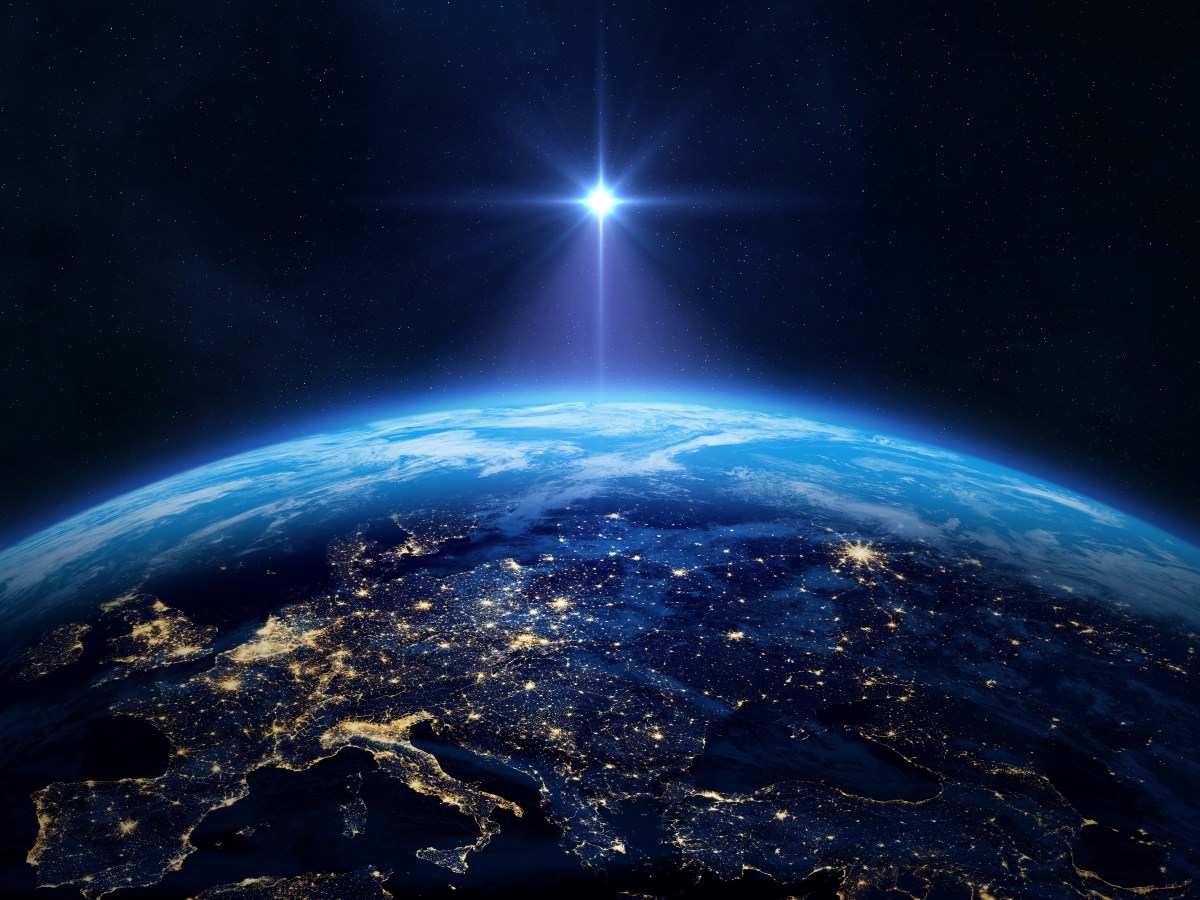
Blue neutron star on black background with two bright blue beams. Compact supermassive object. | Pulsars the Cosmic Lighthouses
Pulsar with energetic jets in space. Shutterstock asset id: 2697475389 by Nazarii_Neshcherenskyi

Below is a one and a half minute NASA video explaining what a pulsar is. It is taken from this website.


Different Types of Neutron Stars and Different types of Pulsars
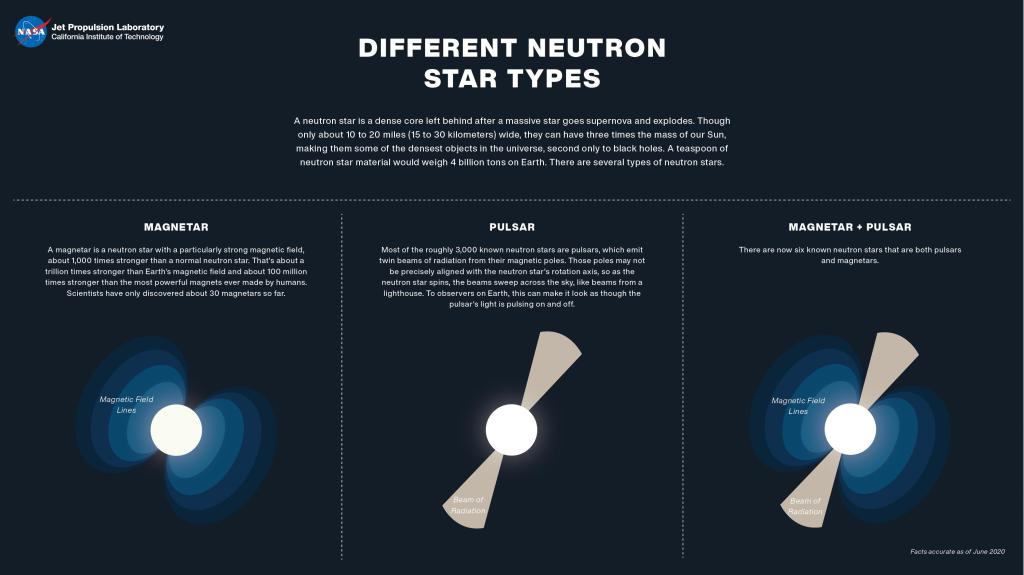
At top there is some text stating “A neutron star is a dense core left behind after a massive star goes supernova and explodes. Though only about 10 to 20 miles (15 to 30 kilometers) wide, they can have three times the mass of our Sun, making them some of the densest objects in the universe, second only to black holes. A teaspoon of neutron star material would weigh 4 billion tons on Earth. There are several types of neutron stars.” :  Below the text at the top there is a picture of a magnetar, a pulsar and a magnetar plus pulsar. The text for each picture says: Magnetar - A magnetar is a neutron star with a particularly strong magnetic field, about 1,000 times stronger than a normal neutron star. That's about a trillion times stronger than a normal neutron star. That's about a trillion times stronger than Earth's magnetic field and about 100 million times stronger than the most powerful magnets ever made by humans. Scientists have only discovered about 30 magnetars so far. Pulsar - Most of the roughly 3,000 known neutron stars are pulsars, which emit twin beams of radiation from their magnetic poles. Those poles may not be precisely aligned with the neutron star's rotation axis, so as the neutron star spins, the beams sweep across the sky, like beams from a lighthouse. To observers on Earth, this can make it look as though the pulsar's light is pulsing on and off. Magnetar + Pulsar – there are about six known neutron stars that are both pulsars and magnetars.
Courtesy NASA/JPL-Caltech, Attribution, via Wikimedia Commons

Neutron stars are extreme stars. They are small super dense stars with extreme gravitational fields. They are in a sense like a gigantic atomic nucleus. Perhaps it is not surprising that they are extreme in other ways as well. There are pulsars, neutron stars which emit twin beams of radiation from their magnetic poles. Those poles may not be precisely aligned with the neutron star’s rotation axis, so as the neutron star spins, the beams sweep across the sky, like beams from a lighthouse. To observers on Earth, this can make it look as though the pulsar’s light is pulsing on and off.

There are different types of pulsars. Some spin extremely fast. They rotate hundreds of times per second, even 700 times per second. They are called Millisecond Pulsars. There are pulsars that emit beams of radio waves and pulsars that emit only gamma rays. A black widow pulsar a star system consisting of a rapidly spinning pulsar and a companion star that is being consumed by the pulsar like a black widow spider eats its mate. This link feature animation videos from NASA showing a star being consumed by a black widow pulsar.

Finally, there are magnetars, neutron stars with extremely powerful magnetic fields trillions and quadrillion times stronger than Earth’s magnetic field at the surface. You can read about them here.

Other extreme Celestial objects


To see the other Super Facts click here

The Sun is White but the Sky steals its Blue

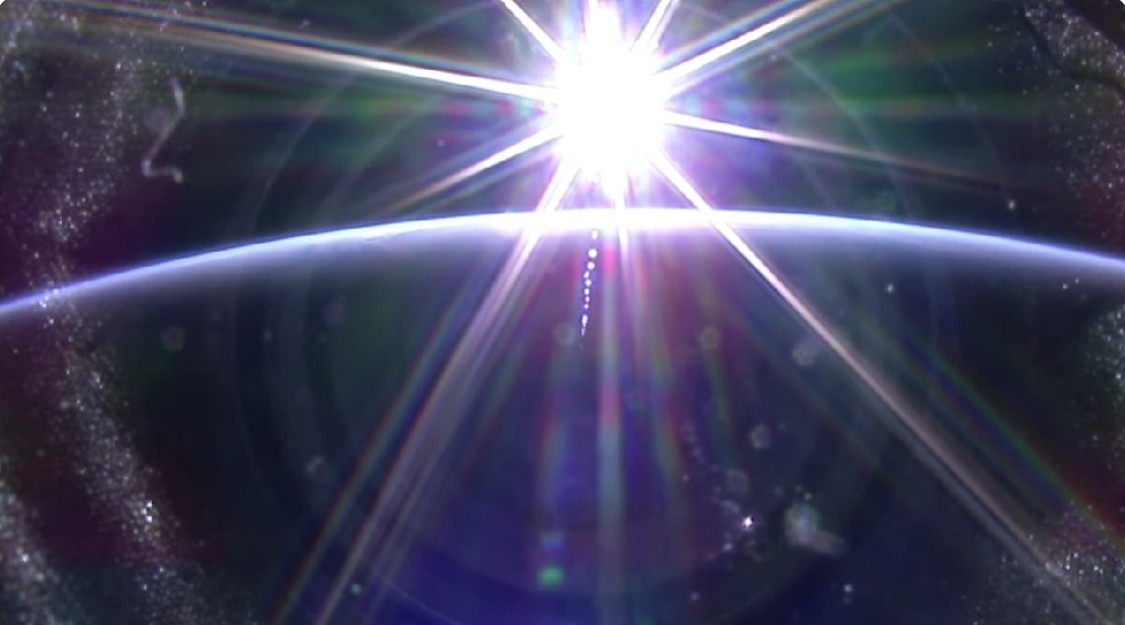
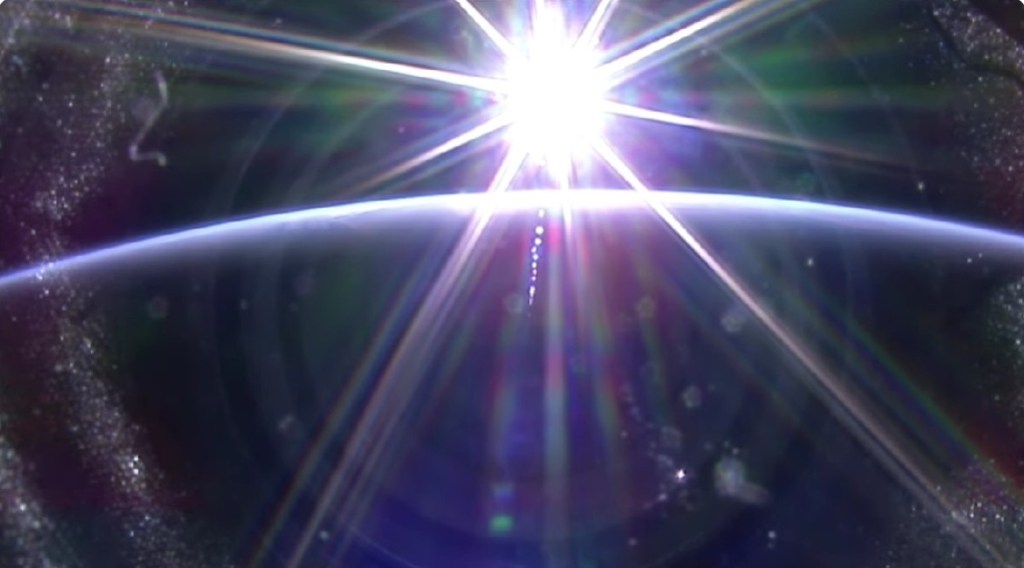
Superfact 105: The Sun is white, but the Sky steals its Blue is a poetic way of saying that the sun’s light is scattered by the atmosphere giving the Sun a yellowish tint as well as giving us our blue sky. From space the sun looks completely white.
A bright white sun is setting over Earth. | The Sun is White but the Sky steals its Blue
Sunset from the International Space Station by NASA

Viewed from space the sun is entirely white. White light consists of a mix of all the colors of the rainbow. However, viewed from earth the sun has a yellow tint, which gets more pronounced, it even dips into orange, as the sun nears sunset. That does not happen in space as can be seen below in the one minute sunset timelapse video taken from the International Space Station.

Sunset Timelapse from the International Space Station

On earth the sunset looks more like something in the picture below.

The sun is setting over distant mountains. There are some clouds, a forest, and field in the foreground. The sun has a yellow tint; the clouds are slightly yellow-orange and sky above is blue. | The Sun is White but the Sky steals its Blue
The sky dusk has a dramatic background featuring a summer season golden sunset landscape. The light is at the horizon is an orange and yellow color with blue sky above. Shutterstock asset id: 2670235703 by Nature Peaceful

The sun is a so called yellow dwarf star, or a G-type main-sequence star. The term yellow dwarf is a bit of a misnomer, because they range in color from white, for more luminous G-types like the Sun, to only very slightly yellowish for less massive and less luminous G-type main-sequence stars. The sun emits all the colors of the rainbow simultaneously, but the most dominant color is green. However, this looks white to us.

When sunlight enters Earth’s atmosphere, tiny air molecules scatter shorter, blue wavelengths of light in all directions. This scattering is what makes the sky look blue. This is called Rayleigh scattering. Because much of the blue light is removed, the remaining wavelengths of light that reach your eyes combine to make the sun appear yellow. This is a super fact because it is a basic but surprising fact, and we know it is true.

Rayleigh Scattering

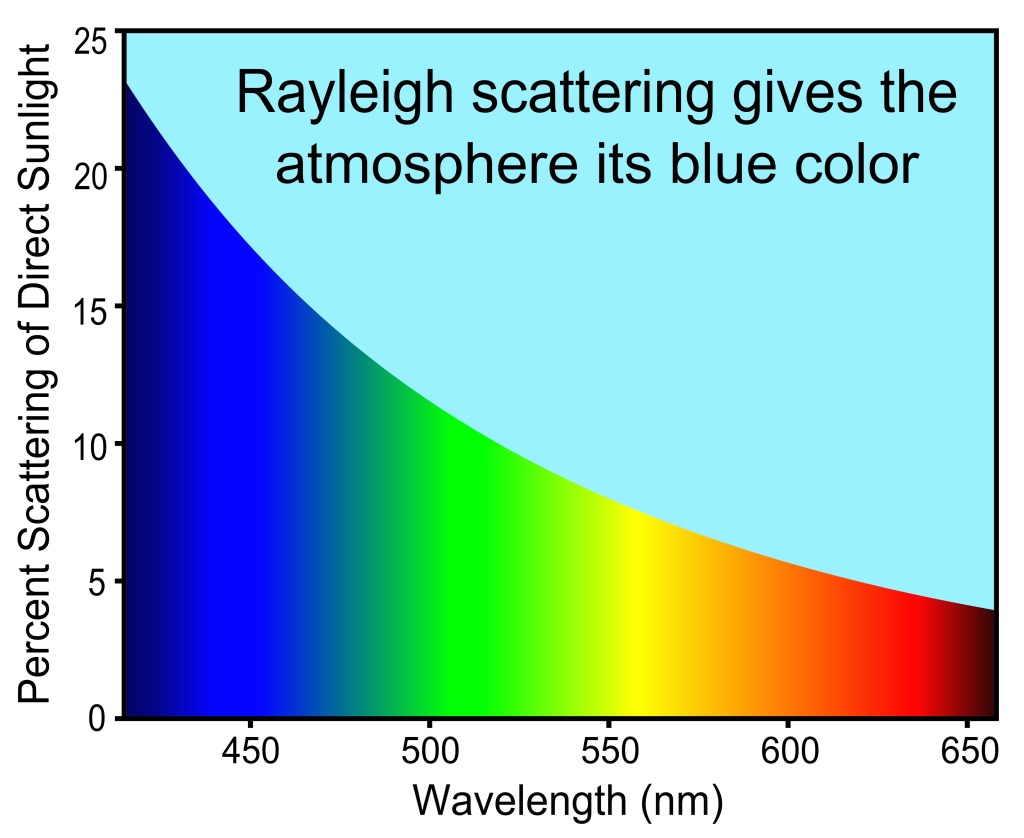
The blue color of the sky is caused by Rayleigh scattering of sunlight by the gases in the Earth’s atmosphere. The image below shows the degree to which Rayleigh scattering occurs at different wavelengths / frequencies of light. Blue has the shortest wavelength (highest frequency) for visible light and red the longest (lowest frequency). The curve shows that blue light scatters more than red light. It should be noted that UV light (not shown) scatter even more. The scattering curve shown is calculated for sunlight passing vertically through the atmosphere.

The graph shows the amount of scattering going from shorter wavelengths (higher frequences) on the left, to longer wavelengths (lower frequences) on the right. Blue has shorter wavelengths and red has longer wavelengths. The graph shows that blue scatter the most.
Figure showing the greater proportion of blue light scattered by the atmosphere relative to red light. Robert A. Rohde derivative work:KES47 (talk) (converted to SVG)., CC BY-SA 3.0 http://creativecommons.org/licenses/by-sa/3.0/, via Wikimedia Commons.


To see the Other Super Facts click here

Stars Twinkle but Planets Do Not

Super fact 102: Stars twinkle but planets do not. Planets reflect sunlight, like the moon, whereas stars emit intense light like the sun. However, stars are thousands of times further away.

Bright white star with a planet and a moon. | Stars Twinkle but Planets Do Not
The light from stars is intense allowing stars to have much smaller discs in the sky for the same amount of light as a planet. Shutter Stock Illustration ID: 566774353 by Nostalgia for Infinity.

The Sun and the Moon appear to have roughly the same sized disk in the sky, about 0.5 degrees of arc, because the Sun is roughly 400 times wider than the Moon but also about 400 times farther away. However, the moon, which reflects sunlight but does that emit any, is much fainter than the sun in our sky. The Sun provides approximately 400,000 times more light to Earth than the full Moon. If you were to move the sun farther away until it provided the same amount of light as the moon you would have to move the sun 632 times farther away until it became a tiny point in comparison to the moon.
The planets in our solar system, Venus, Jupiter, Mars, Mercury, Saturn, etc., appear in the sky as small discs reflecting light whereas the stars appear as intense points of light with a disc diameter that is thousands of times smaller than that of the planets. However, we can’t see the difference with the naked eye. Both planets and stars appear like points of lights to us, but the difference in disc size in the sky is very big.

The picture shows a big bright star (but much smaller than the sun) shining down on planet Earth lighting up the planet a bit. The light from the star is intense. | Stars Twinkle but Planets Do Not
Planets reflect light whereas the stars appear as intense points. Shutterstock asset id: 2709145593 by buradaki

Because stars are tiny intense points of light Earth’s atmosphere can easily refract (bend) their light. This is known as scintillation. I can add that the light from stars that are low in sky go through more atmosphere and therefore twinkle more. Since planets appear as tiny discs rather than tiny points, planets create a steadier beam of light, which averages out atmospheric turbulence. In addition, dust particles in space and in the atmosphere can more easily block the light from stars compared to that of planets, because the planets have much larger discs in the sky (thousands of times larger).

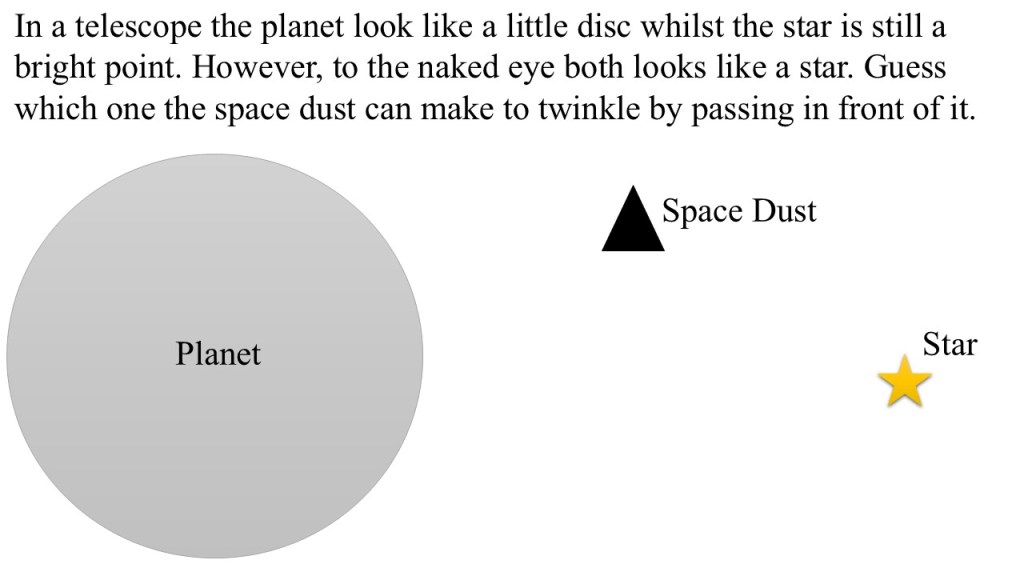
In the picture there is a disc representing a planet and a little yellow star and a small piece of space dust. The text says, “In a telescope the planet looks like a little disc whilst the star is still a  bright point. However, to the naked eye both look like a star. Guess which one the space dust can make to twinkle by passing in front of it.”
To the naked eye a planet and a star point look light points of light. In a telescope the planet will turn into a disc, but the star will remain a bright point of light. For example, a piece of space dust can easily make the star twinkle by moving in front of it but won’t do that to the planet. Note: planets are much smaller than stars, but they are much closer and can look bigger.

Since this fact is not scientifically under question, a lot of people don’t know it, and it is kind of important to anyone interested in the night sky, I consider it a super fact. I should say that I borrowed this super fact from Jacqui Murray’s blog worddreams.

Planets Reflect Light like the Moon

Planets reflect light. They don’t shine and emit light like the sun or the stars.

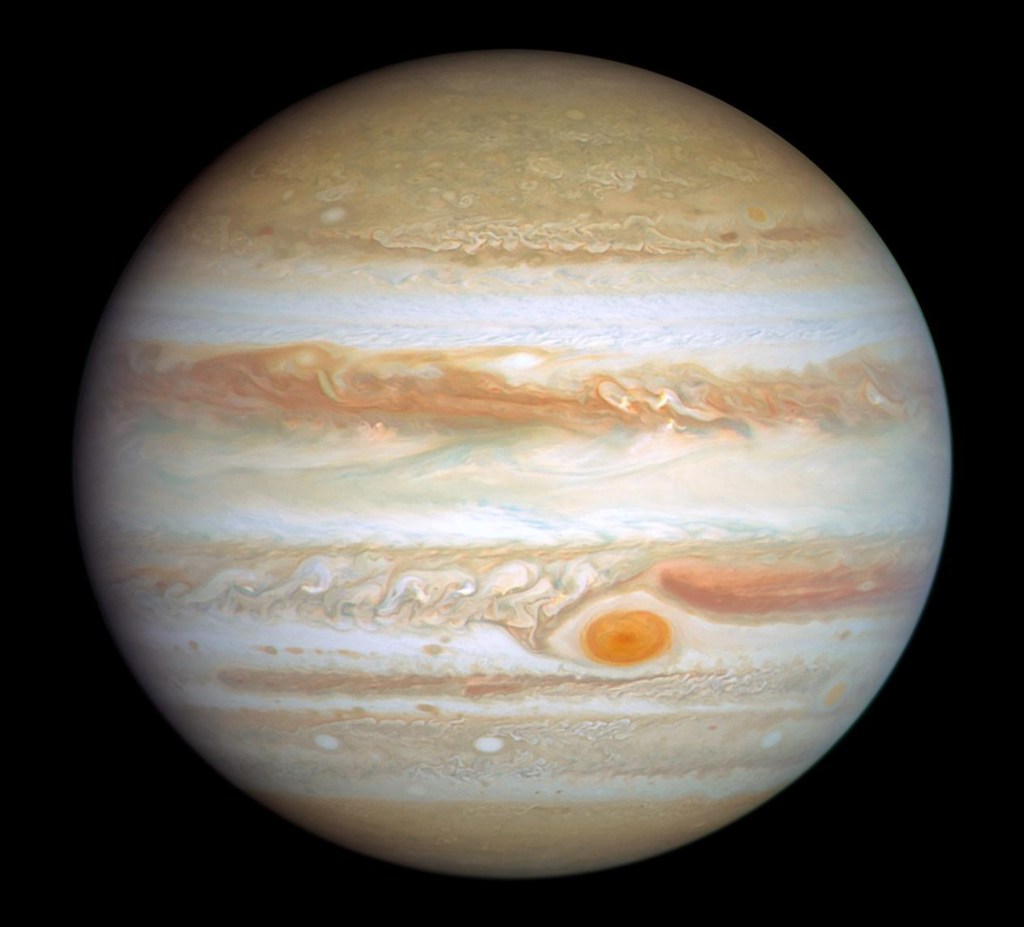
A colorful photo of Jupiter (orange and white) including the Great Red Spot.
Jupiter in true color, taken by the Hubble Space Telescope in January 2024
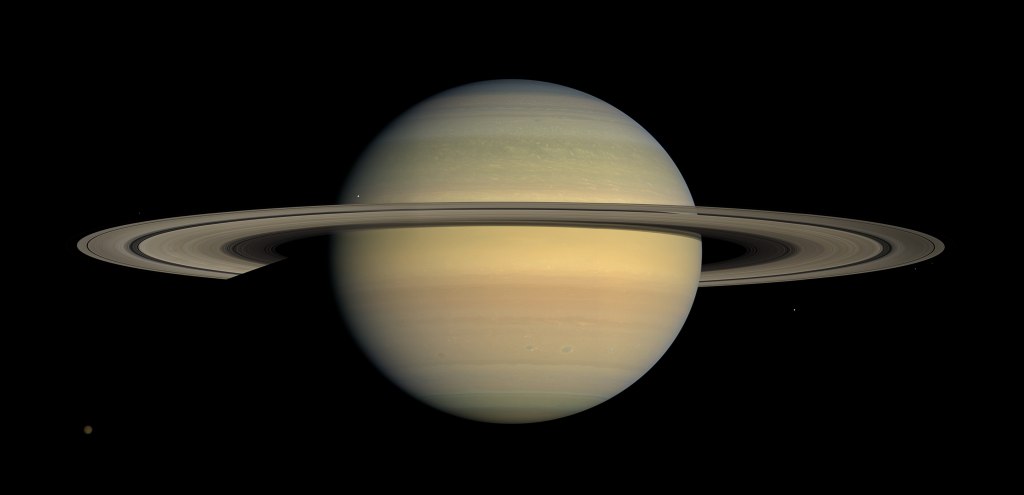
A photo of Saturn including the impressive rings.
Saturn and its prominent rings, as captured by the Cassini orbiter. This natural color view of the planet Saturn was created from images collected shortly after Cassini began its extended Equinox Mission in July 2008.
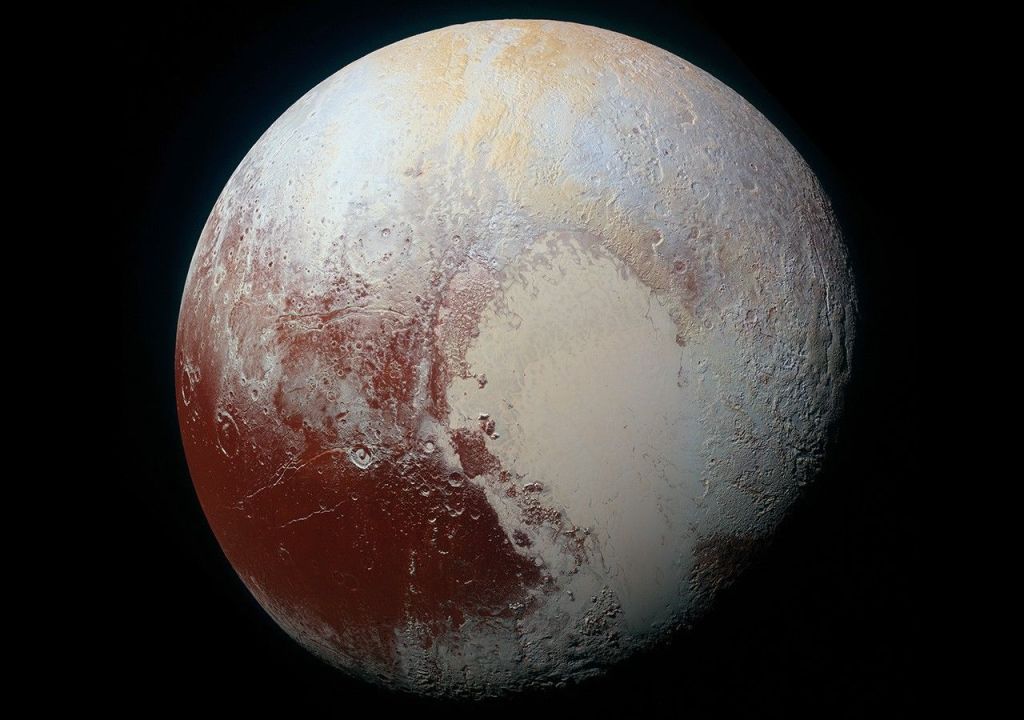
This picture features the photo of Pluto taken by NASA’s New Horizons spacecraft in 2015 plus some text. | Stars Twinkle but Planets Do Not
Pluto from NASA/JHUAPL/SwRI. NASA / Johns Hopkins University Applied Physics Laboratory / Southwest Research Institute, Public domain, via Wikimedia Commons. NASA’s New Horizons spacecraft captured this high-resolution enhanced color view of Pluto in 2015.


To see the other Super Facts click here

The Universe has a Redshift and its Increasing

Super fact 79 : Distant galaxies appear redder (redshifted) because of the universe’s expansion. The farther away the galaxy, the redder it is. This cosmological redshift is also increasing because the Universe’s expansion is accelerating. Our Universe is getting more and more red every day.

Esther’s writing prompt: January 14 : Red

Click here or here  to join in.

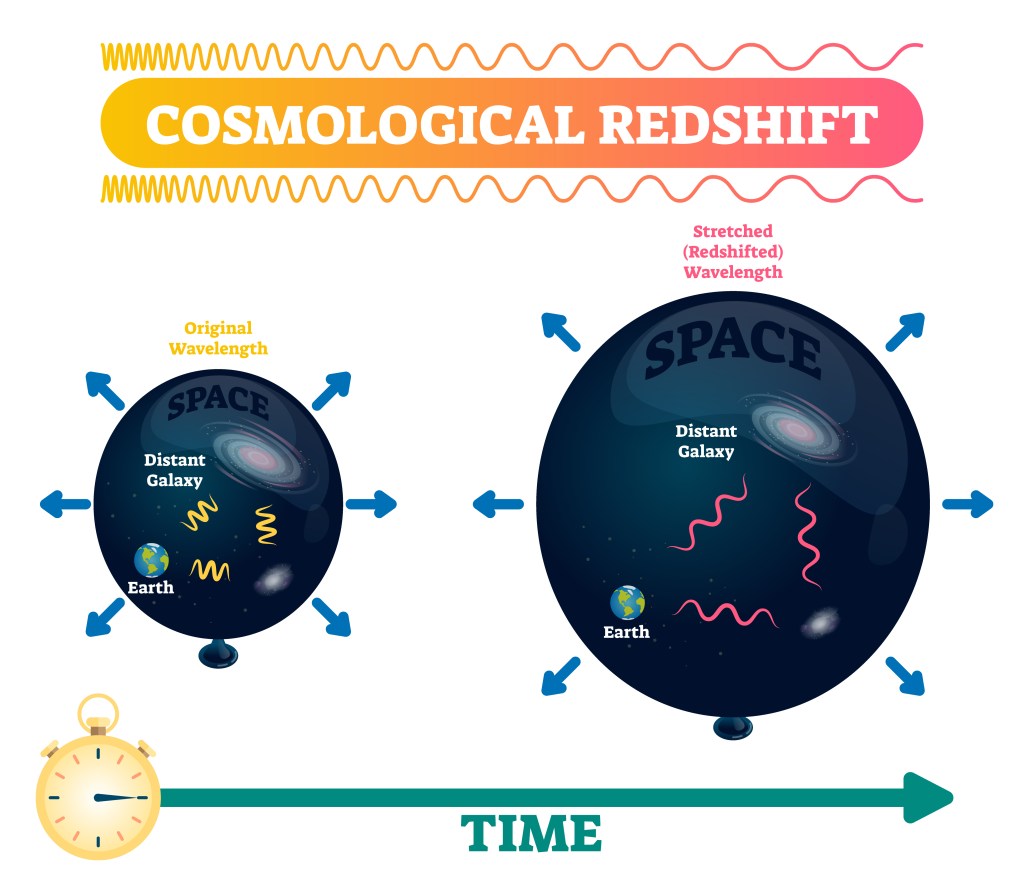
Many people are aware that the Universe is expanding but may not know that this results in a measurable redshift. The faster a galaxy is moving away from us the redder it appears. This is called the cosmological redshift. Measuring these redshifts was how we discovered that our Universe is expanding.

Cosmological redshift vector illustration. Stretched and original space wavelength with earth and distant galaxy. Doppler effect astronomical phenomenon distance example. | The Universe has a Redshift and its Increasing
As the Universe expands and galaxies are moving away from each other the light will be stretched. Stretched light with longer wavelengths are more red. The phenomenon is called redshift. Shutterstock Asset id: 1180828402 by VectorMine.

At the end of the 1990’s it was also discovered that the Universe’s expansion was accelerating. This discovery came from measuring the redshifts (and apparent dimness) of distant Type Ia supernovae. I should add that measuring the increase in the cosmological redshift directly is difficult. However, it is expected to be possible when the Extremely Large Telescope (ELT) starts gathering data in 2027. I can add that there are also other types of evidence showing that the Universe’s expansion is accelerating.

Another surprising aspect is, if the Big Bang was like an explosion, gravity would pull back the galaxies making the expansion slow down and perhaps eventually even reverse. However, the opposite is happening. A common explanation is that a repulsive force, a sort of anti-gravity, referred to as dark energy, is responsible for this acceleration.

I call this a super fact because this is an observed phenomenon, it is important knowledge for how we view the world, and it is surprising. Many people have heard bits and pieces of this but do not have the fuller picture.

The Doppler Effect

The cosmological redshift is an example of the so called doppler effect. The doppler effect is the change in the frequency or wavelength of a wave in relation to an observer if the origin of the wave and the observer are moving compared to each other. If an object is moving towards you, let say an ambulance, the frequency of its sound will be higher (wavelength shorter).

After it passes you and moves away from the frequency will be lower (wavelength longer). In other words, the sound changes when the ambulance passes you. The same is true for other kinds of waves, including waves on the water, and light. If a light is travelling towards you at a high speed, it will look bluer. If a light is travelling away from you at a high speed it will look redder. The latter is what is called a redshift, cosmological redshift in our case.

The object is indicated by a red dot, and a red arrow indicates the direction of motion.
Change of wavelength caused by motion of the source. When an object moves toward you the wavelengths get shorter and the frequency higher. When an object moves away from you the wavelengths get longer and the frequency lower. Original: Tkarcher Vector:  Tatoute, CC BY-SA 3.0 <http://creativecommons.org/licenses/by-sa/3.0/&gt;, via Wikimedia Commons
An animation illustrating how the Doppler effect causes a car engine or siren to sound higher in pitch when it is approaching than when it is receding. The red circles represent sound waves.
The Doppler effect causes a car engine or siren to sound higher in pitch when it is approaching than when it is receding. The red circles represent sound waves. Charly Whisky 18:20, 27 January 2007, CC BY-SA 3.0 <http://creativecommons.org/licenses/by-sa/3.0/&gt;, via Wikimedia Commons

Below is a three minute video explaining the doppler effect and redshift.


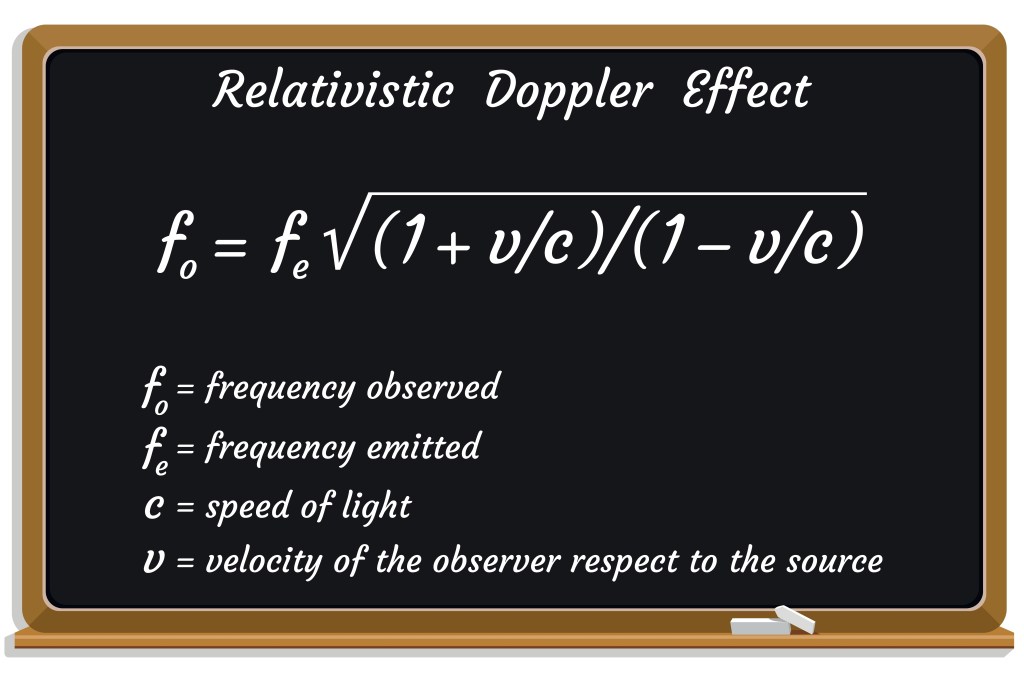
I can add that the constancy of the speed of light in vacuum changes the exact size of the doppler effect. The doppler effect remains as is for the most part but the formulas for the classical doppler effect, which you would use for sound, and the relativistic doppler effect, which you would use for light in space, are different. It is just to pick the right formula.

Doppler Effect Formula on a green chalkboard. Education. Science. Formula. Vector illustration. | The Universe has a Redshift and its Increasing
The classical formula for the doppler effect. There is a medium (air) but you don’t need to consider the constancy of the speed of light in vacuum. You use it for sound and water waves. Shutterstock Asset id: 2365938267 by Sasha701.
Relativistic Doppler Effect Formula on a black chalkboard. Education. Science. Formula. Vector illustration.
The relativistic formula for the doppler effect considers the constancy of the speed of light in vacuum but there is no medium to worry about. You use this formula for the doppler effect of light in space. Shutterstock Asset id: 2416786951 by Sasha701.

Measuring redshift

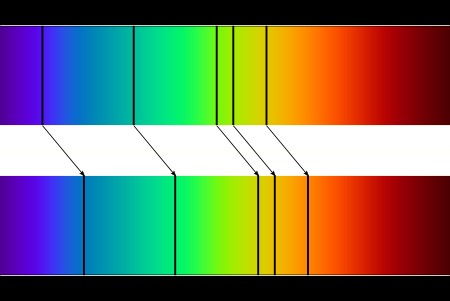
A common misconception is that astronomers take pictures of distant galaxies and somehow measure the “redness” of them, but that is not the case. When you take a spectrum of a heated element (such as hydrogen or helium in stars) it creates characteristic dark lines in the spectrum — like a fingerprint. Everything on the periodic table has its own characteristic fingerprint of lines at characteristic frequencies. In addition to measuring the cosmological redshift it makes it possible to identify the elements in a star and their proportions. See the picture below.

The top shows a colorful spectrum from blue to red with absorption lines in black. The bottom portion of the picture shows the same thing expect the black absorption lines have moved a bit to the right.
Visualization of redshifted absorption lines are redshifted due to velocity away from observer. Top lines are for an object at rest and in the bottom picture the object is moving away. Maxmath12, CC0, via Wikimedia Commons. This file is made available under the Creative Commons CC0 1.0 Universal Public Domain Dedication.

Expanding Universe Hazy IPA

Expanding Universe is a Hazy IPA, or a so called New England style IPA from First State Brewing, ABV 6.5%, IBU 25 (IBU = International Bitter Units). The fact that it is an IPA (India Pale Ale) means that it is Ale and therefore not a Lager. The fact that it is an IPA means that it is hop-forward and has an intense flavor and aroma. The fact that it is a Hazy / New England style IPA means that it is more fruity than bitter and looks cloudy, hazy, like juice. The flavor of Expanding Universe is mango, pineapple, and grapefruit. It has a low bitterness, it is fruity, juicy, and it is great if you like New England IPAs.

The picture shows a glass with yellow to light orange hazy liquid. There are green plants in the background.
Expanding Universe ABV 6.5%, IBU 25.

Related Posts


To see the Super Facts click here

The Great Sun and Moon Spectacle

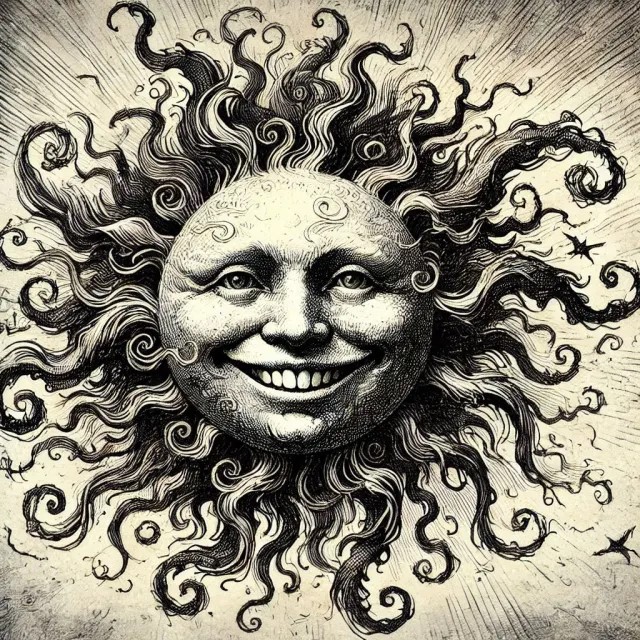
We are all in our places with sunshiny faces  ready to experience the astronomical event of the century, a spectacle that Mr. Sun, Sun, Golden Mr. Sun and the moon provided for us.

This is a submission for Kevin’s No Theme Thursday

The Great Sun and Moon Spectacle
Image by Kevin from The Beginning at Last

For us in Dallas, Texas, 2024 was the year when the sun and the moon put up an unforgettable spectacle for all of us to see. On April 8, 2024, the sun and the moon and earth lined up perfectly so that the moon fully covered the sun. We had a total solar eclipse, and we were lucky with the weather. I can add that experiencing a total solar eclipse is quite different from experiencing a partial or annular solar eclipse. I’ve experienced a partial solar eclipse as well and I can attest to the difference.

Unlike a partial eclipse, it gets dark during a total solar eclipse, the stars come out if the sky is clear like it was. The birds and the insects become quiet. It happens very suddenly, in just a few seconds. The total solar eclipse lasted four minutes.

The Motion of the Sun and the Moon

To understand what a solar eclipse is, the video below might help. What you see is the moon and the earth as seen from the sun’s viewpoint. We see earth all lit up by the sun, like a full moon, and we also see the moon lit up by the sun. 

In this situation, when the people on earth look up in the sky, they see the sun, but they don’t see the moon, even though it is there. It is a new moon, or a black moon if it happens twice in the same month. As the moon begins to partially cover the sun the shadows on the ground start looking different and if you use solar eclipse glasses you can see the sun disappearing and looking like a bright crescent, but it is still daylight and looking at the sun without eclipse glasses would just hurt your eyes.

Well, this is true until the sun is fully covered by the moon. When that happens, the light turns off and at that point it is safe to look at the sun without glasses. What you’ll see is a pitch-black circle in the sky surrounded by wispy faint lights. Those wispy faint lights are the sun’s corona.

Below is a youTube video showing an animation composed of actual satellite photos by NASA.


Solar Eclipse Preparation

I drank a very special beer for the occasion, a Trappist Belgian Strong Ale, or Quadruple, called Westvleteren 12 from Brouwerij Westvleteren (Sint-Sixtusabdij van Westvleteren).

A table set for five with a large parasol | The Great Sun and Moon Spectacle
Our patio table. The little brown packages contain AAS / ISO certified solar eclipse glasses.
My daughter holding a Westvleteren 12 glass with a bow. Grandpa and grandma sitting on chairs in the background | The Great Sun and Moon Spectacle
Our daughter holding a Westvleteren 12 glass with a bow. Grandpa and grandma in the background.
A mini-Australian Shepherd sitting on the patio floor | The Great Sun and Moon Spectacle
Rollo our mini-Australian Shepherd on the patio.

The Partial Eclipse Phase

It was partially cloudy during the partial eclipse, but we were able to get a good look at the eclipse as it progressed. As mentioned, to see the partial eclipse, you have to use good solar eclipse glasses. It is primarily for safety reasons, but it is also pointless to look at the sun during a partial eclipse. You won’t see the eclipse crescent because the powerful light from the sun overwhelms your view.

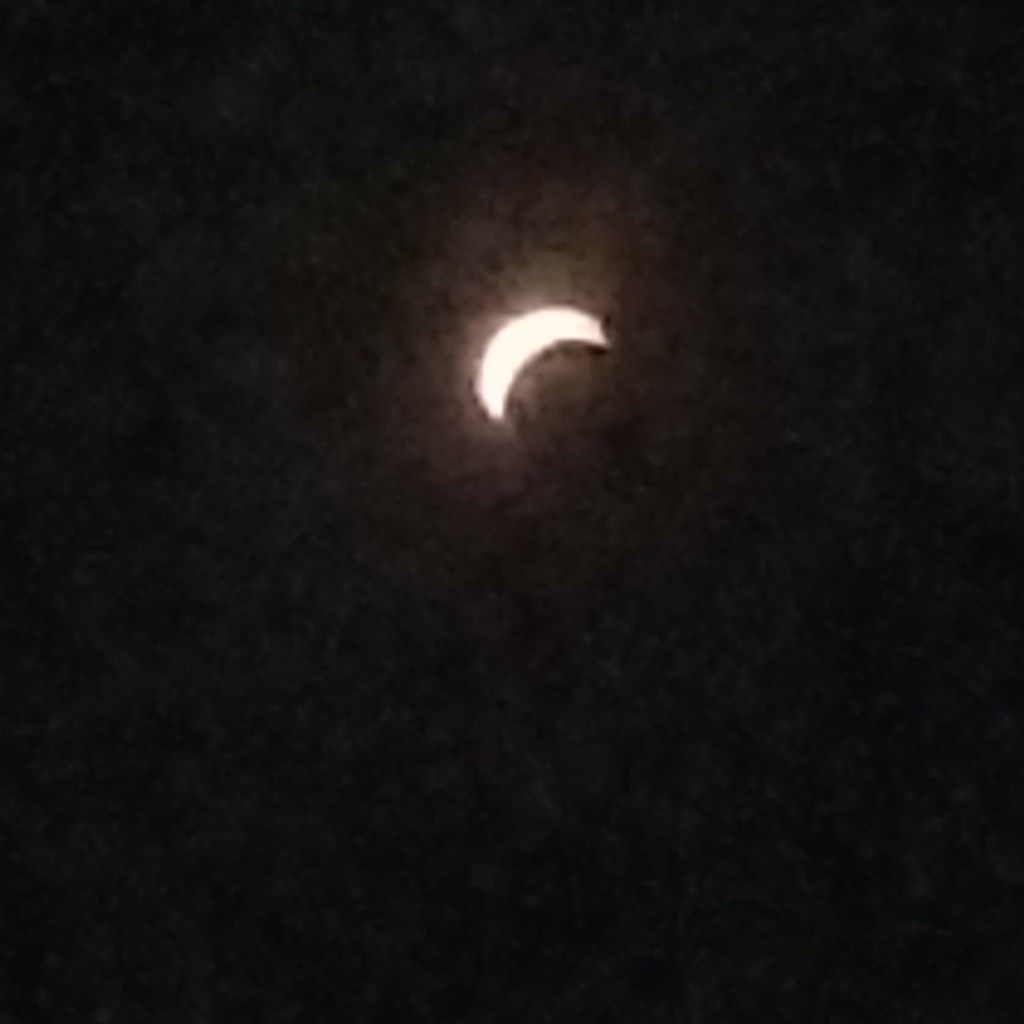
I had a little filter that was placed in front of my phone camera as I took a few pictures. Admittedly they were pretty bad. I have an old Samsung Galaxy S8+ but even using newer phones it is difficult to get decent photos of something like this.

The photo shows a shiny crescent on black background | The Great Sun and Moon Spectacle
Partial eclipse photo taken with my old Samsung Galaxy phone and a filter.

The Total Eclipse

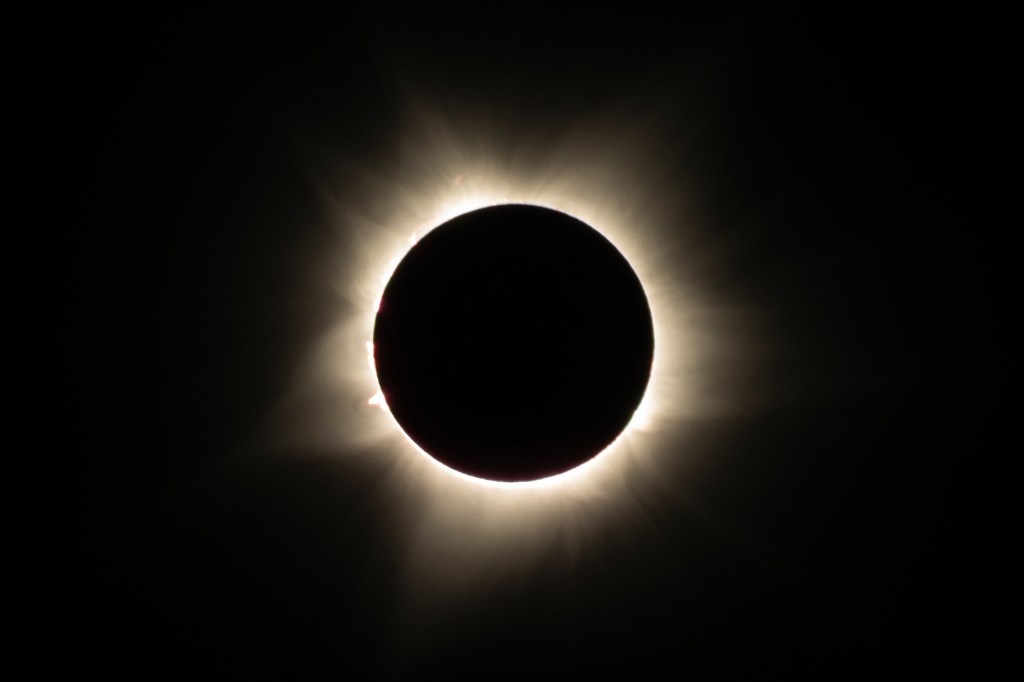
At 1:40PM Dallas time the total solar eclipse happened and luckily it was not covered by clouds. At this point it suddenly got dark and it was safe to look straight at the sun without using the eclipse glasses. The total eclipse lasted four minutes. I have included a shutter stock photo below which closely represents what we actually saw. We saw a black circle and around the black circle was a wispy white fog like light. This was the sun’s corona and it shone with about the same power as the full moon. It kind of looked like a black hole.

Black circle surrounded by a wispy white fog like light. That’s the sun’s corona | The Great Sun and Moon Spectacle
Except for the black background this looks like what we saw with our eyes. The sky we had was dark, like twilight, but not black. Solar Eclipse Stock Photo ID: 2344355767 by aeonWAVE

The Stars and the Planet Venus

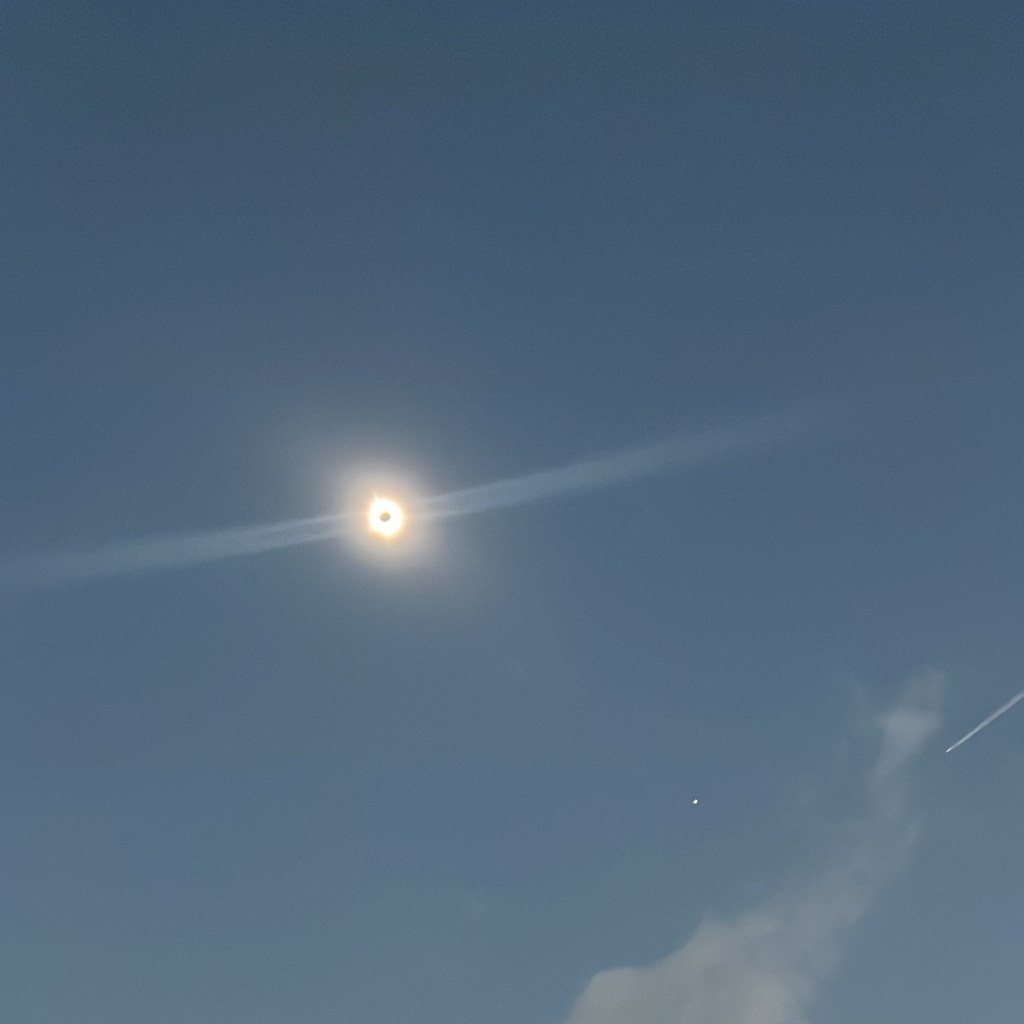
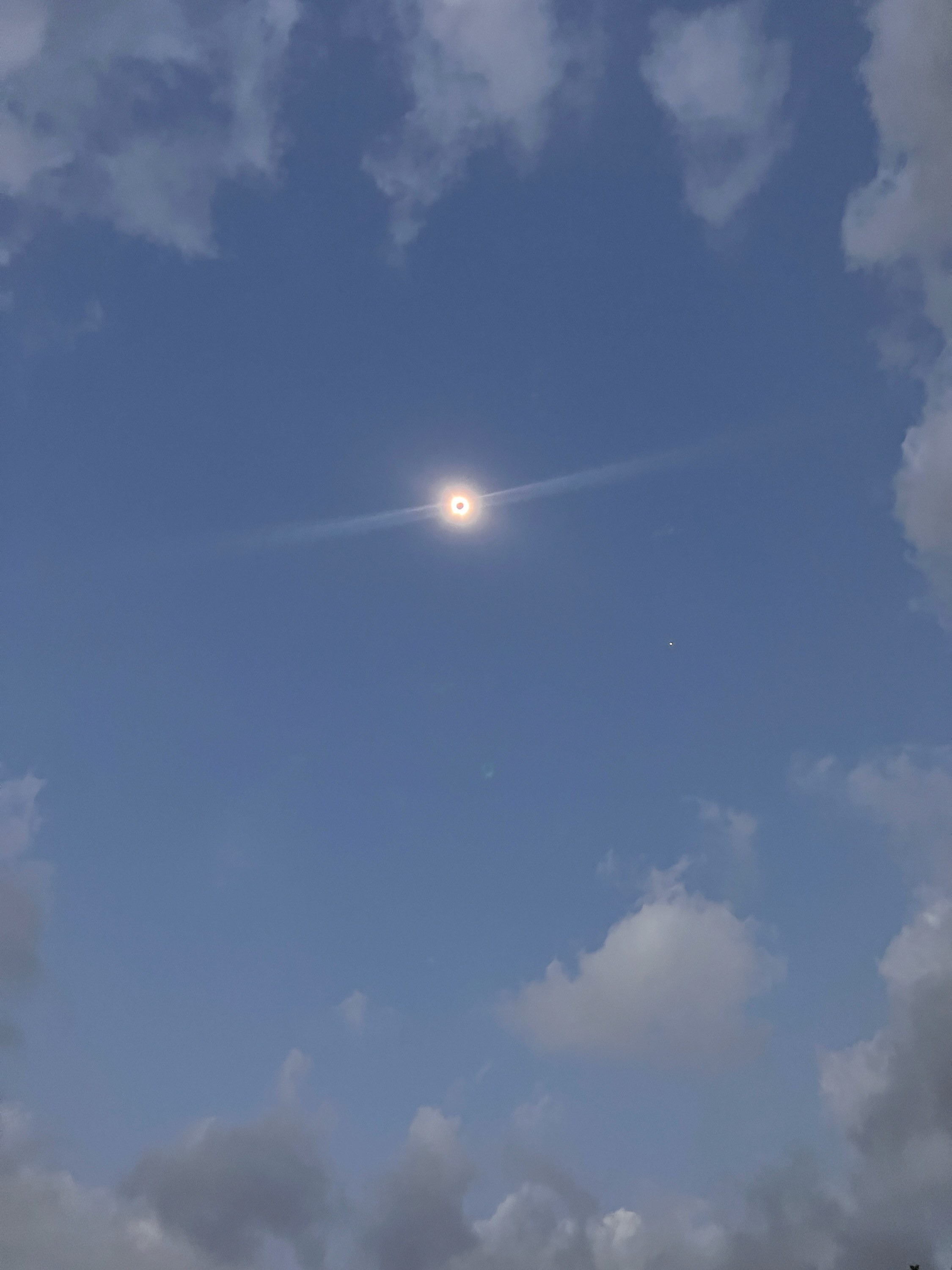
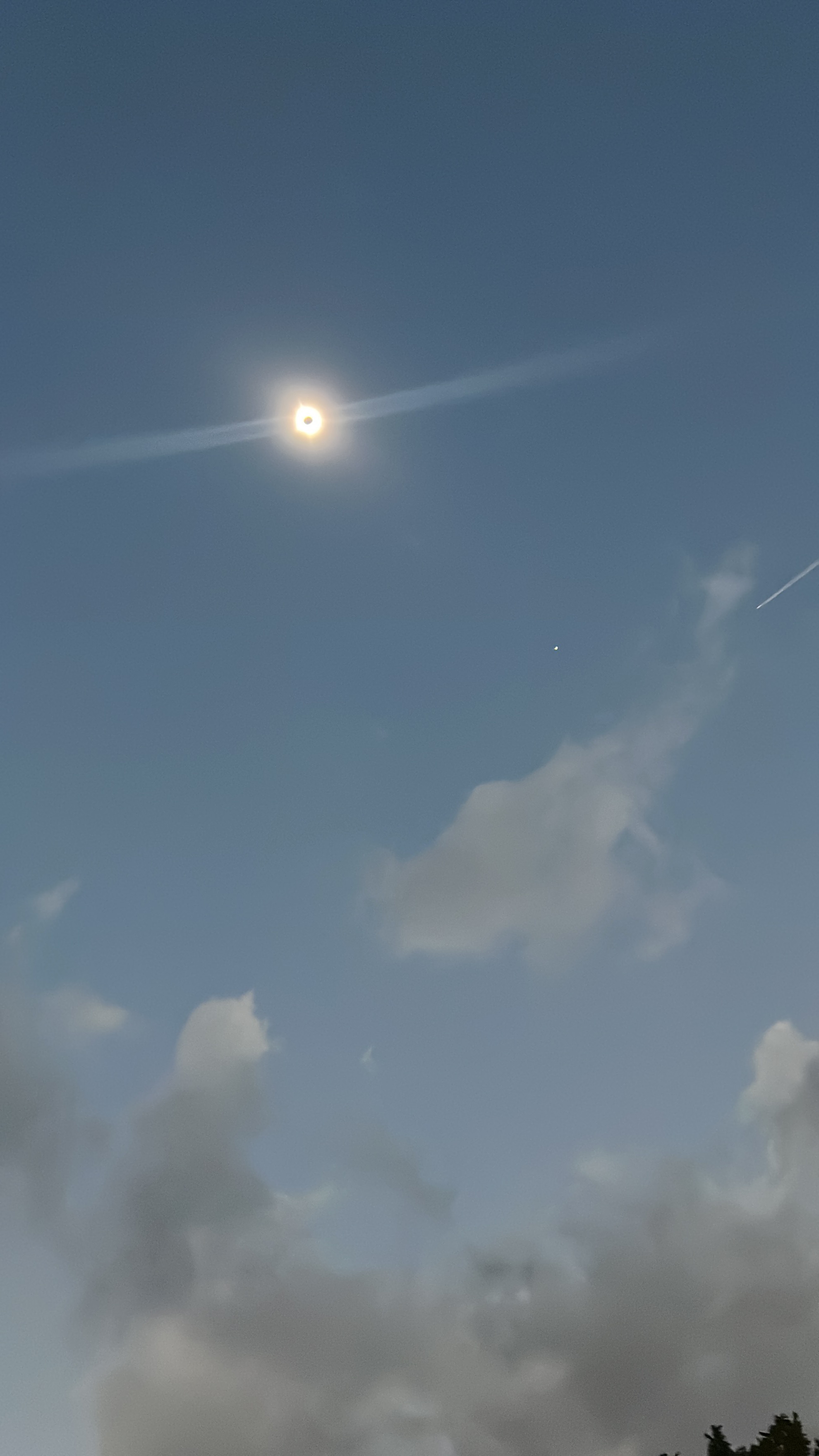
The photo shows the sun totally covered by the moon. It is very small in the photo. There is star like object, that’s Venus, a cloud and airplane contrail | The Great Sun and Moon Spectacle
Total solar eclipse photo that my daughter took. Can you find Venus?

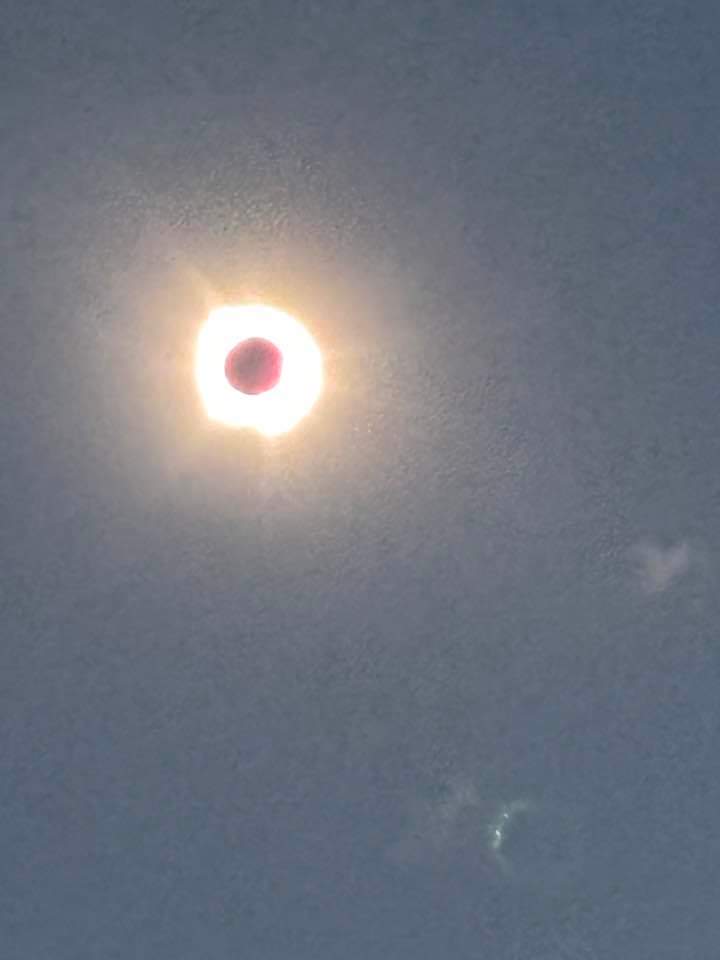
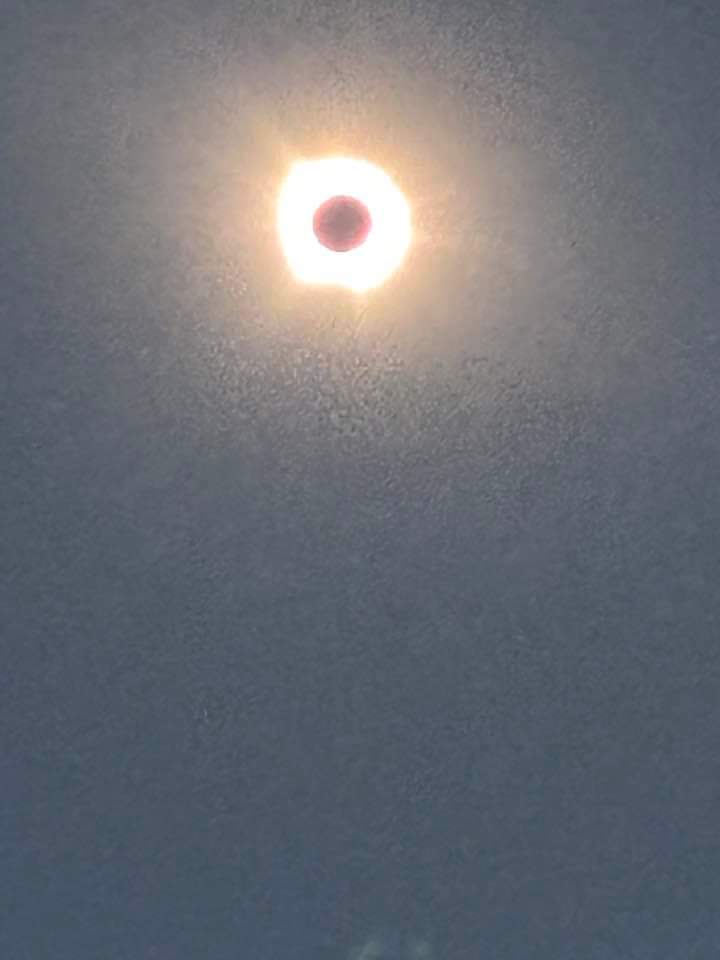
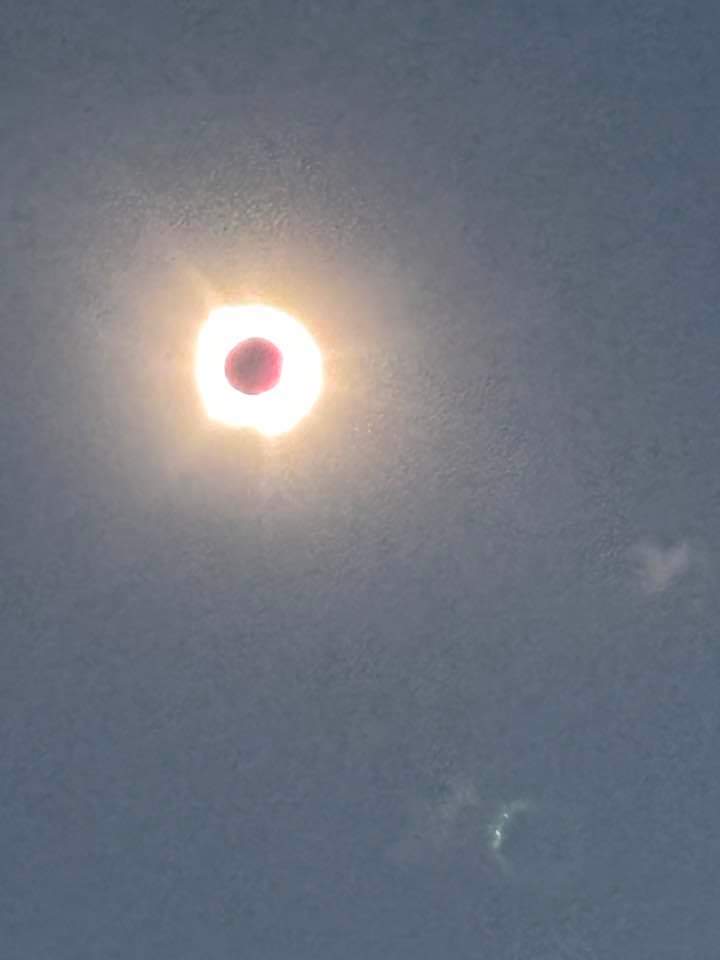
Total Eclipse Photos

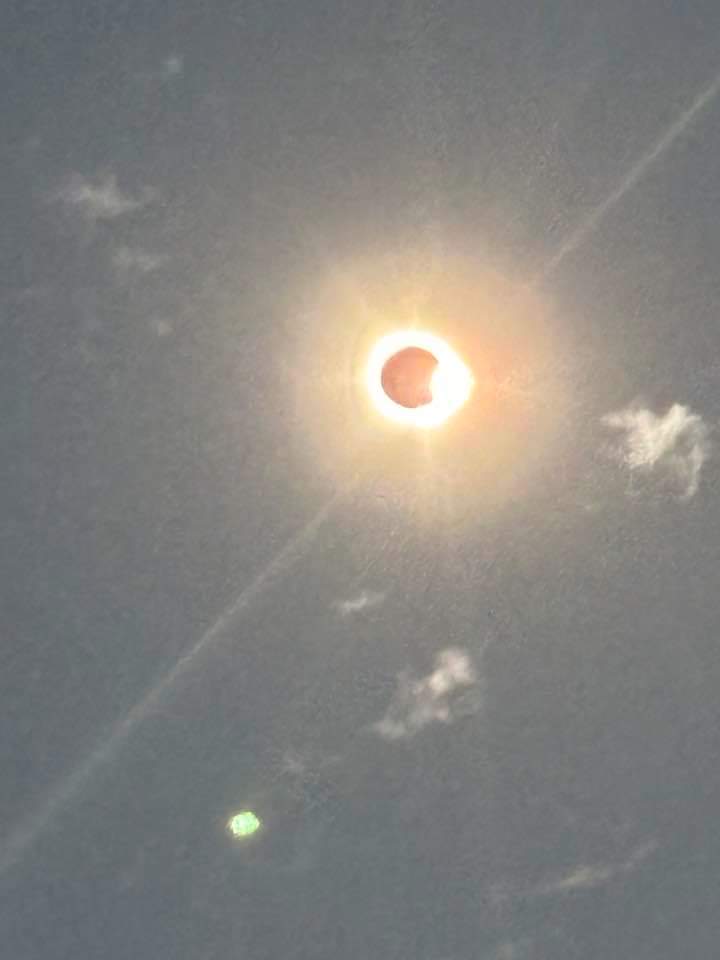
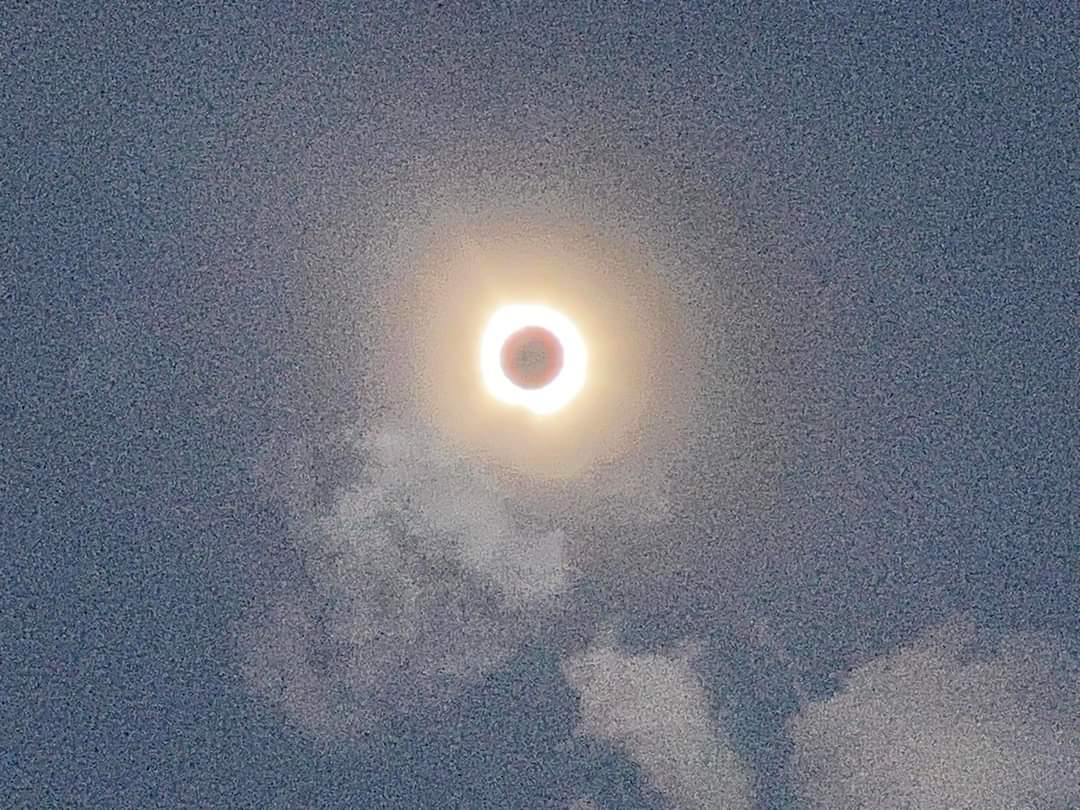
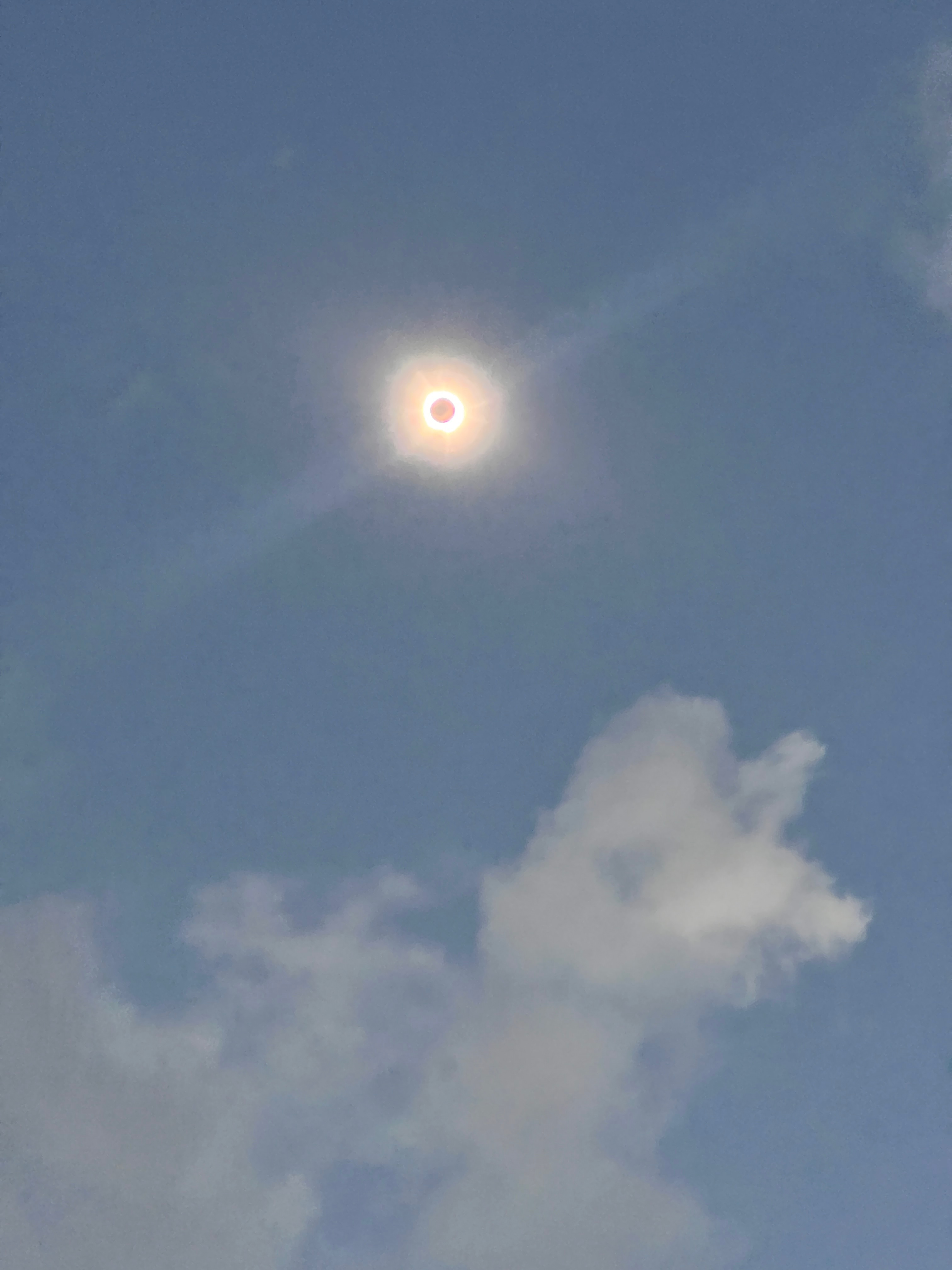
These eight pictures were taken with cell phones by my daughter Rachel, Denise Mosier-Wanken, and Margaret Weiss Bloebaum.

Did you see the total solar eclipse?


To see the Super Facts click here