The Giant Bubble of No Space

Cosmology is the science of the origin and development of the universe, and this post is about a book on Cosmology, “What’s Eating the Universe?: And Other Cosmic Questions” by Paul Davies.

What’s eating the Universe is one of the 30 questions answered in this book. It refers to the mysterious gigantic super-voids we’ve found. Could they be the result of collisions with other universes? Could they be the result of expanding giant bubbles with no space at all in them? That’s not just empty bubbles with empty space, but bubbles in which space itself is missing. Try to imagine that. Some of the 30 questions have answers, others just feature several guesses.

The goal of this blog is to create a list of what I call super facts. Important facts that we know to be true and yet they are surprising, shocking or disputed among non-experts. Super facts are special facts that a well-informed person may want to know.

However, I sometimes create posts that are not super facts but just interesting information, such as this one. What’s eating the Universe is a relatively short and easy read. I bought the hardback version of it.

  • Hardcover –  Publisher : University of Chicago Press; First Edition (September 22, 2021), ISBN-10 : 022681629X, ISBN-13 : 978-0226816296, 208 pages, item weight : 12.2 ounces, dimensions : ‎5.67 x 0.71 x 8.58 inches, it costs $19.84 on Amazon. Click here to order it from Amazon.com.
  • Paperback –  Publisher : University of Chicago Press; First Edition (September 30, 2022), ISBN-10 : 0226823873, ISBN-13 : 978-0226823874, 183 pages, item weight : 9.6 ounces, dimensions : ‎ ‏ : 5.5 x 0.46 x 8.5 inches, it costs $15.67 on Amazon. Click here to order it from Amazon.com.
  • eTextBook –  Publisher : University of Chicago Press; First edition (September 22, 2021), ASIN : B096L2WP51, 172 pages, it costs $14.89 on US Amazon. Click here to order it from Amazon.com.
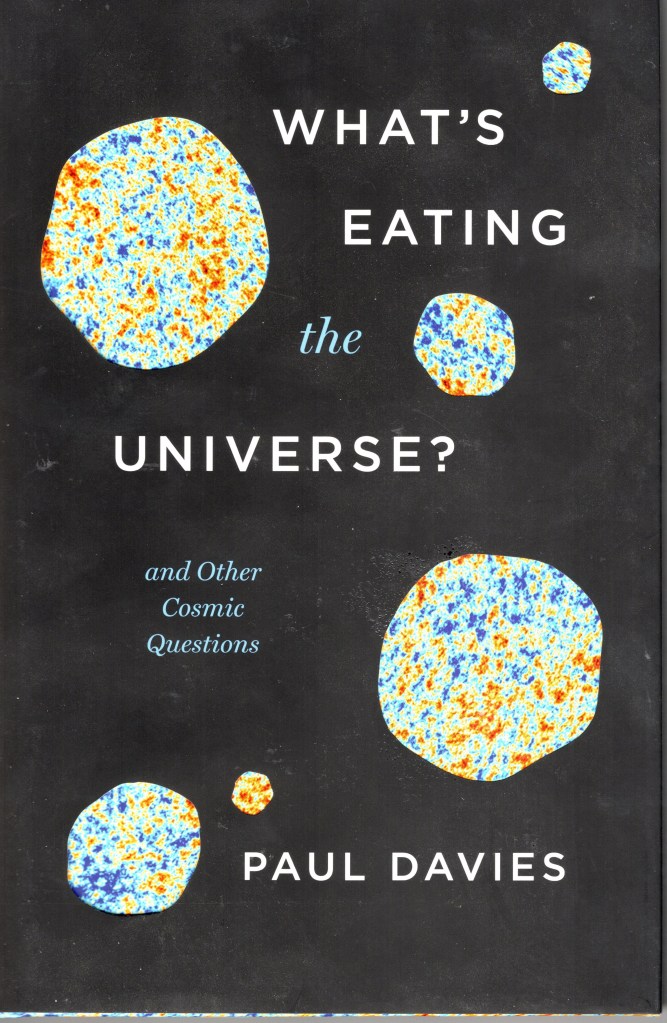
Front cover of What's Eating the Universe | The Giant Bubble of No Space
Front cover of What’s Eating the Universe? Click on the image to go to the Amazon page for the hardcover version of the book.

Amazon’s description of the book

Combining the latest scientific advances with storytelling skills unmatched in the cosmos, an award-winning astrophysicist and popular writer leads us on a tour of some of the greatest mysteries of our universe.

In the constellation of Eridanus, there lurks a cosmic It’s as if something has taken a huge bite out of the universe. But what is the culprit? The hole in the universe is just one of many puzzles keeping cosmologists busy. Supermassive black holes, bubbles of nothingness gobbling up space, monster universes swallowing others—these and many other bizarre ideas are being pursued by scientists.

Due to breathtaking progress in astronomy, the history of our universe is now better understood than the history of our own planet. But these advances have uncovered some startling riddles. In this electrifying new book, renowned cosmologist and author Paul Davies lucidly explains what we know about the cosmos and its enigmas, exploring the tantalizing—and sometimes terrifying—possibilities that lie before us.

As Davies guides us through the audacious research offering mind-bending solutions to these and other mysteries, he leads us up to the greatest outstanding conundrum of Why does the universe even exist in the first place? And how did a system of mindless, purposeless particles manage to bring forth conscious, thinking beings? Filled with wit and wonder, What’s Eating the Universe? is a dazzling tour of cosmic questions, sure to entertain, enchant, and inspire us all.

This is my five-star review for What’s Eating the Universe?: And Other Cosmic Questions.

Cosmology explained the easy way

This book is organized into 30 cosmological questions that the author is answering or clarifying. His explanations are naturally not in depth but high level and easy to understand for anyone with an interest in the topic. He manages to keep the topic fascinating and the book is a real page turner. I read the book in a little bit more than one day.

The book discusses cosmology, relativity, the standard model, black holes, the big bang, the CMB, dark matter, dark energy, multiverses and the fate of our Universe, extraterrestrials, and much more, and he gives us insight into the very latest discoveries and views of cosmology.

I especially enjoyed reading chapter 20 & 21 “Can the Universe Come from Nothing” and “How Many Universes Are There”. He tells us that most cosmologists he knows believe there are infinitely many universes. One model is eternal inflation, a space/time mechanism beyond our universe that keeps causing new universes to bubble up and initially expand rapidly, but there are other models. I was surprised that he didn’t mention Roger Penrose’s model, cycles of time, with one Universe giving rise to another (after full expansion and heat death).

However, if there’s only one Universe and time came into existence with it (singularity) it doesn’t help those who want to insert a creation moment. If time didn’t exist before the big bang, the concept of a prior physical cause is meaningless. Asking what was before the big bang is like asking what lies north of the North Pole.

I also especially enjoyed reading chapter 30 “What’s New on the Cosmic Horizon” in which he lists mysteries and recent exciting discoveries, the cold patch in Eridanus (CMB), the mystery with the Hubble constant, what’s beyond the standard model, the prospect of top-down models, etc. Well, all the chapters were interesting.

This book is a quick and easy summary of what’s going on in cosmology. It’s accessible and engrossing writing and the straightforward organization make the book a great introduction to the topic. I highly recommend this book.
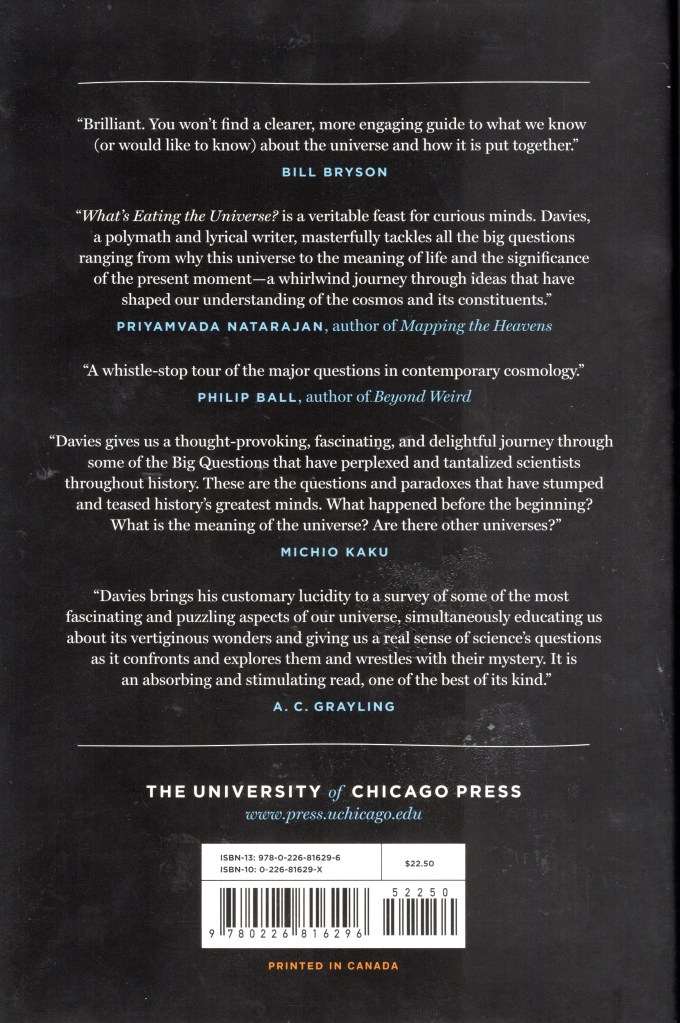
The back cover feature advanced praise for the book | Back cover of “What's Eating the Universe?”
Back cover of “What’s Eating the Universe?” Click on the image to go to the Amazon page for the paperback version of the book.

Finally, a list of the 30 questions

  • Journey from the Edge of Time
  • The search for the key to the Universe
  • Why is it dark at Night?
  • The Big Bang
  • Where is the Center of the Universe?
  • Why the Cosmos is Actually Fairly Simple?
  • What is the Speed of Space?
  • What is the Shape of Space?
  • Explaining the Cosmic Big Fix
  • Most of our Universe is Missing
  • What is Dark Energy
  • Where Does Matter Come From?
  • Gravity Conquers All
  • Warped Time and Black Holes
  • Is Time Travel Possible?
  • What is the Source of Time’s Puzzling Arrow?
  • The Black Hole Paradox
  • A Theory of Everything?
  • Fossils from the Cosmic Dawn
  • Can the Universe Come from Nothing?
  • How Many Universes Are There?
  • The Goldilocks Enigma
  • What’s Eating the Universe?
  • Is the Universe Actually a Botched Job?
  • Are We Alone?
  • Is ET in Our Backyard?
  • Why Am I Living Now?
  • The Fate of Our Universe
  • Is There a Meaning to It All?
  • What’s New on the Cosmic Horizon?

To see the Super Facts click here


The Little Book of Cosmology

Cosmology is the science of the origin and development of the universe, and this post is about a book on Cosmology, The Little Book of Cosmology by Lyman Page. This is a big and, in my opinion, interesting topic. A lot of cosmology is speculative, multiverses, what was before the big bang, has the universe always existed, has there been an infinite number of big bangs, what about conformal cyclic cosmology in which each cycle result in a new big bang (Roger Penrose), what is the future and end of the universe, is the Universe a hologram, is it self-aware, etc.

This book is not focused on scientific speculation but on what we know about the structure of the universe, the big bang and the expansion of the universe, the well understood basics. I think it is amazing how much we can learn from the Cosmic Microwave Background Radiation (CMB).

The goal of this blog is to create a list of what I call super facts. Important facts that we know to be true and yet they are surprising, shocking or disputed among non-experts. Super facts are special facts that a well-informed person may want to know. However, I sometimes create posts that are not super facts but just interesting information, such as this one. The Little Book of Cosmology is a relatively short and easy read. I bought the hardback version of it.

  • Hardcover –  Publisher : Princeton University Press; First Edition (April 7, 2020), ISBN-10 : 0691195781, ISBN-13 : 978-0691195780, 152 pages, item weight : 2.31 pounds, dimensions : 5.59 x 0.79 x 8.58 inches, it costs $15.39 on Amazon. Click here to order it from Amazon.com.
  • Kindle –  Publisher : Princeton University Press (April 7, 2020), ASIN : B07Z1DWB4P, 132 pages, it costs $9.99 on US Amazon. Click here to order it from Amazon.com.
The front cover features the title, the author, and geodesic lines forming a hyperbolic cone mesh | The Little Book of Cosmology by Lyman Page
Front cover of The Little Book of Cosmology. Click on the image to go to the Amazon page for the hardcover version of the book.

Amazon’s description of The Little Book of Cosmology by Lyman Page

The cutting-edge science that is taking the measure of the universe

The Little Book of Cosmology provides a breathtaking look at our universe on the grandest scales imaginable. Written by one of the world’s leading experimental cosmologists, this short but deeply insightful book describes what scientists are revealing through precise measurements of the faint thermal afterglow of the Big Bang—known as the cosmic microwave background, or CMB—and how their findings are transforming our view of the cosmos.

Blending the latest findings in cosmology with essential concepts from physics, Lyman Page first helps readers to grasp the sheer enormity of the universe, explaining how to understand the history of its formation and evolution in space and time. Then he sheds light on how spatial variations in the CMB formed, how they reveal the age, size, and geometry of the universe, and how they offer a blueprint for the formation of cosmic structure.

Not only does Page explain current observations and measurements, he describes how they can be woven together into a unified picture to form the Standard Model of Cosmology. Yet much remains unknown, and this incisive book also describes the search for ever deeper knowledge at the field’s frontiers—from quests to understand the nature of neutrinos and dark energy to investigations into the physics of the very early universe.

This is my five star review for The Little Book of Cosmology

What the Cosmic Microwave Background (CMB) can tell us

This is a short book describing the evolution of the Universe since the Big Bang and its composition. How do we know all this stuff? The Cosmic Microwave Background (CMB) can tell us a lot.

The CMB is a black body radiation remnant from the time (400,000 years after the Big Bang) when the Universe had cooled enough to allow the formation of hydrogen atoms and the decoupling of photons from electrons so that they could roam free.

CMB is in itself evidence for the Big Bang but in addition we get additional information from the minor anisotropy and polarization of the CMB, and add the composition of the elements (hydrogen, helium, lithium, and heavier elements), redshifts of galaxies, gravity lensing, and we can tell quite a bit about the evolution of the Universe and where it is heading.

It’s fascinating science detective work. This eventually leads to the Standard Model of Cosmology, which is something I’ve never heard of before, but it’s cool.

I found the facts about the size and age of the Universe, the early giant stars in the Universe, dark energy and dark matter, very interesting. The book is filled with basic and fascinating facts that I did not know. Because of the CMB (rather than particle accelerator experiments) we know roughly the mass (rest mass) of neutrinos.

We know why dark energy can’t be space dust, or rogue planetoids, or black holes or neutrinos, so what is it? The book explains why it can’t be any of those. There’s a lot we can know because of the CMB and other information, and some things we don’t know. Finding out what we do know was quite exciting and finding out what the mysterious “what we don’t know” was equally exciting. Again, the focus is on CMB and how it is measured, it tells us a lot.

The book is easy to read and require no degree in physics or mathematics. I admit I have a degree in Engineering Physics, and I am also interested in astronomy and cosmology, but I can tell it was light reading. It is a truly popular science book like those that Neil De Grasse Tyson writes, and it was short but very informative. There’s a lot of information you can extract from CMB. It was a fun short read for anyone interested in the mysteries of the Universe.

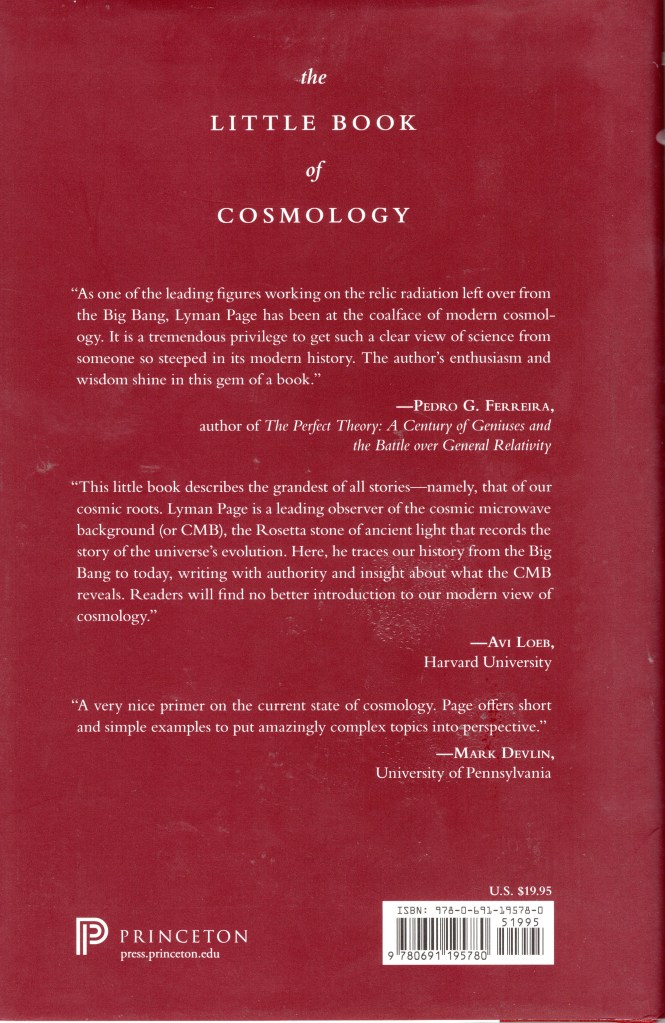
The back cover feature advanced praise for the book | The Little Book of Cosmology by Lyman Page
Back cover of The Little Book of Cosmology. Click on the image to go to the Amazon page for the kindle version of the book.

To see the Super Facts click here