The Surprising Butterfly Effect

Super fact 40 : In chaotic systems the so-called butterfly effect means that a small change in initial conditions, such as a butterfly flapping its wing in Brazil, can lead to large, unpredictable changes in a system’s future, such as the appearance of a tornado in North Texas. However, that does not mean that the butterfly directly caused the tornado. It should also be noted that chaotic systems can contain predictable patterns and external forcings can certainly make aspects of a chaotic system behave in a predictable manner.

The first part of Super Fact 40 describes a well-established phenomenon that is often surprising to people who have not heard about it before. The second part (following the word “However”) address a few common misconceptions about the butterfly effect. The butterfly effect is a surprising and widely misunderstood phenomenon and therefore I consider the information in bold above to be a super fact.

The Surprising Butterfly Effect
Photo by Cindy Gustafson on Pexels.com

The Butterfly Effect and Unpredictability

The butterfly effect is the sensitive dependence on initial conditions in which a small change in one aspect of the system can result in large differences later. A butterfly flapping its wing in Brazil, leading to the appearance of a tornado in North Texas, is one example. The butterfly effect is an aspect of chaos theory.

However, it is important to understand that the butterfly is not directly causing the tornado. It is the wing flaps of trillions of butterflies, the wing flaps of 50 billion birds, the barks of 900 million dogs, all the waterdrops in the world, and all the bushes and trees, etc., which together provide the initial conditions for the world’s weather system.

Remove one butterfly, anyone of them, or the bark of a dog, and you may or may not have a tornado in north Texas on a certain date. It isn’t the butterfly causing the tornado. Any tiny change in the initial conditions will eventually lead to a large difference in the system later. This is how the Butterfly Effect provides unpredictability.

A large well-formed tornado over the plains.
Did a butterfly do this? Stock Photo ID: 2369175167 by g images.com.

The Butterfly Effect and Predictability

Because of the butterfly effect you may not be able to predict whether it is going to rain at 1:00PM next Thursday, but you can still safely predict that Dallas, Texas, will on average be cooler in January than in July. That’s largely because the sun will heat Dallas, Texas more in July than in January. We know that if you add carbon dioxide, or other heat trapping gases, to the atmosphere it will on average get warmer. External forcings make aspects of chaotic systems predictable. You sometime hear the argument that “climate is chaotic and cannot be predicted”. This is a myth that is debunked here.

In addition, chaotic systems can feature predictable patterns, even though chaotic systems are considered unpredictable. Chaos theory demonstrates that within the apparent randomness of chaotic systems, there are underlying statistical patterns, self-similarity, fractals, and interconnection.

I once created a robot control system for which the robot was shaking a little bit. The tool tip was moving in a little circle and did not get to where it was supposed to be. The reason was that the presence of static friction made the control system I was using a chaotic system.

However, the robot didn’t randomly go all over the place. It was moving quickly in a small circle. It was chaotic, and its exact motion was unpredictable, but there was an underlying statistical pattern. Another example is, fractals, which are geometric patterns that emerge from chaotic processes described by chaos theory. Fractals feature self-similar patterns repeating at different scales. They can visually represent the complex behavior of these systems. See an example below.
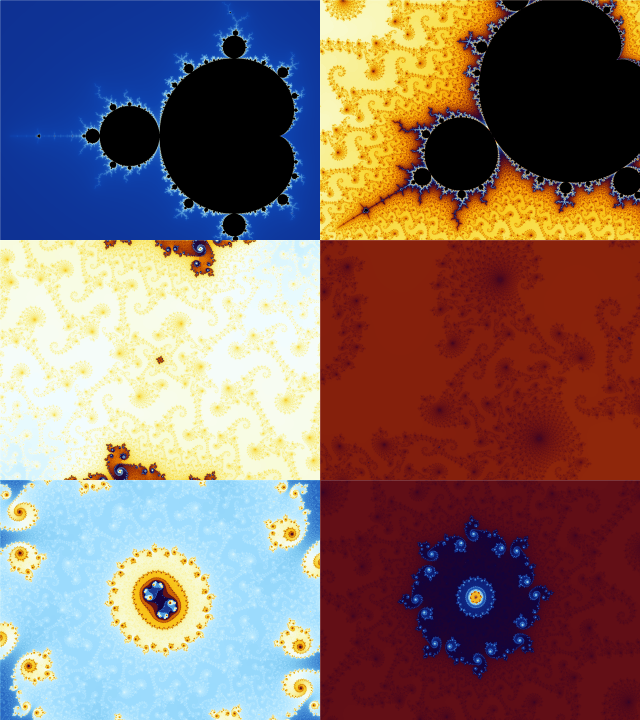
A 450 layer fractal | The Surprising Butterfly Effect
This is a file from the Wikimedia Commons Wikipedia. Simpsons contributor at English Wikipedia, Public domain, via Wikimedia Commons.

Edward Norton Lorenz

In 1961, Edward Norton Lorenz was using a computer to simulate weather patterns by modeling 12 variables (heat, wind, etc.). After finishing one simulation he wanted to see it again but to save time he started it in the middle using the saved variables at the point. To his surprise his simulation ended up with completely different weather. He realized that the computer the saved data had tiny errors from the computer rounding off the numbers. For example, 3.145787 instead of 3.1457872. That small difference was enough to eventually result in completely different weather.

Lorenz was not the first person to realize that, so called, non-linear systems can be extremely  sensitive initial data. This realization goes all the way back to the mathematician Henri Poincaré in the 19th century. However, he was the founder of modern chaos theory and coined the term the Butterfly Effect.

To see the other Super Facts click here

What do you think about the Fractal above?

Freedom to Roam and Concentric Circles

Image above by Kevin from The Beginning at Last

Water surrounded by trees, what looks like coniferous forest. There are circular ripples on the water with drops falling into the lake in the middle | Freedom to Roam and Concentric Circles
This picture reminded me of the Swedish lakes I used to swim in. This is a submission for Kevin’s No Theme Thursday

Freedom to Roam Everywhere

When I was a kid, I used to roam around a lot, in the forest and on the mountains, and I liked to swim and fish in the rivers and the famous deep lakes in the Swedish countryside. Sweden has 97,500 lakes larger than 2 acres and many of them are deep lakes with clean and clear water surrounded by forests, typically coniferous forests. A small deep clean forest lake is referred to as a “tjärn”. I can add that there are no alligators or venomous water snakes in Swedish lakes.

Sweden offers a type of freedom that is rare in the world, and it does not exist in the United States and certainly not in Texas where I live. It is the freedom to roam or more specifically allemansrätten. Whether the land is public or private you have the right to roam, to hike, to camp, to swim, to pick wild berries, to pick wild mushrooms, to fish, and no one can stop you. Landowners are not allowed to tell you to get off their land and they cannot put up fences to stop you or animals from roaming on their land. Everyone has the right to roam and swim everywhere. It is a freedom Swedes love, and if you one day come to experience it you will know why.

My son letting of a swing tire. There are ripples on the lake beneath him. You can see trees on the other side of the lake.
My son is jumping off a tire swing and into a “tjärn” in northern Sweden.

Allemansrätten

The Swedish freedom to roam or allemansrätten, is a right for all people to travel over private land in nature, to temporarily stay there and, for example, pick wild berries, mushrooms, flowers and certain other plants. It is important to point out that you must respect the landowner’s property. You can pick wild berries but not anything the landowner is growing. You cannot destroy or break things or start fires, use ATVs, cut branches off trees, etc. You also need to stay 70 meters or 230 feet away from any dwelling.

As a landowner in Sweden, you can buy land and use it for farming and forestry, and you have the right to prevent people from damaging or stealing your crops. You can buy land for mining, and you have the right to your proceeds and the right to prevent people from stealing from your mines. In addition, people don’t have the right to get close to your house. However, you do not have the right to prevent anyone from roaming on your land.

Other countries with similar laws are Norway, Finland and Iceland. Limited forms of allemansrätten exist in Austria, Germany, Estonia, France, the Czeck Republic, and Switzerland. In the United States, where  allemansrätten does not exist, 63% of all land is private and in Texas 93% of all land is private. Since there is no law in the US protecting your freedom to roam there is noticeably something missing, especially if you are an outdoors person.

Concentric Circles

In addition to evoking my memories of Swedish lakes and allemansrätten, Kevin’s picture tickles my mathematical sense, specifically regarding concentric circles. Concentric circles are beautiful, dreamy, and interesting mathematical phenomena. I could watch concentric circles in the water all day long.

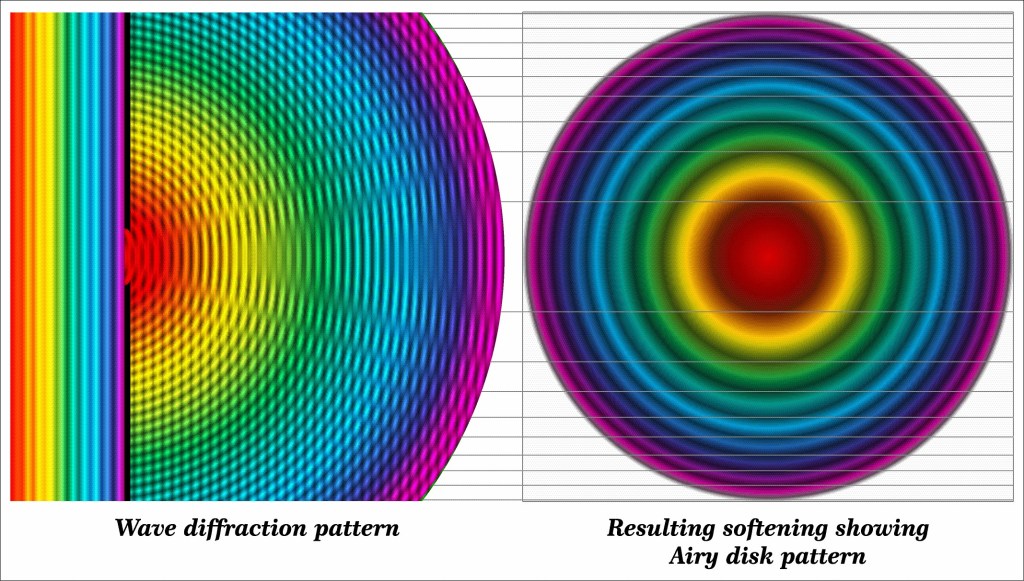
When you jump and play in a lake, when raindrops fall on a lake or a pond you’ll see concentric circles. You see concentric circles on a tree stumps, when you cut an onion, some flower petals, spiderwebs, etc. Concentric circles are everywhere in nature. Light can create concentric circles due to diffraction called an airy disk. Gravitational waves originating from, for example, two black holes colliding create 3D gravitational concentric circles/spheres traveling at the speed of light through space.

Concentric circles are very common in nature. You can see them in Kevin’s picture above. You can see them below my son as he falls into the Swedish lake, and you can see them in the pictures of light below. Whenever waves originate at a point and spread outward you get concentric circles.

There are many kinds of waves, water waves, sound waves, surface waves, seismic waves (earthquakes), mechanical waves, light are waves, electromagnetic waves, matter is both particles and waves, gravitational waves, and they can all make concentric circles. If the waves are moving outward with the same velocity in all directions, you will get equidistant concentric circles.

A real Airy disk created by passing a red laser beam through a 90-micrometre pinhole aperture with 27 orders of diffraction | Freedom to Roam and Concentric Circles
A real Airy disk created by passing a red laser beam through a 90-micrometre pinhole aperture with 27 orders of diffraction. Bautsch, CC0, via Wikimedia Commons
A computer generated an Airy disk from diffracted white light. The colorful light circles come from the hole in the left wall | Freedom to Roam and Concentric Circles
A computer generated an Airy disk from diffracted white light. The colorful light circles come from the hole in the left wall. Asset id: 1973771255 by Fouad A. Saad.
To see the Super Facts click here

The Surprising Monty Hall Problem

Superfact 22: Suppose you’re on a game show, and you’re given the choice between three doors: Behind one door is a car; behind the other two doors there are goats. You want to pick the car. You pick a door, and the host, who knows what’s behind the three doors, opens another door revealing a goat. Now the question is, is it to your advantage to switch door choice? The answer is yes. And that is the surprising Monty Hall Problem.

There is a blue door on the left, a red door in the middle, and a green door on the right | The Surprising Monty Hall Problem
The Monty Hall gameshow Three Doors Problem. There is a car behind one door, and goats behind the other two. You pick a door. Monty Hall, the gameshow host, opens one of the other doors and it has a goat. Should you change your choice of door? Yes, you should. But why? – Monty Hall Problem Stock Illustration ID: 1881849649 by SATYA94.

It is quite common to argue that it does not matter. You don’t know what is behind the two remaining doors so it should be 50/50 right? In a test involving 228 people only 13% chose to switch. However, you should switch.

Monty Hall, the gameshow host of the Let’s Make a Deal television game show, knows where the car is, so he never chooses the door with the car. And by curating the remaining two doors for you, he raises the odds that switching is always a good bet. By switching your choice, you have a 2/3 chance of winning the car but if you stay with your original choice, you only have a 1/3 chance of winning the car.

So why is this a super-fact? First, we know it is true. It is mathematically proven and experimentally verified that switching door is the best choice. Secondly, this was widely contested and is still surprising to people. Finally, probabilistic thinking is the key to being rational and making good decisions. This fact is true, important and disputed and thus a super fact.

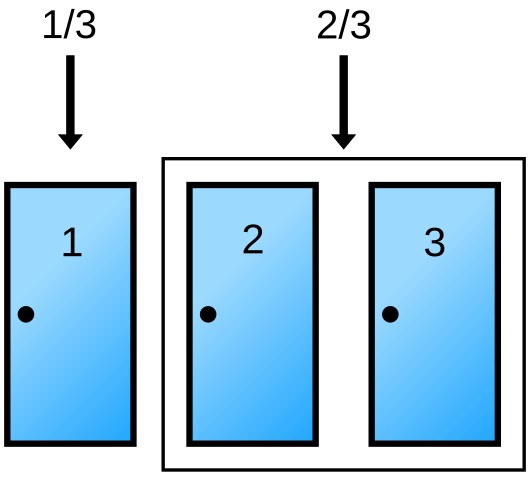
One way of viewing the situation is by noting that there is a 1/3 chance that the car is behind any door that the contestant picks and a 2/3 chance that the car is behind one of the other two doors.

The picture shows three doors, one marked 1/3 and two more grouped together under 2/3 | The Surprising Monty Hall Problem
The car has a 1/3 chance of being behind the contestant’s pick and a 2/3 chance of being behind the other two doors. Picture from Wikimedia commons public domain.

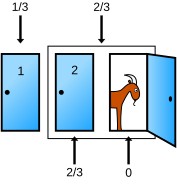
If Monty opens one of the two doors that the contestant did not pick there is still a 1/3 probability that the car is behind the door the contestant picked and a 2/3 chance that the car is behind one of the other two doors. However, one of the doors that the contestant did not pick is now known to feature a goat. Therefore, the probability that the car is behind the other door is 2/3.

The picture shows three doors, one marked 1/3 and two more grouped together under 2/3. The last door has a goat, and it is marked by 0. The door in the middle is marked by 2/3.
The host opens a door. The odds for the two sets don’t change but the odds become 0 for the open door and 2/3 for the closed door. Picture from Wikimedia commons public domain.

The table below is probably (no pun intended) a better way of illustrating the situation. In the table door 1 is the door designated to be the contestant’s first choice. Monty opens one of the remaining doors that has a goat behind it.

Behind door 1Behind door 2Behind door 3Result if staying at door 1Result if switching to door offered.
GoatGoatCarWins goatWins Car
GoatCarGoatWins goatWins Car
CarGoatGoatWins CarWins goat

There are various other ways of explaining the situation including Steven Pinker’s approach. It is easy to test this is real life and repeated experiments and simulations shown that if you switch you have a 2/3 chance of winning.

As an example of the controversy this probability puzzle caused was Marily Savant’s column in Parade Magazine. As a side note, Marilyn Vos Savant is the person who has the highest recorded intelligence quotient (IQ) as stated in the Guinness Book of Records. In response to a question regarding the Monty Hall game show problem she wrote that you should switch. She received letters from 10,000 readers disputing this, including 1,000 with PhDs. In the long run she prevailed.


To see the other Super Facts click here