Millions of species have been documented

Super fact 139 : 2.17 million species have been described but it is possible that as many as 20% of those are duplicates. However, most species are likely undiscovered.
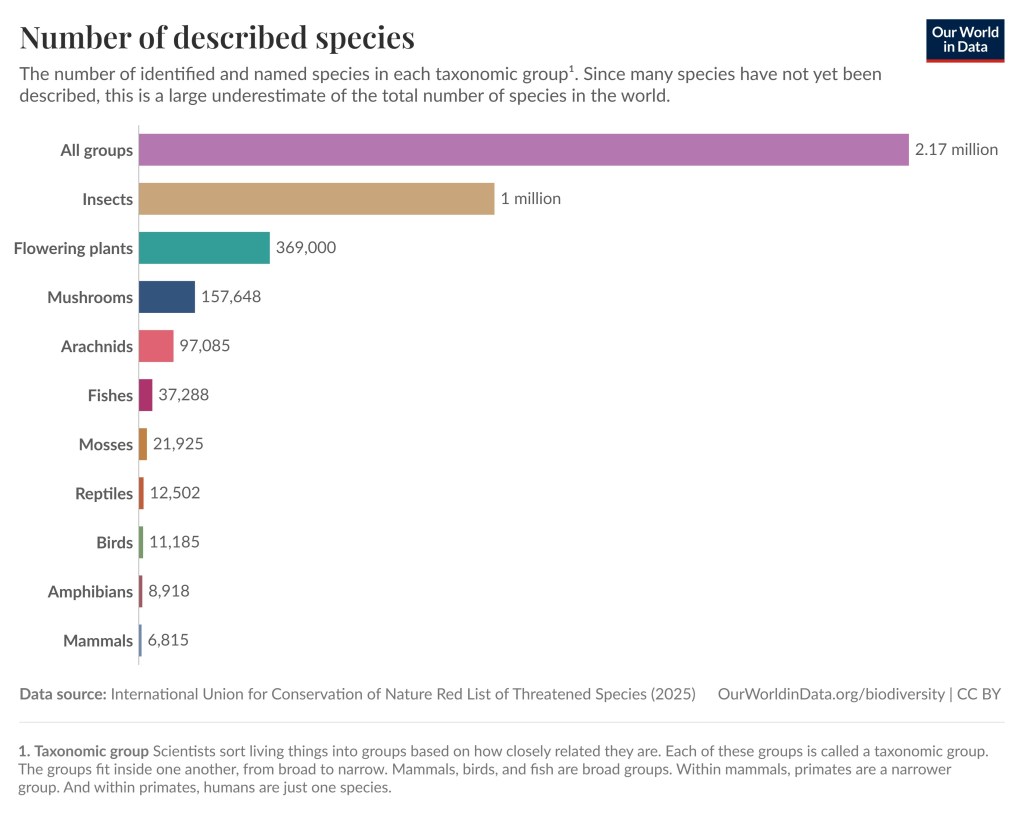
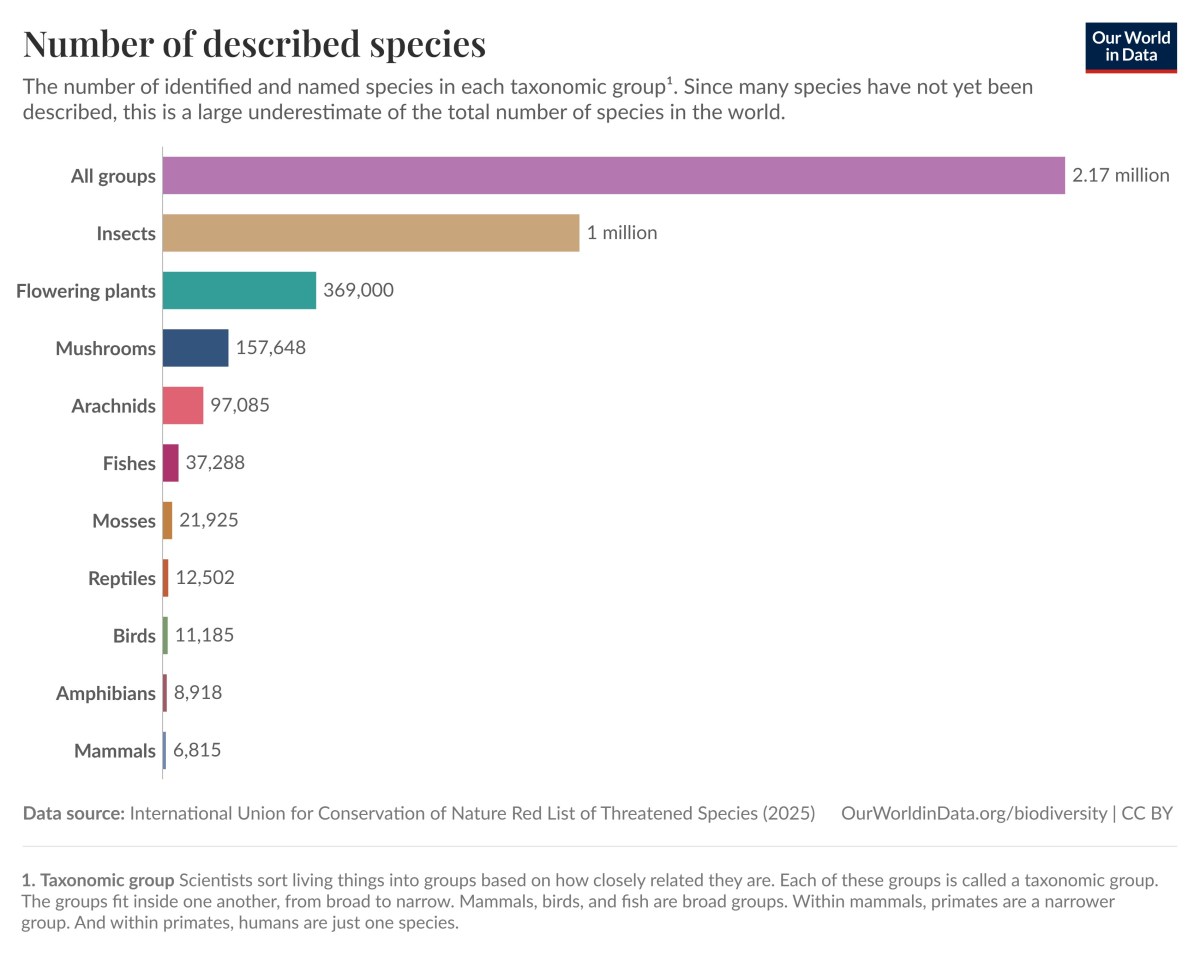
This bar graph feature ten taxonomic groups; Insects (1 million species), Flowering plants (369,000 species), Mushrooms (157,648 species), Arachnids (97,085 species), Fishes (37,288 species), Mosses (21,925 species), Reptiles (12,502 species), Birds (11,185 species), Amphibians (8,918 species), Mammals (6,815 species). | Millions of species have been documented
The number of identified and named species in each taxonomic group. Since many species have not yet been described, this is a large underestimate of the total number of species in the world. Note about Taxonomic group: Scientists sort living things into groups based on how closely related they are. Each of these groups is called a taxonomic group. The groups fit inside one another, from broad to narrow. Mammals, birds and fish are broad groups. Within mammals, primates are a narrower group. And within primates, humans are just one species. Data source: International Union for Conservation of Nature Red List of Threatened species (2025).  OurWorldinData.org/biodiversity | CC BY

As mentioned, a couple of million species have been named and identified. For a species to be formally described, it’s description must be published in a scientific journal or book. Considering this it is quite impressive that we’ve described millions of species, mostly insects and plants. However, according to science magazine the most likely number of species is in the range of 5 to 10 million eukaryotes. Eukaryotes are organisms consisting of complex cells with a membrane wrapped in nucleus and other internal compartments, which exclude viruses and bacteria.
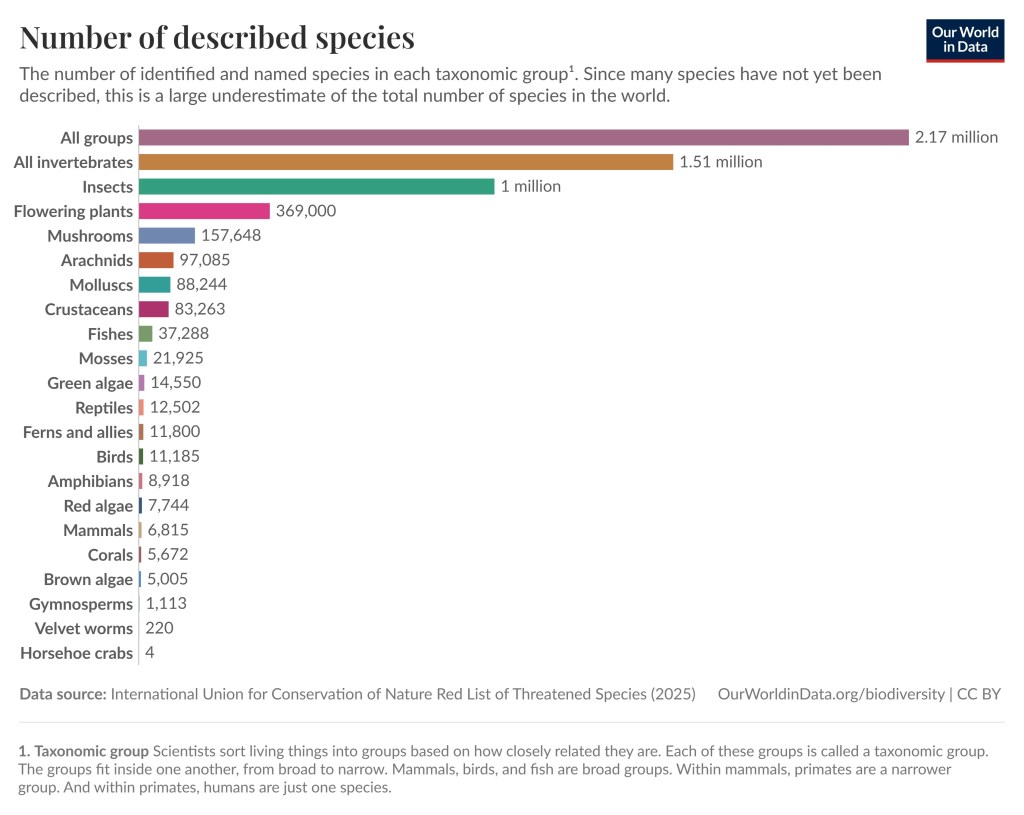
This bar graph feature ten taxonomic groups; Insects (1 million species), Flowering plants (369,000 species), Mushrooms (157,648 species), Arachnids (97,085 species), Molluscs (88,244 species), Crustaceans (83,263 species), Fishes (37,288 species), Mosses (21,925 species), Green algae (14,550 species), Reptiles (12,502 species), Ferns and allies (11,800 species), Birds (11,185 species), Amphibians (8,918 species), Red algae (7,744 species), Mammals (6,815 species), Corals (5,672 species), Brown algae (5,005 species), Gymnosperms (1,113 species), Velvet worms (220 species), Horshoe crabs (4 species), All invertebrates (1.51 million species), All groups (2.17 million species).
This graph includes a more complete set of taxonomic groups. Data source: International Union for Conservation of Nature Red List of Threatened species (2025).  OurWorldinData.org/biodiversity | CC BY

The fact that we have succeeded in describing two million species is impressive and surprising. That is a lot of work. The fact that there are likely millions of more species we haven’t found is equally surprising. There are surprisingly many species and unless you already knew this, this is surprising and perhaps mind-blowing information, and therefore a super fact.

Challenges in Defining a Species

Species is a unit of biological classification and it is the lowest taxonomic rank below genus. Species is often defined using the Biological Species Concept, which is defined as populations whose members can interbreed and produce fertile offspring, and are reproductively isolated from other groups. However, it is complicated. Asexual organisms, hybrids and ring species, and extinct species complicate things. Therefore, other ways of defining species exist.
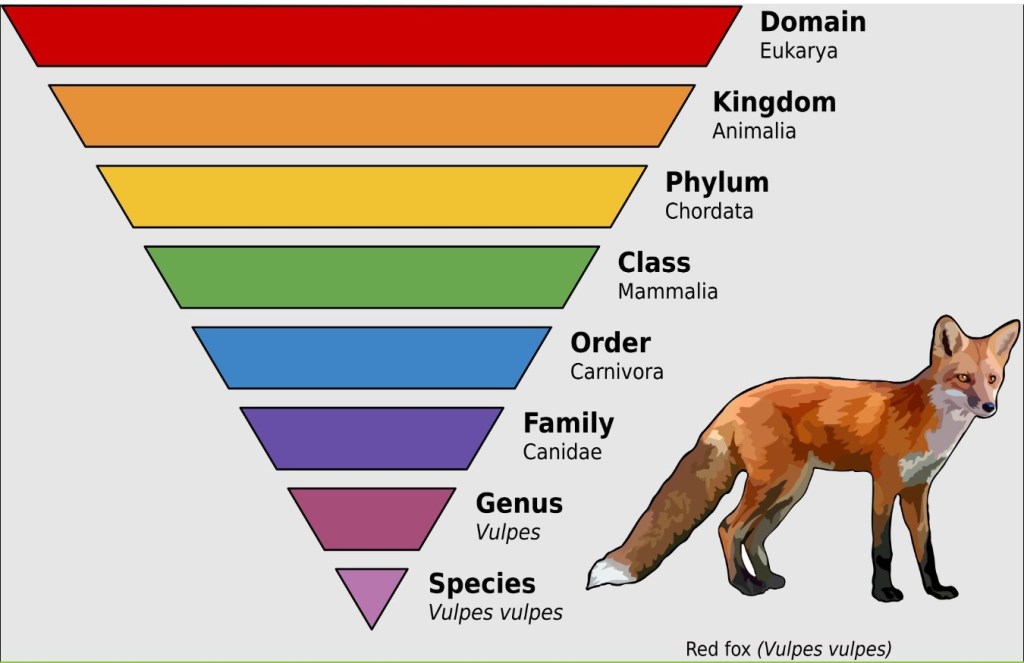
The picture shows a Red Fox with an upside down pyramid showing the different taxonomic ranks. Domain is at the top (Eukarya), Kingdom (Animalia), Phylym (Chordata), Class (Mammalia), Order (Carnivora), Family (Canidae), Genus (Vulpes), Species (Vulpes vulpes, which is the red fox). | Millions of species have been documented
The major ranks: domain, kingdom, phylum, class, order, family, genus, and species, applied to the red fox, Vulpes vulpes. Many classifications based on genetic analysis require more than these eight ranks, not all of which have distinct names. Annina Breen, CC BY-SA 4.0 <https://creativecommons.org/licenses/by-sa/4.0&gt;, via Wikimedia Commons.

To define a species, you can also use genetic similarity, unique ecological niches, unique common ancestors, distinct physical traits, size, shape, and structural features. In other words, species concept is not simple and defining a species requires expertise. This makes it even more impressive that we have identified and described two million species.

I should add that there are also subspecies. A subspecies is a distinct population within a species that lives in a specific geographic region and differs in physical traits from other populations of the same species, while still being able to interbreed with them. An example is the dog which is a subspecies of the gray wolf.

Ring Species

As mentioned, a common definition of species is that two animals belong to the same species if they can interbreed in nature and produce viable, fertile offspring. As I pointed out it is not always that simple. An animal A may be able to successfully interbreed with an animal B, and that animal B may be able to successfully interbreed with an animal C, but animal A and C cannot interbreed. Animal A could be said to be a different species relative to animal C, but animal B could be said to be the same species as both animal A & C using the definition above.

A great geography related example of this is ring species. In a ring species, gene flow occurs between neighboring populations of a species, but at the ends of the ring the populations don’t interbreed.
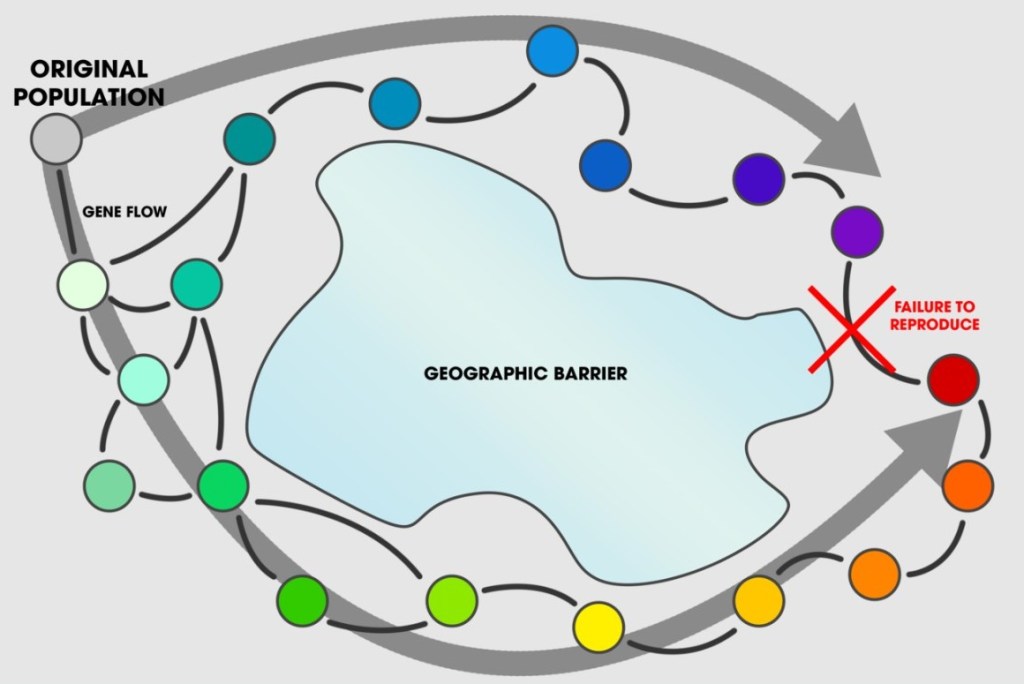
The picture depicts different subspecies as little colored circles centered around a big lake. The color changes a little bit at the time. All the circles next to each other can interbreed.
Illustration of ring species, an example of how speciation can be relative. All the circles next to each other can interbreed but at the end it no longer works. Andrew Z. Colvin, CC BY-SA 4.0 <https://creativecommons.org/licenses/by-sa/4.0&gt;, via Wikimedia Commons

Other Super Facts Related to Wildlife

A couple of interesting super facts related to species and wildlife are :

  • (70) The Wild Mammal Biomass Has Substantially Declined – click to visit
  • (71) The Extinction Rate is Much Higher Than the Natural Baseline Rate – click to visit

The first one is concerning the fact that we humans and our domesticated animals, cattle etc., have largely replaced wild animals and wild mammals. As the total biomass has increased the wild mammal biomass has decreased. The second super fact is about the current extinction rate being perhaps thousands of times higher than what is typical. A mass extinction event is often defined as when 75% of all species, or more, goes extinct within 2 million years. 200 years is only 0.01% of 2 million years so modern society has existed for an extremely short time. It is just a tiny blip on geological scales. So, even with an extinction rate thousands of times above normal, we haven’t gotten very far yet. Luckily, it looks like we might be turning things around, so perhaps we won’t be like the asteroid that exterminated the non-Avian dinosaurs.
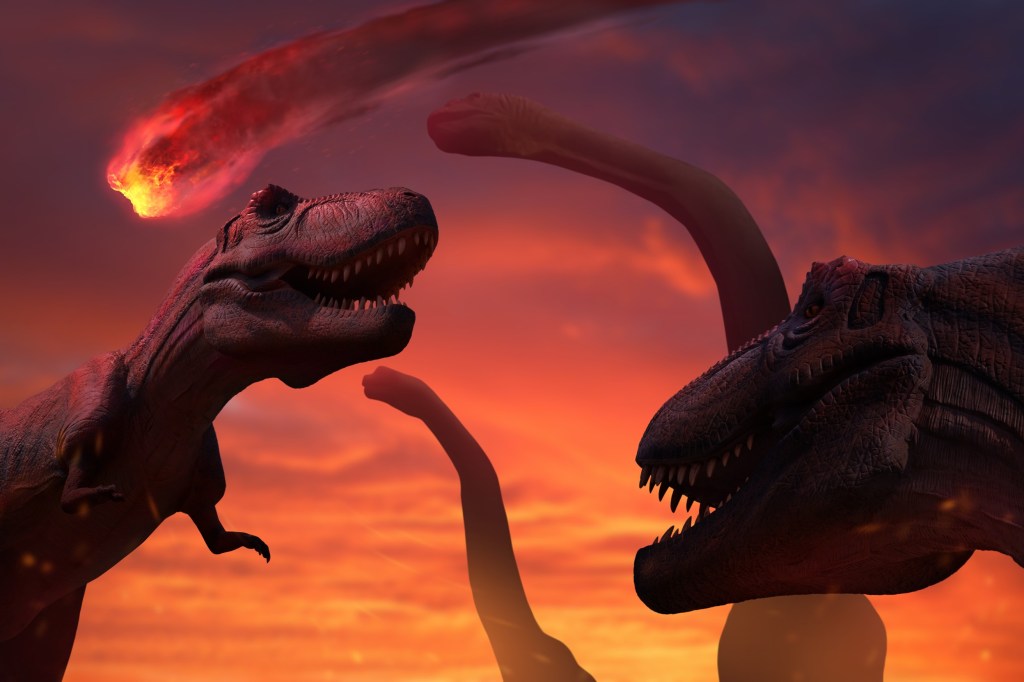
3D illustration showing two carnivorous dinosaurs and two large herbivores looking up at a burning asteroid. | Millions of species have been documented
Extinction of the dinosaurs when a large asteroid hits earth 66 million years ago. It was the last mass extinction event. Asset id: 2196200279 by funstarts33


To see the other Super Facts click here

Freedom to Roam and Concentric Circles

Image above by Kevin from The Beginning at Last

Water surrounded by trees, what looks like coniferous forest. There are circular ripples on the water with drops falling into the lake in the middle | Freedom to Roam and Concentric Circles
This picture reminded me of the Swedish lakes I used to swim in. This is a submission for Kevin’s No Theme Thursday

Freedom to Roam Everywhere

When I was a kid, I used to roam around a lot, in the forest and on the mountains, and I liked to swim and fish in the rivers and the famous deep lakes in the Swedish countryside. Sweden has 97,500 lakes larger than 2 acres and many of them are deep lakes with clean and clear water surrounded by forests, typically coniferous forests. A small deep clean forest lake is referred to as a “tjärn”. I can add that there are no alligators or venomous water snakes in Swedish lakes.

Sweden offers a type of freedom that is rare in the world, and it does not exist in the United States and certainly not in Texas where I live. It is the freedom to roam or more specifically allemansrätten. Whether the land is public or private you have the right to roam, to hike, to camp, to swim, to pick wild berries, to pick wild mushrooms, to fish, and no one can stop you. Landowners are not allowed to tell you to get off their land and they cannot put up fences to stop you or animals from roaming on their land. Everyone has the right to roam and swim everywhere. It is a freedom Swedes love, and if you one day come to experience it you will know why.

My son letting of a swing tire. There are ripples on the lake beneath him. You can see trees on the other side of the lake.
My son is jumping off a tire swing and into a “tjärn” in northern Sweden.

Allemansrätten

The Swedish freedom to roam or allemansrätten, is a right for all people to travel over private land in nature, to temporarily stay there and, for example, pick wild berries, mushrooms, flowers and certain other plants. It is important to point out that you must respect the landowner’s property. You can pick wild berries but not anything the landowner is growing. You cannot destroy or break things or start fires, use ATVs, cut branches off trees, etc. You also need to stay 70 meters or 230 feet away from any dwelling.

As a landowner in Sweden, you can buy land and use it for farming and forestry, and you have the right to prevent people from damaging or stealing your crops. You can buy land for mining, and you have the right to your proceeds and the right to prevent people from stealing from your mines. In addition, people don’t have the right to get close to your house. However, you do not have the right to prevent anyone from roaming on your land.

Other countries with similar laws are Norway, Finland and Iceland. Limited forms of allemansrätten exist in Austria, Germany, Estonia, France, the Czeck Republic, and Switzerland. In the United States, where  allemansrätten does not exist, 63% of all land is private and in Texas 93% of all land is private. Since there is no law in the US protecting your freedom to roam there is noticeably something missing, especially if you are an outdoors person.

Concentric Circles

In addition to evoking my memories of Swedish lakes and allemansrätten, Kevin’s picture tickles my mathematical sense, specifically regarding concentric circles. Concentric circles are beautiful, dreamy, and interesting mathematical phenomena. I could watch concentric circles in the water all day long.

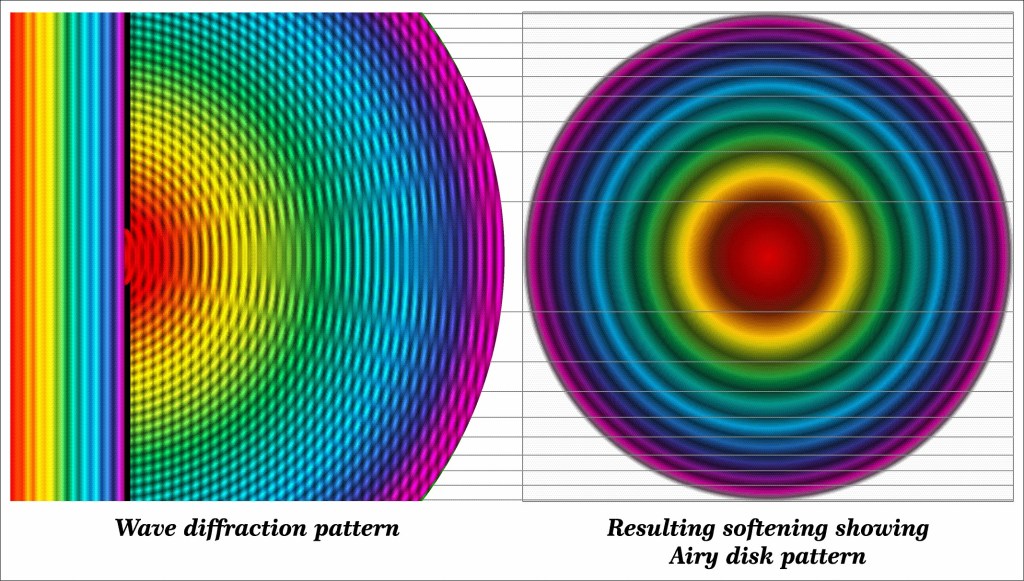
When you jump and play in a lake, when raindrops fall on a lake or a pond you’ll see concentric circles. You see concentric circles on a tree stumps, when you cut an onion, some flower petals, spiderwebs, etc. Concentric circles are everywhere in nature. Light can create concentric circles due to diffraction called an airy disk. Gravitational waves originating from, for example, two black holes colliding create 3D gravitational concentric circles/spheres traveling at the speed of light through space.

Concentric circles are very common in nature. You can see them in Kevin’s picture above. You can see them below my son as he falls into the Swedish lake, and you can see them in the pictures of light below. Whenever waves originate at a point and spread outward you get concentric circles.

There are many kinds of waves, water waves, sound waves, surface waves, seismic waves (earthquakes), mechanical waves, light are waves, electromagnetic waves, matter is both particles and waves, gravitational waves, and they can all make concentric circles. If the waves are moving outward with the same velocity in all directions, you will get equidistant concentric circles.

A real Airy disk created by passing a red laser beam through a 90-micrometre pinhole aperture with 27 orders of diffraction | Freedom to Roam and Concentric Circles
A real Airy disk created by passing a red laser beam through a 90-micrometre pinhole aperture with 27 orders of diffraction. Bautsch, CC0, via Wikimedia Commons
A computer generated an Airy disk from diffracted white light. The colorful light circles come from the hole in the left wall | Freedom to Roam and Concentric Circles
A computer generated an Airy disk from diffracted white light. The colorful light circles come from the hole in the left wall. Asset id: 1973771255 by Fouad A. Saad.
To see the Super Facts click here

There are flying Turkeys

Superfact 20: Domesticated Turkeys and Wild Turkeys are the same species, but Wild Turkeys can fly. So yes, there are flying turkeys.

I think this is a super-fact, because the Turkey is a very important bird to Americans and at the same time a lot of people, including Americans, do not know that Turkeys are not flightless birds.

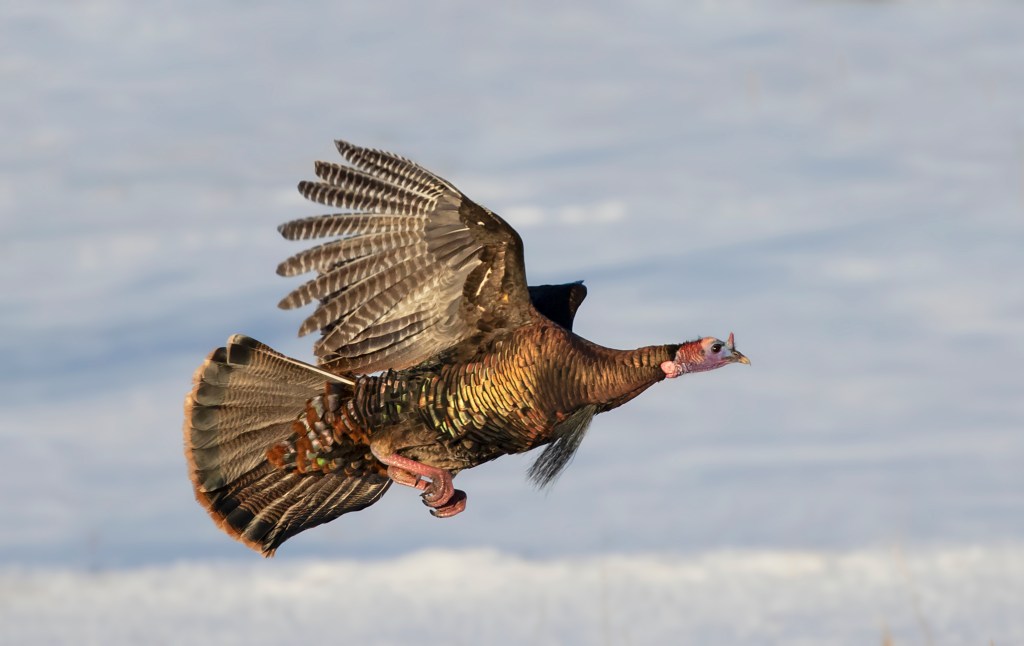
Domesticated turkeys are flightless but wild turkeys are not flightless. Wild turkeys can fly distances of more than a mile, sometimes at speeds of 55 miles per hour. I’ve seen it with my own eyes on turkey hunts. I’ve seen turkeys fly and glide across the sky at the height of 30-50 feet. I’ve seen them flap their wings and then take off.

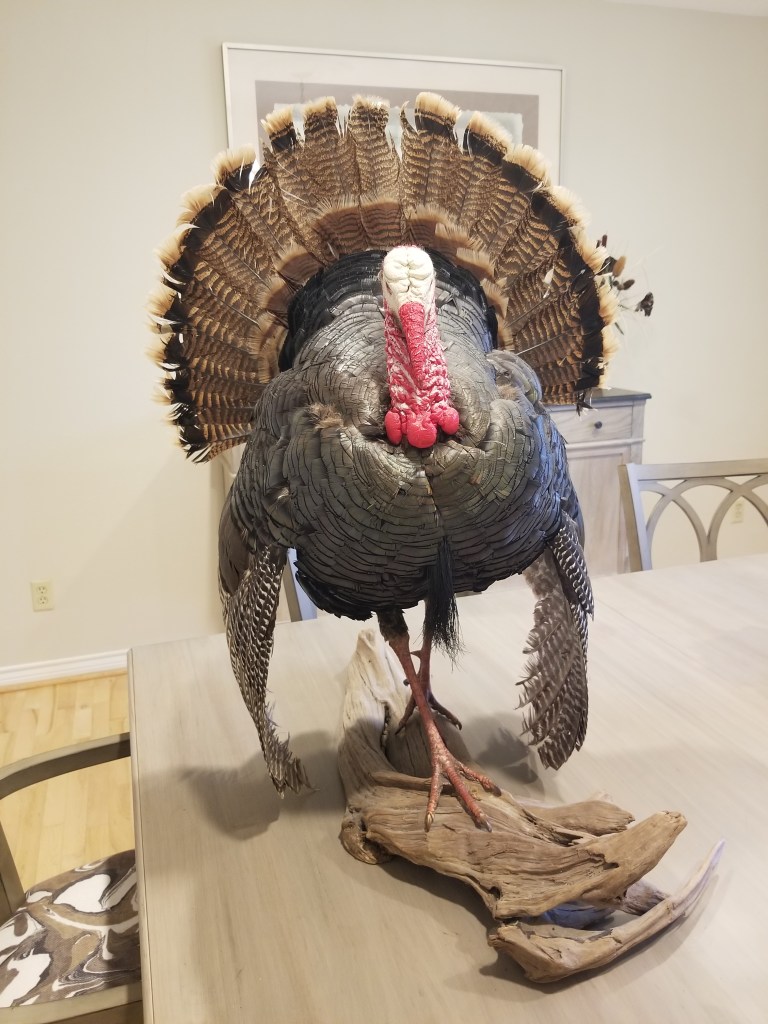
A standing male turkey with a white head, red neck, and fluffed up feathers | There are flying Turkeys
The turkey my oldest son shot when he was 11 years old.
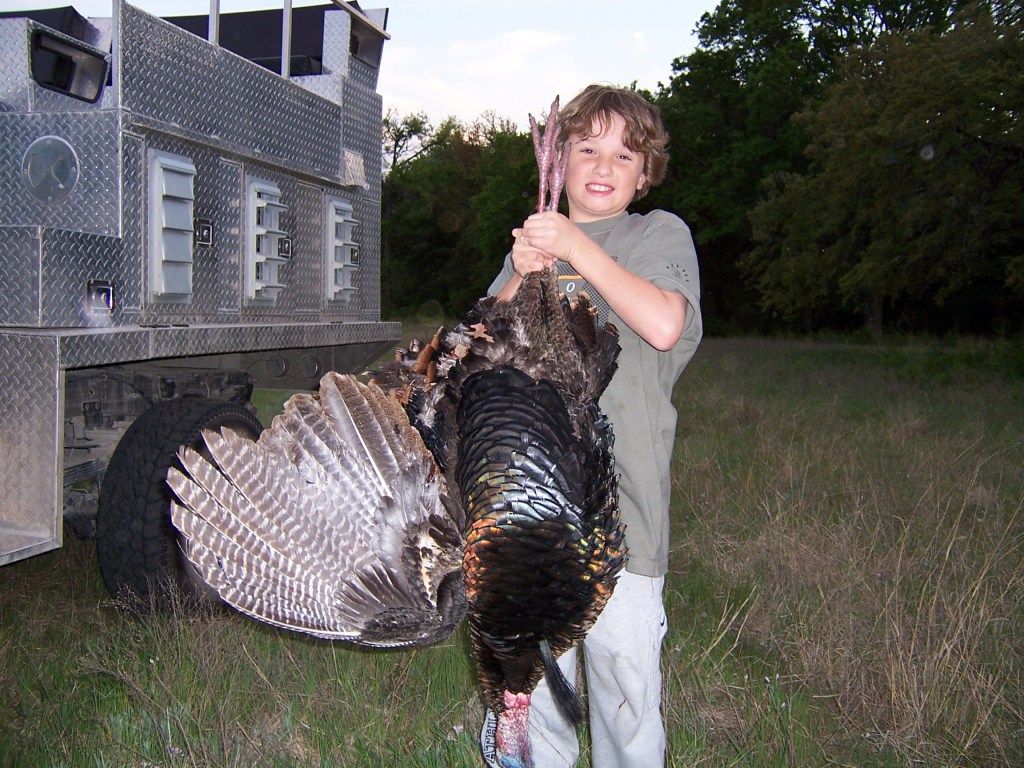
My son is standing next to truck holding a dead turkey by the legs.
My son holding the turkey he shot.

The photo above is a Tom, a male turkey, that my oldest son shot when he was 11 years old. Male turkeys are called Toms and females hens. We took it to a taxidermist for preservation and mounting. I should add that we typically ate the meat of everything we shot. Taking a wild turkey to the taxidermist makes eating the animal more complicated but you can typically ask for the breast meat of the turkey.

Personally, I think that legal hunting is a lot more humane than eating meat from animals from factory farms.

A male turkey in the middle of flight | There are flying Turkeys
Eastern Wild Turkey Meleagris gallopavo flying over the snow in Ottawa, Canada Stock Photo ID: 1358163995 by Jim Cumming.

I should add that legal hunting is often encouraged for conservation and population management. For example, moose are hunted in Sweden (my native country) to manage their large population (400,000 moose), which can cause damage to forests and agriculture, as well as starvation among moose, if not managed. Illegal hunting, on the other hand, is something nefarious. Below is a video showing wild turkeys flying (video is about one minute long).


I wish everyone a very happy Thanksgiving


To see the other Super Facts click here


Grizzly 399 is dead

I just read the sad news 399, a female grizzly bear named after her tag number died on Tuesday October 22 at the age of 28. She was hit by a car. They are looking for her cubs. Grizzly bear 399 was arguably the most famous grizzly bear in the United States. Unlike the typical bear, Grizzly 399 regularly gave birth to triplets rather than twins.

She lived in the Yellowstone and Grand Teton national park area, near Snake River, and she was seen and admired by thousands of visitors. Her Instagram account has 55,000 followers, books were written about her and documentaries were made. She had 22 cubs throughout her life.

Grizzly 399 in the meadow. She is followed by her three cubs | Grizzly 399 is dead
Grizzly 399 with three cubs. Photo from Wikipedia by StevenPDeVries, CC BY-SA 4.0 <https://creativecommons.org/licenses/by-sa/4.0&gt;, via Wikimedia Commons

She is special to me because we also encountered her and three of her cubs during a visit to Grand Teton national park in 2007. It was a school trip organized by the math teacher and each kid was accompanied by at least one parent to give the math teacher a break. Grizzly 399 gave us a very memorable experience.

Photo including a somewhat turbulent Snake River with the Teton mountain range in the background.
My photo of the Teton mountain range taken from Snake River.

Grizzly 399 frequently sought human company. She came down to the roads with her cubs and stayed with the passersby for hours. She did not beg for food. She just wanted to stay with people and this article describes her as a gentle soul.

Grizzly bears seeking human company is normally a dangerous situation and grizzly bears seeking human company are therefore often shot to protect the public. Grizzlies are dangerous animals. They can kill people both out of aggression and for food. However, the park rangers left Grizzly 399 and her cubs alone because they deemed her harmless. She frequently interacted with people without ever showing any aggression towards people.

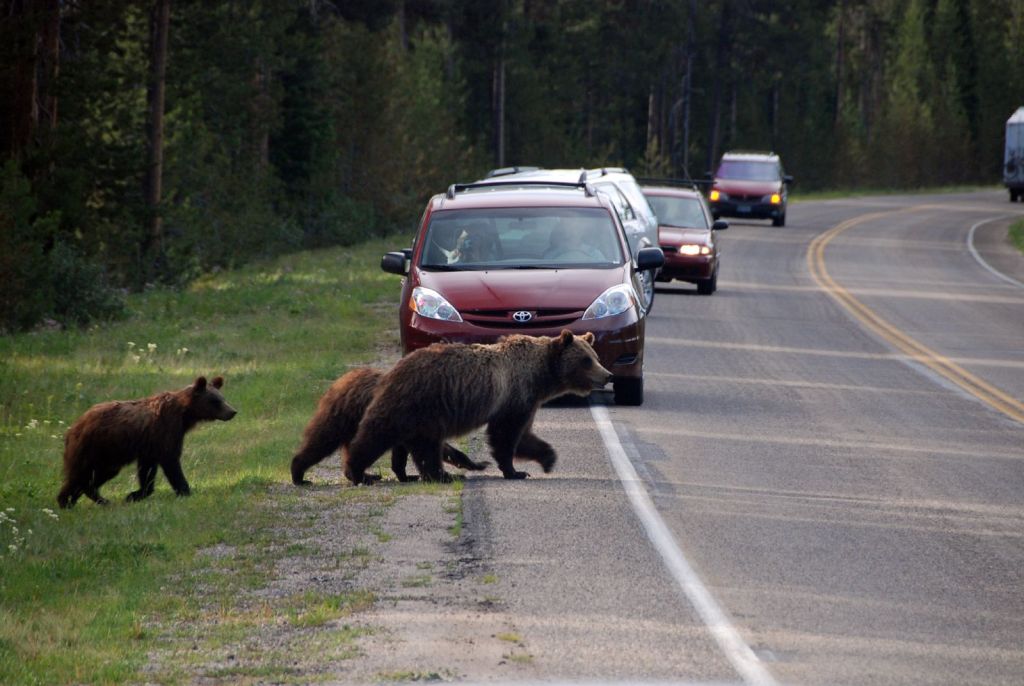
Four cars that are stopped on the road letting the grizzlies cross the road.
A photo of Grizzly 399 and a couple of her cubs taken in June 2007 by fellow trip participant Gabriel Goncalves.

Her behavior was somewhat strange, but I was told by a ranger that male grizzlies sometimes kill cubs, and this was her way of protecting the cubs. Grizzlies tend to stay away from people, except her, so she used people as a shield to protect her cubs.

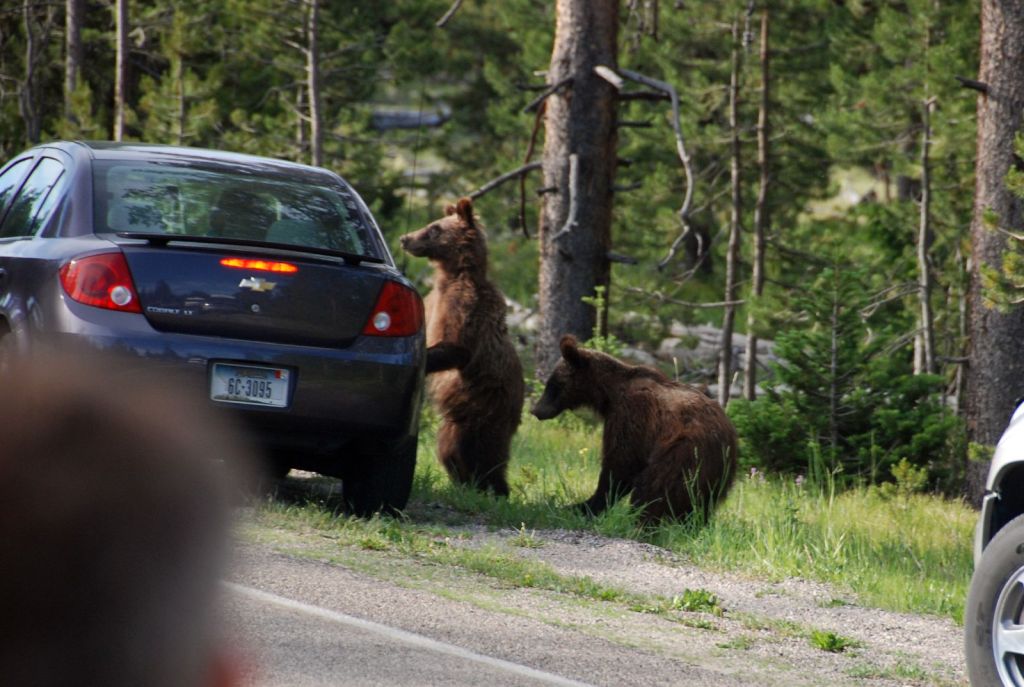
One grizzly cub is looking in the window of a blue car. The other one is right behind.
A photo of two of 399’s cubs. The photo was taken in June 2007 by a fellow trip participant Gabriel Goncalves.

One ranger told us a story about 399 that sounded a bit scary. A hiker, hiking alone (which you should not do) stumbled upon 399 and her cubs as they were in the middle of eating an Elk carcass. He had come out of a thicket and had not seen them until he essentially bumped into them. He screamed on top of his lungs because he was shocked and started running. 399, who was equally startled, pursued him. He laid down on the ground as he had read that he should do when pursued by a grizzly. 399, sniffed him but did not touch him. Her two cubs bit his behind but not hard.

After the grizzlies had left, he stood up, walked away and went to a hospital to check out the bites on his bum, which allegedly were not bad.

Shrubs, bushes and trees and a grizzly bear walking in the middle. There are cubs behind her, still in the bushes | Grizzly 399 is dead
399 is approaching the road. Her cubs are in the background. The photo was taken in June 2007 by a fellow trip participant Gabriel Goncalves.

As for us, we had a somewhat scary experience with Grizzly 399, but as it turned out, we were never in any danger. Someone that he had seen enough and decided to leave, so he drove his car, with a trailer in between 399 and her cubs. Someone rightly thought that was dumb and decided to improve the situation by angrily honking.

As a result, 399 started running towards us, the large group of tourists standing outside taking pictures. People started screaming and running, and unfortunately the math teacher who had organized the trip fell and got trampled by the panicking people.

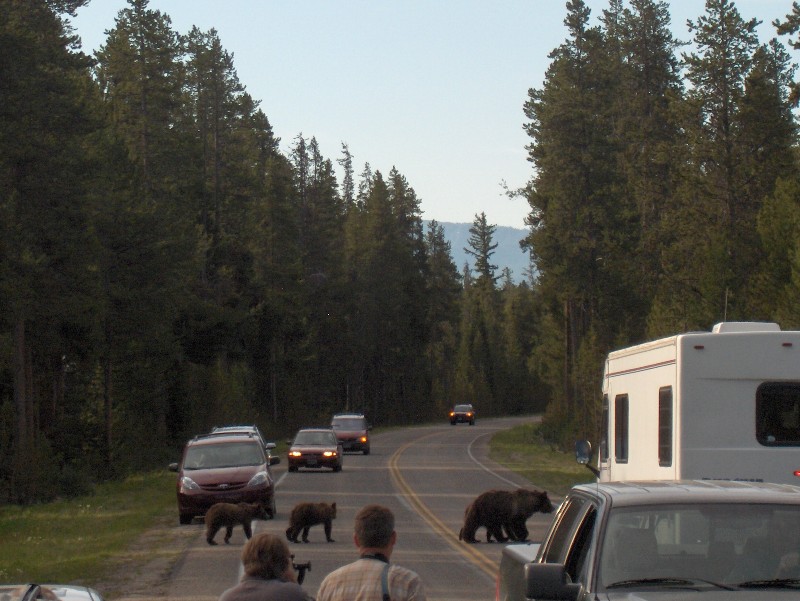
Six cars a car with a big trailer and a grizzly mother and three cubs on the road | Grizzly 399 is dead
399 is crossing the road with her cubs. The photo was taken in June 2007 by a fellow trip participant Gary Weinstein.

A lot of other things happened during the panic. People ran back to their cars or to any car. A couple of my fellow trip participants found themselves blocked from entering their own car (on the side away from the bear) because a plus sized lady was stuck in their door.

By pushing her from behind they were able to get her inside and could then enter the car themselves. The kids were standing on top of the SUVs that we had rented and crawled back into the cars through the sunroofs. My son entered the car last by his own choice.

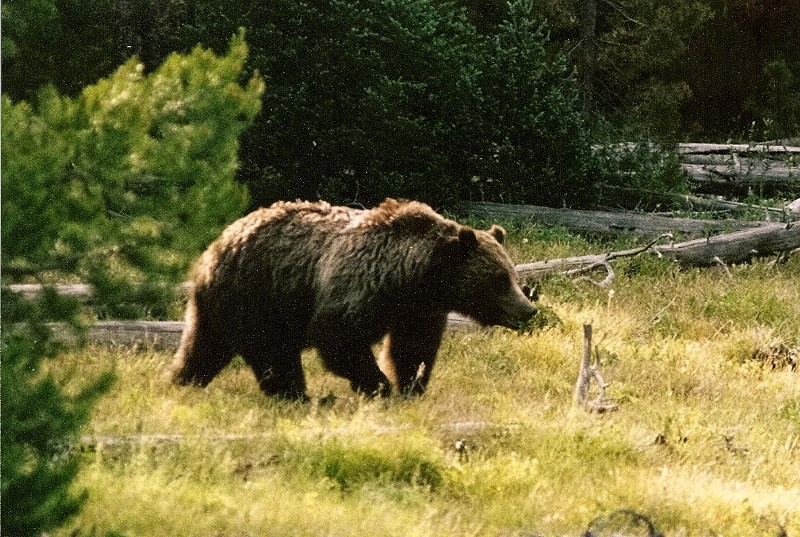
A grizzly bear is walking out of the thicket in a forest nearby the road | Grizzly 399 is dead
The math teacher, Frank Jordan, took this photo of 399.

As it turned out the panic was completely unnecessary. 399 was not chasing anyone and was not really running towards us. She was running to the end of the car with the trailer to get around it to get to her cubs on the other side. Below are a few more photos taken by my fellow trip participants. I did not get good photos of this event, so I am not including them.

Cars a trailer, and grizzly mother with her cubs on the road | Grizzly 399 is dead
399 and her cubs amongst the cars. The photo was taken in June 2007 by a fellow trip participant Carl Ondracek.
Grand Teton and a few other mountains in the Teton range reflected in a lake.
A view of the Teton Mountain range. The big mountain is Grand Teton. The photo was taken in June 2007 by a fellow trip participant Gabriel Goncalves.
The Teton range towering an island is reflected in a lake.
Jackson Lake, an island and the Teton Mountain range in the background. The photo was taken in June 2007 by a fellow trip participant Gabriel Goncalves.

To see the Super Facts click here