Relativity Visualized by Lewis Carroll Epstein

The goal of this blog is to create a list of what I call super facts. Super facts are important and true facts that are nevertheless highly surprising to many or disputed or misunderstood by many. In a sense this is a myth busting blog regarding important information. However, I also make posts that are not super facts but feature other interesting information, such as this book review and book recommendation.

Relativity Visualized by Lewis Carroll Epstein

Lewis Carroll Epstein <<Link-1>> is a physicist, teacher and author who has written a number of physics books for layman. He is somewhat famous for coming up with ingenious ways of using diagrams, pictures and puzzles to explain complex matters without using mathematics. His approach is unorthodox but, in my opinion, quite successful. You still have to invest time in reading this 200-page long book and solving most of the puzzles to understand what is going on. The book features some math, notably regarding the derivation of the formula for energy-mass equivalency E = mc2. However, it is in a special section for “teachers only”.

It is an old book and the only version currently available on Amazon is the paperback version. The publisher of the paperback is Insight Press; First Edition (January 1, 1985), ASIN : 093521805X, ISBN-13 : 978-0935218053, 206 pages, item weight : 12.8 ounces, dimensions : 6.25 x 0.75 x 9 inches. It costs $48.99 on US Amazon. Click here to order it from Amazon.com.

The front cover features the title “Relativity Visualized” and the author’s name and in the background is the night sky with the milky way. At the bottom of the front cover is a train with a head lamp and a light beam | Relativity Visualized by Lewis Carroll Epstein
Front cover of the paperback version of Relativity Visualized by Lewis Carroll Epstein. Click on the image to go to the Amazon page for the paperback version of the book.

Amazon’s Description of the Relativity Visualized By Lewis Carroll Epstein

Perfect for those interested in physics but who are not physicists or mathematicians, this book makes relativity so simple that a child can understand it. By replacing equations with diagrams, the book allows non-specialist readers to fully understand the concepts in relativity without the slow, painful progress so often associated with a complicated scientific subject. It allows readers not only to know how relativity works, but also to intuitively understand it.

This is my five-star review for Relativity Visualized

Note, I wrote this review in 2016, so it is relatively old, pun intended. In my original Amazon review I used very large paragraphs. I have changed that by breaking up the paragraphs a bit but without changing the content in any way.

Relatively Intuitive

In my opinion the theories of relativity are among the most interesting intellectual achievements in human history. They revolutionized physics and changed the way we think about physics, space, time, mass, energy, electromagnetism and essentially everything in nature. Despite that fact, the theories of relativity are deterministic and possible to visualize, and unlike Quantum Physics they are not statistical in nature and they don’t have a big issue with interpretation.

I’ve been interested in this topic ever since I came across it as a high school student. Therefore, I did not learn a lot about relativity from this book. I was more interested in the approach to explaining it, and I think his approach is a very good one.

I’ve found that an explanation for relativity that lacks rigor and quantitative reasoning creates misconceptions. The reader may end up thinking he understands it when he doesn’t. I’ve also found that books that focus on deriving complex equations were not only unattainable to the layman but sometimes left the mathematically inclined student with a poor understanding of relativity as well.

Lewis Carroll Epstein’s book “Relativity Visualized” seems to succeed in making relativity accessible to both the layman and those who are mathematically inclined. He explains the special theory of relativity and the general theory of relativity using graphs, visual constructs, and logical puzzles that the reader solves for himself. In a sense he allows the reader to develop the theories of relativity on his own. He avoids equations and formulas, but the reader will still discover more exactly what is going on.

One thing that really impressed me with this book is its special focus on the difference between what you see/experience and what you measure. As an example, take two lights that flash at the same time (in your reference frame). They could appear to flash at different times if the distance between them is large. So, you will see them flash at different times. However, if you time the light flashes and take the distance into account you can measure that they flashed at the same time (non-relativistic situation).

In relativity the differences you measure between frames do not only arise from the distance the light travels or from Doppler Effects but also from the relativity of time and space as well, and Epstein explains the details without confusing the reader. He focuses a lot on simultaneity/non-simultaneity right from the very beginning, and in my opinion understanding relativistic non-simultaneity is crucial to understanding what is going on.

The book also discusses the General Theory of Relativity. The General Theory of Relativity is often seen as completely off limits to the layman. It is typically explained using complex tensor calculus, differential geometry, and topology, or alternatively in a non-technical vague way that leaves the reader clueless. General Relativity was born out of an enigma. Special relativity had shown that energy and mass are the same things, so light has mass. A light beam traveling through a gravitational field must thus bend.

However, that means that the side of the light closer to the mass will travel a shorter distance. From known properties of light (always a transverse/orthogonal wave) this means that the side of the light beam closer to the mass moves slower than the outer rim which would violate the constancy of the speed of light in vacuum.

To solve this enigma Einstein had to introduce a time warp in gravitational fields. Later he discovered that this time warp would cause objects to fall towards the masses that caused the time warp and the practical effect of this turned out to be essentially identical to Newton’s theory of gravity and thus the mysterious force of gravity could be removed. Einstein also discovered that there is a warp effect on space which is negligible unless the speed of the objects is large (like magnetism for electric forces). The book helps you visualize all of this without using complex math.

Lewis Carroll Epstein’s book contains unique pedagogic approaches, novel geometric representations of relativity, as well as engaging questions and answers. For this reason, the book is fiercely protected by copyright law. On the negative side, his writing style is somewhat rigid and old fashioned, the drawings and the graphics are sometimes of low quality, and the book might be quite a bit of work for the layman reader, so it requires that you are really interested. However, overall, this is a very rigorous, detailed, correct, and yet entertaining book that I highly recommend.

Good Myths

I also would like to mention another tool that Lewis Carroll Epstein use in his book, and that is the concept of a Good Myth. A Good Myth is a description that isn’t technical and maybe not exact but that isn’t wrong either. In a loose way it captures the truth of what is going on.

An example of one of these myths is that everything, including all of us, is always traveling through time and space at exactly the speed of light in vacuum. In other words, we are all traveling at the speed of c = 299,792,458 meters per second. If we are sitting still, then we are traveling through time at the speed of light. If we are traveling through space at the speed of light then we are not traveling through time at all, like photons, for which time does not exist.

If we are traveling through space at a high speed, then if we add, in a vector way (Pythagoras theorem), our speed in space to our speed in time, they together will add up to the speed of light in vacuum. But that means that we are traveling through time at a speed that is less than the speed of light. So, our clocks will run slower.

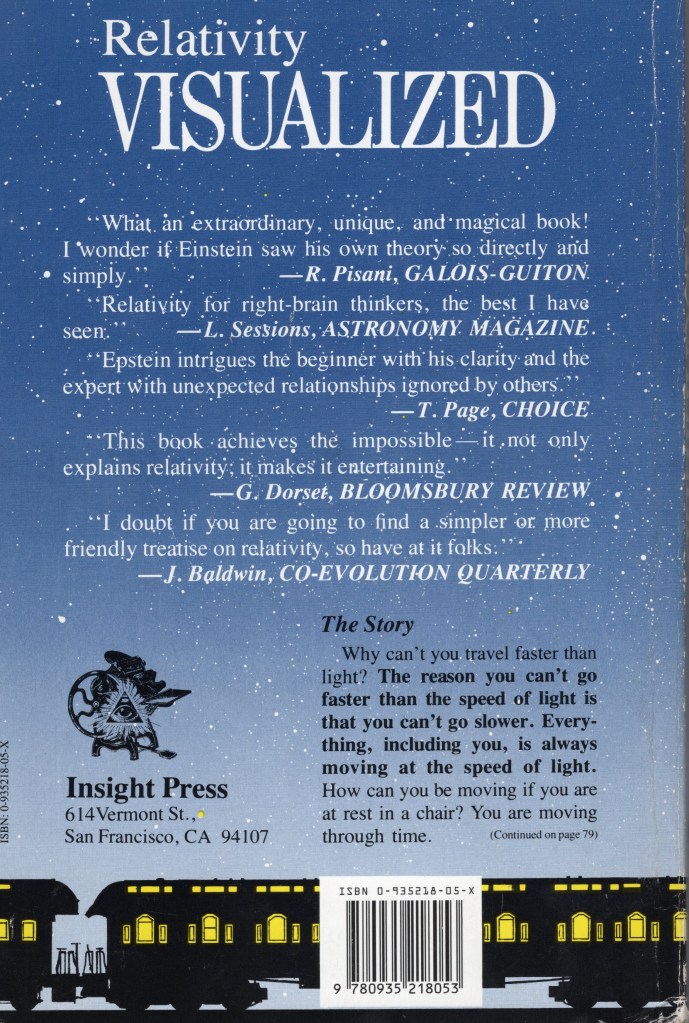
The back cover features the title of the book, praise for the book and very brief description | Relativity Visualized by Lewis Carroll Epstein
Back cover of the paperback version of Relativity Visualized by Lewis Carroll Epstein.

Other Posts on Relativity

Below is a list of other posts I made on Relativity

  • The Speed of Light In Vacuum Is a Universal Constant : to see post click here
  • Two events may be simultaneous for some but not for others : to see post click here
  • Time Dilation Goes Both Ways : to see post click here
  • The Pole-Barn Paradox and Solution : to see post click here
  • Book-Review : The Special Theory of Relativity by David Bohm : to see post click here

Do you feel that you are traveling through time at the speed of light?

To see the Super Facts click here

The Pole-Barn Paradox and Solution

Super fact 39 : Relativistic length contraction goes both ways. If two observers are moving compared to each other both will observe the length of the objects in the other’s system to be shorter in the direction of motion. The first observer will think that a yard stick in the second observer’s frame will be shorter whilst the second observer will think that the yard stick in the first observer’s frame is the shorter one.

Assume a pole and a barn are of equal length when both objects are stationary. If the pole is moving (at a high speed) compared to the barn, then the pole will be shorter than the barn from the barn’s perspective but longer than the barn from the pole’s perspective. Does the pole fit inside the barn or not? This is referred to as the pole-barn paradox, or the barn-door paradox, or the ladder paradox (if a ladder is used instead of a pole).

I call this conundrum a super fact because whilst most people have heard of relativistic time dilation and perhaps length contraction, the fact that it goes both ways comes as a surprising head scratcher. The situation is analogous to my super fact post “Time Dilation Goes Both Ways” where I state:

Super fact 38 : If two observers are moving compared to each other both will observe the other’s time as being slower. In other words, both observers will observe the other’s clocks as ticking slower. Time slowing down is referred to as Time Dilation. And this post is about how time dilation goes both ways.

Both the time dilation paradox and the pole-barn paradox are solved by the non-simultaneity in relativity. However, the pole-barn paradox is more concrete and perhaps more in your face. You can easily imagine the problematic paradox.

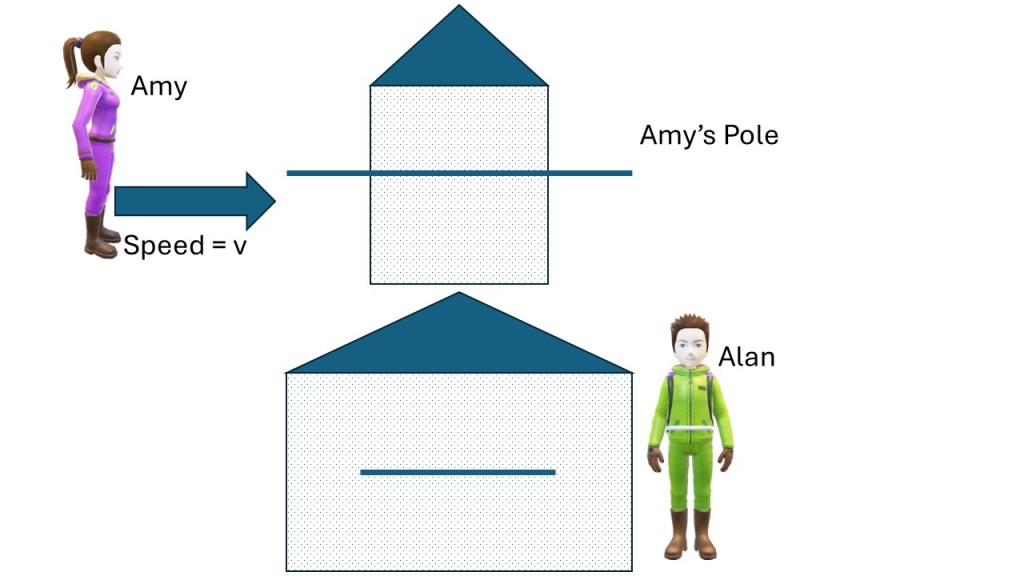
A picture of a girl, Amy who is speeding past a man, Alan and his barn. Amy has a pole. The pole is contracted along the direction of motion from Alan’s perspective and the barn is shorter along the direction of motion from Amy’s perspective | The Pole-Barn Paradox and Solution
Amy is speeding past Alan and his barn at a high speed. Amy has a pole. Because of the high-speed Amy’s pole appears shortened and will easily fit in Alan’s barn. However, to Amy it is Alan’s barn that is contracted, and her pole has the normal length and will therefore not fit in Alan’s barn.

Postulates of Special Relativity

The two postulates of special relativity are:

  • The laws of physics are the same in all inertial frames of reference. An inertial frame is a system that moves at a constant velocity.
  • The speed of light in a vacuum is constant for all observers, regardless of the motion of the light source.

The first postulate is called the principle of relativity and goes all the way back to Galileo Galilei. It means that no experiment can determine whether you are at rest or moving at a constant velocity. The reciprocity of length contraction follows from this postulate. If the length of the pole in the example above is half as long as the barn in both the barn frame and the pole frame then you could tell who was standing still and who was moving from that fact, and that violates the first postulate. The first postulate demands that if the pole is half as long in the barn frame and that the barn is half as long in the pole frame.

The second postulate is the more shocking one and is special to relativity. It was discovered experimentally at the end of the 19th century but was too difficult for scientists to accept at first so various ad hoc explanations were put forth to explain it away, until the theories of relativity were created. I designated this postulate as my super fact #4 and you can read about it here.

Length Contraction

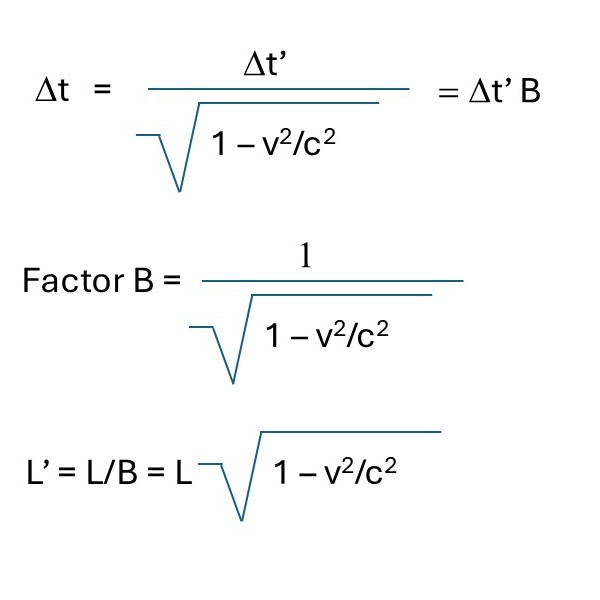
Time dilation means that a time interval between two events in a certain frame is longer by a factor B in a frame moving relative to the first frame (see picture below). Let’s imagine Amy moving at the speed v compared to Alan and his barn. Amy passes the left side of the barn at a certain time and soon after the right side. The time difference from Alan’s perspective is T and the width of the barn is L, so L = vT. From Amy’s perspective the time difference is T’ and width of the barn L’ and L’ = vT’. We denote Amy’s measurements with a prime. Note the velocity must be the same in both systems. However, Amy’s clock ticks slower (from Alan’s perspective) so T’ = BT or T = T’/B (time dilation). So, L’ = vT’ = vT/B = L/B.

If the derivation of the formulas above is confusing to you, ignore the math, and just remember that Alan measures a shorter time for the passing of the pole (because Amy’s clock is slower) from his perspective and therefore the pole must be shorter as measured from his system. If Alan measures two seconds for the passing of the pole than Amy measures maybe four seconds. It is Amy’s pole, so her longer measurement corresponds to the proper length of the pole whilst Alan’s measurement is the contracted length. Note the length contraction can only happen along the direction of motion, not perpendicular to it. To read more about length contraction click here.

This picture shows the formula for time dilation, the expression for the beta factor, and the formula for length contraction | The Pole-Barn Paradox and Solution
The beta factor used in the formula for time dilation as well as length contraction.

Solution to the Pole-Barn Paradox

So, Amy’s pole cannot fit in Alan’s barn. The pole is moving fast so it must move in and out of the barn. Now let’s create the paradox. Imagine the barn having doors on each side that open for the moving pole and then close for a moment to entrap the pole and then they open as the pole leaves the barn. Here is the paradox, if they open and close at the same time, than the pole can be inside the barn (entrapped) from Alan’s perspective but not from Amy’s perspective. From Amy’s perspective the pole does not fit.

However, the solution to the paradox lies in “open and close at the same time”. If the doors open and close at the same time from Alan’s perspective, then they don’t open and close at the same time from Amy’s perspective.

From Amy’s perspective the door on the left side will open first and let the pole in and then after that the right door will open. After the pole has fully entered the barn and some of it is sticking out on the right-hand side then the left door will close but the door on the right will remain open  until the pole is entirely outside. Relativistic non-simultaneity solves the paradox.

A picture of a girl, Amy who is speeding past a man, Alan and his barn. Amy has a pole. The pole is contracted along the direction of motion from Alan’s perspective and the barn is shorter along the direction of motion from Amy’s perspective. There are two doors on each side of the barn. In Amy’s world the left door is open letting the pole into the barn, whilst the right door is closed. In Alan’s world both doors are close thus enclosing his shorter pole.
In Alan’s frame the doors can be closed at the same time and enclose Amy’s pole. In Amy’s frame the doors open and close to let the pole through but they don’t open and close at the same time.

Finally, below is a YouTube video that explains and solves the pole-barn / barn-door / ladder paradox simply and efficiently in a little over two minutes.

Book Recommendations on Relativity

To see the other Super Facts click here

Time Dilation Goes Both Ways

Super fact 38 : If two observers are moving compared to each other both will observe the other’s time as being slower. In other words, both observers will observe the other’s clocks as ticking slower. Time slowing down is referred to as Time Dilation. And this post is about how time dilation goes both ways.

A lot of people know that if someone moves very fast his clocks will run slower. That’s relativity. If someone speeds through space in a rocket ship, close to the speed of light his time will slow down. When one hour passes on earth only half an hour may pass in the rocket. What comes as a shock to many people is when they find out that the converse is also true. When one hour passes in the rocket only half an hour will pass on earth.

Clearly that looks like a contradiction, but there is an explanation. I consider this a super fact because it is so strange and almost impossible for people to believe, and yet it is true.

The image shows two clocks side by side. On the left is a wall clock and on the right a wristwatch | Time Dilation Goes Both Ways
The guy on earth says my clock (left) is ticking double as fast as the rocket man’s clock (right). The rocket man say’s my clock (right) is ticking double as fast as the clock on earth (left). Who is right? Surprisingly both of them.

Postulates of Special Relativity

The two postulates of special relativity are:

  • The laws of physics are the same in all inertial frames of reference. An inertial frame is a system that moves at a constant velocity.
  • The speed of light in a vacuum is constant for all observers, regardless of the motion of the light source.

The first postulate is called the principle of relativity and goes all the way back to Galileo Galilei. It means that no experiment can determine whether you are at rest or moving at a constant velocity. The reciprocity of time dilation follows from this postulate. If the time for the rocket man in the example above was ticking at half the speed compared to the time for the guy on earth and they both agreed, then you could tell who was standing still and who was moving from that fact.

The first postulate demands that they disagree. The guy on earth thinks the rocket man’s clock is ticking at half the speed of his own clock, whilst the rocket man think it is earth man’s clock that is going slow. Therefore, you can’t tell who is standing still, which is what the first postulate requires.

The second postulate is the more shocking one and is special to relativity. It was discovered experimentally at the end of the 19th century but was too difficult for scientists to accept at first so various ad hoc explanations were put forth to explain it away, until the theories of relativity were created. I designated this postulate as my super fact #4 and you can read about it here.

The picture shows two people Alan and Amy. Alan is on the ground. Amy is flying by Alan in a rocket speeding left. Both Alan and Amy are pointing lasers to the left | Time Dilation Goes Both Ways
In this picture Amy is traveling past Alan in a rocket. Both have a laser. Both measure the speed of both laser beams to be c = 299,792,458 meters per second. The speed of light is a universal constant.

Time Dilation

In the pictures below I am showing two rocket systems in space, Amy’s rocket and Alan’s rocket. They are travelling at a high speed compared to each other. Each rocket has a light clock that consists of a light beam bouncing up and down between a mirror in the ceiling and a mirror on the floor. The two light clocks are identical, and each bounce corresponds to a microsecond.

Amy is passing Alan at a high speed, and therefore Alan will see Amy’s light clock running slower than his because Amy’s light beam must travel further. Remember, the speed of light is identical for both light clocks (light speed is a universal constant). For those interested I am also deriving the formula for time dilation.

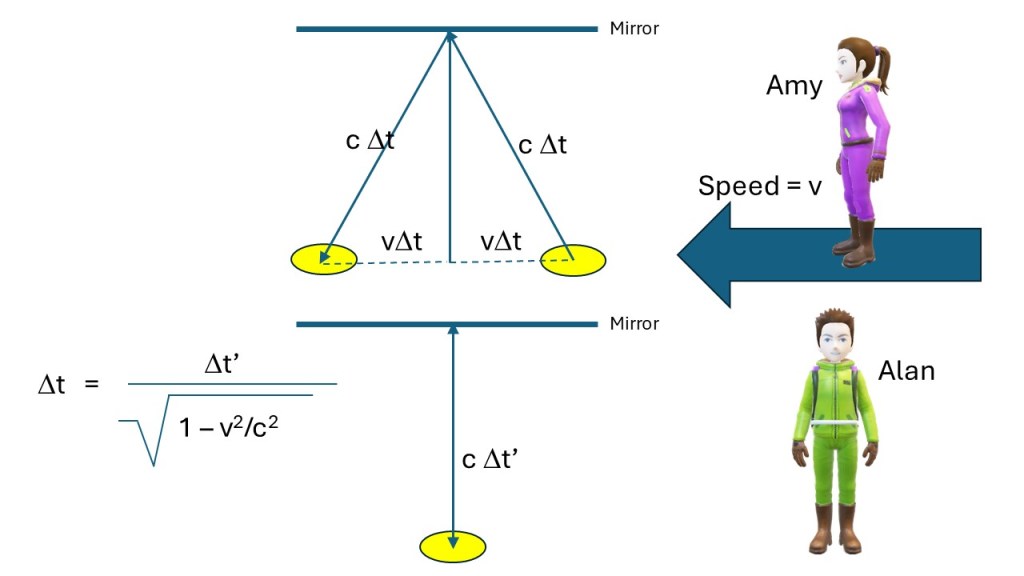
The picture shows two systems, each with a clock consisting of light beams bouncing between mirrors. In this set up Alan is stationary compared to us and therefore his light beam only moves vertically.
Alan and Amy have identical light clocks. We call the time it takes for the light beam to go from the floor to the ceiling (one clock tick) Dt in Amy’s case and Dt’ (reference frame) for Alan. Amy is speeding past Alan towards the left. From Alan’s perspective Amy’s clock is running slower. Using Pythagoras theorem, it is possible to derive the formula for time dilation shown in the lower left corner.

Since Amy moving left is the same as Amy standing still and Alan moving right you can say that Alan is the one moving fast. In this case it is Alan’s light clock that is ticking slower because from this viewpoint it is his light beam that has to travel further. From Amy’s perspective it is Alan’s clock that is going slower.

The picture shows two systems, each with a clock consisting of light beams bouncing between mirrors. In this set up Amy is stationary compared to us and therefore her light beam only moves vertically | Time Dilation Goes Both Ways
It is equally correct to say that Amy is standing still and that it is Alan that is moving fast to the right. This time (pun not intended) it is Alan’s clock that is ticking slower. Dt corresponds to Alan’s clock ticks and Amy’s clock ticks are Dt’.

This seemingly contradictory situation is resolved by the fact that Amy’s and Alan’s perspectives will drift apart as they continue their journey. They will increasingly disagree on whether events are simultaneous or not, and they will disagree in which order events occur. This is another shocking fact, or as I refer to it, super fact. It is strange but it resolves the apparent contradiction of reciprocal time dilation. I am explaining this in greater detail in this post.

The Twin Paradox

But what happens if one of Amy or Alan decides to turn around so that they meet up again. If Amy’s clock runs slower from Alan’s perspective and Alan’s clock runs slower from Amy’s perspective, how can you reconcile that when they meet up again? It turns out that whoever is turning around or accelerating or decelerating to turn back is the one who will have the least time pass. If Amy is the one turning back, then she will age less than Alan. During her acceleration she will see Alan’s clock starting to run faster and faster until he is older her.

Let say Alan’s clock is running half the speed of Amy’s clock from Amy’s perspective and Amy’s clock is running half the speed of Alan’s clock from Alan’s perspective. Let’s also say that Amy traveled to the left for 10 years before turning around.

From Alan’s perspective she would have traveled 20 years before turning around. However, from Amy’s perspective 5 years would have passed on Alan’s clock. As she turns around Alan’s clock will run faster and catch up so that when they meet up again Amy will be aged 20 years, while Alan will be aged 40 years. That is 35 years of catching up for Alan’s clock from Amy’s perspective. Alan’s clock advanced 35 years from Amy’s perspective after Amy turned around. In the end Amy will be the younger one.

The picture shows Amy on the left turning around and Alan on the right. Text explains what happens | Time Dilation Goes Both Ways
Observe that the fast-forward advancement of Alan’s clock from Amy’s perspective happens only while Amy is in the process of turning around (accelerating / decelerating). Further, how fast the fast forward happens depends on the distance as well. Once Amy is traveling at a constant speed again (inertial frame) Alan’s clock will run slower again from Amy’s perspective.

A somewhat halting but OK analogy for the 35 years of catching up that happens on Alan’s clock from Amy’s perspective is when you turn a boat around on a wavy sea. As you are moving in the direction of the waves the waves will hit you much less often (if at all) but after you turn around and move against them the waves will hit your boat very frequently. Alan’s clock will run faster for Amy whilst she is turning around.

Book Recommendations on Relativity

To see the other Super Facts click here

Every Symmetry is Associated with a Conservation Law

Super fact 36: Every continuous symmetry of the action of a physical system with conservative forces has a corresponding conservation law. This revolutionary insight was mathematically proven in 1915 by a relatively unknown woman, Emily Noether.

It is not easy to understand what this super fact means, and therefore it is easy to miss the fact it says something fundamental about the nature of reality. It says something profound about our Universe and all possible Universes. It is arguably one of the most profound discoveries in science. Since the discovery of Noether theorem, we do physics differently and we view our physical reality differently.

In the book “The Theory of Almost Everything” the author, theoretical physicist Robert Oerter states that the standard model of elementary particles, or most of modern physics, rests on three pillars, special relativity, quantum physics, and Noether’s theorem. Which one of those three have you not heard of? I guess Noether’s theorem.

That question brings me to the second part of the super fact. Emily Noether did a lot for mathematics and physics in addition to her first theorem (stated above), and yet she is not well known. Albert Einstein said of Emily Noether : “Fräulein Noether was the most significant creative mathematical genius thus far produced since the higher education of women began”. Notice he didn’t say “woman genius”.

Why I consider Noether’s (first) theorem a super fact is because it tells us something fundamental about reality that is highly surprising and yet undisputable (mathematically proven) and not many of us know about it. The second part of the super fact, that despite being one of the greatest geniuses of the 20th century she is so unknown, is also surprising.

A young woman in Victorian clothing sitting at a small table.
This picture reminded me of Emily Noether a genius and one of the greatest mathematicians in human history. This is a submission for Kevin’s No Theme Thursday.

Noether’s Theorem What Does It Mean

Noether’s theorem, says that symmetries in the universe give rise to mathematical conservation laws. One way to understand this is by using an example. That the physical laws remain the same as you translate a system in time is an example of a continuous symmetry.

If you do an experiment twice at two different times, let’s say at 8:00AM and at 9:00AM, and everything is set perfectly identical both times you are likely to get the same result. Well barring statistical/quantum uncertainty. The point is that the physical laws did not change. If the physical laws do not change between 8:00AM and 9:00AM, then you have a continuous symmetry.

Noether’s theorem says that if you have a continuous symmetry, you also have a conservation law, and the conservation law in this case is the conservation of energy/mass. If the physical laws do not change between 8:00AM and 9:00AM then mathematically the total energy / mass of the closed system must remain constant.

It follows that energy is not destroyed or increased. At first it seems like the time symmetry and energy/mass conservation have nothing to do with each other, but the symmetry gives rise to the conservation law. So, if you ask the question, why is energy / mass conserved, the answer is because physical laws don’t change with time.

There are many symmetry-conservation law pairs in nature. Translational symmetry, the fact that the laws of physics stay the same if you move to the side or forward, results in the conservation of momentum. The symmetry of laws that does not change if moving around in a circle amount to the law of conservation of angular momentum. Other symmetries result in the conservation of charge.

The converse is also true. If you find that a quantity is conserved you can find a symmetry, and if you find a symmetry that is broken you can find a quantity that is not conserved after all. There is not much in science that is more fundamental than that and in addition Noether’s theorem is very useful.

The picture illustrates the collision of two balls. It features mathematics demonstrating that linear momentum (mass times velocity) is preserved | Every Symmetry is Associated with a Conservation Law
If the physical laws stay the same when translated in space then linear momentum is conserved. Conservation of momentum principle in isolated system Asset id: 2319593529 by MZinchenko.

Emily Noether

Emily Noether was born into a Jewish family in Germany March 23 in 1882. She was the daughter of the mathematician Max Noether. She studied mathematics and completed her doctorate in 1907. At the time, women were largely excluded from academic positions, but she worked at the Mathematical Institute of Erlangen without pay for seven years. She eventually gained paid positions. She made huge contributions to abstract algebra, calculus of variations, topology and other mathematical fields.

Her most important contributions are the Noether’s theorems, the first one described here. When Hitler came to power in 1933, she had to flee Germany. She got a position as a professor at Bryn Mawr in 1933. She died in 1935.

Black and white photo of Emily Noether wearing a white shirt, a darker skirt and a black bowtie.
Emily Noether in 1910. Unknown author Unknown author Publisher: Mathematical Association of America [3], Brooklyn Museum [4], Agnes Scott College [5], [6], Public domain, via Wikimedia Commons.

Concluding Summary

Noether’s Theorem changes how we view the Universe and the laws of physics. For example, the conservation of energy is not just something we empirically discovered. It follows mathematically from physical laws not changing by time. It represents a paradigm shift in science that arguably is as important as quantum mechanics or relativity and yet very few people have heard of it. I find that quite shocking.

To see the other Super Facts click here

Radon Represents our Largest Exposure to Ionizing Radiation

Superfact 6 : Radon Represents our Largest Exposure to Ionizing Radiation

Radon represents our largest exposure to ionizing radiation. It is responsible for the majority of public exposure to harmful radiation. It is not the sun, the sky, nuclear weapons or nuclear power, or medical treatment, other terrestrial sources, it’s radon. Since we don’t talk much about the very deadly radiation emitted by the radon in our basements that may come as a surprise.

If a radioactive isotope has a long half-life, is that bad? I mean it will be around for a long time. Well, it is complicated. It is important to understand that if the decay rate for an isotope is very slow, in other words, it has a long half-life then it will be less radioactive. If the half-life is 1,000,000 shorter for an isotope X compared to an isotope Y (with a slower decay rate) than it is 1,000,000 more radioactive than isotope Y assuming their decay is of the same type. Short half life means more radioactivity. Long half-life means less radioactivity. The negative aspect of an isotope with a long half-life is that it will be around long, but the positive aspect is that it is less radioactive.

The image shows a Uranium atom on the left arrows in the middle and an alpha particle, a gamma ray, a proton, a neutron, and an electron on the right | Radon Represents our Largest Exposure to Ionizing Radiation
Radioactive decay is the emission of energy in the form of ionizing radiation. There are different types of decay and the decay-rate for different isotopes vary a lot. Stock Vector ID: 2417370135 by grayjay.

I should explain that isotopes mean that an atom can have a different number of neutrons. For example, carbon (coal) has a few common isotopes. C-12 has 6 protons and 6 neutrons,  C-13 has 6 protons and 7 neutrons,  C-14 has 6 protons and 8 neutrons. The isotope we are talking about when we talk about Radon is Radon-222. That is a really bad one. Radon-222 has a half life of 3.8 days which is 432 billion times shorter than Uranium-238, which has a half life of 4.5 billion years. So, if Radon-222 and  Uranium-238 had the same type of decay (they don’t) Radon-222 would be 432 billion times more radioactive than Uranium-238.

Admittedly Uranium-238 isn’t very radioactive, you can safely hold it, but let’s take Plutonium-238, a famously radioactive isotope with a half-life of 87.7 years. Radon-222 has a half-life that is 8,424 times shorter yielding a decay rate and radiation intensity 8,424 times larger than Plutonium-238.

Radon

An illustration with a blue nucleus surrounded by 86 blue electrons
Radon-222 isotope has 86 electrons, 86 protons and 136 neutrons. Stock Vector ID: 1919418095 by saran insawat

So, Radon-222 is indeed extremely radioactive. But that means it should disappear quickly. Unfortunately, the inside of the earth is constantly supplying more Radon-222 from the radioactive decay and fission occurring there. Nuclear fission (nuclear reactions)  is happening inside the earth providing about half of earth’s heat and powering the movement of Earth’s continents and crust. Since Radon-222 is extremely radioactive and is being resupplied by our own planet it is a very big source of the radiation we are exposed to.

Among all the different kinds of sources it is the biggest one. Since Radon-222 is a natural phenomenon, and we focus on so many other types of other natural and unnatural radiation sources we tend to underestimate the problem. At least I did when we bought our first house. I was asking Radon, what Radon? I think it is a surprising and important fact and therefore a super fact.

Radon Exposure

The various pathways of radon entering a house are shown as red arrows. The house is an illustration.
Illustration of how radon-222 enters a house. Stock Vector ID: 2128365599 by VectorMine.

The WHO estimates that radon exposure alone was estimated to have caused 84,000 deaths by lung cancer in one year. In 50 years, this would be 4.2 million deaths. The WHO predicted that the eventual total death toll from cancer related deaths from the worst nuclear disaster in history, Chernobyl, was 9,000, which is a lot less than 4.2 million. The numbers given by Greenpeace (which WHO does not accept) are up to a million and the Union of Concerned Scientists estimated 27,000.

Those numbers are all still smaller than the estimated deaths from Radon. Keep in mind that the Chernobyl reactor was a very dangerous reactor (RBMK) that lacked a containment shield, a reactor that could never be built in a western country. I can add that according to WHO the predicted future cancer deaths due to accumulated radiation exposures in the population living near Fukushima was between zero and a 100.

According to the United Nations Scientific Committee on the Effects of Atomic Radiation, more than 40% of the average annual human exposure to ionizing radiation is radon in the air. The other sources (all smaller) are cosmic background radiation, terrestrial radiation from the ground, radiation in food and water, exposure to radiation by medical treatment/exams, nuclear testing, Chernobyl, etc. According to former U.S. Surgeon General Richard H. Carmona, Radon is responsible for the majority of public exposure to ionizing radiation. Radon in our basements is indeed a very big deal compared to other radiation sources.


To see the other Super Facts click here