The goal of this blog is to create a list of super facts. Important facts that are true with very high certainty and yet surprising, misunderstood, or disputed by many. This blog aims to be challenging, educational, and fun, without it being clickbait. I determine veracity using evidence, data from reputable sources and longstanding scientific consensus. Prepare to be challenged (I am). Intentionally seek the truth not confirmation of your belief.
Category: Physics
Important but surprising or strange facts relating to Physics
Super fact 49 : The top one-meter (3.3 feet) of a typical 10 meters (33 feet) by 40 meters (131 feet) garden contains 2 kilograms (4.4 pounds) of Uranium. For comparison, the Hiroshima bomb contained 64 kilograms (121 pounds) of Uranium. Certain rocks such as Granite and Shale contain much more Uranium than soil. Uranium also exists in the atmosphere and there is 4.5 billion tons of Uranium in the ocean.
The numbers above come from the IAEA (International Atomic Energy Agency) and Stanford University . I should mention that the numbers vary depending on Geography, type of soil, etc. For example, there is much less Uranium in the soil in Florida compared to the soil in the Midwest.
This may come as a surprise to many people. Isn’t Uranium radioactive? How come we are still alive? That’s why I call this a super fact. The answer is that even though Uranium is used in nuclear bombs and nuclear reactors, it is by itself not very radioactive. You can hold natural uranium in your hand without much risk. The radioactivity from, for example, nuclear explosions come mainly from the fission process and the radioactivity from nuclear reactor waste is mainly from other isotopes created by the fission process in the reactor rather than the uranium itself.
If Uranium is not very radioactive, how come a nuclear bomb spread so much radioactivity. The answer is that the radioactivity comes from the fission process and the resulting new isotopes, not the uranium.
What Are Isotopes?
Before I explain some facts about the radioactivity and decay rate of Uranium, I should explain what an isotope is. Atoms consist of a nucleus and electrons surrounding the nucleus. In the nucleus there are protons and neutrons (and some other stuff). Neutral atoms have an equal amount of electrons and protons, which determines what kind of element it is. Hydrogen has one electron and one proton. Helium has two electrons and two protons. Oxygen has eight electrons and eight protons, etc. The number of protons/electrons is called the atomic number of the element.
The number of protons plus the number of neutrons is called the mass number. Atoms of the same element but different number of neutrons are called isotopes. Uranium-235 or U-235 has 92 protons and 235 – 92 = 143 neutrons. The number if protons/electrons determine the chemical properties of the element. The number of neutrons determines nuclear properties such as the stability of the nucleus, radioactivity, etc., as well as the weight. Therefore U-238 and U-235 are identical chemically and look and feel the same, but U-235 is more radioactive, and you can use U-235 for fission but not U-238.
This is a simplified Bohr model of the Uranium atom. There are 92 little blue balls circling a nucleus in the middle of the atom. Those are electrons. In the nucleus there are 92 protons. Those are the red balls with plus signs. In addition, there is a yellowish smudge around the protons in the nucleus. Those are the neutrons. Depending on the isotope, there are 143 neutrons for U-235, 146 neutrons for U-238 and 142 neutrons for U-234. Shutterstock asset id: 1999370450 by Patricia F. Carvalho
The decay rate of Uranium
There are three main Uranium isotopes. Uranium-234, Uranium-235, and Uranium-238. Uranium-238 is the most common. 99.28% of natural Uranium is Uranium-238, 0.72% is Uranium-235 and 0.0057% is Uranium-234. Uranium-235 is the isotope we use for nuclear weapons.
The different isotopes have different decay rates and different levels of radioactivity. The half life of a radioactive isotope is the time it takes for an isotope to decay so that only half of it is left. The half-life of Uranium-238 is four and half billion years. That means that it will be around for a very long time, but since its decay rate is so slow, it is not very radioactive. The half-life of Uranium-235 is 710 million years, again it will be around for a very long time, but again, since its decay rate is so slow, it is not very radioactive. The half-life Uranium-234 is 247,000 years, a little bit faster but it still has a pretty slow decay rate.
This should be compared to Cesium-137, which has a half-life of roughly 30 years. In other words, it decays 150 million times faster than Uranium-238 and 23.7 million times faster than Uranium-235. Since Cesium-137 decays so much faster than the Uranium isotopes it means that each atom of Cesium-137 will send out radioactive particles much more often than a Uranium atom will, making it much more radioactive.
If you want to read about when I was walking around a whole day with a Cesium-137 sample in the back pocket of my jeans, click here. Radon-222, an extremely radioactive isotope of radon, which seeps into our basements from the inside of earth. It has a half-life of 3.82 days giving it a decay rate that is 430 billion times faster than Uranium-238 and 68 billion times faster than Uranium-235.
What makes it possible to make a nuclear bomb from Uranium-235 is not because it is very radioactive. It is not. It is because it has properties that make it perfect for bomb making. Each nucleus emits more than one neutron, in fact more than two on average, and the neutrons colliding with other Uranium-235 nucleuses can be made to travel at the correct speed to cause fission. In other words, it is fissile. It is a goldilocks situation. It is just right. Below is an illustration showing a chain reaction. Observe, the picture indicates that Uranium has 95 protons. This is wrong. Uranium has 92 protons. When I have the time, I will fix this picture.
This is an illustration of a chain reaction with fission of a Uranium-235 isotope. Notice the atomic number (number of protons) is incorrectly stated as 95 in the picture. It is 92. When I have time, I will fix that. Shutterstock Asset id: 73714504 by Mpanchenko.
I recently read a very interesting book on the history of nuclear power and its possible future, Atomic Awakening: A New Look at the History and Future of Nuclear Power by James Mahaffey. Something like 90% of the book was history, the history of physics, nuclear physics, the Manhattan project, the nuclear bombs, the nuclear tests, nuclear reactors, etc.
About 10% of the book examined the viability of nuclear power and discussed the public’s fear of it. His approach to that is something like; well, no wonder people are afraid of nuclear power, look at the history. However, that fear is still irrational. The awesome power of nuclear power can give us safe and clean energy, replace fossil fuels and fight global warming, and also take us to the stars. He points out that nuclear reactions are millions of times more powerful than chemical reactions.
What Are Isotopes?
I should explain what an isotope is. Atoms consist of a nucleus and electrons surrounding the nucleus. In the nucleus there are protons and neutrons (and some other stuff). Neutral atoms have an equal amount of electrons and protons, which determines what kind of element it is. Hydrogen has one electron and one proton. Helium has two electrons and two protons. Oxygen has eight electrons and eight protons, etc. The number of protons/electrons is called the atomic number of the element.
The number of protons plus the number of neutrons is called the mass number. Atoms of the same element but different number of neutrons are called isotopes. Uranium-235 or U-235 has 92 protons and 235 – 92 = 143 neutrons. The number if protons/electrons determine the chemical properties of the element. The number of neutrons determines nuclear properties such as the stability of the nucleus, radioactivity, etc., as well as the weight. Therefore U-238 and U-235 are identical chemically and look and feel the same, but U-235 is more radioactive, and you can use U-235 for fission but not U-238.
This is an illustration of a chain reaction with fission of a Uranium-235 isotope. Notice the atomic number (number of protons) is incorrectly stated as 95 in the picture. It is 92. When I have time, I will fix that. Shutterstock Asset id: 73714504 by Mpanchenko.
Cesium-137 in my Pocket
Before I continue with my review of the book I am going to tell a story about my crazy adventure with a Cesium-137, a very radioactive and dangerous isotope. In fact, Atomic Awakening claims that Cesium-137 and Strontium-90 are the two isotopes of the greatest concern with regards to nuclear waste.
Once when I was a young student of engineering physics, I was around 20 years old, we were doing experiments with radioactivity. We were using Cesium-137. There were signs on the walls warning about radioactivity and the Cesium-137 sample was enclosed in a little house built from lead bricks. We were supposed to quickly remove the lead bricks, take out the sample, do the experiment quickly, put the sample back and enclose it with the lead bricks. However, I got distracted by something and put the Cesium-137 sample in the back pocket of my jeans.
I walked around school with the Cesium-137 sample in my back pocket the whole day and after school I went shopping at the grocery store still having it in my back pocket. I discovered it once I got back to my room. I put in a drawer and stayed as far away from it as I could. The next day I woke up early, put the sample in my bag, went to the lab at school and when no one was looking I put the sample back in the lead brick house.
No, I don’t have any extra heads growing out of my buttocks, and I did not turn into the Hulk, but so much for nuclear safety.
Atomic Awakening Formats
Atomic Awakening: A New Look at the History and Future of Nuclear Power by James Mahaffey comes in four formats. I bought the hardback format.
Hardcover – Publisher : Pegasus Books (June 23, 2009), ASIN : 1605980404, ISBN-13 : 978-1605980409, 352 pages, item weight : 1.42 pounds, dimensions : 6.4 x 1.2 x 9.3 inches, it costs $49.29 on US Amazon. Click here to order it from Amazon.com.
Paperback – Publisher – Pegasus Books (October 15, 2010), ISBN-10 : 1605981273, ISBN-13 : 978-1605981277, 368 pages, item weight : 12.8 ounces, dimensions : 6 x 0.92 x 9 inches, it costs $15.63 on US Amazon. Click here to order it from Amazon.com.
Kindle – Publisher : Pegasus Books (October 15, 2010), ASIN : B004GUS68I, ISBN-13 : 978-1605982038, Item 369 pages, it costs $13.99 on US Amazon. Click here to order it from Amazon.com.
Audio– Publisher : Audible Studios (September 24, 2013), Listening Length : 11 hours and 44 minutes, ASIN : B00FBPGS78, it costs $21.83 on US Amazon. Click here to order it from Amazon.com.
Front cover of hardback format of the book Atomic Awakening: A New Look at the History and Future of Nuclear Power. Click on the image to go to the Amazon page for the hardcover version of the book.
Amazon’s Description of Atomic Awakening
Nuclear power is a paradox of danger and salvation―how is it that the renewable energy source our society so desperately needs is the one we are most afraid to use?
The American public’s introduction to nuclear technology was manifested in destruction and death. With Hiroshima and the Cold War still ringing in our ears, our perception of all things nuclear is seen through the lens of weapons development. Nuclear power is full of mind-bending theories, deep secrets, and the misdirection of public consciousness, some deliberate, some accidental. The result of this fixation on bombs and fallout is that the development of a non-polluting, renewable energy source stands frozen in time.
It has been said that if gasoline were first used to make napalm bombs, we would all be driving electric cars. Our skewed perception of nuclear power is what makes James Mahaffey’s new look at the extraordinary paradox of nuclear power so compelling. From medieval alchemy to Marie Curie, Albert Einstein, and the Manhattan Project, atomic science is far from the spawn of a wicked weapons program. The discovery that the atom can be split brought forth the ultimate puzzle of the modern age: Now that the energy of the universe is available to us, how do we use it? For death and destruction? Or as a fuel for our society that has a minimal impact on the environment and future generations?
Outlining nuclear energy’s discovery and applications throughout history, Mahaffey’s brilliant and accessible book is essential to understanding the astounding phenomenon of nuclear power in an age where renewable energy and climate change have become the defining concerns of the twenty-first century.
The book is divided into three parts with five chapters each. The first third of the book (titled the Fantasy) recounts the history of physics, electromagnetics, light, the Michelson-Morley experiment, relativity, the nonexistence of simultaneous events, Einstein’s miraculous year, atoms, spectrometry, atomic models, isotopes, the photoelectric effect, radioactivity, quantum physics, nuclear physics, nuclear decay, fission, fusion, and why nuclear reactions are millions of times more energetic than chemical reactions. I already knew a lot of this history having a degree in physics, but I did not know all of it and the way it was written made it very interesting.
The second third of the book (titled the Puzzle) describes the discovery of fission and fusion and it is explained why the isotopes Uranium-235 and Plutonium-239 (among 3000+ isotopes) were perfect for fission. The author provides an account of the Manhattan Project’s history, and he explains in a general sense how a nuclear reactor and a nuclear bomb work. This section reminded me of the movie Oppenheimer. He describes a bit about the various nuclear reactor designs and how the first nuclear submarine came into existence.
This part of the book is filled with interesting and surprising anecdotes about the various scientists. The first part of the book also contained many interesting anecdotes, but this part of the book really has some very interesting and crazy stories to tell. The author points out that because of Hitler there were many Jewish top scientist and other top scientists who had to flee Europe to the US, thus turning the United States into the scientific superpower it wasn’t before. He explains why the Germans did not have a chance creating a nuclear bomb. I found it interesting that the Soviets deduced that the US was working on a nuclear bomb from the fact that so many US. physicist stopped publishing in physics journals. Apparently, the Germans and the Japanese did not figure this out. However, silence is suspicious, very suspicious.
The third part of the book (titled the Paradox) is about what came after the Second World War. The author describes the development of better and safer nuclear reactors (BWR, PWR, CANDU, etc.) as well as giving us an overview of many nuclear accidents, one of them being the terrible Chernobyl accident, which largely happened because of the extremely dangerous and bad reactor design, a so called RBMK reactor. RBMK reactors are monsters that cannot be built in the West. He recounts the development of new nuclear bomb technology, such as thermonuclear bombs, more popularly called hydrogen bombs.
He also tells us about the large number of nuclear tests performed including the detonation of Tsar Bomba, the Soviet 50 Megaton bomb. It was 3,300 times more powerful than the Hiroshima bomb. He makes it clear that there were thousands of nuclear bomb tests, but he did not specify an exact number, but I looked it up. There’s been more than 2,000 nuclear tests corresponding to a yield of 42,000 Hiroshima bombs. Many of the tests were not military. For example, project plowshare was about making a bigger and deeper Panama Canal by blowing a series of deep holes through Panama using hydrogen bombs. There were 35 nuclear bombs tests to determine the feasibility of creating giant holes with hydrogen bombs. He also explains how a nuclear bomb driven spaceship works and how we could have used it for interstellar space travel (Project Orion).
Towards the end of the book, he successfully makes the case that modern Nuclear Power (not the RBMK of course) is safe and clean. We avoid pollution, and it can be used to fight global warming. The same is true for solar and wind. However, he argues that the base power source must be constantly running, high-output nuclear stations. He argues that the public got a very bad impression of anything nuclear because of how it all started with nuclear bombs, nuclear tests, bad reactor designs and accidents, and how misinformation and miscalculations added to the bad impression. We often ignore the many tens of millions of victims of fossil fuels, and the hundreds of thousands of deaths from hydro, while exaggerating the dangers of nuclear power.
However, in nuclear power we have an immense power source that we are eventually bound to start using. That’s the Atomic Awakening. One of the shocking statements in this part of the book is that “all the medical and industrial radioisotopes, used daily in impressive quantities in the United States, are made in one reactor in Canada”. He blamed this on irrational fear of nuclear power. I checked whether this scary situation still existed today. Luckily, it is not as bad. Medical and industrial radioisotopes are still all imported but they also come from Europe and Australia. It is not just one reactor in Canada. He states that “the Paradox of Nuclear Power is that far more people die each year of radiation-induced disease from standing out in the sun than have ever died from the application of nuclear power” (page 223).
There were a few things that I did not like about the book. The first is that the author often describes complex experimental setups, designs, or tools that really could be better understood with an illustration, or a picture, but there were none. I found a typo on page 308, where he refers to fission as fusion in the third sentence. I think he spent too little space on the feasibility of Nuclear Power in the modern world and maybe too much on the history of physics. Nuclear Power seems to be what the book should be about and yet this topic was concentrated to the last 10% of the book and I don’t think he made his case as well as he could have. The end of the book seems rushed. On the other hand, it was a fascinating journey before we got there. Overall, I think this book is extremely interesting, it was a fun to read, and it was fact filled and a great learning experience. I loved reading this book, so even though I have a few misgivings I still think it is a five-star book. I highly recommend it.
Back cover of hardback format of the book Atomic Awakening: A New Look at the History and Future of Nuclear Power. Click on the image to go to the Amazon page for the paperback version of the book.
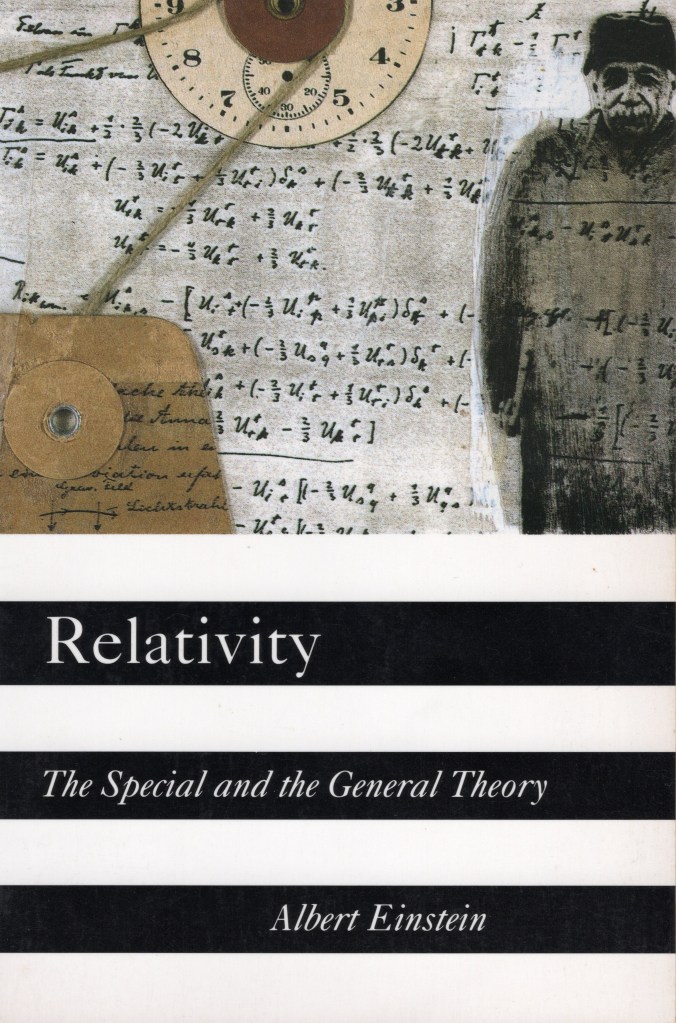
This is not a super fact post but another kind of fact-oriented post. It is a book review for a book that I find interesting, Relativity: The Special and the General Theory by Albert Einstein. Yes, the book was written by Albert Einstein in 1916 and translated into English in 1920. It is written for laymen, average readers, and despite being more than 100 years old (well this reprint is from 1995) it does not feel outdated.
I should say that I wrote my review decades ago and Amazon has hidden about 900 of the oldest reviews including mine. So, you can no longer find it. Luckily, I still had it, but I cannot provide a link to it. The book comes in formats, hardcover (2024), paperback (1995), Kindle (2014), Audio (2009). I bought the paperback version.
Publisher : Independently published (July 29, 2024), ASIN : B0DBQVVJVQ, ISBN-13 : 979-8334454118, 109 pages, item weight : 7.8 ounces, dimensions : 6 x 0.47 x 9 inches, Translator : Robert W. Lawson, it costs $12.33 on US Amazon. Click here to order it from Amazon.com.
Paperback – Publisher : Crown (June 6, 1995), ASIN : 0517884410, ISBN-13 : 978-0517884416, 208 pages, item weight : 8 ounces, dimensions : 5.2 x 0.5 x 8 inches, it costs $7.89 on US Amazon. Click here to order it from Amazon.com.
Kindle – Publisher : Amazon Kindle Direct Publishing (February 23, 2014), ASIN : B004M8S53U, 126 pages, it costs $0.99 on US Amazon. Click here to order it from Amazon.com.
Audiobook – Publisher : HighBridge, a division of Recorded Books (November 14, 2009), ASIN : B002XGLDAA, Listening Length : 2 hours and 14 minutes, it costs $12.09 on US Amazon. Click here to order it from Amazon.com.
Front cover of Relativity: The Special and the General Theory by Albert Einstein. Click on the image to go to the Amazon page for the paperback version of the book.
Amazon’s Description of Relativity by Albert Einstein
This book was originally written in German by Albert Einstein in 1916 and later translated to English by Robert W. Lawson in 1920. In Einstein’s own words, “The present book is intended, as far as possible, to give an exact insight into the theory of Relativity to those readers who, from a general scientific and philosophical point of view, are interested in the theory, but who are not conversant with the mathematical apparatus of theoretical physics. It is an easy-to-understand collection of the ideas of one of the greatest scientists of the twentieth century including the idea he is most known for, the theory of relativity.
Redesigned inside and out to have a fresh, appealing look, this new edition of a classic Crown Trade Paperback is a collection of Einstein’s own popular writings on his work and describes the meaning of his main theories in a way virtually everyone can understand.
Below is my review for Relativity: The Special and the General Theory by Albert Einstein. First, I should mention that the book is divided into two sections, one for the Special Theory of Relativity and another for the General Theory of Relativity. In addition, there are five short appendices. The five appendices are not written for layman and require at least high school mathematics.
Relativity Explained by Einstein himself
I found it very interesting to read an explanation of the theories of relativity by the developer of those theories. However, it is important to remember that the inventors of science theories aren’t always the best ones to explain them. Isaac Newton is a prime example.
Another thing to remember is that today there are a lot of books and online graphics that use clever pedagogic techniques and visualizations to assist you in understanding these theories, and naturally this book does not contain any of that.
This book was originally written in 1916 and updated in 1920 and since then it has been reprinted/edited several times (as this book is an example of). I should say that the General Theory of Relativity had just been published so there weren’t much else out there for laymen at the time.
I’ve already read many good books on relativity, and I believe I understand special relativity pretty well, but my understanding of general relativity is partial. I did not buy this book to understand relativity. The reason I bought this book was to gain another perspective on the subject. If you just want to learn and understand relativity, I recommend Relativity Visualized by Lewis Carroll Epstein instead.
“Relativity: The Special and the General Theory” features no derivations of the formulas in relativity (except in the appendix) and no visualizations demonstrating relativistic effects and phenomena. The book is focused on the conceptual foundations of relativity and physics.
For example, what are Geometrical propositions, what does it mean to measure the length of a rod, or the time of an event, what do we mean by speed, what is simultaneity, what is the difference between what we observe and what we measure, etc? Einstein spends one and a half page explaining addition of velocities in classical-pre-relativistic kinematics (w = v + u) and what assumptions that are inherent with the approach. In that sense the book is quite philosophical, which is what I meant by “another perspective”. The book covers both the Special Theory of Relativity and the General Theory of Relativity. However, the sections on the General Theory of Relativity are quite short and very introductory.
There are some issues with the book. In appendix 1 Einstein (I presume) derives the Lorentz transforms. However, it is not, in my opinion, the best derivation from a pedagogical standpoint and it also had typos in it. As far as I can tell the formula on page 50 is wrong unless what Einstein means with the “m” is “additional relative mass” and not actual “mass” as stated.
The book features an addition written in 1920 where he is discussing an ad hoc modification to his theory that he had previously made but it turned out to be unnecessary (related to cosmology). The language is also very old fashioned. On the other hand, this kind of stuff makes you feel as if you travel back in time to when the theories of relativity were being churned out.
I don’t recommend the book for learning the theories of relativity but overall I liked the book. It focuses very much on basic concepts and near philosophical aspects of time, space and relativity. The book presents a valuable perspective if you already understand what the theories of relativity are about.
Back cover of Relativity: The Special and the General Theory by Albert Einstein. Click on the image to go to the Amazon page for the hardback version of the book.
Super fact 47 : In 1991, after the dissolution of the Soviet Union, Ukraine became the third largest nuclear power in the world after Russia and the United States. Ukraine held about one third of the former Soviet nuclear weapons and delivery systems. Ukraine agreed to transfer these weapons to Russia for dismantlement in exchange for economic compensation and assurances to respect Ukrainian independence and borders.
In 1994, Ukraine agreed to transfer these weapons to Russia for dismantlement in exchange for economic compensation and assurances from Russia, the United States and the United Kingdom to respect Ukrainian independence and sovereignty within its existing borders. These political agreements are referred to as the Budapest Memorandum.
These events are relevant to what is happening in Ukraine today, and yet it is seldom discussed, and many people are unaware of or have forgotten about this history. It also comes as a surprise to many that there are nuclear states who have relinquished their nuclear weapons. This is why I call this fact a super fact.
Nuclear bomb dropped on a big city. Shutterstock, asset id: 2188083835 by CI Photos.
Nine Nuclear States
There are nine nuclear states in the world as of 2025 according to the Federation of Atomic Scientists. There are 12,331 nuclear warheads including 9,600 in active military stockpiles.
Russia – 5,449 warheads
The United States – 5,277 warheads
China – 600 warheads
France – 290 warheads
United Kingdom – 225 warheads
India – 180 warheads
Pakistan – 170 warheads
Israel – 90 warheads
North Korea – 50 warheads
There are also countries that are hosting nuclear warheads owned by other countries.
Italy (the United States) – 35 warheads
Turkey (the United States) – 20 warheads
Belgium (the United States) – 15 warheads
Germany (the United States) – 15 warheads
Netherlands (the United States) – 15 warheads
Belarus (Russia) – ? warheads
Four missiles aimed at the sky at sunset. Shutterstock, asset id: 2131803989 by Hamara
Four nations that relinquished their nuclear weapons programs
The four nations that relinquished their nuclear weapons programs are Belarus, Kazakhstan, South Africa, and Ukraine. Belarus, Kazakhstan, and Ukraine returned their inherited nuclear weapons to Russia after the dissolution of the Soviet Union. However, it should be noted that in 2023 Russia began deploying tactical nuclear weapons to Belarus. However, Belarus does not currently possess its own nuclear weapons. South Africa voluntarily dismantled its nuclear weapons program in 1991.
In 2023 Russia began deploying tactical nuclear weapons to Belarus.Russia (green) and Ukraine (brown) map on a world map. Ukraine is about the size of Texas. Russia is about twice the area of the United States. Belarus is the country located immediately to the north of Ukraine and Kazakhstan is the big country immediately to the south of Russia and east of Ukraine. Shutterstock Asset id: 2121271067 by buraktumler
How to Build a Nuclear Bomb
This section is just some extra reading that is only somewhat related to the topic. However, since it is an interesting topic somewhat related to the topic I might as well explain how to build a nuclear bomb. Don’t worry I will not present any engineering details, only general principals, which is all I know, and which are already all over internet. Besides if I were to give detailed engineering instructions some peacenik hippie might have a hissing fit and swear in the comment section (that was a joke).
Anyway, the main idea behind a nuclear fission bomb is to achieve a runaway chain reaction. A fusion bomb, or a so-called hydrogen bomb is different. To create a fission bomb you are not looking for the most radioactive materials there are. You are looking for a fuel which you can use to create a runaway chain reaction, and which is also stable enough to make a bomb possible, in other words not too radioactive. Basically, the fuel must be just right. The primary fuels used in fission bombs are uranium-235 and plutonium-239. These isotopes undergo fission when struck by neutrons, releasing a massive amount of energy in a chain reaction.
Uranium-235 and Uranium-238 are both not very radioactive and can be used for radiometric dating that stretches millions and billions of years. Uranium-235 is also the “just-right” uranium isotope that can be used for bomb making. Shutterstock Vector ID: 2417370135 by grayjay
I should explain, isotopes are different forms of an element. For example, hydrogen comes in three different forms, a nucleus with just a proton, a nucleus with one proton and one neutron (deuterium), and a nucleus with one proton and two neutrons (tritium). Isotopes for the same element are chemically identical but have different atomic weight and they may or may not be radioactive.
The three isotopes of Uranium are uranium-234, uranium-235, and uranium-238. The one we need is uranium-235, which has 92 protons and 143 neutrons in the nucleus. The isotopes of Plutonium include Pu-238, Pu-239, Pu-240, Pu-241, and Pu-242 but there are others. The one we need is plutonium-239, which has 94 protons and 145 neutrons in the nucleus. There are more than 3,500 known isotopes of which 3,000 are radioactive.
During Uranium-235 fission, an average of 2.5 neutrons are released. Specifically, the fission of U-235 typically releases 2 or 3 neutrons, with the average being close to 2.5. During the fission of plutonium-239, an average of 2.9 neutrons are released (depending on the energy of the incident neutron). The important thing for bomb making is that one atom/nucleus releases enough neutrons so that the neutrons from one nucleus cause more than one fission. For example, a nucleus releases three neutrons and two of those neutrons cause two more fission events, which in turn cause four fission events, etc. 2, 4, 8, 16, 32, 64, a trillion…
Illustration of nuclear chain reaction. Uranium-235 fission. Unfortunately, the picture has an error in it. It is 92 protons not 95 in a U-235 isotope. – Shutterstock asset id: 73714504 by Mpanchenko.
By putting together enough U-235 you can make it so that one fission event will result in more than one additional fission event. This is called the critical mass. The critical mass for U-235 is 47 kilograms (104 pounds). Theoretically, you can achieve this by taking a 24-kilogram half sphere of U-235 in your right hand and a 24-kilogram half sphere of U-235 in your left hand and bring them together. You will achieve a limited chain reaction for a nano second, but you will just blow the two halves apart and kill yourself, but your city will survive. This is called a fizzle. To make most of the 48-kilogram mass undergo fission you have to force them together long enough for the chain reaction to complete (or almost complete). This requires force and precise calculations. See the illustration below.
Components Inside of Uranium Nuclear Fission Bomb illustration – Shutterstock asset id: 2271462995 by BlueRingMedia.
Another difficulty is obtaining nearly 100% U-235 from natural uranium. 99% of the Uranium you find in nature is U-238. U-235 and U-238 chemically identical so extracting U-235 from natural uranium is difficult. However, U-235 is slightly lighter than U-238 so you can use centrifugal separation as you do to separate cream from milk. What is typically done is using a uranium compound, uranium hexafluoride, heat it into gaseous form and then utilize centrifugal separation to extract the uranium hexafluoride with U-235 isotopes. After that you can chemically extract the uranium, which is now U-235.
Many and strange are the universes that drift like bubbles in the foam upon the River of Time—first sentence of Wall of Darkness by Arthur C. Clarke, 1949.
What is Time? What is the arrow of time? Does entropy define an arrow of time? Is there a past and a future? Has time always existed as, for example, in the eternal inflation cosmological model in which universes continuously pop into existence via Big Bangs like the bubbles on the River of Time in the Arthur C. Clarke quote above. Does time have a beginning as a recent Big Bang model by Stephen Hawking imply. If time came into existence with the universe itself then there is no place for creation, just as in an infinitely existing universe. There cannot be anything north of the north pole, and there cannot be anything before time itself.
In the theories of relativity time is relative. The speed of clocks as well as the order of events differ from observer to observer. The presence of energy or mass will bend time. There is no universal flow of time. There is no universal time.
The goal of this blog is to create a list of what I call super facts. Important facts that we know to be true and yet they are surprising, shocking or disputed among non-experts. It is a type of myth busting. However, I also create posts that are not super facts but that feature other interesting information, such as this book review and book recommendation.
This picture reminded me of the mysteries of time. This is a submission for Kevin’s No Theme Thursday
About Time: Einstein’s Unfinished Revolution by Paul Davies
The book I am about to present focuses a lot on relativity. This is not strange since the theories of relativity shed a lot of light on time. Yes, pun intended. I’ve come across a lot of people who make various claims about time, and even consider themselves philosophers of time, and yet they do not even understand the special theory of relativity.
Because of this they say a lot of profound sounding things about time that ultimately are nonsensical. There is no way around it. If you want to say profound things about time and expand human knowledge on this topic you need to first have some understanding of relativity as well as other related physics such as thermodynamics and entropy. This book will provide that.
I should say that the book is somewhat outdated, being written in 1995 and 1996. However, most of it is still relevant and I know of no other book that approaches the topic in such an honest and rigorous way. The book comes in two formats hardcover and paperback. I bought the paperback version.
Hardcover – Publisher – Simon & Schuster; First Edition (March 13, 1995), ISBN-10 : 0671799649, ISBN-13 : 978-0671799649, 316 pages, item weight : 1.3 pounds, dimensions : 6.25 x 1.25 x 9.5 inches, it costs $18.09 on US Amazon. Click here to order it from Amazon.com.
Paperback – Publisher – Simon & Schuster; First Edition (April 9, 1996), ISBN-10 : 0684818221, ISBN-13 : 978-0684818221, 316 pages, item weight : 0.704 ounces according to Amazon but I think that should be 0.704 pounds, dimensions : 9.21 x 6.14 x 0.8 inches, it costs $12.28 on US Amazon. Click here to order it from Amazon.com.
Front cover of hardback version of the book About Time: Einstein’s Unfinished Revolution by Paul Davies. Click on the image to go to the Amazon page for the hardcover version of the book.
Amazon’s Description of About Time: Einstein’s Unfinished Revolution
An elegant, witty, and engaging exploration of the riddle of time, which examines the consequences of Einstein’s theory of relativity and offers startling suggestions about what recent research may reveal.
The eternal questions of science and religion were profoundly recast by Einstein’s theory of relativity and its implications that time can be warped by motion and gravitation, and that it cannot be meaningfully divided into past, present, and future.
In About Time, Paul Davies discusses the big bang theory, chaos theory, and the recent discovery that the universe appears to be younger than some of the objects in it, concluding that Einstein’s theory provides only an incomplete understanding of the nature of time. Davies explores unanswered questions such as:
* Does the universe have a beginning and an end?
* Is the passage of time merely an illusion?
* Is it possible to travel backward — or forward — in time?
About Time weaves physics and metaphysics in a provocative contemplation of time and the universe.
The link above will take you to my original review for About Time: Einstein’s Unfinished Revolution. Below is a slightly modified version of the review.
Our Evolving Concept of Time
Science, particularly physics, has revealed to us some profound insights about time, and yet it remains a mysterious topic. In the first chapter of the book “A Very Brief History of Time” the author describes how the concept of time has evolved throughout human history. The ancient philosophers had a very fuzzy notion of time, and they often dismissed both motion and time as illusions. The author tells us about “cyclic time”, and the “linear time” concept from Judeo-Christian thinking, and how it was incorporated into science as a “time variable”. This made it possible to solve the paradoxes created by such Greek thinkers as Zeno, who based on apparent paradoxes concluded that motion and time cannot really exist. Those “false” paradoxes were solved with the concept of linear physical time.
Physical time also made Calculus and Physics possible, and it became clear that there was a difference between physical time, which is a measurable entity used to sequence events, and experienced time, which is the subjective human feeling of a past, present, and a future.
Most of the rest of the book is focused on the Special Theory of Relativity and the General Theory of Relativity. The theories of relativity revolutionized how we view time, and they enabled a much deeper understanding of time. Special relativity refuted the concept of universal absolute time. Not only do clocks in different systems run at different speeds, but there is no universal “Now”.
However, the theories of relativity are not all there is to know about time, and we are not even done drawing conclusions about time based on the theories of relativity. This is why the book is called “About Time Einstein’s Unfinished Revolution”. The book also discusses quantum time, the arrow of time, worm holes, neuroscience and modern psychological experiments.
The book contains a lot of information and yet it scratches only on the surface. Time is a quite complex concept when you start digging into it. Take, for example, the discussion on the arrow of time. The conclusion of the books seems to be that there really is an arrow of time. Time has direction. The author is presenting both “sides” of the issue and to really get a grasp of the issue you need to clarify and look at the physics. Time certainly seems to have a direction if you look at the concept of entropy. The Cosmos is filled with irreversible processes. Our memory, which is essential for our experience of a self, is another example.
However, time has a direction even on the most fundamental level in subatomic particles. Kaon, a type of meson, decays in a way that is not time symmetric. The same may be true for the neutron. These particles “know” the difference between the past and the future. One could easily imagine how this chapter could be turned into a several thousand pages long book by just digging deeper into the related physics.
“About Time Einstein’s Unfinished Revolution” covers a lot of interesting topics related to time and it is often quite informative. The book is also well written, well organized, it has a good pace, and it is very interesting. It strikes a good balance between depth and breadth, and it does not overwhelm its readers. However, I do have some critique of the book, which prompted me to give the book four stars instead of five stars.
To understand some of the discussions in the book you should have a decent understanding of the theories of relativity, in my opinion. The author is explaining the theories of relativity to some degree, but the explanations did not seem to be that good. I did not have a problem with understanding these explanations since I already studied these topics, but I don’t think I would have understood what I needed to understand had I encountered the theories of relativity for the first time while reading this book.
Another criticism I have of the book is that he introduces ugh Everett’s many-worlds interpretation of quantum mechanics and in my opinion promotes it. This interpretation is in my opinion both strange and implausible and is not necessary for the discussions in the book.
In short, it proposes that every quantum measurement creates new universes, each corresponding to a different possible outcome of that measurement. In essence, our Universe is just one of many, and each quantum event splits the universe into multiple versions, where each version experiences a different outcome.
The problem with this interpretation is not so much that you get multiverses, but that you an infinite number of new fully evolved universes every nanosecond, which in turn create an infinite number of universes, which in turn create an infinite number of universes, and so on infinitely, and there is no way to empirically verify their existence. It is a so-called solution to a problem that is fictitious in my opinion and is derived from an old naïve interpretation of quantum waves. It is “hip” and “cool” interpretation, but I don’t see how it is useful. I should add that I have no problem with, for example, the multiverse idea stemming from string theory.
Anyway, except for my two complaints I think this is a pretty good book that I can recommend.
Front cover of paperback version of the book About Time: Einstein’s Unfinished Revolution by Paul Davies. Click on the image to go to the Amazon page for the paperback version of the book.
About Paul Davis
Paul Davies is an internationally acclaimed physicist, cosmologist, and astrobiologist at Arizona State University, where he runs the pioneering Beyond Center for Fundamental Concepts in Science. He also chairs the Search for Extraterrestrial Intelligence Post-Detection Taskgroup, so that if SETI succeeds in finding intelligent life, he will be among the first to know.
The asteroid 1992OG was officially renamed Paul Davies in his honor. In addition to his many scientific awards, Davies is the recipient of the 1995 Templeton Prize–the world’s largest annual prize–for his work on science and religion. He is the author of more than twenty books, including The Mind of God, About Time, How to Build a Time Machine, and The Goldilocks Enigma. He lives in Tempe, Arizona.