Environmental Benefits of Recycling Are Overestimated

Super fact 32: The common perception that recycling is one of the best things you can do for the environment is an exaggeration. Its impact is often not very large and if not done properly it can be counterproductive.

In general recycling is beneficial, because you conserve natural resources, reduce climate change, save energy and reduce waste and pollution. Battery recycling is particularly important since it reduces toxic waste and reduces the risk of a future shortage of certain minerals. Recycling is often viewed as a very important activity that everyone should participate in, and neighbors often shame those who fail to comply.

The shocking news is that even though recycling in general is good for the environment it may not be as beneficial as it is assumed. It turns out to be complicated. As you will see later, most people think that recycling is the most impactful action you can take as an individual to reduce carbon emissions, when in fact it is of very marginal importance. This is what made me consider this a super fact.

A company where a big green hand is depicted to symbolize the protection of the environment, where climate-friendly topics are also depicted, such as wind turbines or recycling | Environmental Benefits of Recycling Are Overestimated
This content was generated by an Artificial Intelligence (AI) system. Asset id: 2531547331

Recycling and Greenhouse Gases

According to EPA recycling saves 193 million metric tons of carbon emissions, which sounds a lot until you consider that the US emit 6,343 million metric tons per year according to EPA making it 3%. According to this website consumers can save 732 kilograms of CO2 assuming they do the recycling correctly. This should be compared to the average carbon footprint for an American (US), which is 16 metric tons, making the savings for good recyclers 4.6%.

According to our World in Data (Not the End of the World page 114), based on this research, giving up an average SUV for a sedan would save 3.6 metric ton, or 22.5%. Switching to a plant-based diet would save 2.2 metric ton per person, or 13.8%. Actions saving more greenhouse gases than recycling that we as consumers can take, are for example: give up SUV, go car free, have a plant-based diet, avoid transatlantic flights, buy green energy, switch to electric car, switch from electric car to no car, avoid medium flights, laundry in cold water, and hand dry clothing.

Surveys across 21,000 adults in 30 countries showed that the two actions that people believed saved the most greenhouse gases were recycling (59%) and upgrading lightbulbs (36%). Upgrading lightbulbs have an even smaller effect than recycling. It is of course still a good action to take.

However, what this data demonstrates is that we are bad at guessing which actions are impactful. We need to get better informed and not make assumptions. It should be noted that the efficiency of the recycling efforts varies from country to country. Among the 32 developed countries for which there is data the United States ranks 25.

Recycling and Plastic Waste

Greenhouse gas emissions is certainly not the only issue to consider. What about plastic waste? As it turns out plastic is very difficult to recycle (depending on the kind of plastic) and according to the EPA less than 9% of plastic is recycled. According to Our World in Data and the book “Not the End of the World” by Hannah Ritchie the US and Europe have well managed landfills and good waste management systems that make our plastic problem less of an issue. That’s good news.

But what about the awful problem with plastic in the ocean? Plastic ending up in the ocean is indeed a bad problem. However, 81% of all plastic in the ocean come from Asia, and the rest mostly comes from Latin America. Only 1% come from the United States and 1% from Europe and Oceania. According to Scientific American 93% of plastic in ocean come from just 10 rivers. Eight of them are in Asia: the Yangtze; Indus; Yellow; Hai He; Ganges; Pearl; Amur; Mekong. Two are in Africa – the Nile and the Niger.

None of them are in North America or Europe. Therefore, if we in the developed world greatly improve our recycling of plastic, it would not make much of a difference with respect to the problem of plastic in the ocean. What we need to do is assist China, India and southeast Asia with improving their waste management systems.

Whale Shark swimming in the ocean about to swallow a plastic bag.
Plastic Ocean pollution. Whale Shark filter feeds in polluted ocean, ingesting plastic. Asset id: 1120768061 by Rich Carey

Another issue to keep in mind is that uneducated consumers can do a lot of damage to the recycling process. For example, throwing a greasy pizza box into the recycling bin can ruin the entire batch. You are not just recycling incorrectly you are ruining the recycling efforts of your neighbors too. There are many ways to ruin the recycling process, by throwing items in the recycling that don’t belong there. Recycling requires consumers to pay attention to the instructions. It should also be noted that some companies have been found to ignore the recycling process and throw all recycled items in with the trash. There are also neighborhoods that don’t have recycling.

Conclusion

In summary, recycling may not be as great as it is often made out to be. You should still do it if you care about the environment. Just be aware that there are actions that you can take and that your government can take that are much more impactful.

One of the conclusions you can draw from this discussion is that if you are driving a big SUV or eating red meat every day you should probably abstain from shaming your neighbor for not recycling.

To see the other Super Facts click here

Eating Organic is not Necessarily Ecological

Super fact 31: The common perception that organic food is by default better for the environment or is an ideal way to reduce environmental impact is a misconception. Across several metrics, organic agriculture proves to be more harmful for the world’s environment than conventional agriculture.

There are things you can do as an individual to reduce your carbon footprint, use public transportation instead of driving, fly less, eat less read meat, don’t waste food, reduce your energy usage. There are straightforward actions you can take to reduce your use of water and avoid adding harmful pollution to the environment. However, as with eating locally grown food, eating organic food is often viewed as an environmentally friendly choice even though it often is not.

Organic farming is a method of growing food without using synthetic chemicals or genetically modified organisms (GMOs). Organic farming practices are intended to protect soil fertility, promote ecological balance, and reduce environmental impact. That’s all good. On the other hand, it should be noted that modern farming techniques, for example, using synthetic pesticides, have greatly increased cereal yield per acre and GMOs can reduce the use of toxic pesticides. It is complicated.

I consider this a super fact because it is often incorrectly assumed that eating organic food is the best choice for the environment.

Global Land Use

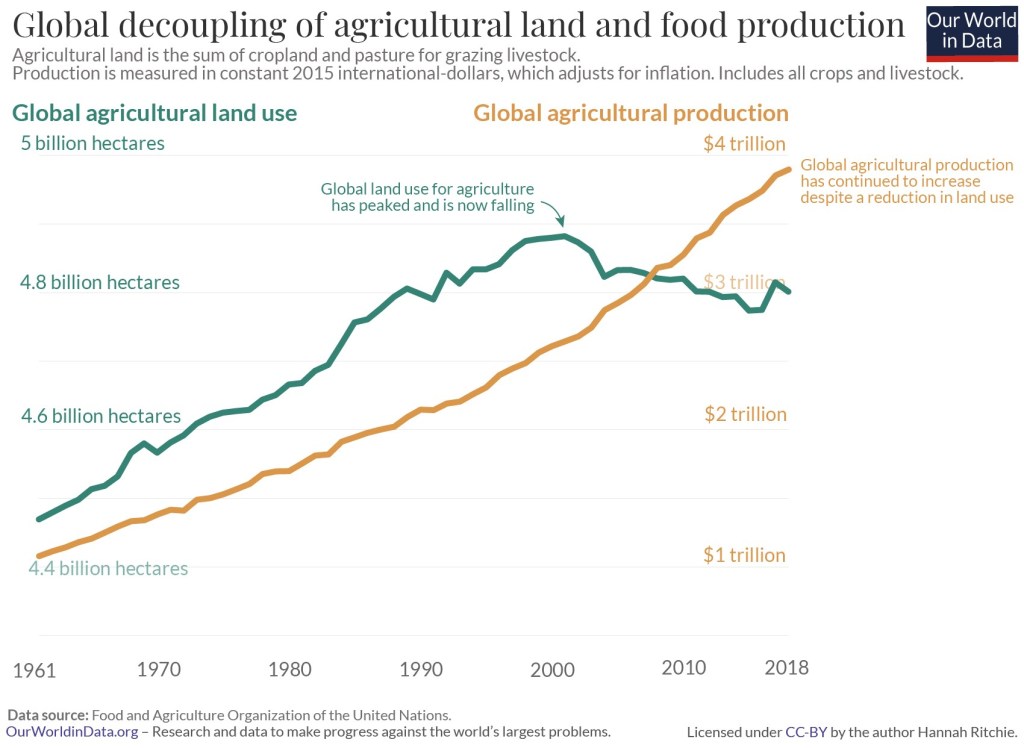
Before looking at the details of conventional farming versus organic farming lets look at global land use. In the figure below from Our World in Data you can see that agriculture already uses nearly half of all habitable land in the world. We cannot easily enlarge this percentage and therefore crop yield per acre is a very important factor to consider, and this is a great weakness for organic farming.

Also notice that 80% of agricultural land is used for livestock, meat, dairy and textile, but it only provides 17% global calorie supply. This second observation indicates that the type of food you eat may matter a lot more than whether it is produced via organic or conventional farming.

Earth’s surface is 29% land of which 76% is habitable land. Of that 45% is used for agriculture, of which 80% is used for livestock, meat, dairy and textiles and 16% is used for crops for food. livestock, meat, dairy and textiles provide 17% of the global calories supply and 38% of the global protein supply.
Global land-use graphics. Licensed under CC-BY by authors Hannah Ritchie and Max Roser (September 2023).

As you can see in the graph below, again from Our World in Data, the land used for producing 100 grams of protein varies enormously between different food groups. 100 grams of protein from lamb and mutton require on average 52.8 times as much land as 100 grams of protein from groundnuts. This graph does not make a distinction between organic farming and conventional farming, but it highlights the huge difference between different food sources. I’ll get to the difference between organic farming and conventional farming with respect to land use later in the post.

The graph shows that for 100 grams of protein you need on average 184.8 square meters for Lamb & Mutton, 163.6 square meters for beef, 39.8 square meters for cheese, 27.1 square meters for milk, 7.9 square meters for nuts, 4.6 square meters for grains, and 3.5 square meters for groundnuts. There are a few more items listed in the graph | Eating Organic is not Necessarily Ecological
Additional calculations by Our World in Data. OurWorldinData.org/environmental-impacts-of-food | CC BY

Agriculture and Greenhouse Gas Emissions

The next two graphs focus on the greenhouse gas emissions including those from agriculture. Electricity and Transport dominate both globally and in the United States, but globally agriculture comes in at 6 billion of the 40 billion tons of greenhouse gas emissions for 2021, which is 15%. For the United States agriculture comes in at 10.6% of greenhouse gas emissions for 2021. In other words, agriculture was not the largest contributor of greenhouse gas emissions but still an important factor.

The largest contributor of greenhouse gas emissions in the World is electricity and then comes Transport. After that comes manufacturing and construction, agriculture, industry, fugitive emissions, buildings, waste, land-use change and forestry, aviation and shipping, other fuel combustion | Eating Organic is not Necessarily Ecological
Data source : Climate Watch (2024). Note : Land use emissions can be negative. OurWorldinData.org/co2-and-greenhouse-gas-emissions| CC BY
The largest contributor of greenhouse gas emissions in the US is electricity and heat but it has gone down. Transport is number two. Then comes buildings, manufacturing and construction, fugitive emissions, agriculture, industry, waste, aviation and shipping, other fuel combustion, land-use change and forestry | Eating Organic is not Necessarily Ecological
Data source : Climate Watch (2024). Note : Land use emissions can be negative. OurWorldinData.org/co2-and-greenhouse-gas-emissions| CC BY

Finally, the contribution for different types of food. Notice that beef (beef herd) at 49.89kg is 188 times larger than the 0.26kg for nuts. 188 people eating nuts contribute as much to carbon emissions as one person eating beef.

The graphs show that beef (beef herd) generates 49.89 kilograms of carbon emissions per 100 gram of protein that it provides. For Lamb and mutton, it is 19.85 kilograms, for prawns 18.19 kilograms, for milk 9.5 kilograms, for eggs 4.21 kilograms, for grains 2.7 kilograms, for groundnuts 1.23 kilograms, for peas 0.44 kilograms and for nuts 0.26 kilograms | Eating Organic is not Necessarily Ecological
Greenhouse gas emissions per 100 grams of protein. Greenhouse gas emissions are measured in kilograms of carbon dioxide equivalents (see below). Data source: Poore and Nemecek (2018). OurWorldinData.org/co2-and-greenhouse-gas-emissions| CC BY

Carbon dioxide equivalents (CO2eq)

Carbon dioxide is the most important greenhouse gas, but not the only one. To capture all greenhouse gas emissions, researchers express them in “carbon dioxide equivalents” (CO2eq). This takes all greenhouse gases into account, not just CO2. To express all greenhouse gases in carbon dioxide equivalents (CO2eq), each one is weighed by its global warming potential (GWP) value. GWP measures the amount of warming a gas creates compared to CO2. CO2 is given a GWP value of one.

If a gas had a GWP of 10 then one kilogram of that gas would generate ten times the warming effect as one kilogram of CO2. Carbon dioxide equivalents are calculated for each gas by multiplying the mass of emissions of a specific gas by its GWP factor. This warming can be stated over different timescales. To calculate CO2eq over 100 years, we’d multiply each gas by its GWP over a 100-year timescale (GWP100). Total greenhouse gas emissions – measured in CO2eq – are then calculated by summing each gas’ CO2eq value.

Environmental Impact of Organic Versus Conventional Agriculture

At this point it should be clear that eating different types of food, nuts and vegetables versus red meat makes huge difference regarding the environment. How about organic versus conventional farming? Well, it is complicated. You have to take into account land use, greenhouse gas emissions, biodiversity, pesticide application, energy use and more.

Clark and Tilman (2017) published a meta-analysis of results of published organic-conventional comparisons across 742 agricultural systems over 90 unique foods. The food groups consisted of cereals, pulses and oil crops, fruits, vegetables, dairy and eggs, and meats. As you can see in the resulting graph below organic agriculture is worse for the environment for most food groups with regards to land use, eutrophication potential, and acidification potential. The result is mixed with respect to greenhouse gas emissions and energy use.

It appears that it is best to choose organic pulses and fruits and choose non-organic for all other food products (cereals, vegetables, dairy and eggs, and meat). However, if your primary concern is whether the potato accompanying your steak is conventionally or organically produced, then your focus is arguably misplaced. Whether you go organic or non-organic the steak is much worse for the environment.

The graph shows the six food groups and their impact across greenhouse gas emissions, land use, eutrophication potential,  acidification potential and energy usage.
Shown is the relative environmental impact of organic and conventional agriculture across various ecological and resource indicators based on a meta-analysis of 164 published life-cycle analyses (LCAs) across 742 agricultural systems. Roughly, lower in the graph means organic is better and higher up in the graph means conventional farming is better. Data source: Clark & Tilman (2017) – Comparative analysis of environmental impacts of agricultural production systems, agricultural input efficiency, and food choice. In Environmental Research Letters. The data visualization is available at OurWorldinData.org. There you can find research and more visualizations on this topic. Licensed under CC BY-SA by the authors Hannah Ritchie and Max Roser.

Conclusion

In this post I present empirical evidence from reliable sources comparing organic to conventional agriculture in terms of environmental impact. Despite strong public perception of organic agriculture producing better environmental outcomes, conventional agriculture often performs better on environmental measures including land use, greenhouse gas emissions, and pollution of water bodies. There are, however, some contexts where organic agriculture may be better for the environment. In short it is complicated.

What really matters though is the type of food you eat, not whether it is organic or not. Another thing to note is that if you eat 300 steaks per year you will have a 100 times larger environmental impact compared to someone who eats 3 steaks per year. Quantity matters. This post was about environmental impacts. There are other considerations such as health, what you like, whom you want to support, etc.

To see the other Super Facts click here

Eating Locally is not Necessarily Ecological

Super fact 30: Eating locally is often promoted as an environmentally friendly choice, but that is not always the case.

Whether the food you eat is sustainable and environmentally friendly or not depends on a lot of factors including agricultural methods, whether greenhouse farming or monocropping was used, and whether the crop is natural to its environment. In addition, inefficient local transportation can result in higher emissions than faraway transport by ships and trains. If a crop is grown locally in greenhouses, the extra energy that is needed, and the resulting extra carbon emissions are often much larger than the emissions from the transport.

Cargo ship at sunset. Emissions from the transport of produce is not the main factor for emissions.
Photo by aries nha on Pexels.com

I consider this a super fact because it is often assumed that buying locally is the best choice for the environment. After all, transporting something across the world causes a lot of emissions, right? It turns out not to be that simple.

Articles on Transportation of Food in my French Book

The first time this issue was brought to my attention was in my French class. I am learning French, just as a hobby. There was an article in our French book on the transportation of food around the world “Notre planète ne tourne pas rond!”.

We read that cashews were grown in the Ivory Coast in Africa and then sent for peeling and cleaning in Brazil and then sent to France to be sold. The cashews travelled 10,000 kilometers or 6.250 miles. We read about cod that was caught in Norway then sent to China to be cut into filets and then sent to France to be sold. That cod travelled 15,000 kilometers. We all thought it was crazy, and very bad for the environment, so much unnecessary emissions from transportation. But we all learned a few new French words.

Then at our next class, we turned the page “Consommer local, vraiment bon pour la planète?” / “Consuming locally, really good for the planet?”. Wait what? The next article confused us since it stated that in many cases eating locally was bad for the environment, not good for the environment. Transporting the food around the globe might be good for the environment.

Incidentally, at the time I was reading “Not the End of the World, How we can be the first generation to build a sustainable planet” by Hannah Richie, the research director for “Our World in Data”. “Our World in Data” is a highly regarded free and open-source website that collects and analysis vetted statistics on a large range of topics. In that book she stated that the data showed that tomatoes imported to Sweden from Spain caused less carbon emission than tomatoes grown locally in Sweden.

The Problem with Locally Grown Tomatoes

This article from University of Southern Denmark claim that importing tomatoes from warm countries are better for the environment than buying locally. The reason being that when tomatoes are grown in an open field, the production emits an average of 80 kg CO2 per ton, but if the tomatoes are grown in a greenhouse, they emit up to 700 kg CO2 per ton. In northern countries it is common to grow tomatoes in greenhouses, especially when they are out of season. The long transport of the tomatoes causes much less emissions than that.

This scientific article analyses the issue a bit deeper and concludes that “that the distance travelled by the tomatoes is not the most important environmental burden”. Whether the tomatoes were grown in greenhouses or not matters a lot, but there are many other factors. In short, it is complicated.

Lots of fresh red tomatoes | Eating Locally is not Necessarily Ecological
Photo by Julia Nagy on Pexels.com

This study of local vs. imported tomato production in Canada concludes that locally grown tomatoes grown in greenhouses on average cause 1,070 grams of carbon emissions per kilo of tomatoes grown and tomatoes grown open field in Mexico cause 775 grams of carbon emissions per kilo of tomatoes, despite the 3,800-kilometer journey from Mexico to Ontario, Canada. The reason for the higher emissions for locally grown tomatoes is again that greenhouses use a lot of energy.

Naturally, this would change if you grew the tomatoes in season without using greenhouses. The article also notes that carbon emissions are not the only issue for sustainability. Water usage is another important factor.

The Problem with Locally Grown Vegetables and Fruits

Tomatoes are just one example. The same hold true for cucumbers, lettuce and salad greens, potatoes, bell peppers, hot peppers, green beans and other bean varieties, berries, pineapples, bananas, mangoes, other tropical fruits. In addition, some of these crops can deplete the soil and require large amounts of water, which can be bad if they are being cultivated in areas where water resources are already scarce such as growing avocados in California. In general, growing vegetables and fruits in their natural environment tends to be the most sustainable.

Fresh yellow bananas | Eating Locally is not Necessarily Ecological
Photo by Dom J on Pexels.com

The Problem with Locally Grown Apples

The problem with apples tends to be the opposite, geography wise. In warmer areas, they might require significant water resources or chemical inputs to thrive. Apples from cooler climates need less water and fewer chemicals, reducing their ecological impact.

Lots of apples | Eating Locally is not Necessarily Ecological
Photo by Pierpaolo Riondato on Pexels.com

Local versus Imported It’s Complicated

I should point out that growing locally sometimes being worse for the environment than importing does not mean that importing produce is better for the environment. It just means that it is complicated and that you need to make that determination on a case-by-case basis. The environment is also not the only concern. Another consideration is the protection of local farmers and the local economy.

My opinion is, instead of worrying a lot about local versus imported produce, it is better to focus on things that we know cause a lot of emissions. A dirty grid, coal power stations, a non-hybrid SUV with an internal combustion engine, unnecessary business trips, eating a lot of red meat, basically start with the low hanging fruit.

Eating Locally is not Necessarily Ecological
Photo by Janusz Walczak on Pexels.com
To see the other Super Facts click here

EV Cars Indeed Emit Less Carbon Pollution

Super fact 29: EV Cars emit less pollution than Internal Combustion Engine Cars, even considering manufacturing, disposal and EV Cars being charged by dirty grids.

EV Cars emitting less carbon pollution is a Super Fact

At least here in Texas it is quite common to hear people say that EV cars do not reduce emissions. After all EV cars use electricity from the dirty grid. It is also frequently implied that environmentalists and people who care about fossil fuel emissions do not understand that the electricity for EV cars typically comes from the dirty grid. However, the environmentalists I know do know that. In fact, they typically know more and have sometimes done the math. This is why I consider it a super fact. We know that it is true that EV Cars emit less carbon pollution. This is a fact that matters, it is not trivia, and yet this fact is frequently disputed, argued over, or surprising to people.

EV Cars are more efficient than Internal Combustion Engines

For starters, EV cars are much more efficient than Internal Combustion Engine cars, or ICE, and even a coal-fired power plant is less wasteful than a car engine. The net result is that the emissions caused by EVs via the electrical grid are significantly less per mile. The miles per gallon equivalent (MPGe) for electric vehicles (EVs) varies by state/grid and depends on the model of the car but in general it is much better than for an ICE . Replacing gasoline-powered cars with EVs saves energy, regardless of the energy source used to recharge the EVs. For an ICE 16-25% of the original energy goes to the wheels whereas for an EV 87-91% of the original energy goes to the wheels.

Image showing an ICE car and its various carbon losses | EV Cars Indeed Emit Less Carbon Pollution
16-25% of original energy goes to the wheels. Data from FuelEconomy.gov, Image by Karin Kirk for Yale Connections.
Image showing an EV car and its various carbon losses | EV Cars Indeed Emit Less Carbon Pollution
87-91% of original energy goes to the wheels. Data from FuelEconomy.gov, Image by Karin Kirk for Yale Connections.

The Manufacture and Disposal of EV Cars

It takes more energy to manufacture an EV battery for an EV car than it does to produce a combustion engine. So, the production of an electric vehicle does emit more carbon than a petrol car. However, the lower emissions resulting from driving an EV means that an electric car quickly pays back that debt, so to speak. It is typically paid back within two years, according to Hannah Richie, the research director at Our World in Data. The statistics show that switching from an average ICE to an equally sized EV will save 1.2 tons of carbon emissions per person and year. That is a lot considering that the average carbon footprint per year is 4 tons worldwide and 14.4 tons per year for an American.

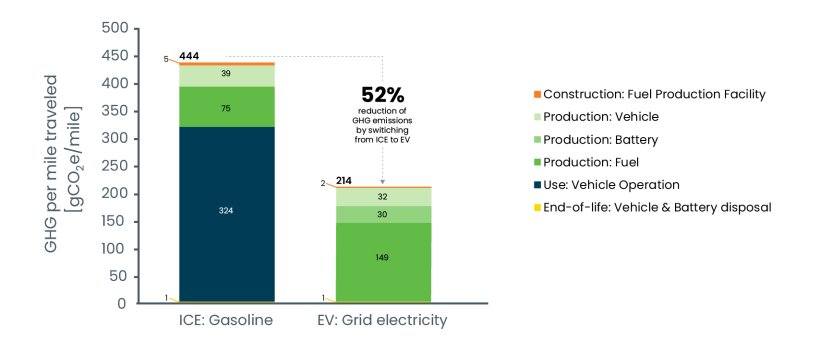
So, are electric vehicles definitely better for the climate than gas-powered cars? This article from MIT answers the question in the affirmative. The graph below includes construction of facilities, manufacturing of vehicle and battery, production of fuel, vehicle operation as well as disposal. It  is taken from this government website and this article also answers the question above in the affirmative. This is an article from the Department of Energy is stating the same thing.

The histogram graph show that if you consider construction of facilities, manufacturing of vehicle and battery, production of fuel, vehicle operation as well as disposal the total average greenhouse gas emissions from EV cars is 52% less.
Lifecycle greenhouse gas emissions comparison of average gasoline car and average EV.

Hannah Richie at Our World in Data also states that other environmental damages related to EVs such as mining for minerals are less than the damage from mining and extraction for fossil fuel cars, and she claims that the price of lithium-ion batteries has fallen by 98% over the last three decades. It should be noted that EVs are becoming increasingly common. According to Our World in Data in 2022, 88% of all cars sold in Norway were EVs and 54% of all cars in Sweden were EVs.

EV Cars Indeed Emit Less Carbon Pollution
Photo by Kindel Media on Pexels.com

Other EV Myths

There are other EV myths that you may want to have debunked, such as Electric vehicle batteries are unreliable and need to be replaced every few years. In 2011 battery failures were common, 7.5%, but in 2023 battery failures were 0.1%. See this article for details and other myth debunking. A related post is my post on electrification.

I should add that there are some drawbacks with EVs such as the easy with which you can charge them, depending on your location. This post is not a promotion of EVs, and I do not drive an EV for various reasons. This post, like most posts in this blog, is about correcting misinformation and getting the facts correct.

To see the other Super Facts click here

That Earth is round was well known long before Columbus

Image above by Kevin from The Beginning at Last

Super fact 28: That Earth is round, or spherical (or closely spherical) had been known for at least a couple of thousand years by the time Columbus set sail. Columbus did not set sail to prove that earth was round, and he knew it was round.

Old wooden ship on stormy waters | That Earth is round was well known long before Columbus
How I imagine one of Columbus’ ships. This is a submission for Kevin’s No Theme Thursday

The ancient Greeks, particularly philosophers like Pythagoras and Aristotle knew that earth was round from observing how ships disappeared over the horizon hull first, while their masts were still visible. They noticed the earth’s round shadow cast on the moon during lunar eclipses.

If earth was flat, earth’s shadow would not appear round, especially not all the time. They also noticed that different constellations were visible depending on the location (on earth). So, noticing that earth was round was a simple and obvious observation that easily could be made thousands of years ago.

A photo of spherical earth | That Earth is round was well known long before Columbus
Earth is a sphere, or closely spherical. Photo by Pixabay on Pexels.com.

According to historian Jeffrey Burton Russell, “no educated person in the history of Western Civilization from the third century B.C. onward believed that the Earth was flat.” In 240 BC (2,260 years ago) the Greek mathematician and philosopher Eratosthenes calculated the radius and circumference of earth within an error of 2%.  So why did Columbus want to sail west?

Columbus thought that the earth’s circumference was smaller than what Eratosthenes calculation had shown because he relied on maps created by Ptolemy instead of the calculations made by Eratosthenes. When he landed in the New World it seemed like Columbus had been vindicated but that did not last long. Essentially, Columbus sailed west and discovered America because he miscalculated the earth’s circumference.

The earth globe showing the side with the Pacific Ocean. The Pacific Ocean covers most of this side.
Columbus thought earth was smaller. He did not know about the Pacific Ocean. Earth Pacific Ocean view Stock Illustration ID: 1617553012 by Matis75

It should be noted that even though the earth is very close to being a sphere, it is more correctly an ellipsoid because it is slightly bulging at the equator due to centrifugal forces. You sometimes hear people say that Copernicus or Galileo proposed that earth was round. This is of course false.

Copernicus’s theory of the solar system, the heliocentric model, proposed that the Sun is at the center of the solar system and the Earth, along with other planets, revolve around it. This was not a well-known fact at the time, unlike the fact that the earth is round. Galileo defended Copernicus theory. The famous alleged quote “And yet it moves” / “E pur si muove” is said to have originated from his argument with the church (however, this is not certain).

So, we know that people knew that earth was round thousands of years before Columbus, and thousands of years before the renaissance, and we know that Columbus did not sail west to prove that earth was round, and he certainly did not prove it. Yet I’ve heard this claim quite often, which is why I consider that earth being round being well known long before Columbus a super fact. Too few people believe earth to be flat like a pancake for me to consider earth being round a super fact.

Eratosthenes Calculates the Circumference of Earth

Around 500 BC (2,500 years ago) most Greeks believed that the Earth was round, but they did not know how big it was. The Greek philosopher and mathematician Eratosthenes devised a clever method of estimating its circumference and he got very close. He had heard from travelers about a well in Syene (now Aswan) that at noon on the summer solstice, about June 21 every year, the sun illuminated the entire bottom of a well, without casting any shadows, indicating that the sun was directly overhead. He had also heard that perfectly vertical poles had no shadows at this time.

The reason for this was that Syene/Aswan is located very close to the tropic of Cancer (23.5 degrees versus 24 degrees, or about 60 miles).

In Alexandria, north of Syene, the sun was not directly overhead on the summer solstice. Eratosthenes measured the angle of a shadow cast by a stick at noon on the summer solstice in Alexandria and found it to be 7.2 degrees. Using the distance from Alexandria to Syene and this angle Eratosthenes calculated earth’s circumference to be between 40,250 to 45,900 kilometers. Earth’s circumference is 40,075 kilometers.

On the left a wheel with spokes. On the right there is a sphere and sun rays that hit in two places. One without a shadow and one with a shadow.
Illustration of the measurement of the Earth circumference by Eratosthenes. On June 21st there is no shadow in Syene/Aswan but there is one in Alexandria. Asset id: 2319651251 by Javier Jaime

Resurgence in Flat Earth Beliefs

While very few people believed the Earth was flat 50 years ago, there has been a recent rise in Flat Earth conspiracy theories, largely fueled by online misinformation. Now a day 2% of Americans aged 18-24 years old firmly believe it is flat. That is despite the fact that it is easy to directly observe earth’s round shape. That is a small minority but why would anyone believe such a thing today.

For example, on a flat Earth, a Sun that shines in all directions would illuminate the entire surface at the same time, and all places would experience sunrise and sunset at the horizon at about the same time. With a spherical Earth, half the planet is in daylight at any given time and the other half experiences nighttime. Well just give someone overseas a phone call and you’ll see what the case is. In addition, different places have different amounts of daylight at the same time, which wouldn’t happen with a flat earth.

You can observe the round shape from an airplane. If you stand on a hill by the coast, you can see ships disappearing over the horizon hull first, and you can see earth’s round shadow cast on the moon during lunar eclipses. If you travel far, you can see the constellations and the stars being in different positions in the sky. The southern and northern hemisphere have completely different constellations.

Never mind Eratosthenes, gravity, the Coriolis force, other celestial bodies being round, eyewitness accounts by astronauts, ring-laser gyroscopes, and Foucault pendulums. The moon shows the same face to everyone on earth, which would not be possible if earth was flat. Also never mind NASA photos and the fact that no one has found the earth’s edge.

Below is a youTube video showing an animation composed of actual satellite photos by NASA. Earth is obviously round in this video.

In this video the near side of the moon is dark and what you see is the far side. The far side looks a little bit different from the near side of the moon. It is a new moon and the people on earth don’t see the moon. The sun is behind us and lights up both earth and the far side of the moon (this side people on earth do not see). Also, since there is daylight, the camera does not capture faint objects such as stars.

To see the other Super Facts click here