The Unfolding Clean Energy Revolution

Superfact 100: The share of fossil fuels for electricity generation is decreasing and EVs are replacing internal combustion engines. The share of hydro and nuclear energy, which is clean energy,  is decreasing, but the sharp increase in the share provided by renewables such as wind and solar is more than making up for it. In addition, there are new clean energy sources that are very promising but not yet widely implemented such as geothermal energy and fusion energy. The energy landscape is changing rapidly.

The chart includes three graphs showing the share of the world’s electricity generated by fossil fuels, nuclear and renewables from 1985 to 2025. | The Unfolding Clean Energy Revolution
Share of electricity generation from fossil fuels, renewables and nuclear, world. Measured as a percentage of total electricity produced in the world. Fossil fuels include coal, oil and gas. Renewables include solar, wind, hydropower, bioenergy, wave and tidal. Data source Ember (2026): Energy institute – Statistical Review of World Energy (2025)  OurWorldinData.org/energy | CC BY.

As can be seen in the graph above the share of electricity in the world generated by fossil fuels has gone down in recent years (from 66.48% in 2015 to 57.39% in 2025), and the share of electricity generated by nuclear has also gone down (from 10.55% in 2015 to 8.85% in 2025) whilst the share of electricity generated by renewables has increased (from 22.97% in 2015 to 33.76% in 2025). This is even though the most prominent source of renewable energy, hydro, has decreased its share substantially (from 16.2% in 2015  to 14% in 2025) as can be seen in the graph below.

What is going on is that two sources of renewable energy, wind and solar, have increased their share of electricity generated substantially (wind: from 3.5% in 2015 to 8.5% in 2025) and (solar: from 1.1% in 2015 to 8.7% in 2025), which can be seen in the graph below. It should be noted that renewable energy encompasses solar, wind, hydropower, bioenergy, geothermal, wave, and tidal sources.

To play around with the graph above and other similar graphs click here and select and look at the bottom charts. To play around with the graph below and similar graphs click here and select and look at the bottom charts.

There are six graphs depicting the share of electricity production by six sources, coal, gas, nuclear, hydropower, solar and wind from 1985 to 2025. The graphs show that the share of electricity production by coal, gas, nuclear and hydropower have gone up and down but have been relatively steady with a decline over the last ten years. At the same time wind and solar have gone from almost to a sharp increase over the last 10-15 years.
Share of electricity production by source, World. Data source (2026): Energy Institute – Statistical Review of World Energy (2025)  OurWorldinData.org/energy | CC BY.

So far, I’ve been talking about the share of electricity production in the world by different energy sources. However, the world is using more and more electricity. Populations are growing, economies are growing, and the world is electrifying, for example, because of the worldwide adaption of EVs.

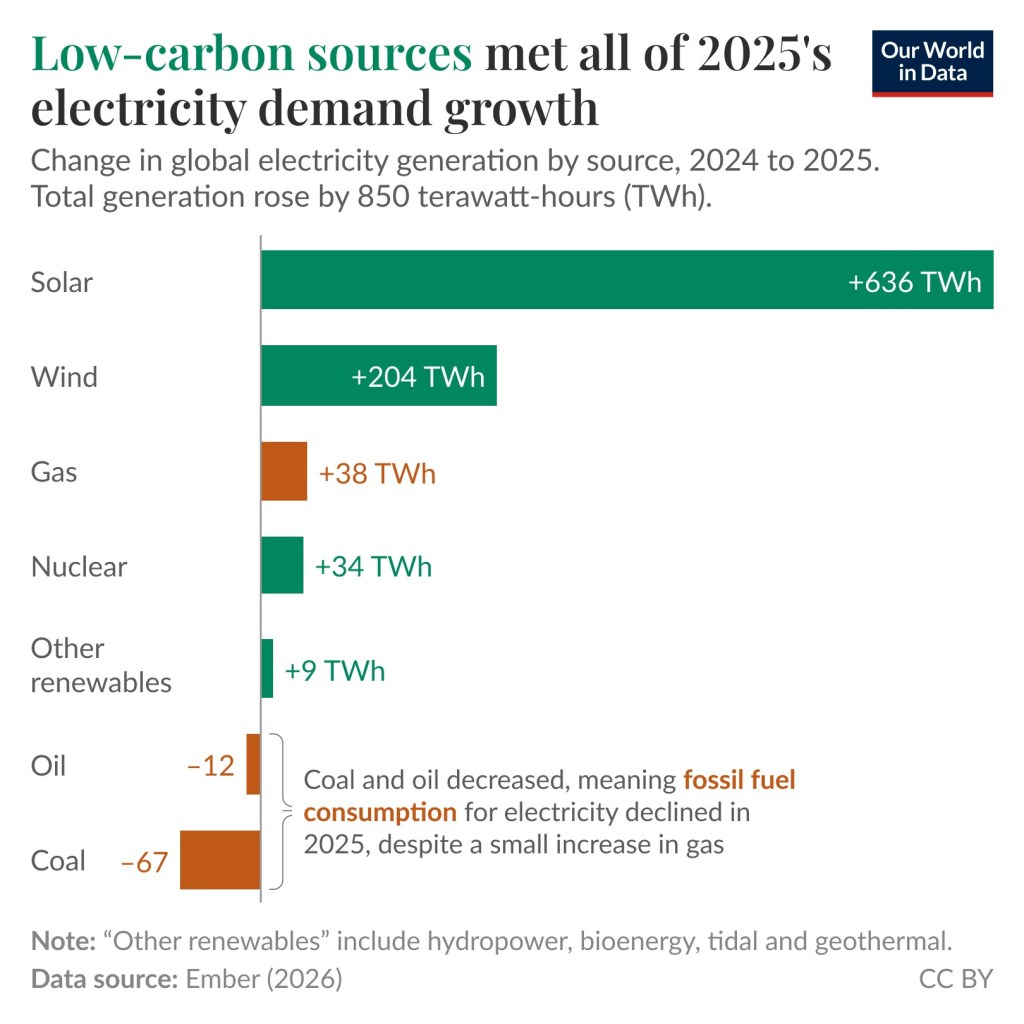
Just because an energy source’s share of electricity production is decreasing does not mean its total global electricity generation by that source is decreasing. In fact, as the share of electricity production by fossil fuels has decreased, the total production of electricity by fossil fuels has increased, well up until now. For the first time in history the total global electricity generation by fossil fuels went down in 2025. Note that since coal and oil decreased in the graph below fossil fuel consumption for electricity declined in 2025, despite s small increase in gas. This means that the use of fossil fuels is finally decreasing.

This is a bar graph showing an increase of 38TWh from gas, a decrease of 12TWh from oil, and a decrease of 67TWh from coal. The energy from wind, solar, nuclear, and other renewables increased by 850TWh. | The Unfolding Clean Energy Revolution
Low carbon sources met all of 2025’s electricity demand growth. Change in global electricity generation by source, 2024 to 2025. Total generation rose by 850 terawatt-hours (TWh). Note: “Other renewables” include hydropower, bioenergy, tidal and geothermal. Data source: Ember (2026). This graph comes from this page.

The practice of burning fossil fuels to generate electricity and for transportation is becoming less dominant. I believe this fact is surprising to many people, especially Americans since the current administration has taken a strong anti-renewable and anti-climate-science stance, and many Americans are not aware of what is happening in the rest of world in this regard. Superfact #100 is a super fact because the data is reliable, it is surprising to many people, and it is important.

It should be noted that we will likely keep using fossil fuels to produce fertilizers, plastics, medicines, and chemicals for a long time. However, this corresponds to only a few percent of our current use of fossil fuels and seems to be a lot better use of fossil fuels than burning it all up for energy. In fact, we may need the remaining fossil fuels for that purpose. In this post I am using data provided by Our World in Data which in turn got data from Ember Energy, or the International Energy Agency.

The Current Administration’s Opposition to Renewables and Climate Science

I am trying to keep politics out of my blog. However, the current administration’s strong opposition to and the misinformation they disseminate about renewables and climate science makes it difficult to discuss this renewable energy without bringing it up. It is an important piece in our understanding of what is going on. The misinformation about climate science (and other scientific topics) has bamboozled a lot of people and the actions taken to hinder the deployment of renewables have had real consequences. However, it is important to remember that the current situation here in the US is temporary and has a limited impact on the rest of the world.

Some actions that current administration has taken are:

  • Science organizations such as NOAA and NFS-NCAR have had their budgets severely cut and have been threatened to be dismantled. Websites related to climate science have been taken down. Click here to read more. NASA is also threatened to have its science programs severely cut (by 47%), as well as other programs, but it has not yet been implemented. Click here to read more.
  • Restricting or ordering the freezing of permits for renewables, canceling tax credits and investment credits for renewables, ordering the cancelation of renewables under construction, for additional information click here, or here.
  • In 2009 the EPA found that atmospheric concentrations of greenhouse gases endanger both current and future generations, enabling EPA to regulate greenhouse gases. This, so called endangerment finding was overturned in February 2026 by the administration. This article explain why there is no Scientific justification to revoke the endangerment finding.
  • The administration paid one billion dollars to France’s TotalEnergies in exchange for not developing windfarms on the east coast (kind of a bribe).
  • Pentagon has frozen permitting since last August halting more than 250 onshore wind projects, including those on private land, which is not only preventing us from meeting our energy needs, but is indirectly a violation of private property rights.
  • The United States is the only country to have withdrawn from the Paris Agreement (January 27, 2026). Three other countries, Iran, Libya, and Yemen, did not join.
  • 95,000 employees, including 10,000+ with PhD’s, at government science agencies (more than a third of them) have either been laid off / fired, or left, as a result of current policies. This effects CDC, NIH (National Institute of Health), and especially anything related to climate science. Many scientists have left the US for Europe.

There is not wonder many in the United States incorrectly believe clean energy is on its way out. I should say that even though support for solar and wind has declined in the US, solar and wind remain the sources of energy that most people want the federal government to encourage over any other source of energy, according to this Pew Research article.

Important Climate and Energy Facts

As I said, the misinformation about climate science has bamboozled a lot of people. As an example. We know that climate change / global warming is happening. We have also known for several decades that the current climate change / global warming is not natural. It is caused by us, chiefly due to the burning of fossil fuels. The scientific evidence is conclusive. It includes satellites directly measuring our greenhouse gases trapping heat, the upper troposphere is cooling whilst the lower atmosphere is warming, showing that the heating is from greenhouse gases, the unnatural speed of the warming, isotope studies, climate models, etc. How many people know about this? I believe very few people do. Below are eleven related super facts.

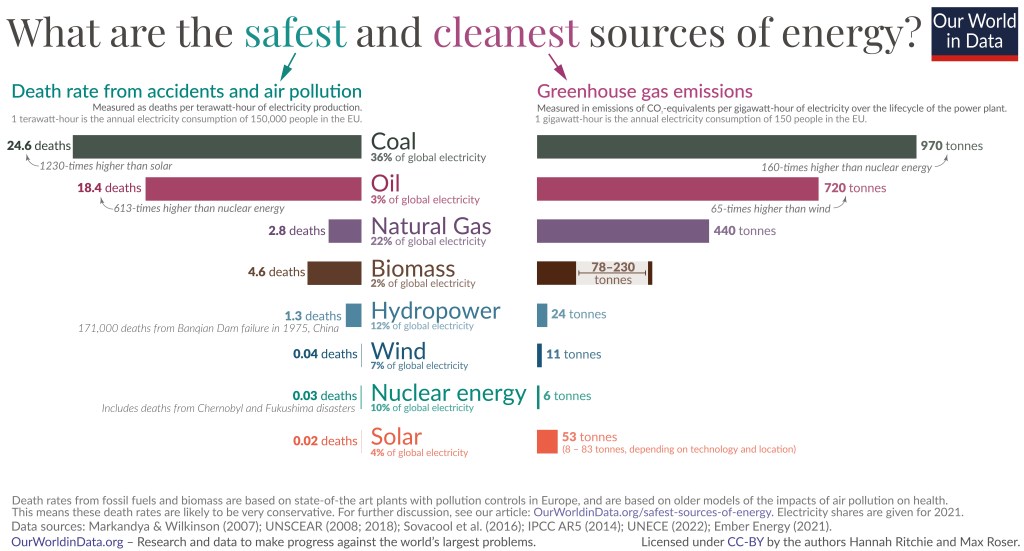
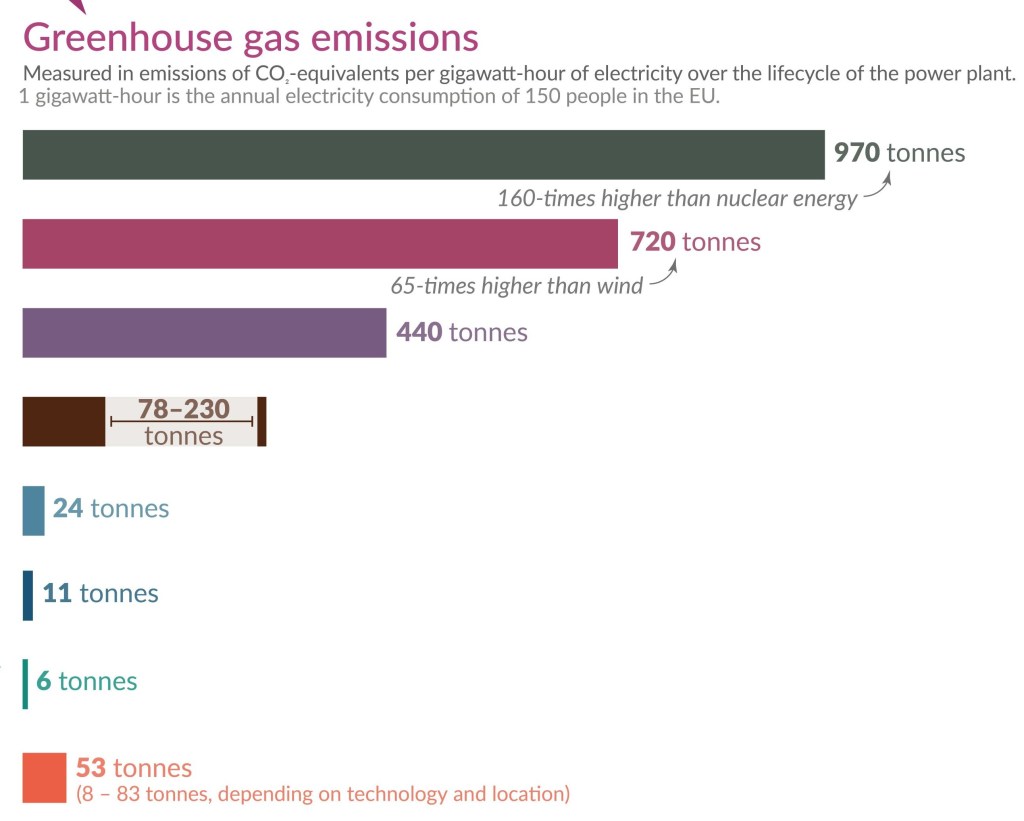
The graph depicts death rates and greenhouse gas emissions per unit for different energy sources including coal, oil, natural gas, biomass, hydropower, wind, nuclear power, and solar.
Greenhouse gas emissions and death rates from various sources of energy. Fossil fuels and biomass are based on state-of-the art plants with pollution control in Europe and are based on older models of the impacts of air pollution on health. This means that these death rates are likely to be very conservative. The graph shows that renewables and nuclear are the cleanest and safest forms of energy. For further discussion see the article: OurWorldinData.org/safest-sources-of-energy. Electricity shares are given for 2021. Data sources: Markandya & Wilkinson (2007); UNSCEAR (2008: 2018); Sovacol et al. (2016); IPCC AR5 (2014); UNECE (2022); Ember Energy (2001). OurWorldinData.org – Research and data to make progress against the world’s largest problems. Licensed under CC-BY by the authors Hannah Ritchie and Max Roser. Citation : Hannah Ritchie (2020) – “What are the safest and cleanest sources of energy?” Published online at OurWorldinData.org. Retrieved from: ‘https://archive.ourworldindata.org/20260202-100556/safest-sources-of-energy.html’ [Online Resource] (archived on February 2, 2026).

The Share of EVs

Another phenomenon that results in less burning of fossil fuels than we otherwise would have is that electric cars and plug-in hybrid are becoming more common in the world. Going from nearly non-existent in 2010 electric cars (EVs) are now starting to show up around the world. The share of electric cars on the roads in 2024 was in the United States was 2.7%, in the world 4.5%, in China 11%, in Sweden 13% and in Norway 32%.

What matters more (for the future) is the sale of new EVs and plug-in hybrids. The share of new cars that are electric was 22% for the world, 10% in the United States, 21% in the EU, 28% in the United Kingdom, 48% in China, 58% in Sweden, 92% in Norway. In 2025 the share of new cars that were electric was 98% in Norway according to this website. To see more EV statistics and play around with various graphs visit this link.

One thing that might be surprising to Americans is that EVs are quite common in many other countries including EU, the Scandinavian countries, and China. Another is that EVs are indeed significantly cleaner than internal combustion engines, even when charged from a relatively dirty grid. See this super fact (29) EV Cars Indeed Emit Less Carbon Pollution.

The graph shows the share of cars currently in use that are electric for the world, the United States, China, Sweden and Norway.
Share of cars currently in use that are electric, 2010 to 2024. Electric cars include fully battery-electric and plug-in hybrids. With battery-electric cars is meant cars or other vehicles that are powered entirely by an electric motor and battery, instead of an internal combustion engine. With plug-in hybrid is meant cars or other vehicles that have a rechargeable battery and electric motor, and an internal combustion engine. The battery in plug-in hybrids is smaller and has a shorter range than battery-electric cars, so over longer distances, the car starts running on gasoline once the battery has run out.
Data source: International Energy Agency Global EV Outlook 2025.   OurWorldinData.org/energy | CC BY
Share of new cars sold that are battery-electric (in brown) and plug-in hybrid (in blue), 2010 to 2024, for six countries and regions, including the world, United States, United Kingdom, China, Norway and the European Union. | The Unfolding Clean Energy Revolution
Battery-electric cars are depicted with brown and plug-in hybrid in blue. Share of new cars sold that are battery-electric and plug-in hybrid, 2010 to 2024. Plug-in hybrids cars can run using an electric motor and rechargeable battery, or an internal combustion engine. Their battery is usually smaller than a fully battery-electric. Data source: International Energy Agency Global EV Outlook 2025.   OurWorldinData.org/energy | CC BY
The bar graph shows the share of new cars sold that are electric in 2024 for the world and 8 countries. The numbers are India 2.1%, the United States 10%, Germany 19%, European Union 21%, United Kingdom 28%, China 48%. Sweden 58%, Norway 92%, and the World 22%
Share of new cars sold that are electric, 2024. Electric cars include fully battery-electric and plug-in hybrids. Data source: International Energy Agency  Global EV Outlook 2025.  OurWorldinData.org | CC BY

Share of electricity production by source EU, US, China

The first graph in this post depicted the share of electricity production by source for the world. The graph below breaks it up to show the share of electricity production by source for the three largest economies in the world, the United States, China and the EU. Again, the share of energy from coal, nuclear and hydro is decreasing whilst the share from wind and solar is going up for all three markets. One notable difference from the top graph is that gas keep increasing for the United States.

There are six charts in the picture depicting share of electricity production by coal, gas, nuclear, hydro, solar and wind. Each charts show three graphs in different colors representing the United States, the European Union, and China. | The Unfolding Clean Energy Revolution
Share of electricity production by source, United States, European Union, and China. Data source: Ember (2026): Energy Institute – Statistical Review of World Energy (2025)     OurWorldData.org/energy | CC BY

The Share of Electricity Production from Wind

Below are a few charts depicting the share of electricity production from wind. The first graph is already included in the second chart from the top (above). However, this is a close up. The second graph depicts the share of electricity production from wind for multiple countries. It should be noted that Denmark and the United Kingdom are prominent users of wind power. For Denmark the share of electricity production from wind is almost 60%. By clicking here you can play around with the graphs and generate as many different graphs as you wish.

This graph shows the share of electricity production from wind for the world. In 1985 it is 0%, in the year 2000 it is 0.2%, in 2010 it is 1.6%, in 2015 3.5%, in 2020 4.0%, and in 2025 8.5%.
Share of electricity production from wind. Measured as a percentage of total electricity produced in the world. Data source: Ember (2026): Energy Institute – Statistical Review of World Energy (2025)   OurWorldinData.org/energy | CC BY
This graph shows the share of electricity production from wind for the world and for five selected countries, India, United States, Austria, United Kingdom, and Denmark. Denmark uses the most wind power at 57.7%.
Share of electricity production from wind. Measured as a percentage of total electricity produced in the country or region. Data source: Ember (2026): Energy Institute – Statistical Review of World Energy (2025)   OurWorldinData.org/energy | CC BY
The graph shows the share of electricity production from wind for the United States (dark blue), China (purple), and the European Union (blue).
Share of electricity production from wind. Measured as a percentage of total electricity produced in the United States, China and the European Union. Data source: Ember (2026): Energy Institute – Statistical Review of World Energy (2025)   OurWorldinData.org/energy | CC BY

The Share of Electricity from Solar

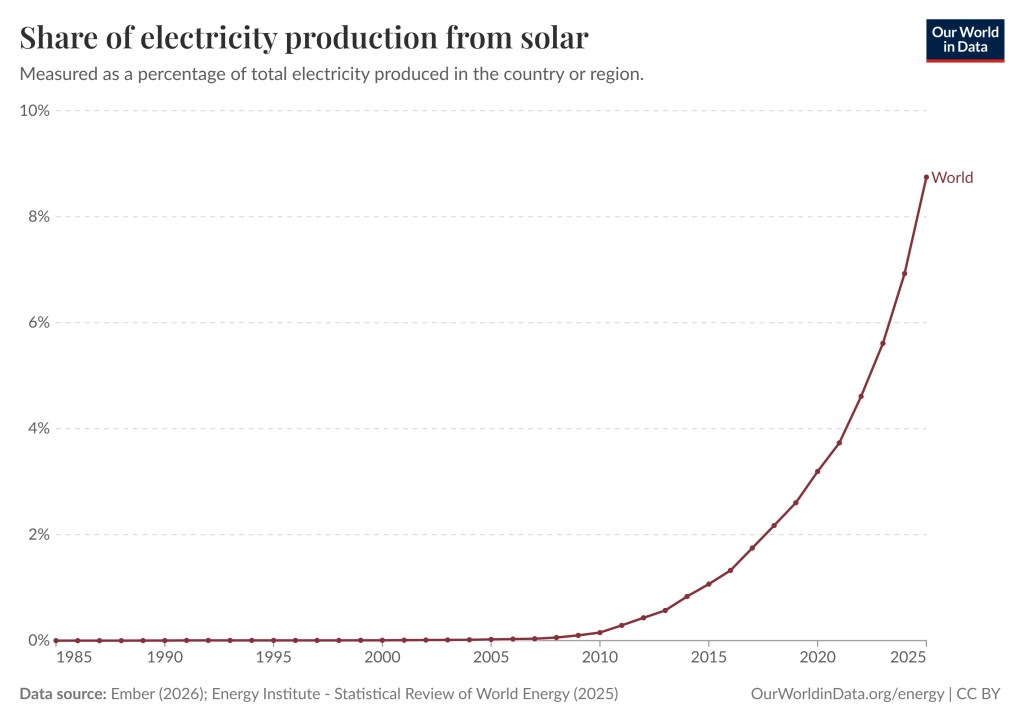
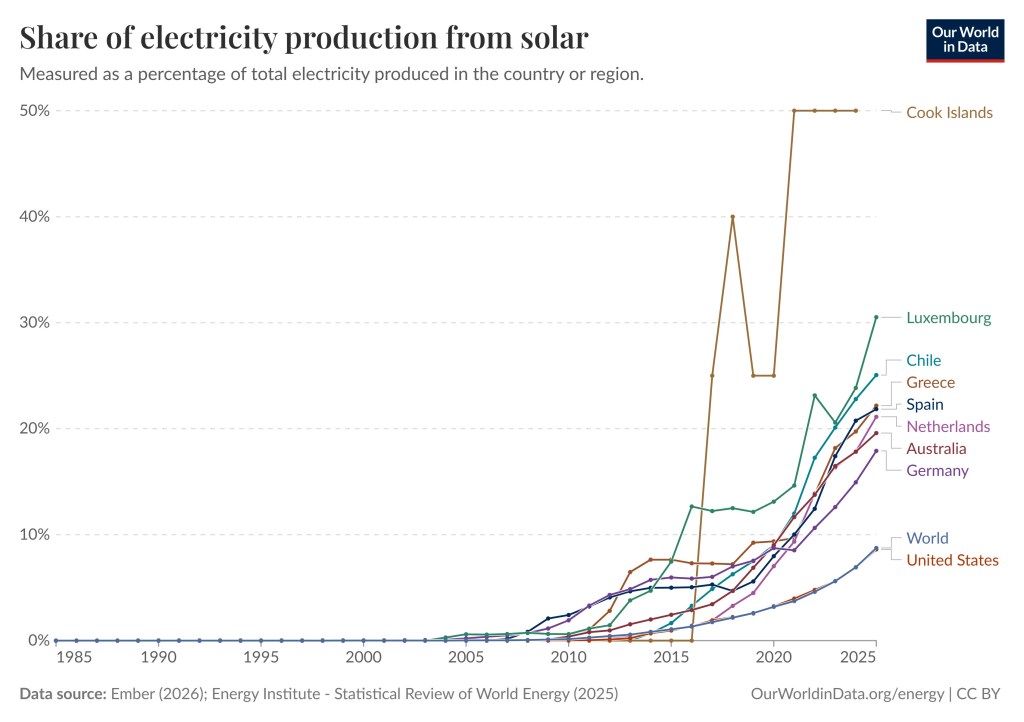
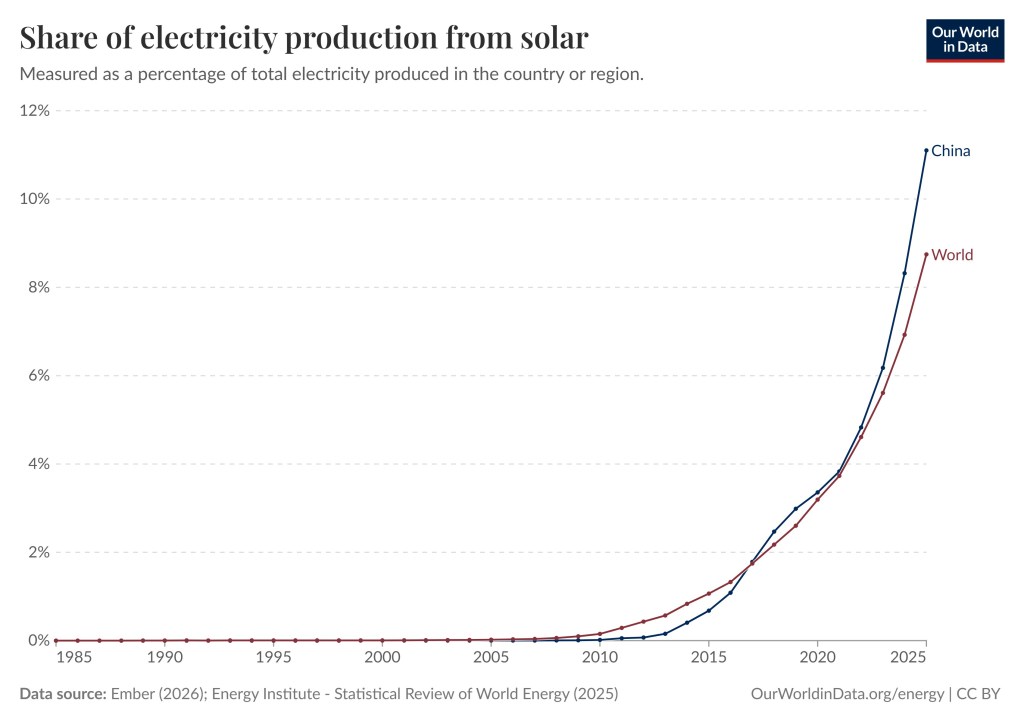
The share of electricity from Solar for the world has grown from essentially 0% in the year 2000 to 3.19% in 2020 to 8.75% in 2025. For solar, the United States follows the rest of the world closely. Some countries have a higher percentage, such as the Cook Islands – 50%, Luxembourg – 30.52%, Chile – 25.06%. If you wish you can take a look here, or here, and you can play around with the different graphs. You can create millions of scenarios at your pleasure.

The graphs shows that the share of electricity from Solar remained nearly zero until the very recent sharp increase. | The Unfolding Clean Energy Revolution
Share of electricity from Solar. Measured as a percentage of total electricity produced in the country or region. Data source: Ember (2026): Energy Institute – Statistical Review of World Energy (2025)    OurWorldinData.org/energy | CC BY

The Share of Electricity Production from Hydropower

Hydro is a renewable energy source but its share of electricity production in the world has gone down. Unlike solar and wind, hydro is not an intermittent source of energy, so that is not necessarily something to celebrate. The intermittency of solar and wind can be mitigated using batteries, or energy sources that are not intermittent, preferably clean energy sources such as hydro and nuclear. Hydro is still the world’s most popular renewable energy source but that is changing quickly.

The graph below shows that the share of electricity production from hydropower for the world is 13.96%, USA 5.35%, Bhutan 100%, Norway 90.03%, Brazil 51.78%, Sweden 39.97%. If you wish you can take a look here, or here, and you can play around with the different graphs. You can create millions of scenarios at your pleasure.

There is only one graph in the chart and that is for the share of electricity production from hydropower. It has slowly been going down from 1985 (20.02%) to 2025 (13.96%).
Share of electricity production from hydropower. Measured as a percentage of total electricity produced in the world. Data source: Ember (2026): Energy Institute – Statistical Review of World Energy (2025)    OurWorldinData.org/energy | CC BY
The chart shows six colored graphs going from 1985 to 2025. The graphs correspond to the world, Bhutan, Norway, Brazil, Sweden, and the United States. | The Unfolding Clean Energy Revolution
Share of electricity production from hydropower. Measured as a percentage of total electricity produced in the world and five countries (Bhutan, Norway, Brazil, Sweden, United States). Bhutan remains at 100% hydro, Norway went from 99.12% in 1985 to 90.03% in 2025, Brazil went from 92.10% hydro in 1985 to 51.78% in 2025, Sweden went from 51.76% hydro in 1985 to 39.97% in 2025, the United States went from 10.81% hydro in 1985 to 5.35% in 2025. The world went from 20.02% hydro in 1985 to 13.96% in 2025. Data source: Ember (2026): Energy Institute – Statistical Review of World Energy (2025)    OurWorldinData.org/energy | CC BY

The Share of Electricity Production from Nuclear

The share of electricity production in the world from nuclear went down from 15.06% in 1985 to 8.85% in 2025, which is a significant drop. During the same time the share of electricity production from nuclear in the United States went from 15.20% in 1985 to 17.36% in 2025, for China the numbers are 0% in 1985 to 4.61% in 2025, and for EU the share of electricity production in 1985 was 27.42% and in 2025 23.32%. However, in 1993% the share of electricity production in 1993 was 33.90%.

So, nuclear has taken a big step back in EU. Germany cancelled nuclear power entirely, for better and for worse. To interact with the graphs shown below or see other (millions) related charts or maps click here, or here.

This chart features three graphs corresponding to the United States, EU, and China. The share of electricity production from nuclear has gone up in both the United States and China while the share has gone down in the EU after a record high in 1993.
Share of electricity production from nuclear. Measured as a percentage of total electricity produced in the world’s three largest economies, the United States, EU, and China. Data source: Ember (2026): Energy Institute – Statistical Review of World Energy (2025)    OurWorldinData.org/energy | CC BY

Geothermal a Promising source of Energy

Another reason to believe that the energy transition away from fossil fuels has begun, is that in addition to fossil fuels losing share of total electricity produced, there are promising emerging renewables, such as Geothermal energy. Geothermal energy uses natural heat from deep within the Earth to generate electricity or heat buildings. Wells tap into underground hot water/steam reservoirs, forcing it up to spin turbines that power generators, after which the water is cooled and reinjected to replenish the source (see the picture below).

The illustration shows hot steam from hot water deep underground flowing up to earth’s surface and driving a turbine generating electricity. Then the steam is cooled and pushed back down into the ground.
Geothermal energy production example diagram illustration. Industrial renewable green energy plant example. Steam flow from the underground hot water to turbine generator and cooling towers. Shutterstock Asset id: 1637621995 by VectorMine.

Just like renewables geothermal energy is low emissions energy source but unlike renewables it is not an intermittent energy source. It is as of yet not widely used and not cost effective. However, it appears that might change soon. The advanced drilling techniques needed are utilizing oil and gas expertise and could therefore provide a good transition from fossil fuels to geothermal.

A geothermal plant. There are pipes going into a circular pool. | The Unfolding Clean Energy Revolution
Geothermal power plant from above Shutterstock Asset id: 2539157855 by Alrasyiqin

Is Fusion Power the Future ?

Fusion power is a clean, and near-limitless energy source generated by smashing light atomic nuclei together, usually hydrogen isotope, to form heavier ones. It is a form of nuclear power that releases immense heat. It replicates the process that powers the Sun. Unlike wind and solar it is not intermittent and can generate carbon-free baseload electricity without long-lived radioactive waste. However, it cannot yet be used to produce energy. That does not mean it will not work in the future.

The inside of a nuclear fusion plant. | The Unfolding Clean Energy Revolution
Nuclear fusion power generator concept image, 3d rendering Shutterstock asset id: 2262106105 by MeshCube.

Conclusion

The share of fossil fuels for electricity generation is decreasing despite the fact that the share from hydro and nuclear is also decreasing. The reason is the spectacular increase in the share provided by wind and solar. In addition, EV cars are rapidly replacing internal combustion cars around the world, especially in the EU and China. There are also renewable or clean energy sources that show great promise even though they are not yet widespread. This means that fossil fuels, coal, natural gas, and oil, which are all dirty and dangerous energy sources, are finally being replaced by cleaner alternatives.


To see the other Super Facts click here

Carbon Capture and Storage an Unfulfilled Promise

Superfact 99: Carbon capture is the process of separating carbon dioxide from industrial emissions. Even though it works and could be helpful it isn’t used very much, at least not the right way.

Esther’s writing prompt: April 29, 2026: Capture

Click here or here  to join in.

Carbon capture and storage is the process of separating carbon dioxide (CO2) from industrial emissions to prevent it from entering the atmosphere and contributing to climate change. There are also systems that can remove carbon dioxide directly from the atmosphere, but this is expensive. After capturing the carbon dioxide, it is compressed and stored permanently underground or used in products.

Capturing carbon dioxide from concentrated sources like ethanol or natural gas plants can cost as little as $15–$25 per ton, which should be compared to the huge cost from the damage to health and the environment caused by carbon dioxide added to atmosphere. This cost ranges from several hundred dollars per ton, to thousands of dollars per ton, and even one hundred thousand dollars per ton according to some estimates. Yet it has only captured about 0.1% of global emissions, making its overall climate impact negligible. Instead of storing the captured carbon dioxide it is often injected into nearly depleted oil wells to force out the remaining oil.

If you have not heard about carbon capture before, its existence may be a surprise to you. If you do know about carbon capture it is likely to come as a surprise to you that it is a potentially promising technology that is underutilized and not used correctly. The facts around this technology are surprising, which is why I call it a super fact.

The illustration shows a geological cross section and includes an ethanol plant, and a coal fired power plant capturing emissions buried below earth’s surface. | Carbon Capture and Storage an Unfulfilled Promise
With CCS, carbon dioxide is captured from a point source, such as an ethanol refinery. It is usually transported via pipelines and then either used to extract oil or stored in a dedicated geologic formation. Congressional Budget Office, U.S. Federal Government, Public domain, via Wikimedia Commons.

Carbon dioxide and Global Warming

Global warming, or if you call it climate change, is happening and it is happening very fast. We also know that it is caused by us primarily as a result of our burning of fossil fuels. The primary culprit is carbon dioxide. There is a long-standing scientific consensus on these two/three facts because the evidence is conclusive. Some organizations and contrarians have successfully confused the public, but that does not mean there is a serious scientific discussion on the issue. To read more about this click here.

The damage caused by carbon dioxide to human health and the environment is difficult to assess, but you can get an idea, and you can put a dollar price on it. The economist William Nordhaus did this and got the Nobel Prize in economy for it in 2018. See my review for his book The Climate Casino. Now the question is what to do about it, and carbon capture and storage is one potential option.

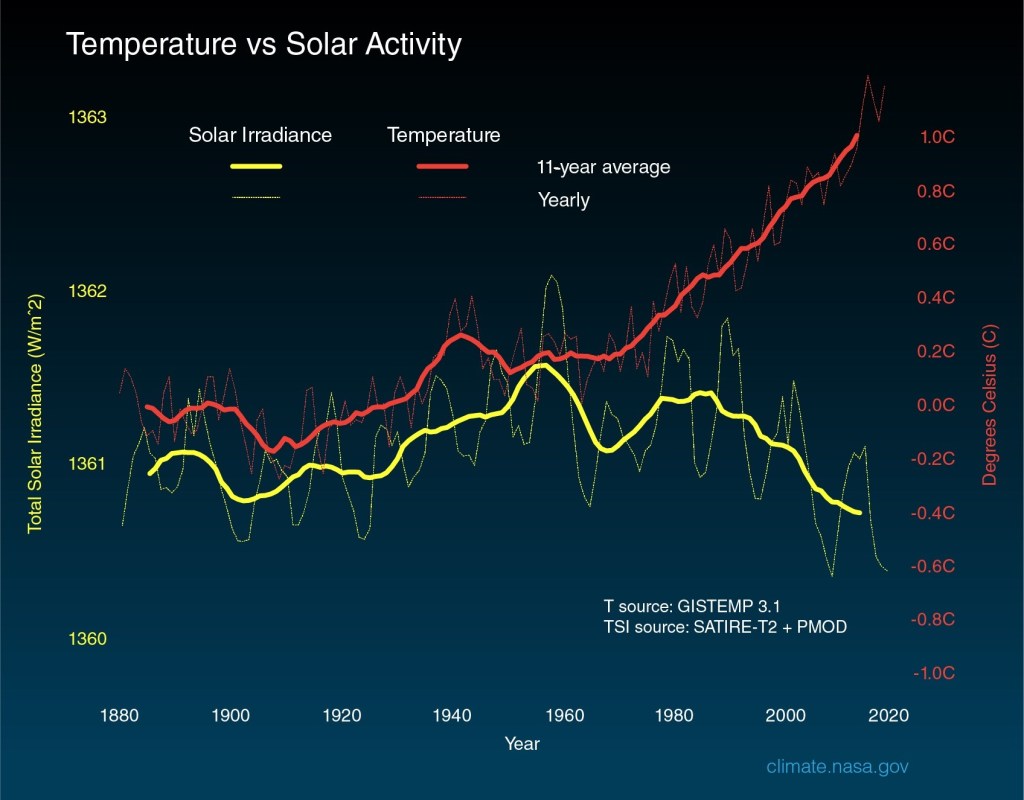
Graph showing possible causes for the observed temperature (blue), natural causes (volcanic, solar), human and natural causes (volcanic, solar, greenhouse gases, NO2, ozone depletion).
Natural causes for global warming / climate change would have cooled the planet, not warm it. Click here to visit this NASA web page regarding the causes behind global warming.

Carbon capture and storage an unfulfilled promise

The following is to a large degree my opinion, not just fact. Carbon capture and storage is a good idea. However, it adds costs to the production of energy, a cost someone must pay for. It seems like a no brainer that if carbon dioxide creates a social cost of several hundred dollars per ton, then paying much less than that to mitigate the emissions would be a good idea. However, the social cost that carbon dioxide imposes on all of us is imposed on all of us whether we are responsible for the emissions or not. Whereas the cost for carbon capture is a cost to a specific company or person responsible for the emissions.

Even though the cost for carbon capture may only be a few dollars added to the natural gas bill or a few cents per gallon on a gas tank it is a cost that is not incurred by your competitor who is not doing carbon capture. Unless the governments of the world either pay for carbon capture or put a price on carbon emissions, carbon capture isn’t going to be economically viable.

In addition, carbon capture and storage has been disappointing in other ways. It has been more difficult and expensive than expected. It has been used to extract more fossil fuels rather than removing carbon emissions. In addition, renewable energy has become so cheap that it is cheaper to use renewable energy instead of fossil fuels with carbon capture.


My Other Responses to Esther’s Prompts


To see the Other Super Facts click here

Science History of the Greenhouse Effect by Craigvad

I came across a very interesting post about the science history of greenhouse effect: “The Greenhouse Effect: From Early Chemistry to the Keeling Curve” by Craigavad miscellany a science blog written by a retired academic. It is a very educational and interesting post related to this topic. Please take a look.

Curve showing CO2 concentration starting 10,000 years ago. Again a very sharp uptick towards end. | Science History of the Greenhouse Effect by Craigvad
From Scripps institute. Keep two things in mind. First the warming from CO2 is delayed and may result in positive feedback that can manifest decades and centuries later. Secondly, human civilization developed during a period of stable climate. That CO2 levels and temperatures were higher millions of years ago is not much comfort.


To see the Super Facts click here

Ten Selected 2025 Super Facts

I started this blog, superfactful, in August of 2024. The goal of my blog is to create a list of facts that are important, not trivia, and that are known to be true yet surprising, shocking or disputed by large segments of the public. I determine what is true by evaluating the evidence I find in reliable reputable sources and if a longstanding scientific consensus is available that certainly helps. In some cases, I have expertise in the subject myself, which also helps. Whether a fact is important and surprising or disputed is a judgment call. In some cases, there are polls to help me determine how surprising or disputed the fact is. I am trying to avoid trivia and click bait, and I am only focusing on what is true, important and mindboggling.

It is a project I hope to learn a lot from, and I hope others will also learn something from reading it. We are all drowning in misinformation, false beliefs and unsubstantiated assumptions. We often know and understand less than we think. I have been bamboozled in the past and I am pretty sure you have too. If this blog can spread a little bit of light, I am happy.

In 2024 I posted 25 super facts and in 2025 I posted 53. I am hoping to one day to have collected 200 super facts. I have also made 64 other kinds of posts on this blog such as book reviews for educational books as well as other fact related posts. Below are ten selected super facts from 2025. To read the full post click the links.

That Earth is round was well known long before Columbus

Super fact 28: That Earth is round, or spherical (or closely spherical) had been known for at least a couple of thousand years by the time Columbus set sail. Columbus did not set sail to prove that earth was round, and he knew it was round.

I’ve realized that this comes as a surprise to some. To read the post click here.

The earth globe showing the side with the Pacific Ocean. The Pacific Ocean covers most of this side. | Ten Selected 2025 Super Facts
Columbus thought earth was smaller. He did not know about the Pacific Ocean. Earth Pacific Ocean view Stock Illustration ID: 1617553012 by Matis75

EV Cars Indeed Emit Less Carbon Pollution

Super fact 29: EV Cars emit less pollution than Internal Combustion Engine, even considering manufacturing, disposal and EV Cars being charged by dirty grids.

There is a lot of misinformation about EVs including that EVs are not better for the environment. To read the post click here.

The histogram graph show that if you consider construction of facilities, manufacturing of vehicle and battery, production of fuel, vehicle operation as well as disposal the total average greenhouse gas emissions from EV cars is 52% less.
Lifecycle greenhouse gas emissions comparison of average gasoline car and 300 mile range EV. Feedstock and fuel include the generation of electricity for EVs.

Scientists Agree that Global Warming is happening and that we are the Cause

Super fact 34: Climate Scientists agree that Global Warming or if you call it Climate Change is happening, and that it is caused by us primarily because of our burning of fossil fuels. There is a long-standing scientific consensus on these two facts because the evidence is conclusive. Typically, studies show an agreement of at least 97% or 98% among climate scientists.

Polls show that most American are unaware of the consensus among climate scientists. To read the post click here.

There is almost total agreement among climate scientists that global warming, or climate change, is happening and is caused by us. To understand why, you need to know a little bit about the impressive evidence, which for all practical purposes is conclusive. Take a look at this post “Global Warming is Happening and is Caused by us

The green graph is going up slightly starting from 46% in 2009 and ending in 58% in 2023. The black graph starts at 33% in 2009 and ends in 22% in 2023. The yellow graph starts at 2% in 2009 and ends in 2% in 2023.
The green graph corresponds to “most scientists think global warming is happening (%).” The black graph corresponds to “there is a lot of disagreement among scientists (%)”. The yellow graph corresponds to “Most scientists think global warming is NOT happening (%)”. Graph taken from the Yale Program on Climate Change Communication.

Time Dilation Goes Both Ways

Super fact 38 : If two observers are moving compared to each other both will observe the other’s time as being slower. In other words, both observers will observe the other’s clocks as ticking slower. Time slowing down is referred to as Time Dilation.

Clocks slow down as you travel at high speeds. However, the person travelling think they are standing still. It is the other person who is travelling. This is confusing. To understand it click here.

The picture shows two people Alan and Amy. Alan is on the ground. Amy is flying by Alan in a rocket speeding left. Both Alan and Amy are pointing lasers to the left. | Ten Selected 2025 Super Facts
In this picture Amy is traveling past Alan in a rocket. Both have a laser. Both measure the speed of both laser beams to be c = 299,792,458 meters per second. The speed of light is a universal constant.

Emissions of ozone-depleting gases have fallen by 99 Percent

Super fact 41 : Largely thanks to the Montreal Protocol in 1987 the emissions of ozone-depleting gases have fallen by more than 99%, 99.7% to be exact, according to Our World in Data. This has resulted in halting the expansion of the ozone holes and the reduction in emissions of  ozone-depleting gases is saving millions of lives every year.

A gigantic victory for the environment that few are aware of. To read the post click here.

Gases visualized in the diagram are CFCs, Halons, HCFCs, Carbon Tetrachloride, Methyl Bromide, Methyl Chloroform. The diagram shows a peak around the end of 1980’s.
The phase out of six ozone depleting gases. Data source UN Environment Program (2023).

Sulfur dioxide pollution has fallen by 95 percent in the US

Super fact 44 : Sulfur dioxide pollution in the US has fallen by approximately 95% since the 1970s. This significant reduction is primarily due to regulations like the Clean Air Act. Global sulfur dioxide pollution has also fallen but not as much.

Another big victory for the environment that we seldom hear of. To read the post click here.

The graph shows a steep increase towards the end of the 19th century with a peak in 1973, followed by a steep decline.
US sulfur dioxide pollution since 1800. Data Source: Hoesly et al (2024) – Community Emissions Data System (CEDS). This graph is taken this page in Our World In Data. US Emissions peaked in 1973.

I should mention that by clicking this link you can visit the graph above Our World in Data and select different countries and regions and play around with the settings.

We Exploded Thousands of Nuclear Bombs

Super fact 48 : Since 1945 we have set off more than 2,000 Nuclear Bombs corresponding to a yield of an estimated 42,000 times that of the Hiroshima Bomb.

That we have exploded these many nuclear bombs was a surprise to me and perhaps to you too. To read the post click here.

Russian Tsar Bomba mushroom cloud rising high above the clouds. High quality photo realist ( 3d make ). | Ten Selected 2025 Super Facts
This is an illustration of the Tsar Bomba explosion by by mbafai Shutterstock Asset id: 2208486661. To see a photo of the actual Tsar Bomba explosion click here (it is copyrighted).

The Euler Number Math Magic

Super fact 53 : The Euler number denoted e, is an irrational number, which like the number pi is extremely important in mathematics. In addition, the relationship between the Euler number and pi; seemingly unrelated numbers, is quite amazing, especially if you throw the imaginary number: i = square root of -1 into the mix. Euler’s formula e^ix = cos(x) + isin(x), where x is degrees expressed in radians, is mind blowing to say the least. Radians means that 180 degrees is replaced by pi, and 90 degrees is replaced by pi/2, etc. A simpler special case, but equally amazing is Euler’s identity e^ix = -1, or e^ix + 1 =0. This is amazing math assuming you understand it.

One of the most amazing math facts explained. To read the post click here.

The formula e^ix + 1 =0 shown on a blue and black background. | Ten Selected 2025 Super Facts
Euler’s formula in cyber space with grid 3d illustration, Asset id: 1636161301 by Giggle2000

The Bermuda Triangle the Big Non-Mystery

Super fact 56 : The Bermuda Triangle mystery is a myth. There is not a higher risk of disappearances in the Bermuda Triangle. To be specific, disappearances do not occur in the so-called Bermuda Triangle, or Devils Triangle, with any higher frequency than in other comparable regions of the ocean. The “mystery” of the Bermuda Triangle is largely a manufactured one, perpetuated by sensationalized accounts that often misrepresent the facts and downplay the role of natural hazards like storms.

A surprise to the people who are convinced that there really is a mystery. To read the post click here.

The Bermuda triangle has one corner in Bermuda, one in Puerto Rico and one around Miami, Florida.
The Bermuda Triangle: It is approximately defined as a triangle Florida, Bermuda, and Puerto Rico. There is no exact definition. Alphaiosderivative work: -Majestic-, Public domain, via Wikimedia Commons.

Evolution is a Fact

Super fact 63 : Evolution is both a fact and a scientific theory. It is a fact that life has changed over time. This is supported by overwhelming evidence, while the theory of evolution provides a comprehensive scientific explanation for these changes, using processes like natural selection.

Yes, there are scientific facts, and that evolution is happening is an observed scientific fact. To read the post click here.

A photo of a trilobite fossil. | Ten Selected 2025 Super Facts
The fossil record is a lot more solid and much less problematic than the creationist books I have read claimed. Shutter Stock Photo ID: 1323000239 by Alizada Studios

Happy New Year to You All


To see the other Super Facts click here

How Our Planet Came to Life

I recently read a very interesting book on the history of our Planet Earth, Becoming Earth: How Our Planet Came to Life by Ferris Jabr. Life of various forms, microbes, fungi, plants, animals, etc., has had a large impact on climate, earth’s crust, the composition of the atmosphere, the oceans, and still do. This fact filled book is about this four and half billion history. Below is my review of the but first something about the book formats.

Becoming Earth Book Formats

Becoming Earth: How Our Planet Came to Life by Ferris Jabr comes in four formats. I bought the hardback format.

  • Hardcover –  Publisher : Random House (June 25, 2024), ISBN-10 : 0593133978, ISBN-13 : 978-0593133972, 304 pages, item weight : 2.31 pounds: ‎ 6.3 x 1.1 x 9.55 inches, it costs $16.68 on US Amazon. Click here to order it from Amazon.com.

  • Paperback –  Publisher : Random House Trade Paperbacks (April 1, 2025), ISBN-10 : 0593133994, ISBN-13 : 978-0593133996, 320 pages, item weight : 4.8 ounces, dimensions : ‎ 5.15 x 0.75 x 7.97 inches, it costs $ 13.57 on US Amazon. Click here to order it from Amazon.com.
  • Kindle –  Publisher : Random House (June 25, 2024), ASIN : B0CJTLBCDX, ISBN-13 : 978-0593133989, 423 pages, it costs $5.99 on US Amazon. Click here to order it from Amazon.com.
  • Audio–  Publisher : Random House Audio (June 25, 2024), Listening Length : 9 hours and 27 minutes, ASIN : B0CKM3P33F, it costs $0.99 on US Amazon with membership. Click here to order it from Amazon.com.
Front cover of Becoming Earth: How Our Planet Came to Life by Ferris Jabr.
Front cover of Becoming Earth: How Our Planet Came to Life by Ferris Jabr. Click on the image to go to the Amazon page for the hardcover version of the book.

Amazon’s Description of Becoming Earth

NEW YORK TIMES BESTSELLER • A vivid account of a major shift in how we understand Earth, from an exceptionally talented new voice. Earth is not simply an inanimate planet on which life evolved, but rather a planet that came to life.

“Glorious . . . full of achingly beautiful passages, mind-bending conceptual twists, and wonderful characters. Jabr reveals how Earth has been profoundly, miraculously shaped by life.”—Ed Yong, Pulitzer Prize winner and bestselling author of An Immense World

FINALIST FOR THE LOS ANGELES TIMES BOOK PRIZE • FINALIST FOR THE OREGON BOOK AWARD • AN AMERICAN LIBRARY ASSOCIATION NOTABLE BOOK OF THE YEAR

A BEST BOOK OF THE YEAR: Smithsonian, Chicago Public Library, Booklist, Scientific American, Nature

A BEST BOOK OF THE SUMMER: The Atlantic and NPR’s Science Friday

One of humanity’s oldest beliefs is that our world is alive. Though once ridiculed by some scientists, the idea of Earth as a vast interconnected living system has gained acceptance in recent decades. We, and all living things, are more than inhabitants of Earth—we are Earth, an outgrowth of its structure and an engine of its evolution. Life and its environment have coevolved for billions of years, transforming a lump of orbiting rock into a cosmic oasis—a planet that breathes, metabolizes, and regulates its climate.

Acclaimed science writer Ferris Jabr reveals a radical new vision of Earth where lush forests spew water, pollen, and bacteria to summon rain; giant animals engineer the very landscapes they roam; microbes chew rock to shape continents; and microscopic plankton, some as glittering as carved jewels, remake the air and sea.

Humans are one of the most extreme examples of life transforming Earth. Through fossil fuel consumption, agriculture, and pollution, we have altered more layers of the planet in less time than any other species, pushing Earth into a crisis. But we are also uniquely able to understand and protect the planet’s wondrous ecology and self-stabilizing processes. Jabr introduces us to a diverse cast of fascinating people who have devoted themselves to this vital work.

Becoming Earth is an exhilarating journey through the hidden workings of our planetary symphony—its players, its instruments, and the music of life that emerges—and an invitation to reexamine our place in it. How well we play our part will determine what kind of Earth our descendants inherit for millennia to come.

My five-star review for Becoming Earth

A Page Turner for People with a Curious Mind

This book gives us a brief overview of the natural history of Earth, emphasizing that not only is life impacted by geological forces, but life is influencing and even creating the composition of the atmosphere, impacting climate and even affecting geological forces. The author explains how microbes, plants, and animals transformed the planet. He is explaining how humans are transforming planet Earth and its climate through fossil fuel consumption, agriculture, and pollution. He is noting that we have altered more layers of the planet in less time than any other species, pushing Earth into a crisis. The author promotes the idea that Earth itself is a living organism (Gaia hypothesis). I am not sure if I entirely buy that idea, but he makes a good case for it.

The book covers a lot of history. Earth is four and half billion years old and a lot has happened. As a result, there are no deep dives into topics. However, the book is filled with hundreds of interesting facts and information, which makes the book a page turner to anyone with a curious mind. One major example of this is that about three billion years ago Cyanobacteria evolved a new type of photosynthesis that used sunlight, water, and carbon dioxide to create energy, while releasing oxygen as a waste product. This transformed the atmosphere and enabled complex life by allowing aerobic respiration to evolve. This invention turned the sky blue, gave us the protective ozone layer, but also caused climate change (snowball Earth) resulting in massive extinctions.

However, there is much more. Another example is that microbes helped transform Earth’s crust. During the first half billion years of Earth’s history, Earth was a water world save for volcanic islands. Trees communicate and assist each other via fungi (Mycorrhizas). Phytoplankton produces 50% of all oxygen, the invention of the Haber-Bosch process more than doubled the world’s crop harvest, there once was 30-60 million Bison roaming the plains, humans now emit 60 to 120 times more carbon dioxide each year than all the world’s volcanoes.

As I mentioned there are hundreds more interesting facts. He also presents a lot of facts and information regarding the destruction of the environment, which may not sit well with everyone. However, I think it is important information. The book includes a large number of references for further reading.

The book is well written and well organized and included fun personal anecdotes. It was easy and entertaining reading and like I said, it is a page turner to people with a curious mind. I loved this book and I highly recommend it.

Back cover of Becoming Earth: How Our Planet Came to Life by Ferris Jabr.
Back cover of Becoming Earth: How Our Planet Came to Life by Ferris Jabr. Click on the image to go to the Amazon page for the paperback version of the book.


To see the Super Facts click here