
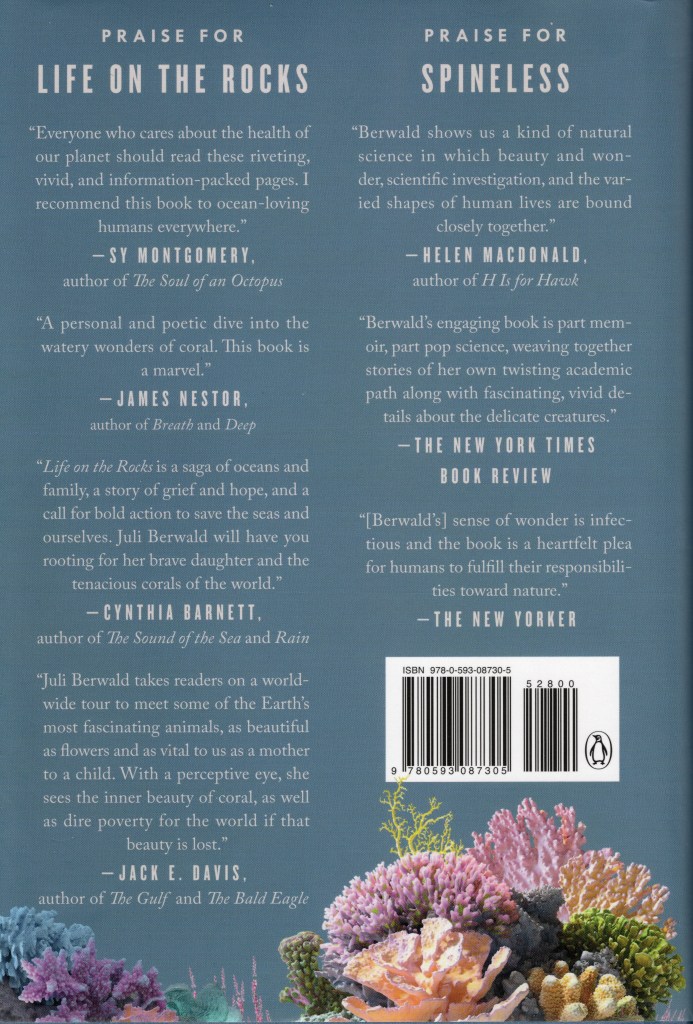
I am not a super fact hunter today. This post is about an interesting book that I recently finished reading, “Life on the Rocks: Building a Future for Coral Reefs by Juli Berwald”, a prominent marine biologist based in Austin, Texas. Coral Reefs are underappreciated. They are extremely important to the ocean’s ecosystems. A fourth of all marine species depend on the reef at some point in their life. Coral reefs are also very important to us humans for a variety of reasons.
Unfortunately, today’s coral reefs are assaulted by a host of environmental stresses. The largest is climate change, or if you call it global warming, which is warming marine ecosystems even faster than those on land. 75% of the reef building corals in the world have already been damaged by high seawater temperatures. This book is about corals, what they are, how they live and evolve, their DNA, and what is being done to save the coral reefs. The book is heavy on the science at the same time as it is not tough reading. She is a great author as well as scientist.
Life on the Rocks Book Formats
Life on the Rocks: Building a Future for Coral Reefs by Juli Berwald comes in four formats. I bought the hardback format.
- Hardcover – Riverhead Books (April 5, 2022), ISBN-10 : 0593087305, ISBN-13 : 978-0593087305, 352 pages, item weight : 1.25 pounds, dimensions : 6.31 x 1.11 x 9.26 inches, it costs $ 3.98 on US Amazon. Click here to order it from Amazon.com.
- Paperback – Publisher : Riverhead Books (April 4, 2023), ISBN-10 : 0593087313, ISBN-13 : 978-0593087312, 352 pages, item weight : 9.2 ounces, dimensions : 5.19 x 0.91 x 7.93 inches, it costs $ 15.44 on US Amazon. Click here to order it from Amazon.com.
- Kindle – Publisher : Riverhead Books (April 5, 2022), ASIN : B098PWTYLL, ISBN-13 : 978-0593087329, 348 pages, it costs $9.99 on US Amazon. Click here to order it from Amazon.com.
- Audio– Publisher : Penguin Audio (April 05, 2022), Listening Length : 10 hours and 52 minutes, ASIN : B09B83BHH1, it costs $ 15.75 on US Amazon. Click here to order it from Amazon.com.

Amazon’s Description of Life on the Rocks
FINALIST FOR THE L.A. TIMES BOOK PRIZE
NAMED A BEST BOOK OF THE YEAR BY THE NEW YORKER AND BOOKLIST
The story of the urgent fight to save coral reefs, and why it matters to us all
Coral reefs are a microcosm of our planet: extraordinarily diverse, deeply interconnected, and full of wonders. When they’re thriving, these fairy gardens hidden beneath the ocean’s surface burst with color and life. They sustain bountiful ecosystems and protect vulnerable coasts. Corals themselves are evolutionary marvels that build elaborate limestone formations from their collective skeletons, broker symbiotic relationships with algae, and manufacture their own fluorescent sunblock. But corals across the planet are in the middle of an unprecedented die-off, beset by warming oceans, pollution, damage by humans, and a devastating pandemic.
Juli Berwald fell in love with coral reefs as a marine biology student, entranced by their beauty and complexity. Alarmed by their peril, she traveled the world to discover how to prevent their loss. She met scientists and activists operating in emergency mode, doing everything they can think of to prevent coral reefs from disappearing forever. She was so amazed by the ingenuity of these last-ditch efforts that she joined in rescue missions, unexpected partnerships, and risky experiments, and helped rebuild reefs with rebar and zip ties.
Life on the Rocks is an inspiring, lucid, meditative ode to the reefs and the undaunted scientists working to save them against almost impossible odds. As she also attempts to help her daughter in her struggle with mental illness, Berwald explores what it means to keep fighting a battle whose outcome is uncertain. She contemplates the inevitable grief of climate change and the beauty of small victories.
My five-star review for Life on the Rocks
Interesting Science an Important Message and the Beauty of Corals
Coral reefs are incredibly important to the ocean and its ecosystems. A fourth of all marine species depend on the reef at some point in their life. Coral reefs are also very important to us humans for a variety of reasons. However, today’s coral reefs are assaulted by a host of environmental stresses. The largest is climate change, or if you call it global warming, which is warming marine ecosystems even faster than those on land. 75% of the reef building corals in the world have already been damaged by high seawater temperatures.
Our burning of fossil fuels also causes ocean acidification. The effects of ocean acidification have not yet damaged corals but will in the future. Add to that, hurricanes (getting worse due to climate change), diseases (SCTLD), pollution, fertilizer and sewage runoff, wild harvesting of corals for export, loss of urchins, illegal fishing, such as using explosives to catch fish (blast fishing), and cyanide. In 2009 70% of all fish in fish markets had telltale scars from explosions and in 2016 more than half the fish in aquarium shops tested positive for cyanide poisoning. The explosives and the cyanide destroy coral reefs. We know what’s causing the loss of coral reefs, but we also know how to solve these things: stop burning fossil fuels, manage fishing, prioritize sanitation, and control pollution.
This book will teach you about corals, that they are marine animal related to jellyfish and sea anemones, consisting of hundreds to thousands of tiny individual polyps that form colonies. That they are in a symbiotic relationship with photosynthetic algae called zooxanthellae. That the algae power the coral by making sugar and the coral provides the supplies the alga needs to make that power. They are 160 million years old.
You will learn about the history of the oceans pH level (acidity). different species, coral bleaching, hybridization and reticulated evolution. You will learn about the threats to corals and the efforts to save the coral reefs. The author is a distinguished scientist who does a lot of research and scuba diving. She takes you on an underwater (and above water) journey around the world, Florida, Sulawesi, Bali, Dominican Republic, and Australia, like Jacques Costeau used to do.
The efforts to save the corals include coral restoration, which is very difficult and expensive, coral farming, marine protected areas, aquarium hobbyists growing corals, cryobiology/ cryogenics, which is a futuristic technology involving freezing and later restoring corals in a better future. It should be noted that as warming events and coral bleaching events kill corals the ones that survive are better equipped to survive future warming. This is not so much adaptation as evolution by natural selection. Even though this can give you hope, one should remember that the current warming is very fast and even if evolution might save some corals, it changes the composition of coral species.
However, scientists have sequenced coral DNA and are trying to identify the genes that help some corals to survive warming events better than other corals. This could lead to assisted evolution. The author also addresses geoengineering techniques to slow down climate change such as marine cloud brightening, and she discusses the tragedy of the commons.
This book is full of facts and interesting science. However, it is not a difficult read. In addition, she makes it more colorful and personal by discussing her personal opinions on issues, her daughter’s mental illness caused by a lingering strep throat infection, her experiences with covid-19, and as mentioned, this book is organized as a journey around the world. I should mention that I felt that some of her personal opinions and personal stories may have been distractions, especially when I could not agree with what she said. But I thought that was a minor issue. She is a great author who knows how to keep an audience captivated despite all the science. She lists 292 references. It is a very well-written and interesting science book about corals. I learned a lot from reading this book. I highly recommend this book.
Posts Related to Climate Change
- What Can We Do About Climate Change
- Global Warming is Happening and is Caused by us
- The Hockey Stick Graph is not Wrong
- Climate Science versus Pseudo Science
- Scientists Agree that Global Warming is happening and that we are the Cause
Note: I have updated my previous super fact post Time is a fourth dimension. Now it is much clearer.
 Super Facts