There is strong evidence for the Big Bang

Super fact 37: There is strong evidence for the Big Bang, and we know a lot about how the Universe evolved through time since the Big Bang.

Considering the evidence that has accumulated throughout the years for the Big Bang it is hard to deny it happened. In my experience very few people are aware of this evidence, and they are surprised to find out how much evidence there is and how many details we know about the evolution of the universe. It is easy to believe that scientists are guessing when you don’t know much about the evidence yourself. But they are not guessing. That is why I call this a super fact.

In addition, there’s a lot of misconceptions around the Big Bang as well surprising facts. A few additional things that might surprise people are that the Big Bang was not like an explosion, the Universe did not expand into something. In addition, there might be multiverses and multiple Big Bangs, and there are cyclic models, and so-called eternal inflation. There are things we know and things we don’t know.
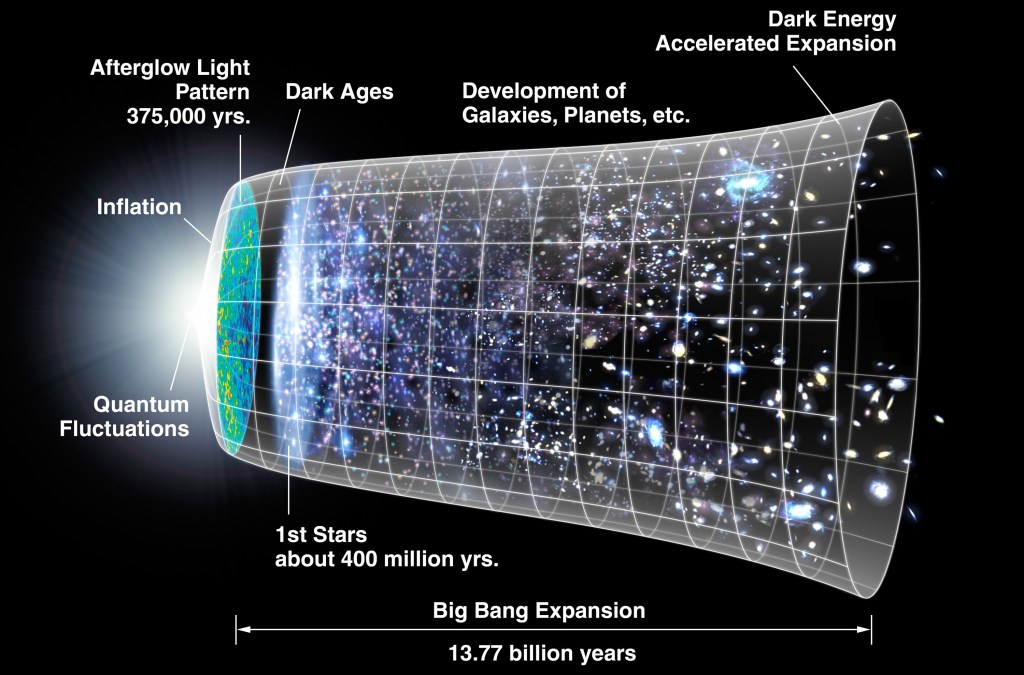
The pictures show an expanding Universe starting with quantum fluctuations followed by inflation, then an afterglow light pattern 375,000 after the Big Bang and then the so-called dark ages, the creation of stars and galaxies | There is strong evidence for the Big Bang
This file is in the public domain in the United States because it was solely created by NASA. (from Wikimedia commons

The Expansion of the Universe

It used to be believed that the Universe was static. In 1929 the astronomer Edwin Hubble discovered that the universe was expanding. He made this observation by analyzing the light from distant galaxies and noticing that their light was redshifted. I am going to explain what that means next.

Light emitted from elements, atoms and molecules have light absorption patterns that are unique to the atom/element in question. This is called a light spectrum. This makes it possible to identify the elements in a star and their proportions. Red shifted means that the absorption lines have moved towards red because the frequency of the light has been shifted due to the motion. This is called the doppler effect.

You can notice this phenomenon for the case of sound when an ambulance is coming towards you and then speeding by you. The sound changes. Hubble was using the redshift to the determine that further away the galaxy was the faster it was moving away from us.
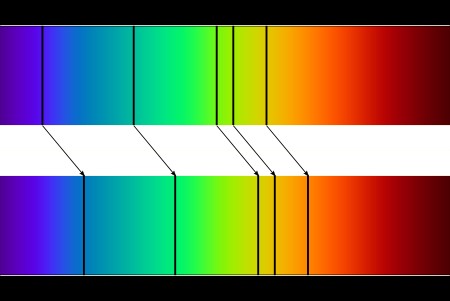
The top shows a colorful spectrum from blue to red with absorption lines in black. The bottom portion of the picture shows the same thing expect the black absorption lines have moved a bit to the right.
Visualization of redshifted absorption lines are redshifted due to velocity away from observer. Top lines are for an object at rest and in the bottom picture the object is moving away. Maxmath12, CC0, via Wikimedia Commons. This file is made available under the Creative Commons CC0 1.0 Universal Public Domain Dedication.

A natural explanation for this is that the universe is expanding, and that it once must have been much more compressed, but it is not the only explanation. However, there is more evidence.

The Cosmic Microwave Background Radiation

If you assume that the universe once was much more compact and much hotter than today, particles such as protons, neutrons and electrons would have been free and close together preventing light from freely moving around. However, as the universe kept expanding and cooling these particles eventually should have been able to form atoms allowing light or electromagnetic radiation to freely move around.

Some physicists, Alpher, Herman and Gamow predicted around 1950 that this should have left behind a detectable microwave background radiation. This radiation was detected by chance in 1964 by two physicists, Penzias and Wilson. This radiation had the expected properties and careful study of this Cosmic Microwave Background Radiation (CMBR or CMB) has given us a lot of information about our universe and may give us information about other universes (multiverses).

Its existence is strong evidence that the universe once was very compressed and much hotter, i.e., the Big Bang. An interesting fact is that in old TVs, between the channels (old people will remember this), you had this fuzz, or war of the ants as some people called it, and part of that TV fuzz is the CMBR.

A big sky map with varying colors, yellow, red, green and blue | There is strong evidence for the Big Bang
This is a sky map of the cosmic background radiation from when the universe was around 380,000 years old. It was created with the help of satellite (NASA) measurements. The colors are artificial and show tiny temperature variations. NASA / WMAP Science Team, Public domain, via Wikimedia Commons.

You can watch a 4-minute video about the discovery of the CMBR narrated by Neil DeGrass Tyson on this PBS web page by clicking here.

Abundances of Light Elements

Yet another piece of evidence is the relative abundance of hydrogen and helium compared to heavier elements. The physics at the beginning of the Universe under the Big Bang tells us that initially regular matter should have consisted of 75% hydrogen and 25% helium and hardly anything else, and that is composition the oldest stars had when they were new. In addition, the oldest stars we’ve found appear to have an age just under the 13.8 billion years that we get for our Universe assuming the Big Bang theory (that’s another piece of evidence).
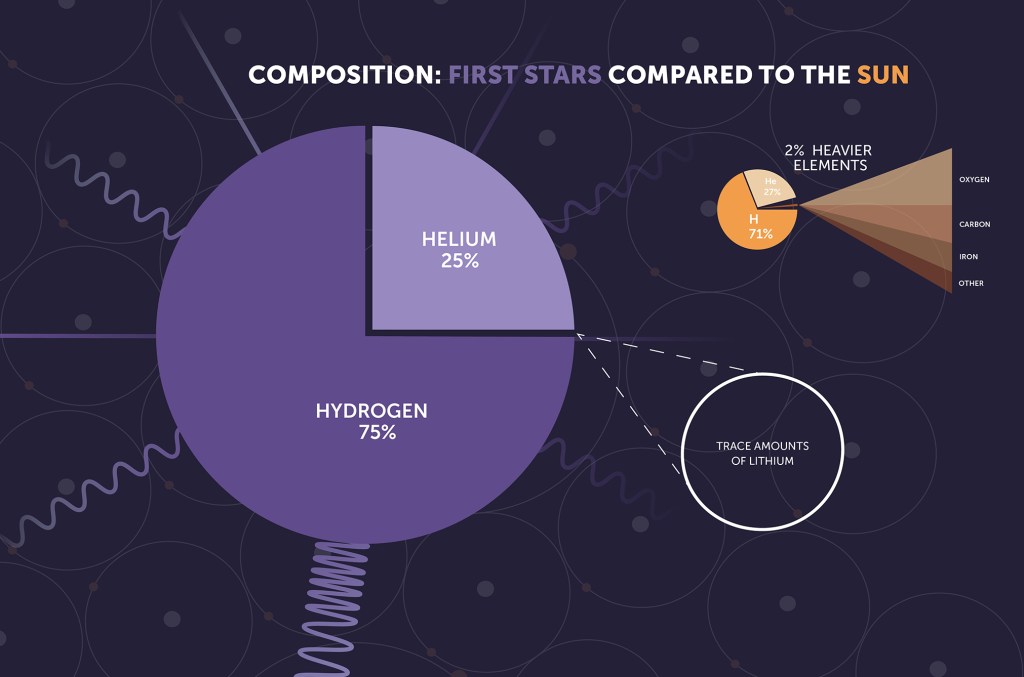
The picture consists of two pie chart graphs representing stars. The left one is a first-generation star with one pie for the 75% hydrogen and one pie for the 25% helium.
The first-generation stars consisted of 75% hydrogen and 25% helium and trace amounts of Lithium. A second or third generation star like our sun is still mostly hydrogen and helium but also many other elements. The rocky planets circling the sun are mainly elements heavier than hydrogen and helium. Image credit NASA, ESA, CSA, STScI

A Very Brief History of Time

So, it all started with a quantum fluctuation. The first 0.000000000000000000000000000000001 seconds is called the inflationary period characterized by super-fast expansion, much faster than the speed of light, as we know it today. At this time the strong nuclear force becomes distinct from the weak nuclear force.

I should point out that during the first 0.0000000000001 seconds the physics laws may not have applied in a normal sense. I should also point out that this was not an explosion. An explosion explodes into something but there was nothing else outside of the universe, so this is more like superfast growth.

At a fraction of a second protons and neutrons form from quarks and after one second neutrinos came into existence and if primordial black holes exist, they were formed at this time too. After two minutes nucleus consisting of neutrons and protons are formed, and the first elements hydrogen and helium formed. After 20 minutes an opaque hot plasma forms, after 100,000 years neutral helium atoms form, and after 375,000 years CMBR is created, etc.

This is just a small sample of everything that we know happened after the Big Bang, based on the known laws of physics. You can read about all the details in books like The First Three Minutes by Steven Weinberg or A Brief History of Time by Stephen Hawking.

vector illustration of up and down quarks in proton and neutron on white background. The proton (left) is a red and blue up quark and a green down quark. The neutron is a red and green down quark and a blue up quark | There is strong evidence for the Big Bang
The proton and neutron each consist of three quarks. They are formed at a fraction of a second after the Big Bang. Asset id: 2333679305 by KRPD.

Pre–Big Bang Cosmology

So, what was there before the Big Bang, if anything? Well, that part is speculation, but there are many good ideas. A popular hypothesis speaks of quantum fluctuations setting off the Big Bang. There are models in which the whole of spacetime is finite, including the Hartle–Hawking no-boundary condition. This means that time itself came into existence with the Big Bang and therefore nothing could have preceded it. This means that the Big Bang could not have been caused or created by anything else, just like a universe that has existed eternally could not have been caused or created by anything else.

In a sense, despite being 13.8 billion years old, the universe in this scenario would have always existed. Because the concept of “always” stops at 13.8 billion years ago. Stephen Hawking used the analogy of the north pole. You can’t go further north from the north pole.

There are other models that include multiverses, for example, eternal inflation, in which universal inflation ends locally here and there in a random fashion, each endpoint leading to a bubble universe, expanding from its own big bang. You can view this model as inflation being the river of time with the various universes popping up like bubbles in the stream.

In another model inflation is due to the movement of branes in string theory and Big Bangs are the result of colliding branes. There are cyclical models, such as Nobel Prize winner Roger Penrose’s Conformal cyclic cosmology in which one universe gives rise to another universe as it dies.

Notice that Pre-Big Bang Cosmology is speculative, but the reality of the Big Bang is backed by strong evidence.
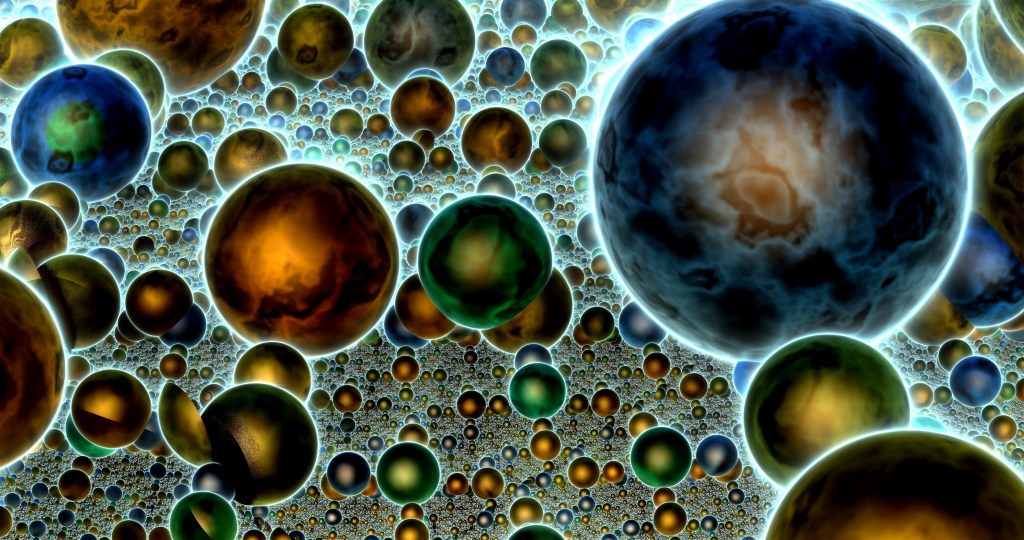
Thousands of universes represented as colorful balls | There is strong evidence for the Big Bang
The surface of a multiverse with a lot of universes 3d rendering Asset id: 2256998119 by Dr. Norbert Lange.

To see the other Super Facts click here

The End of Everything By Katie Mack

What will the end of everything be like? How will everything end? Will it be the Big Crunch as the Universe collapses back to a reverse Big Bang? Will it be the heat death, or what is better called the high-entropy death? Will it be the Big Rip as the Universe is ripped apart, or vacuum decay? Maybe it will be the Quantum Bubble of Death? Wouldn’t the Quantum Bubble of Death be a cool way to die?

The goal of this blog is to create a list of what I call super facts. Important facts that we know to be true and yet they are surprising, shocking or disputed among non-experts. Super facts are important facts that people get wrong. However, I sometimes create posts that are not super facts but other interesting information, such as this book review and book recommendation.

The End of Everything: (Astrophysically Speaking) by Katie Mack is a relatively easy book on cosmology. It features scientifically guided speculation on how the Universe will end. As in the previous book I reviewed the cosmic microwave background radiation (CMBR) is a major source for the information. It is amazing what it can tell you. I bought the hardback version of it. I can add that this book and my Amazon review was written in 2020, a good year for talking about the end of the world.

  • Hardcover –  Publisher : Scribner; Illustrated edition (August 4, 2020), ISBN-10 : 198210354X, ISBN-13 : 978-1982103545, 240 pages, item weight : 2.31 pounds, dimensions : ‎5.5 x 1 x 8.38 inches, it costs $19.14 on US Amazon. Click here to order it from Amazon.com.
  • Paperback –  Publisher : Scribner (May 4, 2021), ISBN-10 : 1982103558, ISBN-13 : 978-1982103552, 256 pages, item weight : 2.31 pounds, dimensions : ‎ ‏ : ‎5.5 x 0.6 x 8.38 inches, it costs $10.99 on Amazon. Click here to order it from Amazon.com.
  • Kindle –  Published : August 04, 2020, ASIN : B07Z41TTNK, 237 pages, it costs $14.89 on US Amazon. Click here to order it from Amazon.com.
  • Audiobook –  Publisher : Scribner (August 4, 2020), ASIN : B07Z8B5NZ8, it costs $13.12 on US Amazon. Click here to order it from Amazon.com.
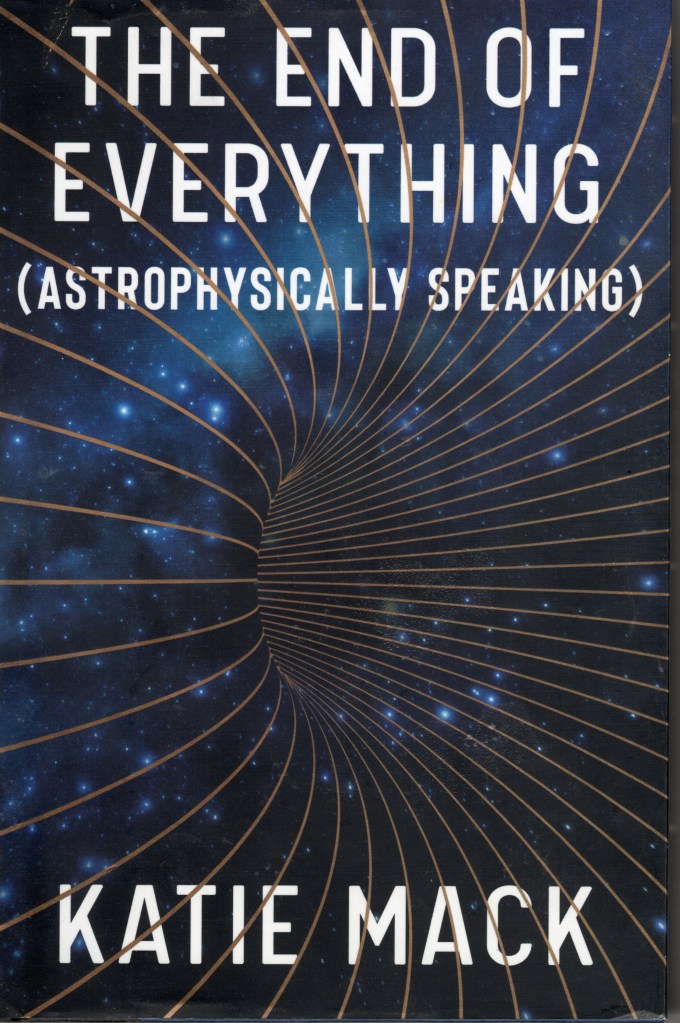
Front cover of The End of Everything By Katie Mack | The End of Everything
Front cover of The End of Everything? Click on the image to go to the Amazon page for the hardcover version of the book.

Amazon’s description of The End of Everything By Katie Mack

A NEW YORK TIMES NOTABLE BOOK OF 2020

NAMED A BEST BOOK OF THE YEAR BY * THE WASHINGTON POST * THE ECONOMIST * NEW SCIENTIST * PUBLISHERS WEEKLY * THE GUARDIAN

From one of the most dynamic rising stars in astrophysics, an “engrossing, elegant” (The New York Times) look at five ways the universe could end, and the mind-blowing lessons each scenario reveals about the most important concepts in cosmology.

We know the universe had a beginning. With the Big Bang, it expanded from a state of unimaginable density to an all-encompassing cosmic fireball to a simmering fluid of matter and energy, laying down the seeds for everything from black holes to one rocky planet orbiting a star near the edge of a spiral galaxy that happened to develop life as we know it. But what happens to the universe at the end of the story? And what does it mean for us now?

Dr. Katie Mack has been contemplating these questions since she was a young student, when her astronomy professor informed her the universe could end at any moment, in an instant. This revelation set her on the path toward theoretical astrophysics.

Now, with lively wit and humor, she takes us on a mind-bending tour through five of the cosmos’s possible finales: the Big Crunch, Heat Death, the Big Rip, Vacuum Decay (the one that could happen at any moment!), and the Bounce. Guiding us through cutting-edge science and major concepts in quantum mechanics, cosmology, string theory, and much more, The End of Everything is a wildly fun, surprisingly upbeat ride to the farthest reaches of all that we know.

This is my five-star review for The End of Everything

The End of the Universe can be a lot of fun

Katie Mack’s timely (it’s 2020 after all) survey of the various ways the Universe might end, based on current physics, was a delightful read. It is an interesting and fun book. We learn about the Big Crunch (the Universe shrinking back), the Heat Death, or rather the high-entropy death, the Big Rip, Vacuum decay, or the “quantum bubble of death” if you want to call it that, and the “bounce”. 

To understand where the various ideas regarding the end of the Universe come from, you need to understand some of the physics and the cosmology. We learn something about CMB, or the Cosmic Microwave Background, Big Bang, cosmic inflation, Planck Time, GUTs, Nucleosynthesis, the standard model, de Sitter Space, black holes, electroweak symmetry breaking, the Higgs Boson and the Higgs field, multiverses, and much more.

Perhaps most importantly, we learn about dark matter and dark energy, which are important concepts that have greatly changed cosmology over the last few years. Chapter 2 on the Big Bang reminded me a lot about an old book by Stephen Weinberg, the first 3 minutes. However, Katie Mack puts a modern spin on it and goes much further beyond our Universe. I was intrigued to hear that it might be possible to communicate between different Universes in a multiverse using gravity, or gravity waves.

The book is written for laymen, and I found it to be between Neil De Grasse Tyson / Carl Sagan and Stephen Hawking in difficulty level. The book covers a lot of concepts and theories but does so concisely, simply and not in a mathematical way. Not so simply though that it is misleading.

I am an Engineer with an undergrad degree in physics so I may not be the best person to judge whether this is an easy read for laymen, but I believe it is. I am very interested in these kinds of topics, and I read all popularized books on cosmology, modern physics, the standard model, that I can find. This was one of the most fun books that I’ve ever read.

The back cover of The End of Everything by Katie Mack
Back cover of The End of Everything? Click on the image to go to the Amazon page for the hardcover version of the book.

Would you like to travel in time into the future to see the end of the Universe?


To see the Super Facts click here


The Little Book of Cosmology

Cosmology is the science of the origin and development of the universe, and this post is about a book on Cosmology, The Little Book of Cosmology by Lyman Page. This is a big and, in my opinion, interesting topic. A lot of cosmology is speculative, multiverses, what was before the big bang, has the universe always existed, has there been an infinite number of big bangs, what about conformal cyclic cosmology in which each cycle result in a new big bang (Roger Penrose), what is the future and end of the universe, is the Universe a hologram, is it self-aware, etc.

This book is not focused on scientific speculation but on what we know about the structure of the universe, the big bang and the expansion of the universe, the well understood basics. I think it is amazing how much we can learn from the Cosmic Microwave Background Radiation (CMB).

The goal of this blog is to create a list of what I call super facts. Important facts that we know to be true and yet they are surprising, shocking or disputed among non-experts. Super facts are special facts that a well-informed person may want to know. However, I sometimes create posts that are not super facts but just interesting information, such as this one. The Little Book of Cosmology is a relatively short and easy read. I bought the hardback version of it.

  • Hardcover –  Publisher : Princeton University Press; First Edition (April 7, 2020), ISBN-10 : 0691195781, ISBN-13 : 978-0691195780, 152 pages, item weight : 2.31 pounds, dimensions : 5.59 x 0.79 x 8.58 inches, it costs $15.39 on Amazon. Click here to order it from Amazon.com.
  • Kindle –  Publisher : Princeton University Press (April 7, 2020), ASIN : B07Z1DWB4P, 132 pages, it costs $9.99 on US Amazon. Click here to order it from Amazon.com.
The front cover features the title, the author, and geodesic lines forming a hyperbolic cone mesh | The Little Book of Cosmology by Lyman Page
Front cover of The Little Book of Cosmology. Click on the image to go to the Amazon page for the hardcover version of the book.

Amazon’s description of The Little Book of Cosmology by Lyman Page

The cutting-edge science that is taking the measure of the universe

The Little Book of Cosmology provides a breathtaking look at our universe on the grandest scales imaginable. Written by one of the world’s leading experimental cosmologists, this short but deeply insightful book describes what scientists are revealing through precise measurements of the faint thermal afterglow of the Big Bang—known as the cosmic microwave background, or CMB—and how their findings are transforming our view of the cosmos.

Blending the latest findings in cosmology with essential concepts from physics, Lyman Page first helps readers to grasp the sheer enormity of the universe, explaining how to understand the history of its formation and evolution in space and time. Then he sheds light on how spatial variations in the CMB formed, how they reveal the age, size, and geometry of the universe, and how they offer a blueprint for the formation of cosmic structure.

Not only does Page explain current observations and measurements, he describes how they can be woven together into a unified picture to form the Standard Model of Cosmology. Yet much remains unknown, and this incisive book also describes the search for ever deeper knowledge at the field’s frontiers—from quests to understand the nature of neutrinos and dark energy to investigations into the physics of the very early universe.

This is my five star review for The Little Book of Cosmology

What the Cosmic Microwave Background (CMB) can tell us

This is a short book describing the evolution of the Universe since the Big Bang and its composition. How do we know all this stuff? The Cosmic Microwave Background (CMB) can tell us a lot.

The CMB is a black body radiation remnant from the time (400,000 years after the Big Bang) when the Universe had cooled enough to allow the formation of hydrogen atoms and the decoupling of photons from electrons so that they could roam free.

CMB is in itself evidence for the Big Bang but in addition we get additional information from the minor anisotropy and polarization of the CMB, and add the composition of the elements (hydrogen, helium, lithium, and heavier elements), redshifts of galaxies, gravity lensing, and we can tell quite a bit about the evolution of the Universe and where it is heading.

It’s fascinating science detective work. This eventually leads to the Standard Model of Cosmology, which is something I’ve never heard of before, but it’s cool.

I found the facts about the size and age of the Universe, the early giant stars in the Universe, dark energy and dark matter, very interesting. The book is filled with basic and fascinating facts that I did not know. Because of the CMB (rather than particle accelerator experiments) we know roughly the mass (rest mass) of neutrinos.

We know why dark energy can’t be space dust, or rogue planetoids, or black holes or neutrinos, so what is it? The book explains why it can’t be any of those. There’s a lot we can know because of the CMB and other information, and some things we don’t know. Finding out what we do know was quite exciting and finding out what the mysterious “what we don’t know” was equally exciting. Again, the focus is on CMB and how it is measured, it tells us a lot.

The book is easy to read and require no degree in physics or mathematics. I admit I have a degree in Engineering Physics, and I am also interested in astronomy and cosmology, but I can tell it was light reading. It is a truly popular science book like those that Neil De Grasse Tyson writes, and it was short but very informative. There’s a lot of information you can extract from CMB. It was a fun short read for anyone interested in the mysteries of the Universe.

The back cover feature advanced praise for the book | The Little Book of Cosmology by Lyman Page
Back cover of The Little Book of Cosmology. Click on the image to go to the Amazon page for the kindle version of the book.

To see the Super Facts click here