Gustav Vasa

Image above by Kevin from The Beginning at Last

Today, June 6 is the National Day of Sweden (or the Independence Day of Sweden). Gustav Vasa, or Gustav I, Sweden’s hero king and the father of modern Sweden, was elected king of Sweden on June 6th, 1523. This was after the Swedish War of Liberation from Denmark 1521 to 1523. Gustav rose to lead the Swedish War of Liberation following the Stockholm Bloodbath, where his father was executed.  Gustav Vasa or Gustav I was King of Sweden from 1523 until his death in 1560. Since I am originally Swedish (now living in Texas) June 6 is a significant date for me.


In the picture there muscular man holding up crown | Gustav Vasa
This picture is how I imagine Gustav Vasa at his coronation. BTW this is a submission for Kevin’s No Theme Thursday
A bearded king and his queen are marching down the middle of beautiful large building, perhaps a cathedral or a castle | Gustav Vasa
This is how I imagine Gustav Vasa’s marriage to Catherine of Saxe-Lauenburg on September 24th, 1531. This picture is also from Kevin’s No Theme Thursday

Depictions of Gustav Vasa

Kevin’s pictures above were, like I said, how I imagine Gustav Vasa. The depictions below might be closer to the truth.

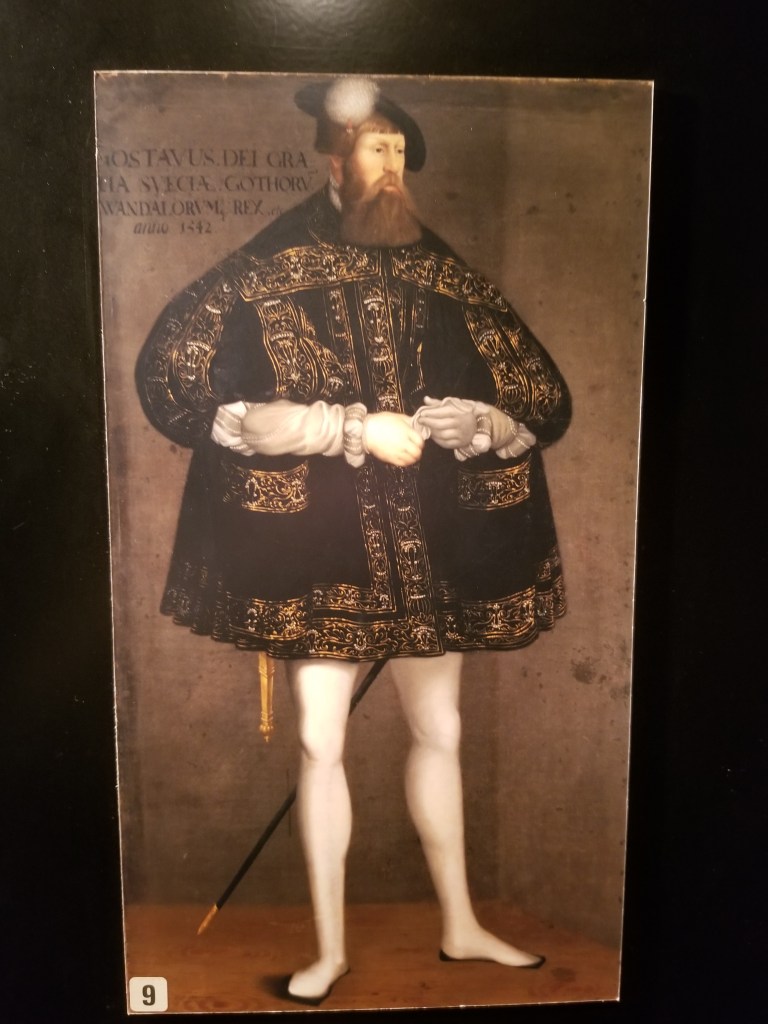
Painting of Gustav Vasa with an interesting hairdo and wearing a large robe.
Painting of Gustav I Vasa. Fashion was somewhat different back in the day.
Gustav Vasa is wearing a big black robe and black beanie looking hat that is slanted on his head.
Portrait of Gustav Vasa (from Wikipedia Commons).

The Kalmar Union

In 1397 a union was formed between Denmark, Norway and Sweden called the Kalmar Union (Kalmar is a city a Sweden). The Kalmar Union came to be dominated by Denmark and there were occasional rebellions. During Gustav’s childhood, parts of the Swedish nobility tried to make Sweden independent. Gustav’s father Erik Johansson Vasa was part of that nobility.
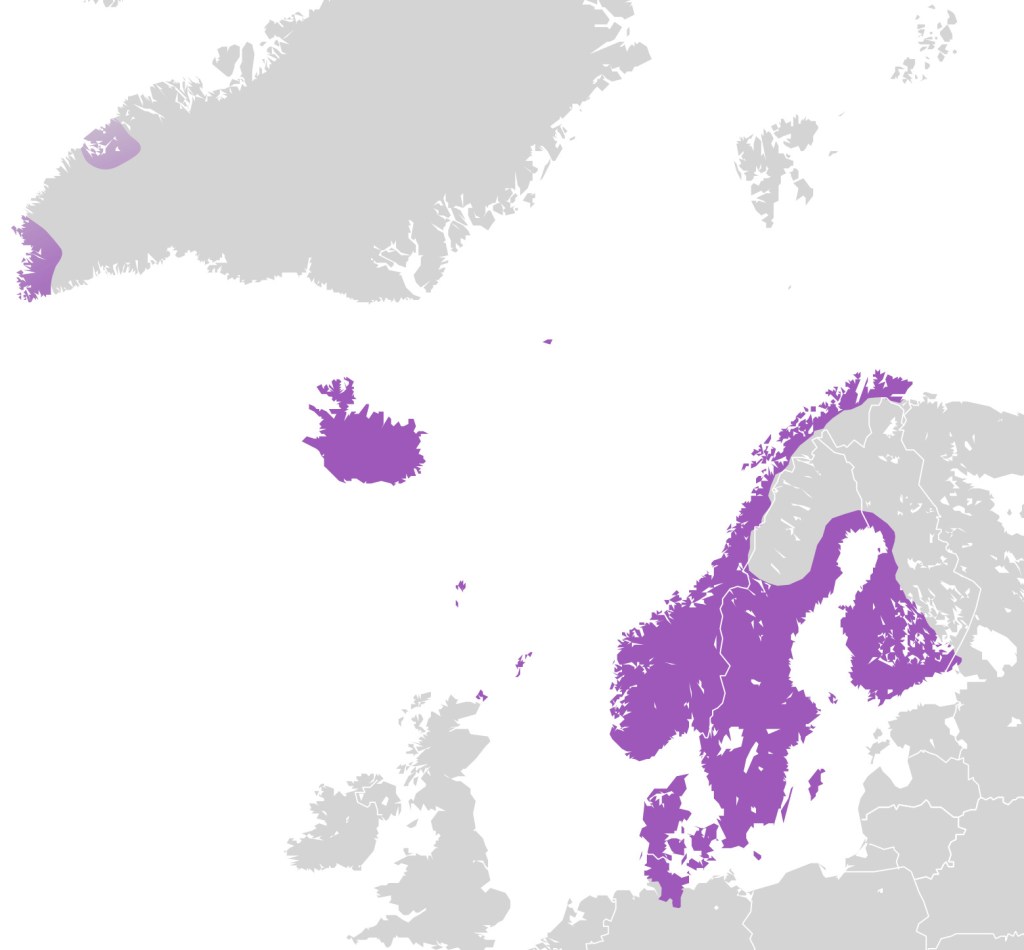
Map showing Denmark, Sweden and Norway in purple. Iceland and Finland are also included.
The Kalmar Union. Finland was part of Sweden at the time. Ssolbergj, CC BY-SA 3.0 <https://creativecommons.org/licenses/by-sa/3.0&gt;, via Wikimedia Commons

After some problematic interactions with Denmark and the Danish King Christian II, King Christian massacred 100 Swedish nobles, November 7-9, 1520, on Stortorget in Stockholm, including Gustav’s father. In 1521 Gustav led a rebellion (or a civil war) against Denmark, which ended in the deposition of King Christian II from the throne of Sweden, effectively ending the Kalmar Union. I can add that King Christian is called Christian the Tyrant in Sweden and Christian the good in Denmark.

Sweden and Denmark has had a complicated history that included a lot of hostilities and eleven wars, but you wouldn’t know it if you looked at the situation today. There hasn’t been a war between Sweden and Denmark in more than 180 years and Swedes and Danes get along very well. However, it is best not to bring up the past. That is probably true for marriages as well.
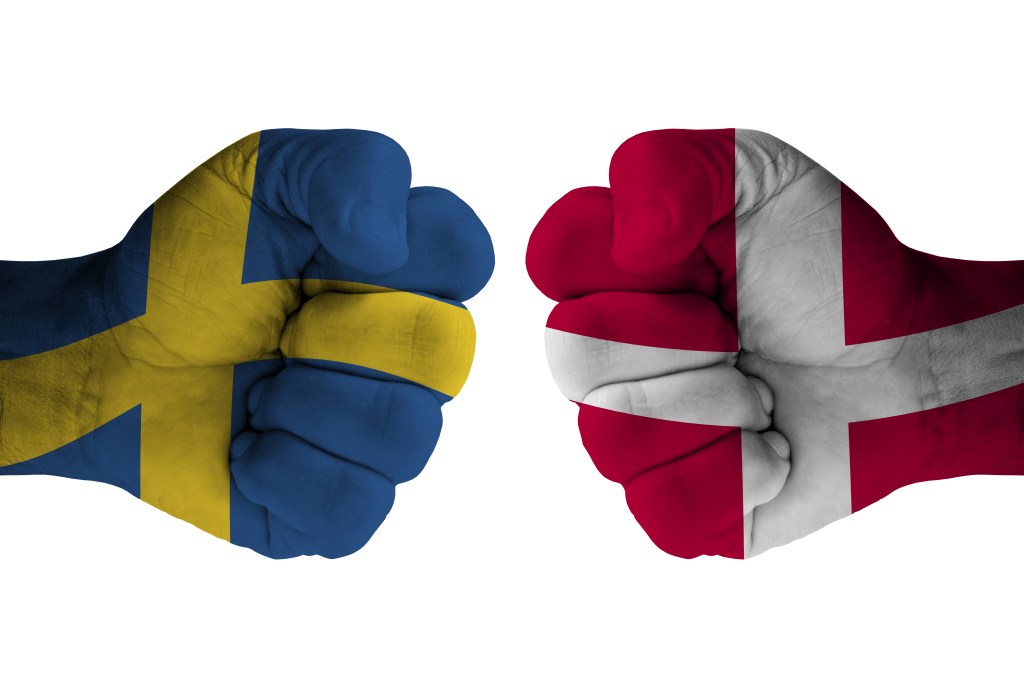
On the left, a fist with a yellow and blue flag. On the right, a fist with a red and white flag.
Denmark vs Sweden. The yellow and blue flag is the Swedish flag. Red and white is the Danish. Shutterstock Stock Photo ID: 1114320377 by Hasanov Jeyhun.

Gustav Vasa’s Burial Place

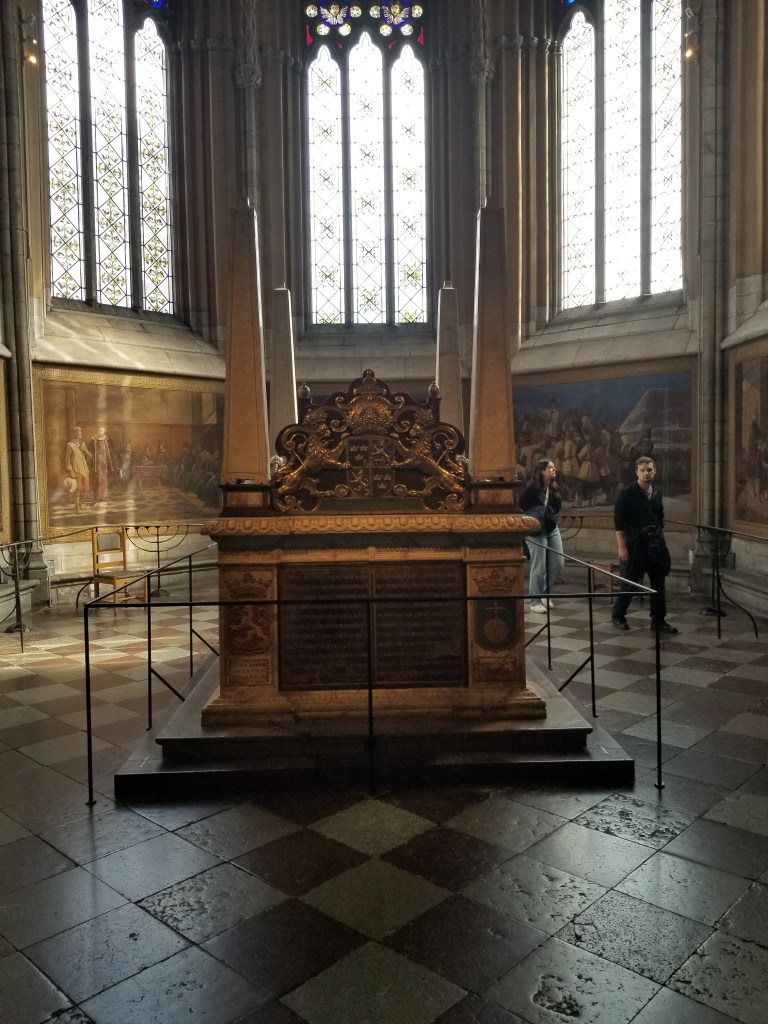
Gustav Vasa died on September 29, 1560, and is buried together with three of his wives (while only two are engraved) in the Cathedral of Uppsala. Uppsala is an old city north of Stockholm famous for its Viking graves/mounds. During the Viking era Uppsala was the religious center of Sweden. Later as Sweden became Christian it remained the religious center of Sweden, however, the Viking temple in old Uppsala was replaced by a Christian church. Uppsala hosts one of the most prominent Universities in the world and it also happens to be where I studied Engineering Physics.

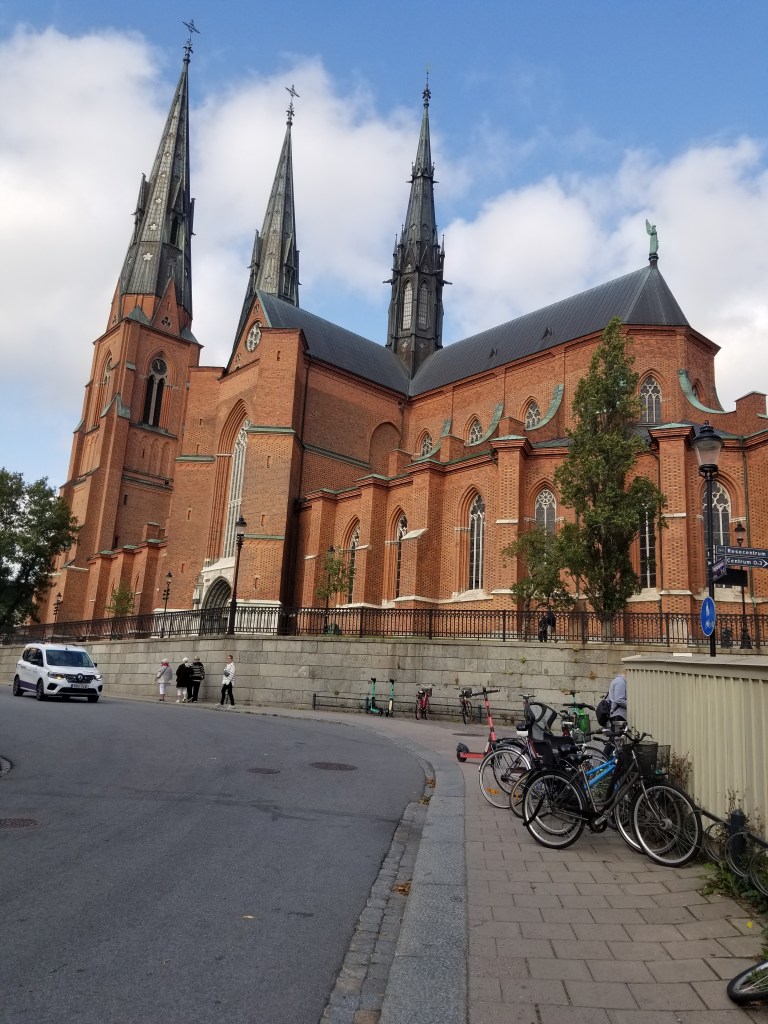
The largest cathedral in Sweden, Uppsala Domkyrka. This is where Gustav I Vasa is buried. Gustav I is arguably Sweden’s most prominent king.
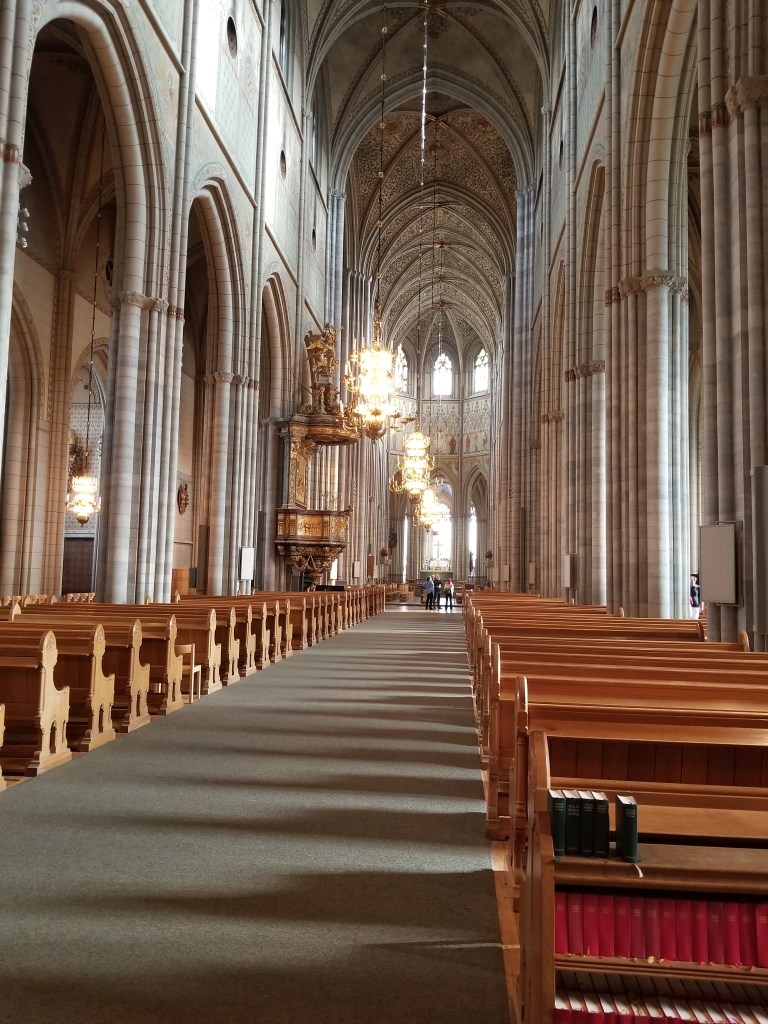
Inside Uppsala Domkyrka
Inside Uppsala Domkyrka.
The tomb of Gustav I Vasa in Uppsala Domkyrka | Heavily decorated coffin shaped tomb placed in a large, decorated room filled with paintings.
The tomb of Gustav I Vasa in Uppsala Domkyrka. In the background is my son and his wife.

Photos from Sweden

Photo of a Leonberger standing on of a bench
I am a fan of Leonberger dogs, and this is a photo of the only Swedish Leonberger I met personally. Her name was Amie. We met her at an interesting place, at the top of a north Swedish mountain called Skule Mountain (Skull Mountain).
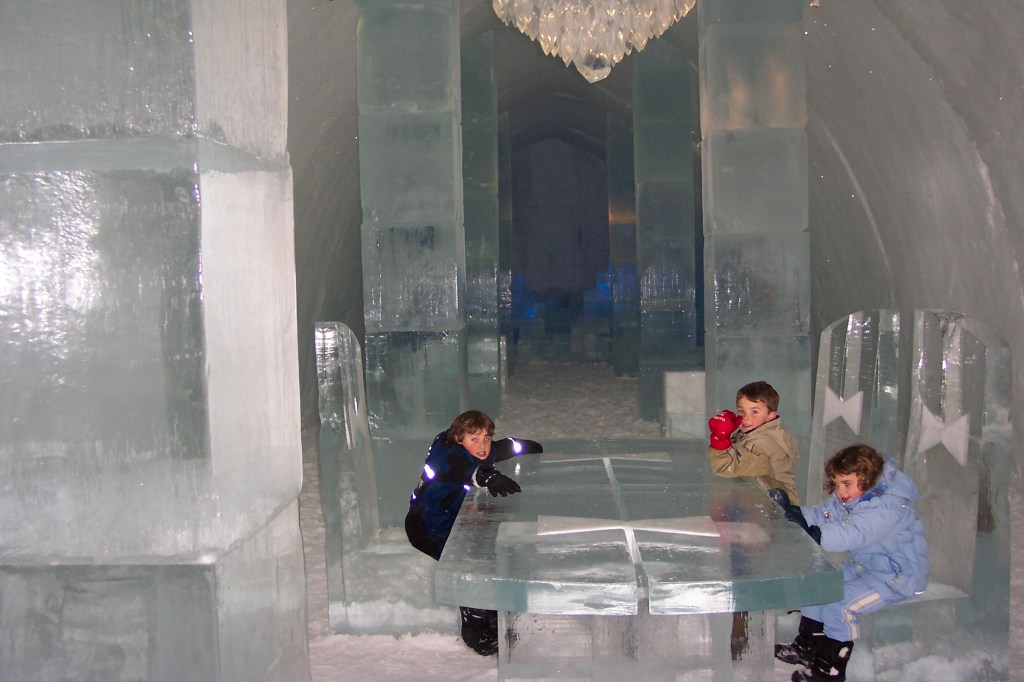
Three children sitting around a large table made of ice in a large room with columns of ice. There is an ice chandelier above the table.
One of the interesting tourist attractions in northern Sweden is the Ice Hotel in Jukkasjärvi . The ice hotel in Jukkasjärvi is the first/original and largest ice hotel in the world. My kids at the lobby of the ice hotel in northern Sweden.

A guard in a dark blue uniform wearing a golden helmet and a gun in standing in front of a booth in front of a big brick castle.
Sweden has a king (Carl XIV), and he owns a couple of big castles. This is my kids with the guard in front of the Winter Castle in Stockholm.
My photo of Drottningholm castle taken from the garden, a very large garden.
Drottningholm, one of the Royal Palaces in Sweden. It was built in the 1660’s and inspired by Versailles.
A photo of the Vasa Ship taken from below.
A photo of the Vasa ship from the bottom floor. My son is standing on the right in a green and black shirt.
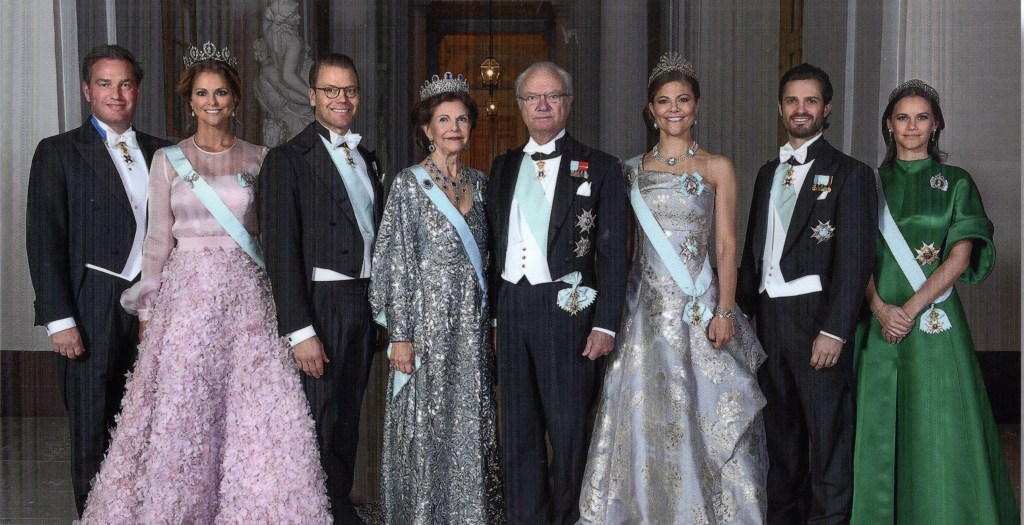
This is a photo of a well-dressed 8-member royal family.
The Swedish Royal family. The two people in the middle are Queen Silvia and King Carl XVI Bernadotte. To the right of the king is the future monarch of Sweden princess Victoria and to the left of Queen Silvia is her husband. The others are their other two children and their spouses.
Yellow and Blue Swedish flag | Gustav Vasa
Finally, the Swedish Flag (Wikimedia Commons). All other photos above are mine

Other Scandinavian Posts


To see the Super Facts click here

The Swedish War King

“The Swedish War King” is not about a super fact. It is just what I think might be interesting information. Americans are obsessed with the British Royalty. However,  there 43 monarchies around the world, including Sweden (my native country). Some of the kings and queens of the past are quite interesting.

The focus of this post is Karl XII  or Carolus Rex, the Swedish War King who invaded Russia before Napoleon did. I made a list of Swedish monarchs that I find interesting. Then I will focus on Karl XII . The number following the name of the king is his/her time of reign.

Painting showing The Swedish War King with an interesting hairdo and wearing a large robe.
Painting of Gustav I Vasa liberator of Sweden from Denmark. Fashion was somewhat different back in the day.
  • Olof Skötkonung, 995–1022, son of King Erik VII and Sigrid the Haughty. He was Sweden’s first Christian King. The Swedish Viking era ended during his reign.
  • Erik IX, 1156 – 18 May 1160. Saint Erik was both a king and a saint. He tried to Christianize Finland and led the first crusade east. He was assassinated. Thereof his short reign.
  • Gustav Vasa or Gustav I, 6 June 1523 – 29 September 1560. From 1389 to 1523, Sweden was often united with Denmark and Norway under the kings of the Kalmar Union. Sweden’s full independence was restored under Gustav I in 1523. Gustav was elected king in Strängnäs 6 June 1523. Therefore, June 6 is celebrated as Sweden’s Independence Day. The Danish king at the time was King Christian II. In Sweden he is referred to Christian the Tyrant and in Denmark as Christian the Good.
  • Gustav II Adolf, 30 October 1611 – 6 November 1632. He is known as the “father of modern warfare”, or the first modern general, and under his reign Sweden became one of the great powers of Europe. Sweden was one of the primary military forces in Europe during the Thirty Years’ War (on the Protestant side). An estimated 4-8 million people died in the Thirty Years’ War, so this was a big war.
  • Queen Christina, 6 November 1632 – 16 June 1654. She was the daughter Gustav II Adolf. Gustav Adolf was closely attached to his daughter, and he taught her everything about being a monarch. Ironically, she fought to end the Thirty Years’ War. She converted to Catholicism, abdicated, and moved to Rome.
  • Carl XII, Charles XII, or Karl XII, or Carolus Rex, 5 April 1697 – 30 November 1718, was the Swedish War King, known for among other things invading Russia before Napoleon did. (see video below).
  • Gustav III, 12 February 1771 – 29 March 1792, was an autocrat and a believer in enlightened absolutism (educated despots). He ended the age of liberty and took away most of the powers of the riksdag/congress. He was assassinated.
  • Carl XIV Bernadotte or Charles XIV John, 5 February 1818 – 8 March 1844, was the king of Sweden and Norway. He was a former General in Napoleons army. Under his reign Sweden entered a long period of peace and neutrality that still lasts today. He is the founder of the current dynasty.
  • Carl XVI Gustaf Bernadotte or as he sometimes spells it himself Cal XVI, 15 September 1973 – present. He is champion for the dyslexic community. He was formerly made fun of because of his problems with spelling. Not anymore. His work for the dyslexic community has earned him respect.
This is a photo of a well-dressed 8-member royal family.
The current Swedish Royal family. The two people in the middle are Queen Silvia and King Carl XVI Bernadotte. To the right of the king is the future monarch of Sweden princess Victoria and to the left of Queen Silvia is her husband. The others are their other two children and their spouses.

When Karl XII was king (5 April 1697 – 30 November 1718) Sweden was a large and powerful country. I should add that Sweden is viewed as a very small country, but it is significantly larger than California even today.

However, back when Karl XII became king Sweden included what is now Sweden, Finland, Estonia, parts of Norway, Denmark, Latvia, Germany, Poland, and Russia. Karl XII attempted to enlarge Sweden and in doing so he invaded Russia with a goal of taking Moscow and overthrow Tsar Peter the Great. It failed. The Russian winter killed the project.

According to the video below Karl XII was an inspiration for Napolean to do same thing. It was my blogger friend Debbie who alerted me this video. It is a bit long, 15 minutes, so you may want to watch only if you are really interested.


To see the Super Facts click here

Sweden and Denmark and Gustav I Vasa

I am currently traveling in Scandinavia with my oldest son and his wife. Therefore, my blogging activities are a little bit less intense than usual. This post is factual, but it is not a super-fact post.

Yesterday, we visited Uppsala, a city north of Stockholm. Uppsala is Sweden’s fourth largest city, and it is the home to one of Europe’s most prominent universities, Uppsala University. This is also where I studied engineering physics before coming to the United States.

Photo of a large red brick church with tall pointy spires | Sweden and Denmark and Gustav I Vasa
The largest cathedral in Sweden, Uppsala Domkyrka. This is where Gustav I Vasa is buried. Gustav I is arguably Sweden’s most prominent king.

During the Viking era Uppsala was the religious center of Sweden. Later as Sweden became Christian it remained the religious center of Sweden, however, the Viking temple in old Uppsala was replaced by a Christian church. Sweden’s largest cathedral, Uppsala Domkyrka, is located in Uppsala. Inside Uppsala Domkyrka is the tomb of the king that is considered to be the father of Sweden, Gustav I Vasa.

The inside of the church is very large.
Inside Uppsala Domkyrka.

The relationships between the Scandinavian countries were quite complicated in the past, especially that between Sweden and Denmark. If you do a google search using the phrase “which two countries fought the most wars with each other” the top results all claim that this was Sweden and Denmark. The websites in question, Quora, Twitter and Reddit, aren’t reliable sources, so this may not be true. However, more reliable sources, such as historical sites, encyclopedia Britannica and Wikipedia state that Sweden and Denmark fought at least 11 wars with each other.

On the left, a fist with a yellow and blue flag. On the right, a fist with a red and white flag | Sweden and Denmark and Gustav I Vasa
Denmark vs Sweden. The yellow and blue flag is the Swedish flag. Red and white is the Danish. Shutterstock Stock Photo ID: 1114320377 by Hasanov Jeyhun.

In 1397 a union was formed between Denmark, Norway and Sweden called the Kalmar Union (Kalmar is a city a Sweden). The Kalmar Union came to be dominated by Denmark and eventually Sweden rebelled against the Danish King Christian II. He was called Christian the Good in Denmark and Christian the Tyrant in Sweden.

This rebellion was led by a noble, Gustav Eriksson who later would be crowned as Gustav I Vasa. He was the first of the Vasa kings. Sweden declared its independence from Denmark on June 6th, 1523, which is why June 6th is Sweden’s national day, or Independence Day.

Map showing Denmark, Sweden and Norway in purple. Iceland and Finland are also included | Sweden and Denmark and Gustav I Vasa
The Kalmar Union. Finland was part of Sweden at the time. Ssolbergj, CC BY-SA 3.0 <https://creativecommons.org/licenses/by-sa/3.0&gt;, via Wikimedia Commons
Painting showing a king with an interesting hairdo and wearing a large robe.
Painting of Gustav I Vasa. Fashion was somewhat different back in the day.

Sweden and Denmark had a complicated history that included a lot of hostilities and wars, but you wouldn’t know it if you looked at the situation today. There hasn’t been a war between Sweden and Denmark in more than 180 years and Swedes and Danes get along very well, well as long as you don’t talk too much about the past. In my opinion Swedes and Danes get along better than Texans and Oklahomans. Maybe it helps that Swedes can’t understand what the Danes are saying.

Heavily decorated coffin shaped tomb placed in a large, decorated room filled with paintings.
The tomb of Gustav I Vasa in Uppsala Domkyrka. In the background is my son and his wife.

To see the Super Facts click here