
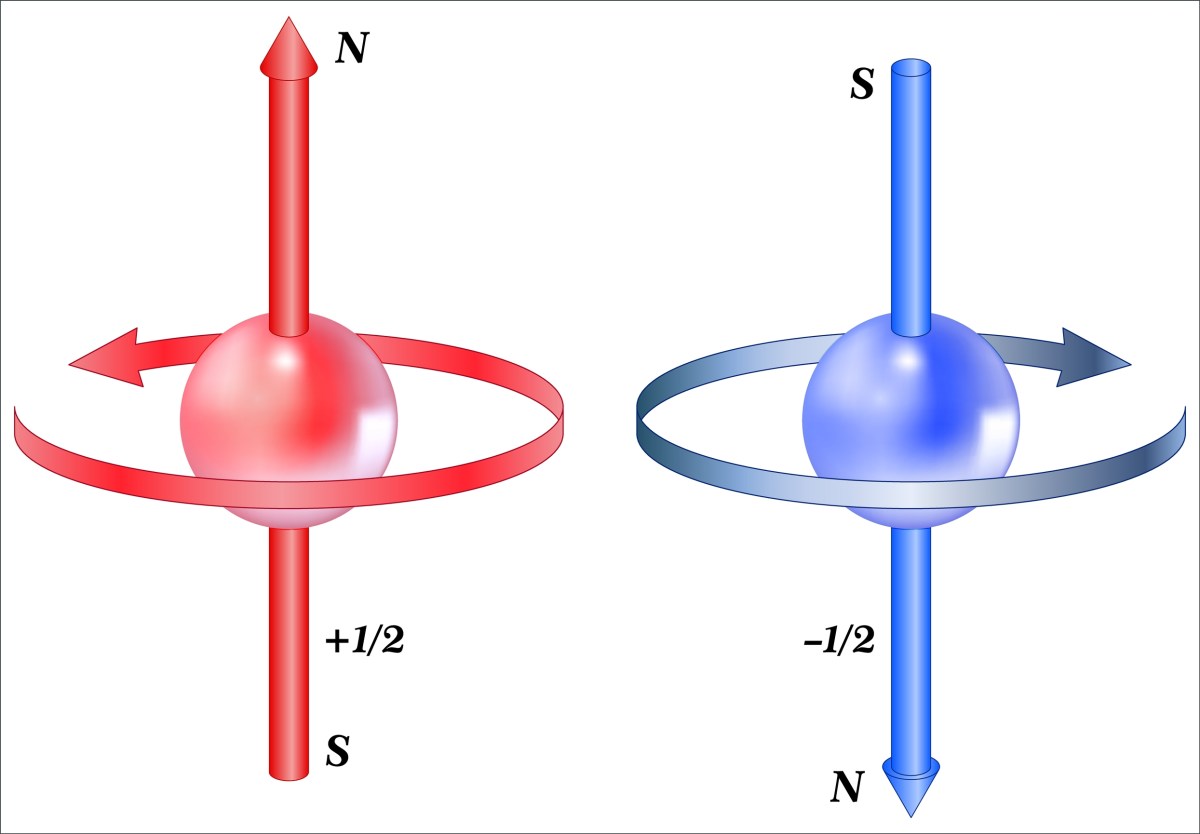
Super fact 97 : Things that spin have an angular momentum and if electrically charged they also generate a magnetic field (magnetic dipole). This is true for electrons and many other elementary particles. However, electrons are not physically spinning. This “spin” is an intrinsic property like electrical charge or mass. In addition, the electron has “Spin 1/2,” meaning you must rotate its wave function 720 degrees (two full circles) to get back to where you started. Moreover, this half spin oddity makes the existence of matter possible.
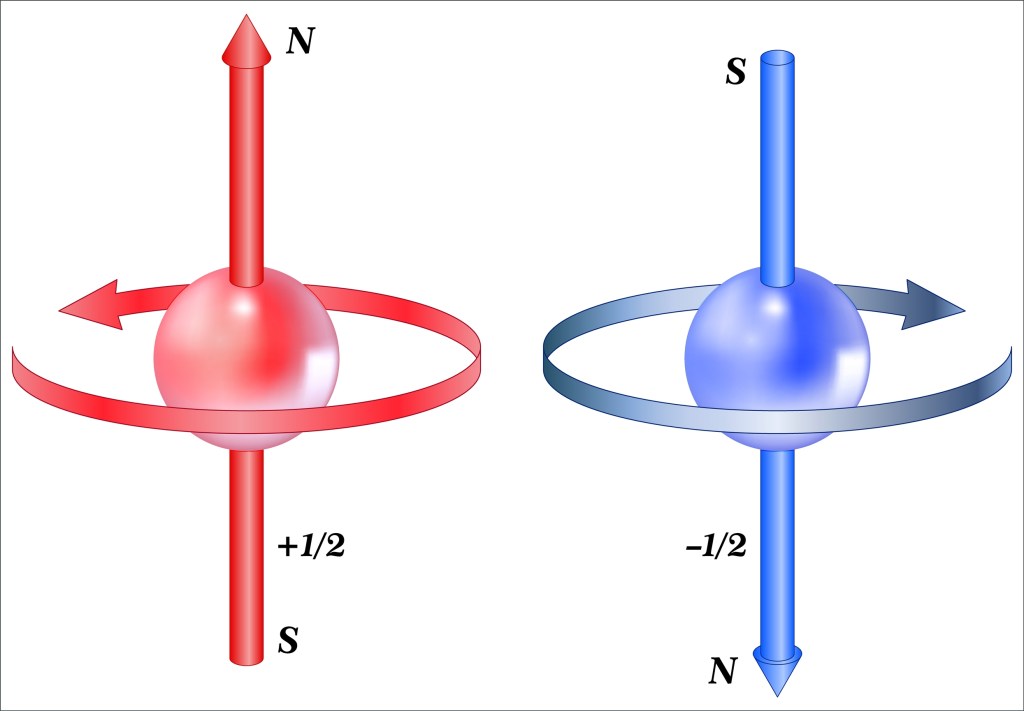
An electron with spin +1/2 will align parallel with an external magnetic field while an electron with spin -1/2 will align in the opposite direction. The existence of intrinsic spin and the fact that the half spin property requires you to rotate the electron’s wave function twice to get back to where you started is very surprising. Particles with half spin (electrons, protons, positrons, muons, etc.) are called Fermions. It is also surprising that the half spin property makes the existence of matter possible. These true but surprising facts are important, which is why I consider this a super fact.
Angular Momentum and Magnetic Dipoles
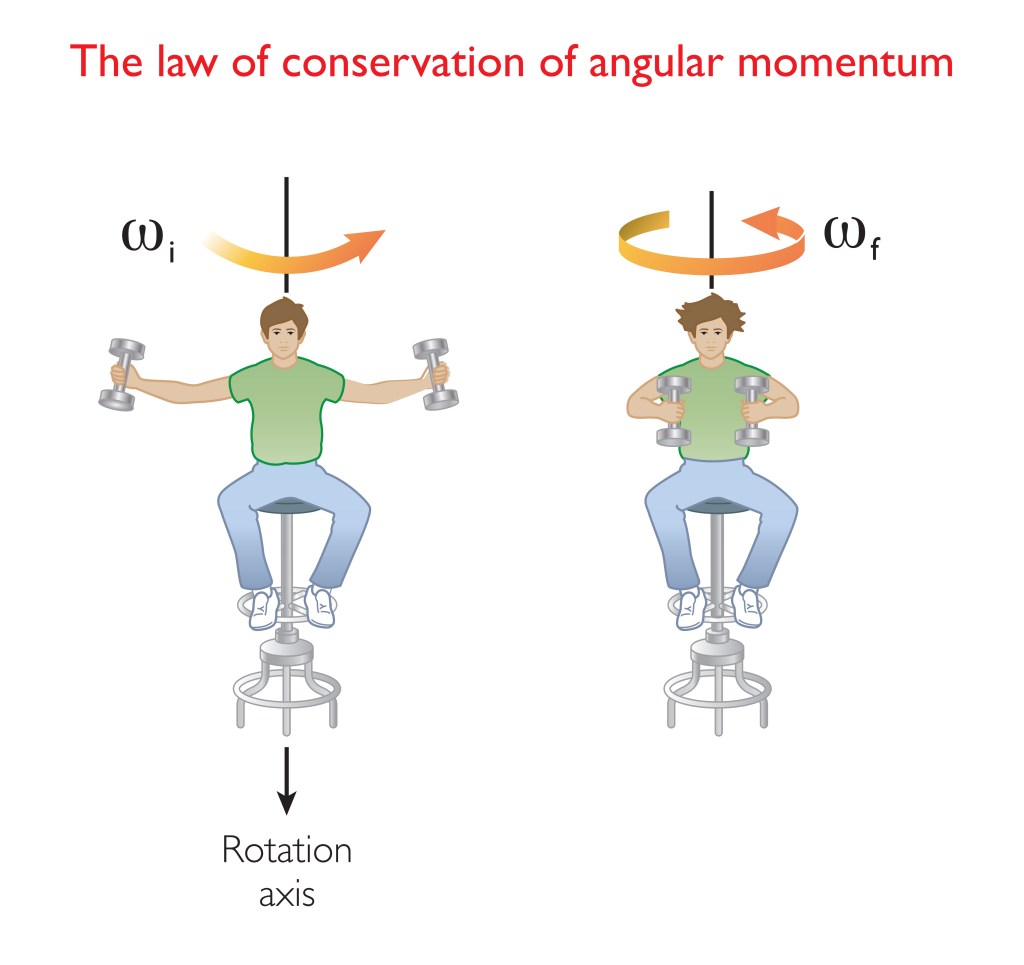
The picture above gives an example of the law of conservation of angular momentum. Bringing weights closer to the body speeds up the rotation. Another example of the law of conservation of angular momentum is when you try to tip the axis of the rotation. This would be the man tipping over. You can’t do that without applying a force. The electron, and other subatomic particles with spin, display this gyroscopic effect, like a spinning top. As mentioned, charged particles such as the electron, positron or proton, also generate a magnetic field as if they were spinning. However, the strange fact is that despite that electrons and other particles with spin display these spin properties, they aren’t spinning.
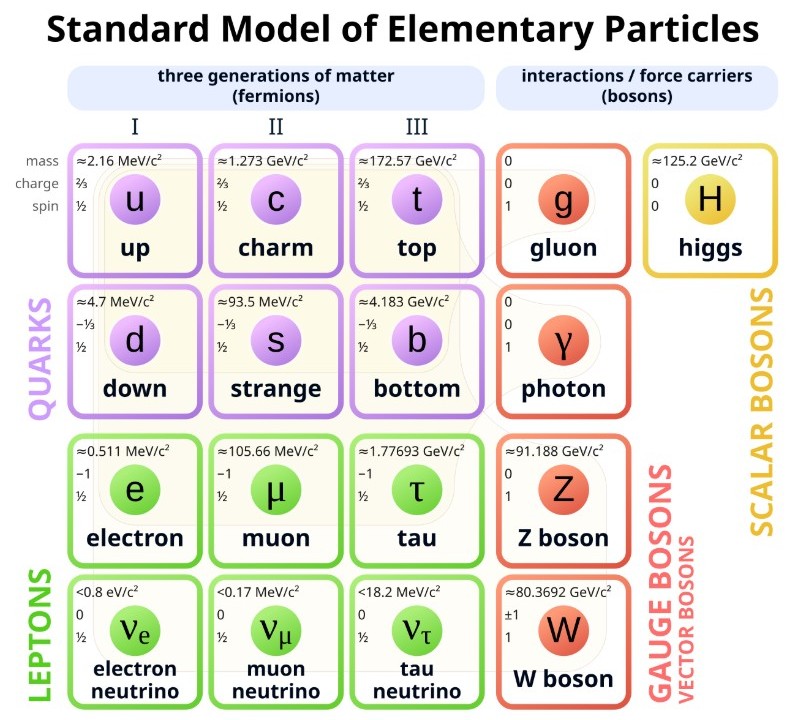
Below is an overview of the elementary particles. An elementary particle is a fundamental subatomic building block of the universe that cannot be divided into smaller components. Notice that the proton and the neutron are not listed because they are not fundamental particles. They consist of three quarks. The top number is the mass (0.511 MeV/c2 for an electron). The number below that is the charge (-1 for an electron) and the bottom number is spin (1/2 for an electron). The diagram shows three intrinsic properties per particle.
Electron Orbitals
I should explain something about particles and waves. Subatomic particles are associated with quantum waves. This is quantum mechanics. For example, an electron is in a sense both a particle and a wave, or more correctly neither. However, it exhibits both point like particle characteristics and wave characteristics depending on circumstances. Below is a picture showing the standing quantum waves representing an electron in different orbitals (different states) in a Hydrogen atom.
Hydrogen atoms only have one electron, but that electron can exist in different orbitals (sort of different orbits). A standing wave is a wave that is not spreading out, like the waves going back and forth in a bathtub. You can’t really say that the electron is orbiting the nucleus like a planet. The standing quantum wave, or electron cloud, or orbital are more accurate ways to view it.
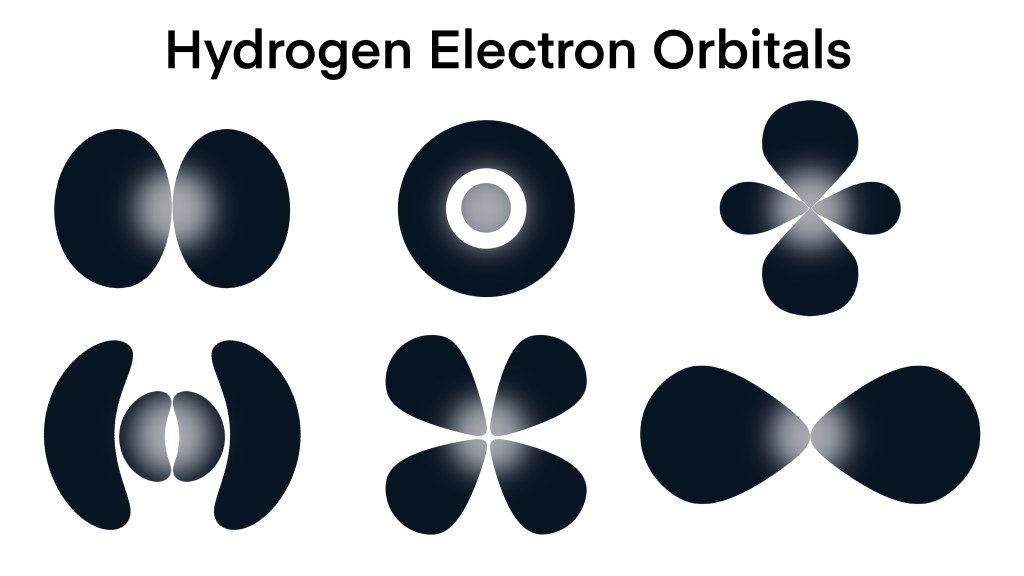
There is some confusion as to what the standing quantum waves represent. The Copenhagen interpretation says that the electron exists in superposition, or all possible states, until measured. The quantum wave indicates the probability that you will find the electron in a certain place when you measure. The square of the amplitude of the wave is the probability that you will find the electron at that point. When you measure it and find out where the electron is the wave will collapse.
Other interpretations say that the electron is in a specific place, you just don’t know where, but again the square of the amplitude of the wave is the probability that you will find the electron at that point. Yet other interpretations say that the quantum wave is a real physical thing that guides the electron (pilot waves). The so called many-worlds-interpretation say that all possible outcomes of a measurement happens but in an infinite number of parallel universes (multi-verses).
Then some people say that the quantum wave does not exist at all, other than as a probability distribution. It represents what the observer knows about the system, nothing else. If you don’t know where the electron is, then the wave is all over the place. If you measure where it is then the wave collapses. Then we also have the you-don’t-know-what-you-are-talking-about-just-shut-up-and-calculate interpretation. The latter interpretation is focused on using the equations, for example the Schrödinger and Dirac equations, to make predictions and measurements and it ignores what’s behind the scenes. This interpretation is popular in college physics classes.
Whichever interpretation you prefer, the you-must-fully-rotate-the-wave-function-twice-to-get-back-to-start property leads to the Pauli exclusion principle.
The Pauli Exclusion Principle
The Pauli exclusion principle states that two identical fermions (such as electrons) cannot occupy the same quantum state simultaneously. For example, two electrons in the same orbital must have opposite spin +1/2 and -1/2 and you could never add a third electron. This adds structure to the atom and to the nucleus. If you did not have the Pauli exclusion principle everything could just fall into one point, and you could walk through walls. Matter as we know it could not exist. This is why fermions (electrons, muons, positrons, quarks, protons, neutrons, etc.) often are referred to as matter particles and bosons (photons, gluons, etc.) are referred to as radiation.
It turns out that that the Pauli exclusion principle is a direct result of the half spin of fermions, in other words, that you have to rotate the associated wave twice around to get back to the original.
Do you think this is confusing ? Don’t feel bad. Richard Feyman one of the most prominent pioneers of quantum mechanics and Nobel Prize winner in physics said, “I think I can safely say that nobody understands quantum mechanics”.
Other Super Facts Related to Modern Physics
- The Speed of Light In Vacuum Is a Universal Constant.
- Two events may be simultaneous for some but not for others.
- The Bizarre Reality of Black Holes.
- Every Symmetry is Associated with a Conservation Law.
- There is strong evidence for the Big Bang.
- Time Dilation Goes Both Ways.
- The Pole-Barn Paradox and Solution.
- Time is a Fourth Dimension.
- Electric Charge is not the only type of Fundamental Charge.
- Superfluid Liquids are Like Magic.
- The Edge of the Observable Universe is 46.5 billion Light Years Away.

