Eulers Polyhedra Math Magic

Super fact 64 : V – E + F = 2 is true for all convex polyhedra, where V is the number of vertices (corners), E is the number of edges, and F is the number of faces of a convex polyhedron. This is called Euler’s formula for polyhedra.
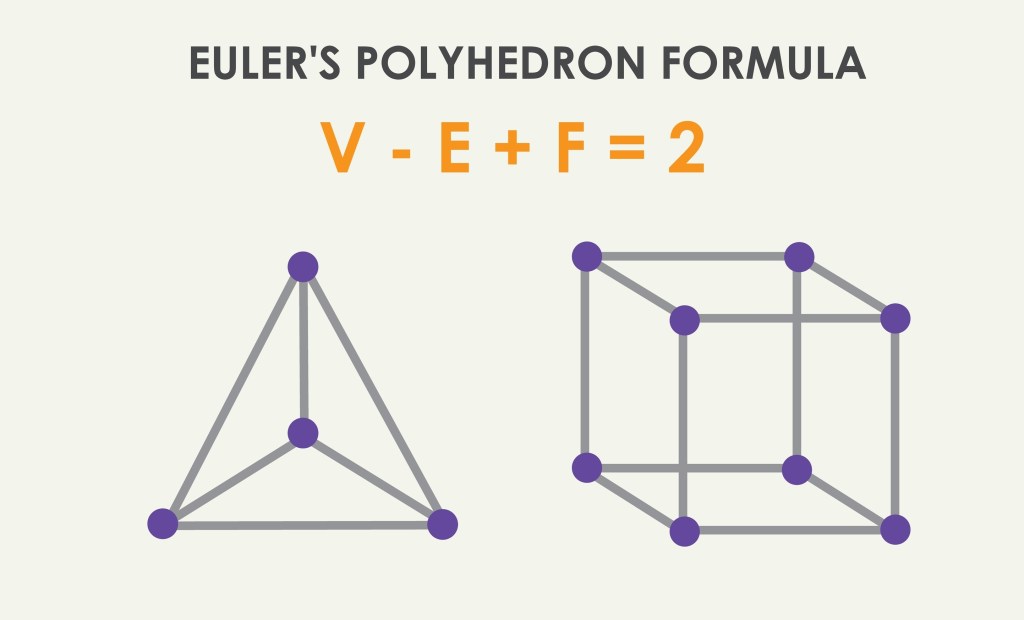
Stick drawings of a tetrahedron on the left and a cube on the right | Eulers Polyhedra Math Magic | Euler's Polyhedron Formula
Polyhedron Euler’s formula. The cube has 6 faces, 8 corners (blue dots), and 12 edges (grey lines) and 8 – 12 + 6 = 2. Popular shapes Asset id: 2362684465 by ramonparaiba.

Convex polyhedra are polyhedra without holes, or it has no internal angles larger than 180 degrees. To express that exactly; A convex polyhedron is a three-dimensional solid with flat polygonal faces where a line segment connecting any two points on its surface or interior remains entirely within the solid. I can add that convex polyhedra consists of convex polygons as their faces. All its faces are convex polygons.

On the left are three convex polygons and on the left are three concave polygons.
The difference between convex and concave polygons. Notice that the concave polygons on the right have “holes” in them, or inner angles larger than 180 degrees, and that you can draw a line starting and ending inside the polygon that goes outside the polygon.

It is easy to understand that there are an infinite number of convex polyhedra. All pyramids (with convex polygons for bottoms) are convex polyhedra whether the bottom is a square/rectangle, or a convex pentagon, hexagon, heptagon, octagon, or any kind of convex polygon, even with trillions.
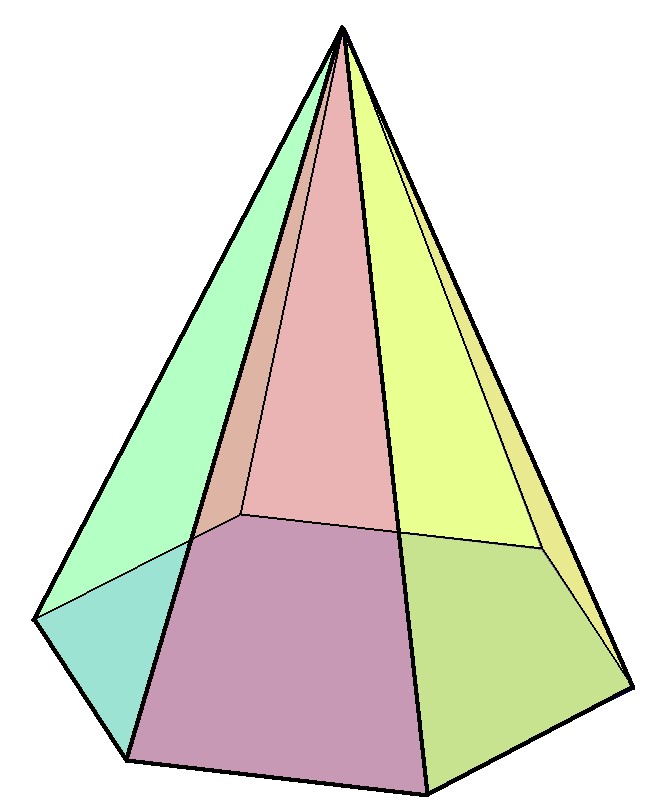
A hexagonal pyramid with differently colored faces | Eulers Polyhedra Math Magic | Euler's Polyhedron Formula
A hexagonal pyramid (it is convex). Tomruen at en.wikipedia, Public domain, via Wikimedia Commons.

Examples of convex polyhedra are cubes, boxes, a tetrahedron, pyramids of various sorts, an octahedron, dodecahedron, icosahedron, but there are infinitely many.

As an example, take a cube (like a dice). It has six faces (F = 6), eight vertices (corners V = 8), and 12 edges (V – E + F = 2 or 8 – 12 + 6 = 2). A tetrahedron has four faces (F = 4), four vertices (V =4), and six edges (E = 6) (V – E + F = 2 or 4 – 6 + 4 = 2). A pyramid (with a square bottom) has five faces (F = 5), five vertices (V = 5) and eight edges (E = 8) (V – E + F = 2 or 5 – 8 + 5 = 2). An octahedron has eight faces (F = 8), and six vertices (V = 6), and twelve edges (E = 12) (V – E + F = 2 or 6 – 12 + 8 = 2). A dodecahedron has twelve faces (F = 12), and twenty vertices (V = 20), and thirty edges (E = 30) (V – E + F = 2 or 20 – 30 + 12 = 2). An icosahedron has twenty faces (F = 20), and twelve vertices (V = 20), and thirty edges (E = 30) (V – E + F = 2 or 12 – 30 + 20 = 2). Euler’s Polyhedral Formula works for all of them and for all the infinite number of convex polyhedra that exists.
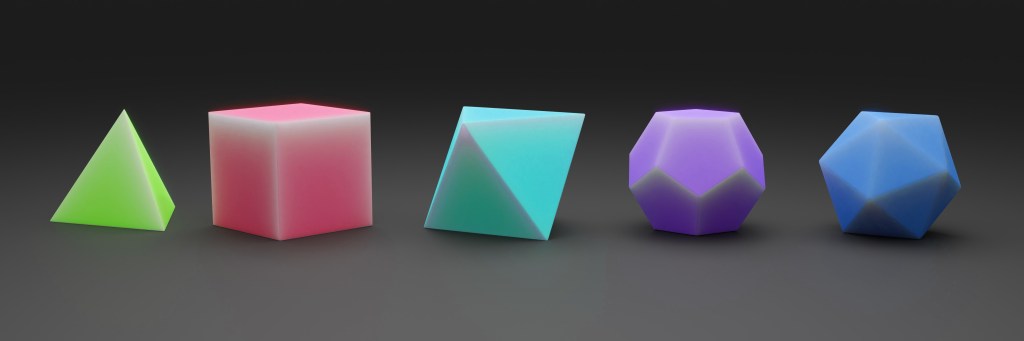
Line of colorful Platonic solids on a grey surface (polyhedra - tetrahedron, cube, octahedron, dodecahedron and icosahedron, 3d render, banner.
Tetrahedron, cube, octahedron, dodecahedron and icosahedron, Shutterstock Asset id: 2138211027 by Dotted Yeti

I consider this a super fact because it is quite amazing and surprising that the number of faces, vertices, and edges follow the same formula for all convex polyhedra. At least it is surprising if you haven’t seen it before. I should say that Leonhard Euler’s most celebrated discovery is probably his discovery of the Euler Number and the associated Euler’s Formula.

More Polyhedra Examples

The three first examples below are convex polyhedra so Euler’s Polyhedral Formula apply. The last two examples are not so Euler’s Polyhedral Formula does not apply.
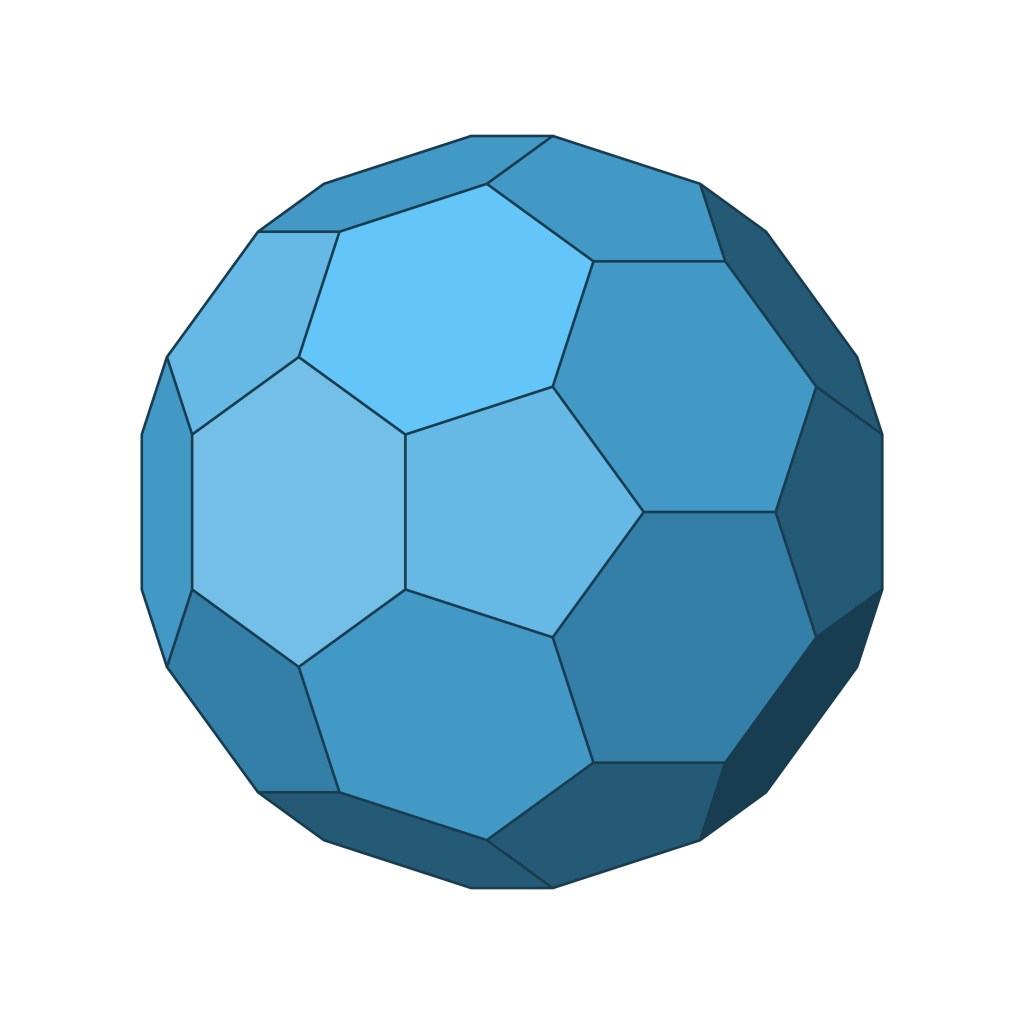
Blue truncated icosahedrons. Geometric soccer ball or football shape. Archimedean solid. Regular polygon outline with pentagonal and hexagonal faces. Blue gradient polygonal figure | Eulers Polyhedra Math Magic | Euler's Polyhedron Formula
This is a truncated icosahedron, which is a convex polyhedra, so Euler’s Polyhedral Formula apply. Shutterstock Asset id: 2309812551 by Mima Subota.
A green Rhombicuboctahedron with 8 triangles and 18 squares as faces.
This Rhombicuboctahedron is an example of convex polyhedron, so Euler’s Polyhedral Formula applies. Cyp, CC BY 4.0 <https://creativecommons.org/licenses/by/4.0&gt;, via Wikimedia Commons.
Icosidodecahedron with faces that are triangles and pentagons.
This Icosidodecahedron is another example of a convex polyhedron, so Euler’s Polyhedral Formula applies. Attribution must be given to Robert Webb’s Stella software as the creator of this image along with a link to the website: http://www.software3d.com/Stella.php. A complimentary copy of any book or poster using images from the Software would also be appreciated where feasible., Attribution, via Wikimedia Commons
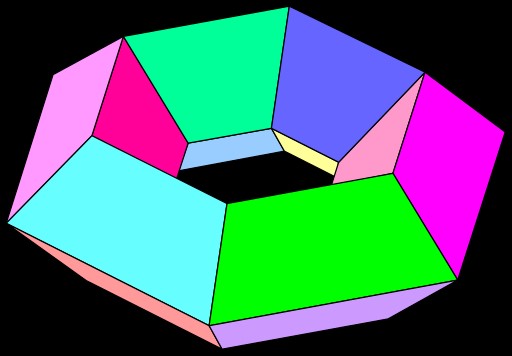
This polyhedron is donut shaped | Eulers Polyhedra Math Magic | Euler's Polyhedron Formula
This hexagonal torus / toroidal polyhedron is not a convex polyhedra, so Euler’s Polyhedral Formula does not apply in this case. Tom Ruen, SVG version from de:User:Antonsusi, Public domain, via Wikimedia Commons
3d polyhedron Merkaba, esoteric bronze crystal, sacral geometry shape, volume david star, mesh form, abstract vector object
This Merkaba Polyhedron is not a convex polyhedra, so Euler’s Polyhedral Formula does not apply in this case. Shutterstock Asset id: 1296063079 by Panimoni


To see the other Super Facts click here