The goal of this blog is to create a list of super facts. Important facts that are true with very high certainty and yet surprising, misunderstood, or disputed by many. This blog aims to be challenging, educational, and fun, without it being clickbait. I determine veracity using evidence, data from reputable sources and longstanding scientific consensus. Prepare to be challenged (I am). Intentionally seek the truth not confirmation of your belief.
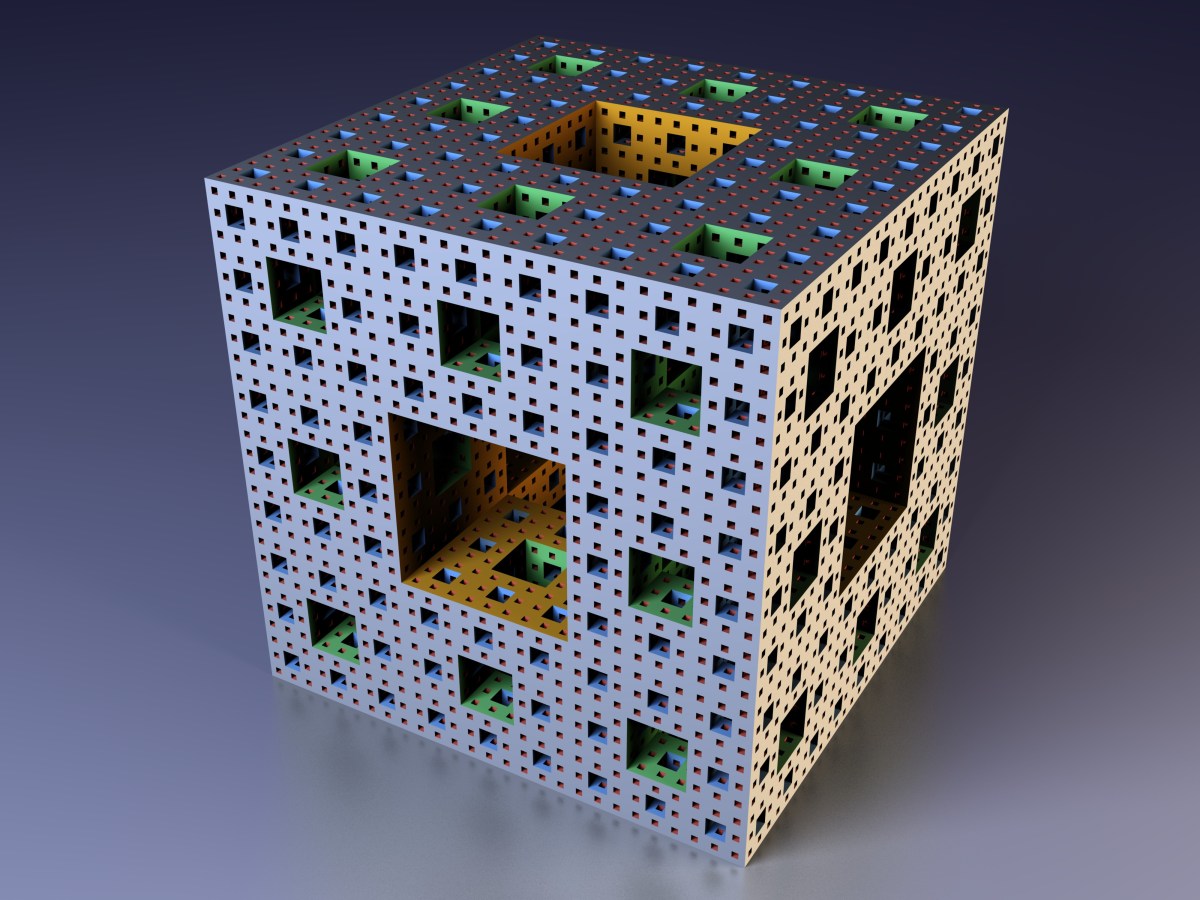
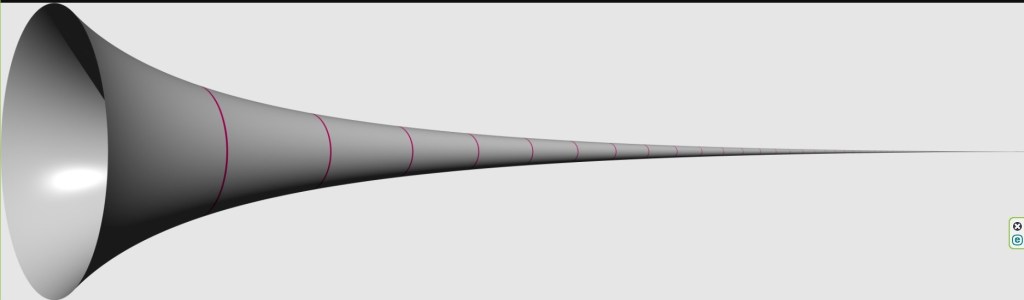
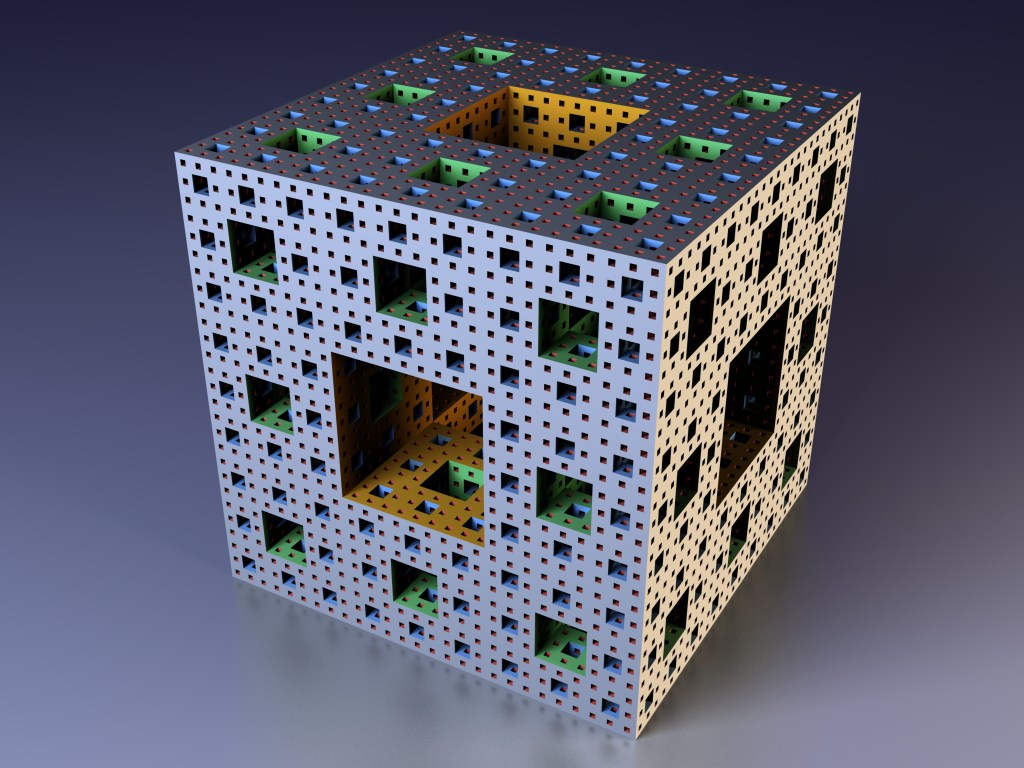
Super fact 113 : There are shapes that have a limited volume but an infinite surface area. Two examples are Gabriel’s Horn and the Menger Sponge.
3D illustration of Gabriel’s horn. RokerHRO, Public domain, via Wikimedia Commons.
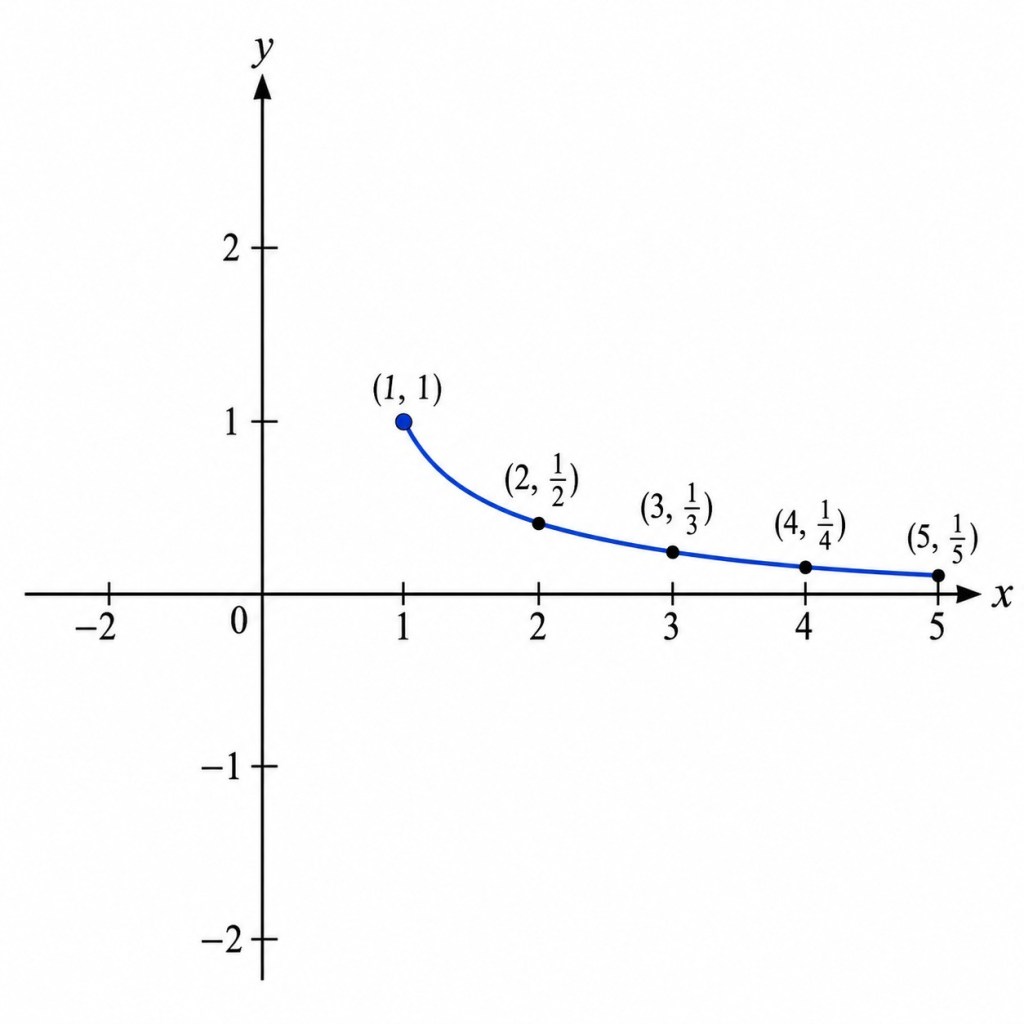
You get Gabriel’s horn by rotating the curve y = 1/x around the x-axis in a coordinate system with the horn starting at x = 1, and y = 1, as in the picture below. Well, you can choose other start values too. A Gabriel’s horn with a beginning radius 1, or widest radius 1, (as in this example) will have a volume equal to pi. Pi is a popular constant. However, it will have an infinite surface area.
This seems like a paradox. The amount of paint you need to fill up Gabriel’s Horn (with widest radius = 1) is pi. However, the surface area of the outside and inside is infinite. So, wouldn’t you need an infinite amount of paint to paint the inside of Gabriel’s Horn? The amount of paint you need to fill up the horn should be more than if you just paint the inside, shouldn’t it? What’s going on? The solution to the paradox is to realize that the radius of Gabriel’s Horn will become increasingly small as it stretches out to the right, and for a coat of paint to take up volume it must have thickness. This is explained well here.
If you rotate this curve around the x-axis, you get a trumpet shape. That is Gabriel’s Horn. I was lazy and drew this using ChatGPT instead of drawing it myself.
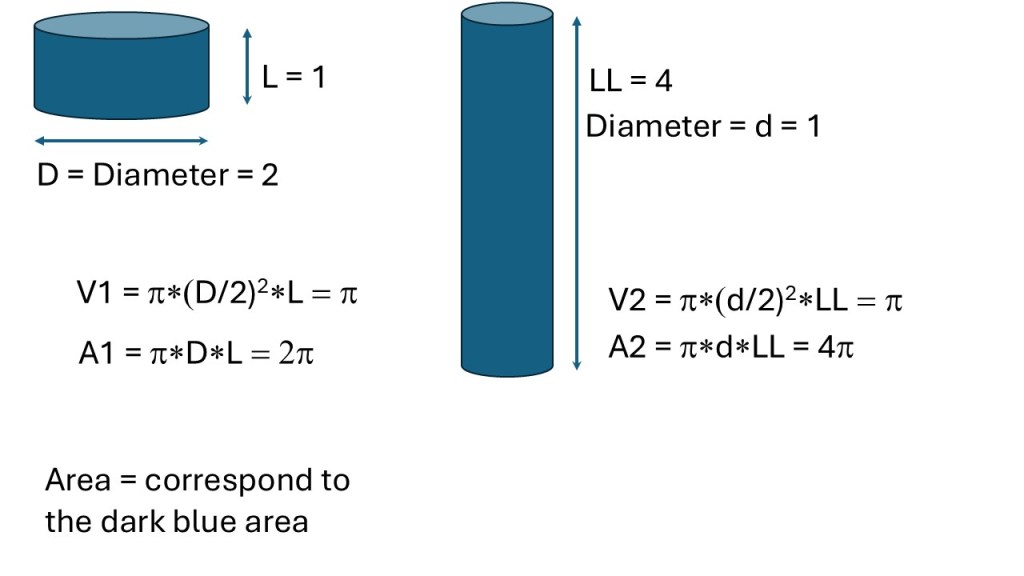
To understand why it is possible for the surface area of Gabriel’s Horn to become infinite you can imagine two cylinders of equal volume, one short (and thick), and one long (and thin). The longer and thinner cylinder will have a larger surface area as shown in the picture below. As Gabriel’s Horn is stretched out and getting thinner and thinner you get an infinite surface area, as you go towards infinity, while the volume does not become infinite. This is analogous to the infinite series in my previous post where adding an infinite number of subsequently smaller addends results in a finite number (corresponding to the volume being finite in this case).
This picture (drawn by me) shows that when you elongate a cylinder but keep the volume the same the dark blue surface area gets larger.
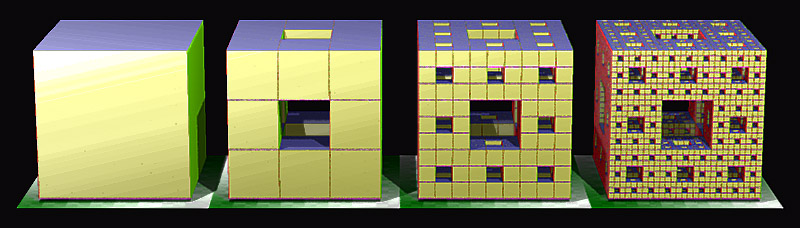
The way you construct a Menger sponge or a Menger cube is by starting with a cube.
Then divide every face of the cube into nine squares in a similar manner to a Rubik’s Cube, dividing the cube into 27 smaller cubes.
Then remove the smaller cube in the middle of each face and remove the smaller cube in the center of the larger cube, leaving 20 smaller cubes. This is a level 1 Menger sponge.
Repeat steps two and three for each of the remaining smaller cubes and continue to iterate infinitely many times.
As you are repeating this process over and over the volume of the Menger sponge will decrease a little bit in every step whilst the area will grow towards infinity.
An illustration of the iterative construction of a Menger sponge up to M3, the third iteration.
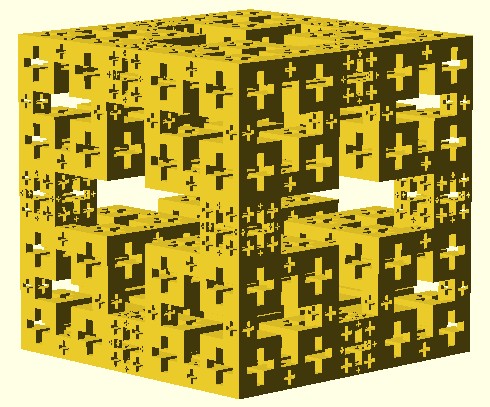
The Jerusalem Cube is like the Menger sponge/cube but instead of removing cubes you remove cross or plus looking 3D shapes from the larger cubes.
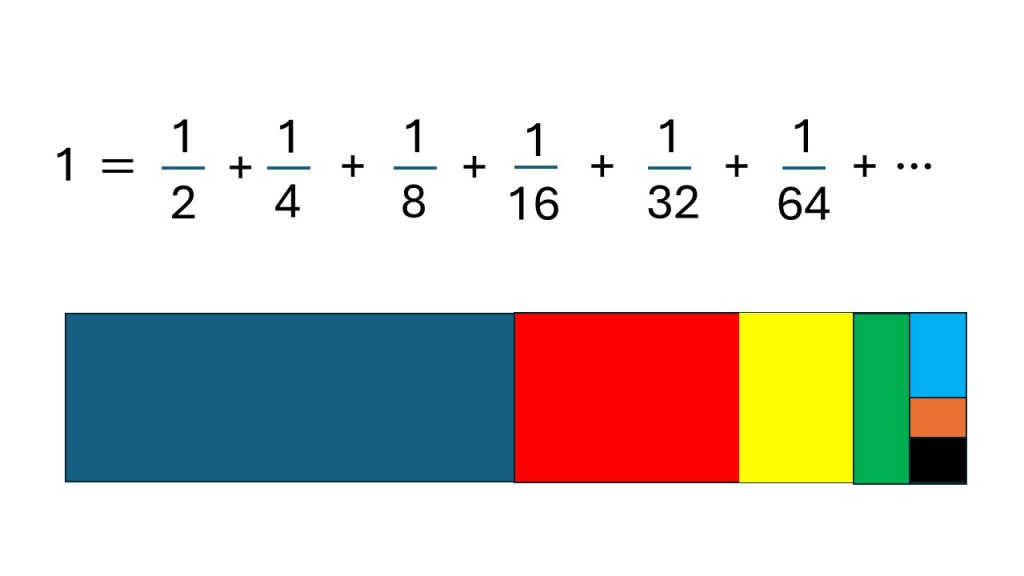
Super fact 112 : Adding infinitely many numbers may result in a finite number. In addition, adding infinitely many numbers may result in an irrational important constant such as Pi. The same holds true for infinitely nested radicals (square roots).
The differently colored rectangles represent the fractions in the equation. Each subsequent addend is the half of the previous. Despite having an infinite number of addends, the total sum is just 1.
That you can add infinitely many numbers and get a finite number as the result is possible to understand if you imagine cutting a rectangle into smaller and smaller pieces and then adding them to get the rectangle back. If you start with half the rectangle and then you add the half of the remaining half and then the half of that remaining half, etc., you can keep doing that forever without exceeding the size of the rectangle. This is illustrated in the picture above. Note all these pictures are drawn by me.
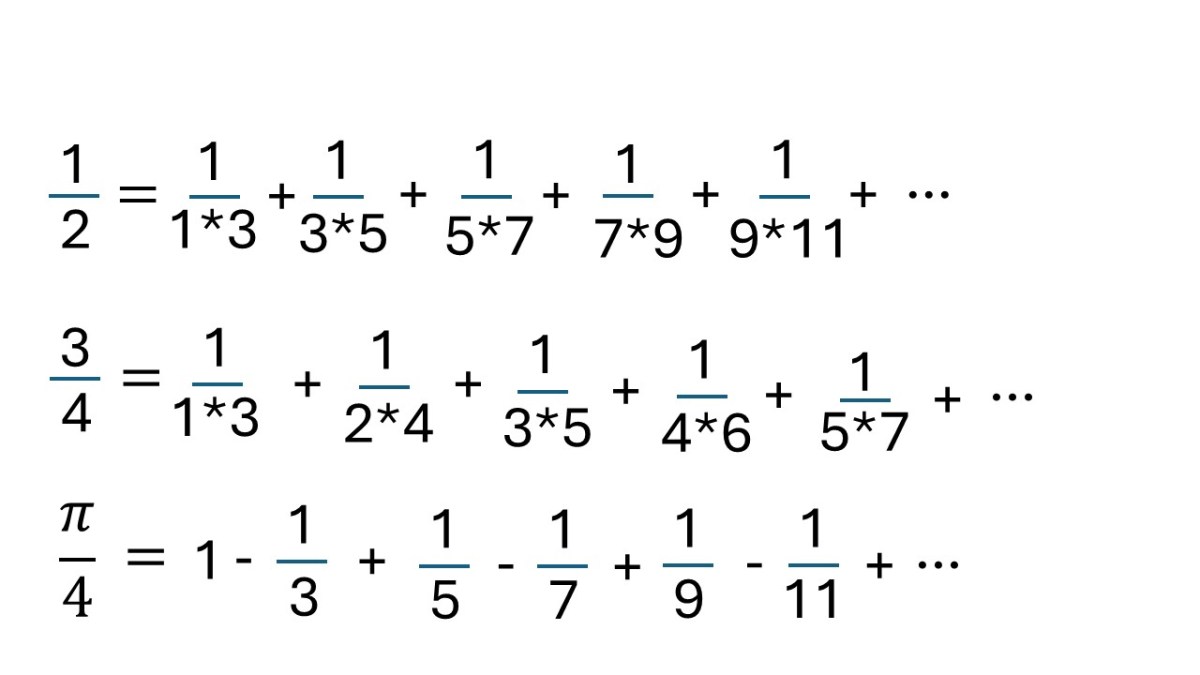
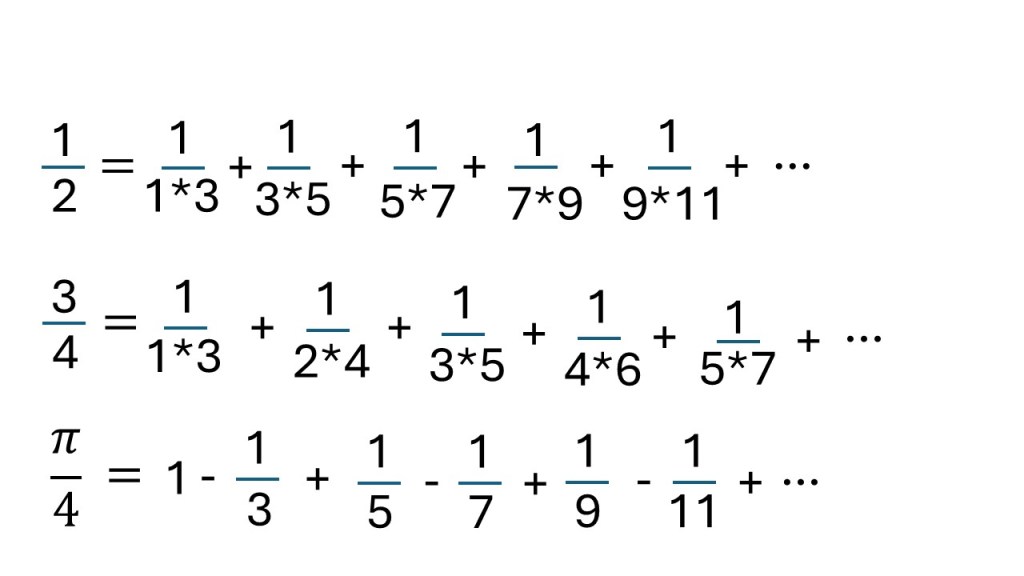
If you’ve never seen an infinite series before this may come as a surprise. However, what is even more surprising is that you can add an infinite number of addends that are constructed from simple patterns and get all kinds of surprising results including irrational numbers with special meaning such as pi. You can easily find thousands of examples in mathematical handbooks and online. This reality is important in mathematics and our understanding of the world, as well as surprising, and therefore a super fact in my opinion.
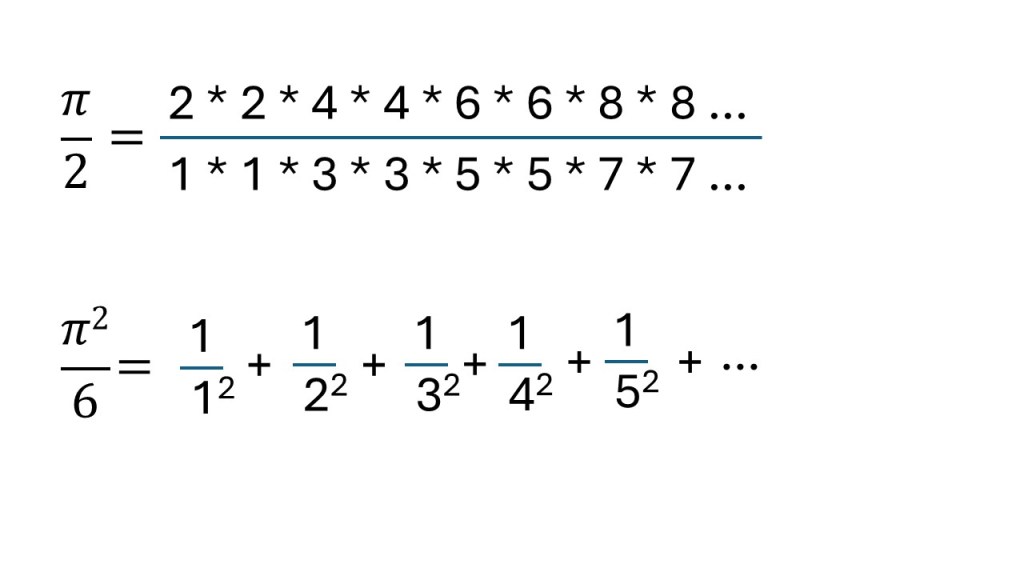
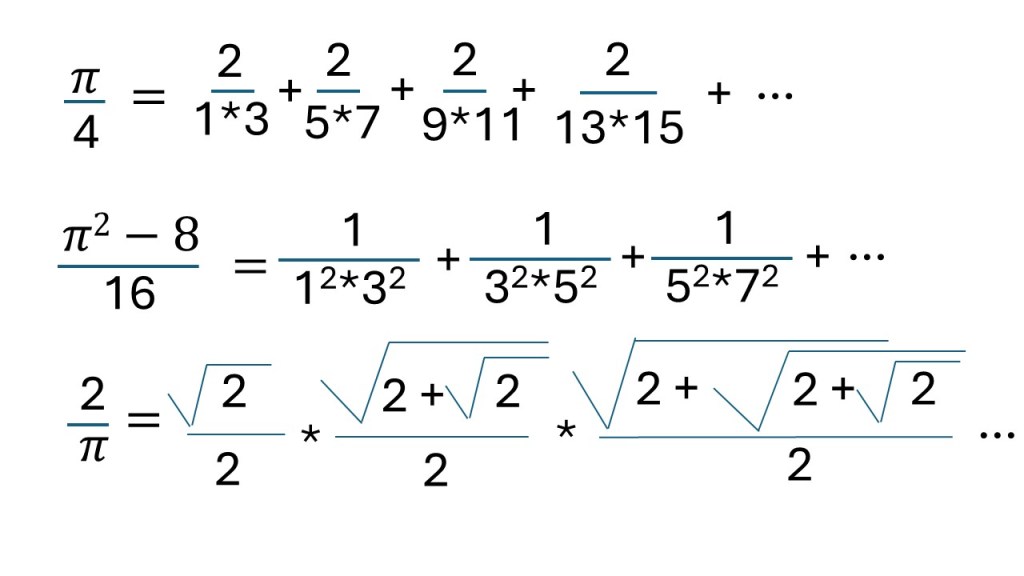
Three fascinating examples of infinite series. Note that I indicate multiplication using a star *.
Infinitely Nested Radicals
In addition, to adding an infinite number of addends you multiply an infinite number of factors and end up with a non-infinite (finite) result. You can even have an infinite number of nested radicals. To explain what a radical is. A square is a number multiplied by itself. For example, the square of 5 is five times five, which is twenty five. A cube is a number multiplied by itself three times. The cube of five is five times five times five, which is one hundred and twenty five. The square is denoted by adding a superscript of 2 (5 with a superscript 2). The cube is denoted by adding a superscript of 3 (5 with a superscript 3).
The square root is the opposite of the square. The square root of twenty five is five. The cube root is the opposite of the cube. The cube root of one hundred and twenty five is five. The square root and the cube root are examples of radicals. Radicals are indicated by using a little house on top of the number as shown in the pictures below. For radicals that are not square roots you add a number indicating what type of radical you have. The cube root has the number three above the house. All the examples below are square roots and in those cases the number two is left out.
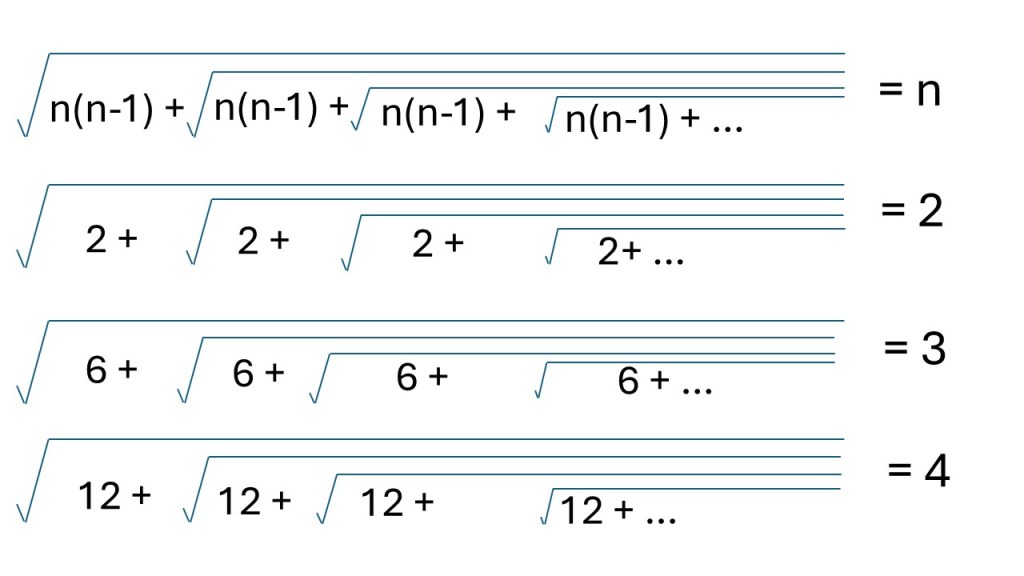
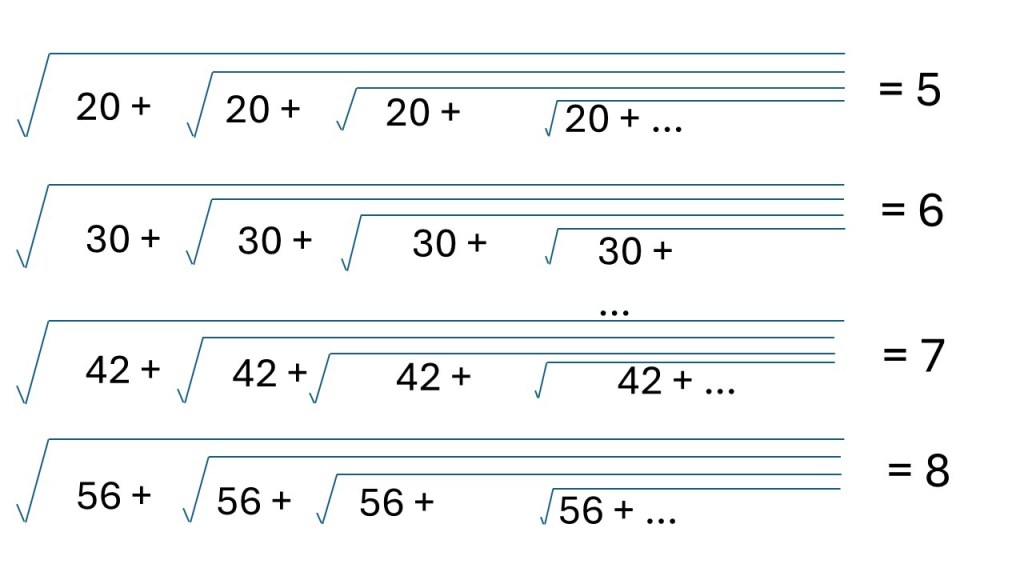
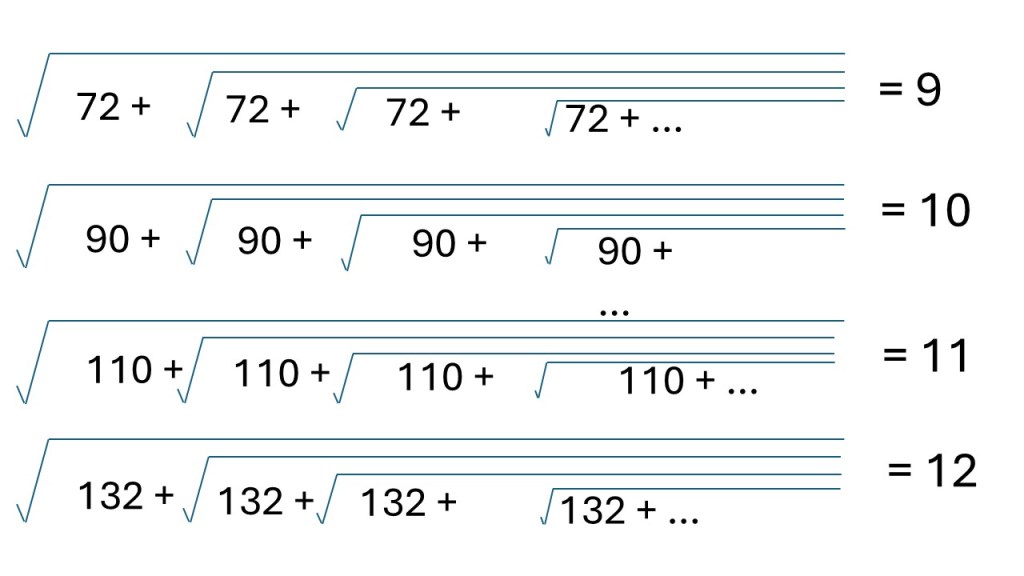
The three pictures below show one example of infinitely nested radicals (square root) using numbers n(n-1) repeatedly in the square roots. When n = 2 then n(n-1) is 2*1 = 2. When n = 3 then n(n-1) is 3*2 = 6, etc.
Infinitely nested square roots using n = 2 is the same as 2. Infinitely nested square roots using n = 3 is the same as 3, etc.Infinitely nested square root for n = 9,10,11,12
Infinite Series and Pi
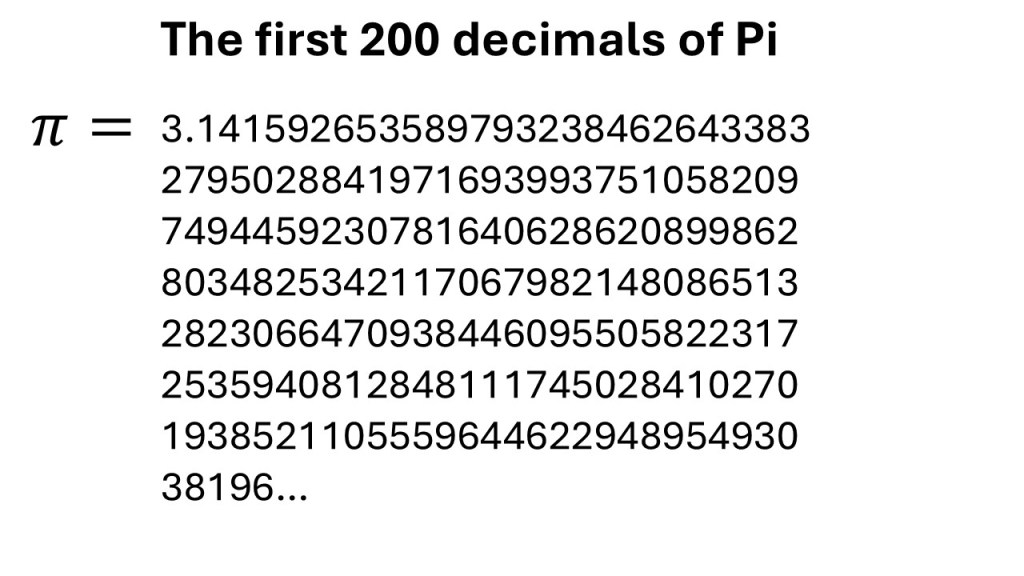
The constant pi is a special mathematical number that tells you exactly how the distance around the edge of any circle compares to the distance straight across the middle (diameter). Pi is an irrational number, meaning it cannot be expressed as a fraction and when written as a decimal it has an infinite number of decimals that have no repeating patterns. Despite pi being irrational, it shows up as the result of a very large number of infinite series that follow surprisingly simple patterns.
The first 200 decimals of pi.Infinite multiplication and infinite number of addends.Infinite series and infinitely nested square roots (radicals) resulting in pi.
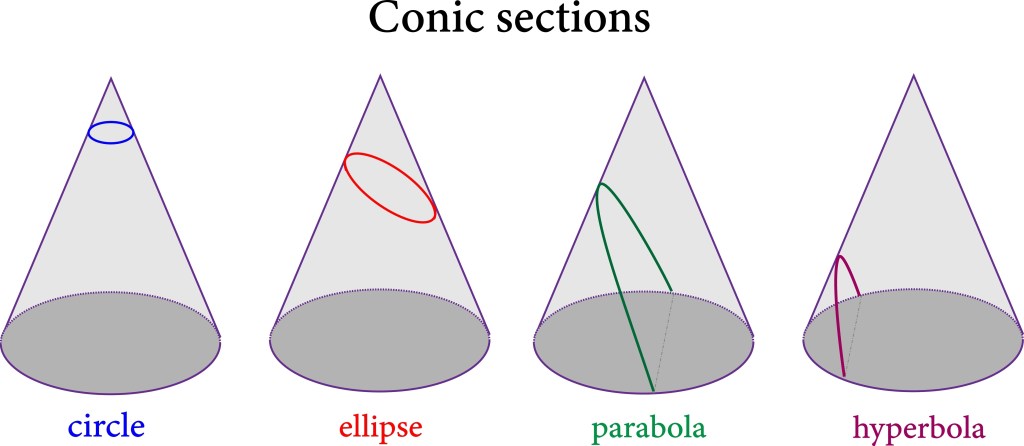
Super fact 80 : A conic section is a shape formed by slicing a cone with a plane. There are four such shapes, circle, ellipse, parabola, and hyperbola. The conic sections universally describe motion under gravity. The orbits of planets around their stars are circles or ellipses, comets fly around space in elliptical orbits, or parabolic or hyperbolic paths. Objects thrown up in the air follow parabolic paths. They are the basis for a huge amount of engineering applications.
Types of conic sections : circle , ellipse , parabola , hyperbola Shutterstock Asset id: 2377159367 by ProfDesigner
The four conic sections, circle, ellipse, parabola and hyperbola are fundamental and very useful shapes in mathematics, physics and engineering. Well, a circle is a special case of an ellipse, so it is really only three conic sections. The motion of the planets and other stellar objects are described by the conic shapes. Isaac Newton derived his law of gravitation from Kepler’s laws, which describe planetary orbits as ellipses.
The conic sections are all described by second degree equations (quadratic equations) and are in that sense the simplest shapes aside from points and lines. It is important to understand that there is an infinite amount of shapes that are almost conic sections and look like conic sections, but it is the exact mathematical properties of the four conic sections that make them so common in physics, mathematics, nature and engineering.
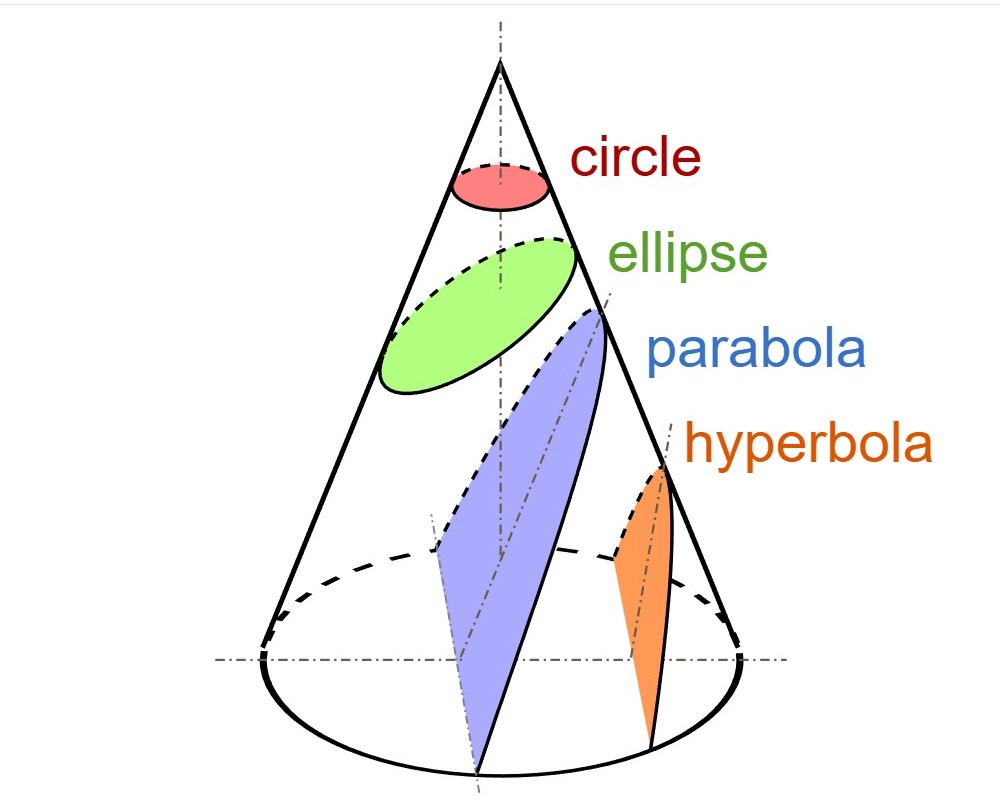
The black boundaries of the colored regions are conic sections. Not shown is the other half of the hyperbola, which is on the unshown other half of the double cone. by Magister Mathematicae, CC BY-SA 3.0, https://commons.wikimedia.org/w/index.php?curid=18556148
It may not come as a surprise that the circle is a fundamental and important shape, but I believe that the fact that the other conic sections are also fundamental in mathematics, physics and engineering come as a surprise to people outside of the STEM fields. It is a true and an important fact regarding how our world works.
Conic Sections
As mentioned, the conic sections are fundamental shapes that appear in a lot of places in STEM. Below are a few examples.
Parabola
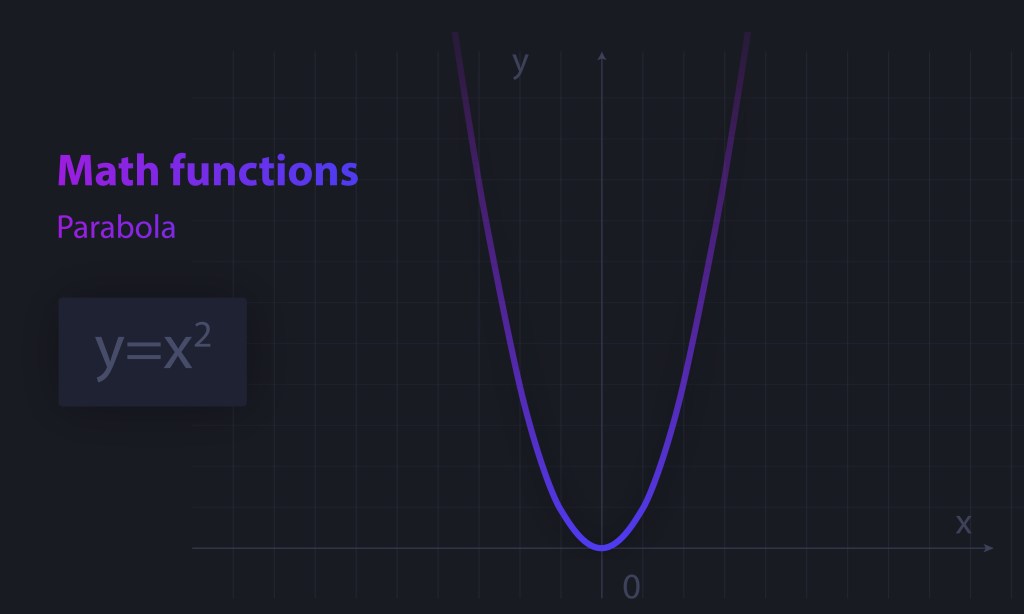
Math function parabola. Shutterstock Asset id: 1628916337 by EleonoraDesigner
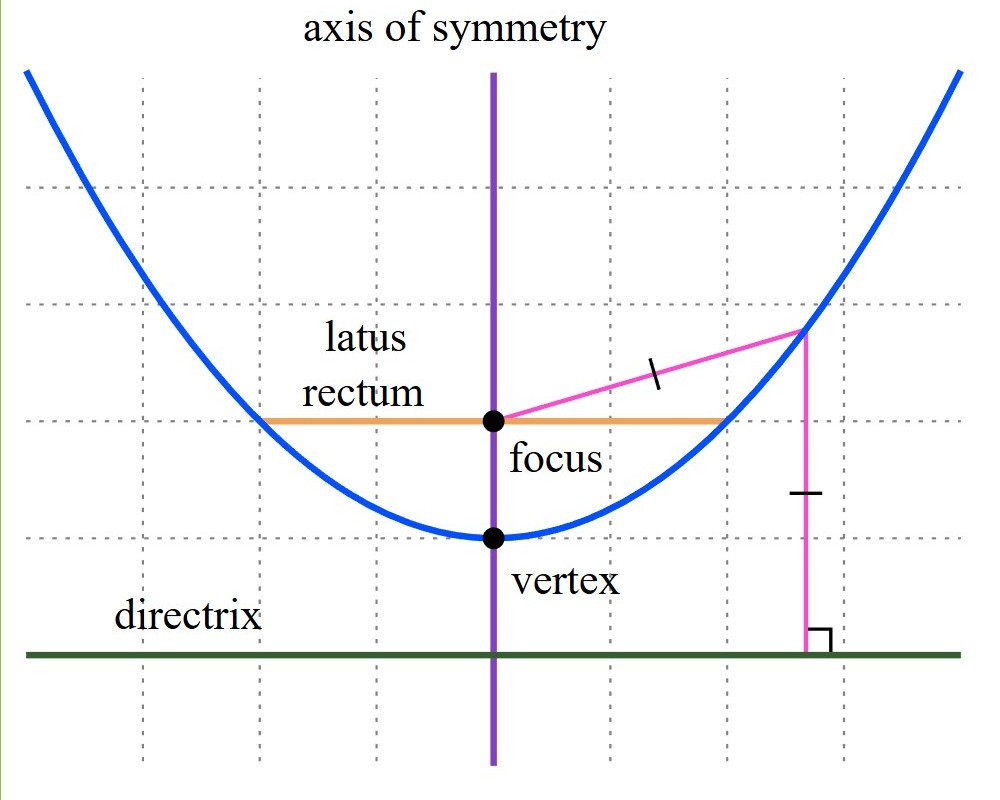
A parabola is formed when a plane cuts a cone, so the plane is parallel to a side of the cone. Parabolas are shapes that are roughly U-shaped and described by the equation y = x^2 or more generally by y = ax^2 + bx + c. Parabolas have a so called focus point. See the picture below. If you throw a ball, or any object, up in the air its trajectory will be a parabola (ignoring distortions caused by friction and wind). I should say the parabola you get in this case is upside down. The parabola is important when you design any kind of projectile.
Part of a parabola (blue), with various features (other colours). The complete parabola has no endpoints. In this orientation, it extends infinitely to the left, right, and upward. Picture is from Wikipedia Melikamp, CC BY-SA 3.0 https://creativecommons.org/licenses/by-sa/3.0, via Wikimedia Commons.
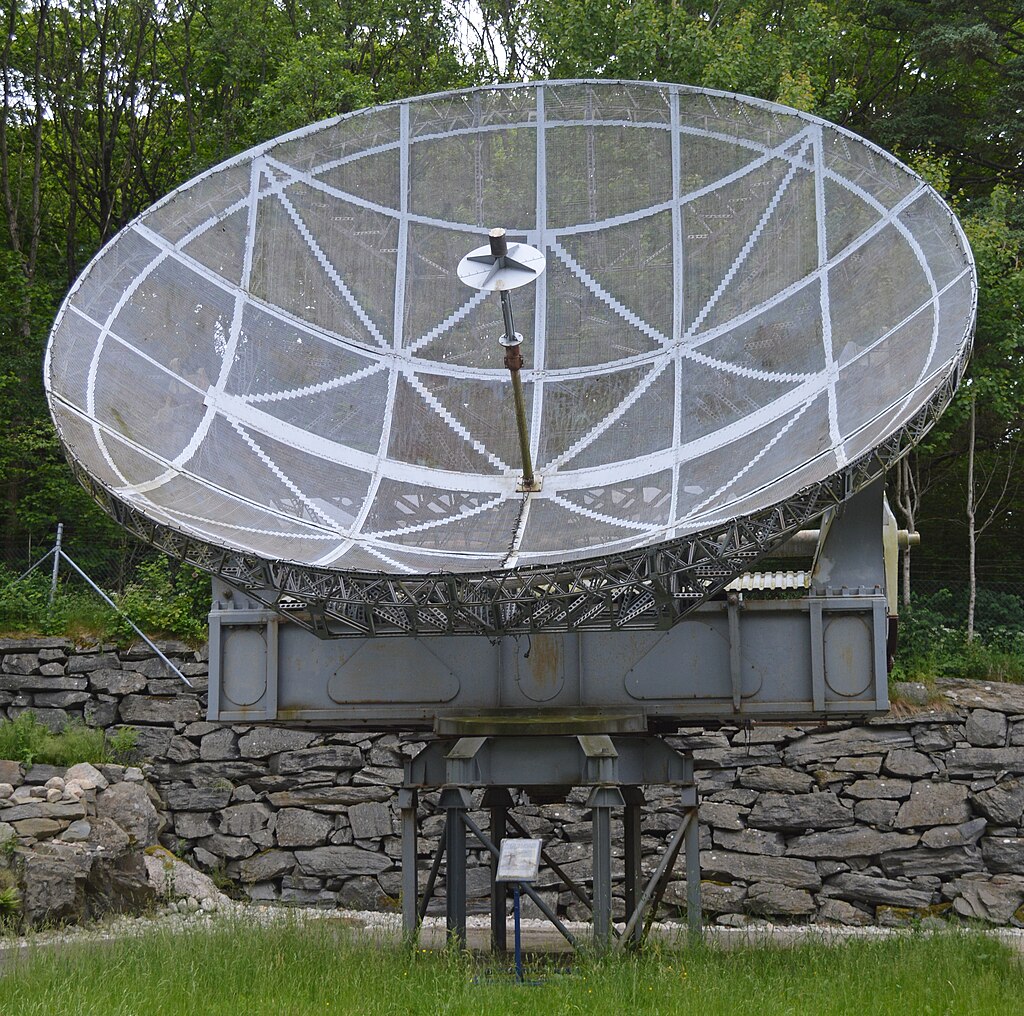
Antennas shaped like parabolas (in 3D) will direct incoming radiation and waves towards their focus point. If the surface is reflective a light located at the focus point will reflect to create a straight beam. Parabolas are used for radio telescopes, satellite dishes, car headlights, flashlights, solar cookers, solar power plants, water fountains, suspension bridges, business modelling and thousands of engineering applications. Parabolas like circles and the other conic sections shape our modern world (pun intended).
Würzburg-Riese radar built by Germany in WW2 had a 7.4 meter (24 foot) dish. From this page. Alan Wilson from Stilton, Peterborough, Cambs, UK, CC BY-SA 2.0 https://creativecommons.org/licenses/by-sa/2.0, via Wikimedia Commons
Ellipse and circle
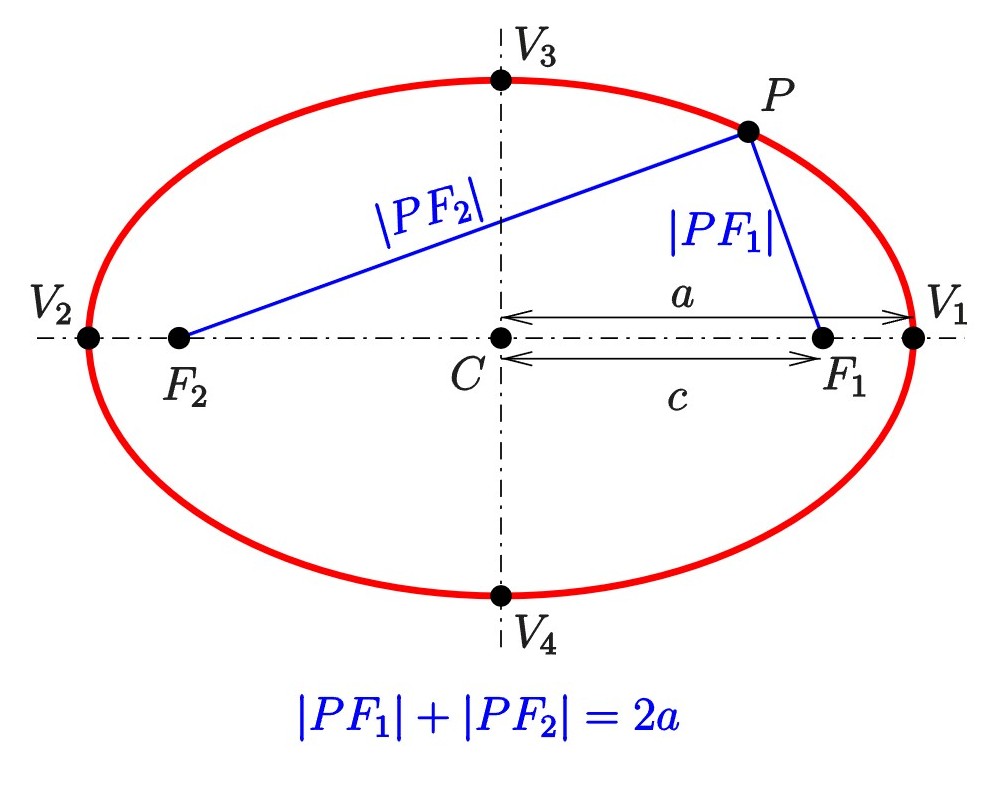
As mentioned, a circle and an ellipse are conic sections formed by intersecting a plane with a cone. You get a circle when the cuts perpendicular to the cone’s axis (see pictures above) and an ellipse form when the plane intersects the cone at a slant but not slanted so much that it becomes a parabola or a hyperbola. An alternative for an ellipse is that the sum of the distances from any point on the curve to two fixed points (called the foci) is a constant. See the picture below. The two definitions are identical. For a circle the two foci are merged into one point at the center.
There are a lot of real world examples of ellipses. Planets orbit the Sun in elliptical paths. The sun is in one of the foci points. The orbits of other stellar objects and satellites are also elliptical. Charged particles follow elliptical paths within magnetic fields. Elliptical patterns are observed in the rotation of ocean currents, elliptical models and algorithms are used in medical imaging, computer science and encryption. Also whispering galleries.
Hyperbola
Comets and spacecraft that are not orbiting another body, in other words, they have enough speed to escape the gravitational pull and continue into deep space, will travel along a hyperbola. The boundary of a shockwave from a supersonic jet (a sonic boom) creates a hyperbolic curve on the ground as it moves. The intersection of two sets of concentric ripples in water makes a hyperbola. The light beam from a lamp or flashlight makes an ellipse or an hyperbola on a plane depending on the angle.
Newton’s Law of Gravitation
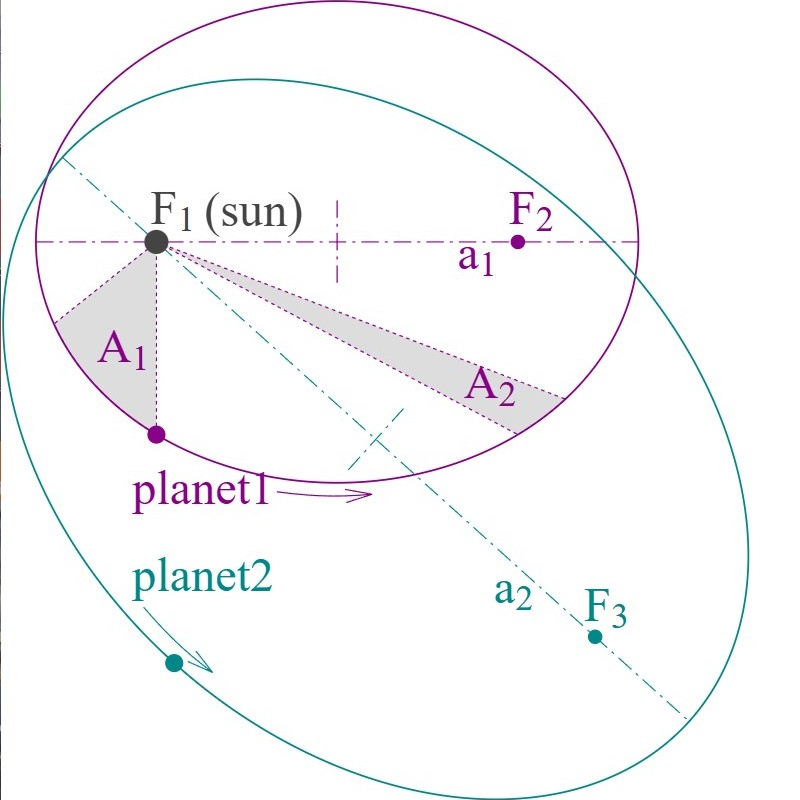
Johannes was an early 17th century German mathematician who derived three laws that describe how planetary bodies orbit the Sun using the observational data collected by the Danish astronomer Tycho Brahe. The three laws are the following:
Planets move in elliptical orbits with the Sun as a focus.
A planet covers the same area of space in the same amount of time no matter where it is in its orbit.
A planet’s orbital period is proportional to the size of its orbit (its semi-major axis).
Illustration of Kepler’s laws with two planetary orbits. The orbits are ellipses, with foci F1 and F2 for Planet 1, and F1 and F3 for Planet 2. The Sun is at F1. The shaded areas A1 and A2 are equal and are swept out in equal times by Planet 1’s orbit. The ratio of Planet 1’s orbit time to Planet 2’s is (a1/a2)^3/2 Hankwang, CC BY-SA 3.0 <http://creativecommons.org/licenses/by-sa/3.0/>, via Wikimedia Commons
Later Isaac Netwon would use Kepler’s three laws to derive his law of gravity. Newton showed that an inverse-square force (gravity) directed toward the sun was necessary to explain the orbits.
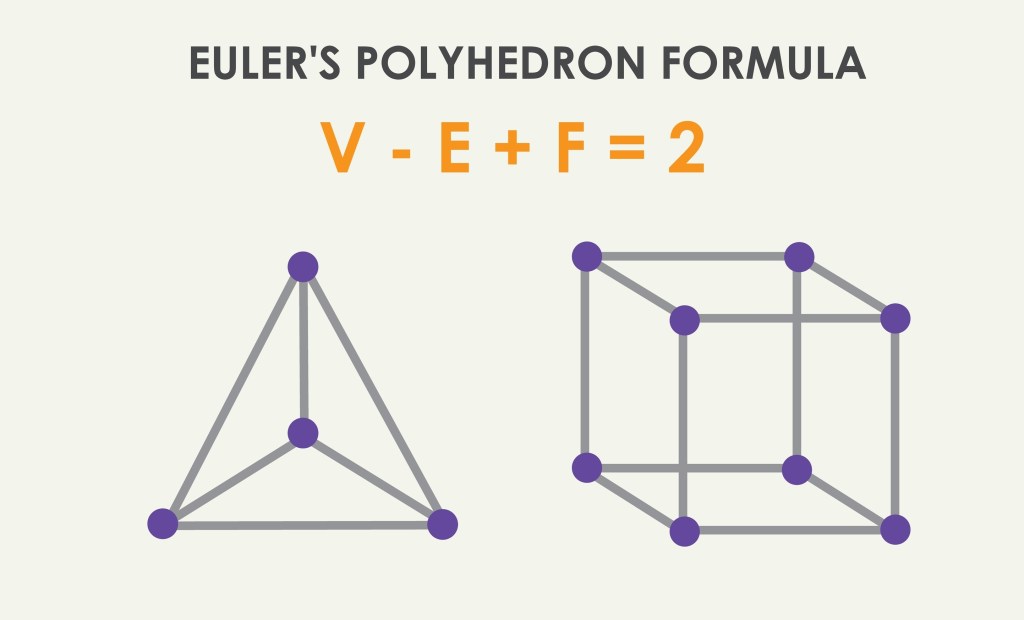
Super fact 64 : V – E + F = 2 is true for all convex polyhedra, where V is the number of vertices (corners), E is the number of edges, and F is the number of faces of a convex polyhedron. This is called Euler’s formula for polyhedra.
Polyhedron Euler’s formula. The cube has 6 faces, 8 corners (blue dots), and 12 edges (grey lines) and 8 – 12 + 6 = 2. Popular shapes Asset id: 2362684465 by ramonparaiba.
Convex polyhedra are polyhedra without holes, or it has no internal angles larger than 180 degrees. To express that exactly; A convex polyhedron is a three-dimensional solid with flat polygonal faces where a line segment connecting any two points on its surface or interior remains entirely within the solid. I can add that convex polyhedra consists of convex polygons as their faces. All its faces are convex polygons.
The difference between convex and concave polygons. Notice that the concave polygons on the right have “holes” in them, or inner angles larger than 180 degrees, and that you can draw a line starting and ending inside the polygon that goes outside the polygon.
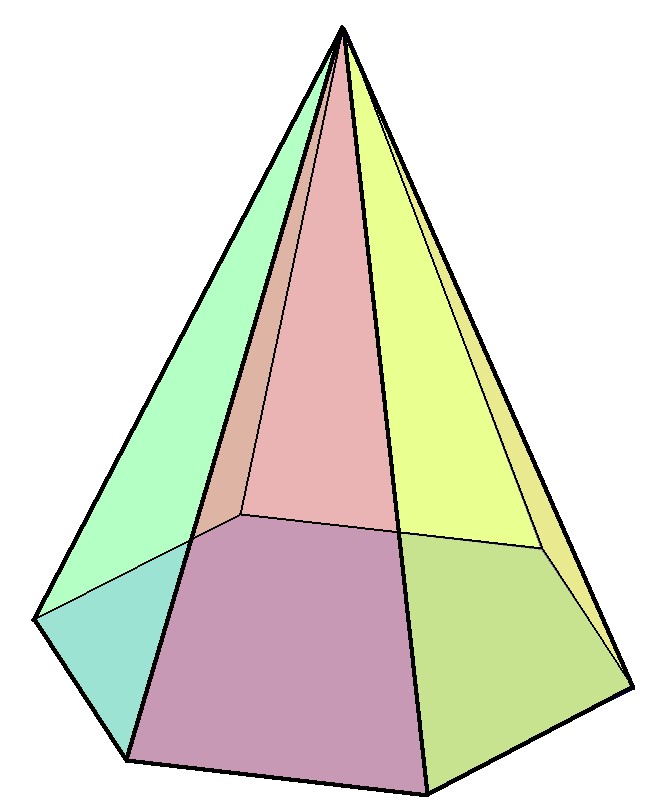
It is easy to understand that there are an infinite number of convex polyhedra. All pyramids (with convex polygons for bottoms) are convex polyhedra whether the bottom is a square/rectangle, or a convex pentagon, hexagon, heptagon, octagon, or any kind of convex polygon, even with trillions.
A hexagonal pyramid (it is convex). Tomruen at en.wikipedia, Public domain, via Wikimedia Commons.
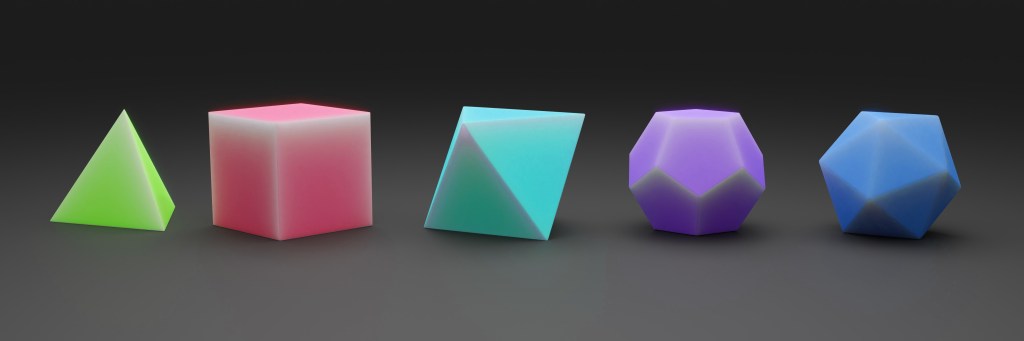
Examples of convex polyhedra are cubes, boxes, a tetrahedron, pyramids of various sorts, an octahedron, dodecahedron, icosahedron, but there are infinitely many.
As an example, take a cube (like a dice). It has six faces (F = 6), eight vertices (corners V = 8), and 12 edges (V – E + F = 2 or 8 – 12 + 6 = 2). A tetrahedron has four faces (F = 4), four vertices (V =4), and six edges (E = 6) (V – E + F = 2 or 4 – 6 + 4 = 2). A pyramid (with a square bottom) has five faces (F = 5), five vertices (V = 5) and eight edges (E = 8) (V – E + F = 2 or 5 – 8 + 5 = 2). An octahedron has eight faces (F = 8), and six vertices (V = 6), and twelve edges (E = 12) (V – E + F = 2 or 6 – 12 + 8 = 2). A dodecahedron has twelve faces (F = 12), and twenty vertices (V = 20), and thirty edges (E = 30) (V – E + F = 2 or 20 – 30 + 12 = 2). An icosahedron has twenty faces (F = 20), and twelve vertices (V = 20), and thirty edges (E = 30) (V – E + F = 2 or 12 – 30 + 20 = 2). Euler’s Polyhedral Formula works for all of them and for all the infinite number of convex polyhedra that exists.
Tetrahedron, cube, octahedron, dodecahedron and icosahedron, Shutterstock Asset id: 2138211027 by Dotted Yeti
I consider this a super fact because it is quite amazing and surprising that the number of faces, vertices, and edges follow the same formula for all convex polyhedra. At least it is surprising if you haven’t seen it before. I should say that Leonhard Euler’s most celebrated discovery is probably his discovery of the Euler Number and the associated Euler’s Formula.
More Polyhedra Examples
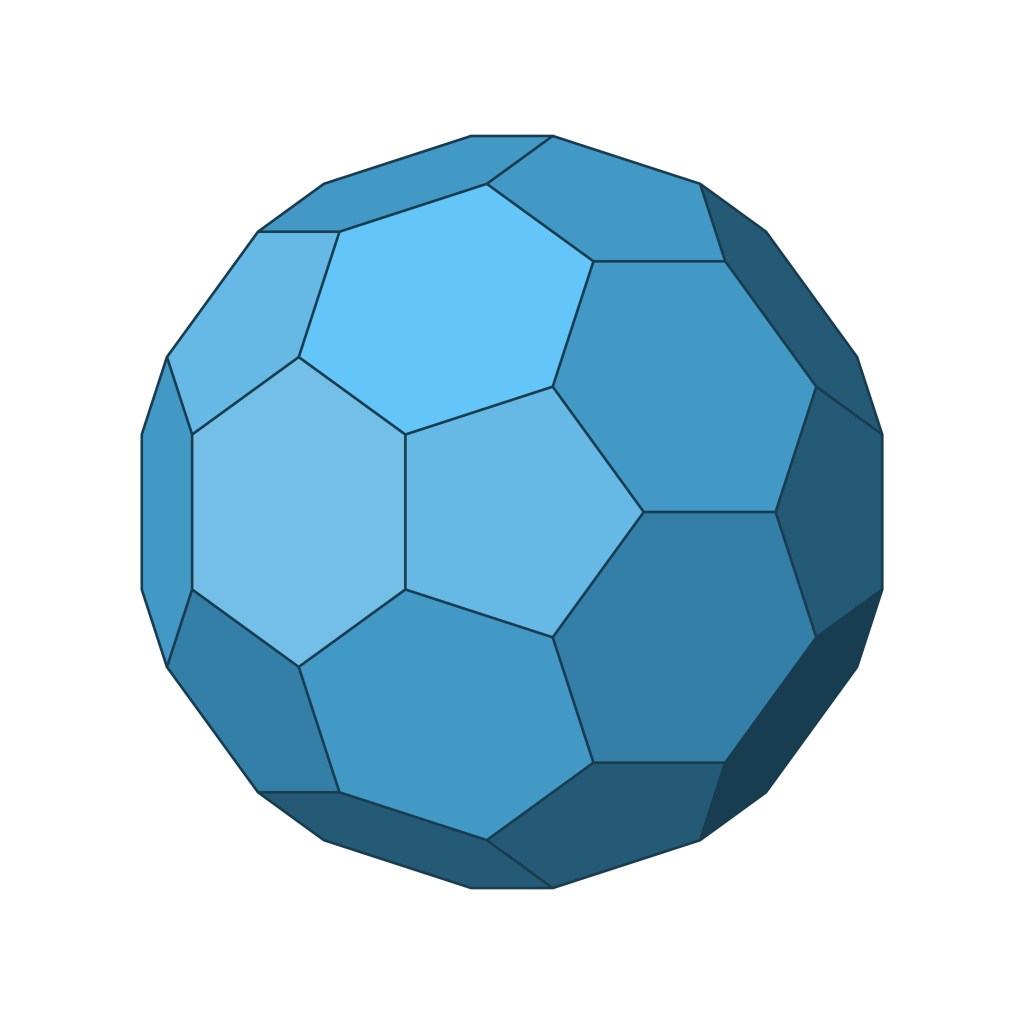
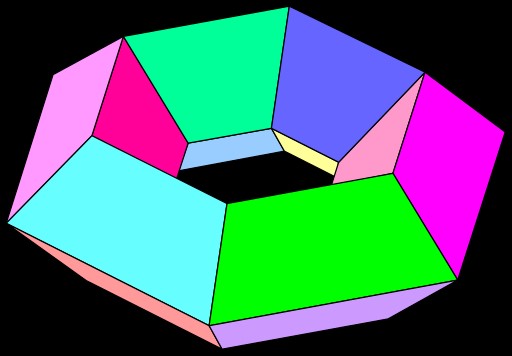
The three first examples below are convex polyhedra so Euler’s Polyhedral Formula apply. The last two examples are not so Euler’s Polyhedral Formula does not apply.
This is a truncated icosahedron, which is a convex polyhedra, so Euler’s Polyhedral Formula apply. Shutterstock Asset id: 2309812551 by Mima Subota.This Rhombicuboctahedron is an example of convex polyhedron, so Euler’s Polyhedral Formula applies. Cyp, CC BY 4.0 <https://creativecommons.org/licenses/by/4.0>, via Wikimedia Commons.This Icosidodecahedron is another example of a convex polyhedron, so Euler’s Polyhedral Formula applies. Attribution must be given to Robert Webb’s Stella software as the creator of this image along with a link to the website: http://www.software3d.com/Stella.php. A complimentary copy of any book or poster using images from the Software would also be appreciated where feasible., Attribution, via Wikimedia CommonsThis hexagonal torus / toroidal polyhedron is not a convex polyhedra, so Euler’s Polyhedral Formula does not apply in this case. Tom Ruen, SVG version from de:User:Antonsusi, Public domain, via Wikimedia CommonsThis Merkaba Polyhedron is not a convex polyhedra, so Euler’s Polyhedral Formula does not apply in this case. Shutterstock Asset id: 1296063079 by Panimoni
Super fact 53 : The Euler number denoted e, is an irrational number, which like the number pi is extremely important in mathematics. In addition, the relationship between the Euler number and pi; seemingly unrelated numbers, is quite amazing, especially if you throw the imaginary number: i = square root of -1 into the mix. Euler’s formula e^ix = cos(x) + isin(x), where x is degrees expressed in radians, is mind blowing to say the least. Radians means that 180 degrees is replaced by pi, and 90 degrees is replaced by pi/2, etc. A simpler special case, but equally amazing is Euler’s identity e^ix = -1, or e^ix + 1 =0. This is amazing math assuming you understand it.
As I said all this is amazing, mind blowing if you will, if you understand it, which is why I will try to explain it. Why I consider this a super fact is because when you first encounter the Euler number and the Euler formula, and you somewhat understand what it means, it is likely to be a mind-blowing experience. Those among you who have studied higher math, AP math classes in high school, or college level math are probably familiar with what I am about to describe, so your mind may not be blown. By the way you pronounce Euler like “Oiler”.
Euler’s formula in cyber space with grid 3d illustration, Asset id: 1636161301 by Giggle2000
Euler’s Number and Pi Two Irrational Numbers
Pi is the number you get when you divide the distance around a circle (the circumference) by the distance across the middle (the diameter). The Euler number is a bit more complicated to explain. I will do that next. Both pi and the Euler number are irrational numbers, which means that when written as a decimal, the number neither terminates nor repeats. As I mentioned, both pi and the Euler number are extremely important numbers in math. Perhaps the Euler should have its own day, just like pi has its own day (March 14). Maybe we should start celebrating Euler number day on February 7.
The first 20 decimals of pi and of the Euler number.
Exponents
Before I explain what, the Euler number is, I need to explain what an exponent is. If you multiply a number by itself x number of times, then x is the exponent. If you multiply two by itself four times 2*2*2*2, called 2 raised to 4, then 4 is the exponent. By the way the answer is 2^4 = 16 (called 2 raised to 4 is 16). I hope the illustration below will explain it.
Overview of exponents.
And finally, before explaining what the Euler number is I should also mention what a factorial is. The factorial of a number is the product of all positive integers less than or equal to that number. The factorial of 5 is denoted 5! and is 1*2*3*4*5 = 120. Also, the factorial of 0 or 0! = 1 (per definition).
Definition of the Euler Number
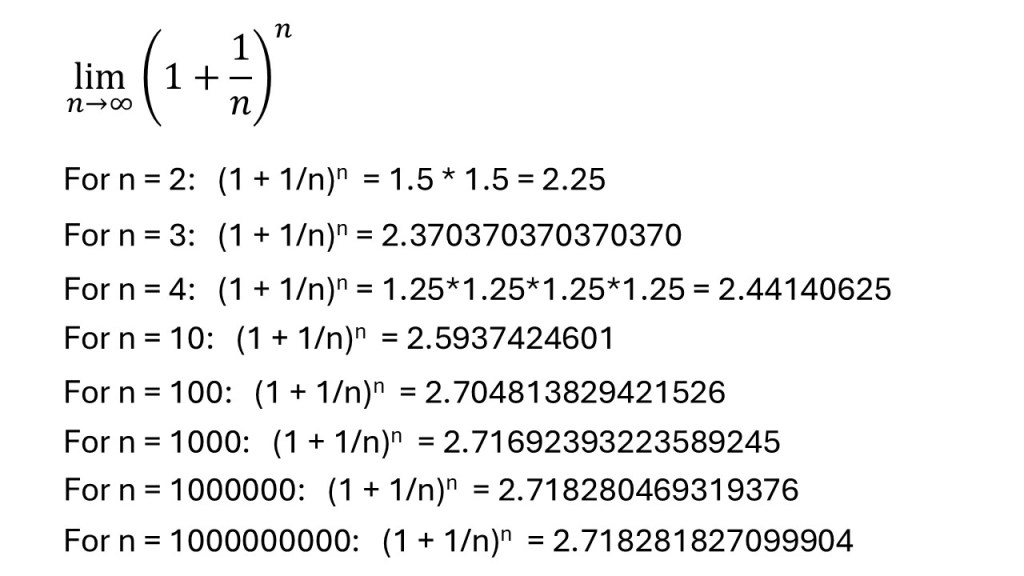
One more thing I need to explain before I go ahead with the definition for the Euler number is what is meant by allowing a number n in a formula to go towards infinity (limit –> infinity). Let’s say you have a formula that contains the number n. If the value of the formula does not change much as n becomes very large than it might be approaching a specific number as n approaches infinity. You say that it approaches a limit. I am trying to illustrate this in the picture below.
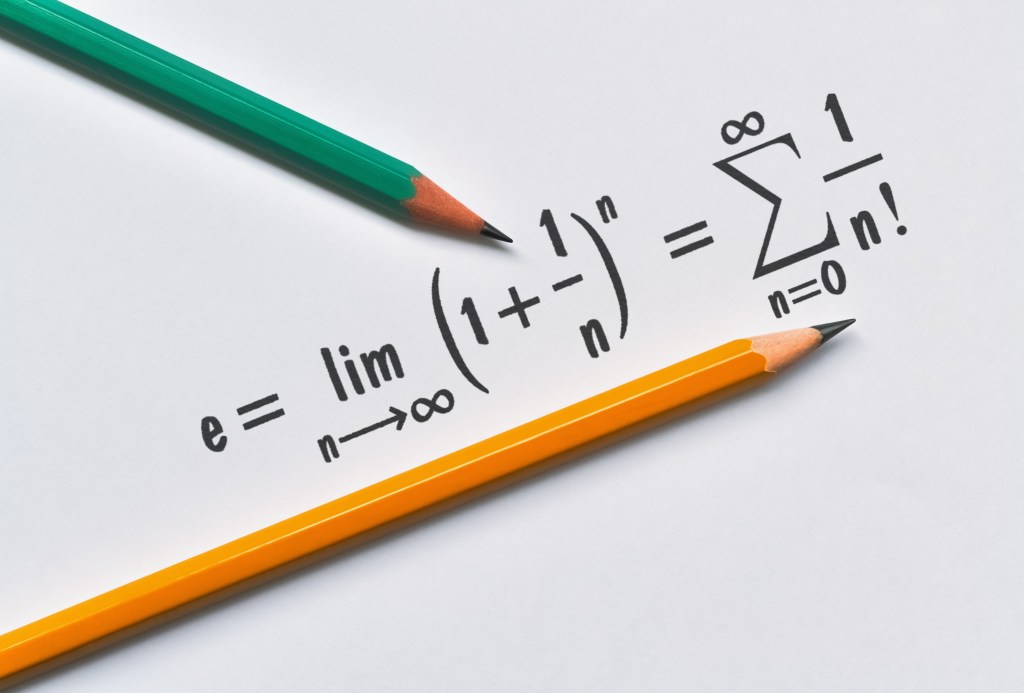
As the number n gets bigger the formula stops getting bigger and instead approaches a limit. When n approaches infinity that will be a very specific number. Which number do you think it is?The definition of Euler’s number plus an infinite series sum that is also the same as Euler’s number.Definition of the Euler’s constant in two different ways, Asset id: 1227561829, by benjaminec.
Euler’s Number in Calculus
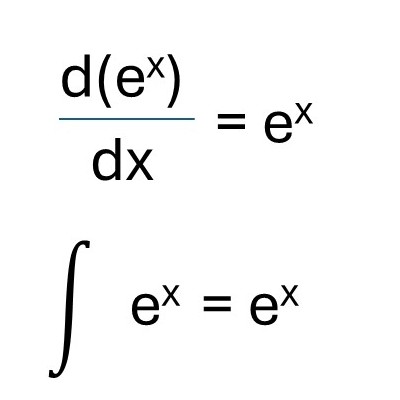
As I mentioned, Euler’s number shows up in mathematics in a lot of places. It is an extremely useful number with some amazing properties and that includes calculus. However, explaining functions and calculus may be going a bit too far, so I am just going to simply state that the derivate of e^x is just e^x and the indefinite integral, or the anti-derivative of e^x is e^x. In other words, differentiation / integration does not change this function. It also means that the slope of the curve is the same as the curve itself. Among all the infinite number of functions this is only true for e^x.
Differentiation and integration does not change the function e^x.
Trigonometric Functions
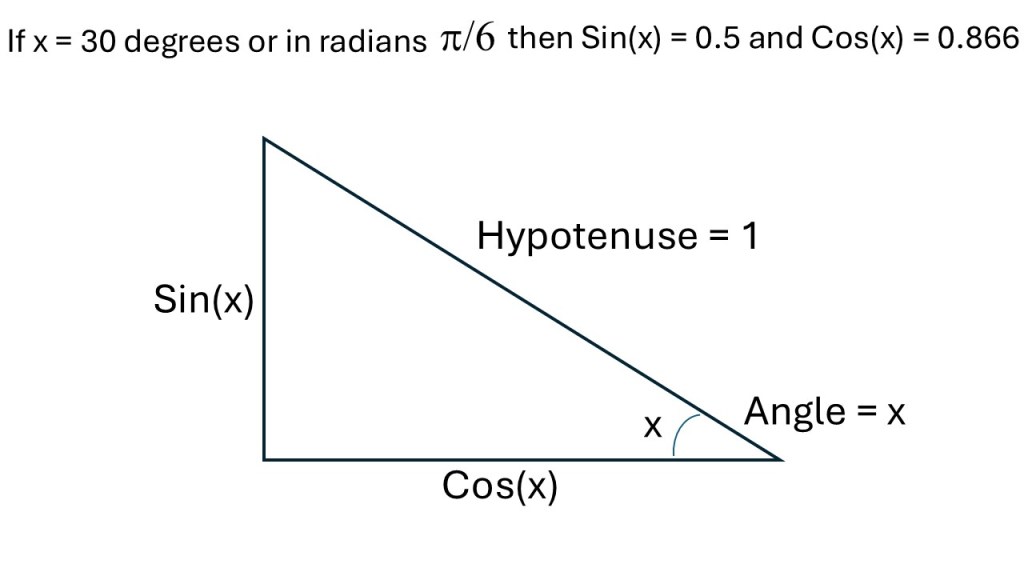
Next, I would like to launch into Euler’s formula. However, before I do that, I need to explain what trigonometric functions and imaginary numbers are. The trigonometric function sin(x) is the ratio of the length of the side opposite to a given angle to the length of the hypotenuse. In other words, if the hypotenuse is equal to 1, then sin(x) is the length of the opposite side to the given angle. The trigonometric function cos(x) is the ratio of the side of the triangle adjacent to the angle divided by the hypotenuse. In other words, if the hypotenuse is equal to 1, then cos(x) is the length of the adjacent side to the given angle.
Sin and cos are always between 1 and -1. ‘x’ is often expressed in degrees going from 0 to 360 (or 0 to 90 in a right-angled triangle). However, there is another way to express angles in triangles and that is radians. In this case the number pi corresponds to 180 degrees, pi/2 corresponds to 90 degrees, pi/4 corresponds to 45 degrees, etc. Euler’s formula uses trigonometric functions, but it only works if you use pi instead of degrees. Pi and Euler’s number have a special relationship. Sin and cos are illustrated in the picture below.
Illustration of the trigonometric functions sin(x) and cos(x).
Imaginary Numbers
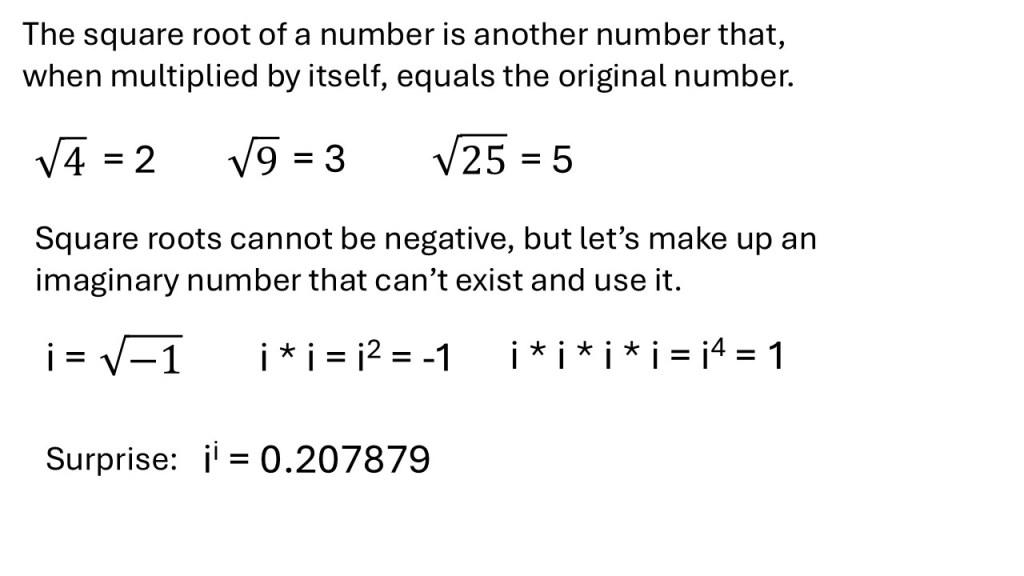
The last thing I need to explain before demonstrating Euler’s formula is imaginary numbers. The square root of a number is another number that, when multiplied by itself, equals the original number. For example, the square root of 4 is 2, because 2 * 2 = 4. The square root of 9 is 3, because 3 * 3 = 9. As long as you deal with real numbers, square roots must be positive numbers because you cannot multiply two numbers and get a negative number. -2 * -2 is 4, not -4.
However, that did not stop some mathematicians from making up a square root that was negative. This imaginary number is the square root of -1 and is referred to as i, yes just i, for imaginary. So, what’s the point of making up numbers that can’t exist? Well, it turned out to be quite useful and you can manipulate imaginary numbers to result in real numbers. For example, if you multiply the imaginary number i by itself i*i you get -1. If you multiply i by itself four times, in other words i^4, or i raised to 4, you get 1. Even more impressively, i raised to i, or i^i, is a real number. i^i = 0.207879… This is illustrated in the picture below.
Imaginary numbers illustrated
Eulers Formula
Without giving the proof, or any detailed explanations, below is Euler’s identity and Euler’s Formula (e^ix = cos(x) + isin(x)). Notice the mix of Euler’s number, pi, the trigonometric functions using radians (based on pi), and the imaginary number. Well, likely mind-blown, if you have not seen it already and you understood this post up to here.
Euler’s identity and Euler’s formula.Euler’s formula illustrated in the complex plane. Asset id: 2345669209 by Sasha701
If you want to see how you prove Euler’s Formula check out this youTube video.
If you want to learn more about the importance of Euler’s number in sommon and useful mathematics, check out this youTube video.









 Super Facts