
Super fact 62 : Facts exist in science; a scientific “fact” is an observation of a natural phenomenon that has been repeatedly confirmed by independent observers and is accepted as true for all practical purposes.
Outside of mathematics and logic nothing is ever the final truth, not in science, and not anywhere else. However, there are facts that have been so well confirmed and are so basic that there is no reason to doubt them. Earth is not flat like a pancake, and the sun is a star, are two examples of astronomical facts. Most dogs have four legs is another fact. The speed of light in vacuum is the same for all observers is a fact in physics that is surprising if you didn’t know it before. Scientific facts are verified by repeatable careful observation or measurement by experiments or other means. It is possible that we are all living in a virtual reality, like in the movie The Matrix, and that Earth is really flat like a pancake after all, because all of reality is a dream. However, for all practical purposes, it is not the case.
This blog, super facts, deal with facts that are surprising, strange, or disputed by non-experts, and yet true because they have been verified, for example, in the case of scientific facts, by repeatable careful observation. Anyone is free to object if you think I am wrong about a fact.
My next super fact is going to be “Evolution is a fact”. Evolution is also a scientific theory, but it means something different from when you say evolution is a fact. Moreover, a Scientific Theory is not a guess, as commonly but incorrectly assumed. I am bringing this up because many people who are typically unaware of the evidence behind a fact will use arguments such as “science does not know everything”, “it is just a theory”, etc., in efforts to dismiss a well-supported claim.
I should say that this post is inspired by a Facebook post by “The Credible Hulk”, a Facebook page managed by a group of anonymous scientists opposing misinformation around vaccines, global warming, evolution and GMOs. I did not save the post, but it went something like this:
- Our planet Earth is not flat like a pancake
- Global Warming is real and is caused by us
- Evolution is a fact
- We’ve been to the moon
- Vaccines do not cause autism
One of the commentors said : “Calling evolution a “fact” defeats your argument. The Theory of Evolution is by definition a theory not a fact. It’s the currently agreed upon hypothesis but not a fact”
What the commentor did not realize is that “Theory” in the context of science does not mean what he thought it did. I am using past tense because he got “schooled”. To his credit he did not respond with insults and neither did the Credible Hulk, which does not seem to be standard on Facebook. However, his comment illustrates something that drives scientists like those who created “The Credible Hulk” nuts, and that is the widespread lack of understanding of the difference between a guess, a hypothesis, a scientific fact, theory as used in common language and used when talking about a scientific theory.
Rather than having this discussion over at my upcoming “Evolution is a fact” post, I am making a separate post about it. I consider “There are Scientific Facts” a super fact because it is true, and yet the confusion around it and what a Scientific Theory pertains is massive, and it is an important topic.
What is Science?
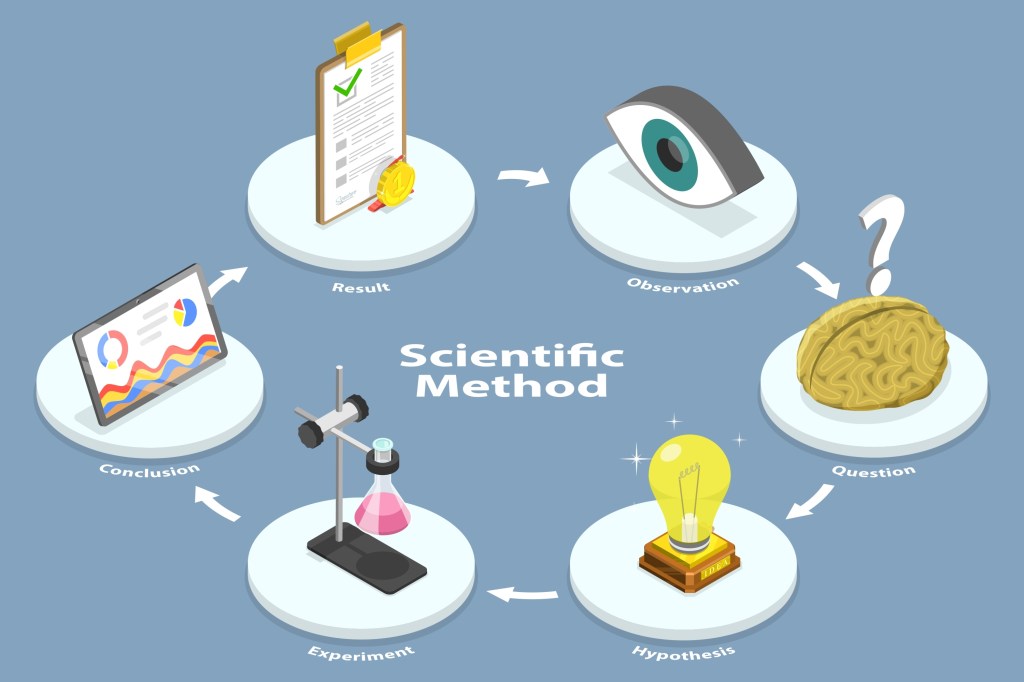
Science is the process of learning about the world through systematic observation and experimentation to gain knowledge about how things work. It involves observing phenomena, forming testable ideas (hypotheses), systematic studies, conducting experiments, and collecting evidence and facts that support or refute those ideas, ultimately leading to a deeper understanding of general truths and natural laws. If an idea/hypothesis correctly predicts and explains facts, it becomes a theory, which is something that is very different from a guess.
The process of making observations, formulating testable hypotheses, conducting experiments, analyzing data, and drawing conclusions to understand phenomena and solve problems is referred to as the scientific method, and there are different types of scientific methods. Some involve experiments, other involve analysis historical artifacts or existing data. Objectivity, reproducibility, falsifiability, and predictive power or problem solving are essential.

What is a Scientific Theory?
When people hear the phrase “evolution is a theory,” many mistakenly assume it means evolution is just a guess or speculation. In science, however, a theory is far more than a guess. A scientific theory is an explanation of an aspect of the natural world that can be or that has been repeatedly tested and has corroborating evidence in accordance with the scientific method, using accepted protocols of observation, measurement, and evaluation of results. In other words, it is a well-tested, comprehensive explanation of natural phenomena, supported by an extensive body of evidence.
The evidence for evolution is both vast and compelling. It is not just the massive fossil record, it is in DNA, anatomy, there’s geographic evidence, and evidence from dozens of other scientific fields, not to mention that evolution is directly observable. There is a Theory of Evolution, that is the well supported explanation for evolution, or evolution by natural selection. There is also “Evolution is a fact” referring to, for example, the fact that we can directly observe it. It is true for all practical purposes, and that does not mean that evolution stops being a scientific theory as well as a fact.
Afterword
Even though science is constantly evolving and our knowledge is evolving and sometimes our understanding and scientific theories on a topic needs to be updated, scientific facts exist. Some scientific facts are extremely unlikely to change. For example, Jupiter has multiple moons, galaxies exist, global warming is real and is caused by us, and evolution is a fact. Before you decide to dismiss such a fact make sure you know what “theory” means in science, and most importantly educate yourself on the relevant evidence. There might be a whole lot more than you imagined, and you may discover that the evidence you thought was contrary is not evidence.
You often hear “science does not know everything”. That’s true. If science knew everything it would stop. However, the collective knowledge created by science is enormous and as individuals we know next to nothing. So be humble and learn from scientific evidence presented by reliable sources.
 Super Facts