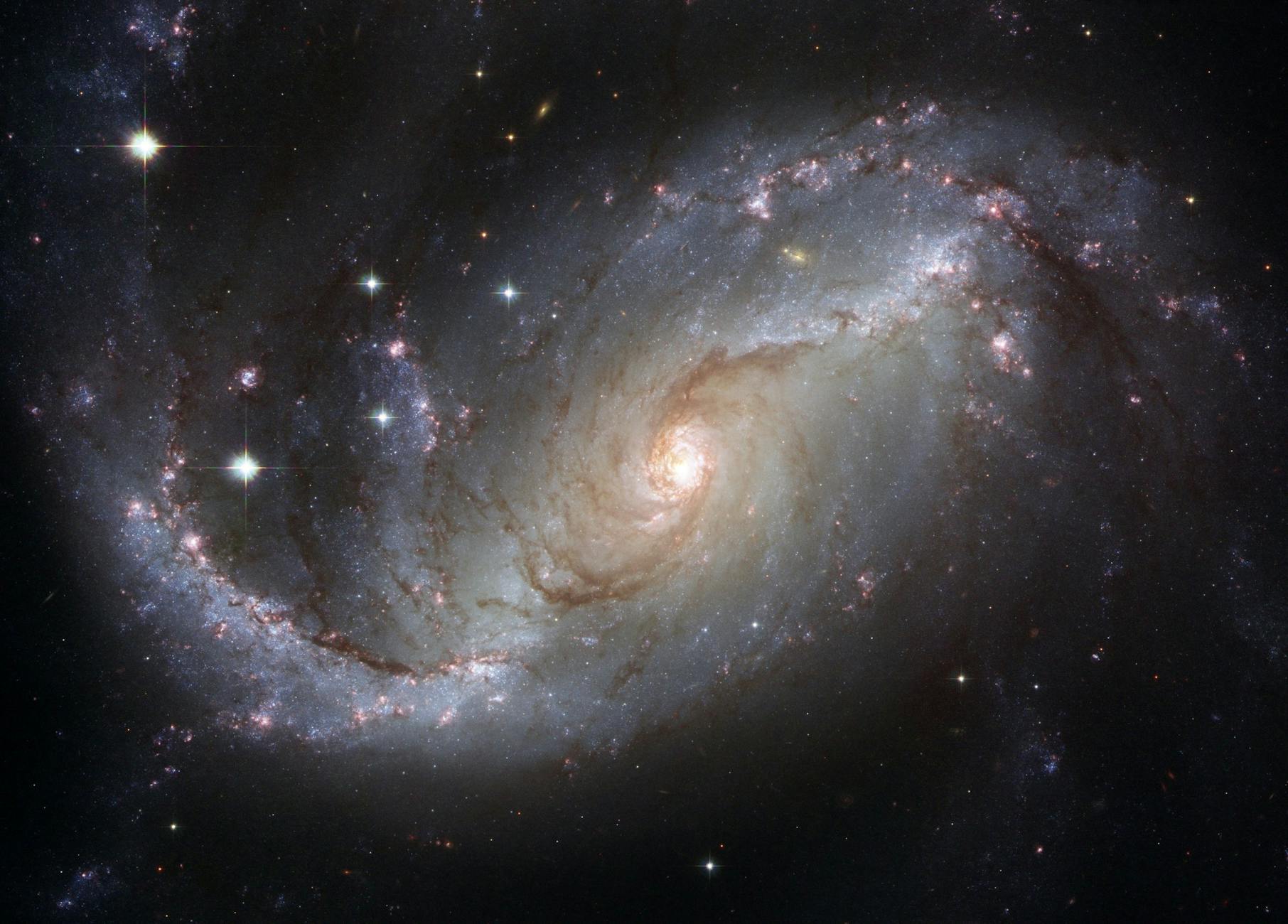
The Enormous Kuiper belt

Super fact 55 : The enormous Kuiper belt.

The Kuiper Belt is a vast torus/donut shaped region of space beyond Neptune, filled with icy, rocky bodies, including dwarf planets like Pluto. It shares a lot of similarities with the Asteroid belt, but it is much larger, and further out. The Kuiper belt is 20 times wider than the Asteroid belt, 1,000 larger by volume, and 20 to 200 times more massive than the Asteroid belt. It extends from roughly 30 to 50 astronomical units (AU) from the Sun.

I can add that one Astronomical Unit (AU) is the distance from the sun to Earth.

In the middle of the picture is the sun and around it is Mercury, Venus, Earth and Mars. Then there is a grey circular band representing the asteroid belt. Further out is Jupiter, Saturn, Uranus, Neptune and Pluto and a large circular band representing the Kuiper belt | The Enormous Kuiper belt
I drew this illustration of the solar system and the Kuiper belt. It is not entirely to scale, and in reality, Mercury and Venus are not attached to the sun.

The Kuiper belt is like a giant Asteroid belt located further out, beyond Neptune. The Kuiper Object Pluto, formerly known as the Planet Pluto, is the most admired, the cutest and most beloved of all planets, and it was the first Kuiper object discovered in 1930. However, we did not know of the existence of the Kuiper belt at the time. The Kuiper belt was discovered in 1992 and predicted to possibly exist by Astronomer Gerard Kuiper in 1951. The discovery of the Kuiper belt was one of the reasons Pluto was demoted from its planet status in 2006. There are other dwarf planets in the Kuiper belt similar Pluto, including Makemake, Haumea, and Eris. However, there could be hundreds. Ceres is a dwarf planet located in the Asteroid belt. To read more about the Kuiper belt and verify the facts above, click here, or here, or here.
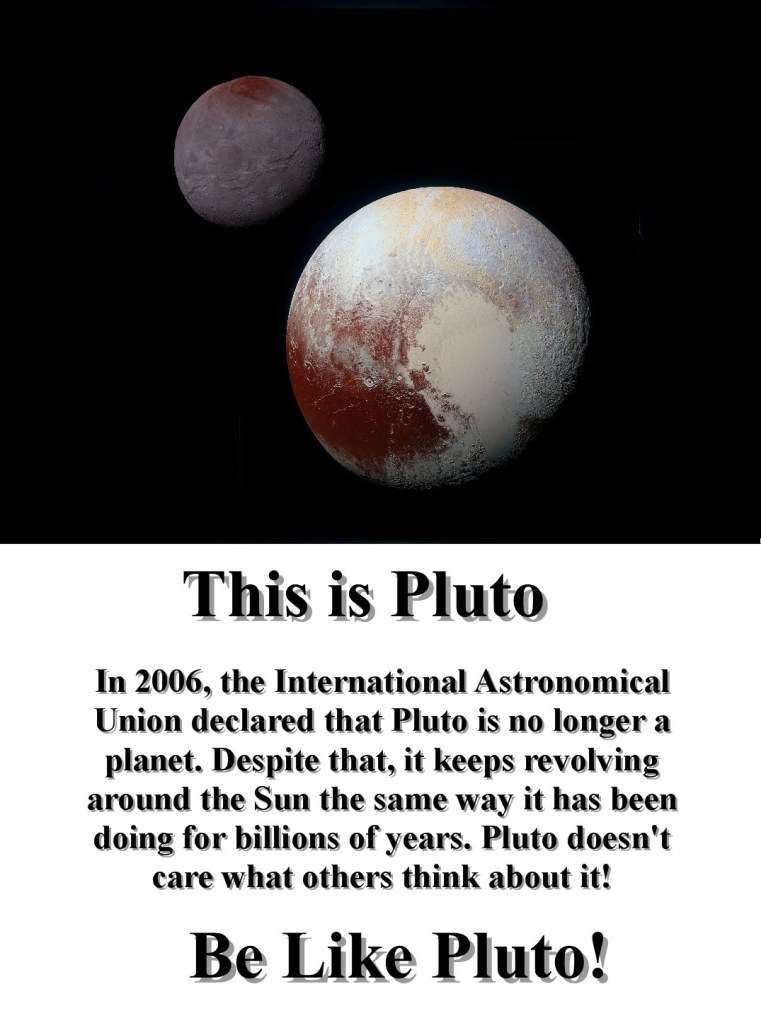
This picture features the photo of Pluto taken by NASA’s New Horizons spacecraft in 2015 plus some text. The text says : This is Pluto! In 2006, the International Astronomical Union declared that Pluto is no longer a planet. Despite that, it keeps revolving around the Sun the same way it has been doing for billions of years. Pluto doesn't care what others think about it! Be Like Pluto!
Pluto and its moon Charon from NASA/JHUAPL/SwRI. NASA / Johns Hopkins University Applied Physics Laboratory / Southwest Research Institute, Public domain, via Wikimedia Commons. NASA’s New Horizons spacecraft captured this high-resolution enhanced color view of Pluto in 2015.

I selected this to be a super fact because the existence of the Kuiper belt drastically changed our view of our Solar system, so it is important, we know it exists, so it is a true fact, and despite its enormous size the Kuiper belt is much less known than the Asteroid belt, and its existence often comes as a surprise to people.

The Kuiper Belt Resides in Darkness

You may wonder why the Kuiper belt was discovered so late whilst the Asteroid belt has been known since the beginning of the 19th century (Ceres 1801, Pallas 1802, Vesta 1807, etc.) The reason is that the Kuiper belt resides in darkness. The Asteroid belt is 2.2AU to 3.2AU from the sun whereas the Kuiper belt is between 30 to 50AU from the sun.

Let’s say you take an object that is 2.5AU from the sun and place it at a distance that is 40AU from the sun. Due to the spreading of the light the object will now receive 16 X 16 = 256 times less sunlight. This is called Geometric dilution. In addition, this light needs to be reflected back to earth for us to see the object, and once again the light will  spread resulting in 256 X 256 = 65,536 times less light reaching our telescopes. The Kuiper belt is huge, but it resides in darkness. Despite this fact, we have now discovered and catalogued more than 2,000 Kuiper belt objects. However, it is estimated that there are hundreds of thousands of Kuiper belt objects wider than 100 kilometers.

What is a Dwarf Planet?

A planet as well as dwarf planet is a celestial body that orbits the Sun and is nearly round due to its own gravity. Basically, it must be large enough to have compressed itself to a near spherical shape. To be classified as a planet and not a dwarf planet it must also have cleared its orbit of debris. So, a dwarf planet is therefore a celestial body that orbits the Sun, is nearly round due to its own gravity, but has not cleared the neighborhood around its orbit. Obviously, a planet in the Asteroid belt or the Kuiper belt is a dwarf planet. Just to make this complicated Astronomers have found giant exoplanets that have not cleared their orbit of debris . I wonder, are these exo-planets giant dwarf planets?

Oort Cloud

Astronomer and Author David Lee Summers (blog here) reminded me of the Oort cloud, which could be interesting to bring up in this context. The Oort Cloud is a vast spherical cloud of icy bodies, which is hypothesized to surround the solar system, extending from about 2,000 to 200,000 AU. It is thus thousands of times further out and wide than the Kuiper belt. I say hypothesized because the objects are so small, there’s really no direct observation of them and there’s some variation in numbers for its distance and extent, meaning it’s still not well defined yet. Still, its outer edge is believed to be the boundary between where the sun’s gravity dominates and the galaxy’s gravity dominates.

The Oort cloud is generally considered to be the outer edge of the solar system and believed to be the origin of most long period comets. The Oort cloud is thought to encompass two regions: a disc-shaped inner Oort cloud aligned with the solar ecliptic (also called its Hills cloud) and a spherical outer Oort cloud enclosing the entire Solar System.

The picture is of the Oort cloud with an inset picture of the Kuiper belt at the top. The inset picture is an enlargement of the dot in the middle corresponding to the Kuiper belt.
NASA This SVG image was created by Medium69.Cette image SVG a été créée par Medium69.Please credit this : William Crochot, Public domain, via Wikimedia Commons.

Other Astronomy Related Super Facts


To see the other Super Facts click here

The vastness of space and the beginning of infinity

Superfact 14: The vastness of space and the beginning of infinity

The Universe is unimaginably large. Our solar system is enormous. It consists of our star, the sun, the planets including earth, dwarf planets, asteroids, comets, rocks, the Kuiper belt, the Oort cloud, and much else. It is 100,000 times wider than the distance between the sun and our earth. Yet it is just one star system among between 100 and 400 billion in our galaxy, the Milky Way. 

But that is not all. According to the Nobel Prize winner in physics, Roger Penrose, our universe is just one in an eternal (infinite) series of universes, an eternal chain of Big Bangs that has always existed. See his conformal cyclic cosmology (CCC) model (and the book cycles of time).

According to Stephen Hawking, M-theory, an extension or collection of string theories, states that there are 10^500 or 10000000000000…(followed by five hundred zeros) possible multi-verses that are all equally possible. Hugh Everett’s multiverse or multi-world theory states that there are infinitely many universes.

Now try to imagine the size of it all. You can’t do that, can you?

The vastness of space and the beginning of infinity
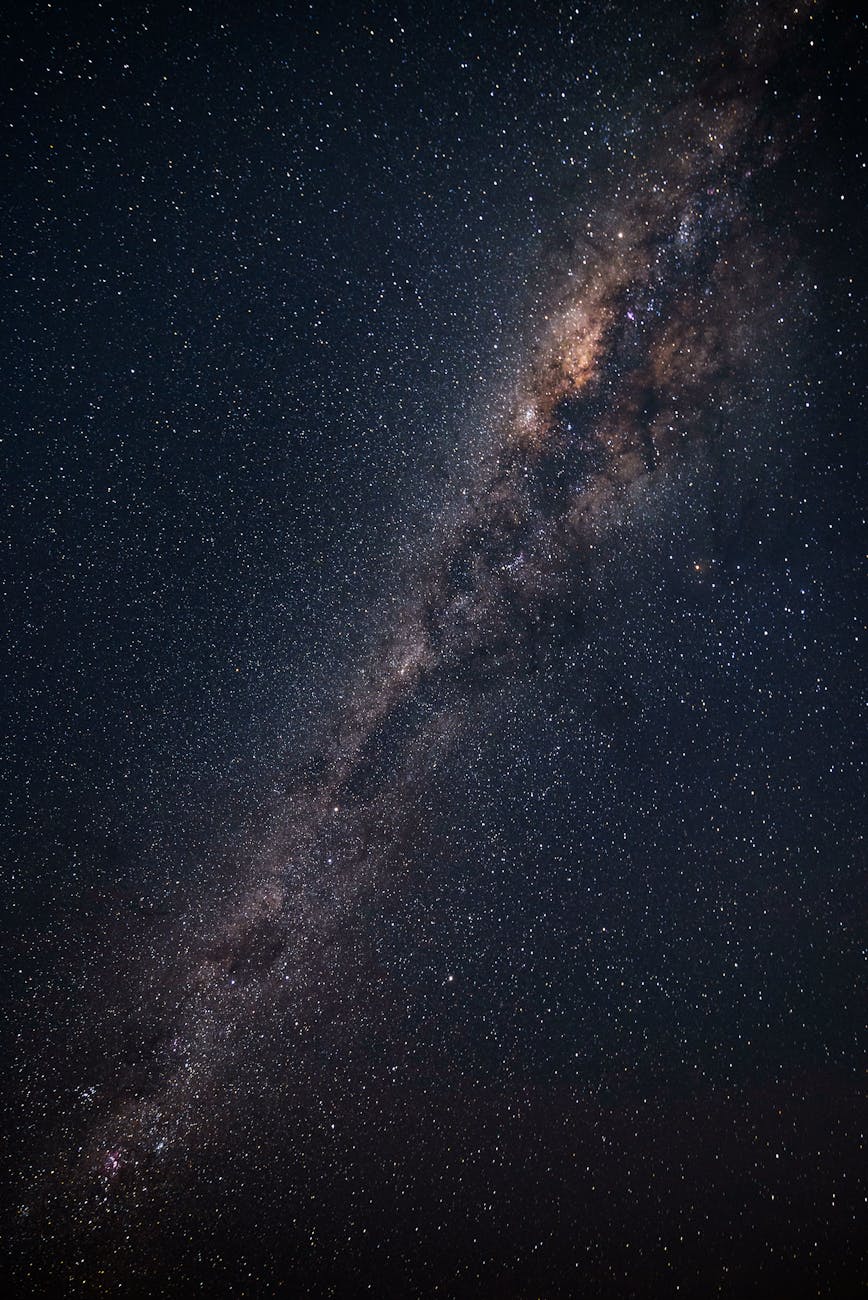
Photo by Pixabay on Pexels.com

About The Universe

When the astrophysicist Brian Cox was asked the question “what is the one fact about the Universe that blows your mind the most?”, he answered, “One. Just the size and scale of it…”.

At first, I thought his answer was a bit boring. I mean, what about neutron stars, which essentially are giant atomic nuclei? What about the amazing mysteries surrounding black holes, and what about supermassive black holes, quasars, magnetars, the great attractor, what about the big bang, quantum physics, massless particles, the amazing general theory of relativity, dark energy, etc.

Then I tried to imagine the size and scale of the universe and I realized that he knew what he was talking about. The more you think about it, the more it blows your mind.

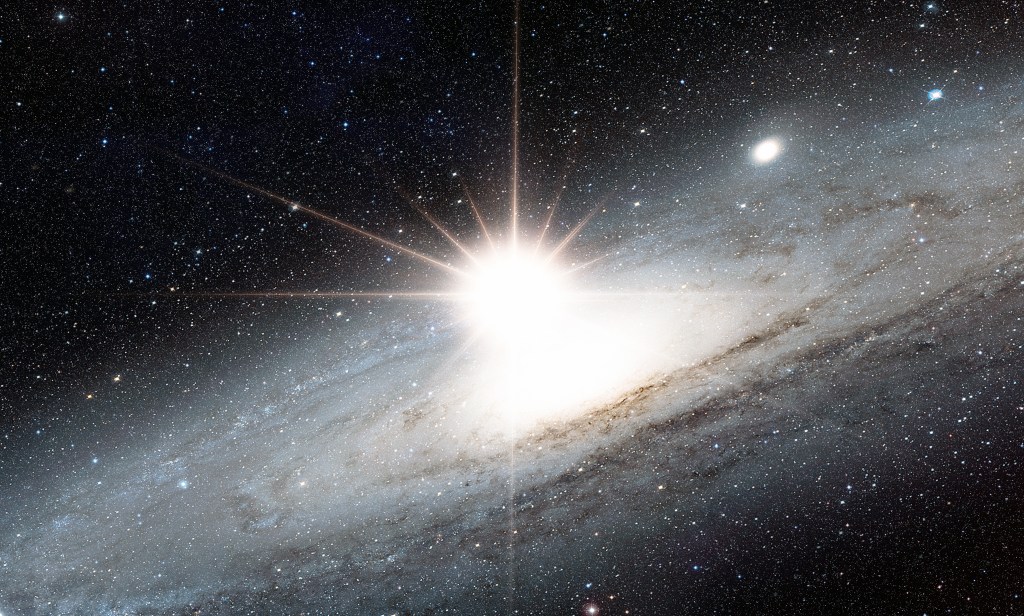
A picture of the Andromeda Galaxy with a bright white light near its center. The bright light is almost outshining the entire galaxy.
An illustration of the Andromeda galaxy with a supernova explosion near its center. “Elements of this image furnished by NASA” Stock Photo ID: 2495486227 by muratart.

The vastness of space and the beginning of infinity

Below is a 55 second video in which astrophysicist Brian Cox ruminates on what it means to live a finite fragile life in an infinite eternal Universe.

Our sun is a star. The sun’s diameter is 109 times larger than earth’s diameter, which means that you could fit more than one million earths inside the sun. The distance between the sun and the earth is called an astronomical unit or 1 AU. 1 AU is approximately 11.7 million times larger than earth’s diameter and 107,340 times larger than the sun’s diameter.

The solar system including all the planets, dwarf planets, asteroids, the Kuiper belt and the Oort cloud is 100,000 AU across with the sun just being a dust speck in the middle.

I mentioned that M-theory implies that there are at least 10^500 multiverses. To get an idea of how bif that number is;  It is a quintillion times a quintillion times a quintillion times a quintillion times a quintillion times a quintillion times a quintillion times a quintillion times a quintillion times a quintillion times  a quintillion times a quintillion times a quintillion times a quintillion times a quintillion times a quintillion times a quintillion times a quintillion times a quintillion times a quintillion times a quintillion times a quintillion times a quintillion times a quintillion a quintillion times a quintillion times a quintillion times. By the way a quintillion is a million trillion.

The vastness of space and the beginning of infinity
Photo by Philippe Donn on Pexels.com

Below are two more videos. The first one is trying to give a perspective on the size of our solar system, our galaxy, and the Universe. It is 11 minutes and 9 seconds long. The second one is very long, half an hour, and it is a bit advanced, so I recommend it only to star nerds.

However, at 22 minutes and a bit more than 30 seconds it states the observable universe is less than a 15 millionth of the universe (which might be even bigger) which contains at least 30 quintillion galaxies.


To see the other Super Facts click here