United States is Tornado Country

Super fact 65 : The United States covers approximately 6.14% of Earth’s total land area. Despite that approximately 75% of the world’s tornadoes occur in the United States, making the risk of a tornado in the US 46 times higher than in the rest of the world. Tornadoes are particularly common in Tornado alley. Canada is the country with the second-highest number of tornadoes globally.

Our neighborhood was ravaged by an EF3 tornado in the evening of October 20, 2019. Today is the six year anniversary of that event. One year ago, I was interviewed by the NBC about this event. Yes, I was on TV. NBC had found me via my Leonberger dog blog. I’ve included the clip below.

It appears that the most common statistics stated by reliable sources is that approximately 75% of the world’s tornadoes occur in the United States (click here, here, or here). As stated, 75% is an approximate number and another common number is 90%.  90% might be overstated because smaller tornadoes are underreported in the rest of the world. Whether the correct number is 75% or 90% it is clear that the United States has the most tornadoes. It is the Tornado Country of the world.

It is quite astonishing that one country, the United States, has such a high concentration of this extreme weather phenomenon. Most Americans know that their country is special in this regard. I’ve met a lot of Europeans (I am from Europe / Sweden myself) who thinks tornadoes is just Hollywood thing. However, it is a real and very common phenomenon in the United States, and that is surprising to much of the rest of the world. It is also an important extreme weather phenomenon that kills a lot of people and causes billions of dollars in damage every year. This is why I consider “United States is Tornado Country” a super fact.

A large well-formed tornado over the plains | United States is Tornado Country
A tornado. Stock Photo ID: 2369175167 by g images.com.

Tornado Alley

Tornadoes can happen anywhere, but as mentioned they are more common in North America and especially in tornado-alley. Despite tornado alley’s small size, a quarter of all significant tornadoes in the world occurred there according to a study (1921 – 1995). The extent of tornado alley includes north Texas, Oklahoma, Kansas, Nebraska, South Dakota, Iowa, and the corners of Minnesota, Wyoming, Colorado and New Mexico. Dallas, where we live, is in Tornado Alley.
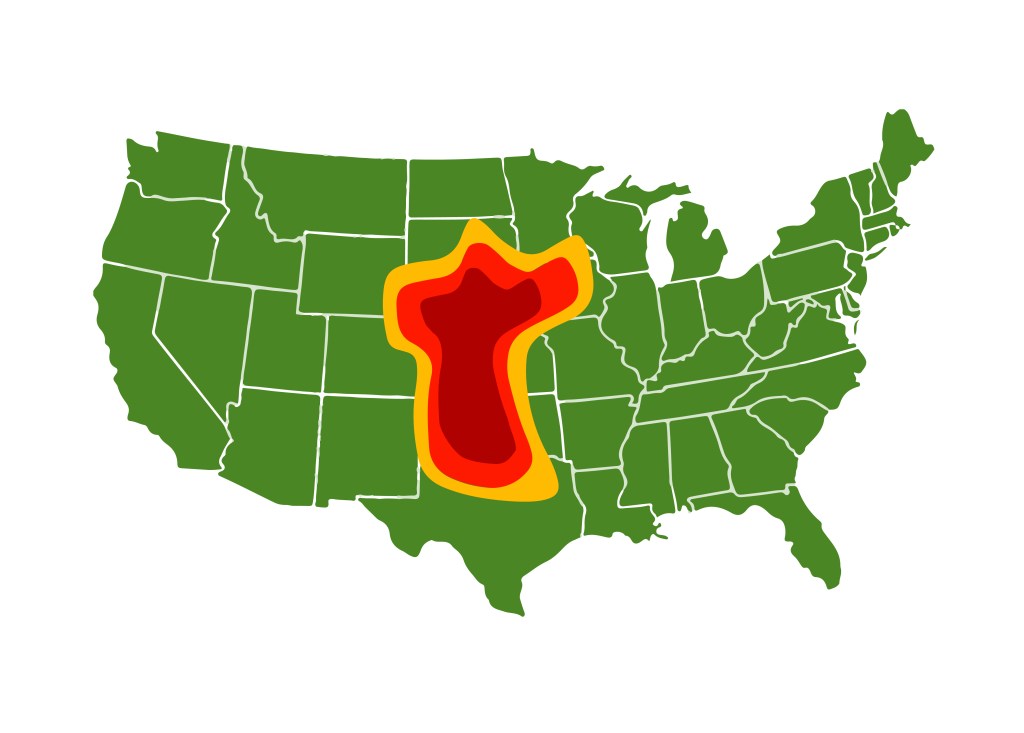
Tornado Alley is indicated in red, orange and yellow covering north Texas, Oklahoma, Kansas, Nebraska, South Dakota, Iowa, and the corners of Minnesota, Wyoming, Colorado and New Mexico.
Map showing Tornado Alley. It includes north Texas / Dallas. Stock Vector ID: 1719764089 by Adansijav Official.

Dixie Alley

Another region with a lot of tornadoes is Dixie Alley. Dixie Alley stretches from eastern Texas and Arkansas across Louisiana, Mississippi, Tennessee, Alabama, Georgia, and mid to western Kentucky to upstate South Carolina and western North Carolina; the area reaches as far north as southeast Missouri.

Dixie Alley has fewer tornadoes than Tornado Alley, but they tend to be deadlier and more violent than in Tornado Alley. The tornadoes in Dixie Alley occur year-round, at night, and the Tornadic storms in Dixie Alley are often high precipitation supercells due to an increase of moisture from proximity to the nearby Gulf of Mexico. The heavy rain makes it difficult to detect the tornadoes. Dixie Alley also has more mobile homes, homes tend to not have basements, and it is more densely populated than Tornado Alley. NOAA records indicate that the majority of deaths from tornadoes in the US have occurred in Dixie Alley.

Map of the United States showing Dixie Alley in red. It includes parts of eastern Texas and Arkansas, Louisiana, Mississippi, Tennessee, Alabama, Georgia, and mid to western Kentucky to upstate South Carolina and western North Carolina and  southeast Missouri.
Map showing Dixie Alley. Bhockey10, CC BY-SA 3.0 <https://creativecommons.org/licenses/by-sa/3.0&gt;, via Wikimedia Commons.

Tornadoes and Hurricanes Are Different

Another related issue that has been brought to me is that many Europeans do not know the difference between a hurricane and a tornado. This is not strange since both of these extreme weather phenomena are less common in Europe.

A hurricane is a big rotating storm system originating in the ocean that sometimes makes landfall and devastates our coasts. Hurricanes are big, thousands of square miles and even a million square miles. A hurricane has wind speeds of 74 miles per hour (mph) or higher. That’s 119 kilometers per hour or 33 meters per second. They are called hurricanes in the Atlantic and the northeast Pacific, and Typhoons in the northwest Pacific, and otherwise just cyclones.
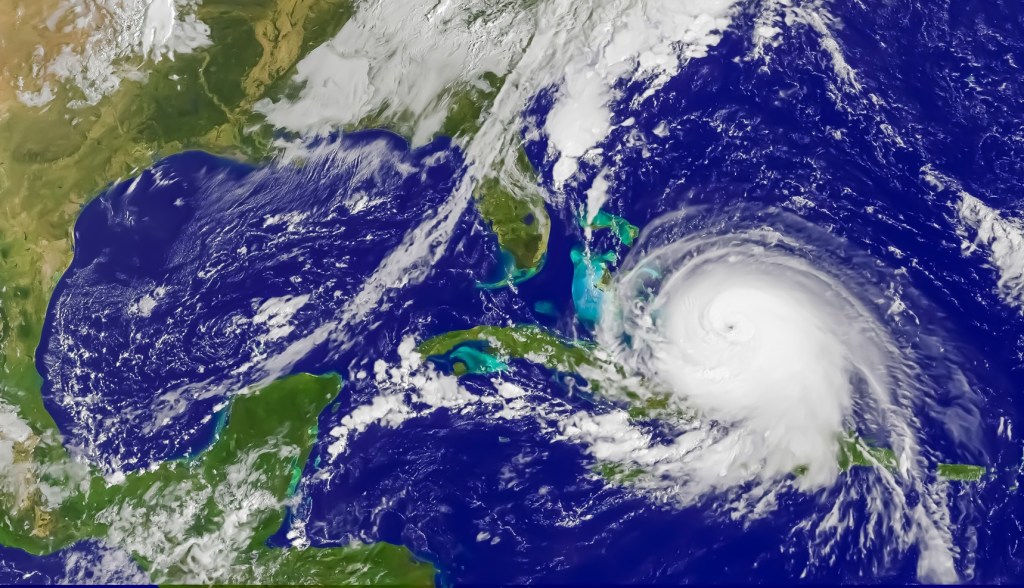
Satellite photo of Mexico, southeastern United States and the Caribbean. A hurricane is approaching from the east. | United States is Tornado Country
Satellite photo of hurricane approaching Cuba and Florida. Stock Photo ID: 2202605185 by Emre Akkoyun.

A tornado is a violently rotating column of air that is in contact with both the surface of the Earth and a cloud. They originate with thunderstorms, especially supercells, and are more of an inland phenomenon even though hurricanes can sometimes generate tornadoes. Tornadoes are much smaller than hurricanes in area, almost always much smaller than a square mile, or just 10 or 30 meters across. The reason they can be as deadly as hurricanes is that they tend to have stronger winds and they appear and disappear quicker thus taking people by surprise.

A threatening supercell with lightning
A so called supercell but without a tornado. Stock Photo ID: 1768468151 by Laura Hedien.
A nice photo of a threatening Tornado. | United States is Tornado Country
An F5 tornado in Canada. From Wikimedia Commons.

So, in summary, Hurricanes cover a large area and lasts a long time. They come from the sea and devastate coastal areas and are less common than tornadoes. Tornadoes are formed on land from thunderstorms, typically supercells. They are particularly common in tornado-alley. They cover a small area and go high up into the air forming a funnel and are commonly more intense. They are also more common, and they can surprise people. Therefore, on average, tornadoes cause more deaths in the US than hurricanes. You can read more about it here.

Our Tornado Experience

As mentioned, on October 20, 2025, our neighborhood was ravaged by an EF3 tornado. I was sitting outside in the backyard drinking a beer (Yellow Rose from Lone Pint brewery) when the sirens went off and my cell phone started screaming tornado warning “seek shelter immediately”. I did not see any problem, so I thought it was just one of unnecessary warnings again and I wanted to finish my beer. However, I decided to walk back into the house. About one minute later there was a lot of noise and a piece of the neighbor’s roof flew into our chimney, smashed it and it started raining bricks.

The house shook and thought to myself, “that was some thunderstorm”. I opened the door to the backyard, and I was astounded when I saw the devastation. My backyard was covered in debris, bricks, trees, garbage, my grill had flown off, several of our neighbors’ houses were just rubble. I guessed it must have been a tornado. My wife Claudia told me to go and check on her parents who lived about a mile away. I started driving my Toyota Prius, but I did not get very far because a neighbor’s roof was lying across the road. We live on a circle, so I decided to go the other way instead but about 30 trees lying across the road stopped me. So, I started walking but four firemen stopped me and told me that it was too dangerous to walk around. I had to go home. We would later learn that my wife’s father was injured. I am describing this in the NBC interview below.

We lost power for four days, we needed a new roof and a new chimney, the wiring and piping (for air conditioning) in the attic was destroyed, the fence and garage door were broken. It cost $50,000.00 to repair, nut our house stood, the frame was fine, and luckily our insurance paid for all of it, except for the parasol the flew away. We had no proof it ever existed. Not everyone was that lucky, especially those whose houses were destroyed. Unfortunately, our Leonberger dog Bronco had a heart failure one week after this. However, he recovered. But we are guessing that the fact that we did not have air conditioning for a while could have affected his heart. It was a tough day for Bronco, our Leonberger Dog. <<Link-13>>

A neighbor’s house with the roof ripped off.
A neighbor’s house the morning of October 21st, 2019.
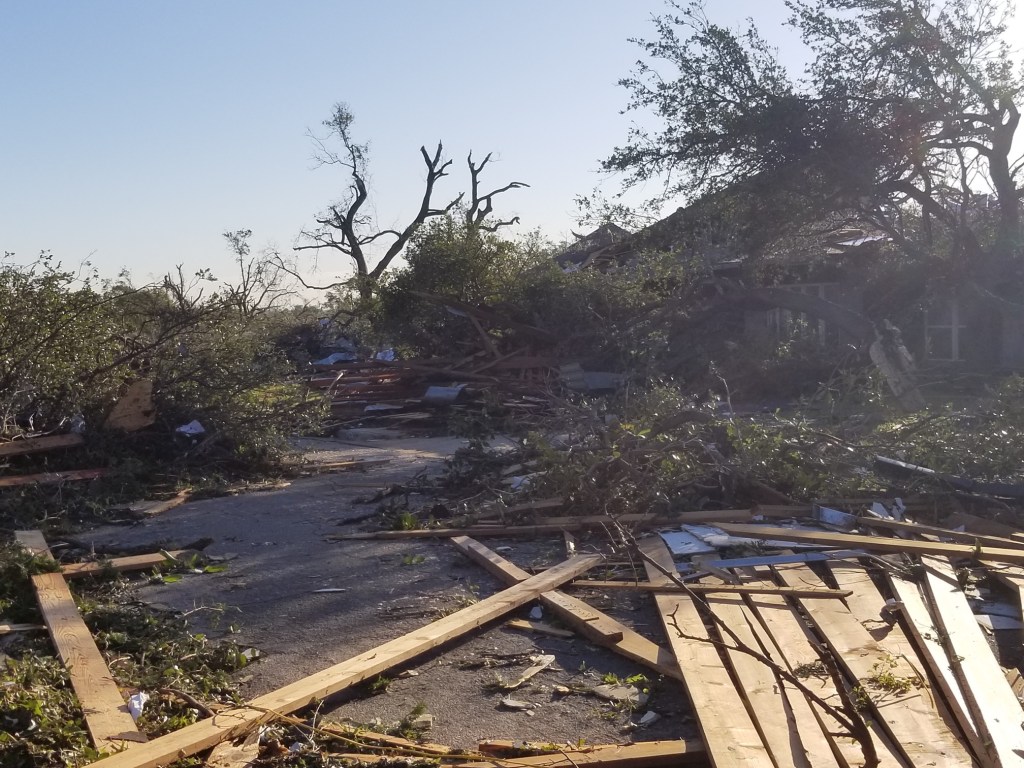
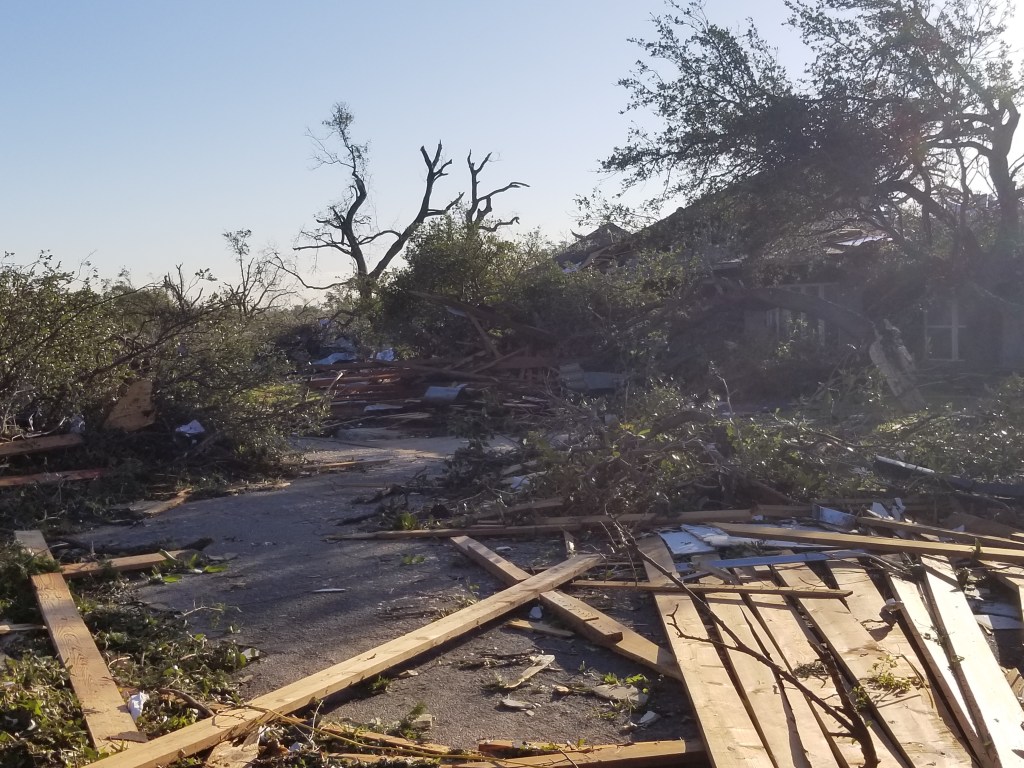
Debris on the street from a neighbor’s destroyed house.
Another neighbor’s house. This house was about 100 yards from our house. It took a direct hit from the tornado.
This house is totally destroyed.
Another neighbor’s house (a bit further away from us).
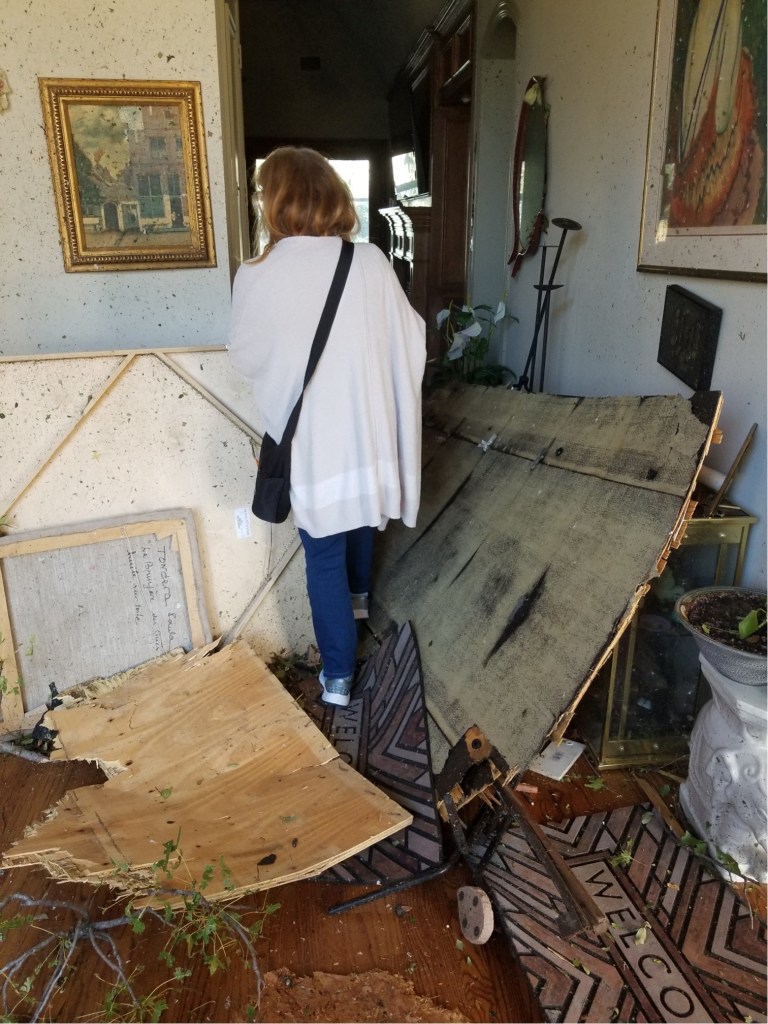
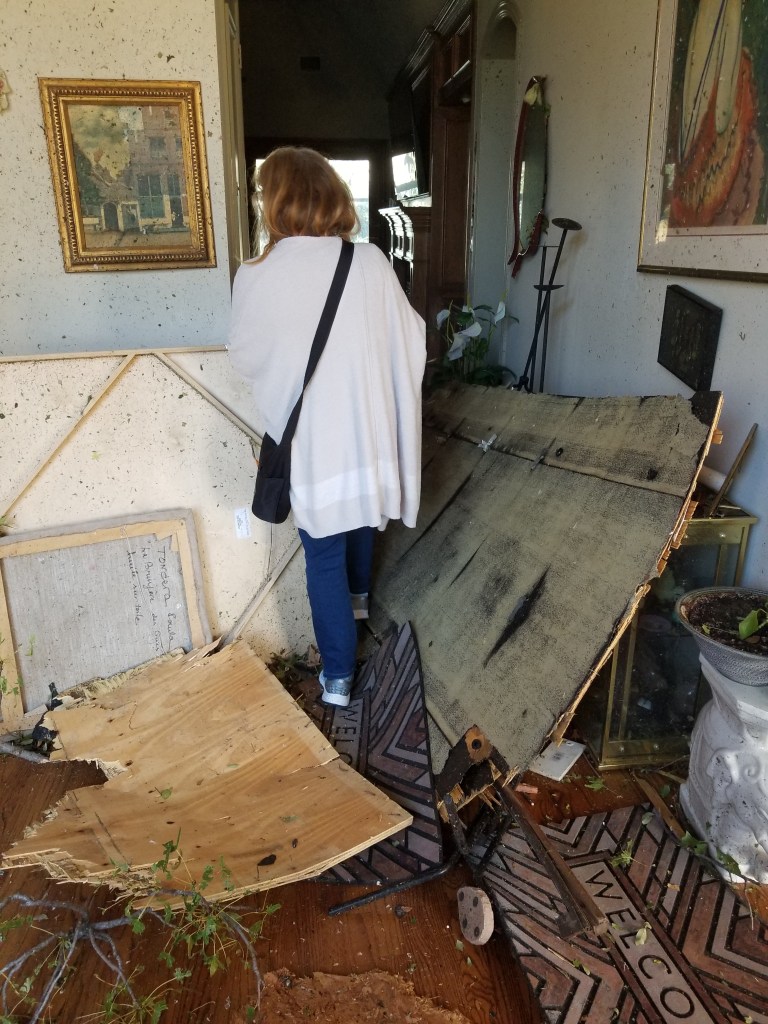
My wife Claudia is walking among the debris in my in-laws house.
Inside Claudia’s parents’ house. This was the morning after. We are walking into their house to check on them (that’s my wife).
The entire top of this house is destroyed.
This is the next-door neighbor of Claudia’s (my wife) parents.
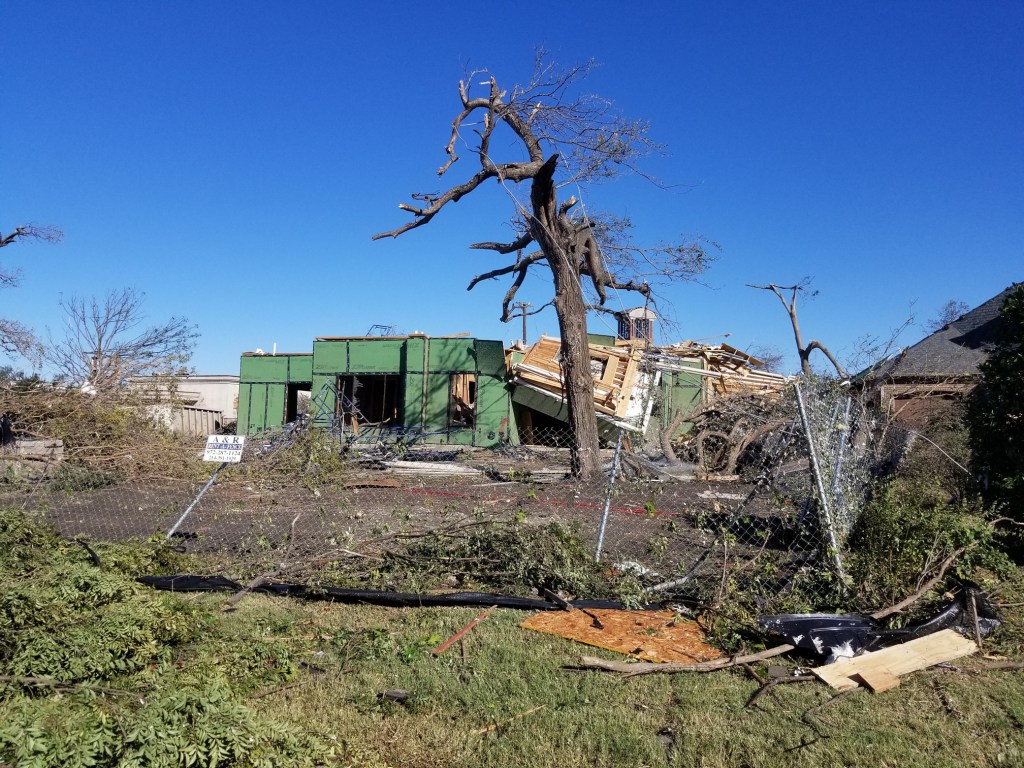
The house is completely flattened. A large tree is destroyed. It has no branches. | United States is Tornado Country
Destroyed house in the neighborhood.
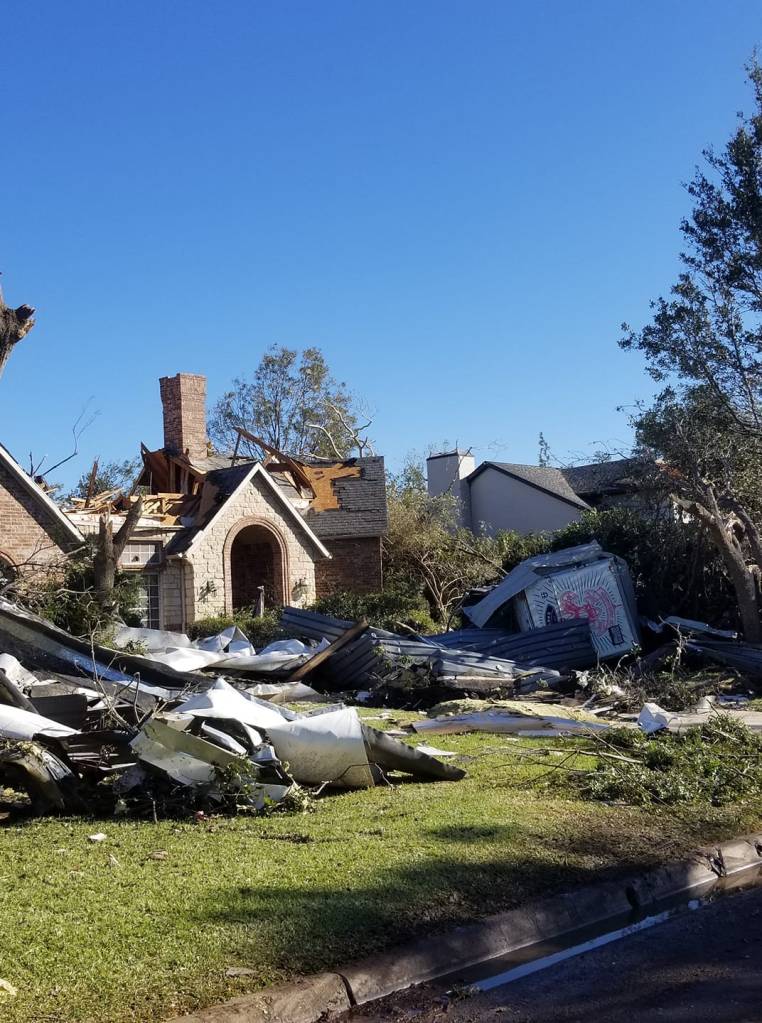
A big nice-looking house destroyed by a tornado.
Another house in the neighborhood.
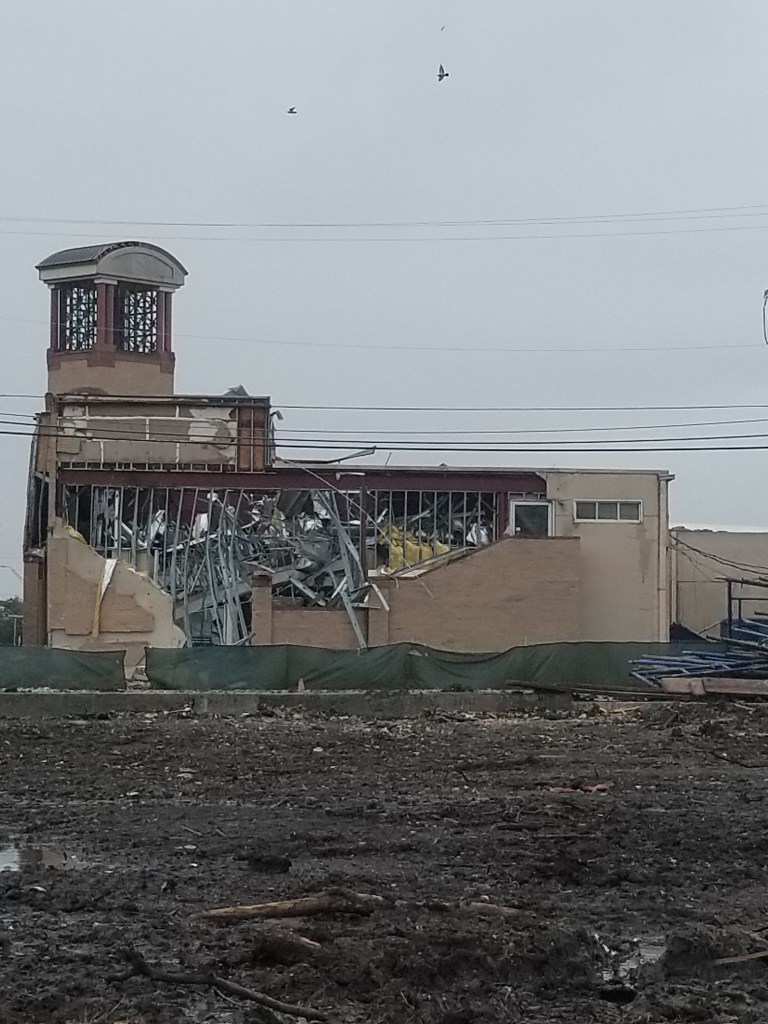
A photo taken from the inside of a destroyed office.
The remains of the veterinary clinic where we used to take our dogs. Luckily there were no animals staying overnight at this time.
Crashed cars and destroyed stores. | United States is Tornado Country
View of the shopping center in our neighborhood.
The Gap store has its entire backside ripped off.
A store at a nearby shopping center
The yellow school bus is wrapped around a tree.
This was a school bus belonging to the school where my boys went.
Trees are ripped up, vehicles are crushed. | United States is Tornado Country
Streetview from the neighborhood.

My Interview with NBC

As I mentioned, last year NBC interviewed me about this event. They said that they had been reading my Leonberger blog and were interested in a post that I had made about the tornado in Dallas on October 20, 2019. They wanted to interview me and asked for permission to use a few of my photos.

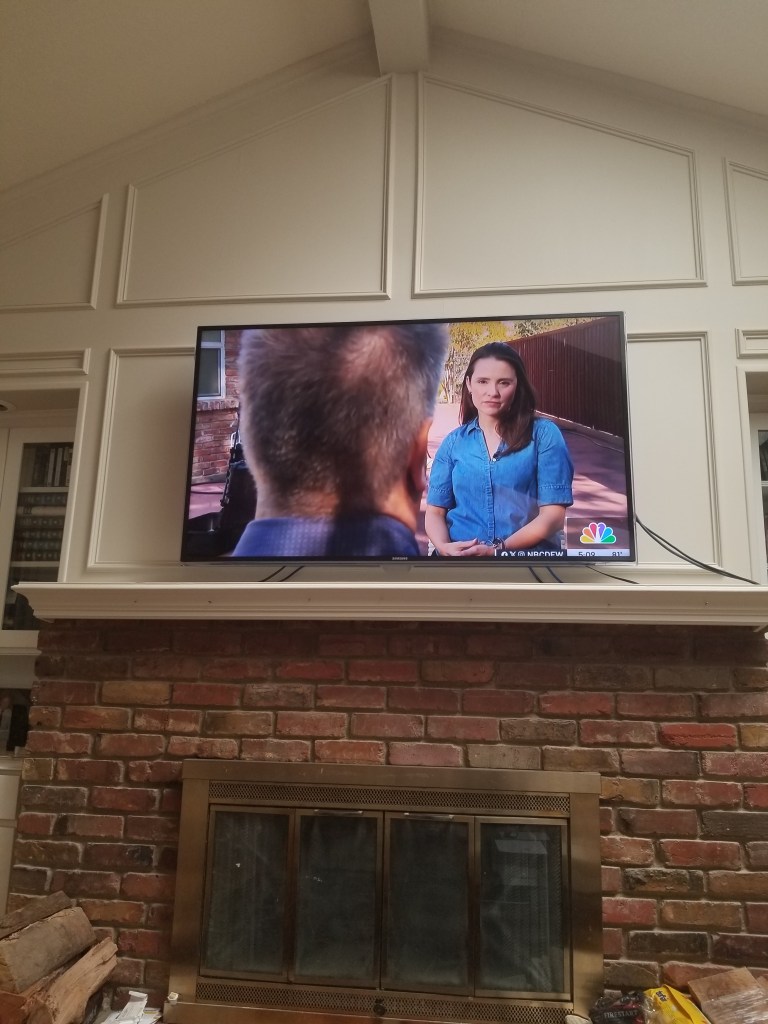
A photo of a TV above the fireplace. Thomas Wikman on the TV screen.
Seeing myself on the TV was a bit surreal. Click on the image to see the interview. My interview starts at 1 minute and 11 seconds.
A photo of my TV above the fireplace. I am on the TV screen. | Thomas Wikman NBC Interview
Here I am with NBC journalist Katie Blake. Click on the image or here to see the interview. My interview starts at 1 minute and 11 seconds.

I would like to stress that there are thousands of people whom they could have interviewed. Thousands of people who probably would have been better candidates. What made all the difference was the post I made on my blog. Therefore, fellow bloggers, perhaps this is an example of the fact that blogs bring attention.
To see the other Super Facts click here

Natural Disasters Kill Less People Now Than 100 Years Ago

Super fact 35: Natural disasters kill a lot less people now compared to 100 years ago. That is despite a larger population and despite the fact that climate change has increased the frequency and intensity of many types of natural disasters.

This is a super fact because surveys, such as this questionnaire from Gap Minder, show that the vast majority of the public (90%) believe that deaths from natural disasters have increased or stayed the same. Gap Minder is a Swedish highly respected non-profit founded by Hans Rosling that promotes increased use and understanding of statistics. Our World in Data (OWID), a renowned scientific online publication focusing on large global problems largely took its inspiration for Gap Minder and Hans Rosling.

The reason for the fewer deaths from natural disasters is not that there are fewer natural disasters, on the contrary, it is because we are now much better at predicting, handling and recovering from natural disasters. Our warnings systems, rescue systems and healthcare have improved significantly.

The graphics in this article from BBC show that the frequency of natural disasters has increased, and that the cost of natural disasters has increased, and yet the number of deaths has decreased.

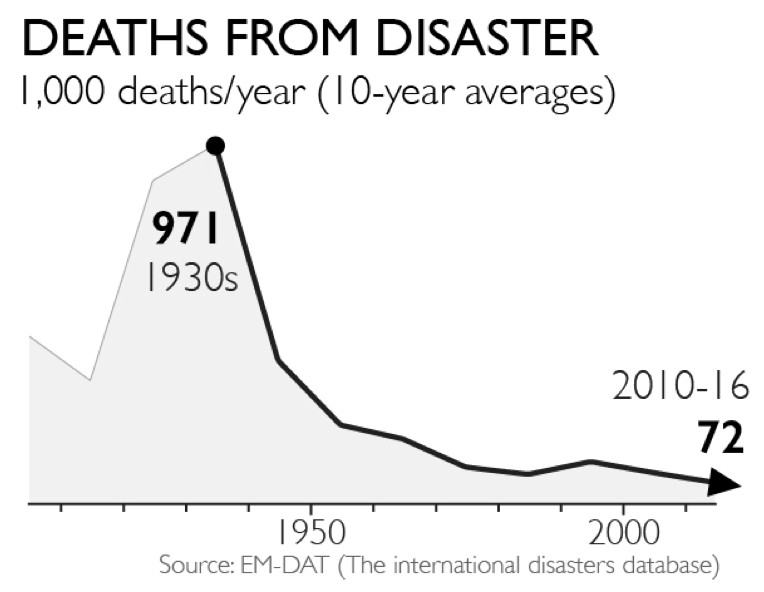
The graph below comes from the Gap Minder article. It shows the annual deaths from natural disasters in ten-year intervals starting with 1930. In the 1930’s there were 971 thousand deaths per year from natural disasters and during the period 2010 to 2016 there were 72 thousand deaths per year from natural disasters, an improvement by more than 13 times.

However, it should be noted that there was a huge flood in China 1931 causing an estimated 3 million deaths, and it skews the numbers for the 1930’s interval.

Originally, I set the headline for this super fact to be “10 Times more people died from natural disasters a hundred years ago” but I changed it to “Natural Disasters Kill Less People Now Than 100 Years Ago” because I realized that the 1930’s peak is an outlier because of the 1931 flood. I don’t want my headlines to be click bait.

The graph shows 300 to 400 thousand annual deaths at the beginning of the 20th century, then 971 thousand annual deaths in the 1930’s, then it continuously gets lower until the annual deaths in the 2010 to 2016 period is 72 thousand deaths per year | Natural Disasters Kill Less People Now Than 100 Years Ago
This graph from the Gap Minder article shows the annual deaths from natural disasters in ten-year intervals starting with 1930. The trend is down.

This does not mean that we should not worry about the increase in frequency and intensity of natural disasters from climate change. First of all, there are no warning systems and healthcare available for Koalas and Elephants, secondly cost matters, and thirdly there is no guarantee that we can keep improving our ability of predicting, handling and recovering from natural disasters enough to match the accelerating risks for natural disasters.

What People Believe Regarding Disaster Deaths

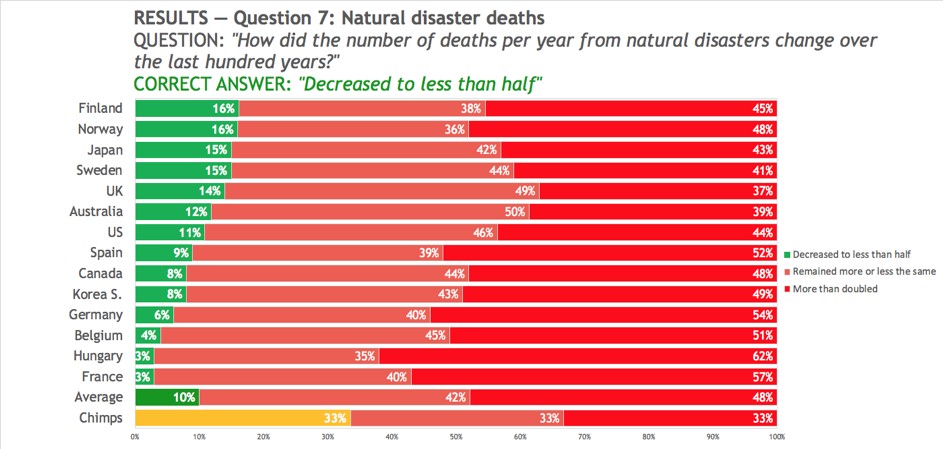
The Gap Minder article above report on a question survey conducted by Gap Minder. They asked large groups of people in 14 countries the following multiple-choice question “How did the number of deaths per year from natural disasters change over the last hundred years?” The choices were:

  • A. More than doubled
  • B. Remained more or less the same
  • C. Decreased to less than half

Most people answered A, a lot

of people answered B, but only 10% got the correct answer C, decreased to less than half. In other words, if chimpanzees had answered this question by randomly picking an answer, they would have done better than people. This is why I consider this a super fact. Below is a graphics taken from the Gap Minder article that shows how people in different countries responded.

There are 16 bars divided into three colors, green for the correct answer – “decreased to less than half”, orange for “remained more or less the same”, and red for “more than doubled”.  The 16 bars correspond to 14 countries, one for the average (10%), and one for random answers by chimpanzees (all 33.3%). The 14 countries are Finland, Norway, Japan, Sweden, UK, Australia, US, Spain, Canada, South Korea, Germany, Belgium, Hungary, and France | Natural Disasters Kill Less People Now Than 100 Years Ago
The histogram graphics above show the answers to the question “How did the number of deaths per year from natural disasters change over the last hundred years?” The correct answer “decreased to less than half” (in green) was rarely picked. The graphics is taken from the Gap Minder article mentioned.

EF3 Tornado in Dallas

In October 2019 an EF3 tornado ripped through our neighborhood. It left a 2-3 miles long trail of destruction. Roofs were lifted off houses, cars and buses were flown around, hundreds of houses were destroyed, bricks were flying around in the wind, trees were uprooted, and tree branches were flying around, and pieces of concrete crashed into buildings and hit steel fences so forcefully that it bent even quarter inch thick steel fences.

Unlike many of our neighbor’s houses, our house stood, but our chimney was smashed by a piece of concrete coming off a neighbor’s house, we had to replace our roof, our garage door, the wiring in the attic, our fence and my grill flew around in the yard. The amazing thing was that no one in the neighborhood died.

Why did no one die? Was it maybe because no one was outside walking the dog, or driving around, because everyone had received the alarm on their mobile phone about the approaching tornado and was therefore sheltering inside in a safe place? Imagine the same thing happening in the 1930’s.

Below are a few photos from that day and here are two links with more photos, link-1 , link-2. On the five-year anniversary of this event NBC news interviewed me about this event. To see the interview click here . My interview is at one minute and ten seconds.

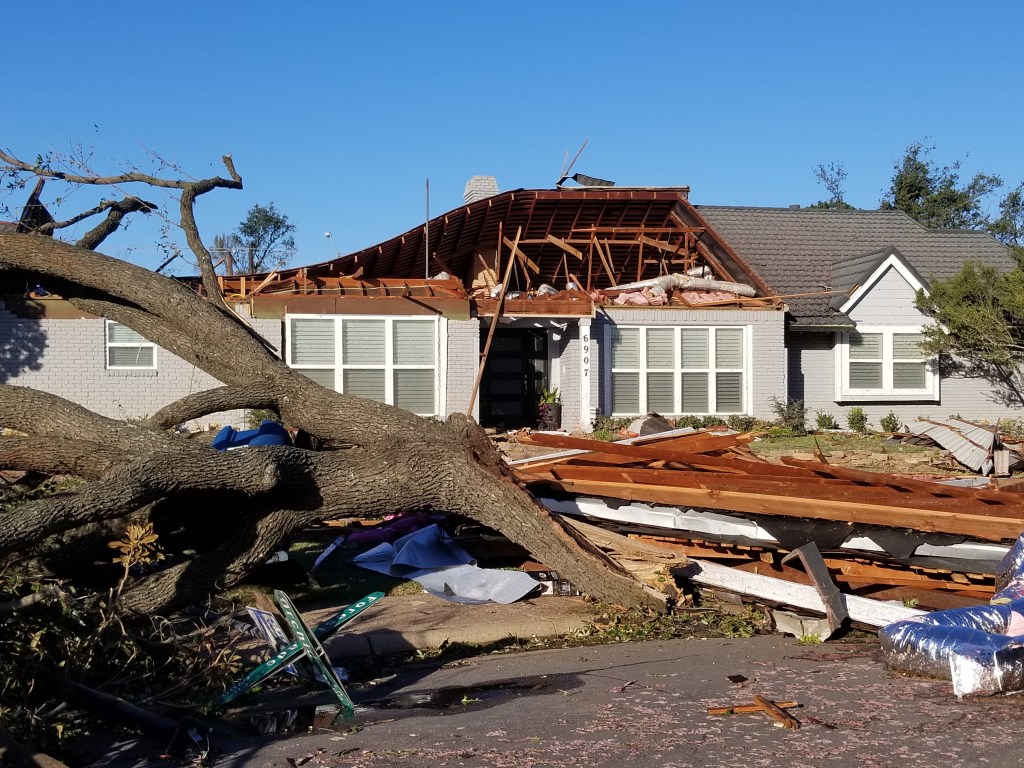
A neighbor’s house with the roof ripped off after the EF3 Tornado in Texas.
NBC used this photo. A neighbor’s house the morning of October 21st, 2019. Again, click on the image, or here, to see the interview. My interview is at one minute and ten seconds.
The photo shows a severely damaged house and lots of debris consisting of wood and trees and tree branches after the EF3 Tornado in Texas.
Another neighbor’s house. This house was about 100 yards from our house. It took a direct hit from the tornado.
This photo shows a house that is completely destroyed after the EF3 Tornado in Texas | Natural Disasters Kill Less People Now Than 100 Years Ago
Another house in our neighborhood.

My wife Claudia asked me to go check on her parents. I drove about 50-100 yards when a neighbor’s roof lying across the road stopped me. I turned around but this time I was stopped by a large pile of trees lying across the street. So, I started walking, but this time I was stopped by a group of firemen telling me that it was too dangerous to be outside. They told me to go back home, and I did. The next day we were able to visit her parents and below is what we saw.

The photo shows my wife Claudia walking into a house with debris everywhere after the EF3 Tornado in Texas.
Inside my wife Claudia’s parents’ house. This was the morning after. In the photo we are walking into their house to check on them (that’s my wife).
To see the other Super Facts click here