
Super fact 44 : Sulfur dioxide pollution has fallen by approximately 95 percent in the US since the 1970s. This significant reduction is primarily due to regulations like the Clean Air Act. Global sulfur dioxide pollution has also fallen but not as much.
Sulfur dioxide is a colorless gas with the formula SO2. It has a pungent smell, which you notice after using matches. It is released naturally by volcanic activity and is produced as a by-product of burning sulfur-bearing fossil fuels and from metals refining. Sulfur dioxide is somewhat toxic to humans and by reacting with water it creates acid rain, which is a serious environmental problem.
The good news is that the Clean Air Act has driven technological advancements and the adoption of cleaner practices in industries that produce sulfur dioxide emissions. This has resulted in a drop of sulfur dioxide pollution in the US by 95% according to EPA and Statista and 94% according to Our World In Data. Statista is a pay site, so I am not going to link to it. Below is a graph from Our World In Data showing the reduction in sulfur dioxide pollution in the US.
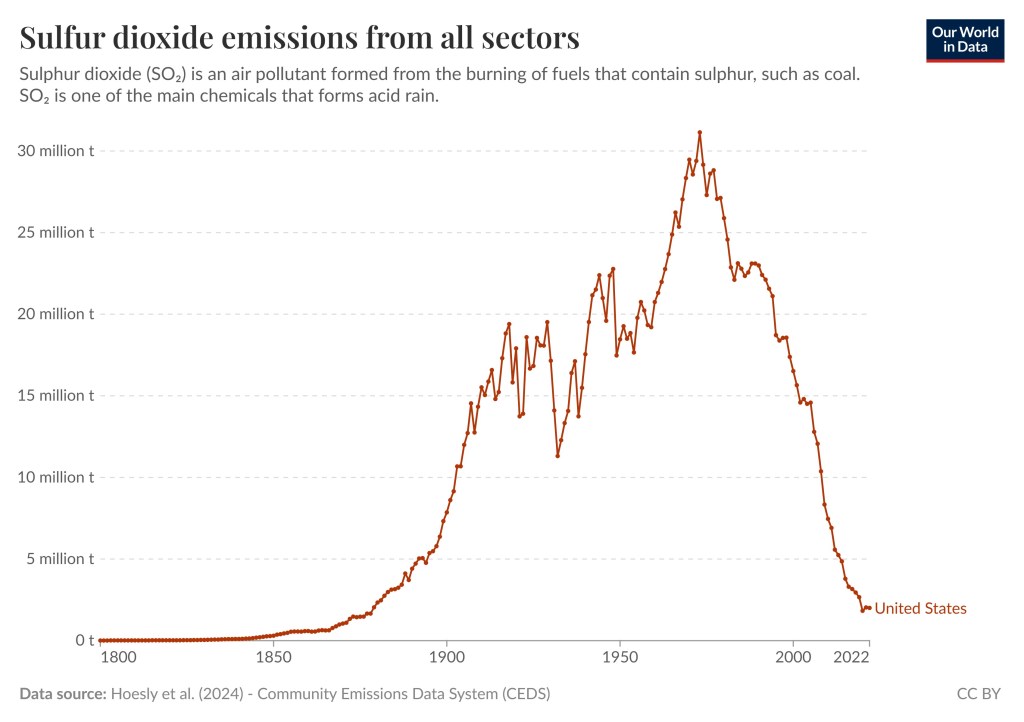
I should mention that by clicking this link you can visit the graph above Our World in Data and select different countries and regions and play around with the settings.
Sulfur Dioxide Emissions Worldwide
The worldwide emissions peaked in 1979 and fell sharply after that even though the progress (reduction in sulfur dioxide emissions) has not been as spectacular as in the US. Worldwide reductions are around 48%. Again, by visiting the Our World In Data page you can play around with the graph and the settings and view different countries and regions. This is an additional source visualizing the data.


Good News with Respect to Pollution
Sulfur dioxide emissions have gone down worldwide, which is good news. However, sulfur dioxide is not the only pollutant that we have succeeded in reducing. The graph below demonstrates that the US has also made great progress in reducing Nitrogen Oxides pollution, Carbon Monoxide, Black Carbon, and Non-methane volatile organic compounds. We have not been as successful with reducing Ammonia pollution.
However, according to Google AI sulfur dioxide, followed by Nitrogen Oxides pollution, Carbon Monoxide, and Black Carbon are the most serious pollutants. The graph below is taken from this page in Our World in Data.
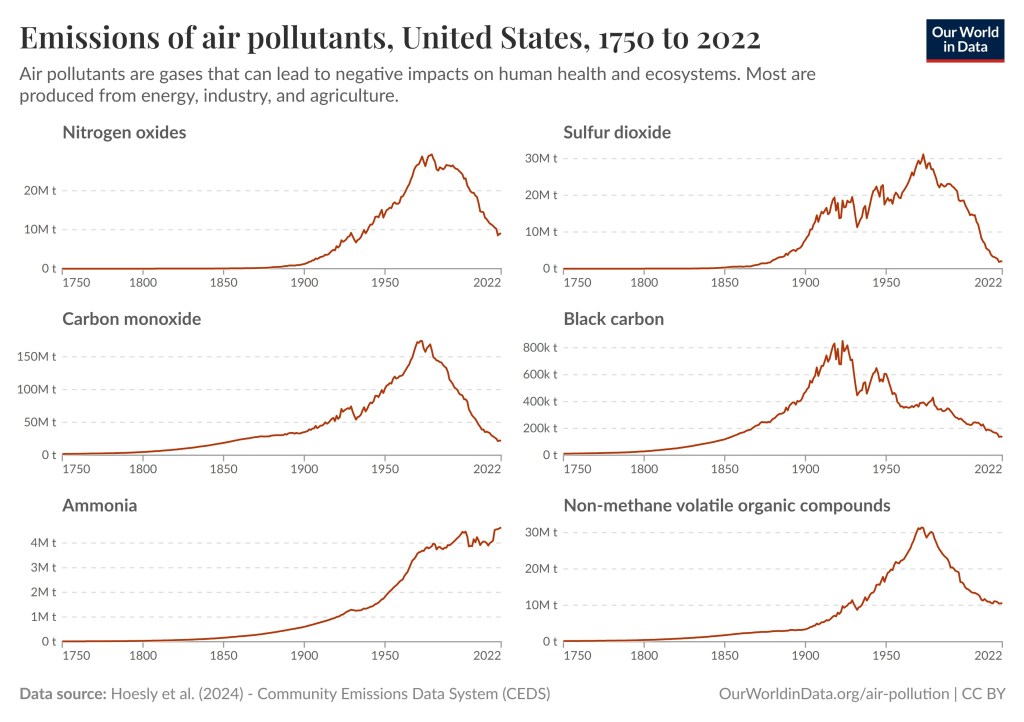
The graphs for the world do not look as impressive. However, even in this case it looks like some progress has been made. Four graphs have peaked and are turning downwards, and one graph has flattened but unfortunately the graph for ammonia pollution is still heading upwards.
It should be noted that these pollutants are more or less local in the sense that they affect the polluting country and/or surrounding countries the most, whilst the climate change / global warming effect from carbon dioxide and other long lasting greenhouse gases tend to affect the entire planet.

Aside from the success in reducing these pollutants there is more good news.
- Emissions of ozone-depleting gases have fallen by 99 Percent. This is a very important one that is saving millions of lives every year (preventing skin cancer).
- Natural Disasters Kill Less People Now Than 100 Years Ago. We have gotten much better at protecting lives in natural disasters and less people die in natural disasters despite the increase in frequency, severity and cost of certain natural disasters.
- EV Cars Indeed Emit Less Carbon Pollution. Due to misinformation spread about EVs this comes as a surprise to many.
- Developed nations have successfully reduced carbon emissions.
To see the other Super Facts click here

 Super Facts
extraordinary stat!
LikeLiked by 1 person
Thank you so much Animalcouriers. And the work you do is good news every day.
LikeLike
You are kind!
LikeLiked by 1 person
Well I love reading what you do for our little friends
LikeLiked by 1 person
This is good news and encouraging in that it shows we can make good progress on pollution when we put good regulations in place.
LikeLiked by 2 people
You are so right Dave. The Clean Air Act and the Montreal protocol made huge differences and we need to remember our successes as well as the threats.
LikeLiked by 1 person
It’s nice to read an article about pollution that interprets as positive news, Thomas.
LikeLiked by 1 person
Yes there are so many negative environmental stories, and we should not forget them, but if we don’t about the successes it will lead to despair. What we do makes a difference.
LikeLike
Yes, I think every small bit helps. Thanks, Thomas.
LikeLiked by 1 person
Your good news reminded me of a childhood swim in the public pool in Sulphur, Oklahoma. The local springs fed the pool, and the sulphur smell proved too potent for my nose. I’m glad at least one government regulation did us some good.
LikeLiked by 1 person
Yes you are right Grant at Tame Your Book. There are big environmental threats but also success stories that we should not forget. Otherwise it leads to despair. It matters what we do.
LikeLike
Good news and information, Thomas:)
LikeLiked by 1 person
Thank you so much Denise.
LikeLike
Good to see some positive news about pollution! Your graphs and charts illustrate these points so well.
LikeLiked by 2 people
Thank you so much for your kind words Debbie. There is a lot of bad news on pollution and the environment, and we should not forget that, but there are so many success stories as well and we don’t talk much about the successes and that can lead to despair.
LikeLiked by 1 person
At last ! It’s great to read some good news on the pollution front…Thank you, Thomas for taking the time to write and research this and share 🙂
LikeLiked by 1 person
Thank you so much Carol. As with the sharp reduction in ozone depleting gases (99+%) sulphur dioxide is another environmental success story. There are several of them and they tend to be forgotten. We do have some dangerous environmental problems to tackle but we shouldn’t forget our successes. Only talking about the bad ones leads to despair.
LikeLiked by 1 person
Absolutely I read today about some kids(17) and they are kids when you get to my age …lol…but they have invented a way that eliminates up to 94% of microplastics from water…So yes there is hope 🙂
LikeLiked by 1 person
Oh wow that is amazing. That is good news indeed.
LikeLiked by 1 person