The goal of this blog is to create a list of super facts. Important facts that are true with very high certainty and yet surprising, misunderstood, or disputed by many. This blog aims to be challenging, educational, and fun, without it being clickbait. I determine veracity using evidence, data from reputable sources and longstanding scientific consensus. Prepare to be challenged (I am). Intentionally seek the truth not confirmation of your belief.
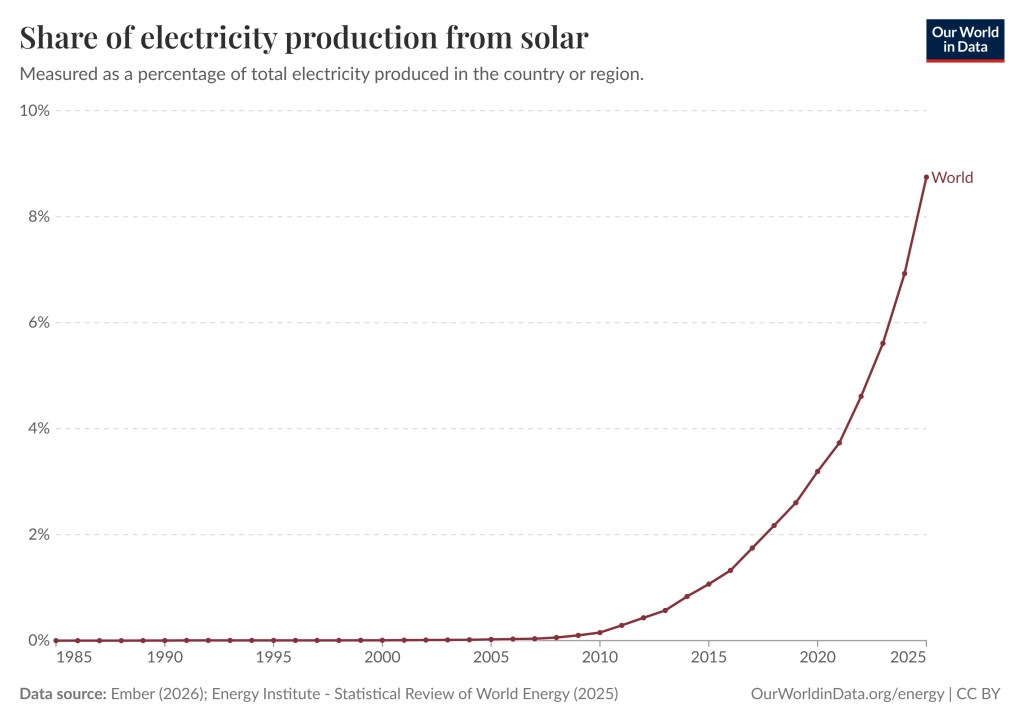
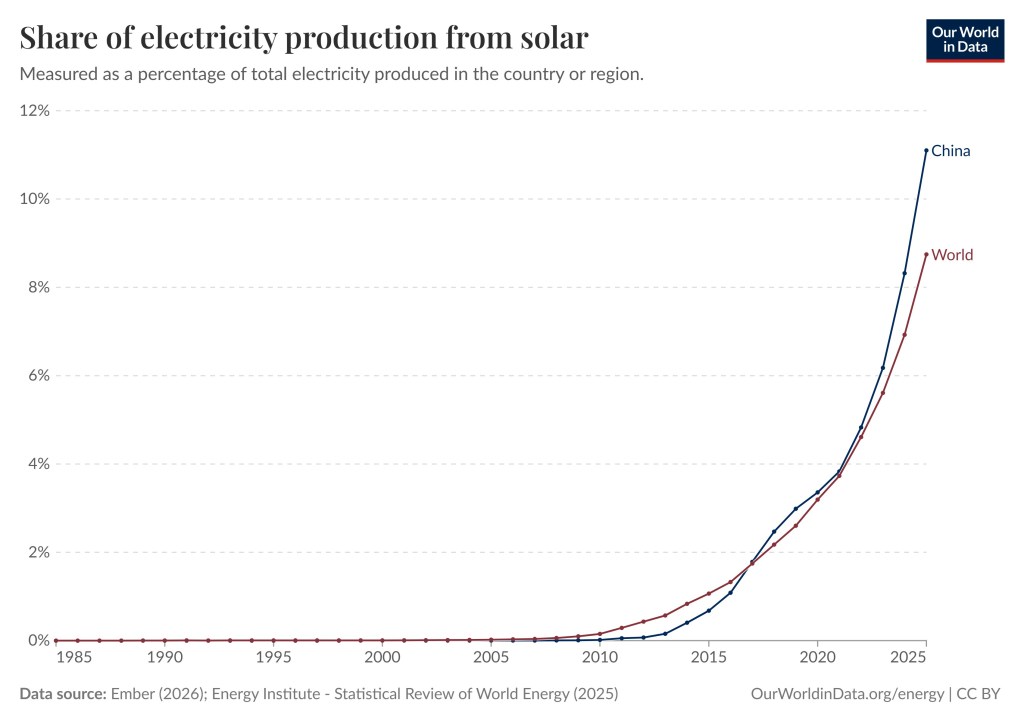
Superfact 117: The share of electricity generated from Solar Power in the world has grown from essentially 0% in the year 2000, 0.15% in 2010, to 3.19% in 2020, and to 8.75% in 2025. Both wind and solar energy are expanding fast around the world, but solar energy is a strong latecomer to the energy scene.
Solar energy panel. Shutterstock asset id: 2459435149 by Nordic Studio.
In the year 2000 less than 0.01% of the world’s electricity was generated by solar. In 2005 it was 0.02%, in 2010 it was 0.15%, in 2015 it was 1.07%, 2020 it was 3.19%, in 2025 it was 8.75%. Can you guess what will it will be in 2030? The United States may be behind the rest of the world with respect to wind power and EVs, but it closely follows the rest of world when it is about solar. You can play around with the graph below and select different countries by clicking here.
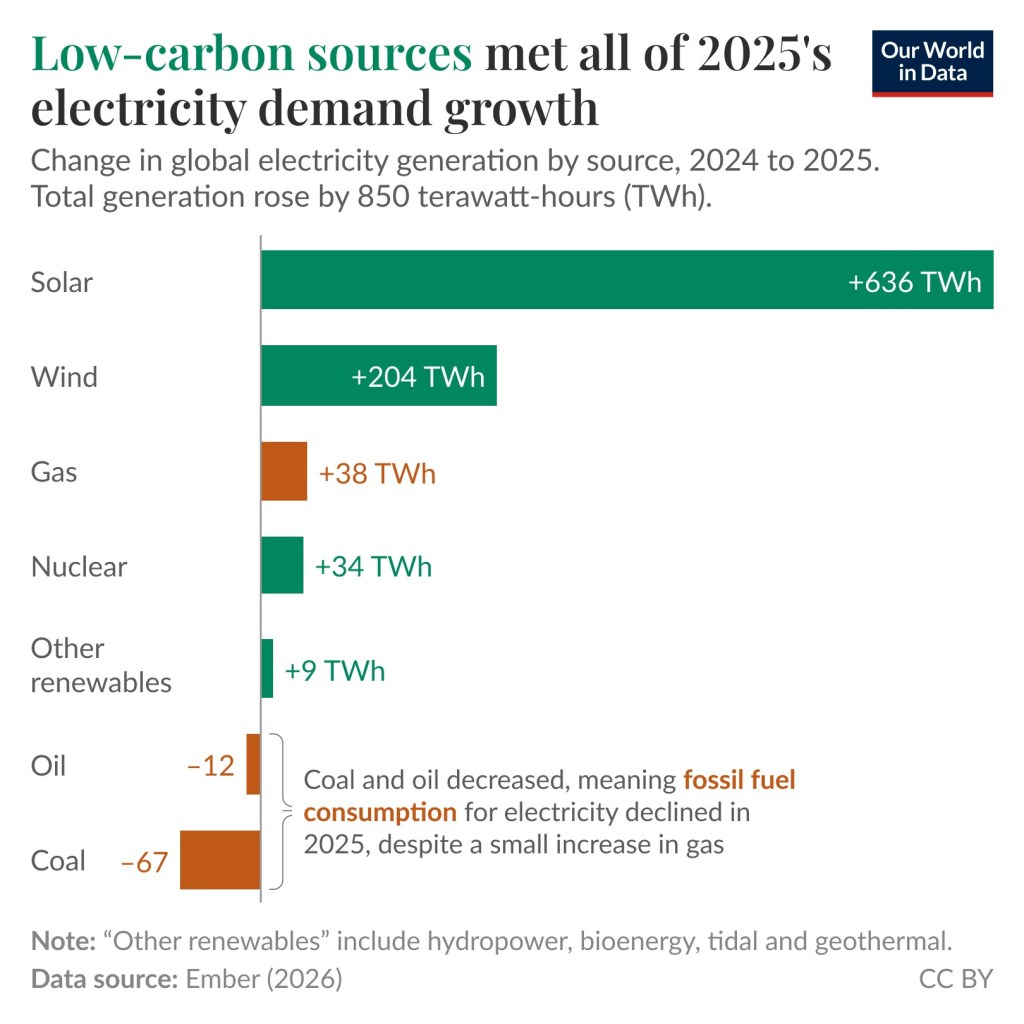
Share of electricity from Solar. Measured as a percentage of total electricity produced in the country or region. Data source: Ember (2026): Energy Institute – Statistical Review of World Energy (2025) OurWorldinData.org/energy | CC BYLow carbon sources met all of 2025’s electricity demand growth. Change in global electricity generation by source, 2024 to 2025. Total generation rose by 850 terawatt-hours (TWh). Note: “Other renewables” include hydropower, bioenergy, tidal and geothermal. Data source: Ember (2026). This graph comes from this page.
New solar panel technology such as Perovskite Solar cells is being developed. The price of lithium-ion batteries has fallen by 99% since 1991 and by 82% in the last ten years. New battery technology such as sodium-ion batteries is being developed. One advantage of sodium-ion batteries is that they function exactly like a lithium-ion battery but replace lithium with abundant sodium ions to carry the electric charge. The evolving battery technology makes it easier to store power from solar during the night. SolarPower Europe project that the global solar fleet will more than double by 2030. In other words, the future looks bright for solar power, and that pun was intended.
Three different scenarios / projections by SolarPower Europe. The medium scenario predicts slightly more than a doubling of global solar fleet from 2026 to 2030.
Solar Power as a Share of Electricity Generation Around the World
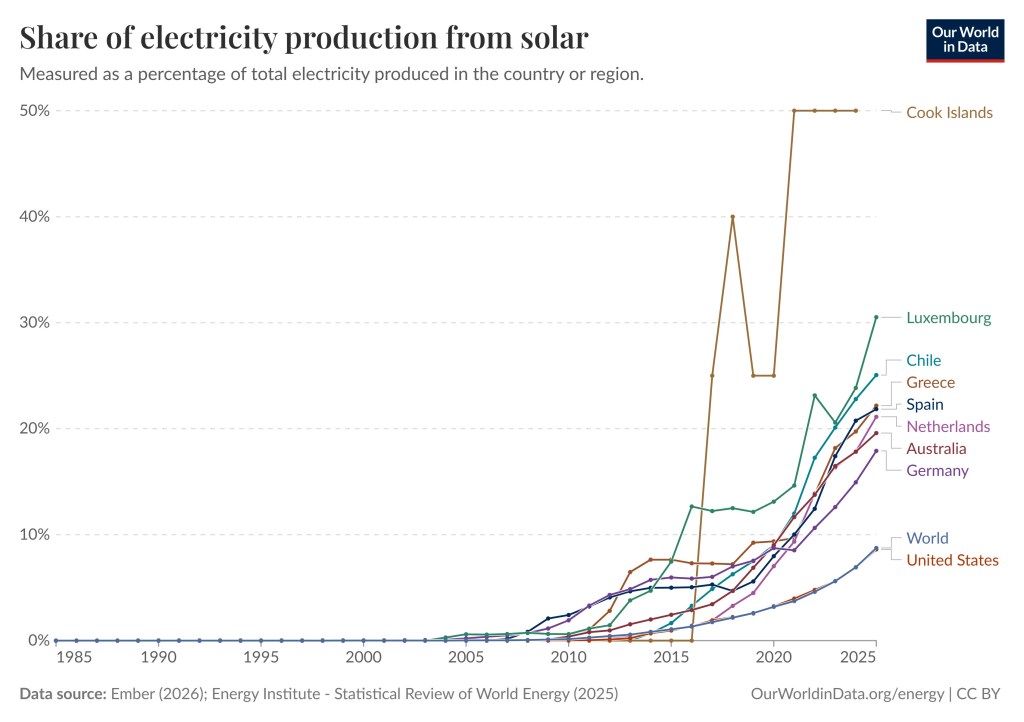
For solar, the United States follows the rest of the world closely. Some countries have a higher percentage, such as the Cook Islands – 50%, Luxembourg – 30.52%, Chile – 25.06%. If you wish you can take a closer look here, or here, and you can play around with the different graphs. You can pick millions of combinations of countries and regions. For illustrative purposes I am showing some combinations below.
Share of electricity production from solar. Measured as a percentage of total electricity in the country or region. Some countries utilize solar more than other countries. These graphs include, Cook Islands, Luxembourg, Chile, Greece, Spain, Netherlands, Australia, Germany, the World and the United States. Data source: Ember (2026); Energy Institute – Statistical Review of World Energy (2025) OurWorldinData.org/energy | CC BYThis graph shows that China has expanded their share of solar power a bit faster than the rest of the world. The share of electricity generated from Solar Power in the world was 8.75% in 2025 and in China 11.1%. Share of electricity production from solar. Measure as a percentage of total electricity in the country or region. Data source: Ember (2026); Energy Institute – Statistical Review of World Energy (2025) OurWorldinData.org/energy | CC BYThis graph shows the share of electricity generated from Solar Power in the largest countries and economic regions in the world. The share of electricity generated from Solar Power in the EU was 13.13% in 2025, in China 11.1%, in India 9.42%, in the World 8.75%, and in the US 8.6%. Data source: Ember (2026); Energy Institute – Statistical Review of World Energy (2025) OurWorldinData.org/energy | CC BY
How Clean and Safe is Solar Energy ?
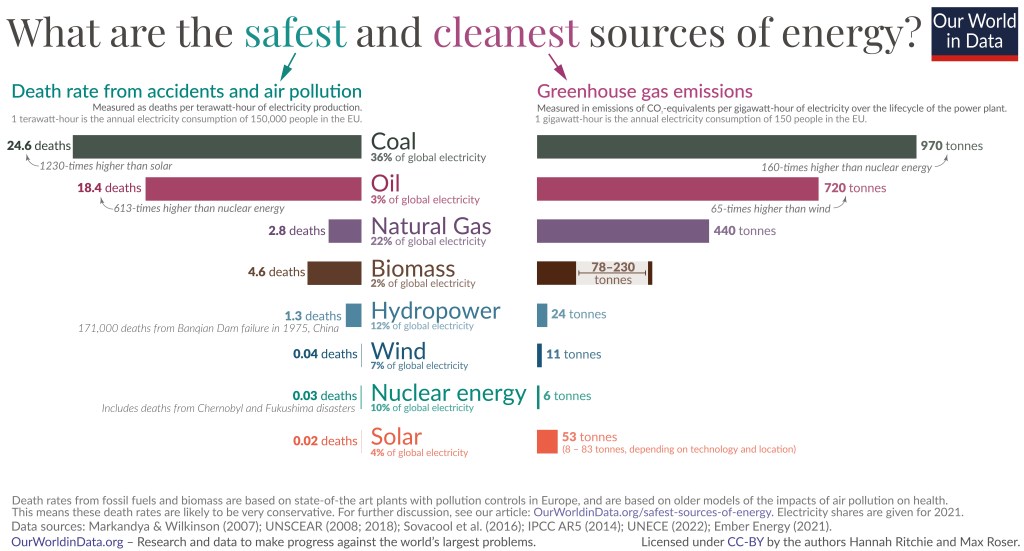
You sometimes come across claims that renewable energy isn’t really clean energy. The truth is that renewable energy such as wind, solar, etc., is much cleaner than gas, oil, and coal. These energy sources are also much safer and using them saves a lot of lives. As you can see, among the eight energy sources depicted solar is the safest, and among the cleanest. Coal has 1,230 times higher death rate than solar. According to the Energy Policy Institute at the University of Chicago Chinese citizens can expect to live on average 2.2 years longer than they would have a decade ago, due to the sharp drop in pollution. This is thanks to the increased use of EVs and renewables such as solar.
Greenhouse gas emissions and death rates from various sources of energy. Fossil fuels and biomass are based on state-of-the art plants with pollution control in Europe and are based on older models of the impacts of air pollution on health. This means that these death rates are likely to be very conservative. The graph shows that renewables and nuclear energy are the cleanest and safest forms of energy. For further discussion see the article: OurWorldinData.org/safest-sources-of-energy. Electricity shares are given for 2021. Data sources: Markandya & Wilkinson (2007); UNSCEAR (2008: 2018); Sovacol et al. (2016); IPCC AR5 (2014); UNECE (2022); Ember Energy (2001). OurWorldinData.org – Research and data to make progress against the world’s largest problems. Licensed under CC-BY by the authors Hannah Ritchie and Max Roser. Citation : Hannah Ritchie (2020) – “What are the safest and cleanest sources of energy?” Published online at OurWorldinData.org. Retrieved from: ‘https://archive.ourworldindata.org/20260202-100556/safest-sources-of-energy.html‘ [Online Resource] (archived on February 2, 2026).
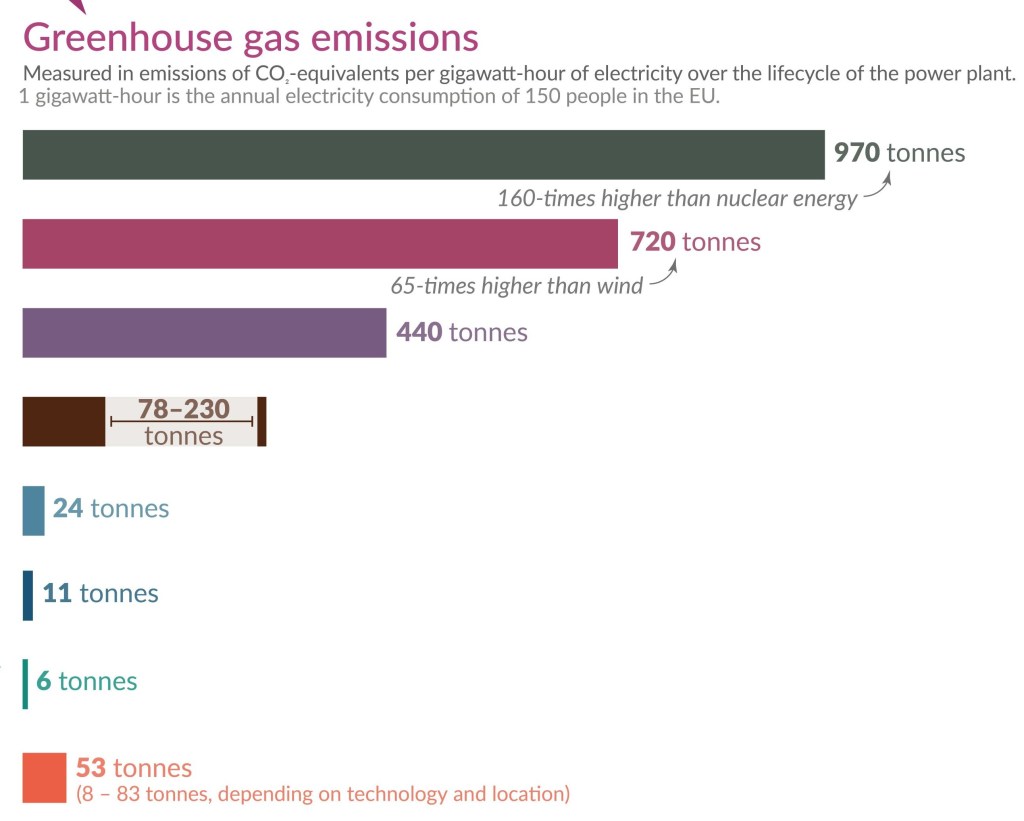
Below are two pictures corresponding to zoom-in of the graph above.
Death rates from accidents and air pollution. Measured as deaths per terawatt-hour of electricity production. 1 terawatt-hour is the annual electricity consumption of 150,000 people in the EU. The graph shows that coal, oil, gas, and biomass are a lot deadlier than hydropower, wind, nuclear power, and solar.Greenhouse gas emissions. Measured in emissions of CO2 per gigawatt-hour of electricity over the lifecycle of the power plant. 1 gigawatt-hour is the annual electricity consumption of 150 people in the EU. The graph shows that coal, oil, gas, and biomass are responsible for a lot more greenhouse gas emissions than hydropower, wind, nuclear power, and solar.
Important Climate and Energy Facts
As I said, the misinformation about climate science has bamboozled a lot of people. We know that climate change / global warming is happening. We have also known for several decades that the current climate change / global warming is not natural. It is caused by us, chiefly due to the burning of fossil fuels. Yet many non-scientists dispute it.
The scientific evidence is conclusive, but a lot of people know very little about the evidence. It includes satellites directly measuring our greenhouse gases trapping heat, the upper troposphere is cooling whilst the lower atmosphere is warming, showing that the heating is from greenhouse gases, the unnatural speed of the warming is another piece of evidence, isotope studies, climate models, etc. Below are fourteen super facts related to climate science and clean energy.
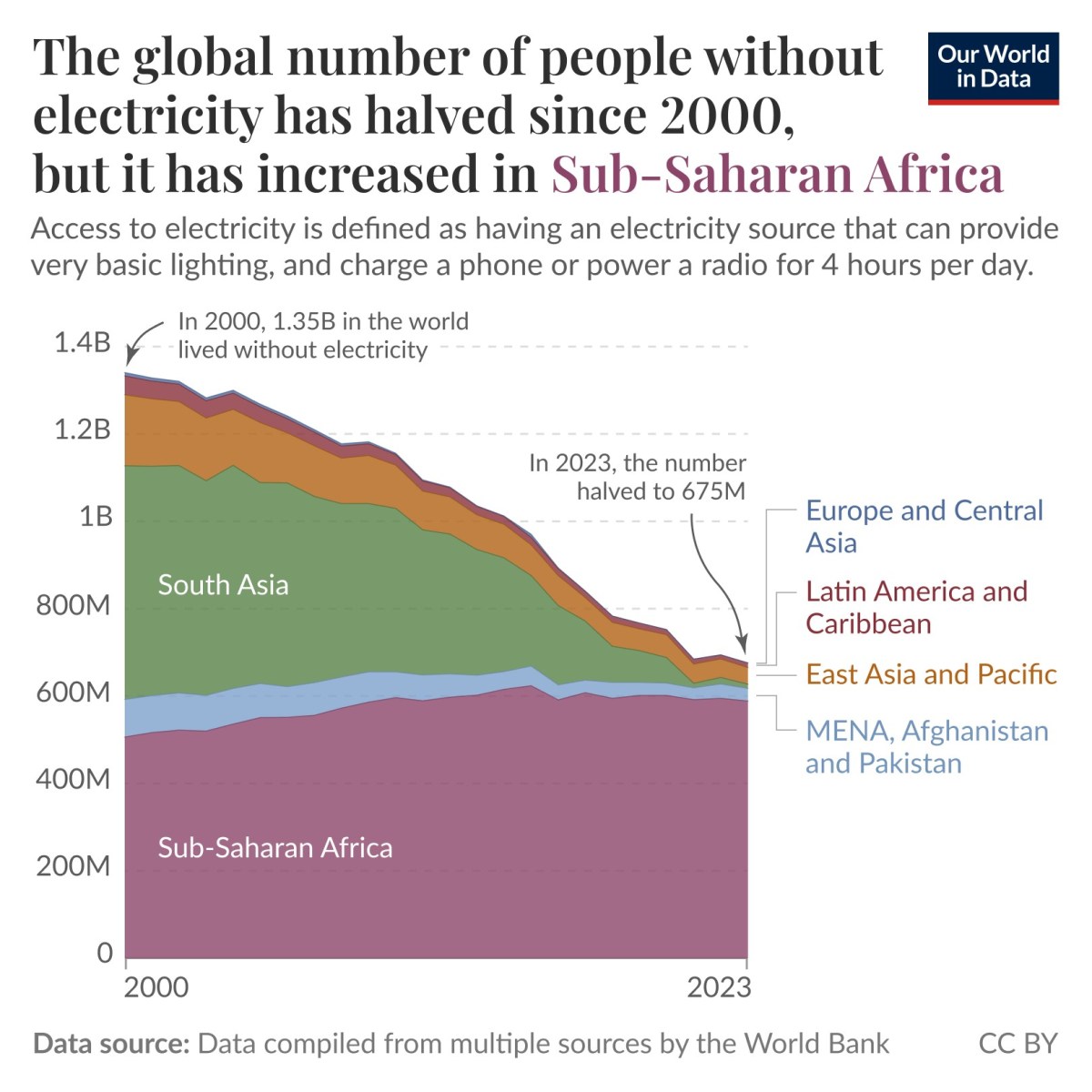
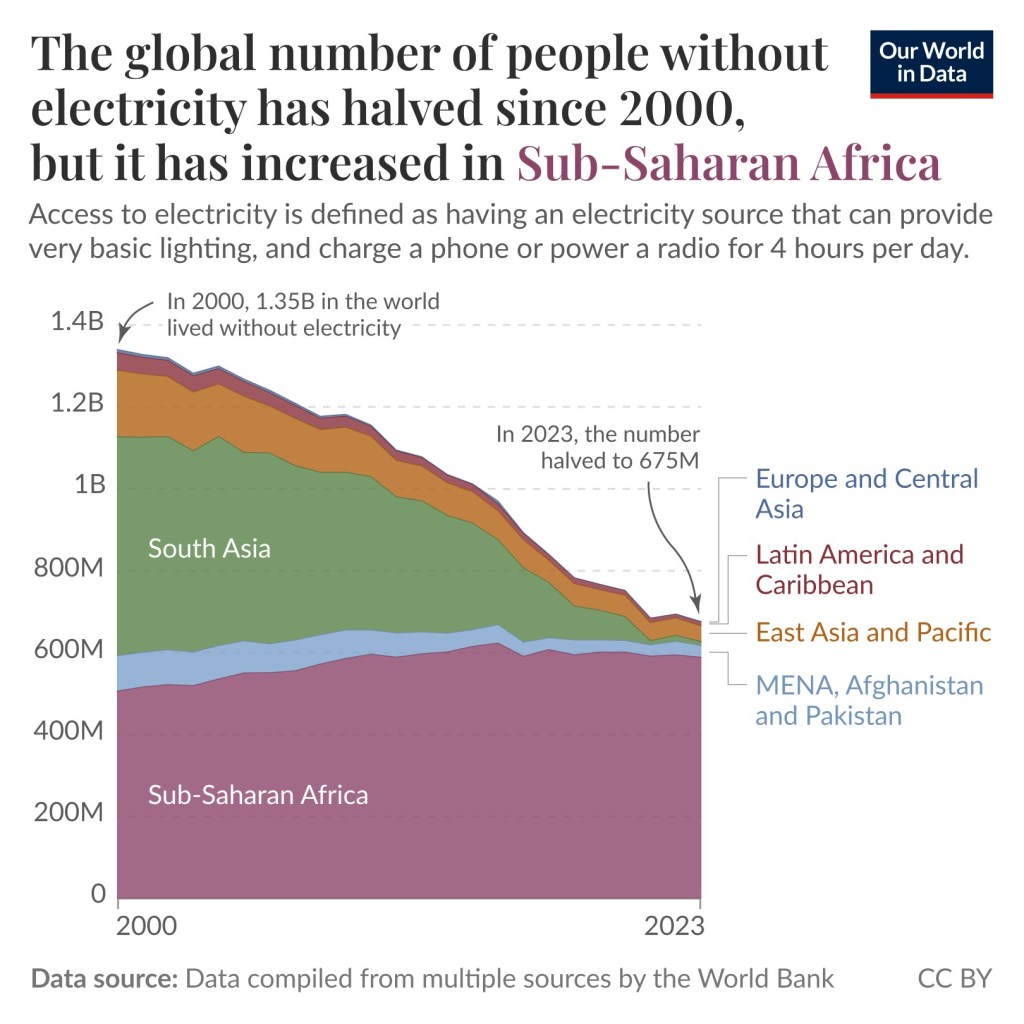
Super fact 109 : The global number of people without electricity has halved since 2000, but it has increased in Sub-Saharan Africa. In the year 2000 1.35 billion people in the world was without electricity and in the year 2023 it was 675 million people according to Our World in Data. The dark aspect of the statistics is that the number of people without electricity in Sub-Saharan Africa has increased from 500 million people to more than 600 million people.
The global number of people without electricity has halved since 2000, but it has increased in Sub-Saharan Africa. Access to electricity is defined as having an electricity source that can provide very basic lightning and charge a phone or power a radio for 4 hours per day. Data source: Data compiled from multiple sources by the World Bank. CC BY. The graphs come from this page from Our World in Data.
This also means that the share of people without electricity living in Sub-Saharan Africa increased from 37% in the year 2000 to 80% now. However, it is also true that the share of people in Sub-Saharan Africa with electricity has doubled, rising from 26% to 53%. What is going on is that population growth has outpaced this expansion, meaning the number of people without electricity has still risen.
For the rest of the world, it is unequivocally good news. For example, in South Asia more than 500 million people lacked electricity in the year 2000, 414 million lacked electricity in 2010, and only 27 million people lacked electricity in 2023. Another way to look at the access to energy gap is by considering how long it is possible to run an air conditioner in different countries. Click here for data and analysis. In summary, the news for Sub-Saharan Africa is complicated but for the rest of the World, it is very good news. To read more about this topic click here.
I consider this a super fact because I believe it is an important but surprising fact in two parts. First the great news for the world and secondly the mixed news for Sub-Saharan Africa.
No Relief for the Heat Down in Africa
As mentioned, four of the five regions of the world, Europe and Central Asia, Latin America and the Caribbean, East Asia and the Pacific, MENA, Afghanistan, and Pakistan have made substantial progress. However, Sub-Saharan Africa is a complicated case. Note that MENA stand for Middle East and North Africa.
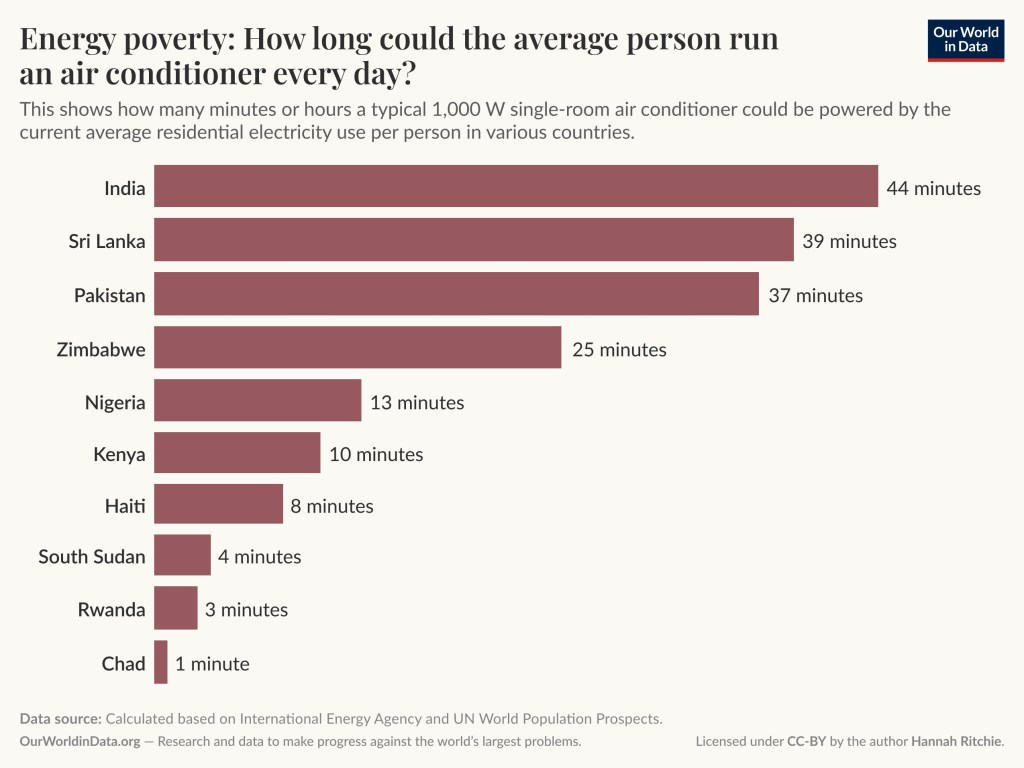
An alternative way of looking at access to electricity is to consider how much electricity is being used in each country and how that translates into the number of hours or minutes that an air conditioner could be running. Note it doesn’t mean that an air conditioner will be shut off after, let say 25 minutes, just that is much electricity one person use. What should be noted from the graph below is how dire the situation still looks like in Sub-Saharan countries. Sub-Saharan Africa is still very behind in this regard, and the fact that global warming is likely to hit Africa very hard that is not good news.
Energy Poverty: How long could the average person run an air conditioner every day? This is how many hours a typical 1000 W single-room air conditioner could be powered by the current average residential electricity use per person in various countries. Data source: Calculated based on International Energy Agency and UN World Population Prospects. OurWorldinData.org – Research and data to make progress against the world’s largest problems. Licensed under CC BY by the author Hannah Ritchie. The graph is coming from this page from Our World in Data.
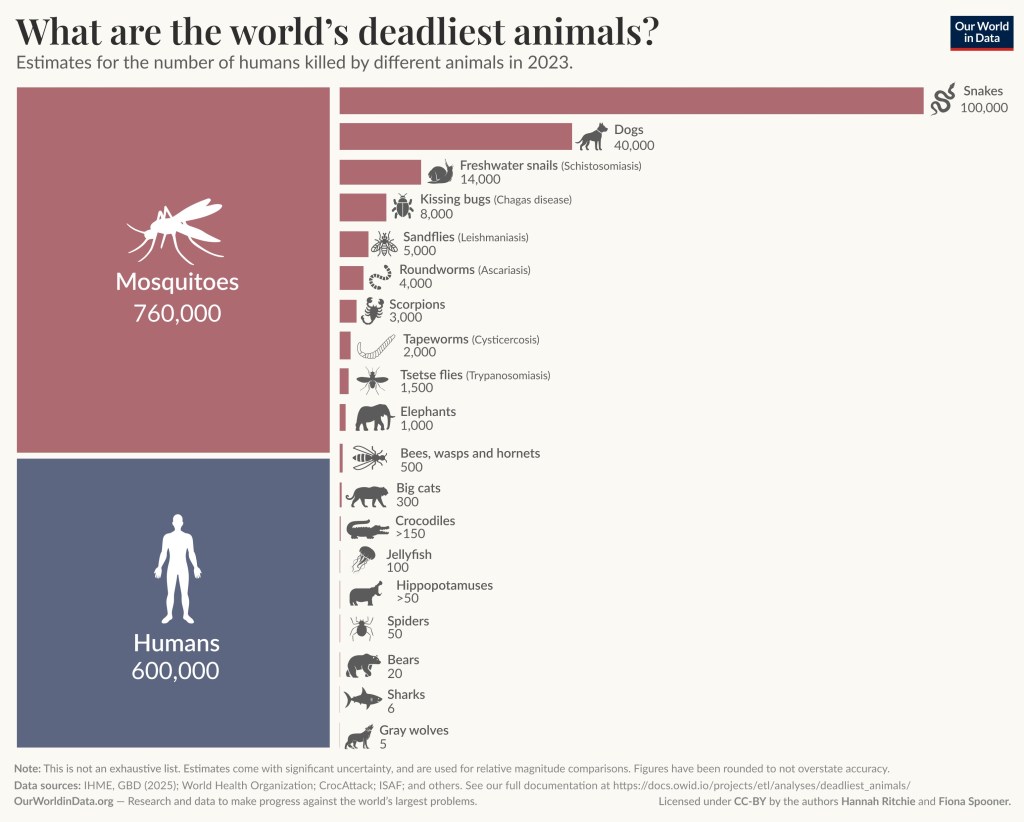
Super fact 98 : The deadliest animals in the world are mosquitos, snakes and dogs. Mosquitos kill an estimated 760,000 people each year. Snakes kill an estimated 100,000 people each year. Dogs kill an estimated 40,000 people each year. By comparison humans kill on average 600,000 other humans annually due to wars and violence.
Estimates for the number of humans killed by different animals in 2023. Note: This is not an exhaustive list. Estimates come with significant uncertainty and are used for relative magnitude comparisons. Figures have been rounded to not overstate accuracy. Data sources: IHME; GBD (2025); World Health Organization; CrocAttack; ISAF; and others. See the full documentation at https://docs.owid.io/projects/etl/analyses/deadliest_animals/OurWorldInData – Research and data to make progress against the world’s largest problems. Licensed under CC-BY by the authors Hannah Ritchie and Fiona Spooner.
The first time I heard that the deadliest animal in the world was the mosquito I was surprised. After I heard that the reason was all the diseases that mosquitos spread, such as malaria, dengue fever, and yellow fever, it made more sense to me. I recently learned that snakes kill 100,000 people every year. It surprised me because it seemed like a lot to me.
I was also surprised to learn that our best friends the dogs, come in as number three on the list of deadliest animals, at an annual kill rate of 40,000 people. Even though scorpions are not at the top of the list they kill 3,000 people annually, while spiders only kill 50 people. We have both venomous spiders and scorpions where I live, but I’ve been worried about spiders, not scorpions. It is also surprising to me that sharks only kill about 6 people per year. I guess my super fact 98 is a collection of facts regarding “killer animals” rather than one specific fact. I am hoping that at least one of the facts will be surprising to you.
I should mention that the numbers vary over time and different sources give different statistics. Therefore, the numbers should be seen as ballpark numbers and not exactly. However, Our World in Data is considered one reputable and highly reliable data source that is frequently cited in scientific journals, and access is free.
Mosquitos Kill 760,000 People Each Year
Mosquitos are the biggest killers of humans by far. 80% of those deaths are the result of malaria which is transmitted and spread by the Anopheles mosquito. We have made progress against malaria, and it used to be worse. In the 20th century 150 to 200 million people died from malaria, which is more than one and half million people per year. Smallpox killed 300 million people in the 20th century, but it was entirely eradicated by 1977 thanks to the smallpox vaccine. The two existing vaccines for malaria are relatively recent (2021 & 2023), not as effective as the smallpox vaccine was, and not yet as widely used, which is one reason malaria is still a major health concern.
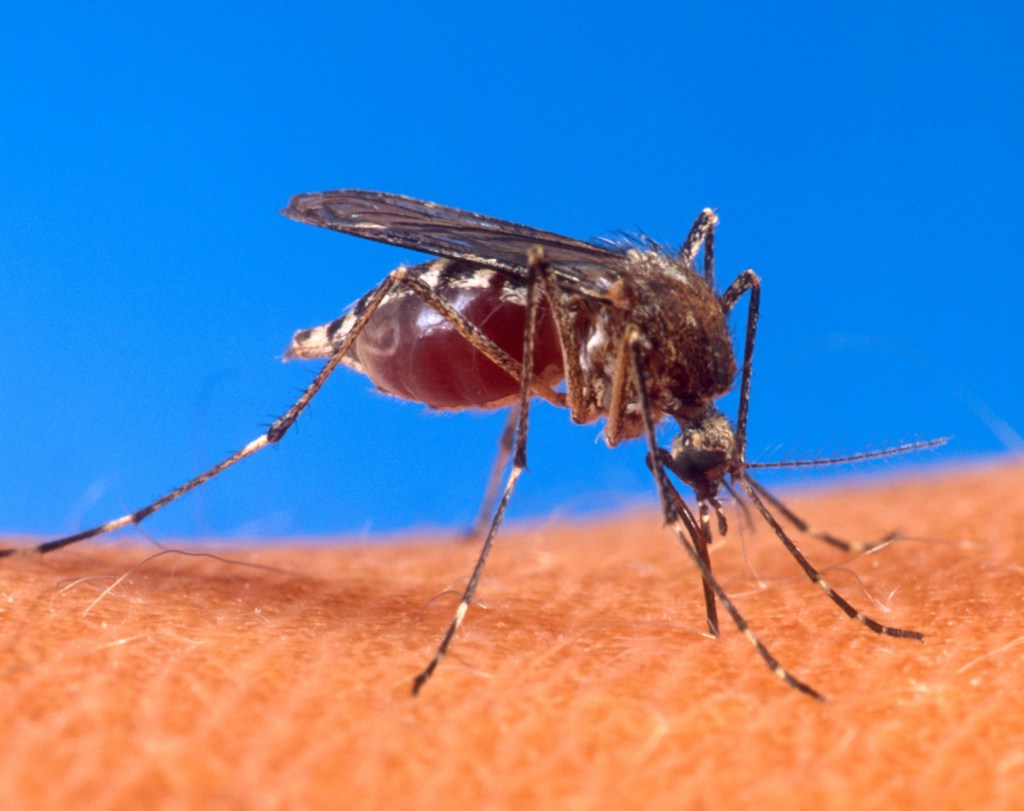
The Aedes aegypti mosquito, which spreads dengue fever and yellow fever. Original author: US Department of Agriculture; then denoised rescaled, enhanced with adaptive denoising filters and minimal resharpening, then unscaled to original resolution, for easier refitting at various resolutions., Public domain, via Wikimedia Commons.
In addition, mosquitos spread other diseases killing more than 100,000 people every year. Dengue fever, yellow fever and Japanese encephalitis, are a few of the more dangerous mosquito borne diseases.
Snakes Kill 100,000 People Each Year
The death toll from venomous snakes is uncertain but it is likely to be 100,000 deaths per year. The World Health Organization estimates that snake bites kill between 81,410 and 137,880 each year.
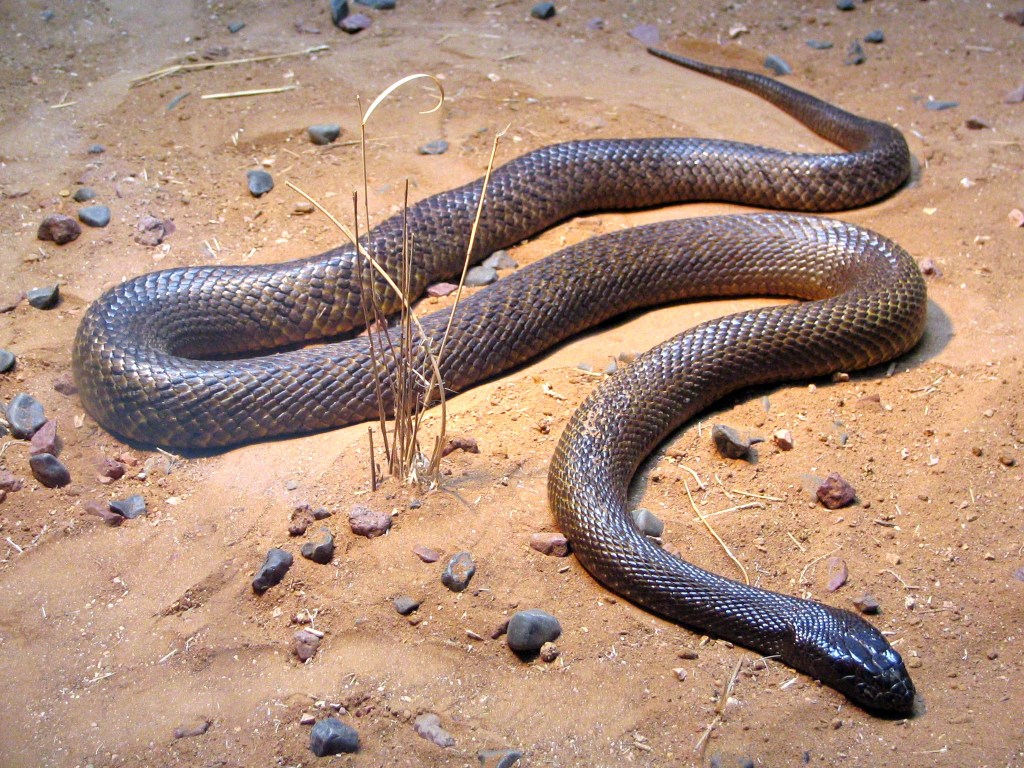
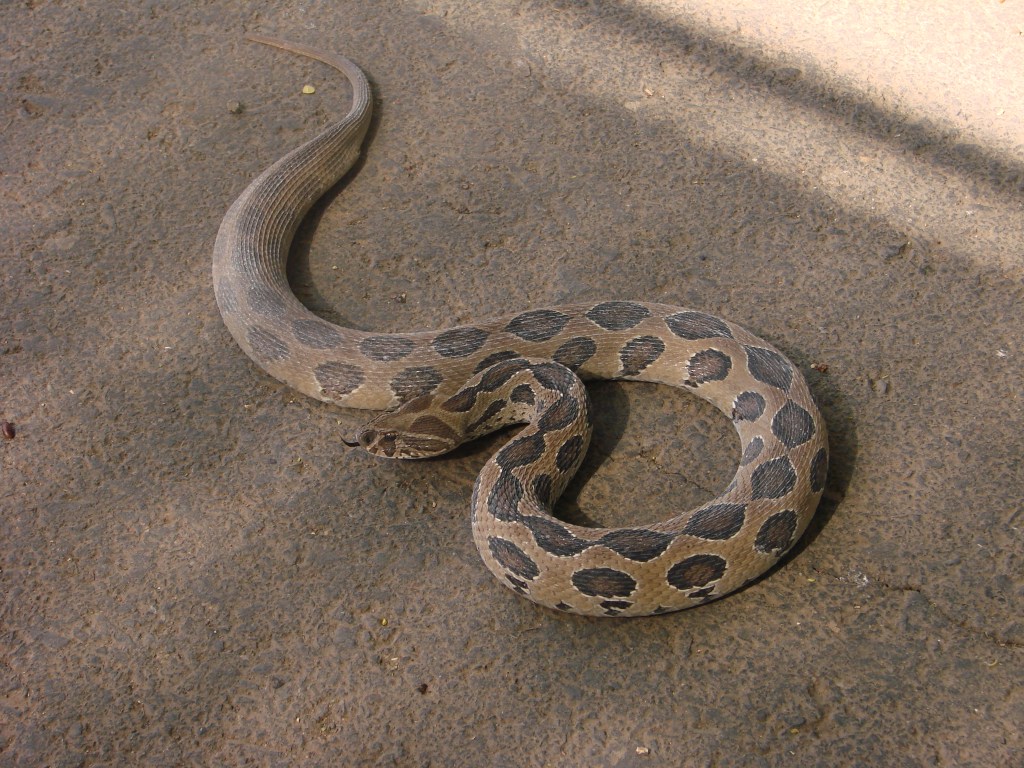
The most venomous snake in the world is the Inland Taipan. Its venom can kill over 100 people in a single bite. However, due to its shy nature and remote Australian habitat, no human deaths have been attributed to it. The most dangerous snake to humans, in terms of fatalities, is often considered the Russell’s viper, responsible for 25,000 deaths annually. Other snakes that kill several thousand people every year are the saw-scaled viper, the common krait, the Indian cobra in Asia, and the black mamba.
Did you kill 40,000 people? Actually, our mini-Australian Shepherd Rollo did not kill anybody.
Even though there are some large and dangerous dogs, most deaths caused by dogs is from rabies resulting from being bitten by a rabies infected dog. See the horror movie Cujo.
Freshwater Snails, Kissing Bugs, Sandflies, Roundworms are Mass Killers
Other critters that kill thousand of people every year are freshwater snails, kissing bugs, sandflies, and roundworms. These critters kill people by infecting them with dangerous parasites or as in the case of roundworms, being a dangerous parasite.
Scorpions Kill 3,000 People Each Year but Spiders Only 50
I was at an overnight outing with the guys at work. I had just moved to Texas. We were standing or sitting around the fire drinking beer when I asked a question. I’ve heard about the scorpions in Texas, but I’ve never seen any. How common are scorpions?
A coworker named Gary told me to turn around, so I did. Behind me was a tree, and the tree was covered by crawling scorpions. Well, I was glad I did not lean on it. The scorpions I saw were the striped bark scorpion.
The reason scorpions kill a lot more people than spiders is that some scorpion species have a very potent and deadly venom. Some spiders are dangerous too, but spiders tend to have less potent venom.
The Big Cats kill only 300 People Annually and Sharks Only 6
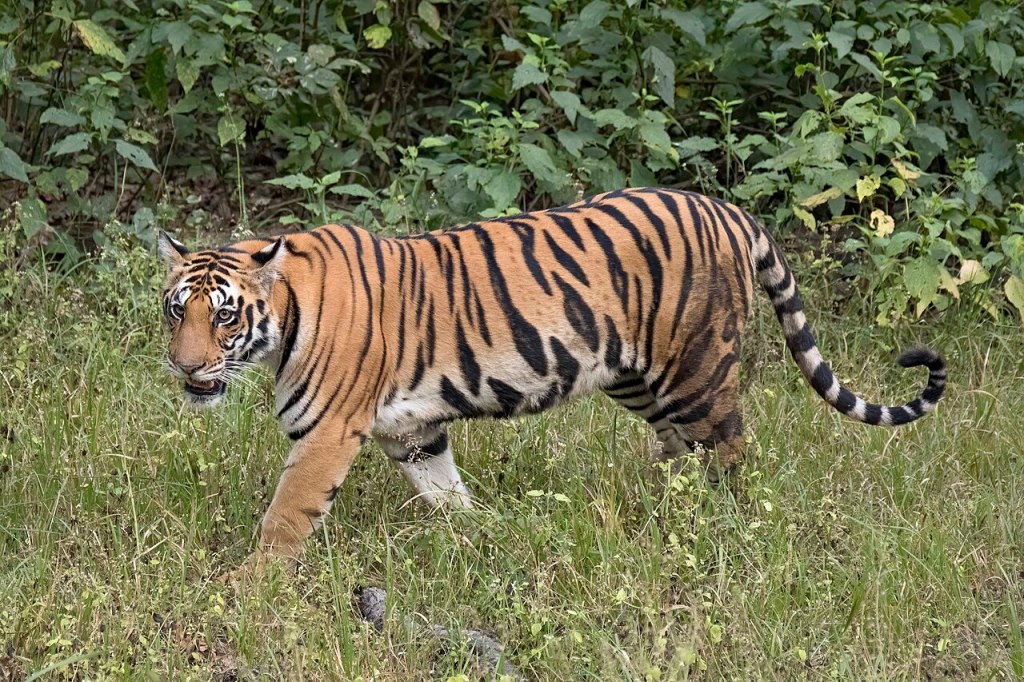
Would you prefer to stay in a room with a Tiger or with a mosquito? Mosquitos kill 760,000 people every year, whilst Tigers only kill a handful of people every year. However, Tigers don’t kill less people than mosquitos because they are less dangerous than mosquitos. The difference is exposure. Mosquitos are everywhere but not Tigers. If Tigers were as common as people and everywhere people were, the numbers probably would be different.
Bengal tiger (Panthera tigris tigris) female, Kanha National Park, India. Attribution: Charles James Sharp.
Superfact 96: Nuclear power is a relatively clean and safe energy source that produces no atmospheric emissions during operation. However, there are some problems with nuclear power, but they are often overblown.
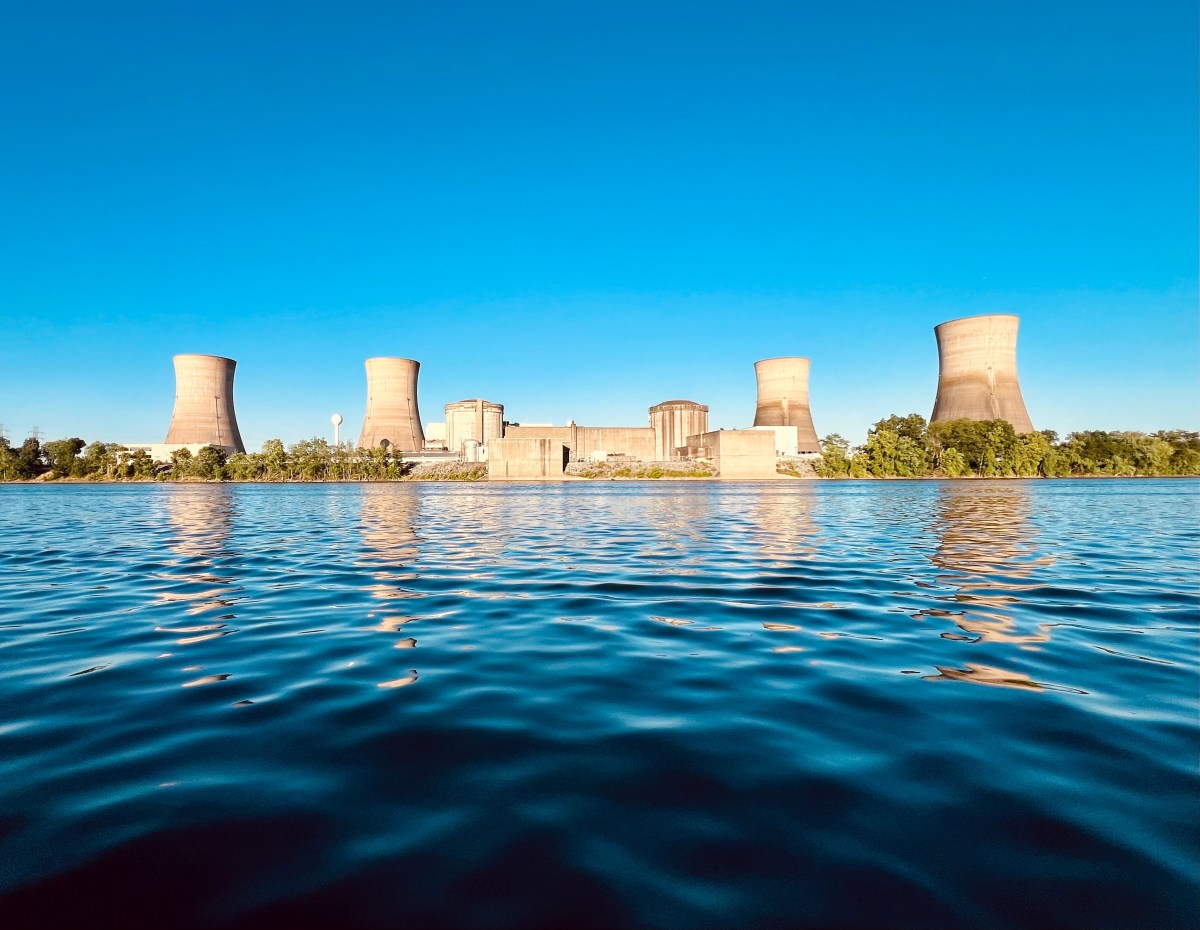
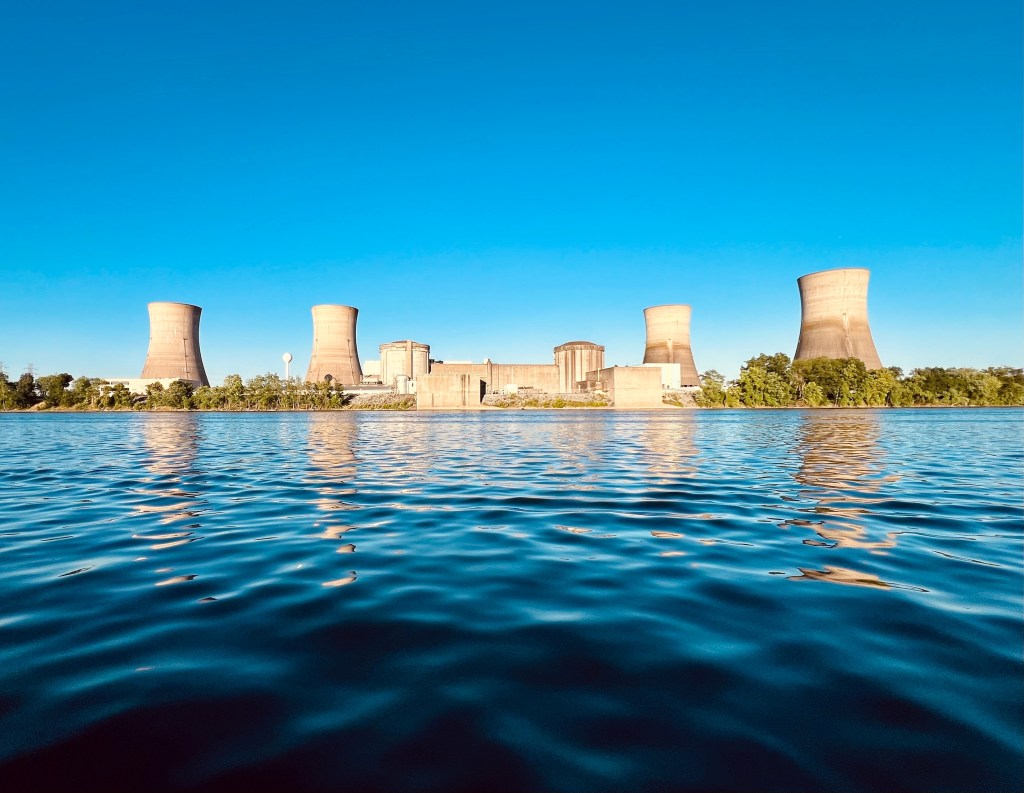
The Three Mile Island Nuclear Power Plant south of Harrisburg, Pennsylvania. March 28, 1979, a nuclear accident at the Three Mile Island nuclear power plant sent shockwaves across the world, raising fears about nuclear power. However, no one died, and no one was hurt. Shutterstock Asset id: 2512612545 by Aubrie K
Clean energy sources are often defamed by disinformation and misunderstandings. For example, wind power turbines are not bird killing machines. Contrary to what you often hear wind power is indeed a very clean, cheap and sustainable energy source. Nuclear power is another misunderstood energy source. Wind power, solar power, hydro, and nuclear power are all considered clean energy because they produce no greenhouse gases or air pollution during operation and they also have very low life-cycle emissions.
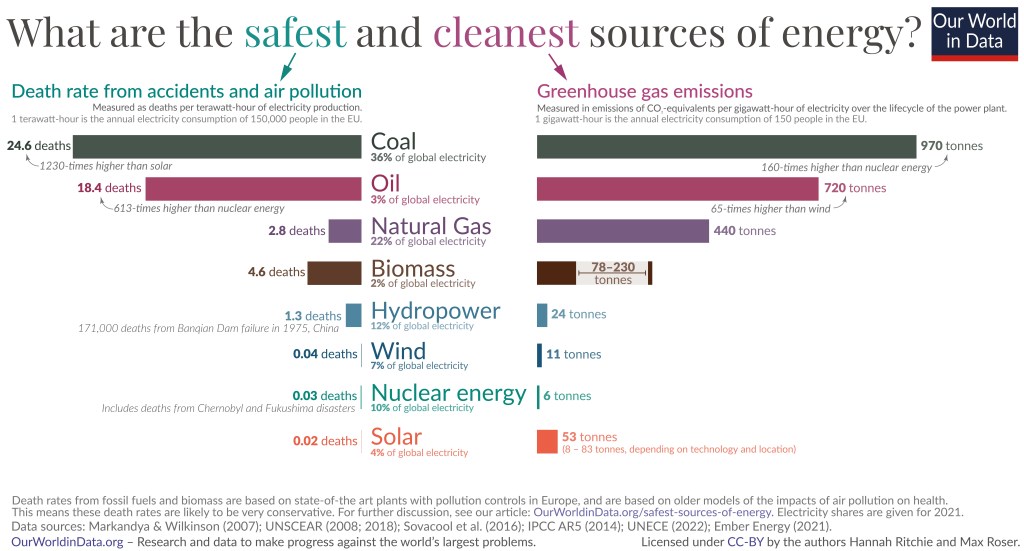
The graph below from Our World in Data depicting lifetime greenhouse gas emissions (construction, operation, disposal) and safety data for the European Union, show that the lifetime greenhouse gas emissions of coal power is 162 times higher than those of nuclear power and coal kill 820 times as many people as nuclear power. The lifetime greenhouse gas emissions of natural gas are 120 times higher than those of nuclear power and kill 613 times as many people as nuclear power. The difference is staggering.
Death rates from fossil fuels and biomass are based on state-of-the art plants with pollution control in Europe and are based on older models of the impacts of air pollution on health. This means that these death rates are likely to be very conservative. For further discussion see our article: OurWorldinData.org/safest-sources-of-energy. Electricity shares are given for 2021. Data sources: Markandya & Wilkinson (2007); UNSCEAR (2008: 2018); Sovacol et al. (2016); IPCC AR5 (2014); UNECE (2022); Ember Energy (2001). OurWorldinData.org – Research and data to make progress against the world’s largest problems. Licensed under CC-BY by the authors Hannah Ritchie and Max Roser. Citation : Hannah Ritchie (2020) – “What are the safest and cleanest sources of energy?” Published online at OurWorldinData.org. Retrieved from: ‘https://archive.ourworldindata.org/20260202-100556/safest-sources-of-energy.html’ [Online Resource] (archived on February 2, 2026).
In the graph above, greenhouse gas emissions are measured of CO2 equivalents per Gigawatt-hour of electricity over the lifecycle of the power plant. 1 Gigawatt-hour is the annual electricity consumption of 150 people in the EU. Death rate from accidents and air pollution is measured as deaths per Terawatt hour of electricity production. 1 terawatt hour is the annual electricity consumption of 150,000 people in the EU.
I should mention that there are problems with nuclear power that are not entirely covered by the graph above, including radioactive waste, a history of spectacular accidents, and a perceived connection to nuclear arms. However, as you will see later in this post, even though these problems get a lot of media attention, they are not as scary as one might think. However, it should be noted that nuclear power in its current form is not a cheap source of energy, but that is a different topic.
I consider this a super fact because nuclear power is often thought of as an extremely dangerous and dirty source of energy, which is not the case.
How Does Nuclear Power Work ?
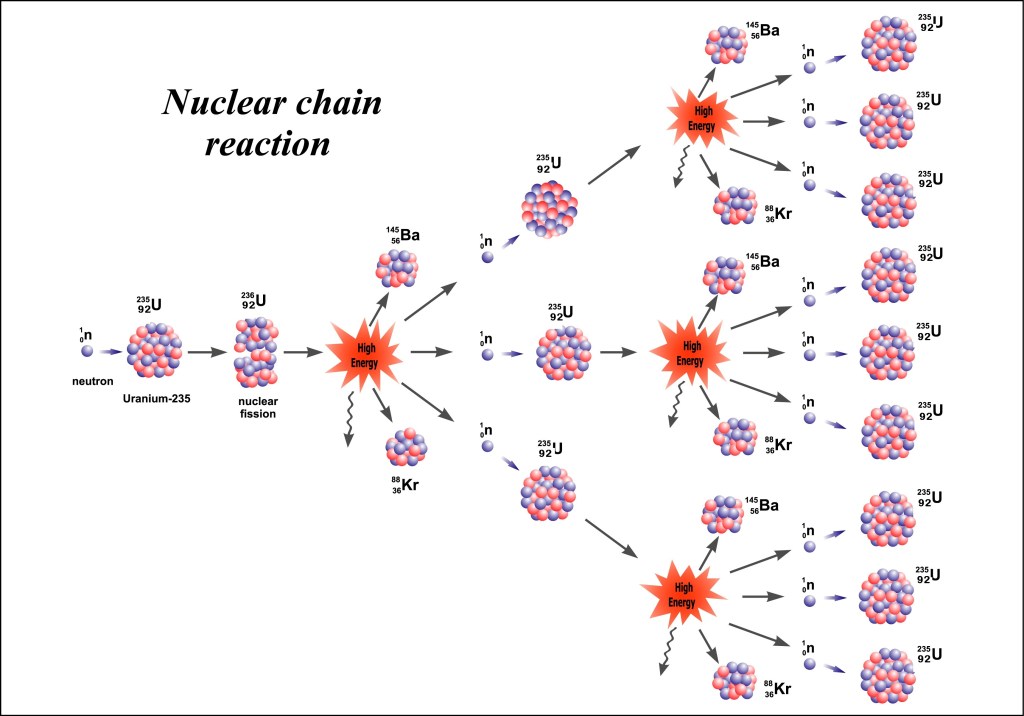
Illustration of nuclear chain reaction. Uranium-235 fission. Shutterstock asset id: 73714504 by Mpanchenko. Note I corrected an error in the picture.
The fuel (fuel rods) in a nuclear power station consists primarily of stacked ceramic pellets made of low enriched uranium dioxide housed inside sealed metal tubes. The uranium consists primarily of two uranium isotopes U-238, which has 92 protons and 146 neutrons and U-235, which has 92 protons and 143 neutrons. Uranium always has 92 protons. The isotope that is used for fission is U-235. Natural Uranium consists of 0.7% U-235, trace amounts of U-236 and the rest (99.3%) is U-238. The uranium in nuclear fuel rods is either natural (0.7% U-235) or a few percent of U-235 (low enriched uranium). This should be contrasted with a uranium atomic bomb which has at least 80% U-235 (highly enriched).
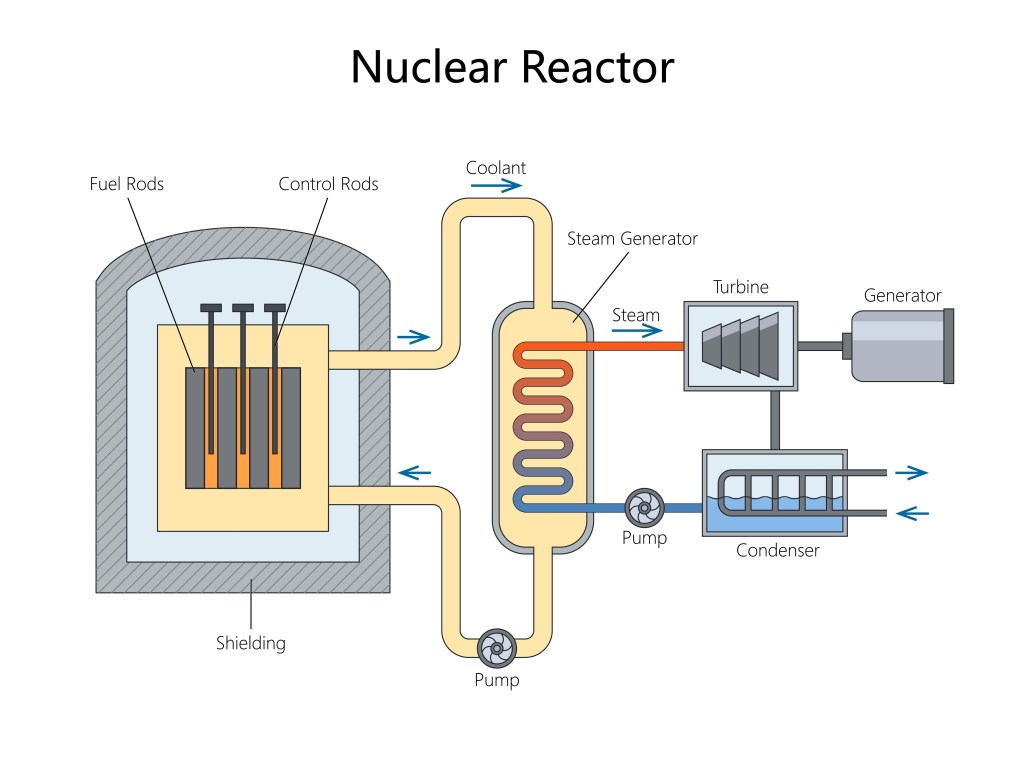
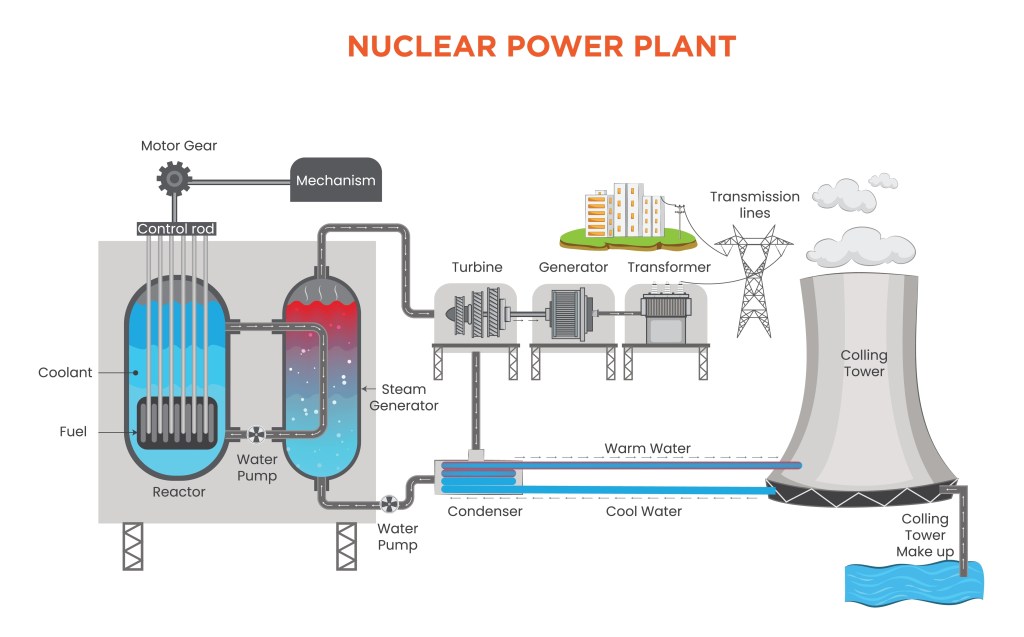
A nuclear power plant generates electricity using heat from nuclear reactions. Inside the reactor, atoms of fuel (uranium) undergo nuclear fission, where they split apart and release a large amount of heat. The fuel rods (see picture below) in a nuclear power station consist primarily of stacked ceramic pellets made of low enriched uranium dioxide housed inside sealed metal tubes. There are also control rods in a nuclear power station, which consist of materials with a high neutron absorption cross-section. The control rods are used to regulate the reaction. If they are fully inserted the reaction will stop. Also note that nuclear reactors have a containment shield (at least in western countries).
Fission generates heat, which generates high pressure steam, which pushes a turbine around, which turns a generator, which generates electricity, which is transformed to the right voltage and delivered to customers. Science educational illustration Shutterstock Asset id: 2658971563 by Alexander_P
Below is an alternative illustration.
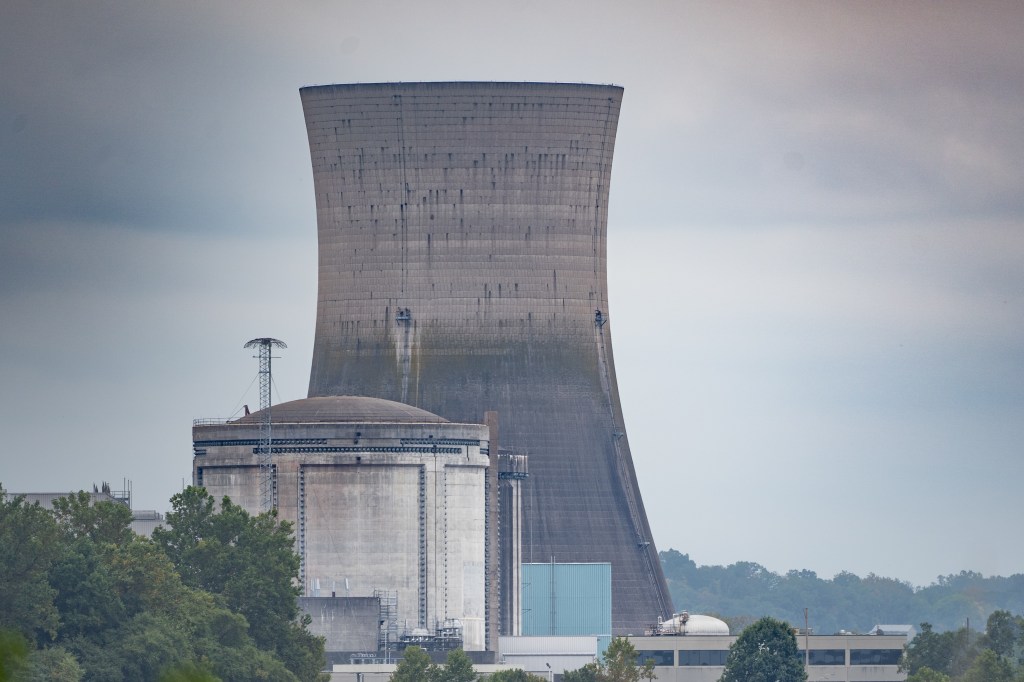
A nuclear power plant generates electricity by using heat from nuclear fission to produce steam, which drives turbines connected to electrical generators. This illustration also depicts the nuclear power plant’s use of water for cooling. Don’t worry, the water will not turn radioactive. It is a separate isolated loop. Shutterstock Asset id: 2525528665 by Papia Majumder.Three Mile Island Nuclear Plant, located in Pennsylvania, is known for a partial meltdown in 1979 Shutterstock. This photo shows the reactor as well as the cooling tower. Asset id: 2520903273 by Amy Lutz.
What about Chernobyl ?
The Chernobyl disaster, which occurred on April 26, 1986, was the worst nuclear disaster in history. 50 people died as a direct result of the disaster and an estimated 4,000, perhaps 10,000 future cancer deaths are predicted from the disaster. However, it should be noted that an estimated half million people died from coal pollution in the United States over the first two decades of the 21st century. You have to compare.
Another, thing to keep in mind is that the Chernobyl reactors were RBMK reactors (Reaktor Bolshoy Moshchnosti Kanalnyy), an extremely flawed, old and dangerous design that only exists in Russia (or the former Soviet Union). Above I mentioned that the control rods slow down the nuclear reaction when inserted between the fuel rods and stop the reaction when fully inserted. In an RBMK reactor, it is the other way around. The control rods speed up the reaction when inserted. Add the fact that the Chernobyl reactor did not have a containment shield designed to contain a major release of radioactivity, unlike Western reactors and that the Soviet Union was an authoritarian and secretive regime that made things much worse. A nuclear disaster similar to Chernobyl is highly unlikely to happen in the West.
The Fukushima nuclear disaster was caused by a severe earthquake and a 15 meter tsunami. Around 2,300 died from the evacuation, and 15,000 people died from the Earthquake, but it is estimated that no one, or perhaps one person died as a direct result from the nuclear disaster itself. As mentioned no one died from the Three Mile Island accident.
What about Radioactive Waste?
Radioactive waste stored on-site at nuclear power stations (spent fuel) is often millions of times more radioactive than long-term disposal waste. It is important to remember that highly radioactive isotopes decay fast (that’s why they are dangerous), which means that long-term disposal waste is not very dangerous. We are surrounded by radioactivity and our by far largest exposure to ionizing radiation comes from the radon in our basements.
Does nuclear power for energy generation increase the risk for nuclear weapons proliferation?
While commercial nuclear energy and weapons programs share technology, they are distinct processes. The historical data and studies show that national nuclear energy programs in general don’t lead to the development of nuclear weapons. No country officially developed nuclear weapons based on a pre-existing commercial nuclear power industry. Typically, nuclear-armed nations developed dedicated, military-focused, and often secret reactors to produce plutonium or facilities to enrich uranium for weapons. Also, the issue is mostly moot for countries that already have nuclear weapons, such as the United States.
Conclusion
Nuclear power is clean and safe. It might be our cleanest energy source that can provide baseload power. However, there are other concerns including the possibility of spectacular accidents, radioactive waste and the possibility that nuclear power for energy might aid nuclear weapons proliferation. Luckily, it appears that these concerns are overblown. It should be noted that nuclear power, as implemented today, is not cheap energy, but that is a different topic.
Super fact 71 : Based on the fossil record today’s extinction rate is hundreds, or even thousands, of times higher than the natural baseline rate.
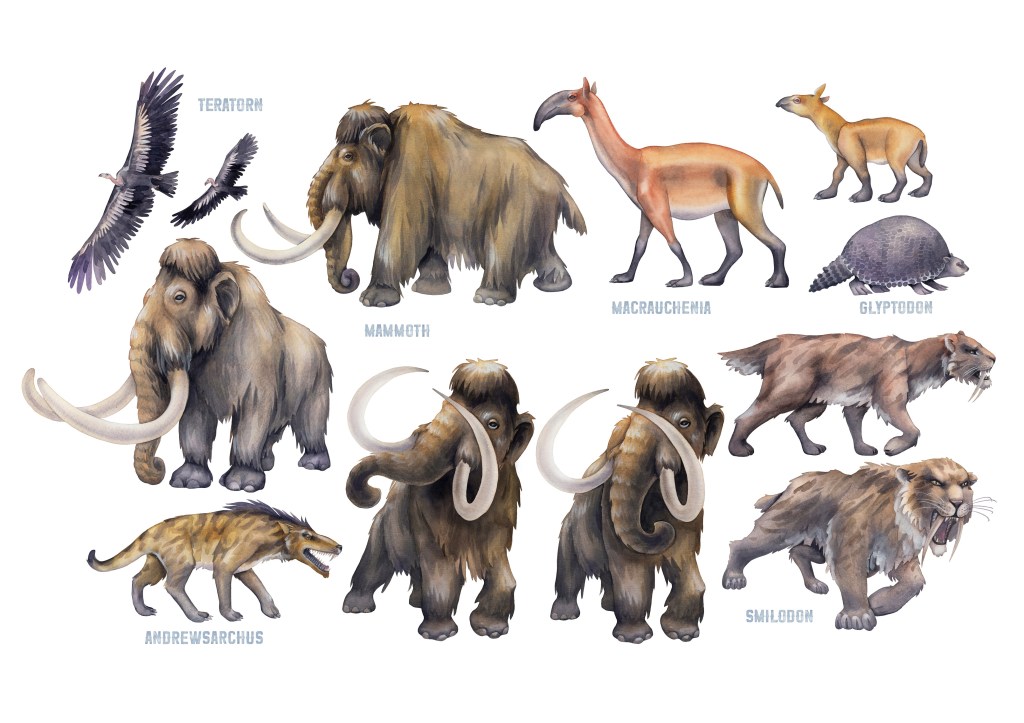
Collection of watercolor prehistoric and now extinct animals isolated on a white background. Hand painted illustration of Ice Age. Asset id: 2169205593 by Ekaterina Glazkova
Estimating the extinction rate is a complicated task that requires some assumptions and estimations. This article from the National Library of Medicine use what it claims to be conservative estimates, which would tend to minimize evidence of an emerging mass extinction. Despite that fact the average rate of vertebrate species loss over the last century is up to 100 times higher than the extinction rate without/before humans (background rate). Other sources claim an extinction rate that is 1,000 or even 10,000 the background rate.
To put some specific numbers on what a high extinction rate means, scientists count 881 animal species are known to have gone extinct since around 1500. If we include animal species that scientists suspect might be extinct, that number shoots up to 1,473. You can read more on the issue here or here or here.
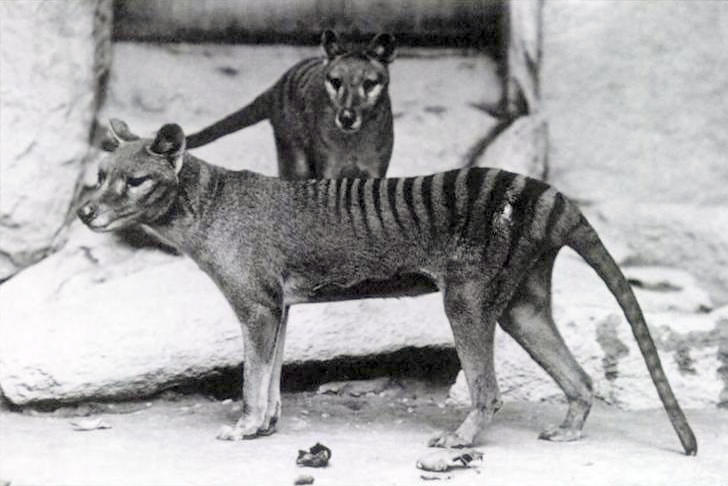
Two Tasmanian Tigers. The Tasmanian Tiger or Thylacine was hunted to extinction. Benjamin, the last Tasmanian Tiger, died in 1936 in the Beaumaris Zoo in Tasmania. Baker; E.J. Keller., Public domain, via Wikimedia Commons
What is clear is that the current extinction rate is much higher than what is typical and we humans are the cause. This came as a shock to me the first time I found out about it, and it is certainly an important topic, and therefore a super fact. It is true, surprising to many, and important.
Those who want to minimize the problem with the ongoing extinctions often point out that extinctions are a natural part of evolution and that throughout Earth’s history up to around 98% of all species that have ever existed are now extinct. In my opinion, that argument fails to consider the enormity of Earth’s four billion year natural history. A lot of evolution happened during that time.
Modern humans have only been around 300,000 years, or 0.0075% of that time, a tiny blip in time. Human civilization has only been around for 12,000 years, or 0.0003% of that time, an even tinier blip in time. Like comparing an ant head to a mile. Us having a large negative impact on the natural world in such an extremely short time is quite notable.
By considering the extinction rate you get a better idea of the scope of the problem. The fact that the extinction rate today is significantly higher than the expected natural rate and that the primary cause of modern extinctions is human impact as opposed to natural phenomena, makes it a case for concern. To read about a related issue, “The Wild Mammal Biomass Has Substantially Declined”, click here.
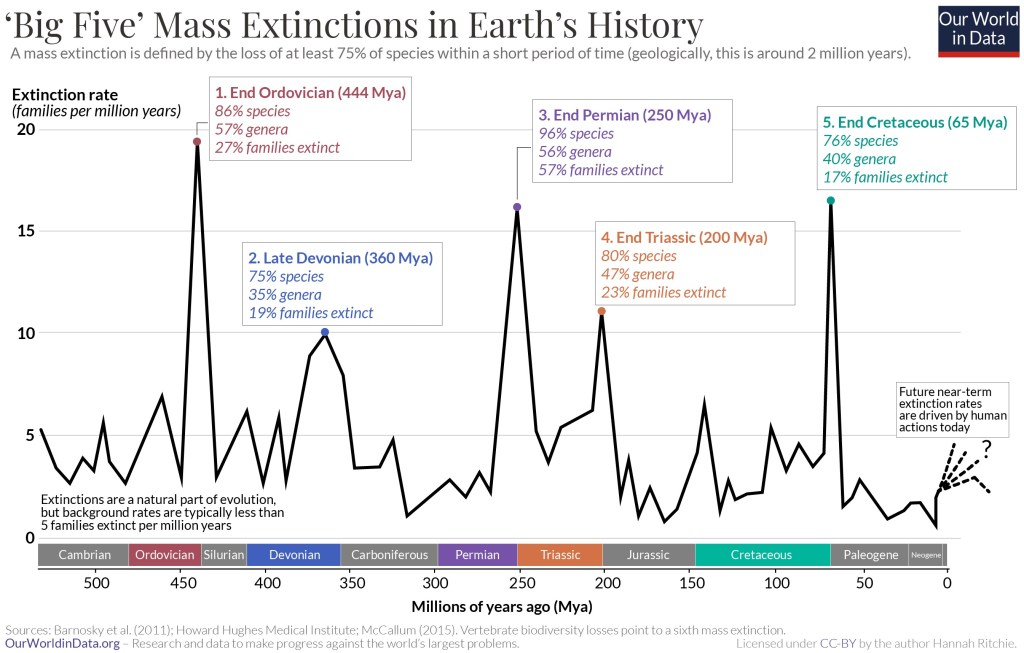
Over the last 440 million years life on Earth has experienced five so called mass extinctions. A mass extinction event is when at least 75% of the world’s species are lost during a short period of time – geologically speaking. This period is not clearly defined but often defined to be two million years. Two million years may seem like a long time, but geologically speaking, it is a short time.
Extinction of the dinosaurs when a large asteroid hits earth 66 million years ago. It was the last mass extinction event. Asset id: 2196200279 by funstarts33
End Cretaceous (65 mya) – the event that killed off the dinosaurs.
Below is an overview of the five big mass extinctions in Earth’s history. The graph is from Our World in Data.
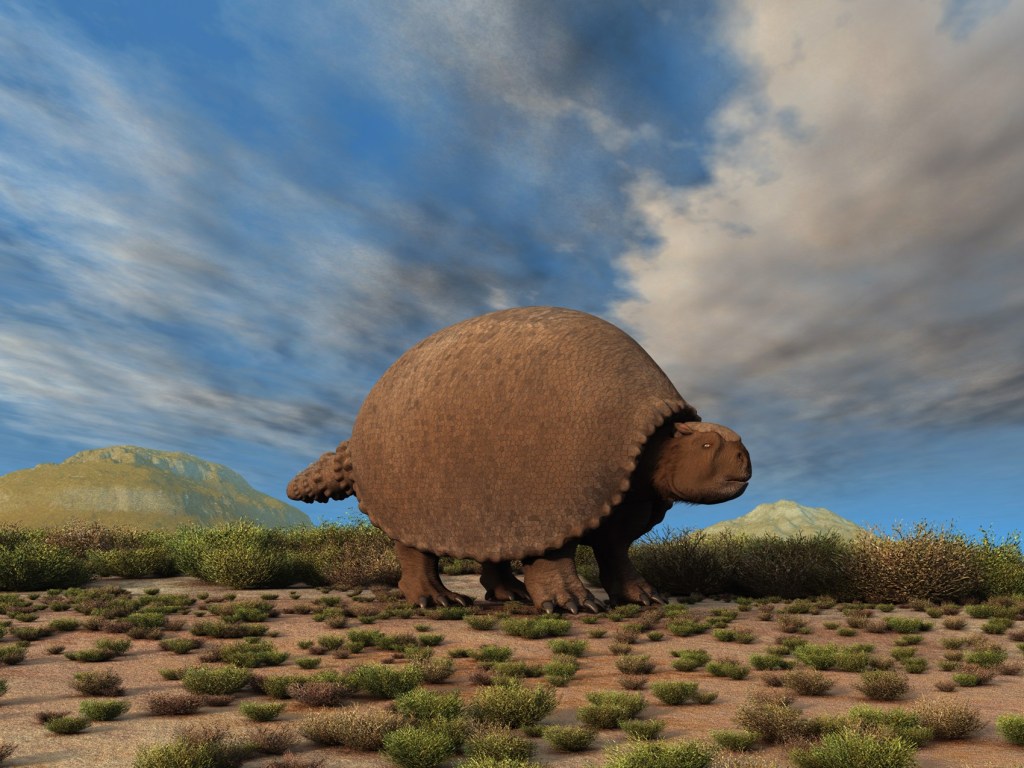
The Big Five Mass Extinctions in Earth’s History. A mass extinction is defined by the loss of at least 75% of species within a short period of time (geologically, this is around 2 million years). Extinctions are a natural part of evolution, but background rates are typically less than 5 families extinct per million years. Sources Barnosky et al (2011). Howard Hughes Medical Institute: McCallum (2015). Vertebrate biodiversity losses point to a sixth mass extinction. From Our World in Data.Are We in the Middle of a Sixth Mass Extinction ?3D illustration of a Glyptodon, also extinct, Asset id: 495169627
Biodiversity experts have estimated that about 30% (uncertainty range: 16–50%) of species have been globally threatened or driven to extinction since the year 1500. 30% globally threatened or extinct is not 75% that are actually extinct, but in just 500 years that looks like a quick start on a mass extinction. It should be noted that 500 years is just 0.025% of two million years. Issues such as deforestation, chiefly the result of replacing forests with agriculture, overexploitation, and global warming / climate change are driving extinctions and represent big biodiversity threats in the near future.
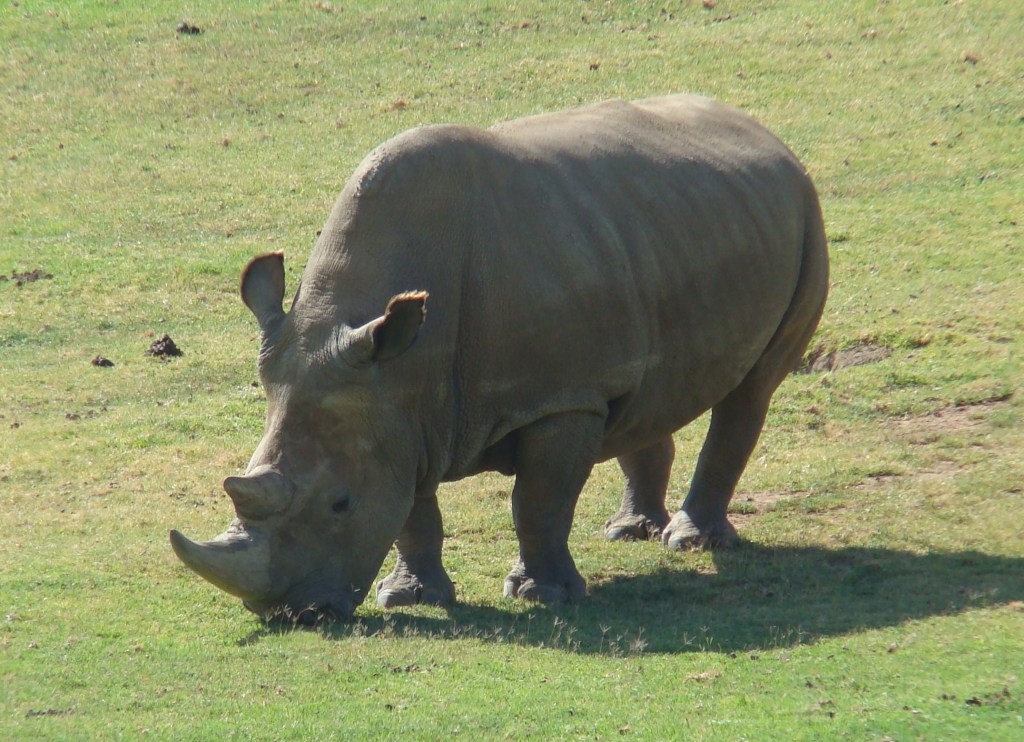
The Northern white rhino subspecies, the second-largest land mammal after elephants, has no hope of recovery after the last male died in 2018. Only a female and her daughter are left. The photo is of Angalifu, a male northern white rhinoceros at the San Diego Zoo Safari Park. Angalifu died of natural causes at the age of 44 on 14 December 2014. Sheep81, Public domain, via Wikimedia Commons.
Posting this on Thanksgiving Day may seem awkward. However, whether there will be a human caused sixth mass extinction or not depends on us, and it looks like more people want to protect our natural world. Many animals, such as the giant panda, bald eagle, the sea otter, black footed ferret, the Peregrine falcon, the blue whale, Rodrigues fruit bat, the Island night lizard, and the California condor, have been saved from extinction through conservation efforts like habitat restoration, anti-poaching laws, captive breeding programs, and reintroduction to the wild. Perhaps we are turning things around. We should give thanks to all who care.












 Super Facts