
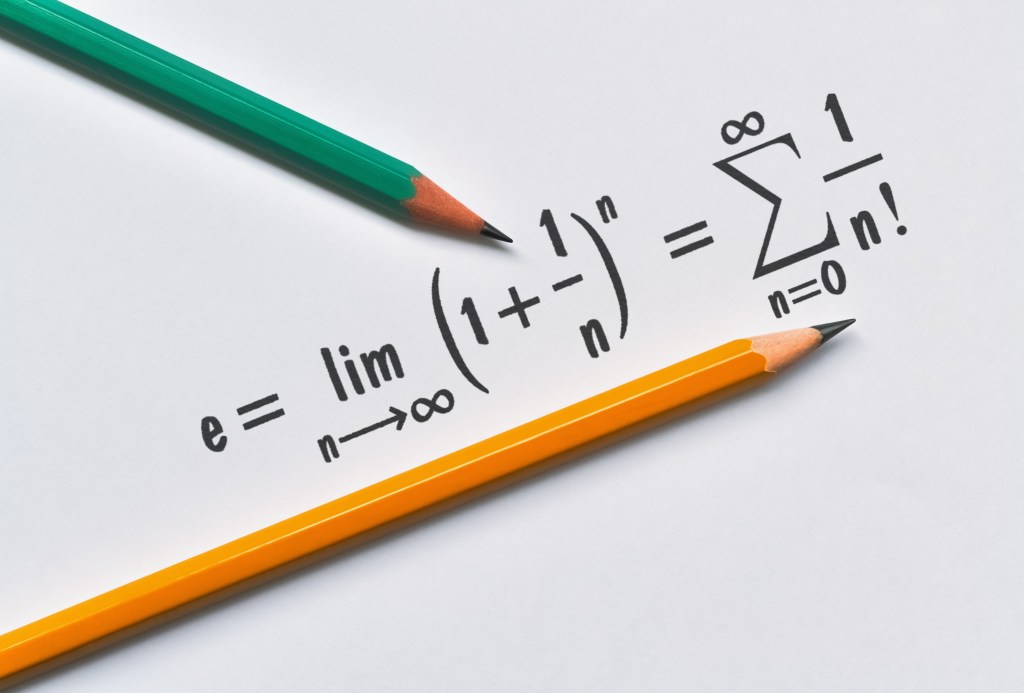
Super fact 53 : The Euler number denoted e, is an irrational number, which like the number pi is extremely important in mathematics. In addition, the relationship between the Euler number and pi; seemingly unrelated numbers, is quite amazing, especially if you throw the imaginary number: i = square root of -1 into the mix. Euler’s formula e^ix = cos(x) + isin(x), where x is degrees expressed in radians, is mind blowing to say the least. Radians means that 180 degrees is replaced by pi, and 90 degrees is replaced by pi/2, etc. A simpler special case, but equally amazing is Euler’s identity e^ix = -1, or e^ix + 1 =0. This is amazing math assuming you understand it.
As I said all this is amazing, mind blowing if you will, if you understand it, which is why I will try to explain it. Why I consider this a super fact is because when you first encounter the Euler number and the Euler formula, and you somewhat understand what it means, it is likely to be a mind-blowing experience. Those among you who have studied higher math, AP math classes in high school, or college level math are probably familiar with what I am about to describe, so your mind may not be blown. By the way you pronounce Euler like “Oiler”.

Euler’s Number and Pi Two Irrational Numbers
Pi is the number you get when you divide the distance around a circle (the circumference) by the distance across the middle (the diameter). The Euler number is a bit more complicated to explain. I will do that next. Both pi and the Euler number are irrational numbers, which means that when written as a decimal, the number neither terminates nor repeats. As I mentioned, both pi and the Euler number are extremely important numbers in math. Perhaps the Euler should have its own day, just like pi has its own day (March 14). Maybe we should start celebrating Euler number day on February 7.

Exponents
Before I explain what, the Euler number is, I need to explain what an exponent is. If you multiply a number by itself x number of times, then x is the exponent. If you multiply two by itself four times 2*2*2*2, called 2 raised to 4, then 4 is the exponent. By the way the answer is 2^4 = 16 (called 2 raised to 4 is 16). I hope the illustration below will explain it.

And finally, before explaining what the Euler number is I should also mention what a factorial is. The factorial of a number is the product of all positive integers less than or equal to that number. The factorial of 5 is denoted 5! and is 1*2*3*4*5 = 120. Also, the factorial of 0 or 0! = 1 (per definition).
Definition of the Euler Number
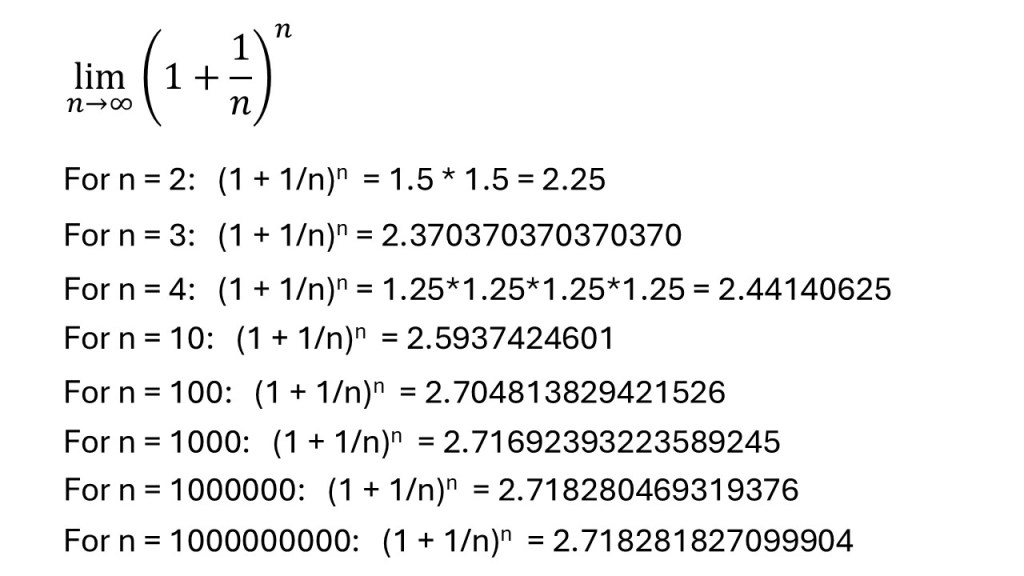
One more thing I need to explain before I go ahead with the definition for the Euler number is what is meant by allowing a number n in a formula to go towards infinity (limit –> infinity). Let’s say you have a formula that contains the number n. If the value of the formula does not change much as n becomes very large than it might be approaching a specific number as n approaches infinity. You say that it approaches a limit. I am trying to illustrate this in the picture below.

Euler’s Number in Calculus
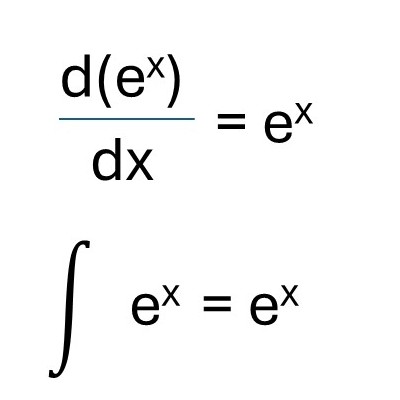
As I mentioned, Euler’s number shows up in mathematics in a lot of places. It is an extremely useful number with some amazing properties and that includes calculus. However, explaining functions and calculus may be going a bit too far, so I am just going to simply state that the derivate of e^x is just e^x and the indefinite integral, or the anti-derivative of e^x is e^x. In other words, differentiation / integration does not change this function. It also means that the slope of the curve is the same as the curve itself. Among all the infinite number of functions this is only true for e^x.
Trigonometric Functions
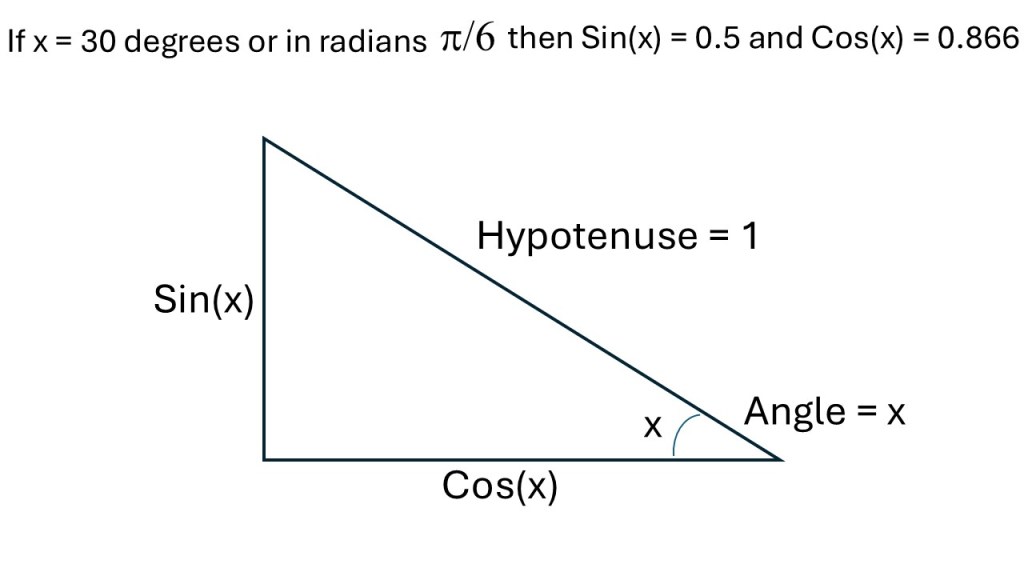
Next, I would like to launch into Euler’s formula. However, before I do that, I need to explain what trigonometric functions and imaginary numbers are. The trigonometric function sin(x) is the ratio of the length of the side opposite to a given angle to the length of the hypotenuse. In other words, if the hypotenuse is equal to 1, then sin(x) is the length of the opposite side to the given angle. The trigonometric function cos(x) is the ratio of the side of the triangle adjacent to the angle divided by the hypotenuse. In other words, if the hypotenuse is equal to 1, then cos(x) is the length of the adjacent side to the given angle.
Sin and cos are always between 1 and -1. ‘x’ is often expressed in degrees going from 0 to 360 (or 0 to 90 in a right-angled triangle). However, there is another way to express angles in triangles and that is radians. In this case the number pi corresponds to 180 degrees, pi/2 corresponds to 90 degrees, pi/4 corresponds to 45 degrees, etc. Euler’s formula uses trigonometric functions, but it only works if you use pi instead of degrees. Pi and Euler’s number have a special relationship. Sin and cos are illustrated in the picture below.
Imaginary Numbers
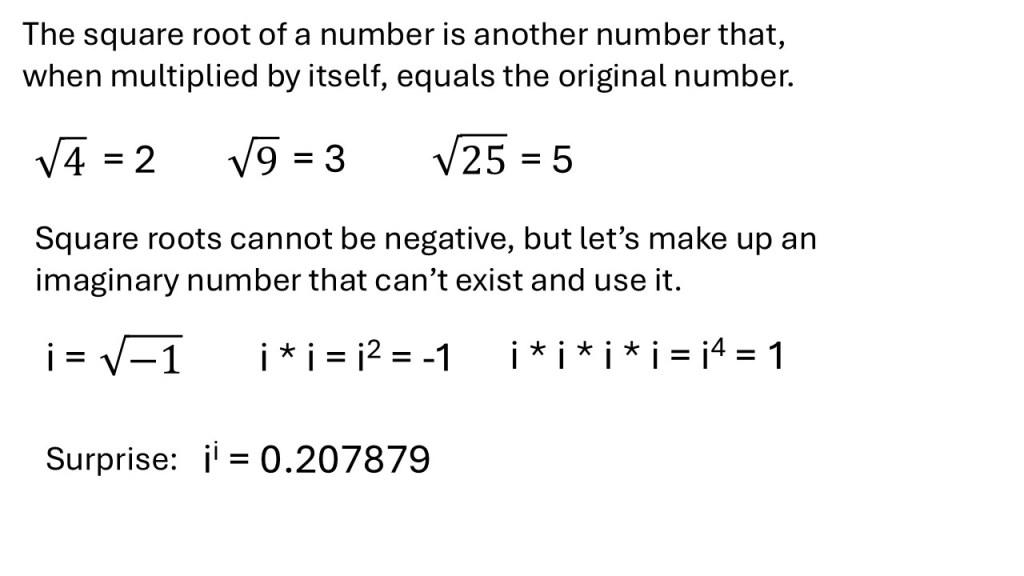
The last thing I need to explain before demonstrating Euler’s formula is imaginary numbers. The square root of a number is another number that, when multiplied by itself, equals the original number. For example, the square root of 4 is 2, because 2 * 2 = 4. The square root of 9 is 3, because 3 * 3 = 9. As long as you deal with real numbers, square roots must be positive numbers because you cannot multiply two numbers and get a negative number. -2 * -2 is 4, not -4.
However, that did not stop some mathematicians from making up a square root that was negative. This imaginary number is the square root of -1 and is referred to as i, yes just i, for imaginary. So, what’s the point of making up numbers that can’t exist? Well, it turned out to be quite useful and you can manipulate imaginary numbers to result in real numbers. For example, if you multiply the imaginary number i by itself i*i you get -1. If you multiply i by itself four times, in other words i^4, or i raised to 4, you get 1. Even more impressively, i raised to i, or i^i, is a real number. i^i = 0.207879… This is illustrated in the picture below.
Eulers Formula
Without giving the proof, or any detailed explanations, below is Euler’s identity and Euler’s Formula (e^ix = cos(x) + isin(x)). Notice the mix of Euler’s number, pi, the trigonometric functions using radians (based on pi), and the imaginary number. Well, likely mind-blown, if you have not seen it already and you understood this post up to here.


If you want to see how you prove Euler’s Formula check out this youTube video.
If you want to learn more about the importance of Euler’s number in sommon and useful mathematics, check out this youTube video.
To see the other Super Facts click here

 Super Facts
Hi Thomas, I have to thank you for bringing back really good highschool memories. We had a fantastic mathematics professor (he was a Bridge champion too) and, back then, Romania had high academic standards when it came to the main subjects. Reading your blog post, I remembered using e in math, both in calculus and trigonometry. I know my son use it in university, he takes many maths classes in the Computer Science department. This was a great post and your explanations very clear and detailed 🙂
LikeLiked by 1 person
Thank you so much for your kind words Patricia. Halfway through I realized how much I would have to explain to reach the goal (Euler’s formula) and I was afraid it would be way too complicated. It seems like Romania, indeed had very high academic standards in math. It is great that your son is studying math and computer science. They are tough subjects but very useful in our modern world. I wish him the best of luck and lots of success.
LikeLiked by 1 person
I vaguely recall studying this, possibly in trig classes, but I don’t think it was called Euler. Maybe just e constant. I’d never know what to do with it today though 😊 Maggie
LikeLiked by 1 person
You are right Maggie the Euler number is often referred as just the constant e. This kind of math is not used by many but it is very useful to many engineering disciplines, such as Electrical engineering, Control Systems Engineering, Signal Processing, Computer Science and Graphics, but also financial analysis, and of course for physicists.
LikeLike
I confess that this went over my head more than a bit! I’ll show it to my son, though, who has a passion for science (and is super smart lol!).
LikeLiked by 1 person
That is great Ada. Congratulations to your son. Science fields are great fields to be in. I should say that when I started typing I did not realize how many things I needed to explain to get to the Euler formula. It became long and more complicated than I had hoped.
LikeLiked by 1 person
Mind + Euler = KABLAM 🤯!
LikeLiked by 1 person
Yes an amazing formula. Thank you Grant.
LikeLiked by 1 person
I’m looking at differentiation and integration and thinking I once understood all of that. Sigh.
LikeLiked by 1 person
When I started typing I did not realize how many things I needed to explain to get to the Euler formula, and differentiation and integration is too much to explain. That would be an extremely long blog post so I had to skipped it.
LikeLiked by 1 person
Ha, I remember “e” and imaginary numbers and all that from my college days. As I recall, “e” showed up like all the time. Prior to reading this though I had long since forgotten why …
LikeLiked by 1 person
Thank you so much James. I admit I have not used it in a while either but I was thinking back and remembered how amazing the formula was, so I thought, that is a super fact.
LikeLike
Hi Thomas, this is a bit to higher maths orientated for me, but Greg is very familiar with it.
LikeLiked by 1 person
Yes it does not surprise me. To Greg it is old news. As I started typing I did not realize how long and complicated it would be. I realized halfway how many things I needed to explain to get to the Euler formula.
LikeLike
Greg holds this mathematician in very high regard. The maths was a little OTT for me but I followed as best I could.
LikeLiked by 1 person
That is interesting to hear and thank you for trying Robbie.
LikeLike
I can always get the main points. The details I don’t worry about much.
LikeLiked by 1 person
I think that is great. The details may be too much into the weeds. The main points are the most important.
LikeLike
Yes
LikeLiked by 1 person
PS Greg has talked about Euler a bit to me. I only recognise the name because you said Oiler.
LikeLiked by 1 person
His name is often mispronounced and from the spelling you don’t expect how it is pronounced but “oiler” is good.
LikeLike
Oiler is very recognisable.
LikeLiked by 1 person
Yes I guess you are right
LikeLike
Well, maybe only to mother’s whose sons aspire to be mathematics professors.
LikeLiked by 1 person
That is very exciting. I wish them the best of luck with that fascinating career.
LikeLike
It’s a calling, I think
LikeLiked by 1 person
Yes I guessed that. That is great.
LikeLike
🩷
LikeLiked by 1 person
Very nice post. On a side note, a math professor of mine once said there were members of the Euler family in Texas. When we looked at him unbelieving, he held out his arms and said, “You never heard of the Houston Eulers?”
LikeLiked by 1 person
Thank you David. Houston Eulers, ha ha that was funny.
LikeLiked by 1 person
Java Bean: “Ayyy, can we use these imaginary numbers to get more treats somehow? Asking for a friend …”
LikeLiked by 1 person
Yes but the risk is that you will get imaginary treats
LikeLike
Nice ♥️
LikeLiked by 1 person
I found this article quite helpful. Looking forward to more content like this.
LikeLiked by 1 person
Thank you for your kind words identity v top up, and sorry for the late reply. Your comment was in the spam and I had not checked it for a while.
LikeLike
Fascinating stuff, much enjoyed – many thanks.
LikeLiked by 1 person
Thank you so much Michael
LikeLiked by 1 person