
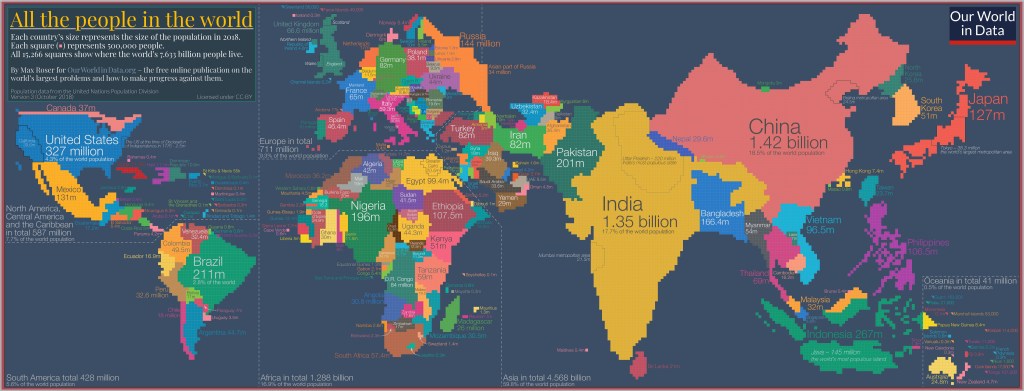
Super fact 57 : Half the World’s Population live within a circle that covers 2% of the world’s surface, or 10% of earth’s land area. This circle is often referred to as the “Valeriepieris Circle” or Yuxi Circle, and it is centered on southeast Asia.
This circle, has a radius of a bit more than 2,000 miles, and encompasses densely populated areas of East and South Asia, including major population centers like China, India, and Indonesia. The original Valeriepieris Circle was created by a teacher named Ken Myers in 2013 and was larger (radius 2,500 miles) than the more optimized circle created in 2015. In 2015, Singaporean professor Danny Quah—with the aid of an intern named Ken Teoh created a significantly smaller circle (radius 2,050 miles) that included half the world’s population. 4.2 billion people live in the Valeriepieris Circle, which is 5.6 times as many people as in Europe and 12.4 times as many people as in the Unites States.
I consider this a super fact because it is true, it is an important fact, and it is a surprising fact to those of us who have not come across this information before. It is an important fact because it impacts how we view our world. The circle is located far away from Europe and North America, in a part of the world that is rising quickly economically. The people in this highly populated circle have different cultures, music, literature and religions from the US and Europe. They speak different languages, and they play different sports, well soccer (the real football) is international but not as common in the Valeriepieris Circle as in Europe or South America.
Those among us who live outside of this circle, for example, in the United States or Europe, probably need to pay more attention to this half of world. Especially, if you live in the United States, it is easy to believe that the world is about us. The existence of this circle demonstrates that this view is not a realistic view.


Population of Southeast Asia
The countries that are part of the Valeriepieris Circle are, for example,
- India (1.47 billion people)
- China (1.415 billion people)
- Indonesia (286 million people)
- Bangladesh (176 million people)
- Japan (123 million people). It is not included in the second circle.
- Philippines (117 million people)
- Vietnam (102 million people)
- Pakistan (256 million people)
- Thailand (72 million people)
- Myanmar (55 million people)
- and a dozen more countries.
Population Statistics
Most people know that in recent centuries the world population has grown almost exponentially but is now projected to level off sometime around the middle of this century. Europe is an interesting example. A thousand years ago Europe’s share of the world population was around 14.5%. Then came the scientific revolution and the industrial revolution and by 1900 it was 25%. As other countries around the world became industrialized Europe’s share of the world population shrunk, even though the population of Europe kept increasing, just slower. Now Europe’s share of the world population is 9%.
As countries become wealthier their population growth tends to slow down, not just in Europe, but around the world. The world’s population growth is illustrated by the image from Our World in Data below (starting 5,000 years ago, ending the year 2000) and the six minute YouTube video below from the American Museum of Natural History (starting 100,000 years ago and ending the year 2100). The YouTube video also shows the projected population decline beyond the year 2050.

A somewhat related super fact is – Poverty and child mortality has been sharply reduced worldwide.
Next Super fact coming up is : Time is the fourth dimension
To see the other Super Facts click here

 Super Facts
Hi Thomas, unfortunately, the area you have mentioned as being so densely populated also has the worst abuse of women’s rights. A big limiting factor in their economic growth and a massive reason for their gross overpopulation. It would be a terrible thing for women everywhere if the American Empire fails.
LikeLiked by 3 people
I did not consider that while writing this but, yes, you are right. That so much of earth’s population is concentrated inside this one circle isn’t necessarily good news, but it is important.
LikeLike
Had no idea that Europe’s share of the world population is just nine percent! What a fascinating post; I always learn such cool things on your blog.
LikeLiked by 1 person
Thank you so much Ada. Yes it it’s share of the world population is likely to continue to decline by a couple of more percent until mid century.
LikeLiked by 1 person
I guess your map is how most Americans see Canada? Just kidding. I knew this area was highly populated, but this puts it into perspective. Maggie
LikeLiked by 2 people
Ha ha yes. I am not surprised you knew. You are very well travelled.
LikeLike
I knew that part of the world is the most heavily-populated, but didn’t realize it was by that much. And I agree with what Roberta said about the reasons why. It’s a terrible state of affairs!
That’s not news to us, in the rest of the world. 😆 And it explains the map, which cut Canada out of the picture entirely, as per Maggie’s observation. 😉
The YouTube video was enlightening! Thanks for sharing it.
LikeLiked by 1 person
That’s how I felt too the first time I saw this. I knew Southeast Asia had a lot of people, but half the world, that was a surprise. And I agree, Roberta, and you have a good point. About the map, Canada is there, north of the US in red, but since the Canadian population is 12% of the US population it is much smaller.
However, I certainly know what you are talking about. My comment “it is easy to believe that the world is about us” was for Americans. I see it all the time. I am administrating several beer review groups on Facebook founded by a group of Italians and 90% of the members are not Americans. Despite that you frequently see posts like “what beer are you going to drink with the football game tonight?” meaning American football like Pittsburgh Steelers, or Dallas Cowboys, as if the Italians, the Chinese, Brazilians and Greeks are going to watch Pittsburgh Steelers play or even know what it is. I don’t see Indians ask what beer are you going to drink with the cricket game tonight. The first time I even knew American football existed was when I came over to the US as an exchange student.
Thank you so much Debbie.
LikeLiked by 1 person
I was just joking about the map, carrying on what Maggie said. 😆 I realize the country size is proportionate to the population and most of ours is centred along the U.S./Canada border, including me. 🙂 And yes, I see it all the time too, that Americans assume they are the only ones in a particular group of people. 🙄 As for football, most of the world recognizes it as the game with the round ball. ⚽ I mistakenly thought “soccer” was a North American word, to differentiate the game from American (and Canadian) football. Not so! This is interesting:
https://www.britannica.com/story/why-do-some-people-call-football-soccer
LikeLiked by 1 person
Yes about the football, the first time I found out about American football, or football as it is called in the US, was when I came over as an exchange student. You are right in the rest of the world football is what is called soccer in the US, which can be very confusing. American football should really be called hand egg since the so called ball looks like an egg and is handled mostly with your hands. (that was a joke) Anyway, most of the world understand that their local sports are not worldwide phenomena but Americans have a hard time grasping that. The awareness of the rest of the world, and the fact that is much bigger than the US is lacking, I think that now when the devloping world is rising in power and economically, that awareness needs to grow.
LikeLiked by 1 person
“Hand egg” 🏈 😆 Regarding awareness, education is the key. For example, most Canadians and Europeans know more about U.S. politics and geography than some Americans do. 😲
LikeLiked by 1 person
Yes I agree, education is the key, and when it is about education about the world it is much better in Canada and Europe than in the US. I’ve noticed that.
LikeLiked by 1 person
This was a typo “Facebook founded by a group of Italians” I meant “Facebook including one founded by a group of Italians”
LikeLiked by 1 person
Interesting.
LikeLiked by 1 person
Thank you Jacqui
LikeLike
Java Bean: “Ayyy, sure is funny how humans live in such kinda concentrated areas and still manage to affect everywhere else on the planet …”
LikeLiked by 1 person
You are right Java Bean. Some things like greenhouse gas pollution, ocean acidification, and access to limited resources affect everyone on the planet.
LikeLike
Why hasn’t the population of China continued to grow, despite the one-child policy? I’ve heard they changed to a three-child policy.
LikeLiked by 2 people
Oops! I meant, why has the population of China continued to grow? Why hasn’t the population of China declined, considering the one-child policy?
LikeLiked by 1 person
There were loop holes and some chose to pay the fines rather than following the policy and then the population momentum from the large number of people born before the policy. However, the population in China is finally declining.
LikeLike
Like other commenters, I knew that region of the world was heavily populated, but I didn’t realize it encompassed a full half of the world’s population. That is fascinating and it does bear paying close attention to what happens in that part of the world.
LikeLiked by 2 people
Yes the same here. I knew the area was heavily populated but before I came across this circle I did not know to what degree. Half the world population is pretty shocking. Yes I think we need to pay more attention to Southeast Asia.
LikeLiked by 1 person
Dear Thomas
The morning tea or coffee can wait, like we wait for spouse to join, but your post can’t wait. In the sense, I can’t wait to read your post.
Thank you for liking my post,’Right’ 🙏🌺
LikeLiked by 2 people
Thank you so much for your very kind comment Veerites
LikeLike
Fascinating, Thomas. I knew we were in the minority, but we’re not even close, and if you add up all the billions that are not us – whew, that’s a huge impact. Robbie brought up an interesting topic, too. Our lives would not be the same if the balance of power tilted even a little bit. Thanks for sharing.
LikeLiked by 2 people
Thank you so much Marsha. You are right we in the US as well as Europe (I’m from both) are a small miniority and as Southeast Asia (half of us) rises economically it will impact geopolitics and everyone on earth, and what Robbie brought up is certainly an interesting angle I did not consider.
LikeLiked by 1 person
Robbie is like that, she is sharp on lots of angles. I wouldn’t have thought of it either.
LikeLiked by 1 person
Yes I’ve noticed. Thank you Marsha.
LikeLiked by 1 person
Oh wow I didn’t know this but do agree with R
LikeLiked by 3 people
Robbie about both women and child abuse and the fact that the trajectory that the US is on at the moment with have grave consequences for not just women but for mankind…A really interesting post, Thomas 🙂 x
LikeLiked by 2 people
Yes I agree with you and Robbie. I just didn’t think about it. Thank you so much Carol.
LikeLiked by 1 person
Yes with Robbie, and you live in the middle of the Valeriepieris Circle so you should know
LikeLiked by 1 person
I do,Thomas and yes there is so much that is better and much that could be improved but at the moment the better out weighs what I am seeing from my home country and the US …
LikeLiked by 1 person
Yes that makes a lot of sense.
LikeLiked by 1 person
Dear Thomas
Thanks for subscribing to my blog 👏
LikeLiked by 1 person
The Valeriepieris Circle is a striking reminder that half of humanity has always been anchored in Asia, where ancient trade, empire, and religion flourished, and where the future is now being shaped. It challenges the Western lens, showing that the demographic and cultural heart of the world lies not in Europe or America, but within this compact, ever-rising sphere.
LikeLiked by 2 people
Yes I think that is a very good way of putting it. Thank you Patricia.
LikeLike
Absolutely eye-opening info as always here Thomas. Thank you. 😋
LikeLiked by 2 people
Thank you so much Debby
LikeLiked by 1 person
😊
LikeLiked by 1 person
fascinating – we’re small, but scary…
LikeLiked by 1 person
I agree, it is fascinating and a bit scary
LikeLiked by 1 person
That’s so interesting, I had no idea.
LikeLiked by 1 person
Yes it is easy to underestimate how densely populated Southeast Asia is. Same here, I knew it was a lot of people, but half the world! That came as a shock the first time I read it.
LikeLiked by 1 person
Exactly, I knew the area was densely populated but had no idea if was this much.
LikeLiked by 1 person
We seem the same thing on a smaller scale right here in California, where by far most of the population lives within a few dozen miles of the coast. (The weather is much milder here than inland so I can’t blame us.)
LikeLiked by 1 person
I think that is a great comparison.
LikeLike
How interesting! I knew that there were population-dense countries in Southeast and East Asia, but I was unfamiliar with the statistics and the Valeriepieris Circle. The shifting demographics are interesting, and yes, the US should be looking for opportunities instead of enemies. Perhaps our schools should be teaching Chinese instead of French (sorry France). 🙂 A fascinating post, my friend. I like these. 🙂
LikeLiked by 1 person
Thank you so much Diana. It was the same for me, I knew Southeast Asia was highly populated but not that half the world was there. Chinese is very large language but so is French. There are a lot more people who speak French as a second language compared to, for example, Spanish, mostly in Africa, which is the fastest growing continent population wise (they are predicted to surpass Southeast in a few decades, and the circle will move). So we shouldn’t discount French just yet.
LikeLiked by 1 person
LOL. I don’t want to discount any living language, really. I wish I spoke a bunch of languages!
LikeLiked by 1 person
I might be biased towards French since I am learning it, but it did come ahead (5th place) of Spanish (8th place) as a second language. Some forgotten (here in the US) but very large languages are Mandarin, Urdu and Hindi.
LikeLike
I bet much of the world’s carbon emissions comes from that circle.
Therefore, maybe the world should focus on minimizing carbon emissions in China and India, etc.
LikeLiked by 2 people
Maybe, what you are saying is true and false. China is the country with the largest amount of carbon emissions in the world, almost a third of the world total. On the other hand the US carbon emissions are 13.83 per capita / per person, while China’s is 9.24, less than us in the US. Add to that the fact that historically the US is the country with the largest total amount of carbon emissions, and in that sense are the most responsible for the current problem. On the other hand China is exporting several goods to us, steel, aluminum, etc., that have been produced with a lot more emissions per ton than we in the US generate for the production of the same products (per ton) without us taking any action on that. On the other hand China, has after a relatively quick rise in GDP, began to address their emissions, and it looks like their emissions have now peaked. You see the blame game is quite complicated and deciding where we should focus is also complicated. It is better if everyone takes responsibility for their own emissions rather than looking across the border. You can read more about that here.
LikeLike
Your narrative flows like a well-drawn map—first a surprising fact, then layers of context, history, and implications. It is a journey easy to follow, each step leading us deeper into the realization of how unevenly the world is populated.
Most importantly, the essay captures the historical and cultural meaning behind the numbers. You remind readers that Asia is not just a distant region, but the vibrant heart of humanity today. That perspective makes the fact both powerful and humbling.
LikeLiked by 1 person
You are certainly very kind and nice Livora. Thank you so much.
LikeLiked by 1 person
What if the population of China dropped to 500 million? What if the population of India dropped to 500 million? Wouldn’t that be good for the environments of those countries? I’d like to see the population decline.
If the world human population dropped to 2 billion, that might be good for the environment. Greenhouse gas emissions would drop for example.
LikeLiked by 1 person
Yes I agree, that would be one way of reducing a lot of greenhouse gas emissions as well as various kinds of pollutants, land use, etc. However, that is very difficult to do and will take a very long time even if you try. It would also meet a lot of resistance from people who want to have kids. I think you start with the lower hanging fruit, such as replacing coal plants with renewables or nuclear.
LikeLike
I forgot to mention, the extinction rate of animals would decline greatly. Deforestation would decline.
LikeLiked by 1 person
Yes you are right
LikeLike