The goal of this blog is to create a list of super facts. Important facts that are true with very high certainty and yet surprising, misunderstood, or disputed by many. This blog aims to be challenging, educational, and fun, without it being clickbait. I determine veracity using evidence, data from reputable sources and longstanding scientific consensus. Prepare to be challenged (I am). Intentionally seek the truth not confirmation of your belief.
Eulers Polyhedra Math Magic
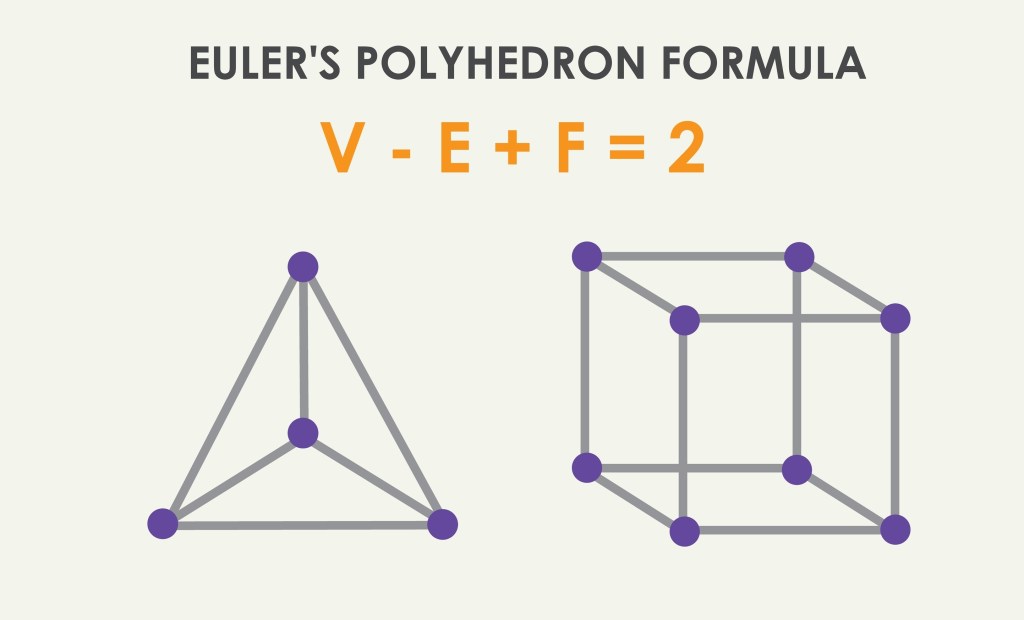
Super fact 64 : V – E + F = 2 is true for all convex polyhedra, where V is the number of vertices (corners), E is the number of edges, and F is the number of faces of a convex polyhedron. This is called Euler’s formula for polyhedra.
Polyhedron Euler’s formula. The cube has 6 faces, 8 corners (blue dots), and 12 edges (grey lines) and 8 – 12 + 6 = 2. Popular shapes Asset id: 2362684465 by ramonparaiba.
Convex polyhedra are polyhedra without holes, or it has no internal angles larger than 180 degrees. To express that exactly; A convex polyhedron is a three-dimensional solid with flat polygonal faces where a line segment connecting any two points on its surface or interior remains entirely within the solid. I can add that convex polyhedra consists of convex polygons as their faces. All its faces are convex polygons.
The difference between convex and concave polygons. Notice that the concave polygons on the right have “holes” in them, or inner angles larger than 180 degrees, and that you can draw a line starting and ending inside the polygon that goes outside the polygon.
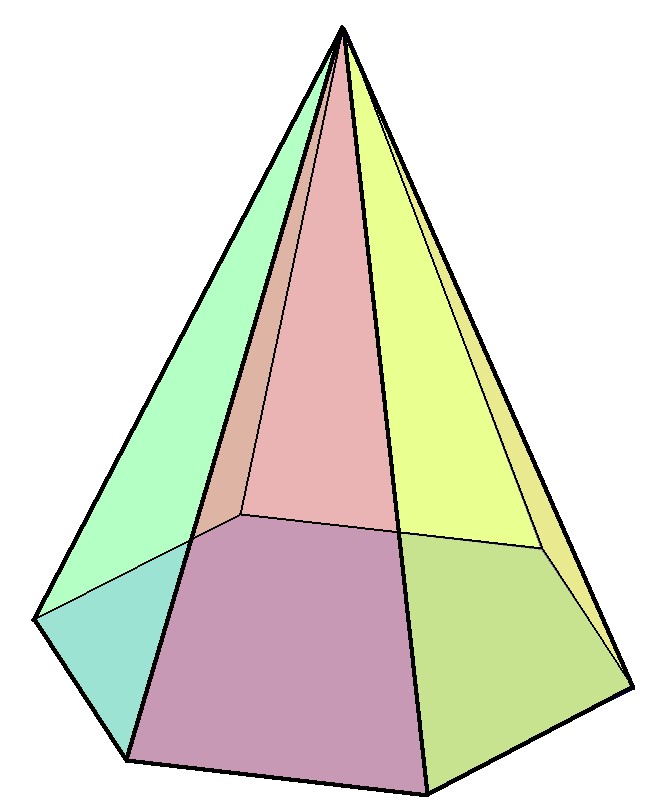
It is easy to understand that there are an infinite number of convex polyhedra. All pyramids (with convex polygons for bottoms) are convex polyhedra whether the bottom is a square/rectangle, or a convex pentagon, hexagon, heptagon, octagon, or any kind of convex polygon, even with trillions.
A hexagonal pyramid (it is convex). Tomruen at en.wikipedia, Public domain, via Wikimedia Commons.
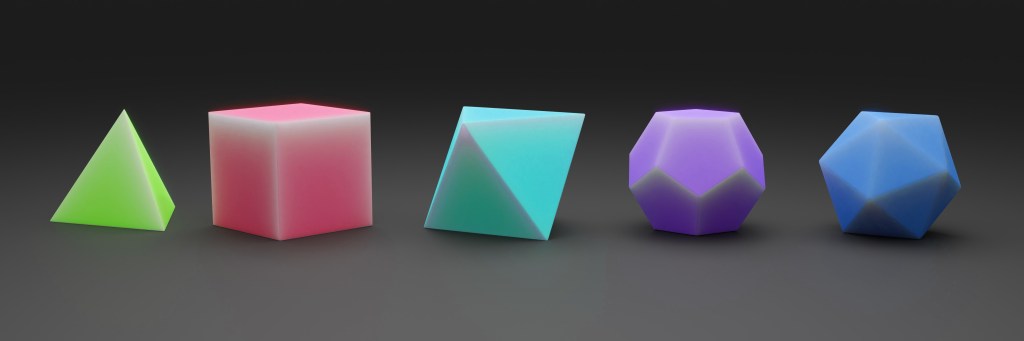
Examples of convex polyhedra are cubes, boxes, a tetrahedron, pyramids of various sorts, an octahedron, dodecahedron, icosahedron, but there are infinitely many.
As an example, take a cube (like a dice). It has six faces (F = 6), eight vertices (corners V = 8), and 12 edges (V – E + F = 2 or 8 – 12 + 6 = 2). A tetrahedron has four faces (F = 4), four vertices (V =4), and six edges (E = 6) (V – E + F = 2 or 4 – 6 + 4 = 2). A pyramid (with a square bottom) has five faces (F = 5), five vertices (V = 5) and eight edges (E = 8) (V – E + F = 2 or 5 – 8 + 5 = 2). An octahedron has eight faces (F = 8), and six vertices (V = 6), and twelve edges (E = 12) (V – E + F = 2 or 6 – 12 + 8 = 2). A dodecahedron has twelve faces (F = 12), and twenty vertices (V = 20), and thirty edges (E = 30) (V – E + F = 2 or 20 – 30 + 12 = 2). An icosahedron has twenty faces (F = 20), and twelve vertices (V = 20), and thirty edges (E = 30) (V – E + F = 2 or 12 – 30 + 20 = 2). Euler’s Polyhedral Formula works for all of them and for all the infinite number of convex polyhedra that exists.
Tetrahedron, cube, octahedron, dodecahedron and icosahedron, Shutterstock Asset id: 2138211027 by Dotted Yeti
I consider this a super fact because it is quite amazing and surprising that the number of faces, vertices, and edges follow the same formula for all convex polyhedra. At least it is surprising if you haven’t seen it before. I should say that Leonhard Euler’s most celebrated discovery is probably his discovery of the Euler Number and the associated Euler’s Formula.
More Polyhedra Examples
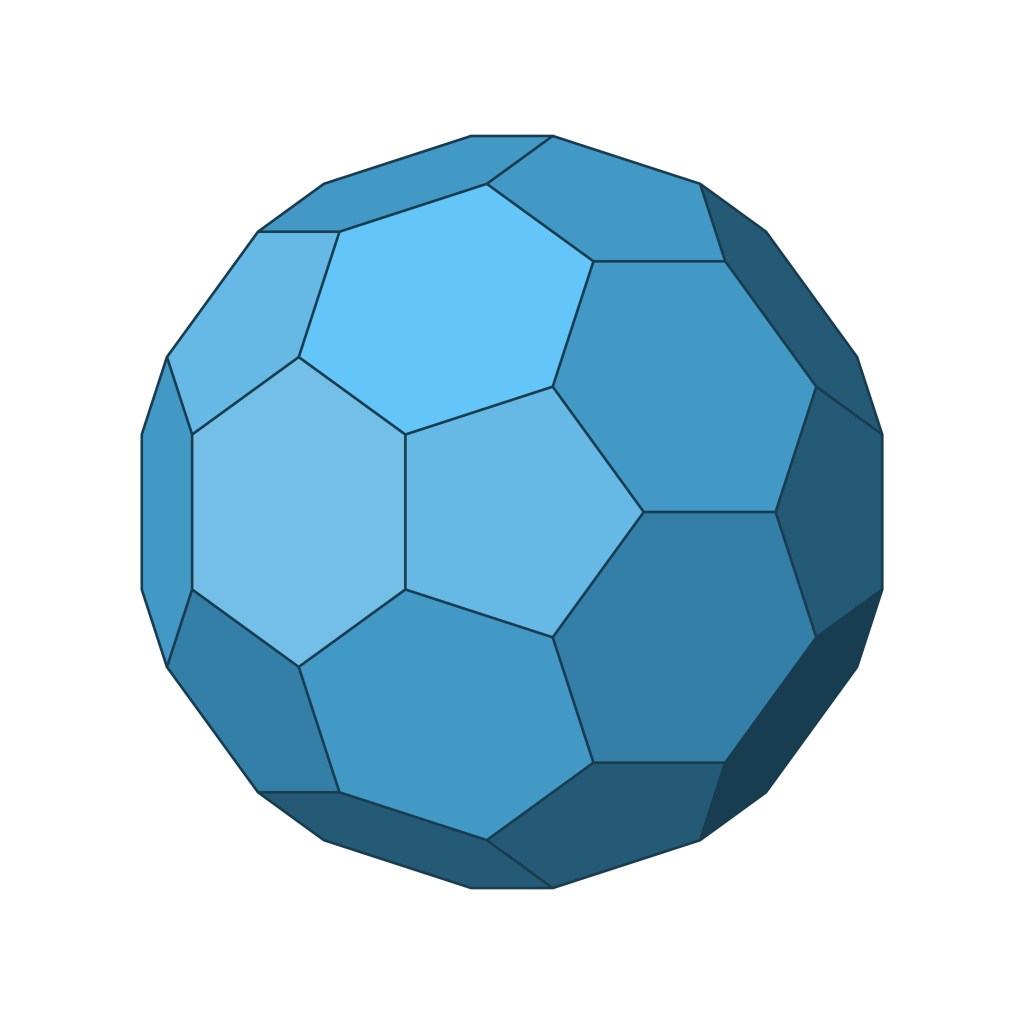
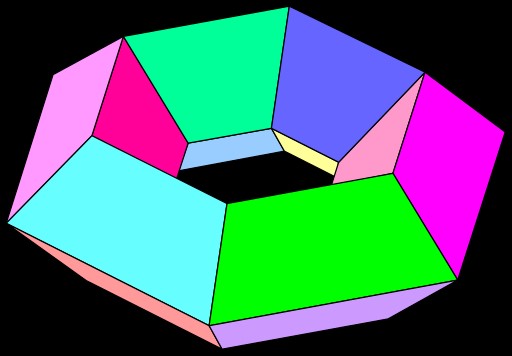
The three first examples below are convex polyhedra so Euler’s Polyhedral Formula apply. The last two examples are not so Euler’s Polyhedral Formula does not apply.
This is a truncated icosahedron, which is a convex polyhedra, so Euler’s Polyhedral Formula apply. Shutterstock Asset id: 2309812551 by Mima Subota.This Rhombicuboctahedron is an example of convex polyhedron, so Euler’s Polyhedral Formula applies. Cyp, CC BY 4.0 <https://creativecommons.org/licenses/by/4.0>, via Wikimedia Commons.This Icosidodecahedron is another example of a convex polyhedron, so Euler’s Polyhedral Formula applies. Attribution must be given to Robert Webb’s Stella software as the creator of this image along with a link to the website: http://www.software3d.com/Stella.php. A complimentary copy of any book or poster using images from the Software would also be appreciated where feasible., Attribution, via Wikimedia CommonsThis hexagonal torus / toroidal polyhedron is not a convex polyhedra, so Euler’s Polyhedral Formula does not apply in this case. Tom Ruen, SVG version from de:User:Antonsusi, Public domain, via Wikimedia CommonsThis Merkaba Polyhedron is not a convex polyhedra, so Euler’s Polyhedral Formula does not apply in this case. Shutterstock Asset id: 1296063079 by Panimoni
My name is Thomas Wikman. I am a software/robotics engineer with a background in physics. I am currently retired. I took early retirement. I am a dog lover, and especially a Leonberger lover, a home brewer, craft beer enthusiast, I’m learning French, and I am an avid reader. I live in Dallas, Texas, but I am originally from Sweden. I am married to Claudia, and we have three children. I have two blogs. The first feature the crazy adventures of our Leonberger Le Bronco von der Löwenhöhle as well as information on Leonbergers. The second blog, superfactful, feature information and facts I think are very interesting. With this blog I would like to create a list of facts that are accepted as true among the experts of the field and yet disputed amongst the public or highly surprising. These facts are special and in lieu of a better word I call them super-facts.
View all posts by thomasstigwikman
Well thank you for kind word Cindy. The genius was Leonhard Euler though. A very smart mathematician. Another one making amazing discoveries is Karl Friedrich Gauss.
I remember the old bouncing ball animation they used to show off the Amiga’s graphics capabilities back in the 80s. That was one of these. I don’t remember how many sides it had, but we were all pretty impressed that you could do that with a computer, back in the day.
Yes I remember something similar. Perhaps not on an Amiga but other computers. In the 1990’s, a bit later, I used to create graphics for simulating industrial robots. I used vrml created from CAD drawings and then I attached robot control systems to the graphics, and kinematics between the simulated motors and joints/links. It was an early factory floor simulation program and I won an award for it.
“Wow! 🌟 Euler’s formula is really fascinating. It’s amazing how V – E + F = 2 holds true for all convex polyhedra, no matter how simple or complex. I also liked the examples of different polyhedra and how you showed which ones it applies to and which ones it doesn’t. The visuals make it super easy to understand. Thanks for sharing this super fact! ❤️”
Yes I agree that is fascinating, and today I discovered it exists for multiple dimensions as well. It wasn’t Euler who invented those extensions, that is modern math, but it makes it even more fascinating. It turns out that the right hand side is 2 for all odd dimensions and 0 for all even dimensions.
// 3D V – E + F = 2 (V = vertices/corners, E = edges, F = faces)
// 4D V – E + F – C = 0 (V = vertices/corners, E = edges, F = faces, C = cells (3D polyhedra))
// 5D V – E + F – C + N5= 2 (V = vertices/corners, E = edges, F = faces, C = cells, N5 = hyper-cells)
// 6D V – E + F – C + N5 + N6= 0 (V = vertices/corners, E = edges, F = faces, C = cells , N5 = hyper-cells, N6 = five dimensional cells)
This was surprisingly fun to read! I never thought math facts about shapes could be this cool. Those examples and visuals really help bring it to life — great post, Thomas!
Oh my, thank you for the gentle correction, Thomas! 😅 My apologies for the mix-up—and I truly appreciate your kindness and understanding. Names matter, and I’ll be sure to remember yours with gratitude. 🌿
Leonhard Euler introduced this formula in the 18th century, and it’s considered one of the earliest results in topological mathematics. His insight laid the groundwork for modern geometry and even influenced fields like computer graphics and architecture.






 Super Facts
Fun math, Thomas.
LikeLiked by 1 person
Yes thank you Grant
LikeLiked by 1 person
Cool post, Thomas!!
LikeLiked by 1 person
Thank you so much Ada
LikeLiked by 1 person
Wow! Really fascinating stuff!
LikeLiked by 1 person
Yes I think that formula is really cool
LikeLiked by 1 person
You’re a genius with these fun math games! 💗
LikeLiked by 1 person
Well thank you for kind word Cindy. The genius was Leonhard Euler though. A very smart mathematician. Another one making amazing discoveries is Karl Friedrich Gauss.
LikeLike
Some interesting information here, Thomas. The colourful shapes remind me of the book Flatland about dimensions.
LikeLiked by 1 person
Thank you Robbie. I did not read that book but I’ve heard of it.
LikeLike
I thought it was very interesting. Quite ahead of its time.
LikeLike
Wow, very interesting. I actually hadn’t even heard of Euler’s formula before.
LikeLiked by 1 person
It is one of those cool math discoveries that most people have never heard of.
LikeLiked by 1 person
I remember the old bouncing ball animation they used to show off the Amiga’s graphics capabilities back in the 80s. That was one of these. I don’t remember how many sides it had, but we were all pretty impressed that you could do that with a computer, back in the day.
LikeLiked by 1 person
Yes I remember something similar. Perhaps not on an Amiga but other computers. In the 1990’s, a bit later, I used to create graphics for simulating industrial robots. I used vrml created from CAD drawings and then I attached robot control systems to the graphics, and kinematics between the simulated motors and joints/links. It was an early factory floor simulation program and I won an award for it.
LikeLiked by 1 person
Oh, very cool!
LikeLiked by 1 person
Thank you James
LikeLike
I had forgotten about Euler’s formula for polyhedra. Thanks for this reminder of a fun, fascinating, and puzzling fact!
LikeLiked by 1 person
Yes I agree, it is a fun and puzzling fact
LikeLiked by 1 person
“Wow! 🌟 Euler’s formula is really fascinating. It’s amazing how V – E + F = 2 holds true for all convex polyhedra, no matter how simple or complex. I also liked the examples of different polyhedra and how you showed which ones it applies to and which ones it doesn’t. The visuals make it super easy to understand. Thanks for sharing this super fact! ❤️”
LikeLiked by 2 people
Yes I agree that is fascinating, and today I discovered it exists for multiple dimensions as well. It wasn’t Euler who invented those extensions, that is modern math, but it makes it even more fascinating. It turns out that the right hand side is 2 for all odd dimensions and 0 for all even dimensions.
// 3D
V – E + F = 2 (V = vertices/corners, E = edges, F = faces)
// 4D
V – E + F – C = 0 (V = vertices/corners, E = edges, F = faces, C = cells (3D polyhedra))
// 5D
V – E + F – C + N5= 2 (V = vertices/corners, E = edges, F = faces, C = cells, N5 = hyper-cells)
// 6D
V – E + F – C + N5 + N6= 0 (V = vertices/corners, E = edges, F = faces, C = cells , N5 = hyper-cells, N6 = five dimensional cells)
LikeLiked by 1 person
This was surprisingly fun to read! I never thought math facts about shapes could be this cool. Those examples and visuals really help bring it to life — great post, Thomas!
LikeLiked by 1 person
Yes there is a lot of cool stuff in math. Thank you so much for your kind comment Livora.
LikeLiked by 1 person
You’re very welcome, William! Math truly holds endless wonders.
LikeLiked by 1 person
Thank you Livora. I should say it is Thomas not William, but it is not important.
LikeLiked by 1 person
Oh my, thank you for the gentle correction, Thomas! 😅 My apologies for the mix-up—and I truly appreciate your kindness and understanding. Names matter, and I’ll be sure to remember yours with gratitude. 🌿
LikeLiked by 1 person
As they say in French c’est pas grave. Thank you so much Livora.
LikeLiked by 1 person
Thank you
LikeLiked by 1 person
Leonhard Euler introduced this formula in the 18th century, and it’s considered one of the earliest results in topological mathematics. His insight laid the groundwork for modern geometry and even influenced fields like computer graphics and architecture.
LikeLiked by 1 person
Thank you for the interesting information ARMYVET
LikeLiked by 1 person
I really enjoy reading these posts. Honestly, some of them I don’t understand. But I believe you. LOL.
LikeLiked by 1 person
Thank you so much for your kind words ARMYVET
LikeLiked by 1 person
💯🙏😁
LikeLiked by 1 person
Thanks 🙏 welcome you
LikeLiked by 1 person
Great maths! I loved Eulers when I was in school 🙂
LikeLiked by 2 people
Thank you Patricia. You are certainly well educated in math. Most people don’t know about Euler.
LikeLike
Amazing that V – E + F = 2 holds true for all convex polyhedra, simple or not…Thank you for another amazing super fact, Thomas 🙂 x
LikeLiked by 1 person
Yes I think it is pretty amazing. Thank you so much Carol.
LikeLiked by 1 person
👌🌟
LikeLiked by 1 person