
Super fact 67 : The Edge of the Observable Universe is 46.5 billion light years away despite the age of the Universe being 13.8 billion years. We can see 3.4 times further than light can travel in 13.8 billion years.
Esther’s writing prompt: October 29 : Edge
Click here or here to join in.
That sounds impossible at first. The age of the universe is 13.8 billion years. How can we see something that is farther away than 13.8 billion light-years if that’s how long the light had to travel. The reason it works is that space itself has been expanding the entire time that the light has been traveling toward us. The light we see today from the most distant regions of the universe was emitted 13.8 billion years ago, but the space between us and the origin of that light has stretched enormously. You can say that the light hitched a ride on the expanding space.
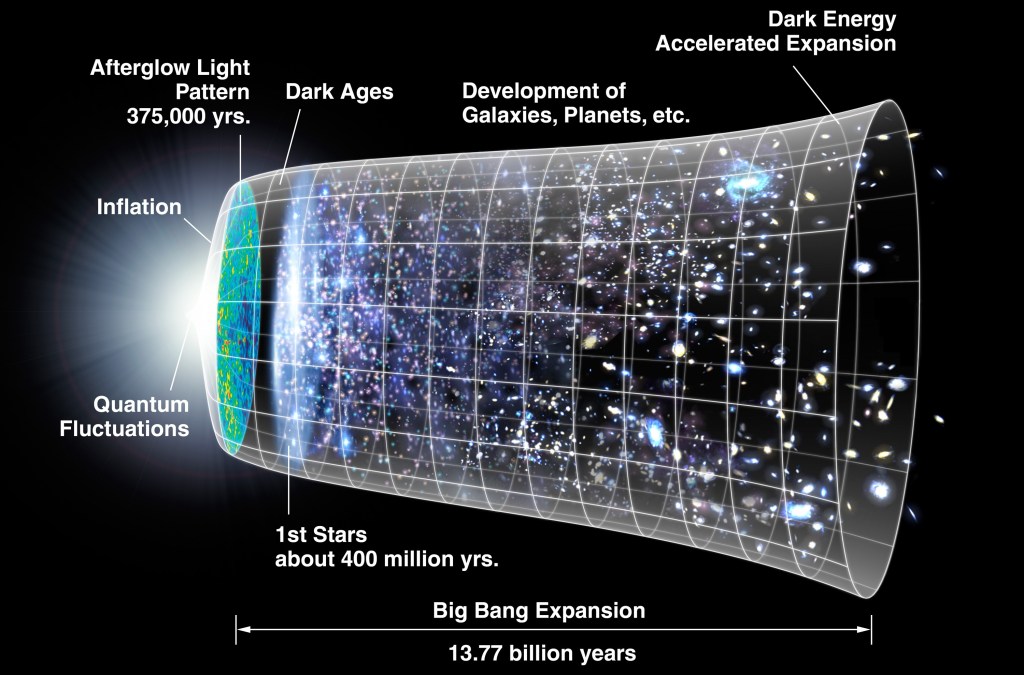
As mentioned, the edge of the observable universe is now about 46.5 billion light-years away in every direction, which means that the observable universe is about 93 billion light-years across (46.5 billion light years times 2) vastly larger than what you’d expect if you just multiplied the age of the universe by the speed of light. Beyond that observable edge there may be much more—possibly an infinite Universe, but it is forever hidden from us because light hasn’t had time to reach us yet and will never reach us.
The speed of light in vacuum is a universal constant and nothing can travel faster then the speed of light. However, space itself can expand faster than the speed of light if measured across large enough distances. The distance between two points in space can expand faster than the speed of light if that distance is large enough. This is possible because there is nothing material that is traveling faster than light. It is just the space of the Universe itself expanding because of dark energy.
Space is expanding right where you are standing too. Can you feel space expanding around you? Well, probably not but it is. I consider this a super fact because it is an important aspect of our view of the universe, it is surprising to those who did not know it before, and it is true.

Galaxies are Moving Beyond the Observable Universe
In the future the far away galaxies will continue to move away from us faster and faster, and beyond a certain distance their light will no longer ever reach us again. Therefore, more and more galaxies will disappear from our view. They won’t vanish physically; they’ll just slip beyond our observable horizon. In about 100 billion years, observers in the Milky Way (or what is left of it) may only see the Local Group of galaxies (Milky Way, Andromeda, etc.). Everything else will have faded out of visibility.
Our Local Group of galaxies consists of 80 galaxies compared to the estimated two trillion galaxies in the current observable universe. That means that the observable universe at that point will have 25 billion times fewer galaxies than now, or in other words only 0.000000004% of the galaxies in the observable universe will remain observable.

The Cosmological Event Horizon Another Edge of the Universe
Beyond roughly 16 billion light-years, galaxies recede faster than light due to the expansion of space. Again, that’s allowed in relativity because it’s space expanding, not them moving through space faster than light. Eventually, most of them will cross a boundary called the cosmic event horizon. Once they do, their light will never be able to reach us, not even given infinite time. We can still see these galaxies because of the light they emitted in the past, but the light they emit now will never reach us.
The cosmological event horizon, not to be confused with the event horizon for a black hole, is 16 billion light years away. That is another limit, or edge of the universe. Below is a 10 minute video explaining both the horizon / edge of the observable universe and the cosmological event horizon for those who are interested.
Black Holes Edges of the Universe

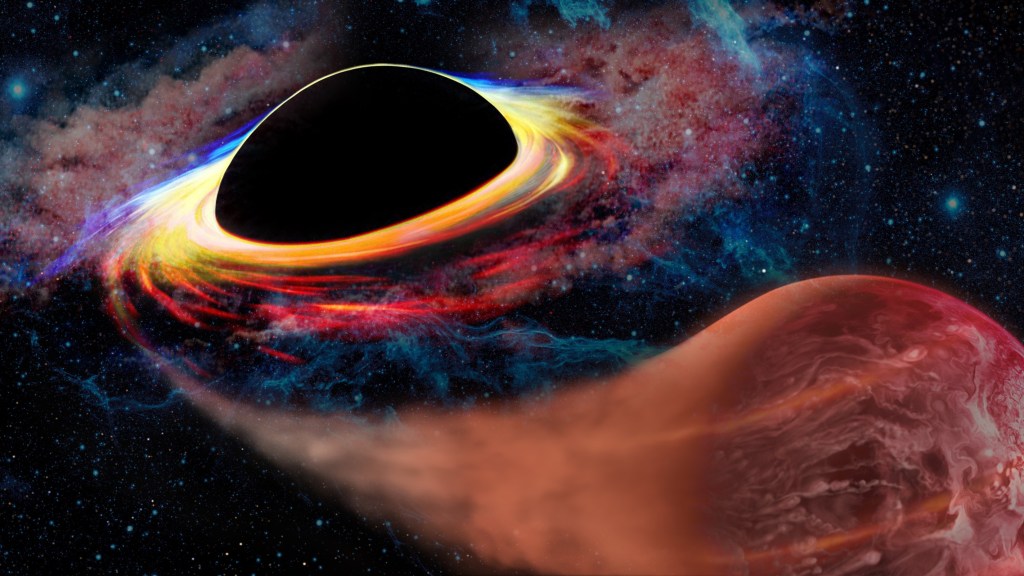
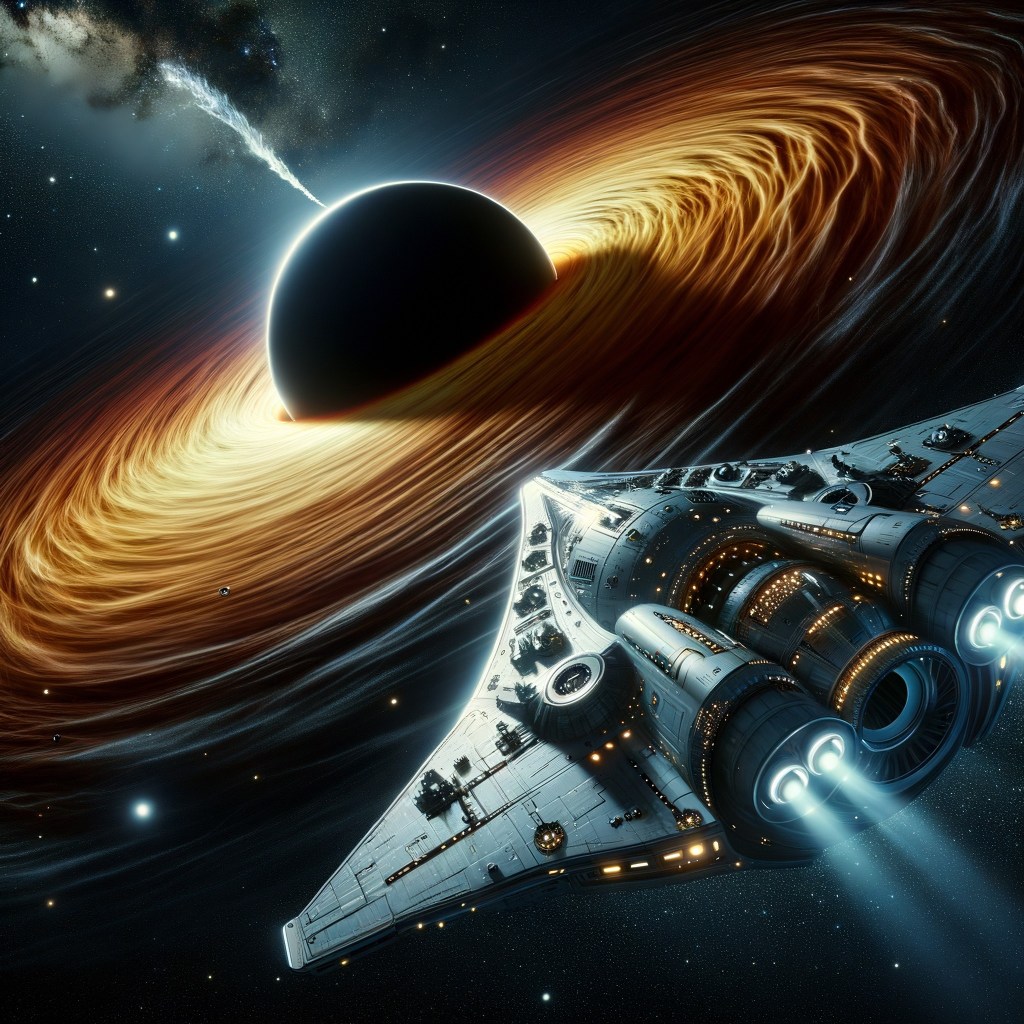
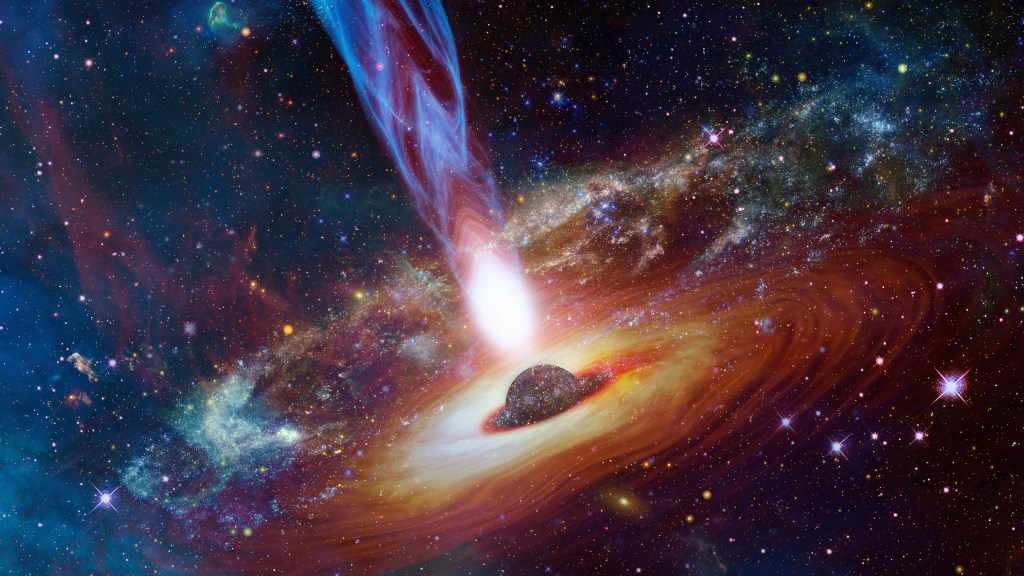
A black hole is a region of spacetime where gravity is so strong that nothing, including light, can escape it. The boundary of no escape is called the event horizon. If you pass the event horizon you cannot come back out no matter how much energy you use. Nothing can escape, no matter, no radiation, not light, or other electromagnetic radiation, and no information. Nothing at all can escape. The curvature of time and space itself forbids it.
I should add that right at the event horizon, there is so called Hawking radiation, but without complicating things it is not the same thing as escaping a black hole. You can guess from physical laws what might be inside, but you can never observe and report what is inside to planet Earth. In a sense, the event horizon of a black hole is another edge of the Universe. You can read about different types of black holes here. You can read more about black holes here, or here.
Below is an animation created by NASA that depicts what an observer falling into a black hole would see.


To see the Other Super Facts click here

 Super Facts
Fascinating explanation! The way you described how space expansion lets us see beyond 13.8 billion light-years really clears up the common confusion. Loved the connection between the observable universe and black holes as “edges” of reality!
LikeLiked by 2 people
Thank you so much for your kind words Glowith. I wasn’t sure whether people would understand that but you did.
LikeLiked by 1 person
A very input, Thomas. Thank you.
LikeLiked by 1 person
The joys of autocorrect! That’s supposed to say “a very interesting post, Thomas.”
LikeLiked by 1 person
Auto correct does its deed. Thank you so much Lynette.
LikeLiked by 1 person
Thank you so much Lynette
LikeLiked by 1 person
Amazing, Thomas. Thank you for sharing these images and dramatizations. Lots to think/dream about….
LikeLiked by 1 person
Yes I think this is fascinating stuff myself. Thank you so much Gwen.
LikeLike
Hi Thomas, some of this detail is a bit complicated for me but I get the gist of it. Pretty amazing
LikeLiked by 1 person
Thank you so much Robbie. Maybe Greg would like it.
LikeLike
Yes, I’ll send it to him.
LikeLiked by 1 person
I think my brain has broken while trying to comprehend the physics of it all. I definitely don’t fully understand it, but I do find this fascinating!
LikeLiked by 1 person
It is fascinating but a bit complicated. Thank you so much Diana.
LikeLiked by 1 person
Thank you for your explanation. You always do it in a way we can understand.
LikeLiked by 1 person
Thank you so much for your kind words and for hosting this Esther.
LikeLiked by 1 person
I like this stuff, but it is so far beyond me. Sigh.
LikeLiked by 1 person
Thank you so much Jacqui
LikeLiked by 1 person
Thanks for the clear explanation of the cosmological event horizon, Thomas. I didn’t get it before, but I do now.
LikeLiked by 1 person
That is great! Thank you so much for your kind words Audrey.
LikeLiked by 1 person
You’re welcome, Thomas!
LikeLiked by 1 person
The universe/space fascinates me thank you Thomas for your virtual tour and in glorious technicolour it was very enlightening. xx
LikeLiked by 1 person
Yes me too. Thank you very much Carol.
LikeLiked by 1 person
Charlee: “Wow, that seems like pretty far away. Maybe even as far away as Murrieta where we had to go while our house was being tented.”Lulu: “I think it might be farther …”Charlee: “Well that’s impossible because we were in our crates in that car for an eternity.”
LikeLiked by 1 person
Charlee and Lulu an eternity is certainly a long time, but it is still not enough time for reaching the edge of observable universe. I hope all goes well with your house, which luckily is not at the end of the Universe.
LikeLike
It’s kind of cosmically lonely, these retreating galaxies emitting light that we’ll never see … And of course, we’re in one of them, emitting light that somebody else will never see. 🤔
LikeLiked by 2 people
Yes you are right. A very good observation.
LikeLiked by 2 people
Thomas, your explanation makes cosmic scale feel both comprehensible and humbling. I especially love how you bridge physics and poetry — the notion that we can “see” light that began its journey before galaxies even formed feels almost spiritual. It’s as if astronomy becomes a dialogue across time itself.
Yet, I kept wondering about something rarely mentioned: the limits of what we define as observable. The cosmic horizon depends not only on physics, but also on the sensitivity of our instruments and the wavelengths we can detect. In a sense, technology keeps pushing back the “edge” of our observable universe — not in distance, but in depth. Perhaps, every new telescope doesn’t just see farther; it teaches us how to redefine what “seeing” truly means.
LikeLiked by 1 person
Thank you so much for your kind words Livora. I should say that in regards to “limits of what we define as observable”, you are right, our instruments have limits too. However, even if we had infinitely powerful telescopes and instruments that could detect everything we still cannot see anything beyond 46.5 billion lightyears because the light (or any type of radiation or matter) from those galaxies and stars have not reached us and will never reach us. Same thing with black holes. Beyond the event horizon nothing, including light, can escape, so you can never glimps inside a black hole, no matter how good your instruments are.
There are other hard limits on what is observable. Heisenberg’s uncertainty principle. For example, it’s not possible to know the position and momentum of an object with perfect accuracy at the same time. We cannot know both the position and speed of a particle, such as a photon or electron, with perfect accuracy. The formula is: dX * dP >= h/4pi. There is also Gödels incompleteness theorem, which states that in any reasonable mathematical system there will always be true statements that cannot be proved. In other words, to find a complete and consistent set of axioms for all mathematics is impossible. I explored this in my old post Some Things Cannot be Known.
LikeLiked by 1 person
What an extraordinary exploration of the universe’s edge! 🌌
Your words make the vastness of space feel both wondrous and accessible, blending science with awe.
It’s truly superb how you explained expansion, horizons, and black holes with such clarity and inspiration!
I’d be delighted if you could visit my blog too and share your thoughts.
Your comments always add that extra spark of connection and joy!
LikeLiked by 1 person
Thank you for your very kind words and insightful thoughts harythegr8. I will certainly not forget about your blog.
LikeLiked by 1 person