
Esther’s writing prompt: November 12 : Fish
Click here or here to join in.
This is not a super fact but a collection of interesting facts about Fish. They are not very important facts but amazing facts.

Most Fresh Water Fish would die from dehydration if put in Sea Water
Most freshwater fish would die from dehydration if placed in seawater due to a process called osmosis. The same is true for saltwater fish placed in freshwater. There are a few exceptions. So called euryhaline species are able to more or less handle both freshwater and seawater, an example is salmon. It is also why freshwater fish native to oceanic islands like Hawaii are euryhaline species. Freshwater fish that are not euryhaline species cannot travel to oceanic islands.
What is a Fish?
A fish is a vertebra (has a backbone and a brain protected by a braincase) that is aquatic, lives in water, has gills, fins, scales and is cold blooded. Dolphins, whales, jellyfish, and starfish are not fish.
Some fish have both gills and lungs
Lungfish have both gills and lungs. Their unique respiratory system allows them to breathe underwater with their gills and also breathe air from the surface with their lungs. Some species of lung fish can survive on land for several months.

Fish Can Be Raining from the Sky
Tornadoes over water have sometimes picked up both water and fish causing fish to rain down over land.

Mudskippers the land dwelling fish
Mudskippers are fish that spend most of their time on land. It can walk on land, jump, and climb trees, by using their strong pectoral fins like legs and their tails as a lever. They breathe air through their skin and gill chambers. Below is a four minute video featuring mudskippers.
Fish the First Vertebra on Earth
Fish appeared more than 500 million years ago during the Cambrian period. They are believed to be the first vertebrates on Earth. They lay the foundation for the diverse array of vertebrate life that has since populated the planet’s ecosystems.
Some Fish can make Light
Anglerfish are deep sea fish that produce their own light using bacteria. The dangling glowing light attracts prey. Some species of angler fish live only 200 meters down in the sea while other species live as far down as 3,300 meters (11,000 feet).

Some Fish know how to use Tools
Wrasse are fish that use rocks as anvils to crack shells. They grab hard-shelled prey like crabs and mollusks, swim to a rock or coral, and repeatedly strike the prey against the hard surface to break it open. This is a form of tool use.

Megalodon
The largest fish that has ever lived is likely the extinct shark Megalodon, estimated to have reached lengths of up to 70 feet and weighing 50-70 tons. The Megalodon was a giant shark believed to have gone extinct 2.6 million years ago, just in time for the appearance of our ancestors Australopithecus and Homo Habilis. They made a horror movie about a Megalodon that survived until modern times. It is called “The Meg”.

Surströmming (Fermented Baltic Herring) a North Swedish Delicatessen
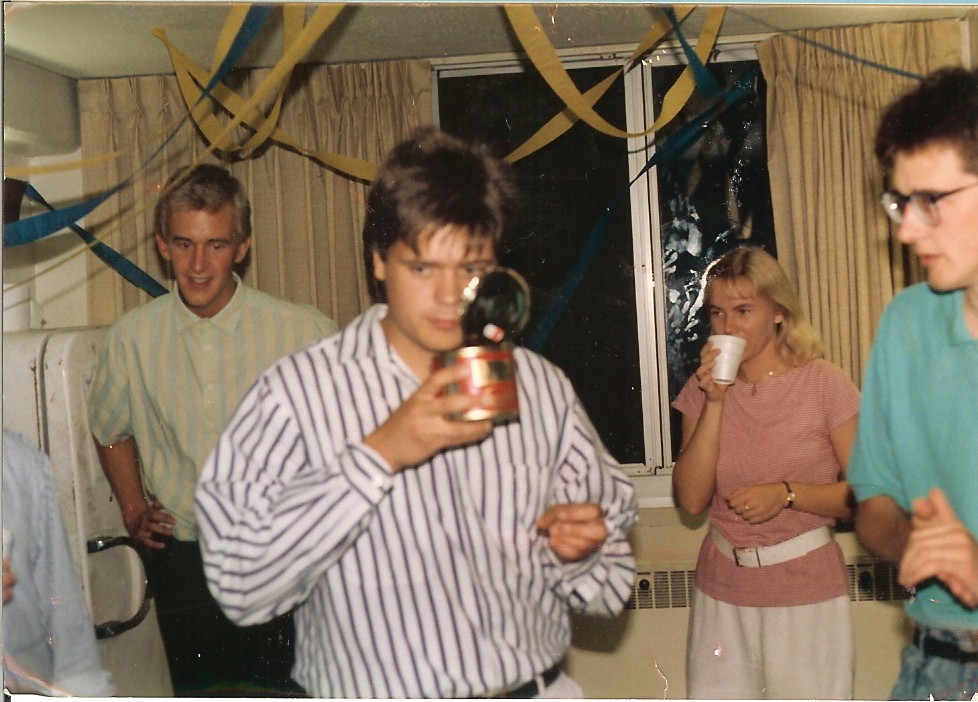
In 1987 I was selected by my University, Uppsala University in Sweden, to be part of a university level exchange student program. The exchange program was between Uppsala University and Case Western Reserve University in Cleveland, Ohio. In total we were six Swedes (two from Uppsala). I was studying Engineering Physics in Sweden. In the US, I would continue studying Electrical Engineering because the Swedish Engineering Physics program was very similar to the Electrical Engineering program at CWRU. One day we invited the other students to a Surströmming party. When we opened the cans, the American students headed for the windows and opened them. I should say there were other things to eat.
The fermented herring Surströmming from Sweden is often considered as one of the most unappetizing foods in the world. Just ask Google AI or ChatGPT this question, “what is the most unappetizing food in the world”, and you’ll see. The three top unappetizing food according to ChatGPT are Hákarl (Fermented Greenland Shark) – Iceland, Surströmming (Fermented Baltic Herring) – Sweden, and Casu Marzu (Maggot Cheese) – Sardinia.
I grew up with this food, and I don’t think it is unappetizing. It might not be beef bourguignon or trout almondine, but it isn’t bad. The problem is that the smell of Surströmming is not very pleasant and it is strong. However, it tastes quite different from the smell. It tastes like pickled herring with the addition of something sour like lemon. The taste is much better than the smell, which is why you should open the cans outside and then bring them in once the smell has settled. We did not do that because our party was partially a prank. Well, if you don’t like pickled herring, then you won’t like this either.
To see the Super Facts click here

 Super Facts
The mudskippers are amazing. Actually, nature is amazing for its adaptations! I remember learning about angler fish when I was a child; they seemed monstrous to me at the time (I was about 6 or 7)!
LikeLiked by 2 people
I agree mudskippers are amazing and angler fish look scary. You are right Lynette, nature is amazing for its adaptations.
LikeLiked by 2 people
I think your Surströmming party is an amusing story. I don’t think Americans would like dried mopane worms either. You can see this dish being made here: https://www.youtube.com/watch?v=BMj-wklmMLE. I love these posts for Esther’s prompts.
LikeLiked by 2 people
Thank you so much Robbie. I have to admit I would have a really hard time with tasting the mopane worms.
LikeLiked by 1 person
Haha, yes, indeed
LikeLiked by 2 people
Another fascinating post, Thomas. I loved reading about the Mudskippers. Amazing.
LikeLiked by 1 person
Thank you so much Esther. I loved the mudskipper video. Thank you for doing these prompts.
LikeLiked by 1 person
The Norwegians have a smelly fish too. Lutefisk. Now that one I have witnessed but never eaten. This was really a fun and informative read.
LikeLiked by 1 person
Thank you so much Violet. Actually, we eat Lutefisk in Sweden too, for Christmas. It’s jellied using lye and is not for everyone but I can promise Surströmming smells a lot stronger than Lutefisk.
LikeLiked by 2 people
I tried lutefisk and really, really didn’t like it.
LikeLiked by 1 person
In guess it is an acquired taste. As for me I don’t have a problem with Lute fisk, but I cannot stand brussel sprouts and cauliflower.
LikeLiked by 1 person
I’m not a big fan either.
LikeLiked by 1 person
Charlee: “I would totally eat an entire can of that pickled herring.”
Chaplin: “Me too.”
Oona: “Oona has another fish fact! If you pull the temperature probe out of an aquarium and leave it dangling out in the room, the temperature in the tank will just go up and up and up and you can make yourself a giant batch of fish soup. Delicious!”
LikeLiked by 1 person
Charlee and Chaplin and Oona I believe everything you say, but I am sorry Oona but I would never eat your fish soup.
LikeLike
Fish are so cool! They can live in some amazing places.
LikeLiked by 1 person
Yes you are right Sara. They are amazing and I found some other amazing fish facts too.
LikeLiked by 1 person
Interesting. In a couple of weeks I’ll be posting about freshwater trout in Armenia that were introduced in a saline lake in Kyrgyzstan. They not only survived but thrived. It’s only a small part of a larger post. Maggie
LikeLiked by 1 person
That is great Maggie. I am looking forward to your post. I can add that euryhaline species includes trout, salmon, bull sharks and round goby, but most other fish cannot adapt between fresh water and salt water.
LikeLike
Your post feels like a delightful stroll through the hidden corners of the aquatic world—playful, curious, and wonderfully informative. I love how you blend science with storytelling, turning each fact into a small spark of wonder. Even the Surströmming anecdote adds a charming human touch that makes the whole piece feel both educational and joyfully personal.
One thought that surfaced for me while reading your collection is how fish often act as silent markers of Earth’s changing environments. From euryhaline species adapting across salty boundaries to deep-sea creatures thriving under immense pressure, their resilience quietly maps the planet’s shifts better than we realize. It feels like a natural extension of your intention—reminding us that every quirky fish fact is also a glimpse into the story of our world evolving in real time.
LikeLiked by 1 person
Wow, you certainly write eloquent and very kind comments. Thank you so much Livora and I believe your observation is is spot on. I love what you said — “fish often act as silent markers of Earth’s changing environments. From euryhaline species adapting across salty boundaries to deep-sea creatures thriving under immense pressure”
LikeLiked by 1 person
What a fascinating collection of fish facts! 🐟
I really enjoyed how each section introduced something surprising — from freshwater fish dehydrating in seawater to mudskippers climbing trees, and even fish raining from the sky! Your explanations were clear, fun, and full of curiosity-sparking details.
The Surströmming story at the end was the perfect personal touch — I could almost imagine the scene with the Americans running to open the windows! 😄 Cultural food experiences really do make the best memories.
Thanks for putting together such an engaging and informative post. Learned a lot and had a great time reading it!
LikeLiked by 1 person
Thank you so much for very kind and beautiful words Glowith. I really appreciate your kindness and support. Yes the surströmming story was a quirky but fun experience. A little prank. Again thank you so much Glowith.
LikeLiked by 1 person
I didn’t know any could!
LikeLiked by 1 person
Obviously you knew something about it already, which is great. Thank you maggie.
LikeLike
Well, I just learned it this summer 😊
LikeLiked by 1 person
So fascinating Thomas thanks for enlightening me🙌
LikeLiked by 1 person
Thank you so much for your kind words petisatinta
LikeLiked by 1 person
You are very welcome Thomas – Ange
LikeLiked by 1 person
“This is such an amazing collection of fish facts! I love how you’ve highlighted not just the biology, but the quirky and fascinating behaviors of fish—from lungfish breathing air to mudskippers walking on land and wrasses using tools. The historical and scientific insights, along with the fun facts like fish raining from the sky, make this post both educational and entertaining. Truly inspiring and a wonderful read for anyone curious about marine life!”
LikeLiked by 1 person
I really appreciate your very kind words harythegr8
LikeLiked by 1 person
You’re very welcome! It’s your writing and thoughts that inspire us, so appreciation is only natural. Keep sharing your experiences and insights like this!
LikeLiked by 1 person
Well, you are too kind harythegr8. I greatly appreciate your kind support.
LikeLiked by 1 person
(*^▽^*) – Light-hearted happiness
LikeLiked by 1 person
Wow such interesting facts, Thomas to see fish raining down from the sky must be an awesome sight…I mentioned Casu Marzu in this post which I would try(just a little) to say I had …lol https://carolcooks2.com/2021/02/03/the-culinary-alphabet-with-a-little-twistfood-terms-ending-in-the-letter-u/
LikeLiked by 1 person
Thank you so much Carol. There were a lot of good things on that list but the Casu Marzu is something I would have a very hard time with.
LikeLiked by 1 person
Thank you for the interesting post about fish. I especially enjoyed learning more about mudskippers. I had not realized they spent so much of their time out of water.
LikeLiked by 1 person
Thank you David. They are certainly amazing creatures.
LikeLiked by 1 person
Gosh, fascinating facts with fish. Good one, Thomas!
LikeLiked by 1 person
Thank you so much for your kind words Chris
LikeLiked by 1 person
I know of frogs raining from the sky, never of fish. Feeling sorry for them .
LikeLiked by 1 person
Oh frogs, yes I’ve heard of that too. Same phenomena. Tornadoes or water spouts lifting things.
LikeLiked by 1 person
I’ve heard of how it can “rain fish” during tornadoes. Nature truly is fascinating and fish in particular have always been interesting to me.
LikeLiked by 1 person
Yes the raining fish phenomena is a strange one and a source for a lot of rumors but the phenomena itself is real. I agree fish are fascinating and there’s a lot we don’t know yet.
LikeLiked by 1 person
It’s interesting how many myths and rumours originated from sea creatures.
LikeLiked by 1 person
Yes you are right Pooja
LikeLiked by 1 person
👋👋👋👋👋👋 hi thomas could you maybe summarize
LikeLiked by 1 person
OK 1. Most freshwater fish die in seawater but some can do both (salmon, trout). 2. What is a fish? 3. Some fish has both gills and lungs. 4. Waterspouts/Tornadoes can make it rain fish. 5. Mudskipper is fish that spends most of their time on land, breath air, and can climb trees. 6. Fish was the first vertebra. 7. Some fish can make light. 8. Some fish know how to use tools. 9. Megalodon an exctinct shark was 70 feet long. 10. Surströmming is a very smelly fermented herring. We had a Surströmming party in the dorm.
Thomas
LikeLiked by 1 person
Hi thomas thanks so much 😀 quite interesting 😊
LikeLiked by 1 person
Thank you Anna
LikeLiked by 1 person
I come from a family of fishmongers and thought I knew a lot, lol. Also, just no on fermented herring. 🤣 Another fantastic post Thomas. 😍
LikeLiked by 1 person
Thank you so much Debby. A family of fishmongers. That is interesting. That is a common job in northern Sweden too.
LikeLiked by 1 person
😊
LikeLiked by 1 person
I knew lungfish could survive for a while on land, but I didn’t know some lungfish could survive for MONTHS out of the water. That’s amazing.
LikeLiked by 1 person
I agree, that is really amazing. Thank you so much Priscilla.
LikeLiked by 1 person
I liked “The Meg I & II” even though the idea is fantastical. I used to have a lovely aquarium that I loved to watch. Fish are so calming. And I remember going out on the lake and fishing with my father and grandfather. We always had great fish frys.
LikeLiked by 1 person
Those are great memories both that you liked the movies and fishing with your dad and grandfather, and the aquariums too. When I was a kid I did a lot of fishing with my father and grandfather too. My paternal grandfather was a very proud expert fisherman. However, one time when he was teaching my brother and I how to through out a lure with a fishing pole the hook got stuck in his pants and we could not get it off. So when we walked back home, through the village, he told us to walk closely right behind him so people wouldn’t see the lure hanging from his pants. He did not want his reputation as an expert fisherman tarnished.
LikeLike