
Super fact 101: We can see what stars are made of and calculate their speed and distance compared to us just by looking at their light.
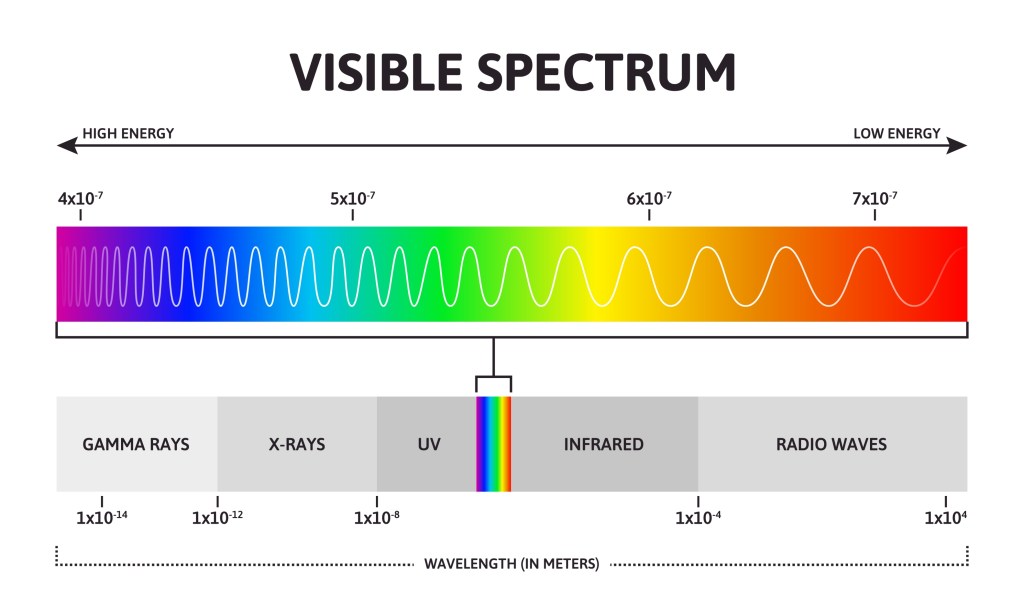
Electromagnetic radiation, including visible light, features a lot of different frequencies, which for light correspond to different colors. Red has a lower frequency, and blue has a higher frequency. For more information about the electromagnetic spectrum and light see Human Vision Only Detects a Sliver of the EM Spectrum.
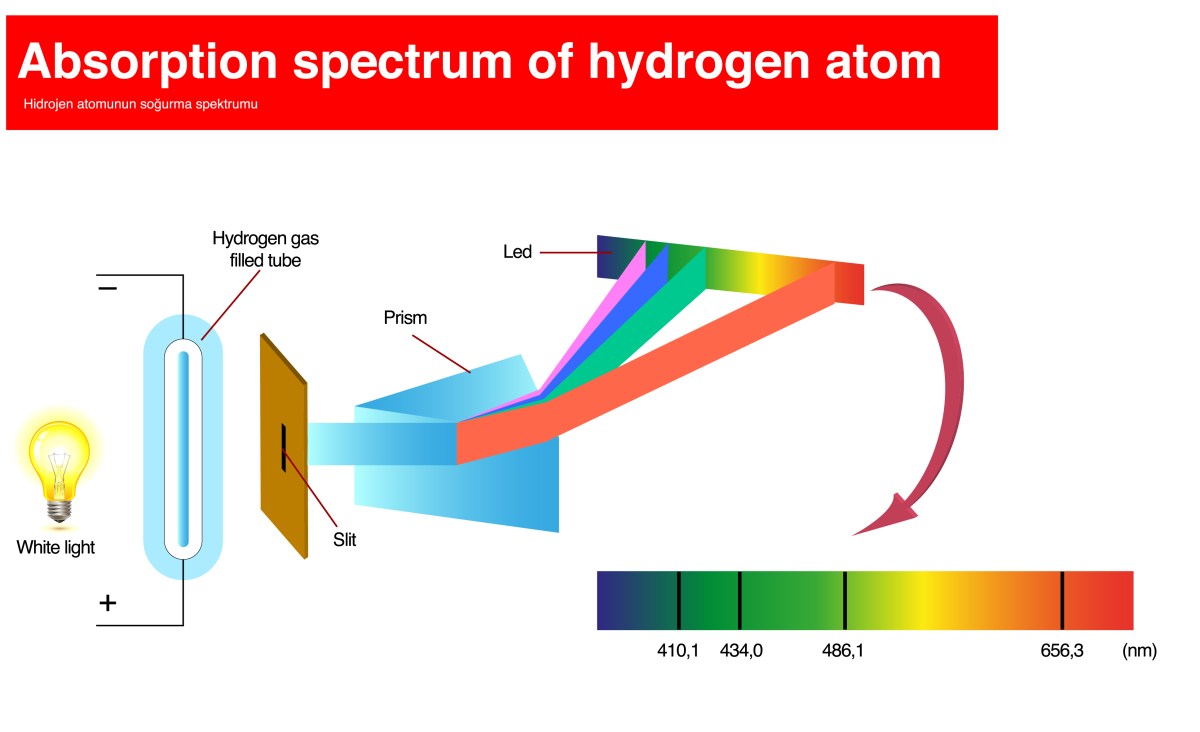
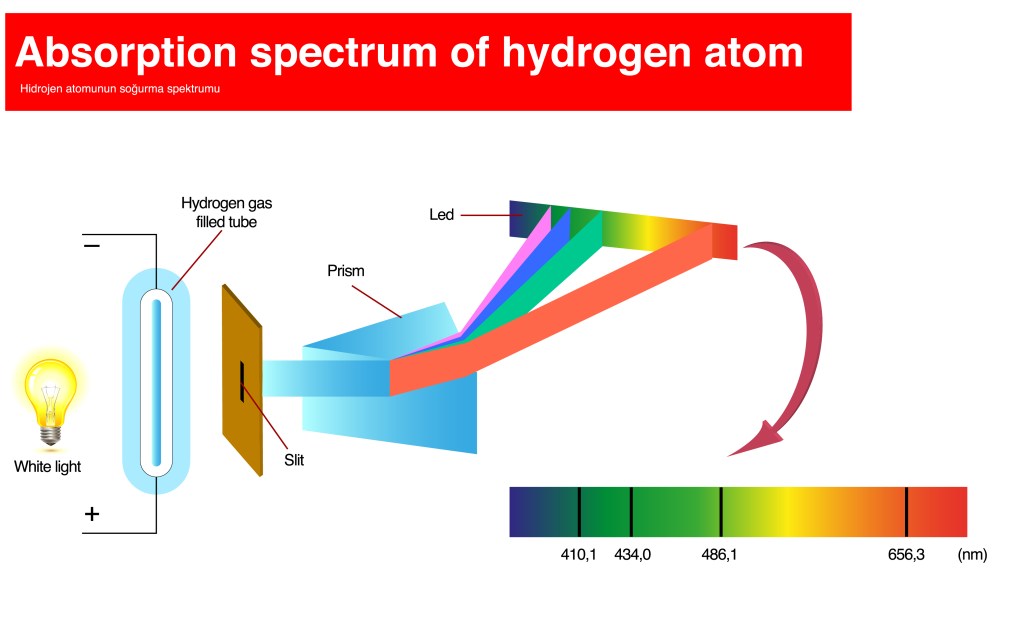
If you place a light bulb (white light includes a spectrum of colors) in front of a container filled with hydrogen and then you let the light pass through a prism, it will split into the different colors (red, yellow, blue, etc.) forming a rainbow, as prisms do. You see this every time you see a rainbow in nature. However, if you measure carefully, as in the experimental setup below, you will notice that some frequencies are missing. That’s because the hydrogen gas will absorb certain frequencies.
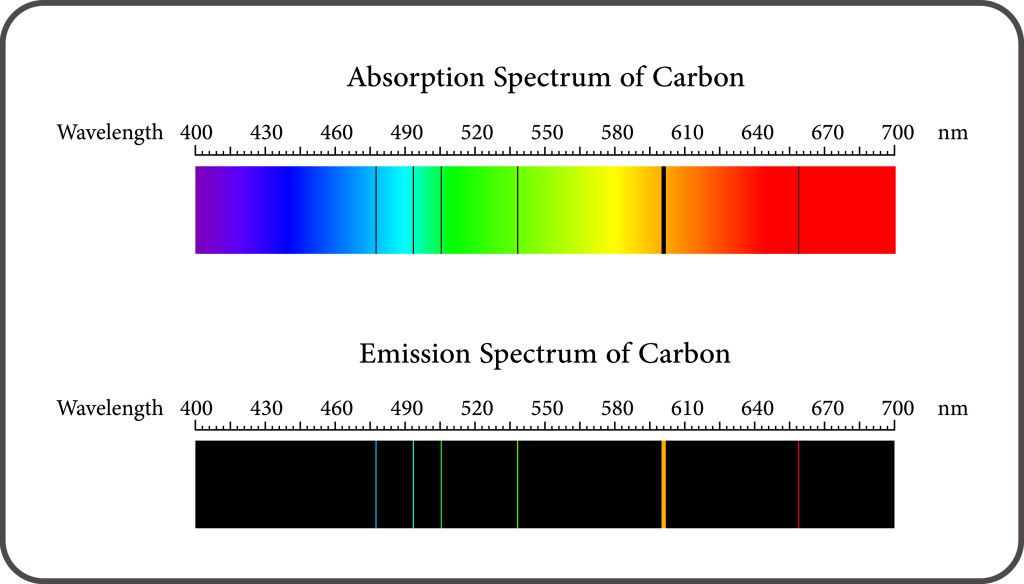
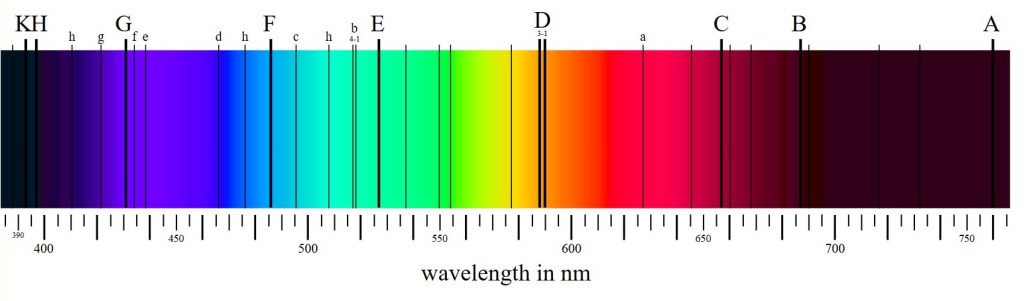
This is true, not just for hydrogen, but for all elements/atoms and molecules. Atoms and molecules have light absorption patterns that are unique to the atom/element in question. The dark lines in the spectra are referred to as Frauenhofer lines. In a sense, all elements have a thumb print resulting from their so called absorption spectra. This makes it possible to identify the elements in a star and their proportions.
Before the discovery of absorption spectra, it was sometimes believed that humanity would never know the chemical elements of stars. Even today many people are surprised to hear that we can indeed know what stars are composed of just by looking at their light. In addition to identifying elements in the upper layers / atmosphere of stars you can use the same absorption spectra to determine the relative velocity of stars compared to us and sometimes the distance to the stars. This is an old discovery that is surprising and important to our understanding of the world and therefore a super fact in my opinion.
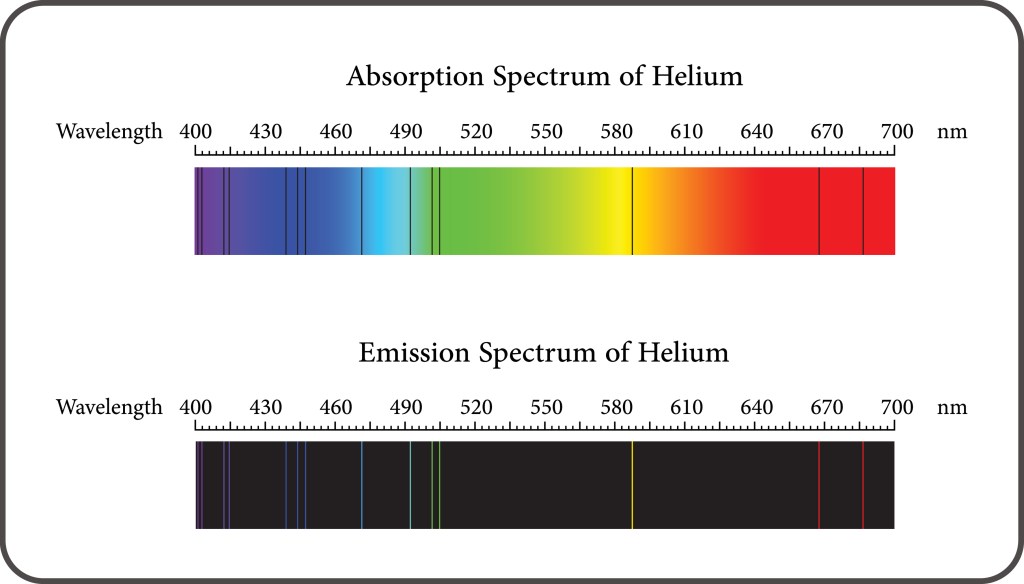
Examples of Absorption Spectra
An interesting, related fact is that Helium was discovered in the Sun before it was found on Earth, with the help of emission spectra (August 18, 1868). Emission spectra are the opposite of absorption spectra. It should be noted that while emission spectra are commonly used for identifying the composition of interstellar gas, absorption spectra are commonly used for identifying the composition of stars.
Using Redshift to Determine how fast Stars are Moving Compared to us
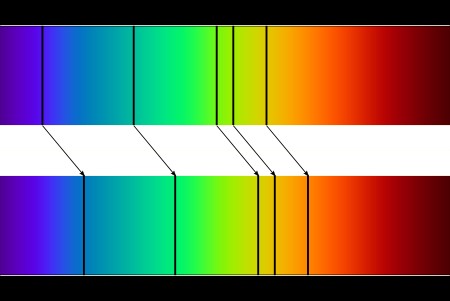
A star or galaxy that is moving towards us will have a blue shifted spectrum. A star or galaxy that is moving away from us will have a red shifted spectrum. Red shifted means that the absorption lines have moved towards red because the frequency of the light has been shifted due to the motion.
This is called the doppler effect. You can notice this phenomenon for the case of sound when an ambulance is coming towards you and then speeding by you. The sound changes. The astronomer Hubble was using redshift to the determine that the further away a galaxy was from us the faster it was moving away from us. Measuring the redshift of a faraway galaxy or star, not only tells us its speed compared to us but can indirectly help us determine the distance to the galaxy or star.
There are other things you can tell from the light from stars and from their electromagnetic spectrum such as the type of star, the size of the star, and the age of the star, but that is for another post. This post is long enough.
To see the other Super Facts click here

 Super Facts
An interesting post, Thomas.
LikeLiked by 1 person
Thank you so much Lynette
LikeLiked by 1 person
So interesting! Thank you Thomas for this excellent presentation. I did not know any of this, I assumed the stars were so far away that specifics on their composition was impossible. Amazing how somethings like color, prisms and the doppler effect, that are known ways to explain everyday occurences of light and sound, can be used to determine information among the stars. Great share as always I learned some new things.
LikeLiked by 2 people
Thank you so much for your kind words Suzette. I think most people are unaware of the things that we can tell from star light and the rest of the electromagnetic spectrum. It is surprising how much we can know.
LikeLiked by 1 person
Great share, Thomas. Thanks again for your insights
LikeLiked by 1 person
Thank you so much Suzette. I appreciate it.
LikeLike
So excited by this post, Thomas! My son was telling me about the electromagnetic spectrum recently, and he will be truly fascinated by this post, especially when you talk about the absorption spectra used for identifying the composition of stars. Thanks for sharing!
LikeLiked by 1 person
Thank you so much Ada. Your son is amazing. I should add that there are other things you can tell from the light from stars and from their electromagnetic spectrum such as the type of star, the size of the star, and the age of the star, but that is for another post.
LikeLike
Really amazing, when we see the stars looking so tiny from here. To be able to gather so much information from their light!
LikeLiked by 1 person
Yes I agree that is really amazing. Thank you so much Anneli.
LikeLiked by 1 person
Hi Thomas, this is very interesting. I learned a lot from reading this detail. You are right about the noise of an ambulance although I hadn’t noticed it before.
LikeLiked by 1 person
It is interesting and you can determine the speed of the ambulance compared to you based on how much the sound changes. The same is true for stars, but with light. Thank you so much Robbie.
LikeLike
A fascinaubg
LikeLiked by 1 person
Isn’t it amazing that we can investigate and understand the whole universe just using electromagnetic waves. Just amazing, and in so many ways a triumph of human intellect!
LikeLiked by 1 person
Yes you are so right Craigavad. Also I just added this “There are other things you can tell from the light from stars and from their electromagnetic spectrum such as the type of star, the size of the star, and the age of the star, but that is for another post. This post is long enough.”
LikeLike
This is very interesting, Thomas! For one thing, I have always been fascinated by colors, color theory and the physics of color… and it is so nice to find out that this is how we can determine the composition of stars and how they travel. 🙂 And speaking about colors, I remember a while ago I found out a quite funny fact about the color pink, that it somehow “doesn’t exist”, being a non-existent color? Better said it is like a mental construction, they say, obtained from “white minus green” which gives our brains the perception of “pink”. I still can’t seem to wrap my mind about it too well, but I understand “the idea of it” in theory.
In fact… I feel exactly the same as when I try to find reflections and photograph them, on the surface of a lake or a puddle after rain. More often than not I am left with that sensation that… ok, the mountain or the trees are high up over there, and the surface down here, so… somehow that reflection exists only because I observe it, standing opposite the respective subject across that water surface from it, if you know what I mean. 😅 Funny thing… quite often when I take reflection photos I end up exclaiming something like this: “Oh my… where exactly is that reflection? That reflection actually doesn’t exist unless I am here to “see” it?!” ☺
LikeLiked by 1 person
Thank you for those very interesting facts and observations. I did not know about pink. That is interesting. What you say about reflections is very interesting. It is the same with a rainbow. There is no specific location of the rainbow. If two people are standing next to each other they see it in the same place. But then if one walks away the rainbow will move from his perspective while the guy still standing in the old spot will see it in the same place as before.
LikeLiked by 1 person
I was able to find my post about pink, with the link to that scientific explanation. It was 10 years ago… time does fly! 😊 https://doarnicol.wordpress.com/2016/06/19/throw-your-dreams-into-space-like-a-kite/ Interesting about the rainbow too, yes. Thank you, Thomas!
LikeLiked by 1 person
I just read your other post and left a comment. I am amazed that it took the comment despite the post being 10 years old. Sometimes that does not work. Anyway, it was very interesting to learn that pink is the absence of green.
LikeLiked by 1 person
Oh… in Discussion Settings I unchecked the box saying “Automatically close comments on old/er posts than…” 🙂
LikeLiked by 1 person
Well that was good for me. Thank you.
LikeLiked by 1 person
Hi Thomas, thank you for a very interesting post!
LikeLiked by 1 person
Thank you so much Charles
LikeLike
Another wonderful share, Thomas. I didn’t know any of this, and now my evening gaze is enriched with understanding. 😊 Thank you!
LikeLiked by 1 person
Thank you so much Gwen. Yes it is amazing what starlight can tell us and I only told half of the story.
LikeLiked by 1 person
Isn’t astronomy cool? Thanks for this wonderful, informative post, Thomas!
LikeLiked by 1 person
Yes you are right Priscilla and it reminds me I haven’t been at the darksite in Atoka/Oklahoma in a while. Jacqui also suggested another Astronomy superfact that stars twinkle but not planets. Thank you so much Priscilla.
LikeLiked by 1 person
Java Bean: “Ayyy, the things humans can figure out just from sitting on a little ball of rock and squinting out at the universe!”
LikeLiked by 1 person
Yes you are right Java Bean. We can figure out a lot from the starlight and I only told half the story. It is also amazing all the things that dogs can figure out just by sniffing the ground and each other and people.
LikeLike
All I can say is… wow!
LikeLiked by 1 person
THank you Chris. Yes it is fascinating what we can know from just studying the star light.
LikeLiked by 1 person
I’m amazed to learn we can gather so much information about the stars just by studying their light! Thank you for this fascinating, educational post, Thomas.
LikeLiked by 1 person
Yes I agree, it is amazing. In addtion to their chemical composition and motion compared to us, we can also figure out type of star, size and age from the starlight. Thank you so much for your kind words Debbie.
LikeLiked by 1 person